Locomotive driver experience at the Museum of Transport

lokfuehrer-erlebnis-im-verkehrshaus-mk-marketing-kommunikation
The "Giruno" train simulator.The new SBB high-speed train can travel at up to 250 km/h and will connect Zurich with Milan in record time from 2019; Frankfurt with Milan at a later date. The train, developed and built on behalf of SBB by Stadler Rail from Bussnang (TG), has been christened "Giruno". An artificial name derived from the Rhaeto-Romanic girùn for buzzard. The multiple-unit train with low-floor access has 405 seats. During its development, particular attention had to be paid to aerodynamics, running dynamics, humidity and heat in the 57-metre-long Gotthard Base Tunnel. The Museum of Transport Giruno simulator was built by Stadler Rail from original parts for the opening ceremony of the base tunnel last June.Ride in the driver's cabThe view of the original user interface in the locomotive driver's cab of the Giruno simulator in the Swiss Museum of Transport's rail hall is impressive. Sitting in the seat, visitors feel like they are in a train driver's cab. You can choose between the Zurich-Milan or Milan-Zurigo routes. The journey is divided into three stages. Each stage contains three route sections. The exact replica of the real route in the video film and the highly recognizable locations make the train journey a unique experience. The simulation software for the Giruno was developed under the direction of Professor Hansjürg Rohrer at the Bern University of Applied Sciences for Engineering and Information Technology in Biel. The SBB, BLS and RhB train simulators at the Swiss Museum of Transport, which are already operating successfully, are equipped with the same software.

The Event Park becomes Samsung Hall

der-eventpark-wird-zur-samsung-hall-mk-marketing-kommunikation
Samsung Hall, c/o Lehmann riverside.About a year ago, ground was broken for the new event location at Stettbach train station, right on the Zurich city border. The project, which is supported by private investors, is positioned as the new mid-size location in the Zurich grasslands and is operated by the company Lehmann riverside.With the three rooms Hall, Club and Loft on an area of over 4,500 m 2 and a variable capacity of 50 to 5,000 seats (seating and standing), the Samsung Hall offers the ideal size to accommodate a wide variety of events. The centerpiece is the 2,000 m 2 hall. The modular space concept allows for a variety of public and corporate events of different types and sizes. The first-class infrastructure with the latest sound, light and video equipment, a hydraulic stage that can be divided into 6 parts (18 x 10m), a telescopic grandstand and the 120m2 LED wall (4mm/5k) make the Samsung Hall the most modern event center in Switzerland. Events can be held efficiently and cost effectively. The Samsung Hall also leaves nothing to be desired in terms of catering: The ln-Hause catering will stand for variety and flexibility and surprise guests with exquisite dishes, from aperitifs or stand-up lunches to large-scale events.Due to its close proximity to the Stettbach train station, it offers excellent public transport connections, and 250 parking spaces are also available.Partnership with SamsungSamsung will equip the entire location with state-of-the-art digital event and presentation technology and, in particular, create an impressive digital experience for visitors with a 20 x 6 meter indoor LED wall. The use of state-of-the-art LED display technology will significantly reduce power consumption. Samsung's commitment is also reflected in the naming: the new event location just outside Zurich, which will open at the end of 2016, is now called "Samsung Hall".Hall (seated and standing): 5,060Hall (seated): 3,100Club: 800Loft: 580

Honeymoon with Mark Twain

hochzeitsreise-mit-mark-twain-mk-marketing-kommunikation
Excerpt from the theater tour.The Rigi Kulm Hotel celebrates its 200th anniversary in 2016. Various attractions are being organized to mark the occasion. The highlight will be the theater "Honeymoon with Mark Twain", which will be performed from now until mid-October. The theater tour starts in Vitznau at the Rigi Bahnen valley station and accompanies the audience until dessert at the 3-course dinner at the Rigi Kulm Hotel. The story is told by Mrs and Mr Fleming from London, in 1902 on their honeymoon in Switzerland and on their way to Rigi Kulm. Because the newlyweds have very different ideas about their honeymoon - she dreams of a luxurious honeymoon, he of a hiking vacation - misunderstandings are inevitable. The story is based on "A Tramp Abroad" by Mark Twain, an American globetrotter and writer who hiked the Rigi during his 16-month tour of Europe in 1879: www.200jahre-rigikulm.ch

Time for Insights - Media Consumption Habits and Daily Routines

time-for-insights-media-consumption-habits-and-daily-routines-mk-marketing-kommunikation
The Swiss Media Research Day will take place on October 12, 2016.How do different target groups structure their daily routine? Which media do they use for different activities? The Time Use Study (TUS) provides answers to these questions. Harald Amschler, WEMF Executive Director of Research and Development, presents exciting results from the study. Tanja Hackenbruch, Head of Market and Audience Research at SRG SSR, together with a representative from the publishing industry, will show how media companies use the Time Use Study for their strategic orientation.Christian Rätsch, CEO of Saatchi & Saatchi Germany, will explain how time budget studies help advertisers to efficiently address multitasking target groups.The future of Swiss media research With the joint "Swiss Media Data Hub" project, Mediapulse and WEMF are laying the foundations for the future of Swiss media research. Franz Bürgi, Managing Director of Mediapulse AG, and WEMF CEO Marco Bernasconi provide information on the aims and content of the project and explain why this approach is unique in the world, and the "Swiss Media Data Hub" project is also the subject of the pre-conferences. The conferences before the start of the event offer the opportunity to enter into dialog with experts from research and practice and to gain first-hand insights. Please register early. The number of places is limited.More information and registration:www.wemf.ch

Snapchat: hype or ingenious marketing tool?

snapchat-hype-oder-geniales-marketing-tool-mk-marketing-und-kommunikation
Snapchat is particularly popular with young people. How can the app be used as a marketing tool?Only on the market since September 2011, Snapchat is increasingly developing into a real competitor for Facebook, Twitter and the like. The app became known for its ability to edit and send images and videos that disappear again after a maximum of ten seconds, and Snapchat's user numbers are growing unstoppably. According to a recently published report by the financial service Bloomberg, the app now has 150 million daily users. In Switzerland, 59% of 14 to 19-year-olds already used Snapchat in 2015 - and the trend is rising (source: Media Use Index 2015). No wonder that more and more companies in Switzerland are considering using Snapchat as a marketing tool. Swissmilk, for example, used Snapchat for a campaign for Milk Day.Increasing importance for social media marketingWhat significance does the instant messaging service really have for marketing? At the MK Opinion poll 34.4 percent of respondents rated its importance as "low", 32.8 percent as "medium" and 15.6 percent as "high". For 14.1 percent, Snapchat is insignificant and only 3.1 percent rate it as "very important".Stephanie Wörmann, Head of Social Media at Goldbach Interactive, emphasizes the increasing importance of Snapchat for social media marketing. "Young people are all about entertainment. Information is consumed in bites and on the go." Generation Z interacts very differently to Generation X or Y and Snapchat makes this possible. Goldbach Interactive has opened a Snapchat account for McDonald's Switzerland, for example. "Within 30 hours, we already had over 2,000 followers," says Wörmann. "We have never gained followers so quickly on any other platform for customers - and the growth is continuing."Particularly suitable for branding measuresBut what marketing purposes can the instant messaging service actually be used for? "Snapchat is suitable for branding measures, especially for positioning yourself with the young target group," says Wörmann. "The app offers the opportunity to give the brand a personality, far removed from stiff company profiles." Brands become directly approachable via Snapchat and enable communication at eye level. "Creative campaigns that use the functions of Snapchat in a playful way can be very efficient". According to Wörmann, the option to create your own filters is the most exciting for brands. These enable interaction with the brand and ensure distribution among users. Global brands have already made their first attempts in this area, and in other countries Snapchat already offers advertising placements in addition to the option of creating your own content. "However, Snapchat's advertising options are currently quite expensive in comparison and not available for Switzerland," Wörmann points out.A rethink is needed for Snapchat marketingAnother problem: Snapchat is not yet as mature for marketing purposes as Facebook or Instagram, for example. There are no detailed analytics, for example on fan growth or reach, but only rudimentary data that has to be added up by hand. "In general, handling and content management is more difficult, as everything has to be done on a cell phone," explains Wörmann. "There are not yet any third-party platforms for dialog management." To remain authentic, the content also has to be "snapped" more or less ad hoc and not pre-produced in professional graphics long in advance.Wörmann believes that Snapchat marketing needs a rethink: "Lengthy approval processes were already outdated for Facebook, Twitter and the like. With Snapchat, management needs to increase trust in the community managers once again and give them a free hand." To make matters worse, many marketing managers do not understand Snapchat."

Campaign: Wastewater treatment explained in a fun way

Abwasser Uri aims to give schoolchildren an understanding of its wastewater treatment plant in a playful way. Herger Imholz created the complete corporate identity with the protagonist "Fred the fish". The story is launched by means of an unmistakable 360° image campaign with a spectacular 3D animated film teaser. A comic in booklet form provides an exciting guide to Fred's eventful story. Accompanying measures include advertisements, posters, various giveaways and the responsive website with parallax scrolling.Responsible for wastewater Uri: Beat Furger (Management), Andrea Imfeld (Administration); responsible at Herger Imholz: Yves Herger (Creative Direction), Philipp Michel (Art Direction), Jasmin Zurfluh (Graphics), Andreas Schuler (Polygraphy), Sebastian Mehl (Web Development)Project direct link: www.hergerimholz.ch/projekte/fred-der-fischAnimated movie direct link: www.vimeo.com/168936529Information Herger ImholzHerger Imholz AG is a design agency operating throughout Switzerland with offices in Uri and Zurich. It specializes in brand strategy, brand conception and brand management. This for over 200 clients in the disciplines of print, web, signage, packaging, motion and sound.Company form: Public limited companyFounded: 2005Owner: Yves HergerManaging Director: Mathias BamertOffices: 6460 Altdorf & 8006 ZurichEmployees: 10

Branding: Five tips for better creative

1. the design must fit the targetIntegrate interactive features into the creative that match your brand and campaign objectives. For example, the user can explore the new sports shoe directly in the advertising material in a video gallery or with the help of a zoom function. The rule here is: never use more than two interactive elements so that the advertising material does not appear overloaded and the user does not know what to try out first because of all the possibilities.2. the intro should attract more attentionArouse the user's curiosity as soon as the ad is launched. This increases the likelihood that they will engage with the ad. This leads to high interaction rates and long dwell times, both on the advertising material and later on the landing page. Animations, such as an image that bursts off the screen, a short video, transparent overlays or high-impact images of people or products, have positive results.3. the content must be clear and focusedUsers are overloaded with content on the Internet. They see several thousand advertising messages per day. Therefore, convey your advertising message as quickly and as forcefully as possible. The length of the main text in the advertising material should not exceed twelve to 15 words for desktop ads and eight to ten for mobile ads. Each line of text must be strong enough to stand on its own. The brand name and logo should be displayed frequently in the advertising material.4. call-to-actions are crucialIn addition to the presentation of the advertising message, the call to action in the creative is just as important. Formulate the call to action as precisely and briefly as possible and make sure that it matches the performance targets of your campaign exactly. Include it in a prominent position in the advertising material. If the call-to-action is always visible in the ad, it is more likely that the user will actually carry out the desired action.5. give the user choice and controlAccording to studies, users react more positively to advertising media if they have a choice and control options. Integrate interactive features that users have to activate themselves, for example videos, image galleries or gaming elements. This allows them to decide for themselves how they experience the advertising and how much or whether they want to interact.Jörg Schneider, Country Manager Germany, Undertone: "The aim of every brand should be to offer consumers an interactive, entertaining and, above all, relevant advertising experience. The more decision-making options the user has, the more likely they are to engage with the advertising content. Control for the user, relevance of the content and entertainment are added values that also counter the trend of growing adblocker use. If a positive emotion is conveyed, the foundation is laid for successful brand recall and the final purchase decision."

Book tip: Conversion optimization

Many websites and online stores have massive numbers of visitors, but only a handful of buyers. The conversion rate is therefore a decisive key figure, says André Morys. In his book, he reveals how to significantly increase conversion, i.e. the successful transformation of a prospect into a buyer. Morys looks at the status quo of e-commerce, sheds light - albeit somewhat superficially - on the psychology of online buying, and presents tools and some models for conversion optimization, before finally describing in detail his model of the "Seven Levels of Conversion".Practical examples and tips for everyday life make the book a helpful and crisp practical guide. Unfortunately, Morys writes only for connoisseurs of the scene; plenty of unexplained technical terms and abbreviations make it difficult to get started with the topic.getAbstract nevertheless recommends the book to anyone who wants to increase purchase rates in their online store and turn "dropouts" into customers.getAbstract rating: 8Feasibility: 9Degree of innovation: 7Style: 7Publisher: entwickler.pressPublication Year: 2011Pages: 221ISBN: 9783868020663

These are the top priorities of Swiss marketers

das-sind-die-top-prioritaeten-der-schweizer-marketers-mk-marketing-kommunikation
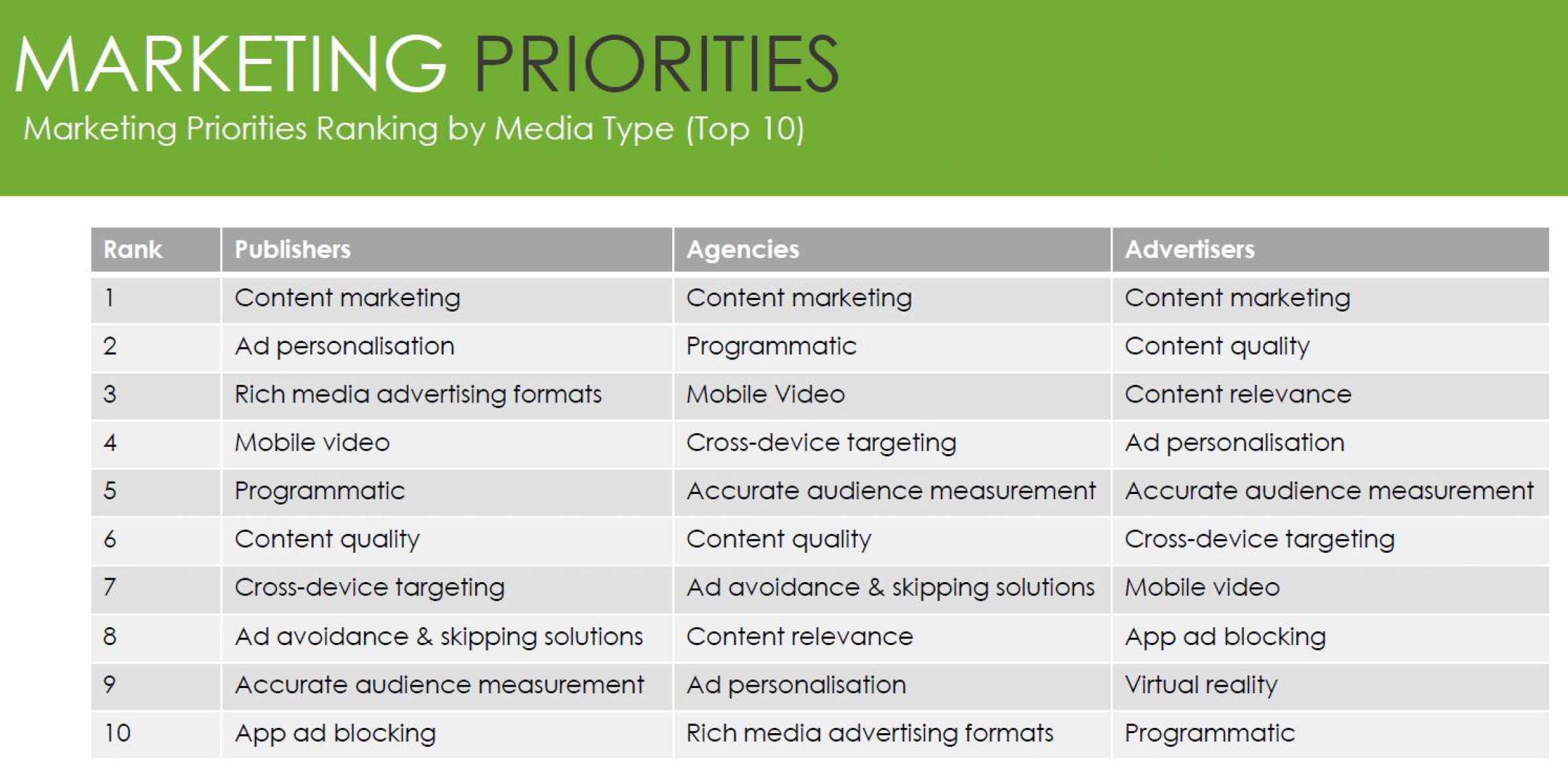
Content marketing is at the top of the priority list for many marketersPublicitas has conducted its first annual international survey to assess industry priorities. This included advertisers', agencies' and publishers' expectations for the future and what they think the next big technology leaps will be, and the survey found some differences between advertisers' and publishers' expectations. In general, executives from all areas of the industry identified content marketing as the number one focus.
die-schweizer-marketers-identifizieren-content-marketing-als-wichtigster-trend-2016-mk-marketing-kommunikation
Swiss marketers identify content marketing as the most important trend in 2016.For 45% of respondents, content marketing is one of the five most important trends in 2016, followed by personalized advertising in second place with 43%. Ad blocking and content quality were also rated as very important by 42%, and a comparison of the spending of publishers, agencies and advertisers worldwide reveals the following priority lists:
content-marketing-steht-bei-allen-interessensgruppen-zuoberst-mk-marketing-kommunikation
Content marketing is a top priority for all interest groups."The survey shows differences and clear gaps in the way publishers and advertisers prioritize their business," says Mike Jeanes, Global Head of Insight at Publicitas International. "The results clearly show that content is at the top of the agenda for client-side marketers as they become more involved in the production and delivery of their own content."Which technologies are most relevant?In terms of technology, 60 percent of Swiss marketers rate mobile commerce (m-commerce) as an important area. Mobile devices and security and data protection follow in second place (56%).
mobile-commerce-ist-fuer-viele-marketers-in-der-schweiz-ein-relevanter-teilbereich-mk-marketing-kommunikation
Mobile commerce is a relevant sub-sector for many marketers in Switzerland.If you look a little further afield, you can see that priorities are set slightly differently abroad. In general, however, the topic of mobile is classified as very relevant.
die-prioritaeten-auf-der-welt-unterscheiden-sich-je-nach-region-mk-marketing-kommunikation
Priorities around the world differ depending on the region.Nearly all 672 respondents agreed that developments in mobile and immersive technologies, and in particular the power of mobile devices, will most likely impact their business over the next 12 months. More than 80 percent of advertisers and executives expect to increase mobile spending in the next 12 months.Andi Hess, Head Digital at Publicitas: "Consumers are adopting new technologies faster than ever before and these trends will be implemented quickly if the application and monetization models are in place to establish them. It will be interesting to run this survey again in another year to compare priorities and industry issues to see if we are better able to align businesses to meet consumer expectations and needs by utilizing engaging content and the latest technologies."

Suisse Emex has started

suisse-emex-ist-gestartet-mk-marketing-kommunikation
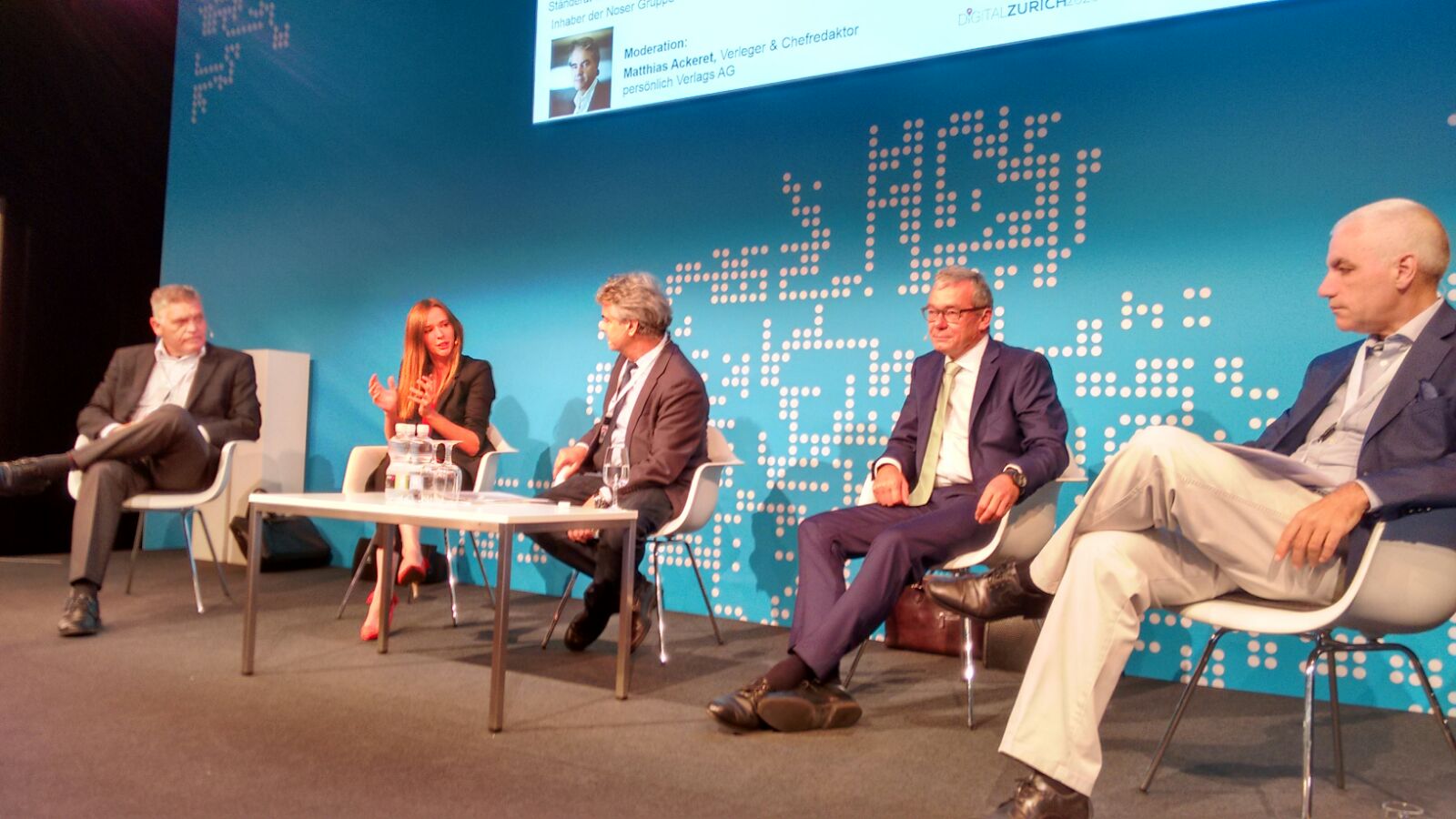
Suisse Emex kicked off with a panel discussion with Marcel Kohler, Tamedia, Sunnie J. Groeneveld, Managing Director DigitalZurich 2025, moderator Matthias Ackeret, Ruedi Noser, Member of the Council of States and owner of the Noser Group, and Jean-Marc Hensch, Swico.In its anniversary year, around 500 exhibitors and experts from Switzerland and abroad will meet around 15,000 expected visitors at Messe Zürich for the trade fair congress; together under one roof with the partner event topsoft. Under the motto "Meet the future", they will present an eventful 360° spectrum - peppered with hot solutions and trends for the marketing and event business of tomorrow.Digitalization is omnipresent today and is both a challenge and an opportunity for every company. The pressure on the Swiss economy and SMEs in particular is increasing all the time. The digital transformation and its impact on marketing and communication are the focus of this year's Suisse Emex, and a Digital Marketing Summit for SMEs is planned for next year on August 29 and 30, parallel to Suisse Emex.With MK to Suisse Emex free of chargeThe MK team will be at Suisse Emex again this year. This time the magazine will be presenting itself together with the publishing marketer Kömedia. All readers, subscribers, friends and colleagues are invited. With a bit of luck, you could win one of the subscriptions. EX717361 about the Ticket page log in.

Media agencies: fraud, concealment and lack of transparency

The list of misconduct found in the ANA report reads like an audit nightmare. Fraud is part of daily business: embezzled free media, misappropriated discounts and sales bonuses disguised as consideration for dubious services. These services, which are of little or no benefit to the media companies and are usually massively overpriced or not provided at all, are intended to conceal the kickbacks.Agencies become marketersMarketing your own agency or holding products is an extremely lucrative field of activity. According to the K2 report, the return on media investment increases to between 30 percent and 90 percent (instead of the usual two to three percent fee). This explains, on the one hand, the high returns that advertising holding companies report every year and, on the other hand, the insistence with which such agency/holding products are pushed into client media plans by agencies, turning the consultant into a marketer and the client media budget into a self-service counter. The latest variant: the agency holding company buys stakes in media companies such as an online provider or a demand-side platform (DSP) and forces its subsidiary agencies to divert as many client budgets as possible to them.Different perceptions of customer serviceSurveys of agency employees and bosses show that the understanding of roles in agencies is very different. While some feel committed to the client and want to fully represent their interests, many see their role as respecting what has been contractually agreed, but also pursuing their own or the agency owners' profit targets. The fact that this often conflicts with the client's interests is accepted, and no significant difference between network and independent agencies was found. Even independent and owner-managed agencies sometimes act in a non-transparent manner. Lucrative business models spread quickly across national borders.A systematic approach to higher returns - also in SwitzerlandIt would be naïve to assume that the kickback practices uncovered are only used in the USA. The same agencies and networks are also active in Switzerland and are adapting successful concepts locally, and in Germany, the specialist magazine Werbung & Verkaufen ran a cover story (W&V No. 30/2015) almost exactly a year ago on the machinations of media agencies and identified similar practices. Complaints from advertising clients and information from the ranks of Swiss media and marketers also confirm this situation in Switzerland, where the SWA has been calling for more transparency in the media business for years and supports its members in agency management. With the "SWA Code of Conduct" published two years ago, a clear position reference was also made to media agencies and providers.Advertising clients need more media know-howMedia management is becoming increasingly complex for advertising clients and is subject to constant change. The SWA therefore advises its members:- To continuously strengthen and expand their own company's media know-how.- To periodically review and adapt media agency contracts, if necessary with the involvement of specialists.- To introduce media controlling for media plans, with an internal dual-control principle or an independent media consultant.- To regularly demand transparency from your agencies regarding their participations in the media business. Do you demand regular transparency from your agencies about their media business investments, the declaration of all reimbursements, freespaces, etc.- Does Switzerland now also need a report on transparency in the media business? The SWA believes that this is not urgent at present and recommends that all clients use the SWA Code of Conduct. The SWA will also examine whether a report on transparency in the media business should be commissioned at a later date.Authors: Sandro Prezzi, Media Expert (Prezzimedia.ch) and Roland Ehrler, Director SWA

New CAS Health Communication course

The healthcare industry is in a state of upheaval: increasing life expectancy, tougher competition and cost growth are just some of the keywords. This means that individual providers (such as health insurers, the pharmaceutical industry and service providers) are navigating between the complexity of healthcare issues, the interests of their stakeholders and the reputation of their company. Communication plays a central role in this process.That is why the MAZ and the Institute for Business and Regional Economics IBR of the Lucerne School of Business have jointly developed a new course of study throughout Switzerland - the CAS Health CommunicationThis is aimed at current or future communication and marketing managers in the broad environment of the healthcare sector and also strikes a chord with the times, as Jeannette Nagy, head of studies at the MAZ, explains: "There are three reasons for this. First: The topic of communication in the healthcare industry is gaining in importance. Second, general communication courses cannot be transferred to the healthcare industry without additional knowledge. Third, all healthcare courses offered on the market to date touch on the topic of communication at most. "The course will be held for the first time from March to August 2017. A maximum of 16 participants will be admitted.Info events: 07.09.2016 and 4.10.2016, 18:15 to 19:30
get_footer();