The agency Matter + Gretener becomes the consulting company Smartcut Consulting

Dominik Imseng has taken over Daniel Matter's shares in Matter + Gretener and is launching the consulting firm Smartcut Consulting together with Marcus Gretener.

smartcut-consulting

After 2016 and 2017, 2018 was also a year of change for the Zurich-based communications agency Matter + Gretener. Increasingly, Marcus Gretener and Dominik Imseng were brought on board not only as marketing specialists. Instead, they were increasingly active in corporate development, product innovation and digital transformation. For example, for the sandwich chain Subway, the author magazine Swiss month, the former Maggi site in the south of Winterthur, the Swiss-wide real estate management company Regimo or for Saastal Bergbahnen.

"All of this work represents strategies and ideas that help our clients achieve their goals faster and more efficiently," says Marcus Gretener. And that is why he is now launching Smartcut Consulting in Zurich together with Dominik Imseng, who has taken over the shares from Daniel Matter. Imseng, with whom Gretener has been working successfully for over 13 years: "A 'smartcut' is a clever abbreviation. So we find shortcuts to our clients' goals, as it were, and thus shortcuts to their success."

Smartcut Consulting advises its clients in the areas of corporate development, digital transformation and marketing. Marcus Gretener and Dominik Imseng use the findings of behavioral economics to ensure that (purchasing) decisions are made in favor of their customers. The effectiveness of this approach is demonstrated by Saas-Fee's WinterCARD, according to the statement. Thanks to the exceptionally low-priced season ticket developed by Smartcut Consulting, sales in the Upper Valais vacation destination have increased by around 100 million Swiss francs in the last three years.
 

"Enough practice": AEK Bank launches new campaign

The message of the new AEK Bank 1826 commercial directed by Luki Frieden is clear: "Enough practice". Anyone who wants to realize their dream of owning their own home can contact AEK Bank for advice.

Pressebild_3-t

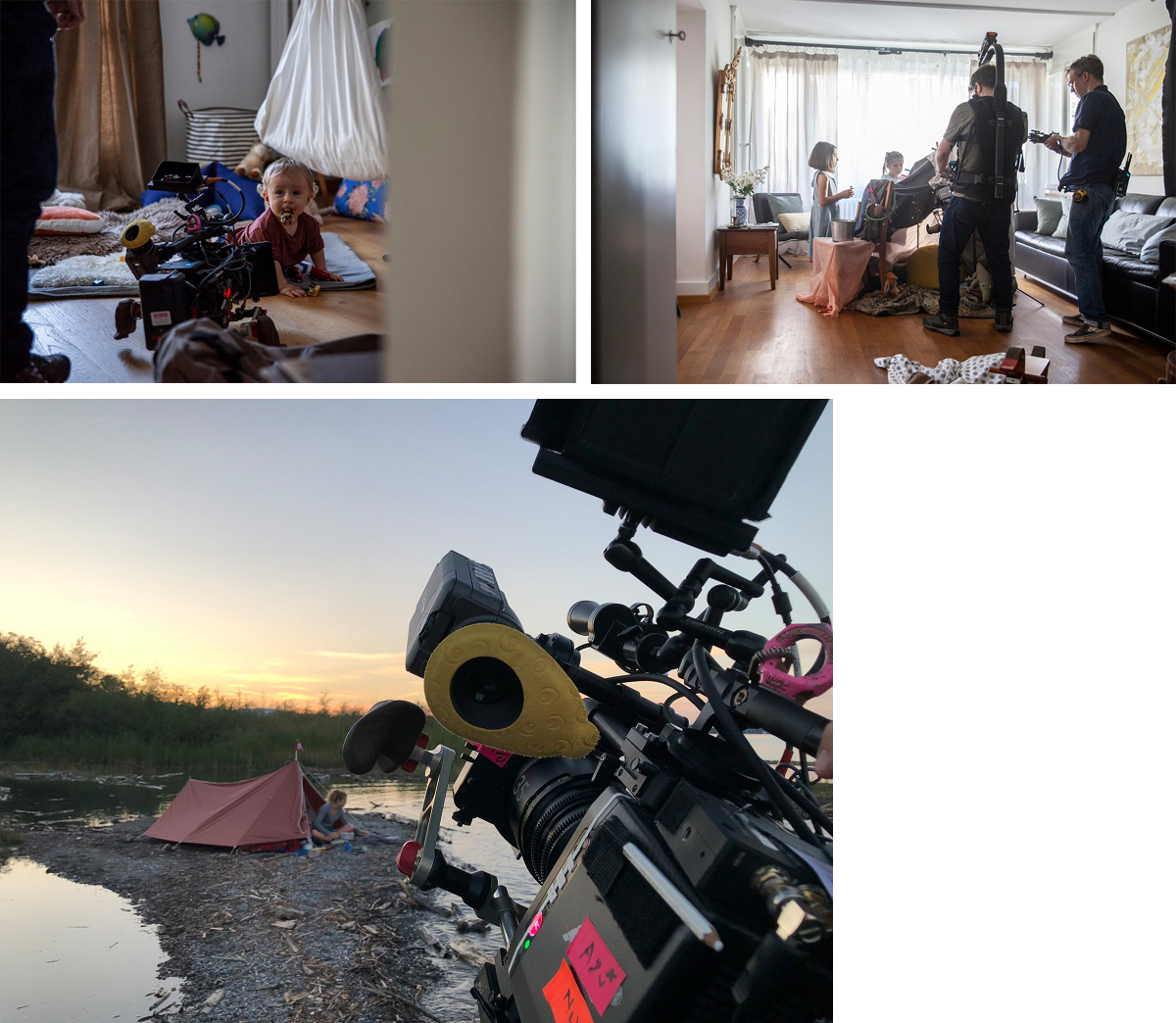
When producing the commercial for AEK Bank, Thun director Luki Frieden opted for tried-and-tested elements and focused on the Thun region. Timeless elements also play a central role: Clothespins, a garland of flags, a sparrow tent or a camper characterize the stages of a person's life, staged against the spectacular panorama that the Thun region offers.

After 2006 and 2012, Luki Frieden is making his third commercial for AEK Bank. With very few exceptions, he sought and found the actors and actresses - mostly amateur actors - himself in the Thun region. Young model Naomi Trachsel from Hünibach, a young woman who has already made a name for herself nationally and internationally as a model, actively applied to appear in the film.

"A collaboration in the region, with Luki as my producer, has always been my secret wish," says Naomi Trachsel, who is also firmly rooted in the Thun region. Knowing that appearances and reality are often at risk of being confused in the modeling business, Naomi Trachsel, like so many others, has a very down-to-earth wish when she says: "A dream that I share with many people is that I might one day be able to afford my own little house by the lake with a view of my beloved mountains."

Thun composer Niklaus Vogel was also involved. Thanks to the music he composed especially for the commercial, the image, editing and sound are a perfect match. The harmonious melody is intended to emphasize the key scenes of the commercial and arouse numerous emotions.

While the new full-length commercial is mainly shown at client or internal bank events, a 45-second version was designed specifically for advertising in cinemas. In addition, three short clips, each 15 seconds long, draw the attention of users of various online platforms to AEK Bank.

gg_1

Responsible at AEK Bank 1826: Simon Sutter, Katrin Leibundgut, Philippe Zürcher. Responsible at Nordland Film: Luki Frieden (creation, production and direction), Bernhard Rüdt (production management), Stephan Fallucchi (camera), Niklaus Vogel (music) Co-producer: Shining Pictures.

Council of States discusses copyright with clause for media publishers

The Council of States will debate the modernization of copyright law on Tuesday. The committee preparing the debate has made a controversial addition: it wants to make Google and Facebook pay in favor of media publishers.

leistungsschutzrecht

In the future, operators of social networks and other Internet platforms are to owe publishers remuneration if they make journalistic works accessible. This primarily involves text snippets and references to articles that are displayed to Internet users in services such as Google News.

In this way, the Internet platforms can gain data for advertising marketing or place advertisements for the text outlines and thus earn money - from the publishers' point of view, money that they are losing. Users may be content with the text outline on the social network and not click on the link that would take them to the media portal.
 

Single words excluded

A compensation scheme is currently also being debated in the EU, under the title of "ancillary copyright". The proponents argue with the difficulties of the media industry due to the loss of advertising revenues. The critics claim that the ancillary copyright would only serve the big publishers, but not the small providers.

According to the proposal of the Council of States Commission, the making available of individual words without independent journalistic meaning together with links that lead users to the original publication or to the information service that published the article would not have to be remunerated.

National Council against

It remains to be seen what the Council of States will decide. Its preliminary committee voted 7 to 3 with one abstention in favor of anchoring such a regulation in copyright law.

In the winter session, the National Council voted 133 to 39 with 5 abstentions against a corresponding motion from the ranks of the SP. The majority found that the media crisis could not be solved in this way. It was also unclear how the platforms could be held accountable for the behavior of users. (More on the "ancillary copyright": Republik.ch: "A tax for stolen clicks".)

Do not place a greater burden on libraries

The Council of States Commission is also proposing changes to other points in the revision of copyright law. For example, non-profit libraries that operate purely on a cost-covering basis should not have to pay remuneration to the collecting societies on their flat-rate fees.

This also applies to educational institutions, museums, collections and archives that operate on a purely cost-recovery basis. The commission thus wants to reverse a system change that goes back to a decision by the Federal Arbitration Commission in December.

Video-on-demand: exception for music

The Council of States commission agrees that filmmakers should receive remuneration for video-on-demand use. The regulation is intended to take into account the increasing online use of works and the disappearance of video stores.

However, the Commission proposes to exempt music in films from such a remuneration obligation. It does not want to change the procedure that has worked well so far, in which a collecting society negotiates with the video-on-demand platforms on behalf of the musicians, the commission argues. The Federal Council's draft would lead to additional work and costs as well as less revenue for the artists.

Hotel levy canceled

The commission followed the National Council's lead on the hotel tax: hotels, hospitals and prisons should no longer have to pay for the use of public works in their rooms. The use is to be defined as personal use.

However, this was controversial in the Council of States committee: The WBK decided with a casting vote by Commission President Ruedi Noser (FDP/ZH). Opponents see the abolition of the tax as an unjustified measure in favor of the hotel industry. The Federal Council had also spoken out against it.

Hosting provider in duty

The core of the copyright revision is the fight against piracy. This is to take place at the Swiss hosting providers that store content. Already today, providers usually remove content from their servers upon notification if it infringes copyrights. In the future, they will have to prevent the illegal content from being uploaded again - without having to report it again. If they fail to do so, they can be prosecuted.

Originally, the Federal Council also wanted to hold access providers - the Internet access providers - accountable. They were to be required to block access to certain sites on the instructions of the authorities. However, following criticism in the consultation process, the Federal Council refrained from imposing network blocks. (SDA)

Outrageously high, but: Council of States against regulation of magazine prices

The Federal Council should not take any measures against the high prices of foreign magazines in Switzerland. On Monday, the Council of States rejected a motion from the National Council's Economic Affairs Committee.

zeitschriften-schweiz-2

The small chamber voted in favor of its committee by 28 votes to 13 with 1 abstention. The motion has thus been dealt with. The National Council wanted to instruct the Federal Council, together with the Competition Commission and the price watchdog, to find a solution to the large differences between domestic and foreign magazine prices (Werbewoche.ch reported).

According to the price watchdog, German magazines are on average 74 percent more expensive in Switzerland than in Germany. French magazines are 79 percent more expensive than in France and Italian magazines are up to 158 percent more expensive than in Italy.

Interference with economic freedom

In the Council of States, committee spokesman Pirmin Bischof (CVP/SO) conceded that the price differences were offensive. However, all magazines are available throughout Switzerland at the same time and at the same price.

Regulation would call the offer into question, said Bischof. It would also represent a considerable encroachment on economic freedom. Furthermore, it is questionable whether there is a constitutional basis for such regulation. Economics Minister Guy Parmelin also pointed this out.

Filippo Lombardi (CVP/TI) stated that the motion was contrary to the system. Foreign magazines would be used to cross-subsidize domestic products. It would also ensure the survival of sales outlets in peripheral regions.

Simply indecent

Anita Fetz (SP/BS) spoke out in favor of the motion. She argued that the price differences were so large that they could not be justified. In recent years they had not decreased, but increased. This pricing policy was not only annoying, but simply indecent. The privilege of fixed prices was being abused.

It would be the task of the Competition Commission (ComCo) to do something about this. However, it does not want to act any more than the Federal Council. A mandate from parliament is therefore needed. (SDA)

Jung von Matt/Limmat: Parquet goes digital

Together with Jung von Matt/Limmat, Bauwerk is revolutionizing the distribution channel for hardwood flooring. Within a digital ecosystem, customers are guided from inspiration through to purchase, with features such as a hardwood flooring finder, recommended price quotes, and a lead management system for retailers. The project is a Master’s nominee for Best of Swiss Web 2019.

Bauwerk-Pressemitteilung-1

Sealed, naturally oiled, oak or maple? Questions that most people ask themselves at most once in a lifetime. And if they do, it's often in a parquet sales outlet far away from the actual manufacturers. For this reason, the parquet flooring professional Bauwerk relies on a comprehensive digital solution to revolutionize the distribution channel for parquet flooring and strengthen customer loyalty.
 

Digital ecosystem 

At the heart of the implementation, for which Jung von Matt/Limmat was fully responsible, is A Responsive Websitewhich gives customers the opportunity to use a parquet finder to find the right parquet for them and to create indicative price quotes. At the same time, dealers are given the chance to manage their orders via a lead management system. "This creates a comprehensive digital ecosystem that ties Bauwerk's value chain even more closely to the brand," says René Schwarz, Chief Experience Officer at Jung von Matt/Limmat

Transparent, customer-centric and nominated

With the solution developed, digital transformation is making its way into the parquet business. While publishing installed end-customer prices on manufacturer websites was previously unthinkable, Bauwerk's guideline price calculator enables transparent and fast calculation of prices and expenses. Service Design Thinking and Customer Centricity are creatively and efficiently implemented with the new online presence. Best of Swiss Web 2019 nominated the project as a master candidate in March (Werbewoche.ch reported). "We are very pleased about the nomination because it underlines the innovative digitalization approach of the project," commented René Schwarz in a statement. 

Bauwerk-Pressemitteilung-2

Responsible at Bauwerk Parquet: Pia Heule (Director of Marketing), Rebekka Raff (Communication Manager digital Marketing and PR). Responsible at Jung von Matt/Limmat: Hanja Heuss (Creative Direction), Michelle Danilschenko (Art Direction, UX, Concept), Christian Koop (Digital Production Director), Paolo Marioni (Digital Strategy), Jan Rohleder (Project Management, Concept), René Schwarz (Chief Experience Officer). Responsible at Jung von Matt/impact: Philipp Bühler, Benjamin Herz. External partners: Jung von Matt/180HB, Warsaw (development), Aioma (end customer database), Astina (middleware).

The Marketing Champions 2019: These are the winners of the Marketing Trophy

ABB FIA Formula E, Weisse Arena Inside Laax, Arosa Bärenland and Baloise Session are the winners of the Marketing Trophy 2019. The audience award goes to Migros.

marketing-trophy-2019

On Tuesday, March 12, 2019, the "Oscars" of the Swiss marketing world were awarded at the KKL Luzern as part of the Marketing Day. The jury, headed by Sven Reinecke from the Institute of Marketing at the University of St.Gallen, nominated nine projects: Three in the small business category, two from medium-sized companies and four from large companies.

13_ABB_FIA_FE_Ulrich_Spiesshofer-ABB_CEO_Alejandro_Agag-founder_CEO_of_Formula_E

Winner in the large company category:

ABB with the project ABB and Formula E - two pioneers for the future of electric mobility 

Involved agency: Serviceplan Suisse

In January 2018, ABB became the title partner and namesake of the ABB FIA Formula E Championship. As the world's leading technology company, ABB is the technology partner of the racing series with electric race cars. The partnership pushes the boundaries of what is possible. It brought motorsport racing back to Switzerland. The project is based on a clear, integrated marketing strategy that focused on long-standing customers, new customers, employees, as well as the general public and the authorities. The figures prove an extremely positive overall impression. It was an event that moved Zurich and set an example for sustainable mobility.

13_Laax_InsideLAAXPushNotifMockup-4

Winner in the category of medium-sized companies:

Winner in the Medium-sized company category:

White Arena Group with the project Inside Laax

Involved agency: Inside Labs

Buy lift tickets, book parking spaces, call up live information, and track your own performance - the Inside Laax app is the perfect companion for experiencing the vacation destination of Laax in depth. The user experience is enhanced with smart content using AI algorithms, which enables personalized communication along the customer journey. With Dynamic Pricing, the app generated sales of CHF 4.4 million in the 17/18 season. With over 130,000 users, it is now impossible to imagine the guest experience without it. The app makes it possible to win back customer relationships with real conversation.

13_Arosa_Baerenland-Plattform_Element5

Winner in the small business category:

Arosa Tourism with the project Arosa Bear Country

Project partner: Four Paws

With the vision of combining animal welfare and tourism, "Arosa Bärenland" has become a lighthouse project for Arosa, Graubünden and Swiss tourism, created by hand and head. The targets for the first three months of operation in 2018 were far exceeded. Overnight stays also increased by nine percent in August, 17 percent in September and 18 percent in October. In addition, Arosa Bärenland achieved immense media coverage and a high level of satisfaction in the guest survey. Arosa has clearly gained in attractiveness during the summer season with this project. This benefits not only partners, but the entire region.

13_Baloise-Session_PLD0607

Special prize of the jury:

Session Basel with the project Baloise Session

Involved agency: Valencia Communication.

The Baloise Session is unique because of the limited audience capacity, the exclusive club table atmosphere and world stars from the national and international concert market. The "presenting sponsorship" with Basler Versicherungen is also unique in the cultural sector. The 100 percent occupancy rate in a competitive and declining market cannot be topped. This festival enjoys an unreservedly excellent reputation among artists, international agents and visitors, which is carried all over the world thanks to TV broadcasting and streams of the concerts in over 140 countries.

Also nominated for the Marketing Trophy 2019 were:

Nominated in the Category large enterprises was Credit Suisse with the project Lancierung Viva Kids/Digipigi. Involved agency: Rod Kommunikation. With its dedicated offering for children, Credit Suisse is following a trend. Several competitors have been offering children's accounts for years. Credit Suisse took up the challenge with the Viva Kids/Digipigi project. Through a clever combination of product innovation and campaign strategy, and thanks to a very successful agenda setting with great media coverage, the new offering playfully triggered the social discussion on financial education. Within the first twelve months, more than 22,000 Viva Kids banking packages were taken out in a highly competitive market, exceeding the ambitious target by 30 percent.

Nominated in the Category large enterprises was the Fifa with the project 2018 Fifa World Cup: When fans and brands celebrate together. Involved agency: Webrepublic. During the World Cup, the Internet is ablaze. Games are watched around the globe, posts are liked and shared. The need for football fans to celebrate their team and favorite players online was greater than ever in 2018. Fifa and its sponsors wanted to capitalize on this potential. Thanks to a consistent focus on formats that aligned with current match events in real time, Fifa not only delighted millions of fans in and outside the stadiums with relevant content on social media during the 2018 World Cup, but also its sponsors with millions of interactions.

Nominated in the Category medium enterprises / organizations is the  WWF Switzerland with the project: Uncozy Sweater. Involved agency: Wirz Communications. Dozens of national and international media reported on the campaign, which generated a media value of 1.5 million Swiss francs for the WWF with a budget of 20,000 Swiss francs. Celebrities volunteered as enthusiastic supporters. The WWF was able to expand its image as a holistically relevant environmental organization among the younger generation. With this project, WWF embarked on an innovative path that went beyond a mere campaign and triggered a rethinking process for the organization's internal collaboration and campaigning. In winter 2018/2019, numerous WWF country offices adapted the campaign for their country.

Nominated in the Category small business is Farmy with the project: Farmy.ch - And the revolution of the Swiss food market. Farmy.ch is the only online provider in Switzerland that offers only ethically produced and delivered food in absolute freshness, because the products come directly from the field. This avoids food waste. With 6600 products, Farmy.ch offers the widest and most diverse range. The company works in a sustainable manner, and some products are delivered by electric vehicles. Farmy.ch won the Swiss E-Commerce Award in 2015 and 2016 and the Digital Commerce Award in May 2018. But all this is just the beginning of a development on which the company wants to work even more intensively in order to expand further.
 

The winners of the Marketing Trophy 2019:

Audience Award:

Federation of Migros Cooperatives with the project M-Budget Mobile - No one needs more subscriptions

Involved agency: Wirz Communications.

M-Budget-Mobile is the first Swiss mobile provider to reward customers for giving up unnecessary data. The broad-based communication campaign takes up the current zeitgeist of "Digital Detox". It shows in a humorous way, but without being cautionary, that modern technology should take place in our lives without dominating them. Thus, all objectives were exceeded. The lead in terms of awareness over the direct competition was extended and the core message firmly anchored. In addition, the Cumulus points flow back into the Migros channels.

13_Migros_Swiss_Marketing_Forum_Anzeigen_MBM_A5_CO_d_2
IMG_7353
goelae
Marketing-Trophy-2

There were fewer complaints to the Fairness Commission in 2018 than in the previous year

In 2018, the Fair Trading Commission handled 63 complaints. Most of the cases involved gender discrimination; by industry, they were concentrated in «Leisure, Tourism, Hospitality, and Restaurants»; and by media channel, they were concentrated on the Internet.

slk_eye_1000x882

As the Swiss Commission for Fair Trading (SLK) announced on Monday, it is not clear why the number of complaints fell from 82 in the previous year to 63 in 2018. The decline could be related to the fact that last year there were no dominant topics such as violations of the stop-advertising sticker, aggressive telephone marketing or tobacco advertising, which had triggered many complaints in previous years.

On the other hand, the SLK received roughly the same number of calls or emails with complaints about advertising measures and even opened more preliminary proceedings than in the previous year. According to the press release, the willingness to complete and send in the complaint form has apparently fallen significantly.

The internet is the media channel that provoked the most complaints (40 percent); twice as many as direct marketing and all other media, which, with the exception of print advertising (12 percent), each accounted for less than ten percent of complaints. The distribution of offenses was just as clear. Gender discrimination was the reason for complaints in just under 37% of cases.

Unfair competition

With regard to the legal basis, the most common reason for complaint (almost 43%) concerned Art. 3 para. 1 lit. b of the Federal Act against Unfair Competition (UWG). This states that anyone who "makes incorrect or misleading statements about himself, his company, his business name, his goods, works or services, their prices, the quantity in stock, the type of sales event or about his business relationships, or who favors third parties in competition in a corresponding manner, is acting unfairly."

From the perspective of the sectors concerned, the highest number of complaints in connection with advertising were in the "Leisure, tourism, hotel + restaurant" sector with just under 13 percent, closely followed by "Food, beverages" with just under 12 percent and "Home, garden" and "Services, administration" with around 10 percent of cases each.

Just under one in ten complaints was a so-called competition complaint by a company against a competitor. The three chambers of the SLK upheld the complaint in 40 percent of cases. Just under 50 percent were rejected and a good 10 percent were not even considered. (SDA)

The willingness to lodge a complaint is apparently declining

The number of complaints procedures fell from 82 in the previous year to 63 in 2018. It is not clear why. The decline could be related to the fact that last year there were no dominant topics such as violations of the stop-advertising sticker, aggressive telemarketing or tobacco advertising, which had triggered many complaints in previous years. On the other hand, the SLK received roughly the same number of calls or emails with complaints about advertising measures and even opened more preliminary proceedings than in the previous year. The willingness to fill out and send in the complaint form has apparently fallen significantly.

Two out of five complaints concerned the Internet

The Internet is the media channel that provoked the most complaints (40 percent); twice as many as direct marketing and all other media, which, with the exception of print advertising (12 percent), each accounted for less than ten percent of complaints. The distribution of offenses was just as clear. Gender discrimination was the reason for complaints in just under 37 percent of cases. In terms of the legal basis, the most common reason for complaint, at almost 43 percent, concerned Art. 3 para. 1 lit. b of the Federal Act against Unfair Competition (UWG). This states that anyone who "makes incorrect or misleading statements about himself, his company, his business name, his goods, works or services, their prices, the quantity in stock, the type of sales event or about his business relationships, or who favors third parties in competition in a corresponding manner, is acting unfairly."

40 percent of the complaints were upheld

From the point of view of the sectors concerned, most complaints were related to advertising in the "Leisure, tourism, hotel + restaurant" sector with just under 13%, closely followed by "Food, beverages" with just under 12% and "Home, garden" and "Services, administration" with around 10% of cases each. Just under one in ten complaints was a so-called competition complaint by a company against a competitor. The three chambers approved the complaint in 40 percent of cases, rejected just under 50 percent and did not even consider a good 10 percent.

Roman Müller becomes new Head of Marketing Communications at Migros

Roman Müller, currently the head of SportXX, will take over as head of the Marketing and Communications Department at the Migros Cooperative Association effective May 1, 2019.

Roman_A_Mueller-t

Roman Müller is already very familiar with Migros. Since 2013, he has successfully managed the Migros SportXX division, one of the leading providers of sports and outdoor articles in Switzerland. Together with his team, he was able to substantially increase SportXX's market share in the sports and outdoor segment and create a new strong brand with Bike World.

Roman Müller has many years of national and international specialist and management experience in marketing, including positions at Odlo and C&A Switzerland and Europe. Before joining the Federation of Migros Cooperatives, Müller worked as Marketing Director and member of the Executive Board at Manor from 2006 to 2012.

"Migros is on the move and is working at high speed to further sharpen its customer focus. It is extremely exciting to accompany this dynamic development with a powerful MarKom team in broad customer communication. I'm looking forward to it," explains Roman Müller. Roman Müller succeeds Roman Reichelt, who left the Federation of Migros Cooperatives at the end of last year.

Study compares Out of Home advertising exposure with other media types

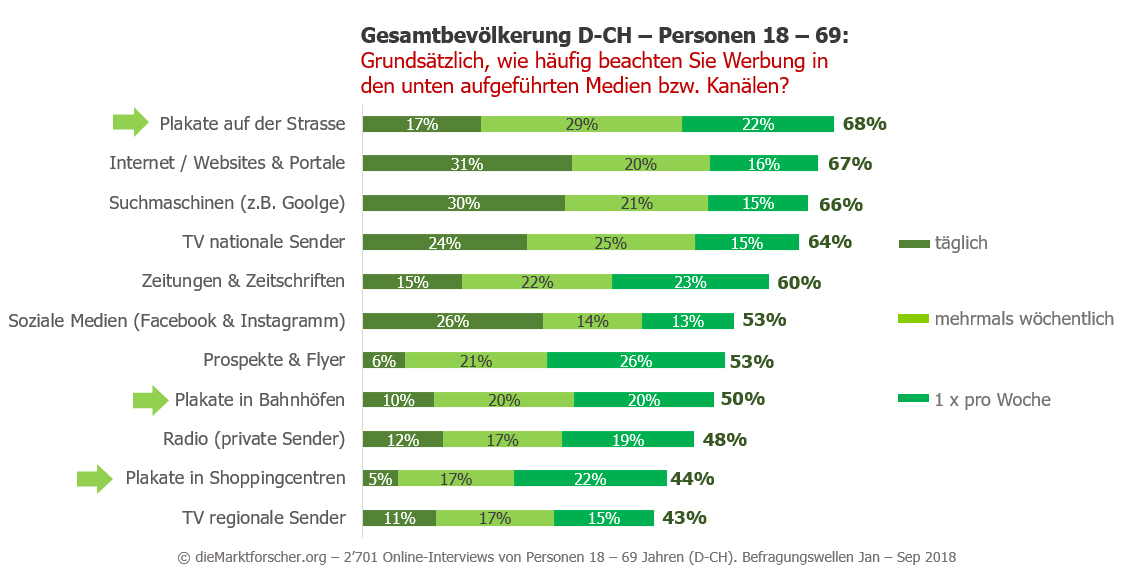
The market research firm DieMarktforscher.org examined advertising awareness among German-speaking Swiss residents, comparing out-of-home advertising (street, rail, and shopping) with other media formats.

As part of advertising tests, the market research company DieMarktforscher.org determines the performance of possible advertising channels and has now published a summary of the results. The study is based on 2,700 interviews conducted in German-speaking Switzerland from February to September 2018. 

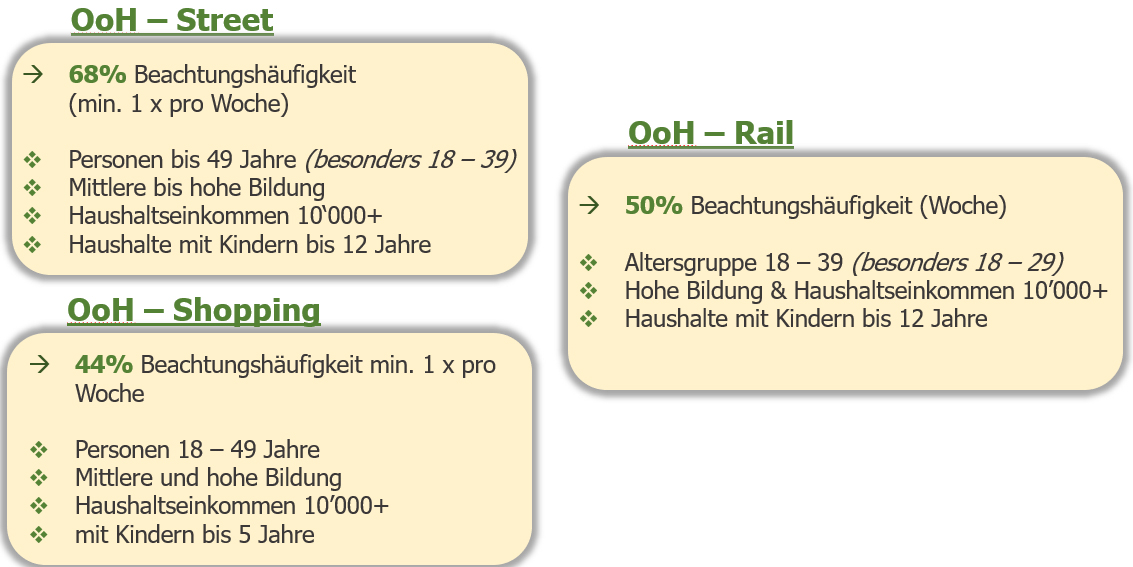
The differences between Out of Home - Street, Rail and Shopping are shown for the first time. 

The advertising attention of the German-speaking Swiss: 
 

OOH-studie-01

It comes as no surprise that Out of Home Street and online advertising are among the channels that attract the most attention, the company writes in a press release. If the recall values of campaigns are measured, channels with high contact intensity are the most convincing, and OoH is unbeatable in this respect.

No other medium can address young and well-educated target groups so effectively: 

OOH-studie-02

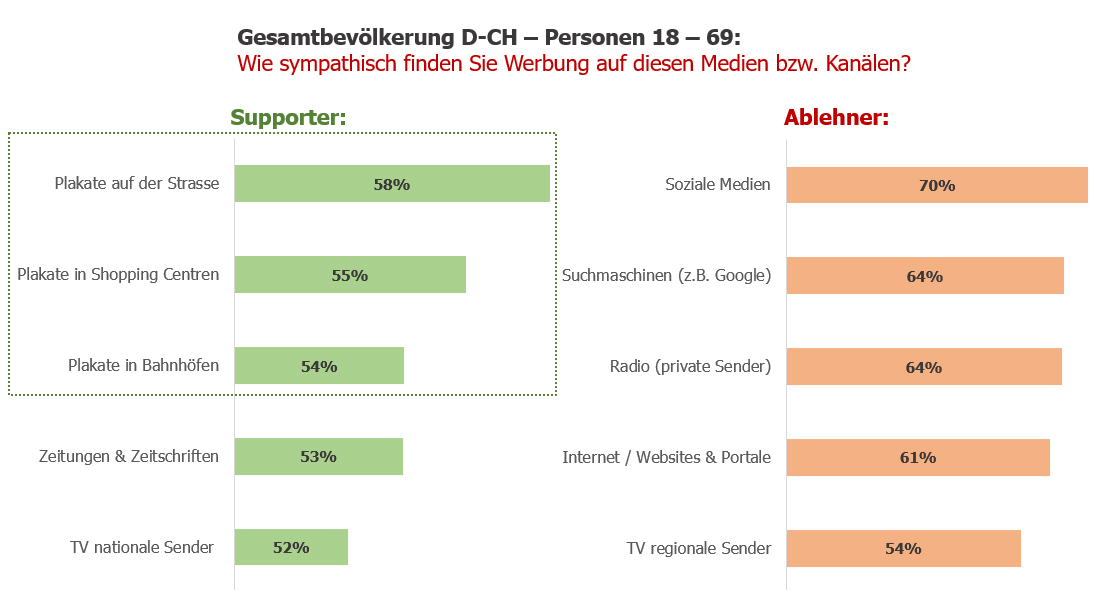
Advertising is only effective if people are not bothered by it. This is a factor that should also be taken into account when choosing an advertising channel. It turns out that out-of-home is the most appealing form of advertising. Online advertising, on the other hand, is perceived negatively. This is especially true for advertising on social media channels.

OOH-studie-03

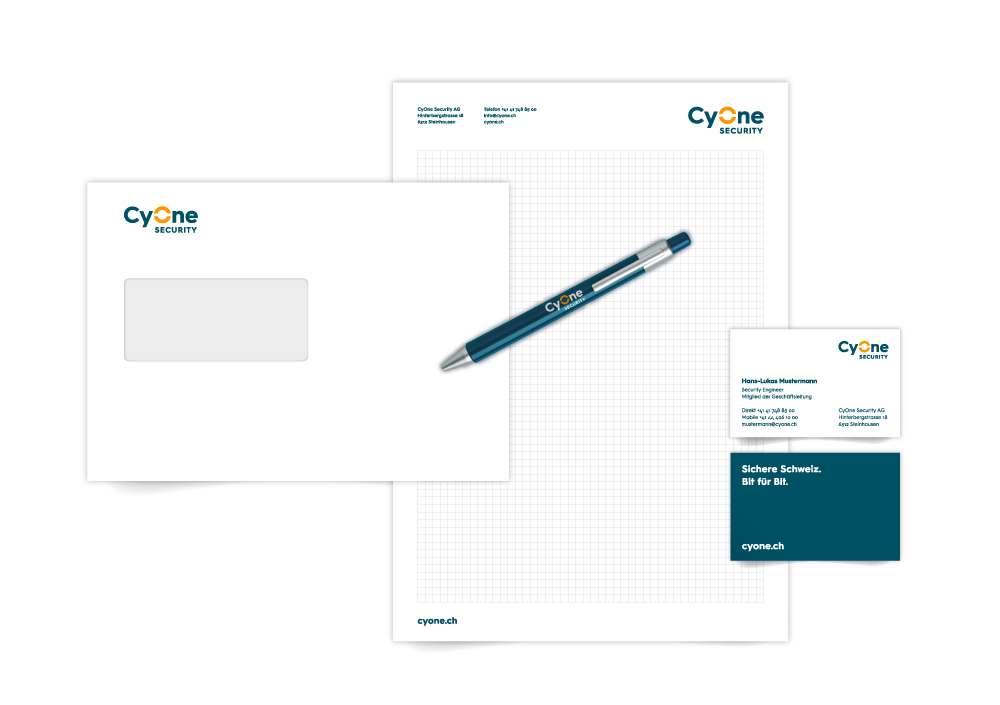
Hug & Dorfmüller Design makes CyOne Security ready for takeoff

Formed in 2018 through a management buyout of Crypto, CyOne Security launched in January 2019 as a Swiss cybersecurity specialist. The Lucerne-based agency Hug & Dorfmüller Design developed the corporate design to reflect the company’s message: A Secure Switzerland. Bit by bit.

CyOne_PresseTitel

When one company becomes two, there is a lot to do. For Hug & Dorfmüller in Lucerne's Hirschengraben, the task was to create a brand from one name. On the one hand a traditional company, on the other a young company with a start-up mentality - a complex starting position. For this reason, the agency conducted a workshop on brand identity together with the newly acquired client. From this, they drew valuable information that was crucial for defining the corporate identity and thus the corporate design. 

CyOne Security positions itself as the only purely Swiss company offering 360-degree security concepts and solutions for government and industry in the areas of Cipher Security, Cyber Security and Security of Things. 

The logo created for CyOne Security symbolizes 360-degree competence as well as clarity, symmetry and stability. The color orange is a reference to the origin, petrol stands for competence and independence, turquoise for the lively cyber energy and the so important agility. 

The introduction of the new brand took place in various stages. In a first step, the vision, mission, brand positioning and brand identity, the corporate story, the new company name and the new logo were presented to the employees. On January 1, 2019, the new website went live. Cyone.ch The newly branded social media channels are also live, a brand movie has been produced, the new offices have been moved into and the first customer event has already been held. 
 

CyOne_04

On March 27, the 3 Plus Group launches the fourth channel

Following 3+, 4+, and 5+, the 3 Plus Group is launching 6+, its fourth in-house TV channel. 6+ will feature free-to-air premieres of series, blockbuster feature films, documentaries, and Swiss original productions. 6+ is also set to become the network group’s testing ground for innovative advertising formats.

6plus-Logo

The channel will launch on March 27, 2019 in the digital program offering of UPC, Swisscom TV, Digital Cable Group and Sunrise, among others.

"We are continuing to gradually expand the range of Swiss in-house productions on 3+. And have also bought in additional exclusive programming packages with top series and big blockbuster feature films. To make room for all these great new programs, some of our popular top series will be permanently moved from 3+ to our other channels. A fourth free TV channel has also become necessary because it's the only way we can give all the top shows in the 3 Plus Group portfolio enough space and thus create the basis for further growth," says Dominik Kaiser, founder and CEO of the 3 Plus Group, explaining the launch of a fourth channel.

The new channel 6+ has a clear program layout: On Monday and Thursday evenings, primetime shows documentaries, on Wednesday and Saturday in-house productions, on Tuesday and Friday it's crime night, and on Sunday 6+ shows hot feature films. In the early evening program, 6+ focuses on docu-series and in-house productions. Because 6+ shows many of its own productions, Dominik Kaiser affectionately calls his station "little 3+.


Program shifts between 3+, 4+ and 5+.

3+'s increasing focus on in-house productions, the acquisition of additional series and feature films, and the launch of the new channel 6+ have also led to adjustments on channels 4+ and 5+. US programs such as "9-1-1," "Bull," and "Seal Team" will move from 3+ to 4+, while series such as "NCIS: Los Angeles," "Unforgettable," and "Rizzoli & Isles" will move from 4+ to 5+. The programs that have been moved will then only run on the new target station. The program shifts are intended to ensure the growth of each existing station and the entire 3 Plus Group.

6+, like the other channels of the 3 Plus Group, is in the digital programming lineup of UPC, Swisscom TV, the Digital Cable Group and Sunrise. At UPC, 6+ takes over a prominent broadcasting slot. As with 3+, 4+ and 5+, advertising marketing will be handled by longstanding partner Goldbach Media.

Zuckerberg promises more privacy at Facebook

This could be the moment of the greatest change in Facebook's 15-year history: Mark Zuckerberg promises that privacy will be the foundation of the online network going forward. But many details remain unclear for now.

facebook-network-t

Following massive criticism in recent months, Facebook CEO Mark Zuckerberg has announced that the online network will focus more on protecting privacy. "I believe that in the future, communication will increasingly shift to confidential, encrypted services where people can trust that what they share with each other will remain secure," Zuckerberg wrote on Wednesday. Facebook wants to work towards this future.

The world's largest online network was sharply criticized for its handling of user data, particularly after the Cambridge Analytica data scandal broke out. "I understand that many people don't believe that Facebook would or wanted to build such a privacy-focused platform," Zuckerberg admitted. The online network does not have a reputation for developing privacy-focused services.

Wednesday's announcement actually represents a categorical rethink compared to Zuckerberg's attitude in the early years of Facebook. Back then, the Facebook founder explained that the trend was for people to make more and more of themselves public. Facebook had repeatedly come into conflict with data protection and regulatory authorities when the company tested the limits of privacy.

Zuckerberg has now announced that more of the Group's services will be fully encrypted along the lines of the WhatsApp chat service. With end-to-end encryption, the content of a conversation can only be viewed by the sender and recipient. It prevents others - "including us - from seeing what people share in our services", Zuckerberg also wrote. Other services such as video chats, e-commerce offers and payment services would be built on this secure basis. Zuckerberg predicted that in a few years, WhatsApp and the Group's second chat service, Facebook Messenger, will become the central way in which people communicate on the platform.

It remains unclear what the new course will mean for Facebook's business model. The online network currently relies on knowing as much as possible about the interests, views, plans and circumstances of its users in order to be able to provide targeted advertising. However, if end-to-end encryption is implemented consistently, Facebook would also not have access to user content.

In his Facebook entry, Zuckerberg did not respond to an interview with the New York Times he signaled that Facebook could find new ideas for making money. "There are lots of business opportunities, especially in developing countries. More private tools can be developed around where people are," he said. Speaking to the magazine Wired he conceded that the ad platform is less efficient with a reduced data supply. But there are also models, for example, in which companies pay money for better interactions with customers in messenger services.

Widespread use of end-to-end encryption on the Facebook platform could also exacerbate the problem of the spread of misinformation and illegal content. This is because even Facebook's teams that review and delete posts would not have access to them. Private WhatsApp groups have already been used for smear campaigns in India and Myanmar, among other countries. Zuckerberg wrote that Facebook is working on identifying accounts with malicious intentions even without access to the content, for example through behavioral patterns.

Zuckerberg also emphasized that Facebook has made the decision not to build data centers in countries that violate human rights or restrict freedom of expression. This could mean that Facebook's services are blocked in some countries and that the company will not be able to open up some others in the foreseeable future. Among other things, this statement is likely to put an entry into the Chinese market, which has been repeatedly speculated about in recent years, off the table again.

The passage on China can also be seen as a dig at Apple CEO Tim Cook. Cook has been emphasizing for years that Apple's products and services are particularly geared towards protecting customer privacy and most recently presented himself as a critic of Facebook, where "the users are the product" that is sold to the advertising industry. At the same time, Apple has been criticized for storing Chinese users' data and crypto keys in China in accordance with local laws. Apple explains that this does not weaken data protection.

Zuckerberg also included the intention to bring WhatsApp, Messenger and Instagram's chat function onto a common technical infrastructure in this new crypto vision. The plan is for users to be able to send messages to their contacts across the boundaries of individual services, with SMS messages to be added at a later date. Users will also be able to keep the individual services separate. The plan offers advantages in terms of data protection and security, argued the Facebook boss. For example, if it replaces SMS, which is basically unencrypted. However, the integration of SMS and Facebook Messenger is only possible on Android smartphones, as Apple does not allow the integration of SMS into external apps, criticized Zuckerberg.

Another aspect of the plan is that user data on Facebook could be automatically deleted after a certain period of time. "This would reduce the risk of messages resurfacing later and embarrassing you," wrote Zuckerberg. Automatic deletion could also be switched off - or even set to a few minutes for some content. Facebook had already copied the "Stories" function from its (in-house) rival Snapchat, which allows users to share their content with friends for just one day.

In the Cambridge Analytica case, which put Facebook under massive pressure, data from Facebook users was illegally passed on to a data analysis company by the developer of a survey app over five years ago. Facebook had known about this since the end of 2016, but was content with assurances that the data had been destroyed and did not inform users. (SDA)

get_footer();