Ombudsman objects to "Rundschau" report on CO2 law

According to ombudsman Roger Blum, the report on the CO2 law broadcast on December 12, 2018, on Schweizer Fernsehen SRF's "Rundschau" lacked distance. Blum agreed with a complainant who criticized the report as one-sided and uncritical.

rundschau-co2

The complainant was of the opinion that the term "hardliner" used in the article for the SVP National Councilor Christian Imark had been used incorrectly. In addition, the article had been very critical of the SVP, but uncritical to sympathetic towards the left-green spectrum.

In his report published by SRF on Tuesday, Blum also came to the conclusion that the existing critical distance to the SVP was missing in relation to the Greens and the Left. According to the normal "Rundschau" concept, it would have been expected that the criticized Imark could have defended himself at the "Rundschau" counter.

However, this principle had been thwarted in the offending broadcast. He was replaced by the party president of the Greens, Regula Rytz. The moderator did not really come down hard on her. The critical questions had rather had a supporting effect, according to Blum.

At one point, the moderator even showed audible solidarity. Overall, the audience had been steered in a certain direction and had not been able to form its own opinion freely.

The "Rundschau" editorial director Mario Poletti contradicted this view: the program had reported fairly and factually. In the report before the conversation with Rytz at the bar, both Imark and Rytz could have presented their best arguments for or against climate protection measures. (SDA)
 

Contcept receives the mandate from Best of Swiss Gastro

Contcept Communication has been awarded the PR mandate for the ongoing campaign for Switzerland's largest and most comprehensive gastronomy competition, "Best of Swiss Gastro".

Gewinnerkreuz

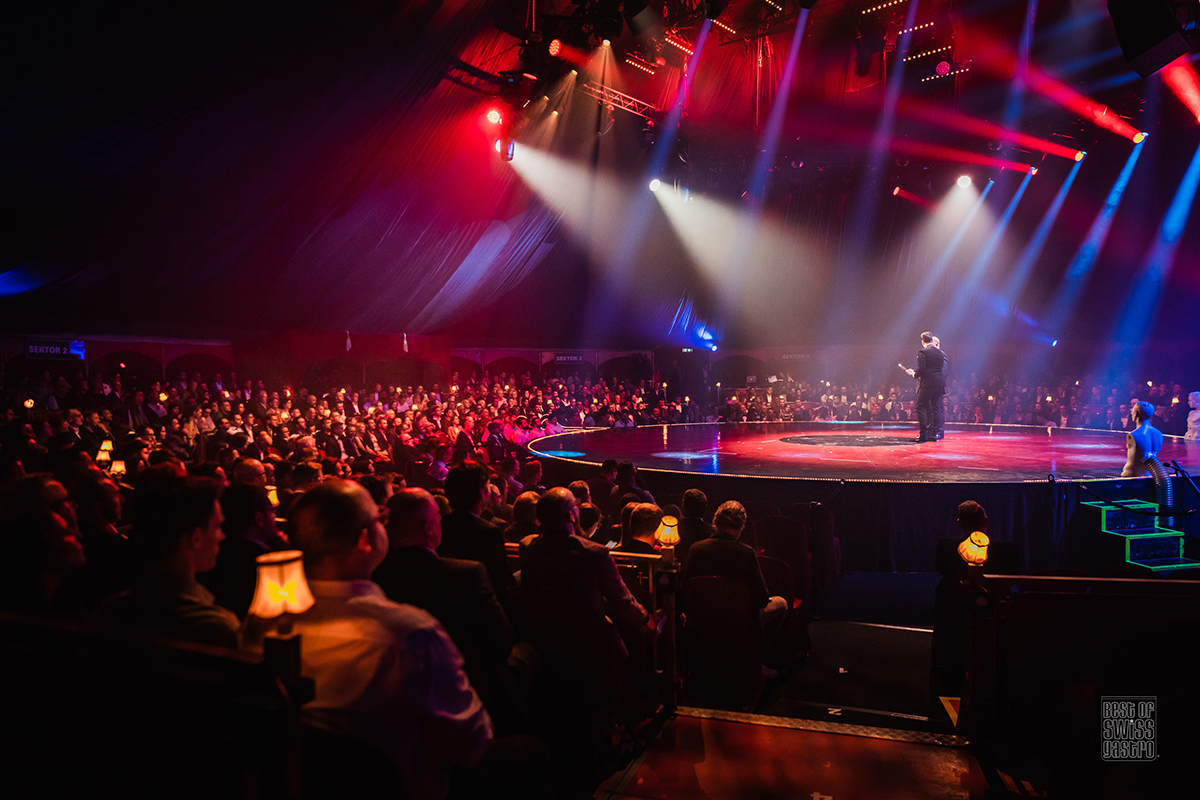
As the only public award in Swiss gastronomy, "Best of Swiss Gastro" annually honors the best gastronomy businesses in Switzerland in eight categories and enables long-term, sustainable and target-group-specific communication. "Best of Swiss Gastro 2020" is the 16th edition of the renowned gastronomy award. The winners will be announced at the Award Night on Oct. 21, 2019.

Contcept Communication's work includes classic media work as well as story creation and storytelling for the whole of Switzerland. Contcep also supports the lead agency Kis-Com in the marketing of several "Best of Swiss Gastro" events and in publishing. 

Andreas Krumes, CEO KIS-COM: "At Best of Swiss Gastro we are already writing the 16th chapter of a success story. With each year, the award becomes better known and brings more gastronomic businesses and more guests together. I am very pleased that we have found a renowned partner in Contcept Communication, which shares and supports our commitment to the Swiss gastronomic scene."

Ambiente

Tamedia with profit decline in the past year

The Tamedia publishing group reported a decline in profits last year. Operating profit (EBIT) fell by 27 percent to 131.6 million Swiss francs. Net income fell by 24 percent to 129.5 million Swiss francs.

Tamedia-Gebaeude

The reason for this was the sharp decline in printed advertising, the Zurich-based company announced in a press release on Tuesday. Tamedia also had to make a value adjustment as a result of the Publicitas bankruptcy.

However, the Group had benefited from various special accounting effects in the previous year. Excluding all special effects, the operating result was slightly below the previous year, Tamedia wrote.

By contrast, sales climbed by 3.7 percent to CHF 1.01 billion. The media company owes this to the takeovers of the advertising marketing companies Neo Advertising and Goldbach (the latter consolidated since September), Basler Zeitung and the continuing prosperity of its commercial digital offerings.

The reported figures are slightly below ZKB's estimates. Zürcher Kantonalbank had forecast sales of CHF 1.03 billion and EBIT of CHF 138.1 million.

Print business under massive pressure

Advertising revenue from printed newspapers and magazines fell sharply again in 2018. Overall, revenue in the Paid Media segment fell by 5.7 percent to CHF 569.6 million. The operating result suffered even more, falling from CHF 54 million to CHF 18 million.

The bankruptcy of the advertising agency Publicitas, closure costs for the printed edition of the French-speaking Swiss newspaper Le Matin and the lower result of the newspaper printing centers.

Commuter media and marketing fared better. Here, in addition to 20 minutes The sales of the newly acquired pure advertising marketing companies Neo Advertising and Goldbach (primarily video) were also included. Overall, revenue increased by 33.7 percent to CHF 206.4 million. EBIT improved by CHF 3 million to CHF 51 million.

Digital drives growth

However, the Marketplaces and Ventures business division was once again the main organic growth driver in 2018. Here, sales increased by 7.3% to CHF 252.8 million, while EBIT improved disproportionately by CHF 11 million to CHF 70 million, which corresponds to a margin of 27.8%. According to the press release, the Jobcloud, Homegate, Olmero and Doodle platforms performed particularly well.

All digital offerings together now contribute over 43 percent of Tamedia's revenues and 86 percent of its EBIT. Over the next three years, Tamedia intends to strengthen the digital part of its core business of journalism and invest CHF 30 million in this area. Two thirds of this will be invested in the editorial area of paid media and one third in the commercial area. The aim is to launch new digital offerings that meet the needs and habits of users.

Corporate structure under review

The entire company organization is also to be reviewed. In this way, the Group aims to create optimal conditions for transparency and growth in all business areas. The corresponding decision-making basis is expected by the summer.

As usual, Tamedia's management will not provide a concrete business outlook for the current year. (SDA)

Photo: hae/advertising week

Tamedia 2018
Key figures 2018 2017 Change
  in CHF million in CHF million in percent
Tamedia Group      
Operating income 1 010.6 974.2 3.7
Operating result before depreciation and amortization (EBITDA) 205.9 245.2 -16
Margin (in percent) 20.4 25.2 -19.1
Operating result (EBIT) 131.6 180.7 -27.2
Margin (in percent) 13 18.6 -29.8
Result 129.5 170.2 -23.9
of which attributable to Tamedia shareholders 96.5 146.9 -34.3
       
Cash flow from operating activities 187.7 223.3 -15.9
Balance sheet total1 2 948.4 2 513.3 17.3
Self-financing ratio (in percent)² 71.3 78.4 -9
       
Paid media      
Operating income 569.6 603.8 -5.7
thereof intersegment 16.5 17.8 -7.5
EBITDA 47.4 82.6 -42.7
EBITDA margin (in percent)³ 8.3 13.7 -39.2
       
Commuter media and marketing      
Operating income 206.4 154.4 33.7
thereof intersegment 1.4 1.2 17.9
EBITDA 62 50.7 22.4
EBITDA margin (in percent)³ 30 32.8 -8.4
       
Marketplaces and shareholdings      
Operating income 252.8 235.5 7.3
thereof intersegment 0.4 0.6 -38.3
EBITDA 104.7 91.8 14
EBITDA margin (in percent)³ 41.4 39 6.2
       
Average number of employees⁴ 3 330 3 204 3.9
Dividend per share (in CHF) 4.505 4.5 0
Source: Tamedia

Ringier Digital Ventures invests in home sharing start-up Airgreets

Ringier Digital Ventures invests in the home sharing start-up Airgreets as part of a current financing round. The company is the leading home sharing service for hosts on Airbnb in the DACH region.

airgreets

Founded in 2016, the start-up Airgreets is a home sharing service that enables frequent travelers to temporarily sublet their apartment during their own absences without incurring any expenses. Airgreets offers an all-round service package that includes advertising the apartment on platforms such as Airbnb, price management, communication with the temporary subtenants, check-in and cleaning of the apartment.

Airgreets' vision is, on the one hand, to ensure the efficient use of vacant residential space without any effort on the part of the landlord and, on the other hand, to develop the hotel of the future, i.e. to bring high-quality hotel standards to guests in apartments.

"Airgreets recognized early on the potential of the home sharing market, which has only been tapped to a fraction, especially in the DACH region. In addition to the general innovation and technology trends in the real estate industry, the increased travel demand of the population as well as the search for alternatives to hotels reinforces the trend towards the home sharing market," says Benjamin Solenthaler, Investment Manager Ringier Digital Ventures.

Airgreets operates in six German cities as well as Vienna and managed over 30,000 nights in 700 apartments. The investment from Ringier Digital Ventures is intended to help drive further expansion in Switzerland.

"Switzerland is an extremely interesting market for us. In major cities, there is great potential for frequent travelers, whose apartments are often empty for short periods and left unused. At the same time, the demand for short-term accommodation among travelers is very high," explains Sebastian Drescher, Co-Founder and Managing Director of Airgreets.

The fresh capital from the financing round will be used for expansion, further growth and the expansion of Airgreets' IT.

Tamedia paid Christoph Blocher more than 50 million Swiss francs for the Basler Zeitung

The acquisition of the Basler Zeitung cost Tamedia a lot of money. This is evident from the figures published on Tuesday.

tamedia-baz

How the Aargauer newspaper the effective price of the Basler Zeitung is said to have been 51.4 million francs last October. Added to this are liabilities amounting to CHF 24 million, resulting in a valuation of the BaZ assets of CHF 75.4 million.

The majority of BaZ's value is of an intangible nature. As Tamedia itself writes, CHF 25.7 million must be regarded as goodwill. This is based on the strong market position of the Basler Zeitung in the Basel region and the expected synergies for the Zurich media company.

According to the Aargauer Zeitung, it is unclear whether the foray into the Basel newspaper business was commercially worthwhile for previous owner Christoph Blocher. However, the CHF 50 million he ultimately received for the newspaper from Tamedia is considered "considerable". (hae)


TV24 launches "Sing meinen Song - das Schweizer Tauschkonzert" (Sing my song - the Swiss swap concert)

TV24 has secured the format license for "Sing meinen Song - das Schweizer Tauschkonzert. Singer Seven was signed up for the role of host.

TV24_SMS_S01_Seven

One episode of "Sing meinen Song - das Schweizer Tauschkonzert" is dedicated to each of the seven artists. In the first seven episodes, the singer is surprised by the six others with a personal, completely new interpretation of one of their own songs. The concert takes place in a very personal setting, accompanied only by a band. In addition, the artist of the evening performs his or her own song and chooses the song of the evening at the end of the episode. In the eighth episode of "Sing meinen Song - das Schweizer Tauschkonzert," selected songs are sung as a duet. 

For the production, seven Swiss musicians from different styles retreat to a secluded location for several days, live and make music together. TV24 is very close to them and shows a very personal insight into the musical work of the singers during the eight episodes. 

Soul & funk musician Seven is the host and is looking forward to the Swiss premiere: "I am very proud to be able to continue writing this fairy tale in Switzerland. It's time to show the diversity and quality of the Swiss music landscape in this unvarnished and genuine way. Everyone who knows me knows that I am an "all or nothing" type. That's why I'm doing everything I can to show Switzerland what its musicians can do and I'm giving all my passion and fire to this format. We build a playground and make music together and for each other - and you out there are right in the middle of it all! 

With "Sing meinen Song - das Schweizer Tauschkonzert," TV24 is launching its third major in-house production after "Ninja Warrior Switzerland" and "Die Höhle der Löwen Schweiz" and has hired the production company Habegger for the implementation. Filming will take place in Gran Canaria in winter 2019/2020. The format license was acquired from Banijay Rights, the international distribution unit of the Banijay Group. Worldwide, the show will be broadcast in 12 countries, based on the original format by InMediate International on FTV Format de Beste Zangers. 

Roger Elsener, Managing Director TV & Radio and member of the CH Media Executive Board, and Andrew Sime, Vice President Formats at Banijay Rights, are looking forward to the collaboration: "The Best Singers is already running very successfully in numerous countries and we are convinced that the format will also find great appeal with Swiss audiences. With a unique line-up and a behind-the-scenes look at the creative process, Sing meinen Song - das Schweizer Tauschkonzert has all the makings of a primetime hit." 

Virtue and Copenhagen Pride introduce Q, the world's first genderless voice

Virtue, Vice's full-service creative agency, and Copenhagen Pride have introduced Q, the world's first gender-neutral voice. Q is designed to reduce gender-based biases and promote greater inclusion in language technology.

Until now, leading technology companies have aligned their voice technology with the perceived needs of consumers. They have created scenarios in which they believe consumers feel most comfortable. A male voice has often been used in authoritative roles, for example in banking and insurance apps, and a female voice in more service-oriented roles such as with Alexa or Siri. In this way, gender-specific stereotypes have been promoted and non-binary individuals have been excluded with this approach.

Q was developed under the leadership of Virtue Nordics (based in Copenhagen). With the launch of Q, Virtue and Copenhagen Pride are promoting a new awareness in voice control and creating a new and contemporary solution. Virtue wants to use the genderless voice not only to change voice control, but also to connect to other areas and technologies. Whether for AI, for games, in the theater or in the subway: Q is set to become the universal voice of the future.

Ryan Sherman, Senior Creative Virtue Nordics: "Technology should not be anchored in outdated cultural standards, but in new ones. Using data and insights from our global Vice network, we have discovered a unique opportunity to develop a technical medium that is becoming more prevalent in our everyday lives. Q is not the voice of one, but the voice of many, fighting for a future that includes everyone." 

Together with Anna Jørgensen, linguist and researcher at the University of Copenhagen, Virtue defined the parameters for a gender-neutral voice. Five voices were recorded that are not typically male or female. With the help of special software, they were shifted into the gender-neutral range. Subsequently, 4600 participants across Europe rated the modulated voices on a scale from 1 (male) to 5 (female). The voice was adjusted and tested again until it was perceived as gender-neutral.

Thomas Rasmussen, Head of Communication, Copenhagen Pride: "Copenhagen Pride is committed to fighting gender binaries and limiting stereotypes. With Q - a neutral voice with no predetermined gender - we want to get the attention of leading tech companies working with artificial intelligence and make them realize that specific binary genders exclude many people. It's about giving people choices and options. For me, it's about freedom and inclusion."

Youtube becomes the second screen of RTS

Swiss Radio Television (RTS) in French-speaking Switzerland is pleased with its "very good audience performance" in 2018, with its radio and TV stations holding a leading position in French-speaking Switzerland despite competition. More and more posts are being consumed on social networks.

rts-youtube

"Youtube is increasingly becoming our second television," RTS Director Pascal Crittin told the media on Tuesday. On this platform, which is particularly popular with young people, RTS accounts recorded an average of 169,999 views per day, an increase of 75 percent. More content is now also available on Instagram.

The Rts.ch website is the second most visited media website in French-speaking Switzerland, behind 20minutes.ch. Daily visitor numbers rose by 17 percent last year, thanks mainly to sports and World Cup coverage.

More TV audience

After a slight decline in 2017, RTS regained ground with the traditional TV audience. Together, RTS 1 and 2 achieved a market share of 35.3 percent last year (33.2 percent in 2017 and 34 percent in 2016). "This slight increase was at the expense of the French TV channels. It shows that proximity is one of our advantages," Crittin said.

In radio, a comparison with previous years is difficult because the calculation method has changed. The channels have a combined market share of 50.9 percent. RTS 1 is in the lead among all age groups, with the exception of 35- to 44-year-olds, who prefer Couleur 3.

Filmed radio news on the web

RTS also used the opportunity in front of the media to present a few novelties. From June 3, the Forum radio news program will be filmed and broadcast live on RTS 2 and on the web.

This is a new step in the convergence between radio, television and the Internet, he said. To meet the multimedia challenges, a new automated studio with nine cameras is being set up in Lausanne.

Save money, yes, but not on the program

According to the director, the SRG savings plan of 100 million francs will not be at the expense of programming at RTS. At RTS, "we will make very few tweaks to the program and the impact on current jobs will be marginal," he said. Instead, savings will be made in infrastructure, buildings and content procurement. (SDA)

Freddy Fallegger new Sales Manager at Brunner Medien

Brunner Medien's new sales manager is Freddy Fallegger. The 48-year-old knows the printing and media industry inside and out and brings more than 25 years of experience to the role. He has held management positions in sales and marketing since 2008.

20190312_Portraet-Fallegger

Fallegger succeeds Martin Hegglin, who left the company at the end of December 2018. Fallegger is responsible for managing sales and will sit on the executive board. At Brunner Medien, in addition to print solutions, he will also oversee portfolios in the areas of web and cross-media.

Freddy Fallegger has held various positions in the print and media business for more than 25 years: first as a printer and office sales clerk, then after various further training courses at "gib" and SKUGRA, among others, in a management position as an office customer advisor, and since 2008 as Key Account Manager and Marketing and Sales Manager. Fallegger has held various professional positions. Among other things, he was Head of Sales and Marketing and a member of the Executive Board at Abächerli Media in Sarnen.
 

Tamedia invests in digital - print business becomes a burden

The media company Tamedia continues to invest heavily in digital—including in journalism, but above all in commercial digital offerings and equity investments. Its former core business in print media continues to be optimized, but is increasingly becoming a burden for the group as a whole.

tamedia-01

Two figures illustrate the problem. While the print business was still responsible for almost 47% of total sales in 2018, printed products only accounted for just under 14% of operating profit at EBIT level. In other words, less and less money can be earned with print. This is reflected not least in the EBIT margin of the Paid Media division, which fell to a low of 3.2 per cent in 2018 and was rated "unsatisfactory" by Tamedia CEO Christoph Tonini. No improvement in sight here. Tamedia's management expects sales in the print advertising market to continue to fall in 2019.

Investments in fintech

Against this backdrop, it seems only logical that the available funds will flow primarily into promising digital activities. The majority of the money received from the sale of the minority stake in Localsearch is to be used for the purchase of new digital investments. As the majority owner of Localsearch, Swisscom is paying Tamedia just under CHF 240 million for its 31 percent stake.

Tamedia CEO Tonini sees a possible investment focus in the fintech sector. The Group has gained initial experience in this area with its investments in Lykke (global blockchain marketplace) and Monito (comparison portal for money transfer services).

But the digital paid media are also to be strengthened. Tamedia plans to invest 30 million over the next three years: Two thirds will go to the editorial department and one third to the commercial sector.

Encouraging development of digital subscriptions

The management's confidence in investing in publishing is based on the recent positive development of the digital reader market. The number of digital subscriptions rose to over 70,000 at the end of 2018, compared to just under 50,000 at the end of 2017. 100,000 day passes were also sold last year. Speaking to the media on Tuesday, Chairman of the Board of Directors Pietro Supino spoke of a "breakthrough". He also expressed his conviction that there will continue to be a willingness to pay for quality journalism in the future.

In order to meet the increasingly divergent challenges, growth prospects and development speeds of the Group's various business areas, Tamedia is planning to adapt its corporate structure. The new organization should make Tamedia more open and agile for partnerships. As an example, CEO Tonini mentioned the Classifieds business segment, where international partnerships could lead to accelerated growth. Tonini sees the bundling of the existing organizational units in the area of advertising marketing and placement as another sensible organizational adjustment.

Sales up but profits down

Thanks to the takeovers of the advertising marketing companies Neo Advertising and Goldbach and the continued success of its commercial digital offerings, Tamedia grew its revenues by just under 4 per cent to over CHF 1 billion in the 2018 financial year. However, operating profit before interest and taxes (EBIT) fell significantly by 27.2% to CHF 131.6 million. The margin thus amounted to 13.0 per cent after 18.6 per cent. However, Tamedia benefited from various one-off accounting effects in the previous year, while in 2018 the bankruptcy of Publicitas had a negative impact of CHF 6.0 million and higher pension expenses. Excluding all special effects, the operating result was only slightly below the previous year, Tamedia wrote.

The bottom line was a net profit of 129.5 million francs (minus 24 percent). Shareholders are to participate in the profit with an unchanged dividend of 4.50 francs. (SDA)

Copyright: Council of States postpones decision on clause for media publishers

The Council of States wants to wait and see how things develop in the EU before deciding on the copyright law revision. On Tuesday, it decided to refer the bill back to its committee.

leistungsschutzrecht

The Council approved a motion by Pirmin Bischof (CVP/SO) without opposition. The committee responsible for preliminary deliberations has thus been instructed to review its decisions and take current legal developments in the EU into account.

The reason for the decision is a controversial addition that the Commission had added: it wants to make Google and Facebook pay in favor of media publishers. In future, the operators of internet platforms should owe publishers a fee if they make journalistic works accessible. This primarily concerns text outlines and references to articles that are displayed to internet users in services such as Google News.
 

Revenue for Google

In this way, the Internet platforms can gain data for advertising marketing or place advertisements for the text outlines and thus earn money - from the publishers' point of view, money that they are losing. Users may be content with the text outline on the social network and not click on the link that would take them to the media portal.

A compensation regulation is also currently being debated in the EU under the title "ancillary copyright". Proponents argue that the media industry is facing difficulties due to the collapse in advertising revenue. Critics doubt that the problems can be solved in this way. The specific form of the rule is also controversial.

Proposal not convincing

The Commission's proposal is not yet fully developed, was the tenor in the Council of States. With the Commission's proposal, Switzerland would have the most restrictive copyright law in relation to the Internet, stated Anita Fetz (SP/BS). Upload filters would be needed for implementation. That would not be in the interests of users or journalists. Small publishers and freelance journalists in particular would be restricted.

Pirmin Bischof recalled that the Federal Council had set up a working group with all the important players, Agur 12, in the knowledge of how difficult it was to reconcile the conflicting interests in copyright law. The working group had actually managed to find a compromise. However, the Commission's decisions now deviate considerably from this. A good justification is needed for this.

Switzerland threatened with isolation

Géraldine Savary (SP/VD) spoke out in favor of ancillary copyright. She emphasized the importance of the media for society. If the EU opted for an ancillary copyright, Switzerland would risk isolating itself. This would have dramatic consequences for the media in the country. However, Savary also did not oppose discussing the regulation again in the Commission.

Hannes Germann (SVP/SH) doubted the benefits of the referral. He stated that a renewed discussion in the committee would not make the difficult decisions any easier. The committee had dealt with the bill in detail.

Doubts about the benefits

Commission spokesperson Ruedi Noser (FDP/ZH) noted that the Commission's proposal goes further than the one under discussion in the EU. It was also disputed whether the ancillary copyright was even suitable for achieving the objective.

In Germany and Spain, where it has already been introduced, it has not been a success. Noser also pointed out that a decision would be made in the EU at the end of March, but possibly not conclusively.

National Council against

Karin Keller-Sutter pointed out that the regulation was extremely controversial in the EU. In Germany, people took to the streets because they feared for the free Internet.

A clause in favor of media publishers was also discussed in the National Council in the form of an individual motion. The large chamber voted against it by 133 votes to 39 with 5 abstentions. The Council of States committee is now looking again at possible regulations in detail.
Note: Message rewritten after decision. (SDA)

Friendly Greetings creates new financial education content platform for UBS

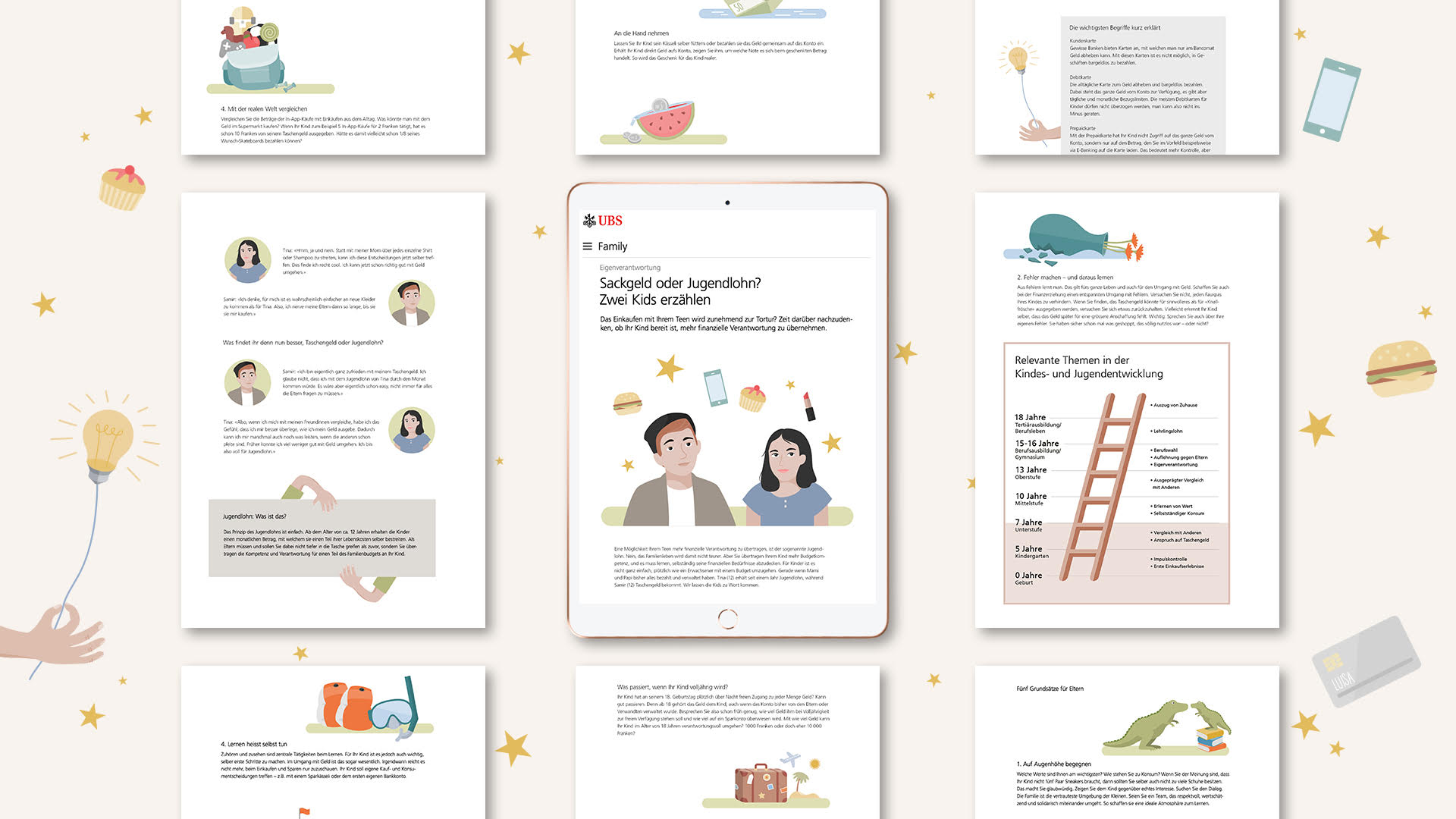
Freundliche Grüsse was commissioned by UBS to design and implement the new financial education content initiative. The concept was developed in collaboration with content specialists and subject matter experts from UBS, as well as Marianne Heller, an educator and expert in financial education.

UBS_Kids_PM1

The platform is convincing in its light-hearted approach to the topic without deviating from contemporary educational principles: Animations, listicles, infographics and interviews explain to parents in magazine style, for example, how to deal with it when glitter ponies suddenly appear in the children's in-app purchases or how to make a used bike appealing to the younger sibling. 

In the first phase, various articles were developed on specific educational milestones for the toddler, schoolchild and teenager age groups, which are being continuously expanded.

As a highlight, the interactive educational game "Birthday Party Planner" was designed and implemented by Freundliche Grüsse. With the responsive online game, children can playfully budget their own birthday party together with their parents, generate a shopping list and print out personalized invitation cards.

The new parents' guide is being promoted with a broad-based social media campaign and conveys the tone of the content in a playful way. Dynamic Language Optimization is used, among other things, to address the target group in the various language regions as efficiently as possible.

NEU_image_screens_UBSKids_FG

Responsible at UBS: Daniel Fischer (Head of Marketing Region Switzerland), Alessandro Monsurrò (Head of Marketing Personal Banking), Lucia Rutishauser (Marketing Specialist Personal Banking - Kids Specialist), Oliver Vedolin (Head of Content Marketing, Digital & Dialogue Marketing), Joël Frey (Head of Content Marketing), Sanja Hauser (Head of Digital Marketing), Iris Keller (Digital Marketing Specialist). Responsible at Friendly regards: Samuel Textor, Pascal Deville (Creative Direction), Janine Yvette Sonderegger, Grégoire Vuilleumier (Text/Concept), Nadine Mojado (Head of Creative Production), Mara Schwegler (Graphics), Alain Aebersold (Art Direction), David Lüthi (UX), Erwan Eydt (Programming), Stefanie Schmid, Jasmine Segginger (Consulting), Illustration: Daniela Benedix, Joel Roth, Pedagogical Specialist: Marianne Heller.
 

get_footer();