Booming online advertising drives faster global advertising growth
Online advertising is growing faster than expected, driving global advertising spending up by 4.7 percent this year. That is the forecast from global media agency Zenith in its "Advertising Expenditure Forecasts" report released on Monday, revising its previous forecast of 4.0 percent from its December report.


Zenith is forecasting growth of 4.6% for 2020 and 2021, which is higher than the previous forecasts of 4.2% and 4.1% respectively.
"Online advertising will exceed the 250 billion dollar mark for the first time this year," says Jonathan Barnard, Zenith's Head of Forecasting and Director of Global Intelligence. "The speed of growth is surprising. The reason is that small companies and digital challengers are encouraging established brands to improve their performance."
The estimates were also adjusted retrospectively, namely for online growth of 16% in 2018 instead of 12%. As a result, the estimate of online advertising revenue in 2018 was increased from USD 231 billion to USD 246 billion. This also suggests rapid growth for the coming years: an average of 10% growth per year until 2021. This means that online digital advertising will reach USD 329 billion in 2021, accounting for 49% of all global advertising expenditure.
This growth will be driven by online video and social media, which are expected to grow by 19% and 14% per year respectively until 2021, while SEA and classifieds will grow at a slightly slower rate of 7% per year on average.
The USA leads global growth The USA is by far the largest contributor to global advertising growth between 2018 and 2021, expanding the market by USD 32 billion. China is in second place with USD 16 billion, followed by India with USD 5 billion.
Small companies target very specifically, digital challenger brands address a broader target group with high frequency
A large part of online advertising growth - and therefore the overall advertising market - currently comes from small businesses such as local stores, restaurants and hobby stores. Platforms like Google and Facebook have opened up the advertising market to many of these small businesses for the first time by offering simple self-service tools to create ads and manage campaigns. Localizing the targeting needed to reach a limited potential customer base is now possible. Advertising for small businesses thus rises from an extremely low base to a share of the advertising market that better reflects their actual contribution to the economy: In most countries, small businesses contribute half or more of GDP and an even larger share of employment. These companies do not use mass media to gain wide exposure. In fact, their customer base is often so limited that this would not make sense.
Digital challenger brands are using the full arsenal of technology to conquer established markets and change entire categories. They also use venture capital to finance their digital campaigns - new money for the advertising market. To grow, these companies need to win new customers above all else. Achieving this online requires a completely different awareness strategy than in traditional media. Social video combines wide reach, precise targeting and impressive creativity, but attention spans are notoriously short, with the average scroll through a newsfeed often lasting just a few seconds. Brands need to create awareness through repeated short-term exposure and use personalization to make advertising more relevant.
Digital challenger brands also in offline media
Digital challenger brands are not only focusing on digital advertising, but are also establishing themselves as leading advertisers in offline media, particularly television and out-of-home. Spending by these digital brands is helping to underpin global TV investment, which is reasonably stable despite the decline in traditional TV consumption in key markets such as the US and China. TV advertising will grow by 0.7 percent annually until 2021. This only refers to traditional advertising on linear television; television-like services offered via the internet are included in internet ad spend.
Out-of-home advertising is the fastest growing "traditional" medium - Zenith expects growth of USD 4.4 billion between 2018 and 2021 (compared to USD 3.7 billion growth for TV). Out-of-home continues to benefit from the growing adoption of digital screens, but also from the introduction of programmatic buying, which allows for more efficient and effective data-driven transactions.
Print advertising continues to decline. We forecast that magazine advertising will shrink by USD 5.0 billion between 2018 and 2021. The volume of newspaper advertising will fall by 6.3 billion US dollars. There is no end in sight to this downward trend. Between 2013 and 2018, print's share of global advertising fell from 24% to 13%, and we expect this share to fall to 9% by 2021. Again, advertising is only included in printed publications - any advertising on publishers' websites or other online brand presences is included in the volume of internet ad spend.
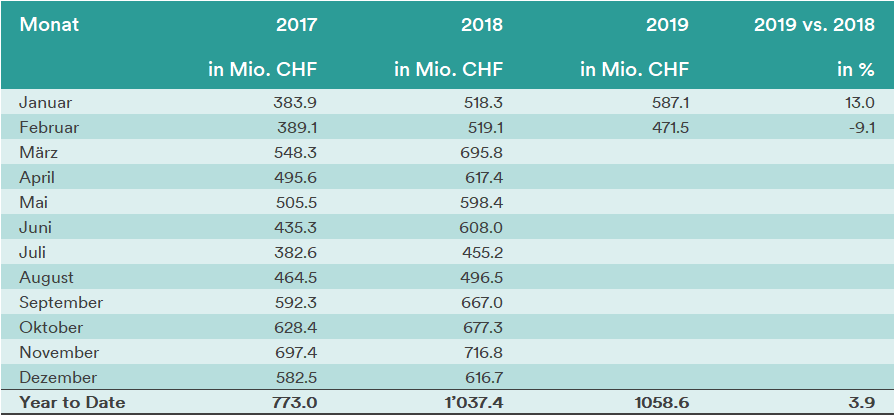
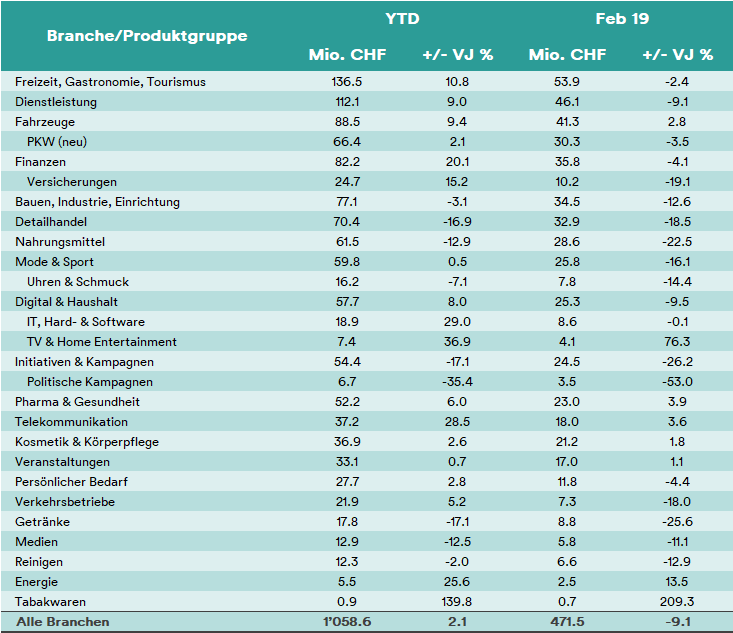
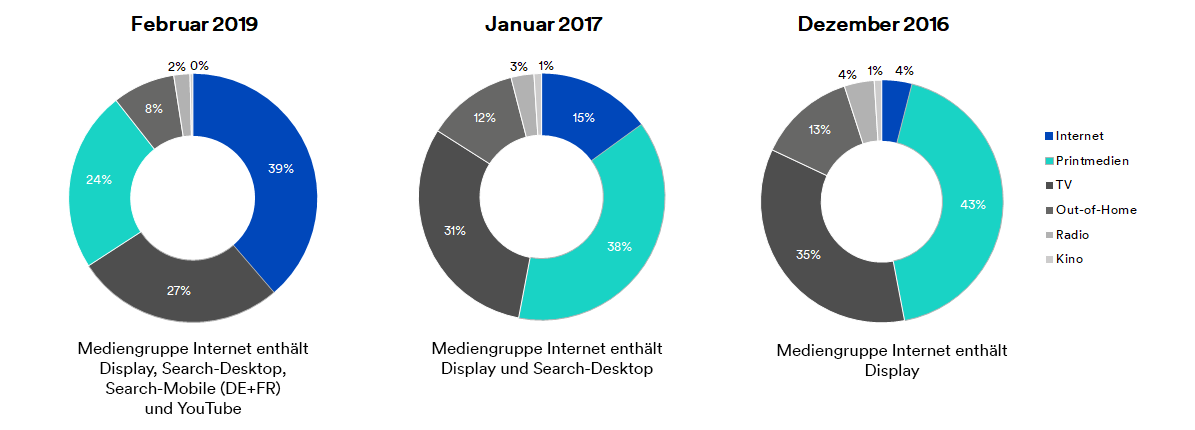
The trend is similar in Switzerland: TV advertising remains stable despite a downward trend in daily viewing time, while out-of-home and online advertising is on the rise and the share of print is declining. In contrast to the global advertising market, print media still have a very significant market position in Switzerland (30% in 2018), but a downward trend is also clearly visible in this country.
"Brands with more than a niche market share still need interruptive advertising at scale to attract new customers," said Ben Lukawski, Global Head of Strategy at Zenith. "With more and more communication taking place online, the challenge for brands is to increase awareness through frequent short contacts, rather than the occasional but longer contacts that are common with traditional media."