The Clientis banks commissioned the Berne-based Casalini agency to launch the new marketing measures for young customers. Together, they developed a cross-group youth marketing strategy that focuses on the individuality of the target group.
Editorial
-
February 14, 2022
"Mix your bank the way you need it" is the slogan of the new youth marketing of the Clientis banks. With its new "myMix" product, Clientis aims to offer young customers a custom-fit solution for their banking with personal advice and position itself as a trusted contact for financial issues.
The focus is on the individuality of the target group and thus on the selection of banking services that people really need. In doing so, Clientis deliberately avoids prefabricated overall packages.
At the heart of the product are advisory meetings with the myMix check. Together with the customer, a consultation is held to define which banking products ideally meet the customer's current needs.
Campaign with a digital focus
From mid-February, the communication campaign will be launched with a focus on digital channels: News and ads will appear on Facebook, Instagram, Google, YouTube, Snapchat and Tiktok. This will be supplemented by an influencer campaign and a billboard campaign starting in mid-March.
The Instagram and Facebook accounts will be filled with contests, interesting topics and stories throughout the campaign period and beyond. The financial needs of young people are described with Stories: While traveling, in education, or exploring the world with friends. Potential customers are also contacted by mail with a new customer mailing.
The aim of the campaign is to inform existing and new customers about myMix and its contents and to invite them to a consultation with a myMix check. New customers also receive an opening gift and myMix goodies.
Responsible at Clientis: Lars Geiser (overall responsibility), Iris Keller, Patrick Neuhaus, Nicole Frischknecht (project team). Responsible at Casalini advertising agency: Seline Freiburghaus, Martina Hunziker, Raphael Rumo (Creation; Graphics), Melanie Hählen (Social Media), Ana Guggisberg (Text), Anna Barbara Schär, Felix Zulauf (Consulting/Concept).
Yes campaign on tobacco advertising ban originates from Feinheit
Like the successful campaign for the care initiative, Feinheit designed the popular initiative "Children without Tobacco", which was adopted on Sunday. In addition, the agency was involved in the basic concept of the equally successful No campaign on stamp duty.
Editorial
-
February 14, 2022
The majority of smokers start using tobacco as minors. Numerous studies show that tobacco advertising contributes massively to the initiation of smoking among children and adolescents. This is why a broad alliance consisting of the entire medical profession, major health organizations such as the Cancer League and Lung League, sports and youth associations, and numerous other organizations launched the "Children without Tobacco" initiative. The goal: to ban tobacco advertising wherever it reaches children and young people.
Visual moves problem to the center
The basic concept of the campaign quickly showed that the initiative had the better arguments on its side. Feinheit was therefore faced with the challenge of giving these arguments sufficient visibility against a million-dollar campaign co-financed by the tobacco lobby.
In the main visual, for example, Feinheit focused on the core emotional problem: too many children and young people in Switzerland smoke occasionally or even regularly - namely around a quarter of 17-year-olds and around 15 percent of 15-year-olds.
With commitment against a campaign of millions
The great strength of the Yes campaign was the commitment of the sponsors and the numerous supporters from all political camps, the health sector and sports. An important goal of the campaign was therefore to enable this commitment and make it visible.
Led by a broad-based national committee with representatives from politics and society, almost 20 cantonal committees did a lot of educational work and distributed hundreds of thousands of flyers.
On the Campaign website well over 1,000 individual messages were created and distributed in person as well as via the campaign's social media channels on Twitter, Facebook and Instagram. In addition, thousands of pharmacies, drugstores, doctors' offices and business outlets were supplied with campaign material.
The challenge of a majority of the cantons
Right from the start, it was clear that the initiative could reach the critical point where, despite a popular vote, it was in danger of failing by a narrow margin. Accordingly, Feinheit focused on the hurdle of the majority of the cantons right from the start: from analysis, through the use of resources and media planning, to online marketing.
Successful referendum on tax policy
Feinheit also contributed to the No vote in the stamp tax referendum - albeit a significantly smaller part. In June 2021, the agency was commissioned by the Swiss Social Democratic Party to develop the visuals and content for the referendum phase.
The concept was deliberately based on the successful tax policy referenda of recent years (USR III, child deductions). On the one hand, to create a substantive link between these proposals, in which a wealthy minority would always have been favored at the expense of the general public. On the other hand, to break down the complex matter of stamp duty in an understandable way. Both efforts succeeded, as the successful collection of signatures and the 62.7 percent "no" vote show.
"Good political communication refrains from mood-mongering".
The explanatory video on the abolition of the emissions levy, which Festland created with the Swiss Bankers Association SwissBanking, is an unusual detour into the political arena for the agency. Marco Casile and Othmar Geser talk about the how and why in an interview.
Editorial
-
February 14, 2022
In this interview, creative Othmar Geser (left) and strategist Marco Casile from Zurich-based agency Festland talk about Swiss Banking's explanatory video for the vote on stamp duty.
m&k Werbewoche.ch: As a rule, Mainland does not do political communication. Why this exception?
Maro Casile: There are two reasons for this. SwissBanking is a client of ours, and we found the opportunity exciting to expand on the concept we created together for explanatory videos. But the decisive factor was that we came to the conclusion in the briefing that it's about a positive, non-polarizing form of political communication. Regardless of how each of us feels about the template.
How did the idea for the explainer video come about?
Casile: To illustrate such a complex topic, a simple frame story is needed. The idea of comparing stamp duty with a ballast bag in aviation proved to be the best solution. The analogy is apt in terms of content and visually inspiring.
Othmar Geser: This was also evident when creating the mood board, where quite a few creative options for images and scenes emerged. Once again, the art of clarity consisted in omission.
Festland has already created many explainer videos. What is special about this production?
Geser: In a particularly vivid film style. Together with the specialists from I/O FX, the key scenes were developed in 3D design, thus adding a dimension to the existing concept - literally. The explanatory facts, on the other hand, are designed as graphic info animations, such as those familiar from SRF explanatory films.
What does it take to turn a good idea into a good explainer video?
Geser: It starts with the story idea, but it's also about finding the right balance between frame story and explanation part in the script. One of the most important things for me is attention to detail, at every stage of creation and at all levels of production: text, image, animation, sound, right down to the short clips for social media. For us, it's a well-rehearsed process, with clear milestones for client feedback and approval.
What characterizes good political communication?
Casile: That it refrains from mood-mongering and conveys arguments openly, with facts that are concrete and verifiable. We also believe that a wink of the eye is more effective than a raised admonishing finger. The result is communication that is, of course, biased, but faces up to the criticism of the other side, and thus contributes to the democratic formation of opinion.
Will you encounter Mainland more often in politics now?
Casile: We look at that on a case-by-case basis. What happens in our Manifestland is particularly true here, however: We'd rather say "No" than "Yes, but."
Atoll shows that Leonteq has full control
Atoll has realized a film for Leonteq. In the TV spot for the Italian market, an astronaut is supposed to symbolize the potential of the trading platform.
Editorial
-
February 14, 2022
Leonteq is a global financial specialist headquartered in Zurich. Its core business is the production and distribution of structured investment products, and since the end of 2020 the company has had a branch in Milan. The continued demand for structured products in Italy drove the decision to intensify brand work in the market there.
To this end, the Zurich agency Atoll developed a TV spot that stylistically makes the reference to the technological in the brand's DNA, but even more illustrates the possibilities of modern financial instruments. An astronaut floats through space with his jetpack. The scene is meant to symbolize total limitlessness and at the same time the control it takes to get where you want to go. Leonteq's in-house online marketplace offers more than 40,000 structured products from a wide range of asset classes, as well as various features for their management.
The media strategy focuses on TV: the spots are used in the context of high-scoring news, sports, finance and political formats on the top 5 stations.
Linear television continues to play a central role in the Italian media landscape. At around five hours, daily consumption is more than double the figure for Switzerland and rose further with the Covid pandemic; also in the target group of wealthy middle-aged private investors.
Responsible at Leonteq Securities: Katja Karpf (Marketing & Communications Specialist), Dominik Ruggli (Head of Investor Relations, Communications & Marketing). Responsible at Atoll: Axel Eckstein, Alexander Kranz-Mars. Film production: Boutiq Films. Recording studio: Bloop Sound and Music. Media agency: Publieurope.
RTL wants to sell Croatia business
RTL Group plans to divest its Croatian operations. RTL Croatia is set to be sold to the media company Central European Media Enterprises (CME) for 50 million euros, the company announced on Monday.
Editorial
-
February 14, 2022
CME is already active in Central and Eastern European countries and has TV stations there. RTL Group was the majority shareholder from the launch of RTL Croatia in 2004 and has been the sole owner since summer 2015. The Croatia business includes eight TV channels, digital offerings and a music label.
Sale to be completed in the 2nd quarter
RTL shareholders are to benefit from the proceeds of the sale, the company added. In addition, the Group will receive payments from CME through a long-term brand licensing agreement. If the respective regulatory authorities approve the deal, the Group expects the sale to close in the second quarter of this year.
RTL Group has been reviewing its business in European countries for some time. The goal is also to ensure that media companies that are strong in the respective countries can keep up with international streaming competition locally. RTL is choosing different ways to do this.
Further measures planned
The Group has a lot planned for 2022: The RTL Deutschland division and the magazines of Hamburg-based publisher Gruner + Jahr - both part of Bertelsmann's portfolio - were merged at the start of the new year. By the end of the first half of the year, RTL Nederland is to merge with John de Mol's media company Talpa Network. Furthermore, the Belgian business is to be sold for €250 million by the end of the year, and the French private channels TF1 and M6 are to be merged. In the case of the latter, RTL Group would become the second-largest shareholder in the new group, with around 16 percent. (SDA)
Blue Entertainment extends marketing agreement with Ringier Advertising
Blue Entertainment will continue to have Ringier Advertising exclusively market the inventory of the Blue News portal through the end of 2025.
Editorial
-
February 14, 2022
Since 2016, the marketing of Blue News' digital inventory has been in the hands of Ringier Advertising. "Blue News is an innovative and strong brand with great reach throughout Switzerland. We are proud and have great fun to continue to exclusively market this great brand together with the Blue News team. We are extremely pleased about the contract extension and the trust placed in us by Blue Entertainment AG," says Thomas Passen, Managing Director of Ringier Advertising.
"Especially in these challenging times, Ringier Advertising's high flexibility and innovative approaches suited us very well," adds Wolfgang Elsässer, CEO of Blue Entertainment. "We are now expressing our satisfaction by extending the marketing contract."
Newspapers look ahead after losing vote
The rejection of additional media funding has been met with mixed reactions in Swiss daily newspapers. While the major publishers felt there was a lack of passion, medium-sized and smaller newspapers are facing an uncertain future.
Editorial
-
February 14, 2022
Newspapers in German-speaking Switzerland are rather sober in their comments on the outcome of the referendum on media subsidies. Passionate debates about the cohesion of the country were absent this time, says the Tages-Anzeiger fixed.
The arguments as to why the fourth estate in the state was in urgent need of support were not convincing. It remains to be clarified whether the rejection is the result of a deeper dissatisfaction with the Swiss media or not.
Questionable in terms of regulatory policy
There is a sigh of relief at the New Zurich Newspaper to feel. It was good that the majority of the electorate had said no to the media package. The bill was more than questionable in terms of regulatory and government policy. Parliament had overloaded the cart.
It is possible that the rejection of additional financial aid is also a reaction to the reporting in the Corona period. The credibility of the media has been put to the test in the last two years. The closeness to the state has shaken trust.
Of a different opinion is the View. The rejection of the media law was clear, but not a vote of no confidence. The pandemic had shown that most people sought information from the established media during the crisis.
Demand for ancillary copyright
In fact, the media are not suffering from the fact that they are losing readers and viewers, but rather that advertising is flowing to Google, Facebook and others. Now more than ever, the Swiss media are calling for a performance protection law.
The Schaffhausen News already see a silver lining on the horizon. The opponents of the media package had always been uncontroversial about extending the support contributions in delivery for small and medium-sized publishers.
The newspapers hardly mention the Röstigraben, which is evident, for example, in the voting results in the cantons of Valais and Fribourg. While the German-speaking minority in these cantons voted against the additional media subsidy, the French-speaking part voted in favor of the package.
French-speaking Swiss newspapers see gap
The vote on the media law shows once again that the electorate dislikes packages that are too big, writes the Westschweizer daily Le Temps. The Federal Council and Parliament must listen better in the future, otherwise the gap between the elected representatives and the population will become even wider.
The newspaper 24 Heures looks ahead and holds that in the near future, the press would have to get by without new financial resources in order to distribute the good old newspaper to mailboxes at a reasonable price - in the city as well as in the countryside, and with rising paper prices. With or without help, the editorial offices would continue to inform with passion and independence. (SDA)
Voters disagree with package for media promotion
There is no additional financial support from the federal government for private media in Switzerland. Voters rejected the media subsidy bill, especially in German-speaking Switzerland. In French-speaking Switzerland, on the other hand, the 'yes' vote prevailed.
Editorial
-
February 13, 2022
Federal Councillor Simonetta Sommaruga assumes that the bill was probably too overloaded. (Screenshot: Srf.ch)
The No vote on Sunday was just under 55 percent. Around 1,303,200 voters cast a "no" vote and around 1,085,200 a "yes" vote. If French-speaking Switzerland had had its way, the additional media subsidy would have been clearly accepted.
The canton of Ticino, on the other hand, was clearly in the "no" camp. Graubünden - where Italian- and Romansh-speaking areas said yes - and the bilingual cantons of Berne and Valais also voted against. The rejection was concentrated in German-speaking Switzerland, where only Basel-Stadt and Uri accepted the proposal.
No money for online media
Media houses would have received additional support of up to CHF 151 million a year, directly and indirectly. The money for this would have come from the federal treasury and the radio and television levy.
After the No vote, the current indirect subsidies for the printed press will remain in place. The federal government will continue to spend 50 million Swiss francs a year on delivery discounts for subscribed daily newspapers, magazines and association and club publications. These funds will not be increased to 120 million Swiss francs.
Online media with paid offerings will not receive any direct subsidies. Nor will the share for private radio and TV stations from the reception fee be increased.
Finally, the additional support for the media system from reception fees also failed. It should have been up to 23 million francs more than the current 5 million francs, including for training and continuing education, news agencies such as Keystone-SDA, media IT projects and the Press Council.
"Market-distorting state intervention" rejected
With their decision, the voters rejected market-distorting state intervention in the media industry and called for a critical distance between the media and the state and politics. This was written by the association "No to state-funded media" led by former St. Gallen FDP National Councilor Peter Weigelt.
The FDP wrote that the media industry, like any other industry, must be able to sell its products. The SVP sees the No vote as a rejection of "government-compliant left-wing uniformity". The association is making demands for a new approach to media funding: For example, only small media that are not owned by media groups should be supported.
The supporters do not want to leave independent journalism to market forces. The civil society committee "Yes to Media Diversity" now sees the ball in Parliament's court, as President Camille Roseau said when asked.
Pleas for a new start-up
In addition to rapid implementation of the undisputed points of the package, Roseau called in particular for contemporary support for online media. Here, the current situation rather corresponds to the situation of the 20th century.
The SP, the Greens, the center party and the unions also pleaded for a new attempt. For the Yes committee and also for the Swiss Media Publishers Association VSM, the financing difficulties of the domestic titles remain unresolved.
Federal Councillor Simonetta Sommaruga commented on the "no" vote by saying that the bill was out of balance and had failed to convince the population, adding that the package, which had been increased by around twice as much as the Federal Council's bill, was "probably too much" for the population.
It is too early, Sommaruga said on the question of whether controversial parts of the package should not be reopened. "When I see the reactions to the referendum result, we would do well to analyze them first," she said. The people's decision should be accepted, she said.
Media remain on the political agenda
The media remain a topic for politics anyway, for example in connection with ancillary copyright. As more and more advertising money is flowing to Internet companies, the Federal Council is having the Justice Department examine how a bill to protect journalistic publications could be structured.
Online groups should have to pay Swiss media a levy for distributing their journalistic content. According to Sommaruga, a consultation draft could be ready by the end of the year. But the implementation of the proposal needs time.
The reception fee could also come up again after 2018 - when the "No Billag" initiative was rejected. SVP National Councilor Gregor Rutz (ZH) told Swiss radio SRF, when asked about a new attack on the Swiss radio and television company SRG, that a non-partisan committee was working on a new initiative on reception fees. (SDA)
Tobacco advertising: advertising industry and SGV call for implementation with a sense of proportion
The “yes” vote on the tobacco advertising ban represents a huge step forward in the fight against nicotine addiction in Switzerland. That’s what the supporters said after the initiative to ban tobacco advertising passed on Sunday. Opponents are warning against further advertising bans on consumer goods that are considered unhealthy but are legal.
Editorial
-
February 13, 2022
The vote restores the balance between an overpowering tobacco lobby with huge resources and powerless parents, Grégoire Vittoz, the director of Addiction Switzerland told French-speaking Swiss radio RTS on Sunday.
There are examples from abroad of public health policies that are effective when it comes to tobacco. Switzerland should follow this example, Vittoz continued. The Cancer League said that the yes vote was a step towards ensuring that children would not become the cancer patients of tomorrow.
Like the Cancer League, the Lung League and other organizations, Addiction Switzerland belongs to the sponsors of the initiative "Yes to the protection of children and young people from tobacco advertising".
Victory over tobacco lobby
The SP praised the victory over the tobacco lobby. Parliament must now finally draw up a bill that ensures that children and young people are not tempted to smoke.
On behalf of the pro-committee, Bernese SP National Councilor Flavia Wasserfallen told SRF radio that the counter-proposal, the Tobacco Products Act, was too full of holes. Thus, tobacco advertising would have remained permitted in free media that are popular with young people, as would the sponsoring of festivals.
The Green Liberals announced on Twitter that the protection of children and young people as well as the health of the next generation should be given higher priority than a business model based on addiction. For the EPP, the time has also come to strengthen the protection of young people. Society bears responsibility for young people.
Ban advertising altogether
The Young Greens immediately made a far-reaching demand. Alluding to the campaign of the opponents of the initiative, the young party headlined "and now the Cervelat" and demanded a general ban on advertising for consumer goods. Advertising creates artificial incentives and needs and is thus harmful to society. The result is "insatiable overconsumption.
The Blue Cross also used the "yes" vote to call for more far-reaching steps. It was imperative that parliament improve the Tobacco Products Act. In particular, the organization envisages sanctions for illegal tobacco sales and mandatory identification on the Internet.
In view of the upcoming revision of the tobacco tax law, the organization demanded a tax increase that would make smoking more expensive for young people.
Encroachment on economic freedom
The bourgeois parties and the business associations regretted the result. A ban on advertising a legal product is not compatible with economic freedom, wrote the FDP, echoing the general tenor.
Young people would not be seduced into smoking by advertising, but by peer pressure. The Yes to the initiative would open the door for further advertising bans on products considered health risks: Alcohol, fat, sugar and more.
The SVP saw in the result a further departure of Switzerland from the liberal order and "prohibitionist Switzerland on the advance". It would continue to do everything "to stop the destructive drive of the left-green paternalistic policy". St. Gallen SVP National Councilor Mike Egger of the opponents' committee accused the proponents on SRF radio of having waged a "dirty campaign".
The business umbrella organization Economiesuisse wrote that the vote should not be interpreted as a general rejection of advertising. Under no circumstances was it a precedent for further advertising bans. The Swiss Trade Association saw an entire industry as being patronized.
The advertising industry associations stated that the concerns of the initiative were largely met in the counter-proposal, the Tobacco Products Act. The ban on the sale of tobacco to young people under the age of 18 is provided for there, as is the disappearance of tobacco advertising from public spaces. In addition, tobacco advertising aimed at children and young people is already banned. (SDA)
Reducing returns with behavioral psychology tips
Returns in e-commerce are a problem - for retailers, the environment and customers. According to a study by Elaboratum, even small adjustments can lead to a significant reduction in returns. In his guest article, Philipp Spreer shows that concrete decision-making aids based on behavioral design are needed.
Editorial
-
February 13, 2022
Consumers want to live more sustainably and avoid returns. But at the moment of decision when making a digital purchase, there is a lack of concrete action. There are solutions for this "intention-action gap". With the right impulses, a large number of returns can be avoided.
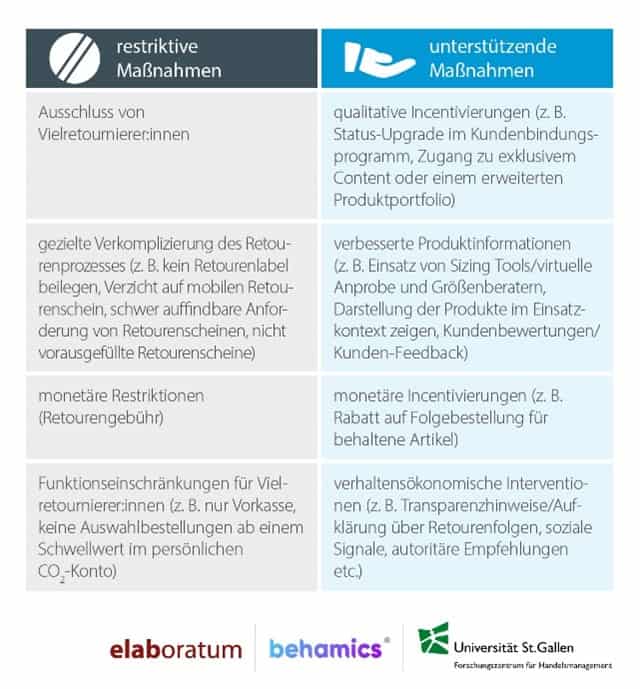
There are two fundamentally different ways for companies to do this: Restriction or support. Restrictive measures include subtle obstacles in the returns process or the exclusion of frequent returners. They make shopping less attractive for customers. Most retailers do not use this approach. There are good reasons for this: Elaboratum's Shopping Frustration Barometer 2021 showed that restrictive measures would lead to abandoned purchases in 53 percent of cases.
Supporting measures to avoid returns
Supporting measures include monetary incentives, improved product information, and behavioral economic interventions such as transparency notices, education on the consequences of returns, and social signals. Behavioral design addresses the behavioral economic interventions that help to avoid returns.
Decision support offered is important
The field of behavioral economics focuses on effectively influencing customer behavior without manipulating customers. The focus is rather on supporting them in a behavior that is advantageous for them and on dispensing with monetary incentives or restrictive measures.
Research has now identified more than 120 intuitive behavior patterns. In the course of behavioral design, effective interventions are used to trigger certain of these behavior patterns and to positively influence behavior in a way that is desired by society as a whole - for example, more conscious consumption, the purchase of more durable products or, precisely, the avoidance of returns. The field experiment showed that even minor changes in communication can lead to significant changes in customer behavior.
Particularly effective interventions
According to the study, there are interventions or behavior patterns that have proven to be particularly effective in preventing returns.
Social normThis intervention communicates that many other customers are already behaving sustainably by avoiding returns. This motivates visitors to do the same.
ReciprocityThe tendency to want to return a favor to the other party. The intervention therefore communicates the favor or the advance performance of the online store in the form of product information and size advice in order to motivate cooperative behavior in return.
Loss AversionLoss aversion describes the fact that people give greater weight to losses than to gains. The presentation of a real time loss of 32 minutes on average due to imprudent ordering - this is how much time customers lose on average due to returns - serves to evoke loss aversion.
Illusion of ControlThe feeling of self-efficacy and control leads to a positive attitude and can thus promote the willingness of visitors to cooperate.
In the study, the shopping cart, the shopping cart confirmation, and the order confirmation were selected as contact points for the interventions. A concrete example: In order to play out the Behavior Pattern social norm, a hint is shown at the shopping cart confirmation, which gives the shoppers concrete hints and sets an impulse in decision-making and active avoidance of returns.
Interventions have three effects:
The rate of returns can be significantly reduced.
More deliberate orders often result in lower conversion rates.
Nevertheless, there is no drop in sales, because customers keep more items as a result of more conscious ordering.
So reducing returns and growing sales are not mutually exclusive - on the contrary.
Dynamic and differentiated
Online retailing is subject to a high degree of dynamism. Therefore, interventions should also be dynamic and differentiated. This is not possible manually. This is where the possibilities of artificial intelligence can help. Algorithms can learn from the most diverse constellations of influencing variables - for example, the click behavior of users - and predict and play out the optimal message in each case.
Deep learning approaches are used to select the appropriate intervention from the pool of behavior patterns and play it out at suitable contact points in the online store. This enables retailers to respond to changes in customer behavior in real time. The tools for this improved analysis and technology-supported automated delivery of the appropriate interventions already exist.
E-commerce should act now
Interventions based on behavioral psychology can lead to significant changes in behavior. This is also a clear recommendation to all e-commerce retailers: The hurdles are not glaringly high, the need on the other hand is. The time to act is now, the means are available. All that is needed now is the necessary courage to implement them.
* Philipp Spreer is Senior Director at Elaboratum Germany.
(Image: Elaboratum)
The e-commerce consultancy Elaboratum conducted a study together with Behamics and the University of St. Gallen. The field experiment with more than 100,000 online shoppers showed that at least 4 percent of returns could be saved each year in Germany - the equivalent of around 16 million parcels.
Brands Are Live implements apps for NMZ radios
The radio stations of Neue Medien Zentralschweiz Sunshine, Central and Eviva have developed three new apps together with Brands Are Live to make life easier for listeners and advertisers and to meet the latest requirements of the future.
Editorial
-
February 11, 2022
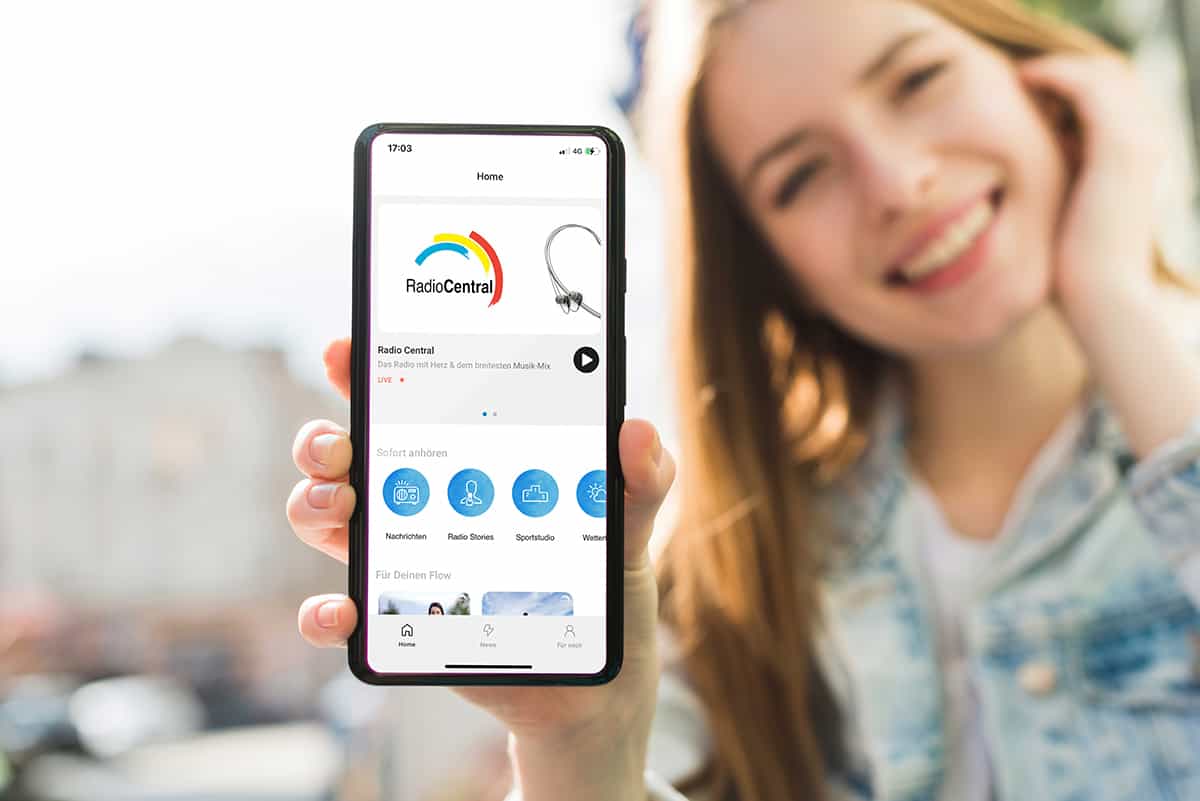
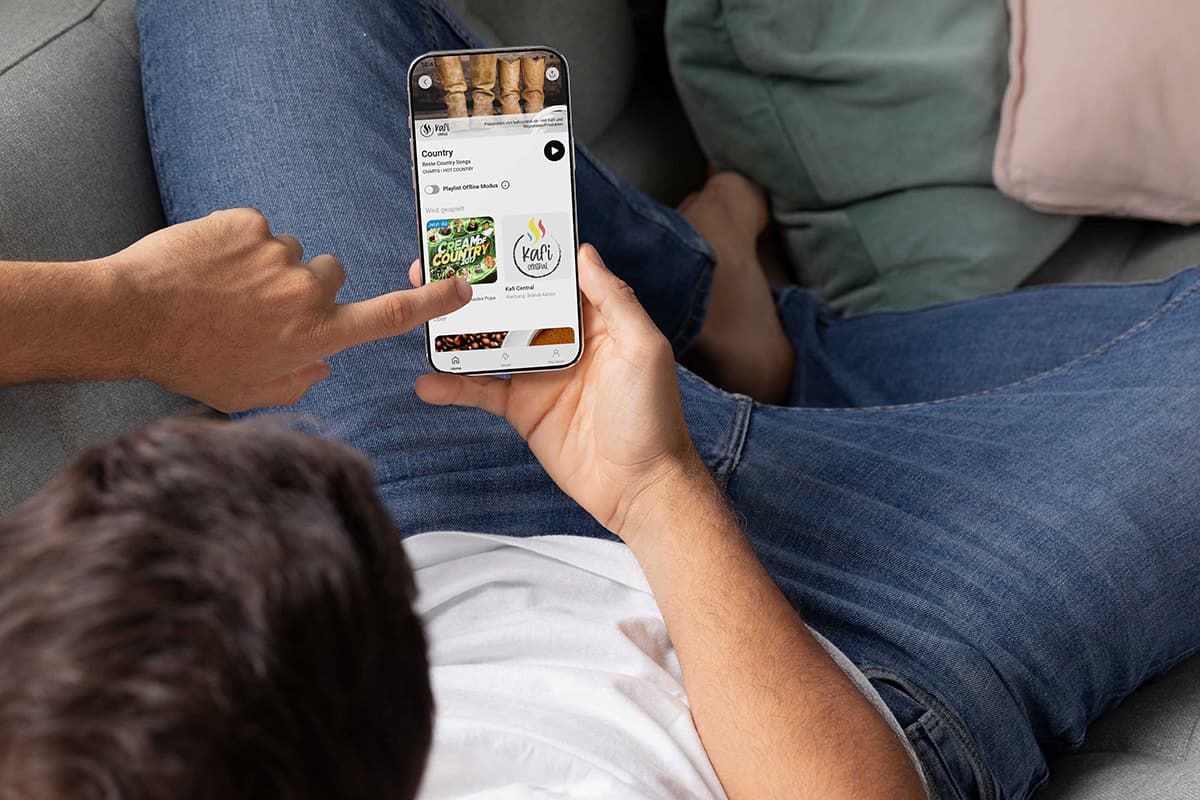
Sunshine Radio, Radio Central and Radio Eviva each have a new radio app. The apps are intended to bring innovation to the Swiss radio market and various added values for users. This would also open up new ways for advertisers to reach and win customers.
According to NMZ, the apps are flexibly customizable and can transform according to the needs of users* and advertisers.
Contests with one-click entries
Contests on the radio are popular, but until now, they required phone numbers or websites that listeners had trouble remembering to enter. On the new apps from Radio Central, Sunshine Radio and Radio Eviva, users can now more conveniently enter contests that are currently running on the radio.
According to NMZ, this will make radio contest participation more effective and interesting - also for advertising customers who want to hold a raffle.
Interactive playlists in on- and offline mode
In addition, the new apps of the respective radios offer various new playlists. There is also a new option to skip music in a radio app. Songs can be skipped up to 6 times per hour. The playlists can now also be listened to offline via download.
In the future, brands, stores and products will be able to sponsor playlists and place their message directly in them. Advertising spots in the playlists will no longer just be audible, but can also be clicked on by users. Playlist sponsors will have their own playlist as well as direct, interactive advertising with links to stores or offers.
Personal Wallet
App users automatically receive their personal wallet when they download the app. Podcasts, radio broadcasts and music tracks can be added to the "personal wallet" with a "Like. There are also coupons and vouchers that give users discounts on selected products, discounts and promotions of all kinds.
For advertisers, this channel offers an opportunity to please users. The additional advertising on the radio could also increase the reach and the customer base.
Effective advertising with pre- and mid-rolls
According to statements by Neue Medien Schweiz, pre-roll spots are becoming increasingly popular in the advertising industry. With pre-rolls, an advertising spot is played first before the radio stream, playlist or podcast.
In the future, it will be possible to display pre-roll spots with a brand or product cover in the apps. Currently, the new app offers the option of linking mid-roll spots to products, landing pages or social media accounts. In the app, these spots can be clicked on by users, which is an advantage for advertisers, NMZ said.
The marketing company of Radio Central, Sunshine Radio and Radio Eviva plans to add further innovations on an ongoing basis. "A 360-degree solution on this scale was only sketched out a few years ago, and many people talked us out of it as sheer impossibility," explains program director and CEO Roman Spirig. "But in 2022, it's here because a team and an extremely innovative partner believed in it unceasingly. A very special day for us, as well as for the radio industry."
The apps can be downloaded for Android from the Google Play Store and for iOS devices from the App Store.
Aldi Suisse participates in "Fairbruary" campaign
The retailer Aldi Suisse is participating in the Fairtrade Max Havelaar campaign. «Fairbruary» is intended to highlight the retailer’s own values in the area of sustainability and to send a message calling for greater fairness.
Editorial
-
February 11, 2022
The Fairtrade Max Havelaar Foundation calls in the Fairbruary to live fairly for a month and give preference to fairly produced products. The term "Fairbruary" is a portmanteau of "fair" and "february. The campaign is supported by various influencers and companies.
Celebrities such as Anna Rossinelli, Beni Huggel, Meta Hiltebrand and Tanja LaCroix have also taken up the challenge and are living as best they can on Fairtrade products in February.
Alongside other retailers such as Coop, Migros and Lidl, Aldi Suisse is also taking part in the campaign. Under the motto "That's fair," the aim is to show that Aldi Suisse understands and lives fairness.
Throughout February, the retailer is promoting fairness across the board in its own flyer, OOH as well as LED billboards, analog and digital owned media channels, and in magazines and newspapers.
In doing so, Aldi Suisse itself wants to set a good example and show that the company is fair in various areas - in the prices of Fairtrade products, as an employer, as a partner for producers, and also as a supporter of various charitable organizations and projects.


 "Mix your bank the way you need it" is the slogan of the new youth marketing of the Clientis banks. With its new "myMix" product, Clientis aims to offer young customers a custom-fit solution for their banking with personal advice and position itself as a trusted contact for financial issues.




 Newspapers in German-speaking Switzerland are rather sober in their comments on the outcome of the referendum on media subsidies. Passionate debates about the cohesion of the country were absent this time, says the Tages-Anzeiger fixed.


 Consumers want to live more sustainably and avoid returns. But at the moment of decision when making a digital purchase, there is a lack of concrete action. There are solutions for this "intention-action gap". With the right impulses, a large number of returns can be avoided.

 Sunshine Radio, Radio Central and Radio Eviva each have a new radio app. The apps are intended to bring innovation to the Swiss radio market and various added values for users. This would also open up new ways for advertisers to reach and win customers.