Press Council reprimands Observer: affected parties not taken into account

The Press Council has reprimanded the magazine *Beobachter* for making serious allegations against a former managing director based solely on information from an insider. In such cases, sources must be verified and the accused must be given an opportunity to be heard.

Presserat
(Screenshot: Beobachter.ch)

The Press Council rejected a corresponding complaint against the Observer partially well, as he announced on Friday. The magazine had claimed in April, first online and then in the printed edition, that the Berner Heimatwerk had run into difficulties because a former managing director had evaded money. This had resulted in eleven dismissals and the liquidation of the cooperative. The only source is an insider.

That is not enough, according to the Press Council. The seriousness of the accusation would have necessitated a hearing, even if the accused was not immediately identifiable to a wide audience.

In addition, the woman had Observer After the first publication, it was pointed out that the evaded sum - if there had been any evasion at all - would not have resulted in the closure of a store and that the alleged liquidation had not taken place at all.

The editorial team should have checked this before publishing in print. In doing so, the editorial team had violated the journalists' code of conduct with regard to the search for truth, source work and the duty to listen. (SDA)

IAB Switzerland postpones DEX until fall 2021

There are no signs of improvement in the situation regarding live events for the time being. For this reason, IAB Switzerland has decided to postpone its DEX20 conference until fall 2021.

IAB Switzerland

Since the Digital Experience Conference - in addition to presentations on the main stage - lives from many small formats such as the master classes or the workshops, but also from personal exchange, the concept is not feasible due to the current situation, as the organizers wrote in a statement on Friday.

Therefore, the implementation will be scheduled only in the fall of 2021. By then, the situation with regard to major events should have improved.

GFK: Technical consumer goods defy difficult economic climate

The market for technical consumer goods (TCG) has experienced turbulent weeks and months. Nevertheless, Growth from Knowledge (GfK) forecasts that the global TCG market will continue to generate strong sales in 2020 and remain at last year’s level despite the current situation. Growth was driven primarily by consumers« strong focus on »home” and their desire for greater digitalization of their personal living environments.

GFK

"We expect the market to continue to recover. For the last quarter of 2020, there are several indicators that point to a stable scenario for the crucial season at the end of the year," explains Luca Giuriato, GfK expert for the TCG sector. "However, market volatility will not disappear, as there have been and, in our view, will continue to be significant changes in terms of consumer demand. Sustained growth in e-commerce, in particular, will accelerate such a trend reversal. Retailers and manufacturers are now being asked to take the omnichannel experience to a new level and offer consumers what they are currently demanding."


From "want to have" to "really need"

Covid-19 had a big impact on the global TCG market. Even if it's not entirely obvious with "growth" of 0 percent compared to 2019, market volatility has never been as strong as it is this year. Proof of this is the expected 6 percent decline in the telecom/smartphone market. This market accounts for 40 percent of total TCG revenue. By contrast, the IT/office business is developing positively and is expected to grow by 15 percent.

Here, a fundamental shift occurred in the market: the "I would like" IT/office equipment became the "I need" equipment due to the lockdown and increased work from home. Somewhat later and after initial declines, demand in the small household appliances market also increased after the lockdowns and is expected to see near double-digit growth (+9 percent) in 2020. Consumer electronics (-1 percent) and large household appliances (-2 percent) are also contributing to the good development and are increasingly benefiting from trends such as "Cook@home" and "Entertain@home".


Emerging markets spend less on TCG - Europe invests 

In terms of demand for technical consumer goods, there are clear differences between the various regions of the world: Industrialized countries in particular are coping better with the effects of Covid-19 than emerging economies. For example, consumers in Europe (including the CIS) spend money on technical consumer goods even in times of crisis. Here, a growth rate of 5 percent is expected for 2020 as a whole. In the emerging markets of Asia, on the other hand, a decline of 6 percent is forecast, as consumers have less money to spend due to the difficult economic situation.


Products in the area of health and well-being more in demand

Globally, demand was stronger for products that simplify our daily routine, as well as for products in the health and well-being theme worlds. In times of Covid-19, such product promises are particularly relevant for consumers, as they want to make their time at home as pleasant as possible, but also as efficient as possible. For example, the sales volume of kitchen machines in the period from May to July 2020 doubled compared with the same period last year; dishwashers, after all, increased by 16 percent. Further growth can be expected, at least in the medium term.

The focus on health and well-being has also accelerated sales of air purifiers and humidifiers (+20 percent sales growth from May to July 2020). With hygiene playing an increasingly important role in our daily lives, washing machines with a steam function to kill bacteria and viruses will also continue to sell strongly. These recorded further significant growth of 32 percent from May to July 2020 compared with the same period last year.

GfK regularly collects sales data for the consumer electronics, photographic, telecommunications, information technology, office equipment, large and small electrical appliances segments via its retail panels in more than 70 countries worldwide. All figures assume a fixed euro exchange rate.

Press Council reprimands Tamedia editorial team for misleading quote

The Press Council partially approves a complaint against the Tamedia editorial team. The editorial team had foisted a quote on the mastermind of a coronavirus demonstration in Berlin. However, he had never said this.

 Tamedia-Redaktion

The criticized passage was in a text about Ken Jebsen, who was presented as the mastermind behind the demonstrations against the corona measures in Berlin. This text stated that Jebsen "serves anti-Semitic resentments against the alleged 'Jewish capitalism'".

The term "Jewish capitalism" was placed in quotation marks, although no evidence was presented that Jebsen had ever used it. In a reply to a private individual from Switzerland, Tamedia confirmed that Jebsen did not actually use this term.

Tamedia argued that "Jewish capitalism" was not intended as a quote from Jebsen, but merely as an example of the anti-Semitic resentment Jebsen serves up.


Opinion distorted

In the opinion of the Press Council, the Tamedia editorial team had thus violated the rights and obligations of journalists. Anyone who puts a term that describes a person's way of thinking in quotation marks is attributing that term to that person.

Tamedia had thus distorted the opinion expressed by Jebsen, the Press Council announced on Friday. However, the Press Council sees no problem with the statement that Jebsen's online platform KenFM had called for "barely veiled violence against a TV team from the satirical 'heute-show'" in the run-up to a demonstration. (SDA)

Swiss Heart Foundation and Republica save lives

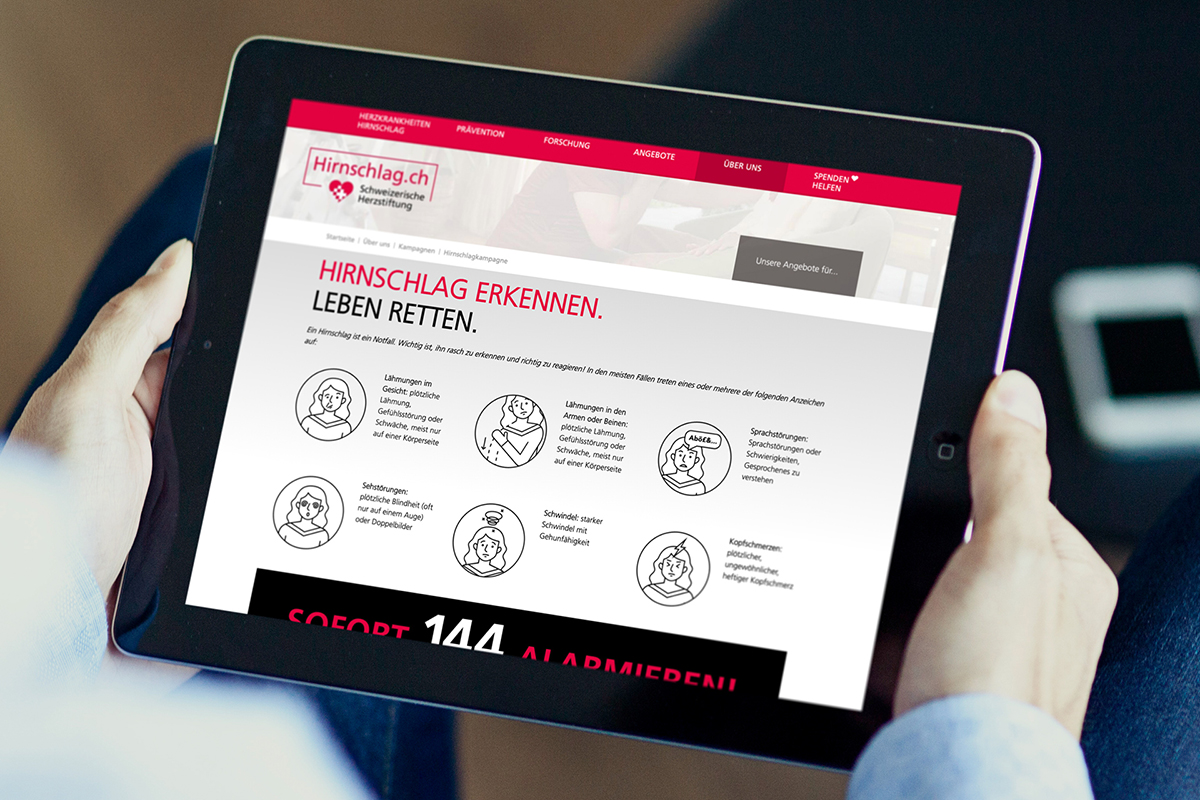
Since 1967, the Swiss Heart Foundation has been working to reduce the number of people suffering from cardiovascular disease or suffering a stroke. The Bernese agency Republica has developed a national campaign for them that focuses on the right action to take in the event of a stroke.

Republica

Every 30 minutes, a person in Switzerland suffers a stroke. That is 16,000 people per year. One fifth of those affected die, one third remain disabled. Many deaths or serious consequential damage could be avoided if more people recognized the symptoms and reacted correctly.

The Swiss Heart Foundation, in collaboration with Republica, has therefore launched the national awareness campaign "Recognize stroke. Save lives." with the aim of making the general population more aware of the symptoms of a stroke and improving the correct response in an emergency.

"We decided on a campaign that informs and sensitizes people through entertaining components and invites them to engage with this difficult topic. At the same time, it should convey the right knowledge clearly and quickly," explains Simon Schatzmann, partner and responsible project manager at Republica.

The campaign consists of two main storylines: On the one hand, an informative spot, which is played out on the relevant online and social media channels as part of a national paid media campaign and highlights the most important signs of a cerebral stroke (paralysis in the face or in the arms or legs, as well as speech disorders) and the correct action (alert 144 immediately).

On the other hand, numerous other digital content measures will come into play by the beginning of December, such as an informative facts and figures animation video or classic media work.

In addition, Republica developed icons that are used in print measures as well as in paid ads and on the landing page Hirnschlag.ch.

Republica

Responsible at the Swiss Heart Foundation: Maja Traber-Watters, Jardena Rotach. Responsible agency: Republica. Production: Elura Films. Direction and camera: Phil & Jones.

TX Group invests in marketplace lending platform Lend

TX Group acquires a stake in the Swiss crowdlending platform Lend.ch. The platform handles loans directly between borrowers and investors, without the intermediate route via a bank.

TX Group

Investors receive an attractive return and borrowers, both private individuals and SMEs, pay comparatively favorable interest rates. The Zurich-based fintech company was founded in 2015 by Florian Kübler and Michel Lalive d'Epinay and now employs 17 people. Borrowers have already applied to Lend for over 1.3 billion Swiss francs in loans. As part of a cooperation, PostFinance also offers its business customers loans via Lend.

In the Series B financing round in the amount of 5.5 million Swiss francs, PostFinance and Alpana Ventures, the existing Geneva-based venture capital fund, have invested in the Marketplace Lending platform in addition to TX Group as lead investor.

Samuel Hügli, Head Technology & Ventures and member of the Group Executive Board of TX Group and new member of the Lend Board of Directors: "Startups like Lend can draw on our expertise in technology, data analytics, marketing, product and business development to accelerate their growth. They also benefit from the high reach of our media and platforms, as we reach over 80 percent of the Swiss population every day."
 

These are the top 5 commercials on YouTube in the third quarter

The "YouTube Ads Leaderboard Switzerland Q3 2020" shows the top 5 advertising videos on YouTube in Switzerland from July to September 2020. Roger Federer is No. 1 - Digitec Galaxus dominates.

lindt

To determine the top 5, YouTube measured the number of views on YouTube advertising videos from Switzerland in Q3 2020. For the ranking, only videos that could show a minimum share of unpaid views were considered. Every quarter, Google publishes those YouTube advertising videos that are particularly popular with YouTube viewers. The ad ranking is determined by an algorithm that takes into account paid and organic views as well as viewer engagement.

In the third quarter of 2020, the top 5 are as follows:

1st Lindt Chocolate World - Lindt Home of Chocolate | The Grand Opening with Roger Federer

2. galaxus - A cappuccino in bed - galaxus tv spot

3rd Galaxus - The early bird catches the worm - Galaxus TV commercial

4. digitec - POV Roomba

5. Digitec - POV Navigation

What retailers and brands can expect from the upcoming Christmas business

In the wake of the COVID-19 pandemic, consumer shopping behavior has changed, and despite the gradual lifting of restrictions, the retail sector will continue to feel the effects of the pandemic through the end of the year. Bazaarvoice has examined what retailers should be preparing for as they plan for the upcoming holiday shopping season.

Weihnachtsgeschäft

The survey polled 5,000 consumers worldwide, including 1,000 from Germany. Bazaarvoice also analyzed data from its network.


UGC is crucial for the search for gifts

Half of consumers surveyed worldwide (49%) plan to buy Christmas gifts online more frequently than before the pandemic, with this figure standing at 32% in Germany. Price (37%) and price performance (20%) will be the most important factors for German consumers when it comes to Christmas shopping this year, although 27% admit that their planned spending has been affected by the Covid-19 pandemic.

According to the survey, 48 percent of consumers worldwide say that the chances of purchasing a product increase when companies respond to online reviews. "It is therefore important that retailers and brands consider their UGC strategy for the festive season in good time, as consumers rely on this information to make purchasing decisions. UGC is booming in times of lockdown and social distancing, but a similar trend was already evident last year in the run-up to Christmas. October 2019 alone recorded almost five percent more user-generated content compared to an average month. An even stronger increase in UGC is expected this year. This information is increasingly influencing customers' purchasing decisions," explains Tobias Stelzer, Head of Sales Central Europe at Bazaarvoice.


Amazon faces competition from social media

Amazon will once again be the first port of call for consumers this winter season. More than half of Germans (57%) use the platform as a starting point for their gift search and almost three quarters (71%) plan to buy from the world's largest online retailer. Among 18 to 24-year-olds, however, Amazon is increasingly facing competition from social networks: The marketplace is still the most important source of inspiration, but Instagram is already in second place among the young target group with 48 percent, followed by Pinterest (23 percent) and TikTok (20 percent) Overall, Facebook (20 percent) remains the most influential social media platform when it comes to buying gifts, followed by Instagram (17 percent) and Pinterest (13 percent).


The online boom, Prime Day and the Christmas business

With each month of lockdown, the Bazaarvoice network, which includes over 6,200 manufacturer and retailer websites, has seen a significant increase in page views and orders. In fact, 85 percent of retailers surveyed from the network believe that online sales in the 2020 holiday season will be higher than the previous year and 61 percent expect higher engagement via social networks.

This year's Prime Day takes place on October 13 and 14 and will herald the start of the Christmas season not only for Amazon, but also for all other companies. After all, 70% of Amazon customers bought at least one Christmas gift on Prime Day last year. According to data from the Bazaarvoice network, 27% more orders were placed outside of Amazon on July 15, 2019 than on an average day. And with consumers likely to be looking for more bargains this year, this date is all the more important.

"There is no doubt that this Christmas will be like no other, with more online shopping than ever before," adds Tobias Stelzer. "Retailers need to provide customers with quick answers to their questions through FAQs, customer reviews and responses from retailers. The effects are clear: we see that FAQs on product pages lead to an increase in sales of 120% per visitor and that customer reviews even lead to an increase of 159%. Amazon has become even more prominent during the pandemic and this scale gives the platform an almost unbeatable advantage. But where brands and retailers can win is in providing a better customer experience and tailored information. Younger generations identify more strongly with brands than older generations and use social media at every touchpoint. To differentiate themselves from Amazon, brands and retailers should therefore increasingly rely on social media to create an optimal shopping experience."

Protective film of UFA-Revue new with 70 percent recycled content

UFA-Revue now uses a protective film made from at least 70 percent recycled material. As a result, the agricultural trade journal saves 1.54 metric tons of virgin plastic annually.

UR-70-%-Recyclingfolie

Thomas Keller, Managing Director of pmc AG (left) and Markus Röösli, Editorial and Publishing Director of UFA-Revue (right), present the October issue of UFA-Revue, packaged in foil with 70 percent recycled content. (Image: Hans Weber)


Those responsible for UFA-Revue together with the printing company PMC, a company of the Schellenberg Group, have found a more ecological variant for the packaging. Starting with the latest October issue, the protective film of UFA-Revue has a recycled content of at least 70 percent. With this step, the trade magazine is one of the first print titles in Switzerland with such a high proportion of recycled plastic. The monthly title, which has a circulation of over 72,000 copies, saves around 1.54 tons of virgin plastic per year, which corresponds to a saving of almost five tons of CO2.


Recycled plastic improves the eco-balance

Recycling plastic is generally more environmentally friendly and less raw materials such as petroleum are consumed. This conserves natural resources and helps save CO2. Packaging expert Roland Hischier from the Swiss Federal Laboratories for Materials Testing and Research (Empa) in St. Gallen confirms this: "The higher the recycled content of plastic packaging, the better the eco-balance. Paper envelopes are not an alternative, because their eco-balance is clearly worse due to their significantly higher weight.

Protective film therefore remains the number one method for securely mailing magazines in terms of handling and environmental footprint. And with the waste film content of 70 percent, even more so. "The topic of sustainability is central to agriculture and therefore also important editorially," says Markus Röösli, publishing and editorial director of UFA-Revue. "By increasing the recycled content of the protective film, we are now not merely reporting on sustainable topics, but are making an active contribution to conserving resources," Röösli continues. In addition, the film is 100 percent recyclable and can thus be returned to the plastic cycle.


Great demand for sustainable packaging solutions

The new type of protective film was introduced in cooperation with the PMC print shop. Thomas Keller, Managing Director of the print shop, notices a general rethinking among customers. The desire for more sustainable solutions is increasingly an issue, he says. "After the go-ahead with UFA-Revue, we will completely switch our foil stock to ECO recycled foil with 70 percent recycled waste foil and thus use this foil as standard." In total, this will save the print shop up to 50 tons of new plastic, which equates to a saving of up to 160 tons of CO2.

Publicis for UBS: Doing good does good

UBS is launching UBS Helpetica, a platform for connecting people with volunteer opportunities. Publicis is responsible for the campaign, naming, and branding.

UBS

UBS is a long-standing "corporate volunteering" player in Switzerland. The bank introduced employee volunteering in Switzerland over 15 years ago. Now UBS is going a step further and bringing volunteers and non-profit organizations together so that they can implement sustainable projects together: With UBS Helpetica, the big bank is launching an intermediary platform that allows committed people to actively help with various sustainability projects in the areas of environment, education, social affairs and entrepreneurship.

In addition, private individuals can also submit their own sustainability ideas and find suitable implementation partners or helpers for their project. "Sustainability is becoming increasingly important for people in Switzerland. Many want to get personally involved, but not all know how and where they can best get involved - with UBS Helpetica, we want to change that," says Sonja Kingsley-Curry, Strategic Initiatives & Brand Management at UBS Switzerland, explaining the idea behind the initiative.


Doing what is good

Publicis is responsible for branding, naming and the associated campaign. The aim of the campaign is to get as many people as possible excited about volunteering. After all, those who do something for the common good also do something for themselves. This is also made clear in the campaign films, in which the protagonists are rewarded for their efforts with a good feeling, improved stamina, or simply a deep sleep.

The four films have been used in various online formats since mid-October, flanked by print, POS, DOOH and social media implementations.

UBS

Responsible at UBS: Daniel Fischer (Head of Marketing Region Switzerland), Sonja Kingsley-Curry (Head of Strategic Initiatives & Brand Management), Rita Vozarova (Strategic Initiatives & Brand Management). Responsible at Publicis: Sascha Fanetti, Jan Kempter (Creative Direction), Yannick Schaller (Text), Nina Martens (Art Direction), Nina Nesnidal, Simon Häusler, Jonas Koutrios (Graphics), Mark Becher (Strategy), Angelos Apostolidis, Judith Schnigula (Consulting), Urs Hirschi (Managing Director), Suzana Kovacevic (Integrated Producer), Thomas Wildberger (CEO). Production: Shining Pictures (film production), Marco Lutz (director), Ralph Bätschmann (DOP), Stefan Bircher (executive producer), Alessandra Dolci (producer), Jingle Jungle (sound studio), Sven Germann (photography), Prodigious Zurich (production partner PrePress).

Bakom comes under fire for faulty Serafe invoices

The Federal Office of Communications (Bakom) underestimated the risks associated with the introduction of the new radio and television license fee. This is the conclusion reached in a report by the Council of States’ Committee on the Examination of Government Affairs (GPK-S).

Bakom

The Bakom had largely fulfilled its supervisory duty in the changeover of the collection of radio and television fees. This is stated in the report published by the GPK-S on Thursday. However, the changeover to the collection per household had been underestimated.

When the new collection agency Serafe sent out the first bills for reception fees at the beginning of 2019, several thousand Swiss households received incorrect fee invoices. Bakom pointed out that the incorrect bills were due to faulty household data from the cantons and municipalities. The municipalities' residents' services and Serafe were then flooded with complaints.

Bakom reacted quickly and declared Serafe the sole point of contact, the report says. In addition, Bakom has been working to reduce the number of false invoices per month since the problems began.


Unclear cost implications

However, the commission regrets that several thousand households still received an incorrect bill each month, the parliamentary services announced on Thursday. Most recently, it was revealed in June this year that 224,000 households received two bills for reception fees in May. The commission said it expects Bakom to review the cooperation between the municipalities and cantons and Serafe and take further improvement measures.

The commission also notes that the costs for the incorrectly sent Serafe invoices are not yet known. The GPK-S therefore demands that the Federal Council now clarify how much this additional expenditure costs and who has to pay for it.

The commission has asked the Federal Council for a statement by January 25, 2021. The Commission reserves the right to reopen the dossier in the event of new incidents and to take action if necessary. (SDA)

Amazon plans new attack on Switzerland

According to the Handelszeitung, e-commerce giant Amazon is planning a major expansion of its offering in Switzerland.

Handelszeitung

This involves the shipment of items from third-party sellers whose products are managed by Amazon itself in the "Fulfillment by Amazon" (FBA) program. Until now, a large number of such items could not be ordered in Switzerland because many of the third-party sellers did not have a customs agreement with Switzerland. "We are in the process of bringing FBA to Switzerland," an Amazon spokesperson confirmed to Handelszeitung, but gave no details on the timing.

According to a report in "Internetworld" magazine, Amazon itself is to collect Swiss customs duties and import VAT from its customers. According to the report, the Amazon export program is to be launched in the coming weeks. This step could massively increase Amazon's range of products in Switzerland, Thomas Lang of e-commerce consulting firm Carpathia tells Handelszeitung: "It's likely to involve an assortment worth millions."

get_footer();