Singles Day still little known in Switzerland, but has a lot of potential

The fact that «Singles Day,» a shopping event, takes place on November 11 is still not widely known in Switzerland. Nevertheless, the discounts are likely to be widely taken advantage of, as a study by Profital shows. This offers retailers an opportunity to boost consumer confidence, which is currently low.

Singles-Day_Profital-Studie_2020-5
Of those who were aware of Singles Day, 35% had already taken advantage of Singles Day discounts in 2019. Among all respondents, only 6% had shopped on Singles Day in 2019. (Source: Profital)

While most people are familiar with Black Friday, Singles Day on November 11 still has to fight for its place in the minds of consumers. 81 percent of the 2,515 Profital users surveyed were not aware of Singles Day. However, Profital Managing Director Raphael Thommen is confident that November 11, 2020 will be a success for retailers: "In terms of awareness, Singles Day still has a lot of room to grow, but we can still expect sales to increase compared to the previous year.


Good reasons to be optimistic

The optimism seems to be justified: 72 percent of Singles Day connoisseurs plan to make purchases. And even among consumers who were previously unaware of Singles Day, the prospect of good deals increases the mood to buy. More than half intend to take advantage of the offers. The younger the respondents, the greater their interest.

Singles-Day_Profital-Studie_2020-6
(Source: Profital)

The fact that most (67%) want to find out about offers in preparation for Singles Day represents an opportunity for retailers. Consumers are particularly interested in deals in fashion, food and electronics. In these product categories, half to around three quarters of respondents want to grab a bargain.


Into the stores for bargains

Contrary to what one might expect based on the current situation, brick-and-mortar retailing remains highly popular. 21 percent of respondents only want to store online, 32 percent only in stores - for almost half, both are an option. "Consumers are particularly hybrid when it comes to bargain hunting, i.e., whether it's the Internet or a brick-and-mortar store is secondary. The good offer is more important," says Raphael Thommen.

Singles-Day_Profital-Studie_2020-7
(Source: Profital)

In individual regions of China, Singles Day has been celebrated on November 11 since the 1990s, symbolizing the uniqueness of singles. The tradition has become increasingly popular thanks to the Internet. Retailers increasingly use the day to run special offers. Singles Day is now said to be the biggest shopping day of the year worldwide - ahead of Black Friday.

For the ProfitalThe study surveyed 2,515 users of the Profital app throughout Switzerland, including 1,681 in German-speaking Switzerland, 570 in French-speaking Switzerland, and 264 in Ticino. The survey took place between October 13 and October 16, 2020.

Media Week introduces patron subscriptions

The trade magazine *Medienwoche* is introducing patron subscriptions. It has also recently expanded its content offerings with the weekly review column «The Good, The Bad, and The Ugly» and the podcast «Das Monokel,» which explores power, ideology, and the media.

MW-Goenner-Abo

Medienwoche is also feeling the effects of the Covid-19 pandemic: the job advertisements business, which previously financed Medienwoche to a large extent, has collapsed. As a result, the magazine has had to significantly reduce its number of articles in the meantime.


Patronage contributions for journalism

In order to support the financing of Medienwoche on a broader and more sustainable basis, the magazine is now introducing patron subscriptions. "We want to continue to cultivate and expand our independent, in-depth media journalism," explains Thomas Paszti, publisher of Medienwoche. "In future, media freedom and media diversity will largely depend on whether the media manage to attract not only an appreciative audience for their services, but also a paying audience."

The income from patron subscriptions flows exclusively into the journalistic work of Medienwoche. Patrons of Medienwoche can choose between three subscription types depending on their financial strength. Medienwoche will continue to function without a paywall, without ad tracking and largely independent of advertising.


Weekly review in column format

To complement its more analytical and in-depth articles with a topical short format, Medienwoche also launched the weekly column "The Good, The Bad & The Ugly" after the summer vacations - a weekly review with commentary on three current events: one good, one bad and one particularly ugly. "The Good, The Bad & The Ugly" is published every Saturday as a newsletter, which also contains the previous week's articles and recommended reading.


New podcast about power, ideology and media

Medienwoche not only regularly reports on podcasts, but also offers contributions for listening. Marko Ković and Christian Caspar produce an episode of their podcast every week "The monocle". In it, the two social scientists examine how power and ideology are reflected in the media and what consequences this has for society and public discourse.

Ringier sells Le Temps to Aventinus Foundation

The French-Swiss newspaper Le Temps will be taken over by private patrons effective early 2021. The Aventinus Foundation, based in Carouge, has purchased the newspaper from the Zurich-based media company Ringier Axel Springer Switzerland. It will take over the entire editorial staff, which will relocate from Lausanne to Geneva.

Logo_Le_Temps

Ringier Axel Springer Switzerland will in future focus on its core publishing products, Ringier CEO Marc Walder announced to the media in Carouge on Tuesday. The decisive factor in the publisher's decision was the lack of synergies with its publishing portfolio, which consists largely of magazines. In the long term, the sale of Le Temps to Aventinus the future of the title along with its more than one hundred jobs, Walder emphasized.


Quality journalism in French-speaking Switzerland

The newspaper will change hands on January 1, 2021. François Longchamp, president of the Aventinus Foundation and former Geneva FDP councillor, would not comment on the purchase price. He said the editorial office will move from Lausanne to Geneva, to a location that has not yet been specified. The editorial move is expected to take place during the first half of 2021.

The newspaper will continue to be printed at the current printing plant, that of the Tamedia Group in Bussigny VD, as Longchamp specified. The foundation intends to, Le Temps as an independent quality newspaper and to take over the entire editorial team. The previous Le-TempsEditor-in-Chief Stéphane Benoit-Godet moves to Ringier magazine in the same position on December 1. L'Illustré. He succeeds Michel Jeanneret, who is moving to Blick.ch's French-speaking counterpart after ten years in his editor-in-chief position. (Werbewoche.ch reported).


Foundation model praised

According to Walder, the Ringier media house came to the conclusion that continuation through the involvement of a renowned foundation is more promising in the long term. When a group of foundations and private patrons announce the takeover of a daily newspaper, this is "very good news," Walder said. The CEO of Ringier went on to say that the advertising direction of Le Temps will remain with the Ringier company - Admeira - for another two years.

The foundation model is new for the Swiss media landscape, said Longchamp, president of the foundation. Quality newspapers in France and Great Britain had already taken a similar path. With Aventinus, the long-term continuation of quality journalism, for which Le Temps is guaranteed in French-speaking Switzerland, Longchamp emphasized.


Long-term and independent future

The foundation's mission, he said, is to support and promote high-quality, autonomous and diverse media in western Switzerland. Especially at a time when the media world is going through a turbulent phase, the foundation can support the editorial team of Le Temps assist in securing a long-term economic future for the title.

The Aventinus Foundation was established in October 2019 with the support of several foundations, including the Leenaards Foundation, the FoStiftung Jan Michalski and the Hans Wilsdorf Foundation. Pending the closing of the transaction, the Aventinus Foundation is to form the new Board of Directors of Le Temps which - under the chairmanship of Eric Hoesli, the first editor-in-chief of Le Temps - will consist of five to six independent members.

The new editor-in-chief of Le Temps is not yet determined.

The Aventinus Foundation further announced on Tuesday that it intends to acquire a majority stake in the western Swiss news portal Heidi.news, which was founded in May 2019, in the medium term. This is intended to generate additional synergies for Le Temps arise in order to further strengthen the title's position. Aventinus already owns 5.81 percent of the share capital of Heidi Media SA since December 2019.


Syndicom and imprint pleased

The media union Syndicom and the Association of Swiss Journalists Imprint welcomed the commitment of the Aventinus Foundation to Le Temps and at Heidi.news. The solution reached in French-speaking Switzerland makes it possible to strengthen media diversity in French-speaking Switzerland, said Dominique Diserens, trade union secretary of Impressum Romandie.

The national daily newspaper Le Temps was launched in 1998 as a merger product of the Le Nouveau Quotidien and of the Le Journal de Genève was founded. Ringier took over the daily newspaper Le Temps completely in April 2014. Previously, the newspaper had been owned by the media houses Tamedia and Ringier, each with 46.2 percent. (SDA/swi)

UPC has secured a 96.6 percent stake in Sunrise

The takeover of the telecom company Sunrise by UPC is on the home stretch. Following the completion of the takeover bid, UPC owns 96.6 percent of all Sunrise shares. The delisting from the Swiss stock exchange is thus drawing closer, a joint statement said on Tuesday.

liberty-will-sunrise-kaufen

UPC had made public its interest in Sunrise at the end of August (Werbewoche.ch reported). UPC owner Liberty Global is digging deep into its pockets for this: Sunrise shareholders are to receive 110 francs per share - that makes a total of 5 billion francs. This means that Switzerland's second-largest telecoms group is valued at 6.8 billion francs, including debt.

In the previous year, the liaison had played out the other way around: At that time, Sunrise wanted to walk UPC down the aisle for CHF 6.3 billion. However, the deal failed due to opposition from shareholders led by Germany's Freenet, which criticized the purchase price and the necessary capital increase as being too high. (Werbewoche.ch reported). Freenet is known to support the current deal.


Challenger for Swisscom

Together, UPC and Sunrise want to become a potent challenger to top dog Swisscom. Together, they will achieve sales of CHF 3.1 billion and have 2.1 million mobile subscribers. With 1.2 million broadband customers and 1.3 million TV subscribers, they will achieve a market share of around 30 percent in each area.

One goal of the merger is also to eliminate the respective weak points. Sunrise, for example, is getting its own fixed network, while UPC is now getting a mobile network. (SDA)

Ad spending for moving image entertainment services stable despite pandemic

The "Business Intelligence - Video Entertainment" report by Zenith forecasts that advertising expenditure for video entertainment in ten key markets will fall by just 0.2% this year. This means that the industry will far outstrip the advertising market as a whole. The latter will shrink by a total of 8.7 percent in these same markets. The situation looks more precarious in Switzerland.

Maria Brinkmann
Maria Brinkmann, Managing Director of Zenith Switzerland.

"In Switzerland, the picture is somewhat different," explains Maria Brinkmann, Managing Director of Zenith in Switzerland. "Despite the market entry of Disney+, we expect a decline of around 18% in this sector in 2020, which is even slightly below the general market trend. However, competition is also intact in this country, which is why this market will see a full recovery by 2022," explains Brinkmann.

The remarkable development of advertising expenditure in this sector worldwide despite the global pandemic and subsequent recession is the result of increased consumer demand, a growing number of providers and intense competition between these providers.


Increased consumption of moving image content

As people spent much more time at home than usual this year, they increasingly turned to video content for information and entertainment. In Switzerland, for example, significantly higher TV ratings were measured in all age groups during the lockdown in spring. At the same time, streaming services have invested huge sums in new content to attract new users. This is also forcing traditional TV channels to expand their offering.

The global advertising volume of streaming services has far outstripped advertising for traditional television channels. In the US, online video services increased their advertising budgets by 142% in 2019, while television brands only increased their spending by 15%. In the UK, advertising expenditure by streaming services rose by 79%, while advertising expenditure by traditional television increased by 34%. In both markets, broadcasters and pay-TV platforms temporarily increased their advertising investment in response to their new competition, but this strategy will not be sustainable as TV broadcasters' revenues decline. In the meantime, streaming platforms have increased their budgets even further as they try to take advantage of the current historically favorable opportunity to build a loyal customer base.

"Consumers today are faced with a vast and confusing array of moving images, with all providers vying for attention," explains Christian Lee, Global Managing Director at Zenith. "Video providers need to resolve this complexity and offer consumers the exact entertainment that matches their personal preferences with a minimum of effort for the user. Providers that offer compelling experiences and are more than just cloud storage for films and series will be the most likely to grow in the long term," continues Lee.

"In Switzerland, it will be exciting to see how many providers there will be room for in this small but attractive market," adds Maria Brinkmann. "The supply is huge and consumer purchasing power is high, but in the long term we expect a market shakeout, especially among streaming providers. Local providers in particular will tend to have a hard time."


Lockdown has made digital advertising channels even more important 

In the past, moving image entertainment providers have spent more on digital advertising, out-of-home and cinema than the market average. However, empty cities and closed cinemas have forced the industry to rethink this media mix. This means even more digital advertising investments, which Zenith forecasts will increase from 53% in 2019 to 57% in 2020.


Advertising for moving image entertainment will continue to rise

While the industry is expected to significantly outperform the market in 2020, Zenith forecasts below-average performance for the next two years, with no growth in 2021 and growth of 1.3 percent in 2022. Streaming platforms will have fewer opportunities to increase their budgets after spending heavily in 2020, and traditional TV broadcasters will also have little room to maneuver due to declining revenues from TV advertising and pay-TV subscriptions.

Nevertheless, Zenith expects advertising expenditure for video entertainment to be 1.2% higher in 2022 than in 2019, while the global advertising industry as a whole will still be 0.6% below its 2019 peak.


Strongest growth in Spain and India 

Advertising growth in the video entertainment industry hides considerable differences between the ten markets analyzed. For 2022, Zenith forecasts 27 percent growth for Spain between 2019 and 2022 and 19 percent growth for India. In the USA and Australia, on the other hand, Zenith expects advertising investments to fall by 5% and 7% respectively over the same period.

Both Spain and India are experiencing rapidly growing demand in the
video-on-demand sector, particularly on smartphones in India. Unlike in most Western countries, the Indian television advertising market is also enjoying rapid long-term growth and is expected to recover quickly in 2021.

In the USA, advertising revenues for video entertainment are expected to continue to decline after 2020, as rising online revenues will not be able to offset the ongoing decline in TV advertising and pay-TV subscriptions, which will reduce the available advertising budgets.

"Consumers are currently benefiting from a wide range of video providers vying for their loyalty," comments Jonathan Barnard, Head of Forecasting at Zenith. "This competition is providing a big boost to advertising investment in this sector this year. But this level of investment will be difficult to sustain in the long term, which is why we are forecasting very low growth for 2021 and 2022."

The Zenith study The markets covered are Australia, Canada, Germany, India, Italy, Russia, Spain, Switzerland, the UK and the USA, which together account for 57 percent of all global advertising investments.

Moving image entertainment refers to long-format video content that is offered either via conventional television or online, including free TV, pay TV and online video-on-demand platforms.

What consumers want from this year's Christmas advertising

The thought of the first Christmas since the start of the COVID-19 pandemic evokes mixed feelings for many people. The majority want advertisers to create the much-needed festive spirit during this difficult time, as shown by a study by Unruly on Christmas advertising and consumer behavior.

covid-weihnachten

As the Christmas season approaches, coronavirus restrictions are tightening again. It is still unclear under what conditions the festive season can be spent. The current developments also pose difficult questions and new challenges for advertisers.

The Unruly study is designed to help them strike the right note with their advertising campaigns and takes a closer look at how people feel about the Christmas season this year, but also what they expect from advertisers and what feelings and messages Christmas advertising should convey this year. It also looked at when and how consumers plan to do their Christmas shopping and how the Covid-19 pandemic is affecting shopping and consumer behavior overall.


Mixed mood

It turns out that the mood is mixed. Only around 40 percent of those surveyed have feelings of joy and warmth about Christmas this year. Just under a quarter are sad at the thought of Christmas. 7 percent are even decidedly angry.

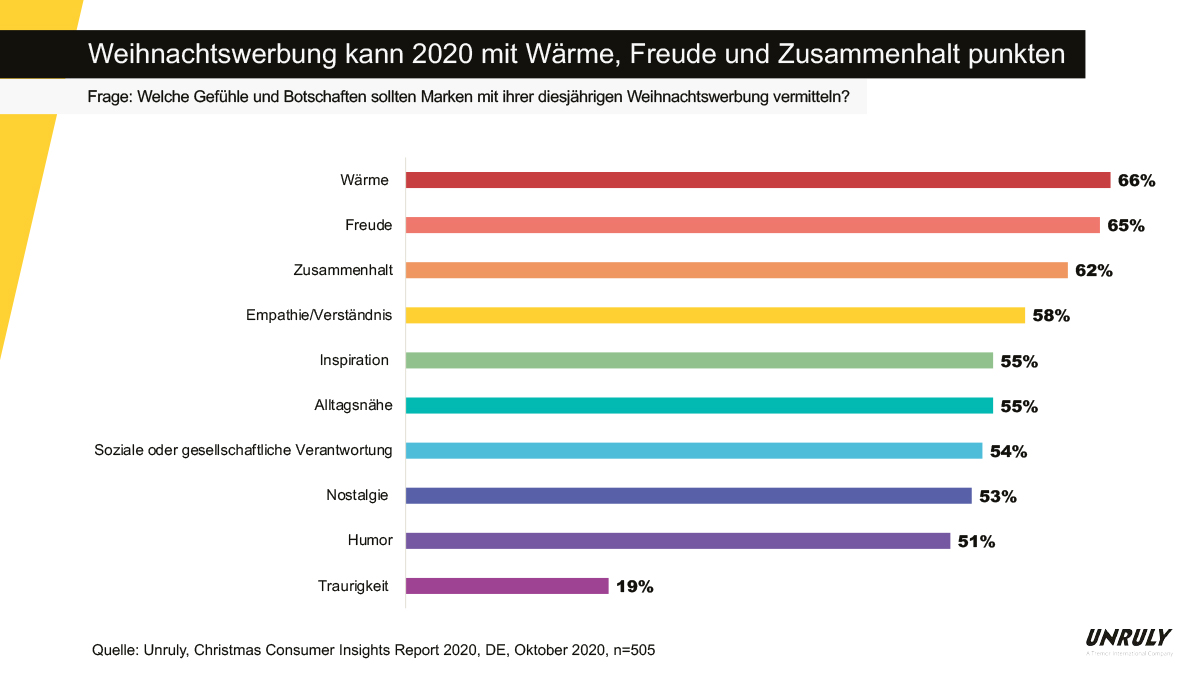
The message to advertisers is even clearer: two thirds of consumers want Christmas advertising to convey warm feelings in 2020, closely followed by a longing for happiness and messages of solidarity.


Advertising with Covid-19 reference

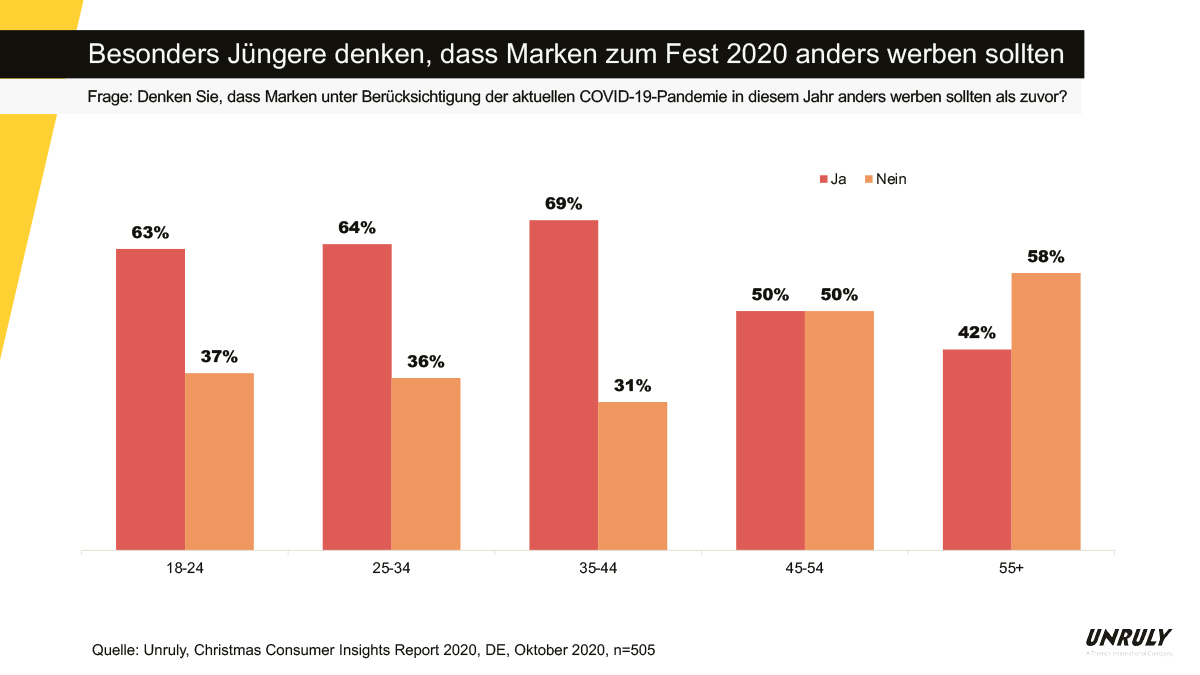
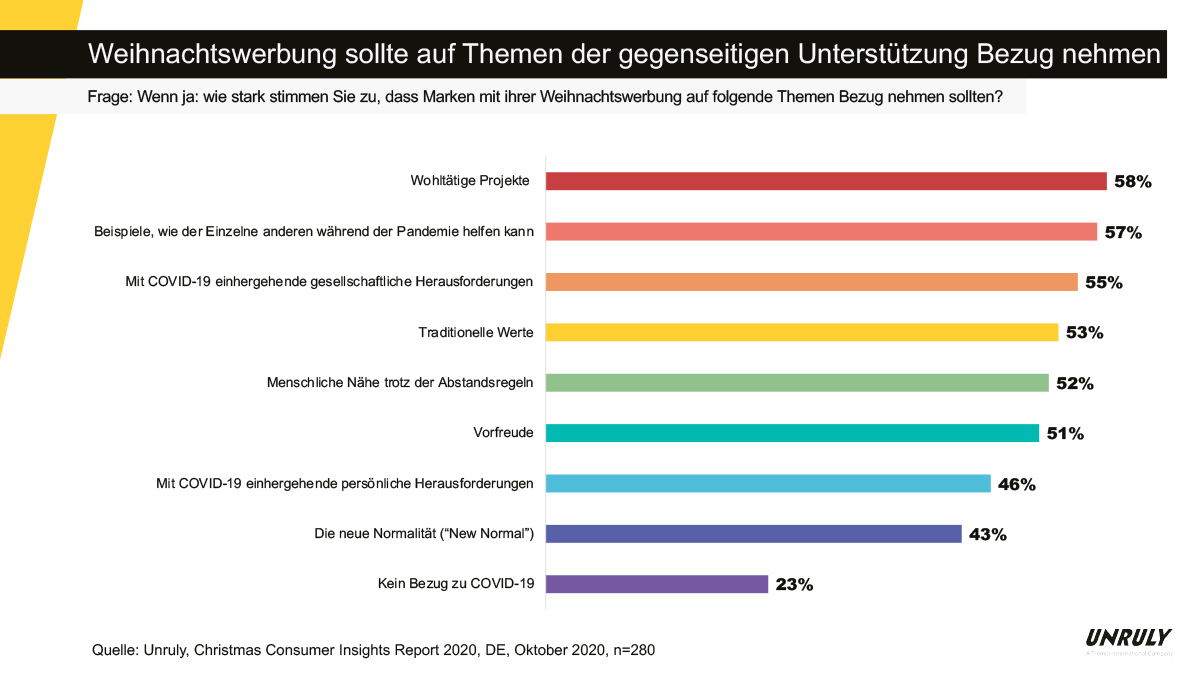
In general, the majority think that brands should advertise differently this year in light of the current Covid-19 pandemic. Most of them are in favor of Christmas advertising referring to themes of mutual support and charitable projects, examples of how individuals can currently help others or social challenges associated with Covid-19. Only 23% are currently against a reference to Covid-19 in Christmas advertising.

2020_Unruly_Christmas_Insights_DE-9

The study conducted in Germany came to five key conclusions.


1. the real Christmas business is just beginning 

At 84%, most consumers still have the majority of their Christmas shopping ahead of them. Over half (54%) of those surveyed plan to do most of their shopping in November. 14 percent plan to do most of their shopping on Black Friday.


2. the majority of Christmas shopping is done online

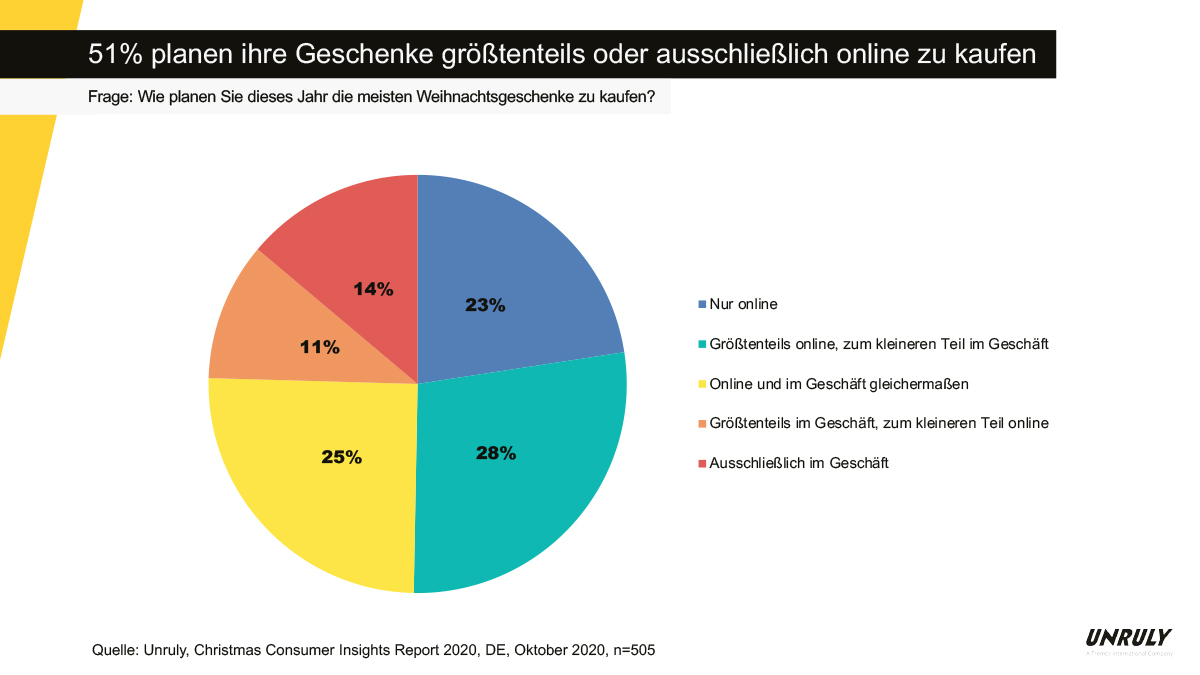
Three quarters of consumers plan to do at least half of their Christmas shopping online. 51 percent even want to do most or all of their shopping online. Many plan to spend the same or even more than last year on various things, such as Christmas presents (75%) or festive food (79%).

2020_Unruly_Christmas_Insights_DE-13

3. inspiration is obtained online

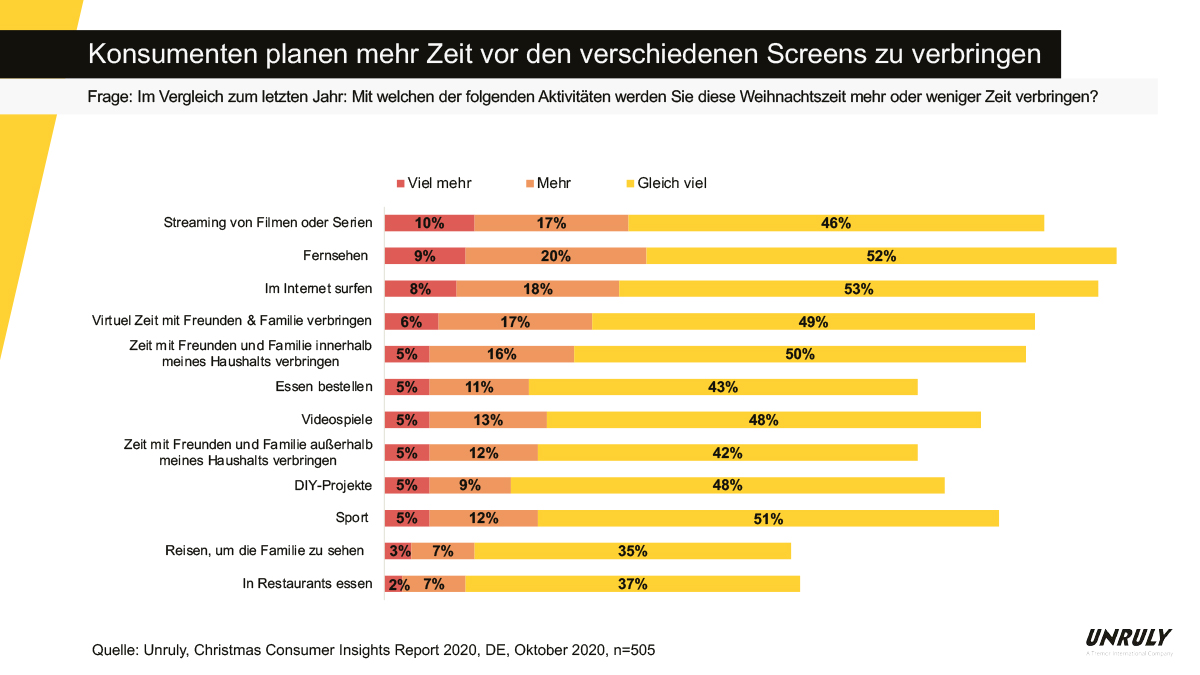
Online influences, such as surfing the internet (45%) or online advertising (32%), strongly inspire the search for suitable gifts. Many consumers also think that they will spend as much or more time in front of the various digital screens during the festive season for streaming (73%), watching TV (81%) or surfing (79%).

2020_Unruly_Christmas_Insights_DE-19

4. mixed feelings about Christmas

The thought of Christmas triggers mixed feelings in people, but joy (41%) and warmth (40%) dominate. Just under a quarter (24%) of respondents said they felt sad at the thought of Christmas. Christmas advertising should also primarily convey feelings and messages of warmth (66%), joy (65%) and solidarity (62%).

2020_Unruly_Christmas_Insights_DE-11

5. brands should advertise differently

More than half of respondents (55%) think brands should advertise differently this year in light of the current Covid-19 pandemic. Most respondents want Christmas advertising to make reference to how support is or can be provided. Only 23% do not want any reference to Covid-19.

2020_Unruly_Christmas_Insights_DE-10

The complete "Christmas Consumer Insights Report 2020" can be found on the homepage of Unruly can be downloaded.

Halder Record and Swiss Life celebrate long-standing partnership

In a new campaign, Swiss Life highlights its long-standing customer relationships. In advertisements created by Halder Record, as well as in an internally produced short film, historical footage blends with the present day. The campaign illustrates Swiss Life’s long-standing partnership with its corporate clients.

Print-Sujet_Werkstatt

The subjects of the current campaign can be seen in print media and online. They focus on the history of corporate customers and the partnership with Swiss Life - a successful collaboration that has lasted for generations. For example Sigvaris GroupWhen the foundation stone for today's Sigvaris Group was laid in 1864 with the founding of "Ganzoni and Barthelts" in Winterthur, the term "start-up" did not yet exist. What did exist, however, was the will to constantly reinvent itself - just like a start-up. At first, the company produced simple elastic bands. Today, it is the leading supplier of medical compression textiles. Swiss Lift has been around for 102 years.

In addition to the Sigvaris Group, corporate client Müller Verpackungen, which manufactures containers for the transportation of hazardous and demanding goods and has been a Swiss Life customer for 84 years, is also portrayed. The advertisements feature historical photos of the companies, combined with pictures of employees from the present day.

Print-Sujet_Gründer

Direct link to the purpose of the company

The advertisements are intended to express how Swiss Life thinks long-term and accompanies its customers for decades. The company portraits also establish a direct link to Swiss Life's corporate purpose. "We show how we stand by our customers through ups and downs in matters of pensions so that they can concentrate on making self-determined decisions and pursuing their entrepreneurial goals", says Christian Pfister, Head of Group Communications and Strategic Marketing at Swiss Life.


Advertising campaign and short film

The advertising campaign, developed and realized by Ralph Halder of Halder Record, will run until the beginning of December and will appear in print media such as the NZZ am Sonntag and the Tages-Anzeiger as well as on various online portals. Swisslife.ch also features other stories about long-standing customers: The short film produced internally by Swiss Life tells the story of the Sigvaris Group and the customer relationship that goes back over a hundred years.

Videobanner-still_Näherin

Lifelong learning at the center of the Digital Days

The fourth Digital Days in Switzerland will focus on lifelong learning. Europe’s role in digitalization will also be discussed. Due to the pandemic, many events will be held online this year.

digitaltage_2020_europa (2)

More than 10,000 people have already taken part in the Digital Days activities, Digitalswitzerland founder Marc Walder said at the online media conference on Monday. In her address, former Federal Councilor Doris Leuthard invited people to get involved with the new technologies, because digitization was changing "everything at a rapid pace".

The Digital Days also aim to promote the next generation of STEM (mathematics, information technology, natural sciences and technology) students in Switzerland. Google CEO Patrick Warnking spoke about this. For example, he said, there would be a shortage of around 120,000 skilled workers in this sector of the economy over the next few years. The goal, he said, is to get the new generation excited about it, which is why a campaign has been launched to get young people interested in STEM professions. Ana Brnabic, Serbia's prime minister, spoke about Europe's role in digitization.


Digital and physical

The Digital Days are taking place for the fourth time, lasting until Tuesday. The event will be held digitally and physically throughout Switzerland, lasting three days for the first time. Around 400 free events at more than 20 locations across Switzerland will bring together like-minded digital enthusiasts, newcomers, industry experts and companies to foster the development of ideas.

One of the topics to be debated is the digital transformation of tomorrow's Switzerland. Start-ups are also to be promoted. The Digital Days were opened by Federal President Simonetta Sommaruga.

The Digitalswitzerland initiative launched in 2015 at the World Economic Forum WEF has since grown into a movement in which over 150 major Swiss companies and institutions have joined. Since 2017, Digitaltag has been held every year under the auspices of Digitalswitzerland. According to Digitalswitzerland, Switzerland is in sixth place in the digital ranking (Werbewoche.ch reported).


Europe-wide alliance

As part of the Digitaltage, seven organizations committed to digitization will also sign a joint declaration of intent. Switzerland, Sweden, Serbia, Ukraine, Poland, Liechtenstein and the city of Vienna intend to hold parallel Digitaltage events across Europe from 2021 in order to achieve a broader impact. Digitalswitzerland is to assume the role of project sponsor and coordinate the activities. (SDA/swi)

TX Group sells Olmero to Swedish Byggfakta Group

TX Group has sold Olmero, a company specializing in digital construction project management, to a Swedish buyer. The buyer is the Stockholm-based Byggfakta Group, which provides business intelligence and data analytics services. The sale price was not disclosed.

olmero-ch-screenshot

Following a strategy review and focus on three investment areas (consumer fintech, productivity, digital entertainment), it was concluded that TX Group was no longer the perfect owner for Olmero, Samuel Hügli, head of technology & ventures at TX Group, was quoted as saying in a statement Monday.

On Friday, TX Group already announced the divestment of the shares in the Danish Trendsales. The second-hand fashion platform caused TX Group an unscheduled write-down of around CHF 18 million.

Olmero was created as an ETH spinoff for the digitization of the construction industry and, according to the company, mediates construction volumes on the Olmero platforms of around CHF 5 billion per year.

The Byggfakta Group employs around 600 people in Sweden, Denmark, Norway, Finland, the Czech Republic, Portugal and Spain, according to the statement. (SDA)

Two-thirds in favor of banning tobacco advertising

67 percent of Swiss people support a general ban on tobacco advertising. 78 percent favor strict regulations on tobacco and nicotine products such as e-cigarettes, IQOS, and chewing tobacco. These are the findings of a survey conducted by the Swiss Lung League.

luckies-zigarettenpackung

The acceptance goes through all parts of the country and the population, the Lung League announced on Monday.

In first place, 47 percent of respondents cited the rejection of advertising for products and addictive substances that are hazardous to health as a reason for a ban. 27 percent cited the protection of young people. Young people are particularly at risk of addiction. In third place, with 18 percent of respondents, were health costs.

70 percent of respondents were in favor of banning tobacco producers from sponsoring cultural and sporting events. This is precisely where young people would be addressed as a target audience.

On behalf of the Swiss Lung League, the LeeWas company surveyed people throughout Switzerland between September 15 and 30, 2020.

The Lung League published its survey in view of the meeting of the Commission for Social Security and Health of the National Council (SGK-N) on Thursday and Friday. The SGK-N bends beside the popular initiative "Yes to the protection of the children and young people before tobacco advertisement" over different other presentations to the topic. For example, it is about a law for the sale of chewing tobacco snus. (SDA)

Audiokanzlei launches mobile podcast studio "Podcar

In the wake of the audio boom, Audiokanzlei has developed a mobile recording studio for podcasts on four wheels. Since Monday, the Podcar has been on the roads of Switzerland and presents itself as a rentable high quality studio for everyone - directly at the places where the stories are created.

audiokanzlei-mobilerpodcast

Behind the podcar wheel is former 105 program manager Dino Giglio. The Audiokanzlei Managing Director notes that podcasts are currently high on the agenda and the demand for audio content has increased enormously: "Both companies and individuals are looking for new ways to reach people - especially in the current climate. Digital solutions are becoming increasingly important in this regard." The offer of podcast productions is to be revolutionized by the mobile PodCar, according to a statement from the audio law firm. "There are already many recording studios. But people often don't have time to travel to one place. They want to be flexible and stay in their familiar surroundings. Most of the time, they also lack space, equipment and expertise. Thanks to our newfound mobility, we can now meet the individual needs of our customers," explains Dino Giglio.

For the implementation, a Mercedes Marco Polo was converted into a mobile recording studio and equipped with 5G technology. The aim is to achieve the same sound result in a comfortable touring car as in a professional recording studio.

audiokanzlei-mobilerpodcast2

Professional recording studios are a costly undertaking, it continues. The makers of the podcar therefore wanted to offer all target groups a professional and at the same time affordable solution right from the start. For example, the mobility of the podcast car would eliminate high rental costs. For the launch of the Podcar Audiokanzlei boss Giglio developed three new packages, which are to cover different needs of the target groups: With many marks a Full management is very in demand with the topic Podcasts. However, independent podcasters often simply want a tool to achieve their vision. We can broadcast live from anywhere with the PodCar in broadcast quality."

Schläfle Trittibach makes headlines with Alvoso pension fund

The Alvoso Pension Fund was founded over 35 years ago out of a sense of connection to the business community in Eastern and Central Switzerland as well as the Zurich economic region. Schläfle Trittibach created a campaign for the pension solution.

01-Alvoso-Pensionskasse-Imageinserat

The completely redesigned brand identity is now being followed by the communication campaign for the Alvoso pension fund from Schläfle Trittibach. The advertising materials are visually unmistakable and consistently implemented in the new corporate design with Alvoso font and colors. The pension fund communicates the complex topic of retirement provision verbally with a pleasant simplicity and straightforwardness. The target groups are addressed on various channels and the campaign can be seen in digital and analog media.


03-Alvoso-Pensionskasse-Imageinserat

Responsible at Alvoso Pension Fund: Remo Schällibaum (President of the Board of Trustees and project initiator), Thomas Schmidiger (Managing Director), Josef Bickel (Deputy Managing Director). Responsible at Schläfle Trittibach: Marcel Schläfle, Christoph Trittibach (Creative Direction), Jürg Waeber (Text).

get_footer();