#MeToo commercial from Gillette infuriates "real" men

The razor giant Gillette polarizes with an advertising clip published on YouTube. The video mentions the #MeToo movement right at the beginning and questions what exactly is best in men.

It portrays classic aggressive masculinity as negative and calls on men to behave more positively. While some welcome this, the ad has been met with massive criticism and even calls for a boycott from those who apparently see themselves as defenders of true masculinity.


"Feminist propaganda"

The clip plays with Gillette's well-known slogan by turning it into the question of what is the best a man can be. According to the commercial, the answer seems clear: not a reckless hooligan for whom bullying and sexual harassment are normal with the argument "boys will be boys", but rather someone who intervenes when he observes such behavior. Because this could have a role model effect for boys who see it - because the boys of today are the men of tomorrow. However, what some see as a really positive message also attracts a lot of harsh criticism.

For example, some see the clip as "feminist propaganda" or proof that Gillette does not want "masculine" customers. Accordingly, the call #BoycottGillette is already being circulated and some people are calling off their long-standing loyalty to the brand. A quick look at the YouTube comments reveals the source of much of the criticism. The abbreviation "SJW" ("Social Justice Warrior") comes up again and again. This once-neutral term is now a popular tool used by right-wing online outlaws to question the character of people who stand up for socially liberal values such as feminism.


Problematic brand

The fact that Gillette, of all companies, has been caught in the crossfire of criticism from self-declared real men with its reinterpretation of its own slogan "The Best Men Can Be" is certainly not without a certain irony. After all, the 30-year-old English slogan "The Best A Man Can Get" is more ambiguous than its German counterpart "Für das Beste im Mann" ("For the best in a man") when you consider what is stereotypically the best a man can get. So it's no wonder that critics believe the slogan could have come straight out of the 1960s.

Gillette is also facing accusations of sexist pricing. When this issue made waves in the UK at the beginning of 2016, the company investigated The Telegraphthat the Gillette Venus Swirl Flexiball razor costs four times as much as a comparable men's model. So it's not surprising that the abbreviation SJW is used in connection with Gillette's latest clip - after all, it implies that someone is pushing an agenda out of self-interest rather than conviction. That doesn't seem to be entirely out of the question here. (Thomas Pichler/Press release)

SRG production sites are not to be anchored in law

The SRG’s production sites should not be mandated by law. However, the National Council’s Committee on Transport and Telecommunications (KVF-N) expressed regret over the relocation of some of the radio editorial offices from Bern to Zurich and criticized the lack of sensitivity in the process and communication.

After an extremely intensive discussion, the committee decided by 14 votes to ten, with one abstention, to propose to the Council that the five parliamentary initiatives "Diversity instead of concentration. Ensuring decentralized programme production by the SRG".

In a statement issued on Tuesday, the Commission expressed regret at the relocation of part of the SRF radio editorial offices from Bern to Zurich and in particular at the lack of federal and regional sensitivity in the approach and communication.

However, a majority of the committee pointed out that the domestic editorial team would remain entirely in Bern and that federal and regional reporting would also continue to be produced in Bern.

A minority, on the other hand, requested that the initiatives be approved. It is of the opinion that the diversity of the media landscape and competition between opinions can only be maintained with a geographical separation of editorial offices. It therefore believes that it is entirely appropriate for politicians to set specific guidelines for SRG in this regard. (SDA)

Schwarztorstrasse2-srf
undefined

Forget everyday life with Kuoni: Unikat launches new campaign for the tour operator

This summer, DER Touristik Schweiz issued a call for proposals for Kuoni’s new brand identity. The Küsnacht-based creative agency Unikat took the top spot—with a concept that was also validated by the target audiences in a pretest conducted as part of the competitive presentation. Now the results of this work are on display—a wide-ranging media campaign currently includes TV commercials, posters, online content, print ads, and point-of-sale materials.

The creative concept is based on the claim "Holidays where you forget everything", which has already been used successfully in recent years and is still associated with Kuoni by numerous Swiss people today. The seamless continuation and current staging breathes new life into it with text/image combinations and proves to be extremely declinable. Thus, for the first time, the brands of the "Premium Specialists" (specialized travel companies of DER Touristik Suisse) and Helvetic Tours are also integrated into the campaign. 


In addition, specific regional subjects were created for all of the approximately 80 travel agencies, which will be used at the POS. DER Touristik Suisse and Unikat expect the new campaign - which also contains provocative elements - to significantly update and increase awareness of the brand. The integrated price examples also draw attention to Kuoni's good price/performance ratio.

Responsible at DER Touristik Suisse: André Plöger (Vice President Corporate Development & Marketing), Heidi Raff (Head of Creative Art and Design), Sabrina Fürst (Head of Marketing Operations), Nadia Peter (Marketing Manager). Responsible at Unikat Kommunikationsagentur: Daniel Meier and Patrick Lienert (creative direction and text), Manuel Schnoz (art direction), Simone Jung (consulting), Christoph Herter (DTP). Film production: WirzFraefelPaal Productions, Zurich: Stefan Fraefel (director), Felix Seuffert (camera/photography), Nina Wirth (producer), Renzo d'Alberto and Tom Wenger (sound studios Z).

RZ_OOH_Kuoni_Benzinpreis_F12_DE
RZ_OOH_Kuoni_Boardmeetings_F12_DE
RZ_OOH_Kuoni_Boss_F12_DE
RZ_OOH_Kuoni_Laufband_F12_DE
RZ_OOH_Kuoni_SocialMedia_F12_DE
RZ_OOH_Kuoni_Trump_F12_DE

n

RZ_POS_Feinregionen_Emmenbruecke_Screen
RZ_POS_Feinregionen_Jona-SG_Screen
RZ_POS_Feinregionen_Onex_Screen
RZ_POS_Feinregionen_Schlieren_Screen
RZ_POS_Regionen_Bern_Screen
RZ_POS_Regionen_Lugano_Screen
RZ_OOH_Asia365_Steuerfuss_F12_DE
RZ_OOH_Cruises_Wahlkaempfe_F12_DE
RZ_OOH_Dorado_Gummibaum_F12_DE
RZ_OOH_HelveticTours_Bundeshaus_F12_DE
RZ_OOH_Kontiki_Sonnenuntergang_F12_DE
RZ_OOH_Manta_Schwerkraft_F12_DE
RZ_OOH_PSAF_Morgenstau_F12_DE

These three aspects will determine whether brands remain relevant in the future

According to the media agency Initiative, three key aspects will determine whether brands retain their relevance for consumers in the future.

With new innovations and changes in consumer and information habits, the pressure on brands continues to grow. In a dynamic environment, brand strategy must be regularly reviewed in order to meet consumers and their needs. "For us, trend research is not about chasing after every trend, but about gaining a basic understanding of contemporary society with all its drivers, needs and cultural and technological trends and developments. We have to recognize, name, sort and locate these. This is the only way we can develop communication strategies that match the reality of consumers' lives," says Dorothea Plümer, Senior Consultant Strategy Group and responsible for trend research at Initiative.

These three key aspects will therefore determine whether brands retain their relevance for consumers in the future.


1. brands will only remain relevant for customers if they interpret and react to cultural signals at an appropriate speed.  

New trends are constantly being proclaimed and chased through the village like the proverbial pig - or the hip flamingo or sloth. However, a deep, holistic consideration of the relevant cultural drivers, social change and technical developments is necessary in order to prepare for changes at an early stage and take them into account in brand management. Brands must learn to move at the speed of change. This is the only way they can adapt to the changes or even help shape them. Because this is how they are measured by their consumers.


2. we can only be successful with communication if we understand how consumers think, feel and act and where they get information and inspiration along their dynamic customer journey.

Technological progress, changing consumer needs and the resulting micro and macro trends are moving the market and therefore also the way we communicate - or should communicate. How and through which channel companies can best get in touch with consumers in the future is fed by the knowledge of these changes.

It is primarily on the basis of innovative and sustainable trend management that we can derive communication strategies that support companies in reacting appropriately to change. Because only if we know where to pick up consumers in their world of life and needs can we respond with communication offers that capture their attention.


3. strategically classifying cultural change, aligning it with the brand core and deriving suitable communication measures will become an important lever for communication and differentiation for companies.

Cultural and social change as well as the technological progress taking place in parallel are becoming increasingly relevant for brand communication. For example, new platforms and technologies are leading to a further increase in consumer behavior that avoids advertising. The ever-growing need for transparency and trust or the constant search for even more convenience or individualized offers are also constantly presenting brands with new challenges.


However, not every consumer need and every trend influences every brand in the same way. The challenge is to recognize and anticipate relevant trends without compromising the brand essence. When trend-based brand management and sustainable brand development and maintenance are combined, the brand always remains current and at the same time recognizable in the context of social change.

Transparency, credibility and trust are highly valued by consumers. Nevertheless, even in data-sensitive times, they are still and increasingly willing to hand over their data. What do they want in return? Buying tips, inspiration and simplification in the jungle of offers.

These six developments are relevant for Initiative 2019 in terms of communication.


#1: Instant Marketing:

Expectations of brands and companies are growing in line with consumers' ability to do and access things immediately and locally at any time. A mobile approach is highly relevant and increasingly unavoidable in order to satisfy and fuel consumers' hunger for information.


#2: Voice - When brands learn to speak

With the rise of smart speakers, marketers need to remember that there is an audio element to branding. After all, people communicate through a multitude of senses. A brand's visual identity is reinforced by its audio identity. Companies should use sound branding to anchor their brand in the consumer's ear canal.


#3: YOUniverse

The trend that was already relevant in 2018 is continuing thanks to big data and AI. Microsites, personalized landing pages, user-generated content and, above all, context marketing with its unique content tailored to the individual user journey are good communication channels for a contemporary one-fits-one approach.


#4: My-tainement

The process of digital evolution in the media industry continues unabated. Not only music streaming and VoD, but also e-books, e-papers, online news and podcasts are being used more and more by all age groups. Users are increasingly willing to pay for customized content.


#5: Live Video

We already predicted a renaissance for live communication in 2018 with experiential consumption. In times of fleeting to non-existent advertising contacts, this type of approach offers an attention-grabbing opportunity to get in touch with consumers. This strengthens brands, as authenticity in particular is becoming increasingly relevant for consumers in these "fake" times.

However, as the number of platforms grows, so do consumers' expectations of content and its senders. Good live content needs good preparation. It must be conceived by the consumer.


#6: Recipient KPIs - New qualitative indicators

When the consumer is at the center of communication, user signals become increasingly important. Marketers who want to provide a holistic view of the consumer need key figures that reflect this view. New currencies such as engagement or dwell time are increasingly being used to reclassify the quality of customer contact.

The combination of relevant key figures, i.e. a kind of scorecard for customer contacts, represents the future of evaluation. However, there are no established standards for this yet. Cross-channel and cross-platform measurement requires individual cooperation between companies and agencies, as well as a bit of pioneering spirit.

However, this is necessary for all trends and as nothing is as constant as change, trend analysis and integration of the results is a continuous, year-round process.

Advertising clients optimistic about 2019 - agency business remains a people business

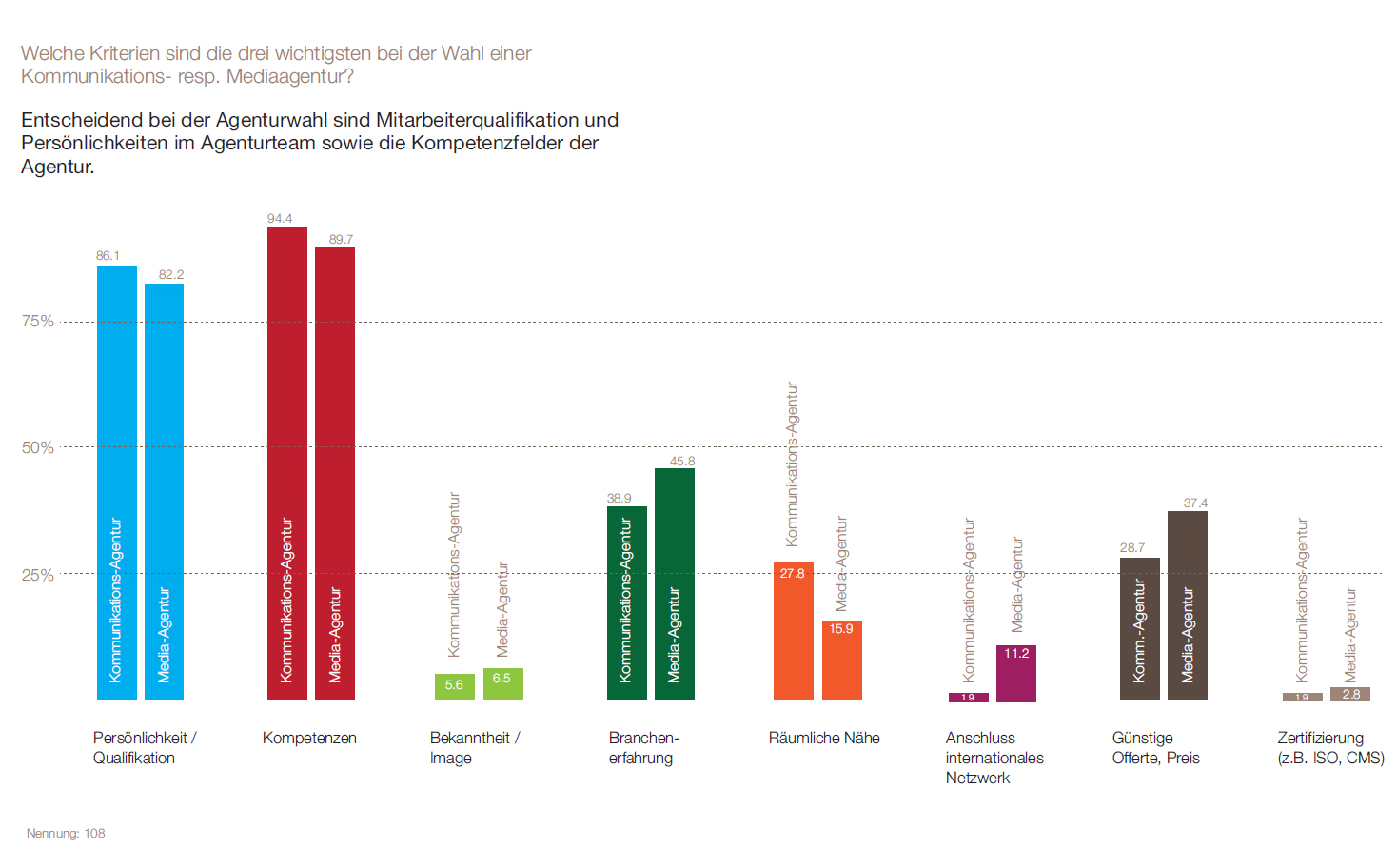
In December, the Swiss Association of Advertisers (SWA) and Leading Swiss Agencies (LSA) launched the new «Industry Indicator 2019» survey. The survey asked advertisers and agency executives for their assessments of the market. More than half of the advertisers reported an increase in revenue for the past year and also expect an increase in 2019. Meanwhile, communication budgets remain stable. The key factors in selecting an agency are the qualifications and personalities of the agency team. The agency business therefore remains a people business.

Many advertising clients are likely to be satisfied with the past year. Only 12% reported a decline in their company turnover, 17% reported no change and 58% reported an increase. The outlook for 2019 is similarly positive: More than half expect an increase. At the same time, communication budgets remain at a stable level: 45% of respondents are leaving their communication budgets unchanged, 30% want to reduce their communication expenditure and 21% want to increase it. The development of media budgets is comparable. However, the survey results show that the order situation in the communications industry remains stable even in economically uncertain times, as clients are aware of the importance of their public presence.

In order to keep the survey short, no questions were asked about trends in the individual media types this year. From a similar survey of advertising companies in Germany last November, it is known, among other things, that print will remain under pressure in 2019 and that digital channels are likely to continue to grow. 


Top challenge: Reaching the target groups 

Reachability of target groups (50 percent), the complexity of channels (42.7 percent), digital transformation (42.7 percent), marketing automation (35.5 percent) and data protection (26.4 percent) are the most frequently mentioned topics in terms of the most important challenges. As a result, more specialist knowledge, networked thinking, flexible forms of collaboration and organization as well as skilful handling of data are required. This is the only way to develop holistic communication solutions and achieve individual, relevant and targeted consumer involvement.
 

chart-01

Agency business is a people business

In addition to the trends, the advertising companies were asked about their agency relationships. The advertising clients responded that the main sources of information used to select an agency were recommendations, contacts with the agency management and agency websites. When it comes to the actual selection of an agency, the competencies and personality/qualifications of the employees are clearly the most important factors. The agency business is and remains a typical people business.  


chart-2

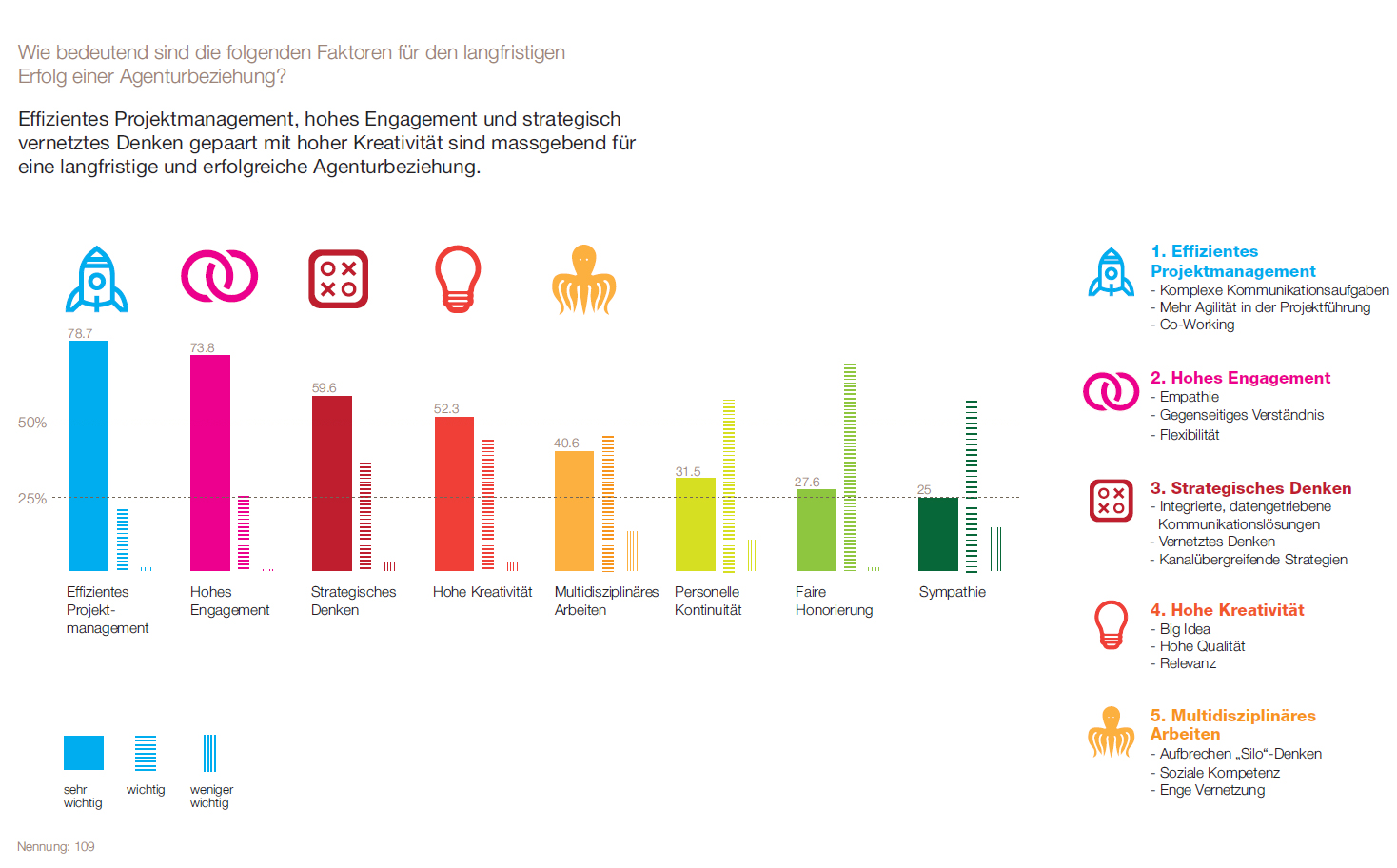
For long-term success in the collaboration, advertising clients expect above all a high level of commitment and efficient project management, followed by strategic thinking and a high level of creativity.

chart-3

The most popular form of remuneration for communications agencies is currently the "scope of work" with a clear project definition and corresponding agency expenditure. For media agencies, the percentage fee on the media volume is still the most common fee model. In addition, agile pricing is clearly gaining in importance due to new, flexible forms of collaboration between client and agency. 

164 well-known advertising clients and 43 LSA agencies took part in the annual survey. The survey was conducted between November and December 2018 and the detailed results can be obtained from the offices of both associations.

Mateo Sacchetti is the new head of creation at Rod Kommunikation

Rod Kommunikation’s new Creative Director is Mateo Sacchetti. The experienced and highly decorated creative professional has also joined the executive board of the Zurich-based advertising agency.

Mateo_Sacchetti_2017_0072_802x702_quer_rgb

The career of the concept designer from Thurgau started at Scholz & Friends in Berlin, led him to Jung von Matt in Zurich, then to freelance work for two years and finally to Rod Kommunikation on Bürglistrasse.

The ADC member is responsible for the successful campaigns of Love Life (Safer Sex Check), Pro Infirmis (Mannequins) and Swiss Life (Sorg für dich), among others. Mateo Sacchetti has received several awards for his work, including three ADC Gold Cubes in the last five years alone.

Pablo Koerfer, Managing Director Rod, said in a statement on Monday evening: "I am extremely pleased to be working with Mateo. He is the perfect person for this challenging position."

Mateo Sacchetti, Creative Director Rod, returns the flowers: "Rod is a great place to do two things: create relevant advertising and feel good about it. I am delighted to now also take responsibility for this."

Sacchetti succeeds Martin Arnold, who left the agency in December 2018 (Werbewoche.ch reported). The reason for the separation was "different views on the creative direction of the agency", as was stated in a press release at the time. (hae)

Heads of the Young SVP Bern sentenced for "Gypsy" ad

The two leaders of the Young SVP in the Canton of Bern have been convicted in the first instance on charges of racial discrimination. On Monday, the Regional Court in Bern handed down suspended fines to Nils Fiechter and Adrian Spahr.

zig3unersvp

The two young politicians are responsible for a drawing that was posted on Facebook before the March 2018 cantonal elections. It made sentiment against transit places for foreign travellers. The illustration showed a Swiss man in alpine dairyman's costume holding his nose in front of a pile of garbage in a trailer park. "We say no to transit sites for foreign gypsies," the poster read.

The Association Sinti and Roma Switzerland filed a complaint for violation of the racism penal norm. The Bernese single judge also saw a case of racial discrimination and sentenced the two young politicians to fines of 30 daily rates each. Fiechter and Spahr can appeal the verdict. (SDA)

New agency focusing on health, medicine and social affairs in the canton of Zug

Health, medicine and social issues - these are the thematic focuses of Antiva Consulting, the new communications and marketing agency from the canton of Zug.

antiva

The Antiva team commenced business operations and supports customers from all over German-speaking Switzerland. They appreciate the solid industry expertise and the dialog at eye level.

More digital, more transparent and faster - society and the healthcare sector are changing. As a result, the demands on communication and marketing are also changing. The view of medicine and well-being as a service, informed and demanding patients or the expectations of "convenience" and availability from other areas of life are just a few keywords.

Antiva intends to counter this development with a broad offering and a clear sector focus, as detailed in a press release issued on Monday.


Customers: from established providers to eHealth start-ups

"We support and advise companies, organizations and individuals from the health, medical and social sectors on all issues relating to brand and positioning, strategy and concept, implementation of online and offline measures as well as corporate design and web design," says Irene Dörig, owner of Antiva. Typical clients are companies from the medical technology and life sciences sectors, public and private service providers such as clinics, home care, health centers and social institutions, as well as non-profit organizations with a medical or social focus or independent doctors and practice groups.


With solid industry expertise

"Our customers appreciate the fact that we understand the language of the industry and are partners at eye level. For example, they don't have to first explain what referrers are or what a service mandate means," says Dörig, explaining the benefits of specialization.

The focus is no coincidence. The roots and history of the owner and her cooperation partners lie in medical technology and the health and social care sector. Before founding Antiva, Irene Dörig worked as an independent consultant for five years. She is now bringing this experience and her many years of professional experience in management positions in medical technology and the public healthcare sector to the new company.

antiva-consulting

These are the nine nominated projects for the Marketing Trophy 19

The Marketing Trophy, the «Oscar» of the Swiss marketing world, will be presented on March 12, 2019, as part of Marketing Day 19 at the KKL Lucerne. The jury has nominated nine outstanding projects—including those from Migros, CS, and ABB.

09_Trophy_quer_SMF_MT17_124646

The award is presented annually to recognize the most innovative and successful marketing ideas in Switzerland. The jury, chaired by Prof. Dr. Sven Reinecke of the Institute for Marketing at the University of St. Gallen, has nominated nine projects.


Category large enterprises:

  • ABB Switzerland Featuring the project: ABB and Formula E – Two Pioneers for the Future of Electric Mobility
    • Agency involved: Serviceplan Suisse
  • Migros Cooperative Union with the project: M-Budget Mobile – No one needs more than one subscription
    • Agency involved: Wirz Communications
  • Credit Suisse with the project: Credit Suisse: Launch of «Viva Kids/Digipigi»
    • Agency involved: Rod communication
  • Fifa with the project: 2018 FIFA World Cup: When Fans and Brands Celebrate Together
    • Agency involved: Webrepublic


Category: Medium-Sized Companies

  • White Arena Group with the project: insideLAAX
    • Agency involved: Inside Labs
  • WWF Switzerland with the project: Uncozy Sweater
    • Agency involved: Wirz Communications

Category small business

  • Arosa Tourism with the project: Arosa Bear Country
    • Project partners: Four paws
  • Session Basel with the project: Baloise Session
  • Farmy with the project: Farmy. And the revolution in the Swiss food market


The Keynote Speakers at Marketing Day 19

Karsten Ranitzsch, Head of Coffee at Nestlé Nespresso SA, addresses the following question in his presentation: What is a unique selling proposition in our fast-paced world, and how can I maintain it? The focus is on differentiation and the creation of added value as an ongoing challenge for every company, regardless of its size.

Martin Limbeck, a sales, management, and personal development coach, provides answers to current questions that salespeople must address in the digital age: How do you deal with increasingly critical customers? How do you deal with the consequences of changing buying behavior?

Martin Lindstrom is the chairman of Lindstrom Company Inc., the world’s leading company in brand and cultural transformation. His topic is “Small Data”: How seemingly insignificant consumer observations are fundamentally changing the way companies are structured and managed. And why Big Data can no longer stand alone. Among other things, Lindstrom explains what changes companies should make to be prepared for the next phase of the data revolution.

Philipp Zutt, a lecturer on neuromarketing at various universities, author of numerous academic articles, and founder of the GlobalEmotionsForum, speaks about emotions as a key to success: “Light My Fire” – an experience that resonates. In markets with interchangeable products, the brand that wins is always the one that ignites an emotional spark in customers’ minds. This can be managed through a thorough evaluation of the gold standard and by weaving an emotional core throughout all touchpoints and all the senses. Zutt takes us on an illustrative journey through our brains. A presentation for all the senses.

For more information about the program and to order tickets, please visit Swissmarketingforum.ch

Viva for the AGVS: Event as a strategic part of communication

This week, Bern was the capital of the Swiss automotive industry: 850 industry leaders gathered at the «Swiss Garage Owners» Day” to learn how the garage owner’s business model is changing. Behind the scenes, the Viva content team is pulling the strings.

20190114_Viva_Tag-der-Schweizer-Garagisten_Bild-1

Within a few years, the "Day of the Swiss Garagists" has become the largest trade conference of the Swiss automotive industry. Even the Auto Summit in Germany does not reach such dimensions, according to the press release. The Viva agency was commissioned by the Auto Gewerbe Verband Schweiz (AGVS) with the content design and the accompanying communication. The team leads within an association-internal working group the annual topic identification, arranges from it a program aligned on high use and organizes and briefs the advisers, panelists and moderators. At the event on site, the Viva experts together with Habegger's technical crew direct the content. Ten editors, designers and consultants process the conference content via internal and external print, online, social media and video channels. The Garagistenverband's own media - the monthly association magazine Autoinside, the B2B website Agvs-upsa.ch and various newsletters - benefit greatly from this.


Stringent connection of all channels

"One of the challenges is to align the relevant success factors in such a way that the combination of individual media parts becomes a whole and the spiral of success turns upwards through the interaction of the individual parts," explains agency manager and owner Georg Gasser. In this case, interaction means: a client who recognizes the strategic importance of high-quality and authentic association communication, a topic that appeals, speakers who not only have a name but also deliver concrete benefits, a program that offers variety, in-house media that have the necessary reach, and professional key media management for external trade and public media. The close cooperation between AGVS and Viva as well as with the Kursaal in Bern, a location that creates atmosphere, are also among the success factors. "The stringent combination of all these elements," says Gasser, "pays direct dividends for the association's reputation."


Consistently focused on editorial content

As a communications partner, Viva also maintains the AGVS newsdesk outside the event. Thanks to a consistent commitment to solid content that is relevant to readers, the association's own media now reach 100,000 readers and users every month and are by far the leading media in the Swiss automotive industry.
 

2018_BOE_072

Pablo Schencke is the new Creative Director at Publicis

Pablo Schencke has joined Publicis as Creative Director, effective immediately. He succeeds Head of Art Michael Brauchli, who will, however, continue to work with Publicis on special projects.

Pablo-Schencke-t

Pablo Schencke is Chilean and Swiss. After studying at the Minneapolis School of Advertising, he began his career as an art director at Leo Burnett and 180 Mullen Lowe in Santiago de Chile. In 2005, he switched continents and started as an art director at Jung von Matt in Hamburg. In 2008, he moved to Zurich, where he worked as Creative Director at Spillmann Felser Leo Burnett and Jung von Matt/Limmat for several years before joining Thjnk Zurich and helping to establish the newly founded agency.

Many well-known Swiss campaigns bear Schencke's signature. His best-known work includes campaigns for Migros - such as the Micasa name promotion - as well as for other well-known clients such as Victorinox, BAG, Ovomaltine, OBI, WOZ, Chocolat Frey, Die Post, Edelweiss and Bio Suisse. The 41-year-old has also played a decisive role in several award-winning campaigns for Pro Infirmis, including the current film "Alle sind gleich. No one is more equal".

Thomas Wildberger, CEO of Publicis Communications, is looking forward to the new addition: "Pablo's years of experience in international and in the best Swiss advertising agencies made him a top creative. He meets well-known former companions at our company, which is why I am convinced that he will quickly feel at home and will excellently complement and inspire our teams."

Pablo Schencke is a member of ADC Switzerland and has won numerous awards at all relevant award shows worldwide.

Unchanged for two years: stable earnings situation at ASW agencies

The earnings situation of all ASW agencies has not changed in the survey period of the last two years. While gross operating income per capita has remained at a pleasing level according to the ASW, the number of employees has actually increased by around four percent.

The continuing price erosion could have been successfully countered with standardized processes, writes the agency association in a press release on Monday. The model of the owner-managed communications agency has thus once again proven to be a success factor in an uncertain environment. In addition, the high level of trust on the part of clients as well as short decision-making processes and low fluctuation on the part of agencies contributed to this pleasing overall result. 

The owner-managed communications agencies in the ASW expect 2019 to be another challenging year, but do not anticipate any changes in employee-related gross operating income.

The Alliance of Swiss Advertising and Communication Agencies (ASW) is the association of owner-managed communication agencies in Switzerland. It is committed to fair competition and supports its members with all available tools and resources, particularly in ensuring quality standards and continuous professional development.

get_footer();