Evaluation shows: Winterthur newspaper has become significantly more political thanks to Blocher

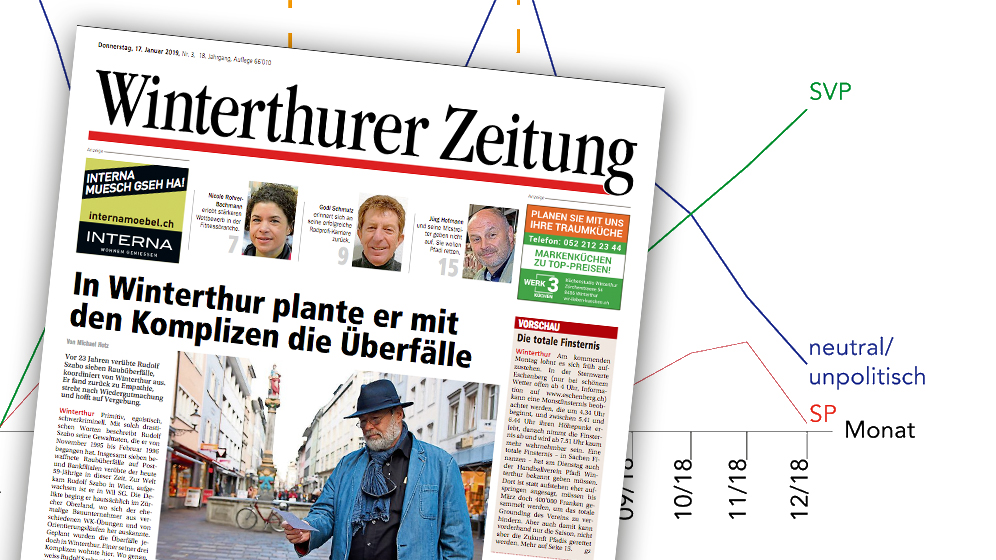
More and more politics—but above all, more and more SVP politics. That is the conclusion of a qualitative and quantitative analysis of the editorial content of the *Winterthurer Zeitung* from March 2017 to December 2018, conducted by the Association for Media Diversity.

winterthurer-zeitung-t

In principle, the owners are free to determine the party-political course of a newspaper, write the authors of the study. This naturally also applies to Christoph Blocher and his Zeitungshaus AG, which now comprises around 30 local newspapers. However, according to the Association for Media Diversity led by media professor Heinz Bonfadelli, it becomes problematic when the influence of content and party political orientation is concealed and a newspaper that promotes a specific political line is described as politically neutral.

The Winterthur Newspaper - according to the publishers, one of the most important titles in Blocher's newspaper empire - was to be "expanded with local stories without a political background" - _and that "the newspaper was virtually taken over by the SVP" was "stupid stuff", CEO Rolf Bollmann was quoted as saying in the "Landbote" newspaper on August 17, 2017. The analysis now available from the Association for Media Diversity, which relates to the period six months before the takeover and up to December of last year, clearly refutes these statements: the Winterthur Newspaper has become an SVP newspaper.


Expanded political reporting with a clear focus

44 issues from March 2017 to December 2017 and 49 issues in 2018 were analyzed. The most important findings:

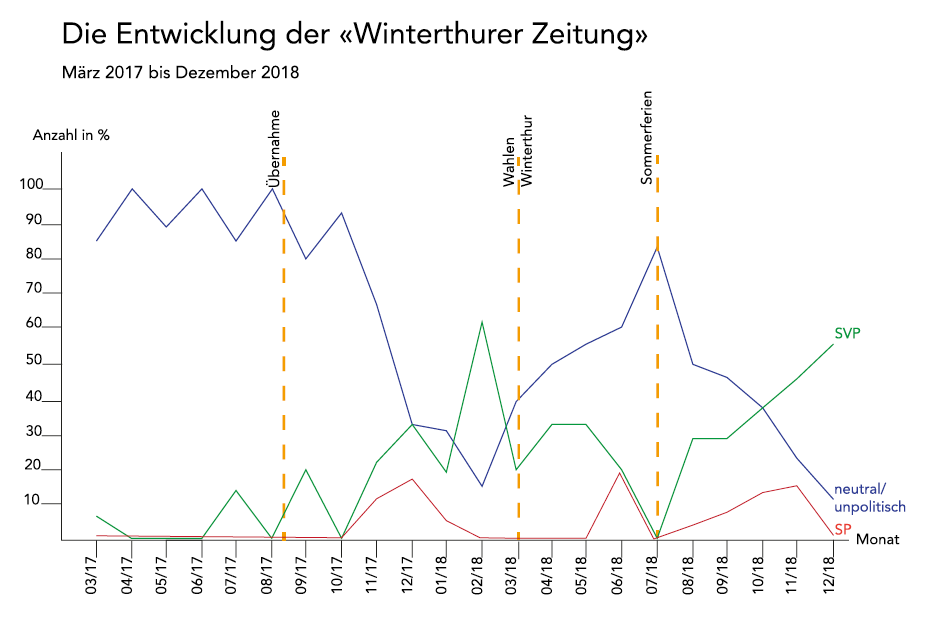
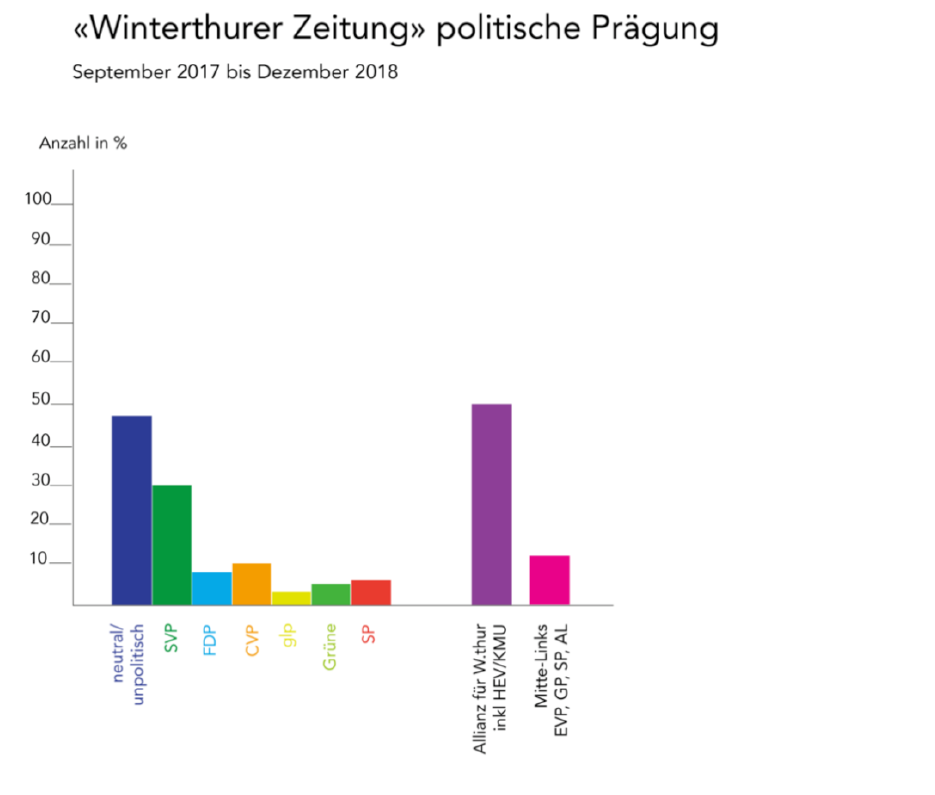
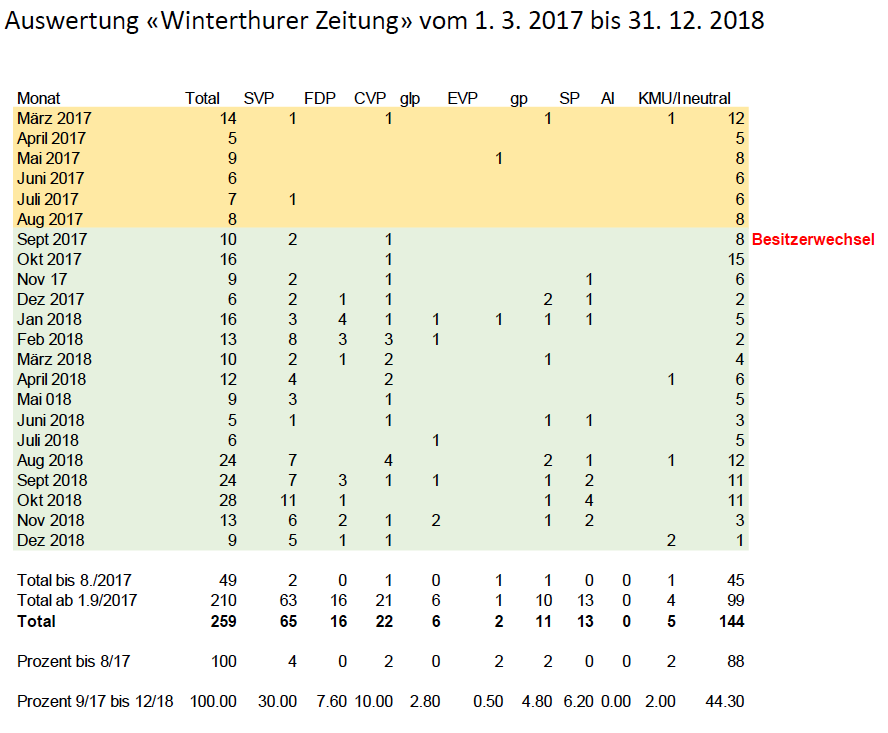
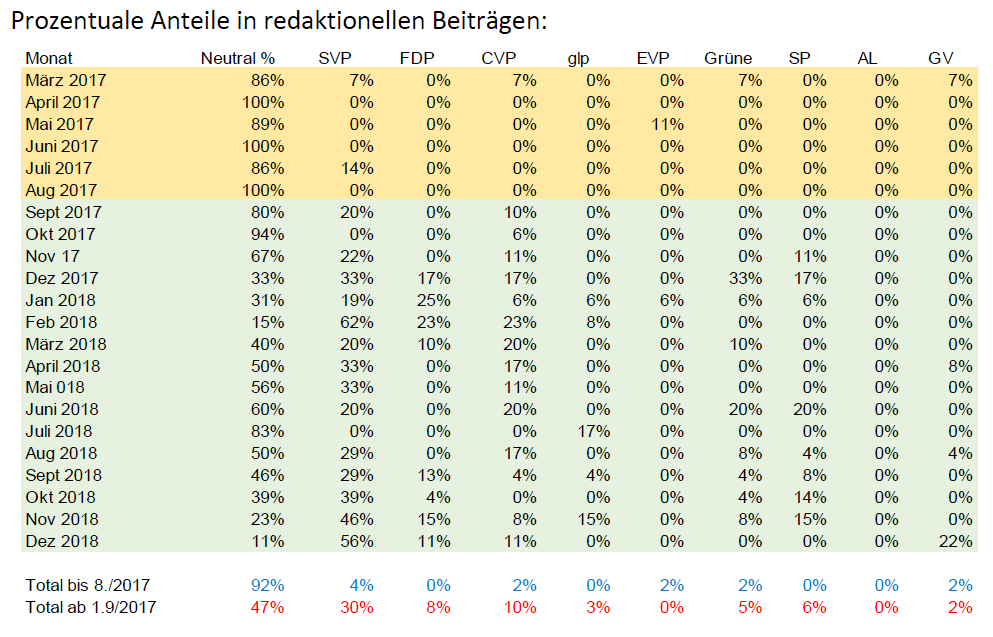
  • The Winterthur Newspaper became much more political: from March to August 2017, around 92% of editorial articles were apolitical or politically neutral. Between September 1, 2017 and December 31, 2018, only 47% of articles were apolitical or politically neutral.
  • The SVP was able to Winterthur Newspaper While it was only mentioned in 4% of articles in the six months before the newspaper was taken over, between September 2017 and December 2018 this figure was 30%, with the SVP reaching a peak of 62% shortly before the city and municipal council elections in Winterthur on March 8, 2018. In December 2018, the SVP's share was 56%.
  • This picture is further reinforced if you look at the shares of the middle-class "Alliance for Winterthur" as a whole and also include the political contributions dominated by the Homeowners Association (HEV) and the SME Association: since the takeover, the SVP, FDP, CVP and HEV/KMU have been present in 50 percent of the contributions, while the parties from the center to the left (EVP, Greens, SP and AL) only account for 11 percent. The glp is present in around 3 percent of contributions.
  • Thanks to City President Michael Künzle, the CVP is more often in the Winterthur Newspaper present than the FDP.


Clearer direction ahead of the elections

Back in August 2017, the Landbote wrote: "The reporting ahead of the upcoming general elections in March 2018 will show how Bollmann and Blocher envision the new journalism in Winterthur". The present evaluation shows a particularly clear political orientation in February 2018, i.e. precisely before these elections: in this month, not only did the SVP achieve an absolute top score of 62%, but the FDP and CVP also achieved their top scores with 23% each, while the SP, GP and EVP did not receive a single mention.

The fact that the SVP was not mentioned in any of the relevant editorial articles during the 2018 summer recess will hardly bother the party. More important for them is the fact that towards the end of 2018, in parallel with the start of the election campaign ahead of the cantonal elections in spring 2019, their share rose again and reached 56% last December, the second-highest figure ever.

The authors of the study wrote in a press release on Tuesday that a further evaluation of the local newspapers managed by Christoph Blocher currently exceeds their own possibilities. The Winterthur Newspaper was described by its CEO Rolf Bollmann as one of the most important acquisitions at the time of the takeover. It is therefore assumed that the other media of Zeitungshaus AG will also develop in the same direction.
Bildschirmfoto 2019-01-22 um 07.36.58
Bildschirmfoto 2019-01-22 um 07.37.11
Bildschirmfoto 2019-01-22 um 07.37.23
Bildschirmfoto 2019-01-22 um 07.37.30

Head of Marketing Marcel Graf leaves Bern Welcome

After ten years, the last five of which as Head of Marketing, Marcel Graf has decided to leave Bern Welcome.

In 2008, Marcel Graf started as project manager for Euro'08 at Bern Tourism. After the successful implementation, he took over the organization and implementation of various sporting events, such as the 2009 Ice Hockey World Championships or the 2011 European Figure Skating Championships. From 2011, Graf held the position of Head of Sales and Markets, before taking over as Head of Marketing in 2013 and becoming a member of the Executive Board. He also served as president of the marketing committee BE! Tourism.

Marcel Graf played an important role in the reorientation of Bern Welcome after the merger of Bern Tourism and Bern Meetings & Events. His successes include the introduction of the destination brand BERN and the reorganization of Bern Welcome's powerful, young marketing and communications team. Graf drove the digital transformation in market cultivation with great conviction: digital brand management under the label "I love Bern" set new standards in the industry. The "Aaregeschichten" campaign, which Graf implemented with his team last year, was awarded the Edi.18, the Swiss commissioned and advertising film prize, last November.

Marcel Graf will leave Bern Welcome at the end of January 2019. "After ten exciting years, it is time for me to tackle something new," says Graf. Where it will go, he leaves open. Max de Boer, until now Market Manager, will take over as Head of Marketing ad interim. The internal solution ensures a smooth transition.
 

Marcel-Graf

Creative female power: Fruitcake launches under new management

With the turn of the year, there was a change in leadership at the helm of the long-established Bern-based advertising agency Fruitcake. Thirty-three years after the founding of «AWP Agentur für Werbung und Presse AG» (known as «Fruitcake» since 1988), Lahor Jakrlin handed over the full-service advertising and web agency to a new management team led by CEO Christine Kohli.

Fruitcake_GL_Presse-(2)

Photo: Christine Kohli (CEO), Sam. Wolff (AD) and Lara Hitz-Jakrlin (CD) (from left).


Christine Kohli has been working at Fruitcake for eight years, since 2012 as co-owner, consultant, trainer in social media and internet optimization and in the management. After commercial school, the 38-year-old completed a Bachelor and Master of Arts in Literature and Media in Bern, Paris and Freiburg im Breisgau. 

Lara Hitz-Jakrlin worked in international trade fair construction and retail design for luxury brands after her four-year training at the Kunstgewerbeschule Bern and at Globus as a decor designer. The 29-year-old joined the agency at the beginning of 2018 and holds the position of Creative Director. 

Sam. Wolff is a communication designer who studied at the University of Marketing, Communication and Design in Berlin. The 48-year-old has been in Switzerland since 2012 and has been Art Director at Fruitcake since 2015, where she heads the graphics department.

Fruitcake has since its inception transformed from newspaper production and editorial to a comprehensive advertising agency and finally to a holistic internet and advertising agency. While creative advertising, classic graphics and journalism are still a strong pillar of the agency, the area of Internet and custom made websites is being further expanded with great emphasis on SEO and SEM. In addition, the agency is also increasingly positioning itself in the field of 3D design. "We are currently experiencing that many customers are looking for creative communication and professional support from a single source again, after years of being bogged down and do-it-yourself. They want a partner who can offer them the entire range of classic and digital communication from a single source," says Christine Kohli, new CEO of Fruitcake AG, "because with digitization and the associated flood of data, creativity, production expertise and the right media mix in the online and analog sectors are once again providing the decisive edge over the competition. Because the advertising spend remains the same, it just has to be used more wisely today. Experienced full-service agencies have the necessary expertise and can achieve higher reach. 

These are the trends in video employer branding for 2019

Constant change in employer branding is nothing new. It's just getting faster and faster. The days when you could bring new talent on board with a nicely written company brochure or a weekly yoga class for employees are long gone. Video production agency Faeh+Faeh lists nine video employer branding trends for the current year.

employer-branding-2019

1. show us your videos - also in employer branding

We don't need to mention here that video content is no longer a trend. The positive marketing effects of moving images can now be read about in many blogs and info newsletters and proven via sober analysis and evaluation of view figures. As a result, the number of new films is increasing rapidly.

As a result, it is becoming increasingly difficult to be found and seen. Digitization, with its new, networked channels for employer brands, offers an optimal basis for differentiating oneself in various ways through videos. However, it is imperative that the stories arrive in the right form, on the right channel and at the right time. Viewers are becoming more demanding. So are the algorithms.


2. in the middle instead of just there - interactive videos

Netflix recently released its first interactive series of the hit show "Black Mirror". Interactive videos have also been used in employer branding in the past. The gamification aspect was often used for the corporate cultural fit.

Example Deloitte

Using interactive videos in employer branding makes perfect sense. Interactivity puts the viewer "in the driver's seat. They go from being passive to active players. This significantly increases the time spent on the website and positively influences the conversion rate and engagement. In addition, they differentiate themselves from the classic employer branding video.


3. "Storytelling is king" - people for people

This trendy term has been haunting the HR industry for some time. But "storytelling is king" is more relevant than ever, because it refers to the general development in the employer market. Potential applicants want more than ever to get a glimpse behind the (real) scenes of a company. For a long time, companies were unable or unwilling to comply with this wish. Today, an open view into the company serves as an important differentiator in order to survive in the battle for talent.

What is the benefit of storytelling?

  1. Reducing the fear of changing jobs
  2. Building identification with the company
  3. Sympathy for employees/work colleagues
  4. Refute prejudices
  5. Referral marketing

Stories move people and therefore the right content is very central.


4. one size fits all is game over

With the target group in mind, it makes sense for campaigns to spotlight different characteristics. "One size fits all" fails to address the individual and thus authenticity is also invalidated.

Especially in larger companies with different departments, it is essential to pay attention to the individual employee groups and teams and their special nooks and crannies. A digital marketeer has different ideas and wishes for his work environment than an employee on the shop floor.

The completed employer branding film therefore does not necessarily have to appeal to the CEO or the HR manager within the commissioning company. Rather, it is important that it serves the intended target group and arouses interest.

It helps if these questions are answered during the conception phase:

  1. Who is our target group?
  2. What do these people do?
  3. What are these people interested in?
  4. How do these people speak?
  5. Where do we find these people?

If necessary, it is also helpful to work with personas. Among other things, we also want to arouse the interest of passive searchers in advance. These are the top performers and/or top talents from competitors or industry outsiders who could be of great value to our own company. They are satisfied in their current function and only through our employer branding are they made aware of us as an opportunity.


5. provoke to activate

Just as in traditional marketing, the topic of activation is also an important hot topic in the area of employer branding in 2019. Because the best employer branding film is of no use if no added value can be seen or if no action is called for. Because without activation, measuring the added value of the employer branding campaign remains vague. It helps to be self-critical during the concept phase and throughout the entire process - does the film offer added value? Is there a call-to-action? Does it convert the selected target group?


6. draw the short straw - not with new talent

Our attention span is getting shorter and shorter. This is regardless of how old we are or which generation we belong to. This has a big impact on the length of videos. The longer the more; "the shorter the better".

"Most-viewed videos have a length of 31-60 seconds "There is no general, generally applicable length recommendation. The possible uses of videos in HR and employer branding are too varied for that. In addition, the length should definitely be individually adapted to the channel, the target group and the place of consumption. It may also make sense to work with teasers (short clips), especially in social media channels. The first three seconds of a video are also very important. This is where the viewer decides whether to stay tuned, fast-forward or zap away. The key message should also be recognizable within the first 10 seconds.


7. see and be seen

The best employer branding film is of no use if it is not seen. A professional and authentic film is important. But it is just as important to think about the target group, the channel, the format and especially the appropriate marketing. In this context, seemingly small details, such as the choice of thumbnail or even the title selected, are of great and decisive importance for the performance of the videos.


8. high has format

The vertical format trend is exciting and should be taken seriously. Even if not all channels allow vertical format (yet) and the content does not make sense in all channels, there is a strong movement towards vertical. Instagram, for example, is focusing heavily on vertical video content with its recently launched IGTV. YouTube is also starting to introduce vertical format films, at least in the ad space.

The vertical screen mass places completely new demands on visual storytelling and production, but at the same time also offers new possibilities. It remains to be seen whether this will catch on. However, the constant 1/4 turn of the mobile or tablet is already often too tedious for many, especially younger people.


9. uses the commute as a "communication channel

Whether it's on a Monday morning, without motivation on the current job or after an exhausting or frustrating day at work: the commute to work is the perfect opportunity to get in touch with potential talent. Whether on foot, bus, streetcar or train - what is better suited for this than a mobile-optimized video? No other advertising medium can deliver a message as briefly and effectively - be it with sound or with easy-to-read subtitles.

But "mobile first" and adapting the format to the channel is undoubtedly very important in connection with video content. The trend towards "even more mobile" will increase and, among other things, Google and the SEO / SEA rules will also go in this direction accordingly.


Conclusion of the Video Employer Branding Trends 2019

The best employer branding film is of no use if it is not seen. That's why it's important at the start of the project that all relevant key points are included and taken into account. In particular, the target group and its consumption channels should be approached individually. To ensure that this is not only done from the company's point of view, we recommend involving a competent external partner to guide the way to a successful employer branding process.

Five facts about blockchain that we can't ignore

Blockchain has been in development for over ten years now, and even in 2019, it has yet to become established. Meanwhile, an increasing number of critical voices are asking when the technology will finally gain momentum. According to the Gartner Hype Cycle, however, the “Year of Blockchain” is not that far off.

"Although the industry still has a lot of fundamental issues to resolve, all the signs are already pointing to standardization," explains Teal CMO Michael Pruban. The Teal team has compiled five facts that even blockchain doubters can no longer ignore. Teal is a new smart blockchain ecosystem from Europe. It combines the decentralized infrastructure of blockchain with a proven, associative AI technology to create a variety of new applications for consumers and businesses.


1. Blockchain will become the standard in 2024

Blockchain is now more than ten years in the making, but has still not fully arrived in everyday life. This is hardly surprising when you compare it to the World Wide Web - which has been in development since the 1970s. Fortunately, the decentralized storage and transaction structure, the distributed ledger, will establish itself much faster: Gartner's Hype Cycle predicts that the blockchain will leave the valley of tears in 2024 and will then have finally arrived on a broad scale.


2. the economy has blockchain firmly in its sights

The potential applications of blockchain are diverse, which is why 84% of companies are already working intensively with the infrastructure. According to Bitkom, 36% of large companies even assume that blockchain will have a similar impact on society and the economy as the internet.


3. the blockchain is a driver of innovation

Blockchain can not only change processes and business models, it also offers completely new scope for innovation, even outside of business. The UN World Food Program (WFP), for example, uses Ethereum to provide people in need in Jordan with financial aid to buy food. Another example is the travel provider TUI. They are working on using blockchain to do away with travel agents altogether.


4. the blockchain is global

One of the advantages of the infrastructure is that it can be used anywhere in the world. This is also confirmed by PwC's global blockchain study. According to this study, a full 84% of the organizations surveyed already have points of contact with blockchain.


5. the value of the blockchain is enormous

The added business value of blockchain will increase to just over 176 billion US dollars by 2025. By 2030, it will reach over 3.1 trillion US dollars. This is according to Gartner's business value forecasting methodology, which quantifies the value of technology innovation.


Michael Pruban, founder and CMO of Teal: "Blockchain will clearly establish itself as the standard and change our society. The signs of this are already clearly visible. Anyone who still doesn't want to acknowledge this and doesn't at least begin to get to grips with the infrastructure is running out of time."
 

blockchain.t

Marcus Hebein joins Keystone-SDA from APA as new Head of Multimedia Newsroom

Keystone-SDA has appointed a new head of its multimedia newsroom: Marcus Hebein will take over as editor-in-chief starting in March 2019. In this role, the 48-year-old will drive the development of digital services and the integration of technology and innovation across the editorial teams.

Hebein was most recently deputy editor-in-chief of the Austrian news agency APA, where he was responsible in particular for the development of multimedia editorial services and workflows. At Keystone-SDA, the 48-year-old journalist and digital expert will not only focus on innovation and technology, but will also drive forward the integration of the various editorial offices at the shared Wankdorf site in Bern. In addition to journalistic management, Jenatsch will also be responsible for content development and content management.

marcus-hebein-keystone-sda

The current editors-in-chief will report to him. "The management of the Keystone-SDA editorial offices is currently one of the most exciting positions in the entire DACH media landscape," says Hebein. "An ambitious innovation and change process, a new, joint newsroom and a highly qualified and very renowned editorial team, even by international standards, are excellent prerequisites for dynamic development in the coming years." He also emphasizes: "We want our employees to think and work in a multimedia way. We will encourage them in this direction, but also challenge them". 

Hebein was born and raised in the Austrian province of Carinthia. He later moved to Vienna to study business administration and began his journalistic career at the APA news agency. Among other things, he was also one of the founding members of the global news agency network Minds, of which Keystone-SDA is also a partner.

Migros and Coop remain among the world's 50 largest retailers

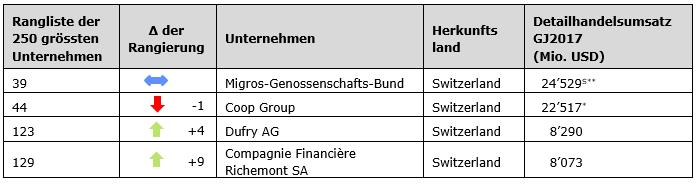
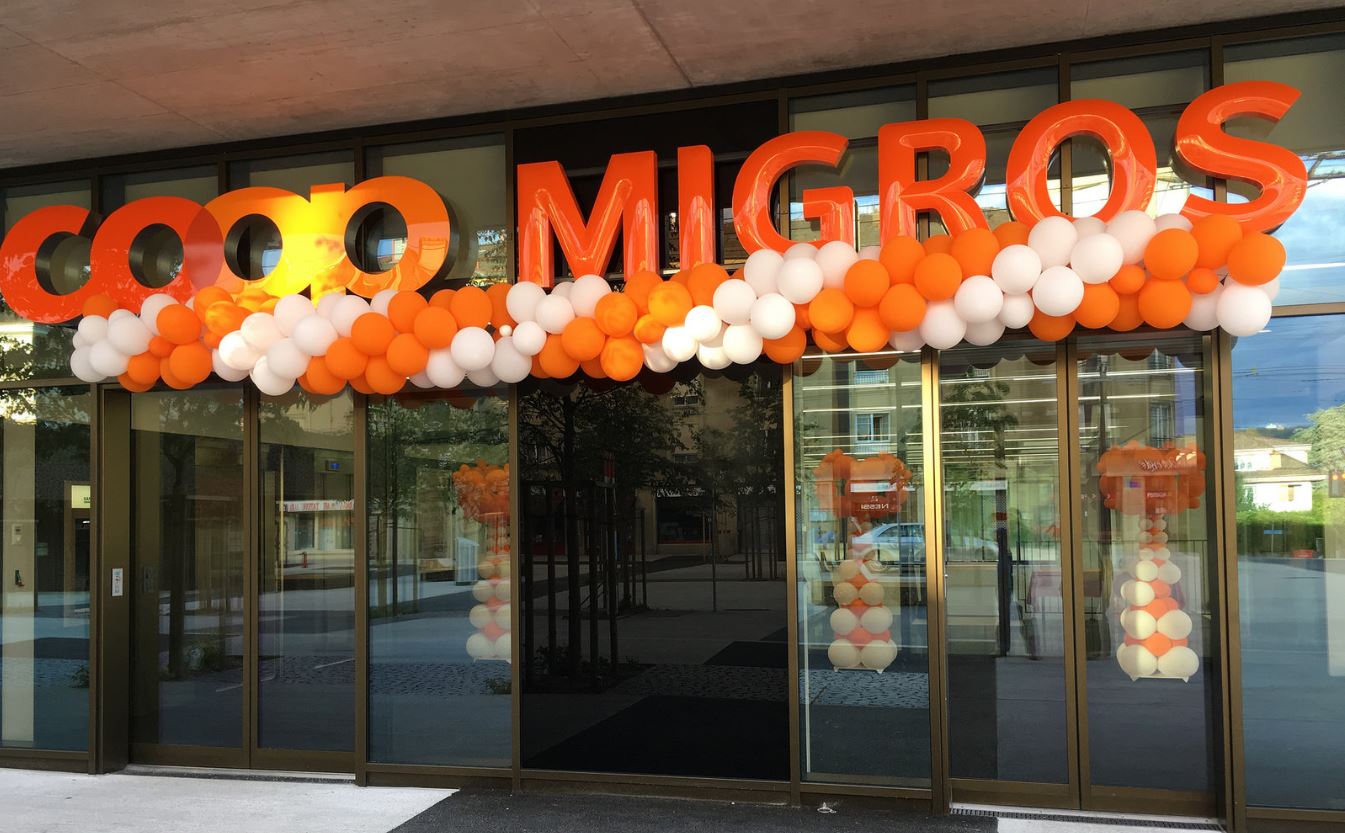
Among the world's top 250 retailers, Migros ranks 39th and Coop ranks 44th. The Swiss duty-free group Dufry is one of the fastest-growing retailers in the world.

The world's 250 largest retailers generated revenue of USD 4.53 trillion in the 2017 financial year, which corresponds to growth of 5.7 percent overall. In the "Global Powers of Retailing" report, Deloitte identifies the world's 250 largest retailers based on publicly available data from the 2017 financial year (financial years ending June 2018). 

The global economy enjoyed strong growth until the beginning of 2018. But recently, inflation has picked up in key markets, a number of governments are changing their monetary and fiscal policies, and currencies in various emerging markets are falling significantly, meaning that the global economy could cool down in the near future. For retailers, this means slower growth in consumer spending, higher consumer prices and a disruption of global supply chains. 

In Switzerland, the outlook is more promising, says Konstantin von Radowitz, Managing Partner Consumer and Industrial Products at Deloitte Switzerland. "2018 was a decent year for the Swiss retail sector compared to other countries," says von Radowitz. "Sales in the Swiss retail sector increased by an estimated 0.4% thanks to the healthy economic environment in Switzerland. Despite global uncertainty, the overall outlook for the Swiss economy in 2019 is good. Private consumption is also expected to remain stable."


Little has changed among the world's ten largest retailers

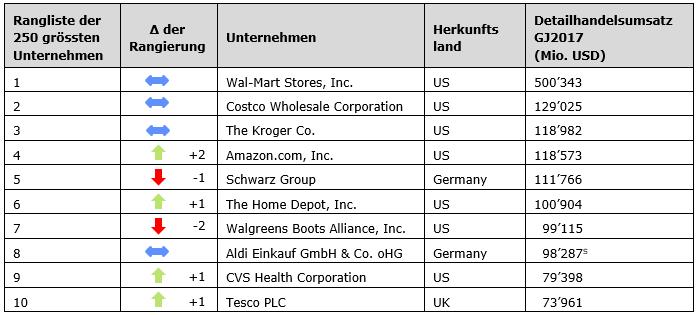
In the 2017 financial year, the ten largest retailers were responsible for almost a third (31.6%) of the total turnover of the top 250 companies worldwide. The three largest retailers, US-based Wal-Mart, Costco and The Kroger, defended their positions. Amazon continues to grow and moved up to fourth place, thanks in part to the acquisition of Whole Foods. Over the past five financial years, the company has moved up eleven places.

deloitte-rangliste

With growth of 6.1%, the ten largest retailers performed slightly better than the 250 largest retailers as a whole, which grew by 5.7%. However, the net return on sales for the top 10 was weaker than in the previous year and also weaker than for the 250 largest retailers. This is largely due to the fact that eight of the ten largest retailers operate in a sector where products are sold quickly and are relatively inexpensive. Margins are coming under pressure here because costs are rising, because pricing power is decreasing due to increasing competition and transparency and because investments need to be made in the digital transformation of the business. 


Migros and Coop remain in the top 50

Migros and Coop are at the top of the Swiss retail market, and both maintained their strong positions in the Top 250 ranking: Migros (with retail sales of USD 24.5 billion in the 2017 financial year) reached 39th place and Coop (USD 22.5 billion) 44th place. Richemont, the Geneva-based holding company for luxury goods, moved up nine places to 129th place, while duty-free group Dufry continued its growth trajectory and took 123rd place. Dufry is one of the fastest-growing retailers in the world over the past five years (annual growth rate of 21.7%). 

deloitte-rangliste2
migros-coop

"It is impressive that Migros and Coop are keeping pace with the growth of the global retail trade, while the Swiss market offers only limited opportunities for growth. Switzerland is a small country and there are only small economies of scale in the stationary retail trade. In addition, consumers from Switzerland are still flocking across the border to shop there, even if cross-border shopping has become less attractive for Swiss shoppers in terms of price," says Konstantin von Radowitz. 

He adds: "E-commerce has not yet had a significant impact on the Swiss retail trade. Internet sales continue to grow, but their share of the overall retail business is still low: in 2018, online sales accounted for less than 10 percent of total retail sales in Switzerland. On the other hand, there are more and more foreign players such as Amazon, Zalando and AliExpress, which continue to grow strongly in the Swiss market. Swiss retailers must therefore continue to invest in their online business."

Andermatt Swiss Alps hires Harry John as marketing manager

Tourism expert Harry John is taking on the new position of Head of Destination Marketing at Andermatt Swiss Alps. The 53-year-old from Leukerbad was most recently responsible for establishing and leading BE! Tourismus.

harry-john

With the newly created position of Head Destination Marketing, Andermatt Swiss Alps aims to coordinate and strengthen the positioning and marketing of the various brands and companies (Andermatt Swiss Alps, SkiArena Andermatt-Sedrun, The Chedi Andermatt, Radisson Blu Reussen, Concert Hall, Andermatt Swiss Alps Golf Course) both nationally and internationally, according to a press release. Harry John will take up the position of Head Destination Marketing and member of the Executive Board on February 1, 2019.

Between 2013 and 2018, John managed the BE! Tourismus AG between 2013 and 2018 and Montreux-Vevey Tourism between 2000 and 2011. In 2009, he won the Milestone for brand management and destination management with Montreux Riviera. The tourism graduate with national and international experience will use his expertise in tourism, marketing and sales to shape the further development of the destination Andermatt Swiss Alps and its brands.

Galaxus expands range to include Migros own brands

Galaxus customers now have access to over 20,000 products from the Migros universe: The online store now also features private-label brands from Migros supermarkets as well as the specialty stores Micasa, Melectronics, Do it & Garden, Interio, and SportXX.

Migros-Produkte-Fachmaerkte

Until now, many of Migros' own products were not available for purchase at Migros' online subsidiary Digitec Galaxus. This is now changing, according to a statement: As of now, the online department store Galaxus offers around 20,000 items from the parent company. Newly available on Galaxus are own brands of the Migros supermarkets as well as the specialty stores Micasa, Melectronics, Do it & Garden, Interio and SportXX. Perishable foods are still not included in the range; they will continue to be sold online by LeShop. 

"More and more Migros customers want to shop online," says Migros Managing Director Fabrice Zumbrunnen. "The fact that our specialty and supermarket stores are now offering their assortment on Galaxus is the logical consequence." In an initial phase, Galaxus customers will be able to buy those Migros products that fit into common package sizes. Initially, the specialty and supermarket stores will deliver the majority of orders directly to Galaxus customers. However, the online department store already stocks some of Migros' own brands itself. "In the future, we will store all products with high demand in our logistics center in Wohlen and deliver them directly," says Florian Teuteberg (pictured), CEO of Digitec Galaxus.

Florian_Teuteberg

Examples of own brands newly available on Galaxus are Micasa and Interio, Mio Star and Durabase from Melectronics, or Miogarden, Miocolor and Miocar from Do it & Garden. SportXX contributes its brands Crosswave, Bodyshape, Extend, Perform and Trevolution. And from the supermarkets, products from Central Square, Cucina & Tavola, M-Topline, Miobrill, Papeteria, Milette and Bellcolor, among others, are added. 

Migros' specialist stores and supermarkets have also supplemented the Galaxus range with external brands from their own assortment on a selective basis. For the time being, however, the focus is on own brands: "We are bundling the online power of Migros on Galaxus: In the future, we want to offer further own-brand articles from the non-food area of the supermarket and the specialist stores on Galaxus as well," explains Migros CEO Zumbrunnen. Through the new sales channel, Migros wants to tap into new target groups and strengthen Galaxus.

Warenlager-Wohlen

Matchcom wins new customers for Schweizer Illustrierte

Matchcom developed a promotional insert for *Schweizer Illustrierte* in the *Sonntagszeitung* on behalf of Ringier Axel Springer Switzerland. The offer was promoted using a winter-themed design that matched the look and feel of the celebrity magazine.

1_SI_Beilage_Titelbild_1000px

Schweizer Illustrierte inspired Sunday newspaper readers with a gift idea for Christmas: A six-month subscription to Schweizer Illustrierte at preferential rates. A personal gift card can be given away with best wishes. To complement the insert, the offer is available at the online newsstand until the end of January 2019.


2_SI Beilage_1000px

Responsible at Ringier Axel Springer: Ninu Amirfallah. Responsible at Match Communications: Christian Staub (project management), Eveline Hagenbuch (consulting/text).

Eyeloveyou wins three pitches and hires Stefan Kempf as Head of Digital

In the digital sector, Eyeloveyou recently won several competitive pitches. That’s reason enough to strengthen the digital team: Stefan Kempf has joined the company as Head of Digital.

eyeloveyou_stefan-kempf

The Basel agency Eyeloveyou is delighted to have won three pitches that will expand the agency's portfolio: Firstly, the agency is developing a comprehensive online archive of Basel's history as part of Stadt.Geschichte.Basel. In addition, Eyeloveyou is conceiving and designing the relaunch of the online knowledge database for the Swiss Academy of Sciences. And last but not least, the agency is launching various online and offline measures to celebrate the 100th anniversary of Carl Spitteler's Nobel Prize for Literature. 

The agency has brought Stefan Kempf on board as part of the growing order situation in the digital sector. The man in his mid-thirties most recently managed the digital division of Tageswoche and, as project manager, contributed his knowledge of user experience, web design and development as well as digital customer care. Kempf has a bachelor's degree in interaction management and process design and is a qualified computer scientist.

These five trends will shape 2019 in the field of artificial intelligence

Pegasystems, provider of strategic software solutions, shows the direction in which the development of artificial intelligence (AI) will go and which trends will shape 2019.

kuenstliche-intelligenz

1. artificial intelligence and empathy 

The focus of AI will shift towards empathy, because "cold analytical intelligence" is no longer sufficient for truly consumer-oriented AI. Customers want to be viewed as individuals and not just as customer data records. The task for AI providers is therefore to equip the technology more strongly with emotional intelligence and empathy, i.e. to "humanize" it.


2. real time interaction management (RTIM)

Real Time Interaction Management (RTIM) is reaching a turning point: the early adopters of AI in the RTIM environment can massively increase the returns on their investments. As a result, even those companies that have been reluctant so far will shed their skepticism and embrace RTIM - and thus contribute to significant RTIM growth. Only if a company uses AI-supported RTIM for customer engagement will it remain competitive. 


3. customer value officer 

In customer relationship management, the use of AI must benefit both the company and the customer. But whose responsibility is it to make sure it happens? This is where the Customer Value Officer comes in. He or she will prove to be an important link in reconciling the needs and interests of a customer on the one hand and the company's business objectives on the other. To perform this balancing act, customer value officers need an AI that continuously optimizes business value - including products, channels and functions such as sales and service. 


4 AI and data protection 

Companies will increasingly have to view the use of AI in the context of the EU General Data Protection Regulation (GDPR). This means that they need to review the way in which they use AI. On the one hand, AI can be a black box that is overloaded with learned biases; on the other hand, it can promote smooth, personalized customer engagement. As regulations tighten and customer demands increase, companies will need to be able to control and regulate AI judgments and decisions to ensure privacy compliance. 


5. AI-driven app development 

In the low-code concept, experts from specialist departments can also contribute to software development even if they do not have any specific programming expertise. The next evolutionary step is AI-controlled app development. This refers to applications that develop themselves without any human influence. AI-driven app development goes beyond low-code development and creates software by identifying problems itself and generating solutions automatically. When implemented effectively, AI can recognize patterns of inefficiency and write software without interacting with business users or IT departments.

get_footer();