Admeira study underscores effectiveness of advertising on SRF

Television advertising resonates with the target audience and achieves the desired effect. This is shown by a study conducted by Admeira and GfK Switzerland. The study analyzed the two TV commercials from the SBB campaign «clever kombinieren.» The commercials had the strongest impact on viewers who saw them on SRF 1 or SRF zwei.

sbb-spot

To communicate its combined mobility offer, SBB created two commercials that ran across screens on various TV channels in winter 2018/2019. 

To measure the advertising impact of the spots, SBB and Admeira conducted the Intramedia Check in collaboration with GfK Switzerland. The panelists consisted of 15- to 74-year-old onliners in German-speaking Switzerland who are part of GfK's MediaFusionPanel. 

sbb_kontakt_de

The contact group (n=615) was made up of people who had contact with the TV spot via the various TV channels. Effectively, a distinction was made between three different contact groups. One contact group (n=290), which was only contacted with the advertising medium (TV spot) via SRF channels. A contact group (n=110), which was contacted exclusively via non-SRF channels and a contact group (n=215), to which persons were assigned who were contacted via both SRF and non-SRF channels.


The two television ads reached 40.3 percent of all study participants, and these individuals could thus be assigned to the contact group. Previous impact studies show: Larger contact groups than with TV are not known in impact research. According to Admeira, the results underpin TV's position as a mass medium with proof of impact.

The two TV commercials helped SBB achieve statistically measurable improvements in several areas. Among other things, the campaign contributed significantly to the target audience recognizing the added value of the Swisspass and wanting to make more use of the PubliBike and TaxiGo offers as part of the SBB "clever combine" service. SRF delivered the highest impact contribution of all German-language TV stations. If the TV spots reached the target audience via SRF 1 or SRF zwei, they had a particularly positive impact.

sbb_kampagne_de

For the KPI "SwissPass is more than a public transport ticket", which was significantly improved by the campaign, the following impact contributions are shown, for example: The contact group "SRF" brings a 14 percent increase in impact compared to the control group. In the "Mixed" contact group, we observe an impact contribution of 10 percent compared to the control group. Advertising impact can also be achieved with "non-SRF contacts" compared to the control group. However, at +5 percent, the effect is significantly lower than with SRF contact, Admeira comments on the result of the competition.

About the method

  • Universe: 15-74 Onliners in German-speaking Switzerland
  • Web contacts: Panelists are part of the MediaFusionPanel, which allows the determination of advertising contacts based on media usage behavior.
  • Sample: n=1,503 panelists
  • Measurement period: 12.2.-19.2.2019
  • Data supplier: GfK Switzerland
  • more about the study

Laurent Pignot becomes new head of communications at TCS

After five years as head of the TCS Communications Department, Yves Gerber is leaving headquarters to take over as director of the TCS Geneva Chapter. Laurent Pignot, a Geneva-based communications expert, has been the new head of communications at TCS since July 1.

laurent-pignot (1) (1)

Yves Gerber took up his position as TCS communications manager in 2014. In this role, he consolidated internal communications and ensured the club's visibility in traditional and electronic media, according to the statement. After five years with the central club, he moves to head the TCS Geneva section.

Laurent Pignot succeeded Yves Gerber as Head of Communications on July 1, 2019. He will perform his duties in Vernier and Berne. Like his predecessor, he will act as media spokesperson for French-speaking Switzerland in addition to managing internal and external communications at TCS headquarters.

With twelve years of experience in the public and private sectors, Laurent Pignot has a broad knowledge of the entire communications field, the statement continues. A graduate in political science with a master's degree in international relations, he is bilingual French-Italian and also speaks fluent German and English.

The Circle: Running smoothly in a year

Construction Site Tour: Anticipation is building, the sales teams are coming together, and the outlines of the new neighborhood right next to Zurich Airport are becoming increasingly clear. MK spent an afternoon getting a firsthand look at Switzerland’s largest construction site.

The-Circle-4---Foto-Daniel-Tschudy

American author and business consultant John D. Kasarda once wrote that the best train stations of the past have become today's urban centers. And that today's best airports will one day be the urban centers of the future. And so, exactly one year from now, "The Circle" will open at Zurich Airport, a completely new format for our country in this form and volume. Under the motto "Business meets Lifestyle", a hub for entertainment, shopping, hotels, conferences, education and medicine is being created on 180,000 square meters. It is currently the largest construction site in Switzerland and the project is being jointly financed by Flughafen Zürich AG (51 percent) and Swiss Life; there is talk of an investment sum of over one billion Swiss francs. 

A key partner in the Circle project will be the Hyatt hotel group, and Srdjan Milekovic, senior vice president operations for Europe, Africa and the Middle East, and head of sales and marketing Paul Dirksen have already positioned themselves. Their offering includes two hotels, several restaurants and bars, and an exciting meeting and event center. The largest hall will be able to host events for up to 1,500 guests; the Hyatt Regency will open 255 hotel rooms, and the slightly less expensive Hyatt Place will open its 300. Sales work is already in full swing, and this week Milekovic and Dirksen hosted a high-level group of industry insiders and opinion leaders from the greater Zurich area (pictured below). During the tour, the two Hyatt managers pointed out how compact their offer will be and how competitive the situation around Zurich Airport will be. After all, there are other openings in the immediate vicinity; for example, the hotels Intercity with 260 and Leonardo with 116 rooms. However, The Circle is likely to appeal more to the upscale clientele in terms of its concept alone; in other words, it is ideal for Hyatt's offerings.  

The-Circle-11---Foto-Daniel-Tschudy
Rundgang am 'The Circle' - 8. Juli 2019

The new outpatient health center of the university hospital is also worth mentioning; it offers interdisciplinary diagnostics, medical emergency consultations and therapy care on 10,000 square meters. So there's a lot of life coming into the new "round" at the airport - with hundreds of hotel guests every day and thousands of employees who will work there. The total of twelve catering establishments will therefore have plenty to do. 

Text and photos: Daniel Tschudy

Five tips for perfect summer marketing

These are the weeks when not only are blockbuster movies off the TV schedule, but advertising spending also tends to decline during the summer months. However, with the right strategies, summer can also become the perfect time for marketing. The marketing team at Cewe-Print shares five tips on the best ways to make your mark.

Bild_Liegestühle

1. involve the summer in the design - also in social networks

Summer is the time of year that many people look forward to. It is often associated with positive feelings and marketing managers should take advantage of this. Integrate summer into your communication. For example, write posts on social media that address the current temperatures or post summery pictures with your products. Especially during this time, users tend to make heavy use of these channels and post vacation photos. You can use this increased activity for a creative competition, for example: for the most beautiful deckchair motifs or similar. Flyers, catalogs and even the website should also have a summery design, for example with bright, friendly colors or by adapting the logo with a parasol and palm tree. It is also important to advertise the "right" products, i.e. especially those that are also used in summer. This is because customers are more likely to buy the things they currently need, regardless of the season. This may sound simple, but some companies are not always aware of this. 


2. summer offers increase the willingness to buy

Bargains are always attractive - no matter what time of year. Special summer discounts help to convince customers and keep sales figures high in summer too. Another advantage is that you can also sell off stock and make room for winter items. To reach customers in the summer, however, you need to come up with something, as newsletters and direct mailings will have little success in the warmer months. Follow your customers outside and on vacation, for example to the beach with deckchairs, beach flags, flags or banners.


3. offer added value in summer

Especially in summer, customers want to be entertained a little and not just be confronted with "normal" marketing. Simply integrate a few summery tips into your newsletters and social media communication. How about sharing the best tips against sunburn or the tastiest summer recipes from your employees with your customers and followers? You could even include your products - at Cewe-Print, for example, we like to bring out our deckchairs in summer and show how comfortable they are for lying in the sun. 


4. initiate internal projects

The summer slump doesn't always have to be used for external communication - take advantage of the peace and quiet and initiate internal projects that you wouldn't otherwise have time for. Now is the time to develop new social media strategies, tackle the rebranding of your website or revise your marketing materials. Now is also the right time for early planning of trade fair appearances and conferences. Order the necessary materials such as brochures, flyers, business cards or banners now and prepare important presentations and speeches. This way, you won't be pressed for time before the trade fair. 


5. organize summer events

When you think of summer, you immediately associate it with warm days and socializing with friends. It makes sense to organize a summer party to make the most of the summer break and at the same time strengthen the cohesion of your employees. You can also use various advertising materials such as beach flags, paper cups and many other items with your logo. If you share pictures of this event on your social media channels, not only will your company stand out as an attractive employer, but it will also be remembered by your followers.
 

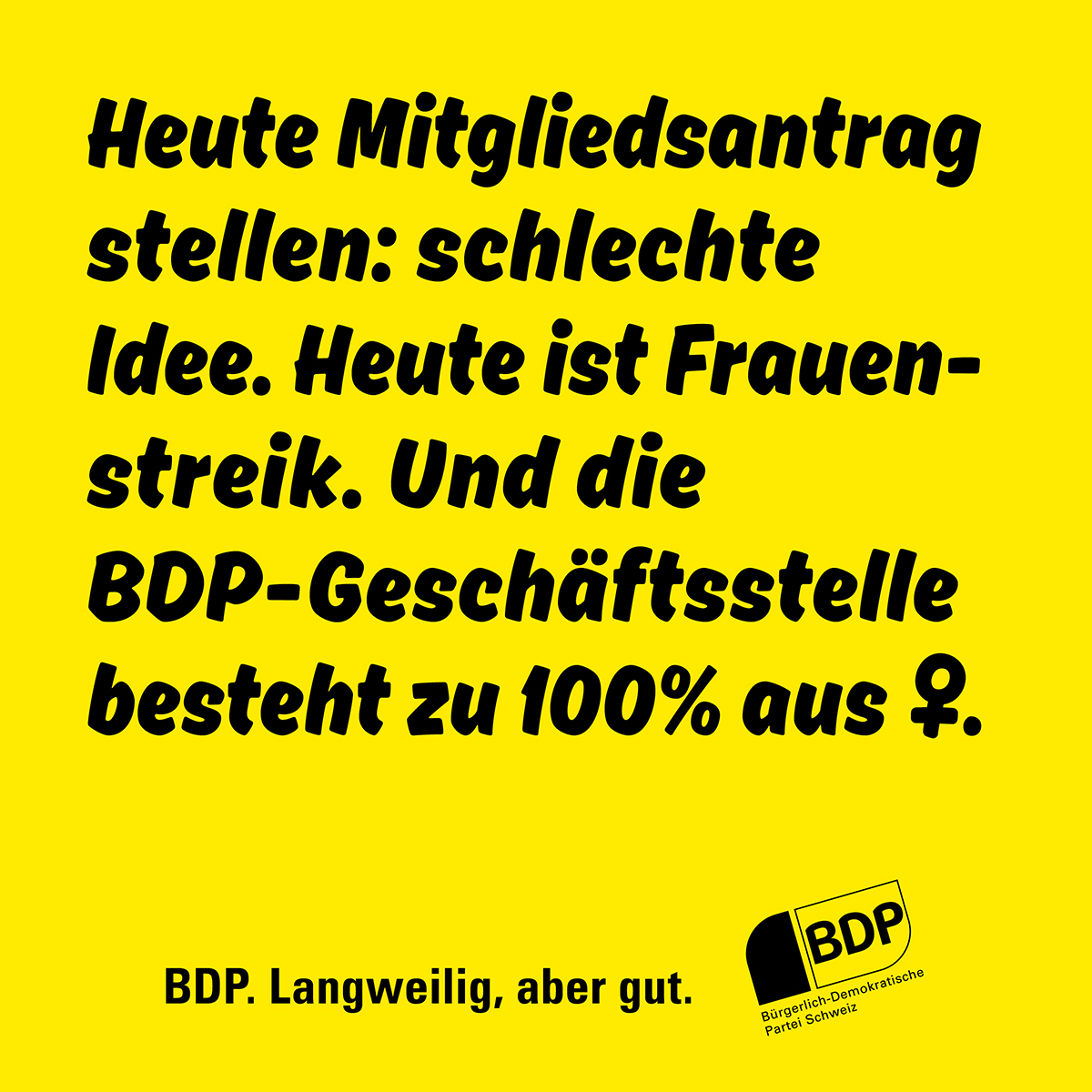
Friendship Plus, mirage and the Pope: PAM continues BDP campaign

PAM Advertising has created additional ad concepts for the ongoing «BDP. Boring, but good.» campaign.

00_Titelbild

Other new slogans promote the BDP's policies, including on Europe and pensions. The party launched its election campaign at the end of April with the slogan "BDP. Boring, but good", which attracted a lot of media attention (Advertising Week reported).

09_Frauenstreik_SM

Responsible at PAM Advertising: Parvez Sheik Fareed, Miro Pfister (creation, strategy, consulting).

In addition to posters, news-related posts are circulating on social media, such as the SP switching to the GLP or the women's strike day. PAM also created a social media video that turns SP Federal Councillor Alain Berset into a BDP mouthpiece: they used Berset's speech at Oxford University, in which he emphasizes the advantages of boring politics.

Alexandra Freyenmuth becomes new Marketing Manager at Converto

Online marketing provider Converto is expanding its team: Alexandra Freyenmuth will join the team as Marketing Manager in July 2019. A graduate in linguistics and history, she brings experience in the fields of PR and social media.

Alexandra-Freyenmuth-Converto-Bild

Alexandra Freyenmuth was already enthusiastic about media work during her studies of Hispanic studies and history, including a teaching diploma for secondary and vocational schools at the Universities of Zurich and Zaragoza. She gained her first experience in this field as a junior PR manager for various Swiss parliamentarians. After graduating, she moved to Düsseldorf and joined TSS in 2015 as PR & Social Media Manager in the B2C sector. In addition to traditional public relations work, she increasingly took on tasks in digital marketing until the end of 2017. During her parental leave, she returned to Switzerland and worked on a project basis as a proofreader at the Institute of Educational Science at the University of Zurich until mid-2019.

Hej wins annual report of the ZVV

Zurich agency Hej wins pitch for ZVV's next annual report trilogy.

zvv-logo

The Zürcher Verkehrsverbund (ZVV) was looking for a new agency for the conception and realization of the ZVV annual report 2019-2021. Hej prevailed in the two-stage competition.

"Hej convinced us with a coherent overall concept and a good understanding of the multi-layered environment of ZVV," Stephan Kaufmann, Deputy Head of Communications ZVV, explained the decision in a statement. 

Hej now also works for the Association of Museums in Switzerland and for the UZH Foundation of the University of Zurich. The agency for branding, reporting and publishing was founded in 2014 by Janine Widler and Helm Pfohl, now has six employees and currently serves around 40 clients from business, education, sports and culture.
 

Y&R Wunderman: A Deal for Infinity

The new campaign for the unlimited UPC Mobile subscription captivates viewers with its "Infinity Zoom" feature.

aba43547-6866-4e9f-b1b8-7a534d98e269

UPC's mobile subscription "Unlimited Swiss" offers unlimited data, calls and SMS at a highly attractive price. Y&R Wunderman designed a campaign that hypnotizes the infinity factor of this offer.

The different subjects use the Droste effect to create a seemingly endless loop. When zooming into the screen of a smartphone, the smartphone itself appears again and again. The headline "The infinitely good mobile deal" is the main message across all media.

UPC-cc

Online banners, out-of-home media, mailings, newsletters, POS material and a double-page spread in Blick as a special format were created. The latter ad shows a seemingly endless spiral of smartphones, which dramatizes the unlimited usability of the subscription. If you look at the screens clockwise, you get an excerpt from the life of a young person in the form of an entertaining, ongoing story. The campaign can currently be seen throughout Switzerland.

Responsible at UPC: Nikki Constantine (Director Brand, Media & Communications), Laura Ballestrin (Manager Marketing Communication), Graziella Gut (Marketing Communication Manager), Ingrid Zaissenberger (Director Content Creation). Responsible at Y&R Wunderman: Swen Morath (CCO), Annette Häcki (CD), Stephanie Belvedere, Andrei Vid (AD), Winfried Schneider (text), Eveline Hagenbuch (consulting).

Mint Architecture develops spectacular facade for Jelmoli at Zurich Airport

Mint Architecture, an architectural firm specializing in commercial and function-oriented architecture, is developing a unique façade for Jelmoli at The Circle as part of a comprehensive commission. Thanks to a sophisticated mix of materials, the façade unites the two planned stores into a strong visual whole.

jelmoli-the-circle-6

The façade design is part of the overall concept developed by Mint Architecture for Jelmoli's presence in The Circle. This comprises two stores on a total area of 2110 square meters, each of which separately reflects Jelmoli's high level of expertise in the fashion and sports sector. "The challenge in developing the design concept was to communicate the individuality of the two stores through the façade and still make them appear as one unit," says Rafael Parga, Head of Design, Mint Architecture.
 
To express the differentiation, Mint Architecture relies on a material mix of black ceramic, white glass and gold metal. In combination, these convey the values of the traditional Jelmoli company in an international environment and give each store its own identity, both inside and out.
 
The façade concept is based on the interplay of materiality, texture, transparency and reflection and is visually inspired by the architecture of The Circle by Riken Yamamoto. The three materials - ceramic, glass and metal - reflect the brand values of timelessness, quality and modernity and change the overall appearance of the façade depending on the angle from which they are viewed. For example, the ceramic façade with its partially broken up herringbone pattern sometimes appears glossy, sometimes matt. The translucent, specially printed glass façade reflects the surroundings, while the golden metal façade stands for performance and dynamism. In combination with the lighting concept developed together with the lighting specialists from Reflexion, the effect of the three façades changes constantly, depending on whether they are viewed from near or far or by day or night. The entire material for the round façade surface is specially developed and produced for Jelmoli.
 
Thanks to the unique appearance of the façades and the stringent continuation of the architecture in the interior design, the two Jelmoli stores are to significantly characterize the "Brands & Dialogue" area.
 
"It is a unique opportunity to freely design the façade and thus convey the value of our brand to the outside world. It reflects our high aspiration to offer our national and international guests a great shopping experience," said Franco Savastano, CEO of Jelmoli, in a statement.
 
The opening of The Circle and thus the two Jelmoli stores is planned for 2020.
 

The-Circle-Jelmoli_Tag_Ansicht (2)

Experience the Orient with all senses thanks to Wirz Brand Relations

Experience the Orient in a contemporary way and with all your senses: This was the essence of Two Spice's assignment to Wirz Brand Relations for the conception and realization of the brand identity for an oriental restaurant in Zurich's Sihlcity.

Yalda_Case_Logo_Medienmitteilung

Designer Timo Lorch dived deep into the oriental world: "It's unbelievable what variety of colors, patterns and materials the Orient offers". In addition to hummus and falafel, the Wirz project team got to know and appreciate numerous other oriental dishes and spices. Light, warm colors and materials, discreet patterns go well with this.
 
The name should also sound oriental, but at the same time be catchy and inviting. "Yalda" meant "winter solstice" in Persian, but also "night of birth," when lovers give each other gifts and have a joyous time. Not a bad premise for a restaurant visit. In addition to the name, Wirz developed the logo, fonts, color scheme and imagery for Yalda, as well as various design applications, for example for the website.
 
Working well and closely with Nader Interior's interior design team and Two Spice's graphic designers has been instrumental in ensuring that a lunch or dinner at Yalda lives up to the brand promise, according to a statement.

Yalda_Case_Umsetzungen_Medienmitteilung

Responsible at Two Spice: Marc Saxer (Managing Director), Annika Koller (Head of Projects), Christian Wirz (Head of Graphics), Katja Gubser (Graphic Designer). Responsible at Wirz Brand Relations: Thomas Städeli (mandate management), Michaela Burger (art direction), Timo Lorch (design), Sandra Kollinger (consulting).

More mobile, more personalized: new digital presence for NZZ am Sonntag

Effective immediately, the digital edition of *NZZ am Sonntag* features a new design and new services. As part of the relaunch, the website was completely rebuilt from the ground up and thoroughly optimized for mobile devices. With this move, *NZZ am Sonntag* aims, in particular, to better cater to the usage habits of a younger readership.

NZZaS-Desktop

The new look, which is characterized above all by clear typography, structuring, warm colors, and generous white spaces and images, is in keeping with the character of the NZZ on Sunday and the younger target groups targeted by the digital presence. The website consistently places journalistic content at the center... "With the new design, we are taking account of structural change and changes in media use," says Luzi Bernet, Editor-in-Chief of the NZZ on Sunday. 

Among other things, readers will receive new personalized and tailored content recommendations based on their reading behavior. Registered users can also save content to a watch list.

In addition to the new design and features, there are also technical adjustments. The website is based on a new frontend technology and was completely rebuilt. Thus, the loading of dynamic content and the speed of the website could be optimized significantly.   

It is striking that the new "look and feel" has clearly converged with the digital NZZ. Identical and related font styles and the introduction of coinciding services and functions, such as the watch list function, underscore the fact that the "Neue Zürcher Zeitung" and "NZZ am Sonntag" brands belong to the same product family. "Our goal was, on the one hand, to combine the strengths of the NZZ am Sonntag digital to be highlighted. On the other hand, we also want to provide users with functions and services for Sunday reading that are the same as those of the digital NZZ. In this way, we are also creating the basis for more efficient technological development of both titles," says Katrin Huth, Product Manager at NZZ Management. 

The new design language was developed and implemented in collaboration with the Berlin design agency Eden Spiekermann and the in-house designers.
 

"Employers have become more reluctant to co-fund"

For career counselor Caroline Schultheiss, going back to school just for the sake of it makes no sense. Instead, the career counselor advocates an analytical approach that involves honestly answering a number of questions in order to derive the maximum benefit from continuing education.

54_Caroline-Schultheiss

Caroline Schultheiss has been working at the Kaufmännischer Verband Zürich (KFMV Zürich) since 2017, where she has established a professional career counseling service.


MK: Continuing education is part of good manners in the professional world today. Is there some kind of unwritten code about the intervals at which you should dedicate yourself to new training once you reach a certain position?

Caroline Schultheiss: I'm not aware of a code, but knowledge becomes outdated quite quickly these days. That's why it makes sense to continue your education on a regular basis in order to stay up to date, i.e. to keep your employability high. At the moment, there is almost a hype about continuing education, that's correct. It has become a huge business, which naturally increases the pressure on employees. People often forget that continuing education cannot only take place in a school/institution: When I read technical literature, attend lectures and events, I am also continuing my education. And of course I can also continue my education on the job by using new tools or computer systems, exchanging ideas with experts or keeping up to date in my field.


Isn't there a danger that people will sign up for further training for image reasons, but which in fact brings them hardly anything apart from costs and loss of time?

It is important for me to answer the following questions before making a decision about continuing education: Why do I want to do continuing education? What do I want to achieve with the continuing education? Do I want to obtain a recognized degree or do I want to expand specific competencies? I recently had a client who was interested in a PR specialist and a CAS at a university of applied sciences. She had talks with the head of the program, studied the curriculum and finally sat in on a class. Only then was the decision clear for her. And not to forget: Many roads lead to Rome. In very few cases is there only one "right" continuing education program.


In your opinion, what conditions and framework conditions should be in place to ensure that the investment in continuing education is really worthwhile?

Interest and motivation in the subject is the most important thing for me. What skills and competencies do I have, which ones do I want to acquire or are important for my job? As far as the framework conditions are concerned, time is certainly relevant, that you plan your absences from work and family in advance and think about time windows for learning. Then, of course, the question of costs is important: Will I pay for the training myself? Will my employer support me?


Does further training, for example in marketing and communications, usually also result in a direct jump in career and salary?

It is often the case that employees change jobs after further training or take on more responsibility in the company. When there is a change of function, the salary is of course always an issue. You simply have to pay attention and ask whether the training you have completed is also relevant to your function - this is often forgotten. In my opinion, it's worthwhile to discuss this issue with your supervisor before you start your training. What's in it, what's not? Or do I see my next career step with another employer?


Is it advisable to ask the employer for a financial contribution for further training?

Employers have become more reluctant to co-fund in recent years. Often, when an employee reaches a certain amount, he or she is obliged to stay with the employer for a certain time after graduation. I think that's a fair solution per se, but of course you can always buy your way out. If the training is relevant to the job, then I would certainly ask the employer for a contribution. If I'm doing something to develop in a new direction, then probably not.


Before signing up for further training, should you always consider who exactly stands to gain from it? Only oneself or also the employer?

Each person always sits in a further education and invests a part of his life time in it. You always do continuing education for yourself - usually the technical aspect is only one aspect of it. Equally important is the personal development, the broadening of horizons and the change of perspective, and of course the network that one can build up.


What misconceptions should you avoid when starting a continuing education program?

Further training does not per se mean a career move or a leap up the hierarchy. The transfer of the acquired knowledge is important: How do I use it in practice, how do I implement it successfully? What can I take away for my own personal development?


In our fast-moving and increasingly digitalized world, the number of people changing jobs and career changers is on the rise. A clear argument for more training?

Yes, definitely. Changing industries without practical experience requires at least a theoretical grounding in order to learn the subject matter. The world of continuing education has also changed in recent years, and there are increasingly shorter courses to familiarize yourself with a subject - it doesn't always have to be a multi-year course of study.


Interview: Robert Wildi


Caroline Schultheiss has been working at the Kaufmännischer Verband Zürich (KFMV Zürich) since 2017, where she has established a professional career counseling service. In addition to the introduction and use of diagnostic test procedures, she also conducts various seminars or application workshops, among other things. At the same time, Caroline Schultheiss is herself an active consultant for professionals. The trained literary scientist and business economist trained among other things as a career, study and career counselor and worked before her engagement at KFMV Zurich at Credit Suisse, DZ Privatbank (Switzerland) and in various career information centers.

get_footer();