Ruf Lanz launches new campaign for the Animal in Law Foundation

The Tier im Recht (TIR) Foundation is once again featuring Ruf Lanz in its current campaign.

Ruf Lanz

Animals are at our mercy and cannot stand up for their interests themselves. They are therefore dependent on people who do not look the other way in cases of animal cruelty and other violations of the law, but act and stand up for animal-friendly animal protection regulations and consistent enforcement.

With its latest campaign, the Foundation for Animals in Law (TIR) draws attention to the fact that in Switzerland, too, countless animals live under conditions that violate the law. Many animal welfare violations are not investigated and punished adequately or at all. The awareness of these abuses must be raised again and again.

"Only animals are allowed to look the other way when it comes to animal cruelty" - humans, on the other hand, are not allowed to look the other way, but must act. This is already the fifth appearance that Ruf Lanz has conceived and realized for Tier im Recht. According to Gieri Bolliger, TIR's managing director, the previous campaigns "have caused quite a stir and triggered committed debates around animal welfare. In addition, awards such as ADC Gold or Poster of the Year have brought us and our work to the attention of new media."

From May 11, the new campaign can be seen in media-appropriate versions on F200 and F12 posters, on ads in newspapers and magazines, in various online media and social media channels, and on the TIR website. All subjects were created entirely on the computer. Of course, no animal was harmed in any way.

Ruf Lanz

Responsible at Tier im Recht (TIR): Gieri Bolliger (Managing Director), Christine Künzli (Deputy Managing Director), Vanessa Gerritsen (Deputy Managing Director), Michelle Richner (Legal Research Associate). Responsible at Ruf Lanz: Markus Ruf, Danielle Lanz (Creative Direction), Isabelle Hauser (Art Direction), Christian Stüdi, Markus Ruf (Text), Armin Arnold (DTP), Lara Cavelti (Consulting). Post production: Michèle Aschmann, Aschmann Klauser.

m&k: Total relaunch for Swiss marketing magazine

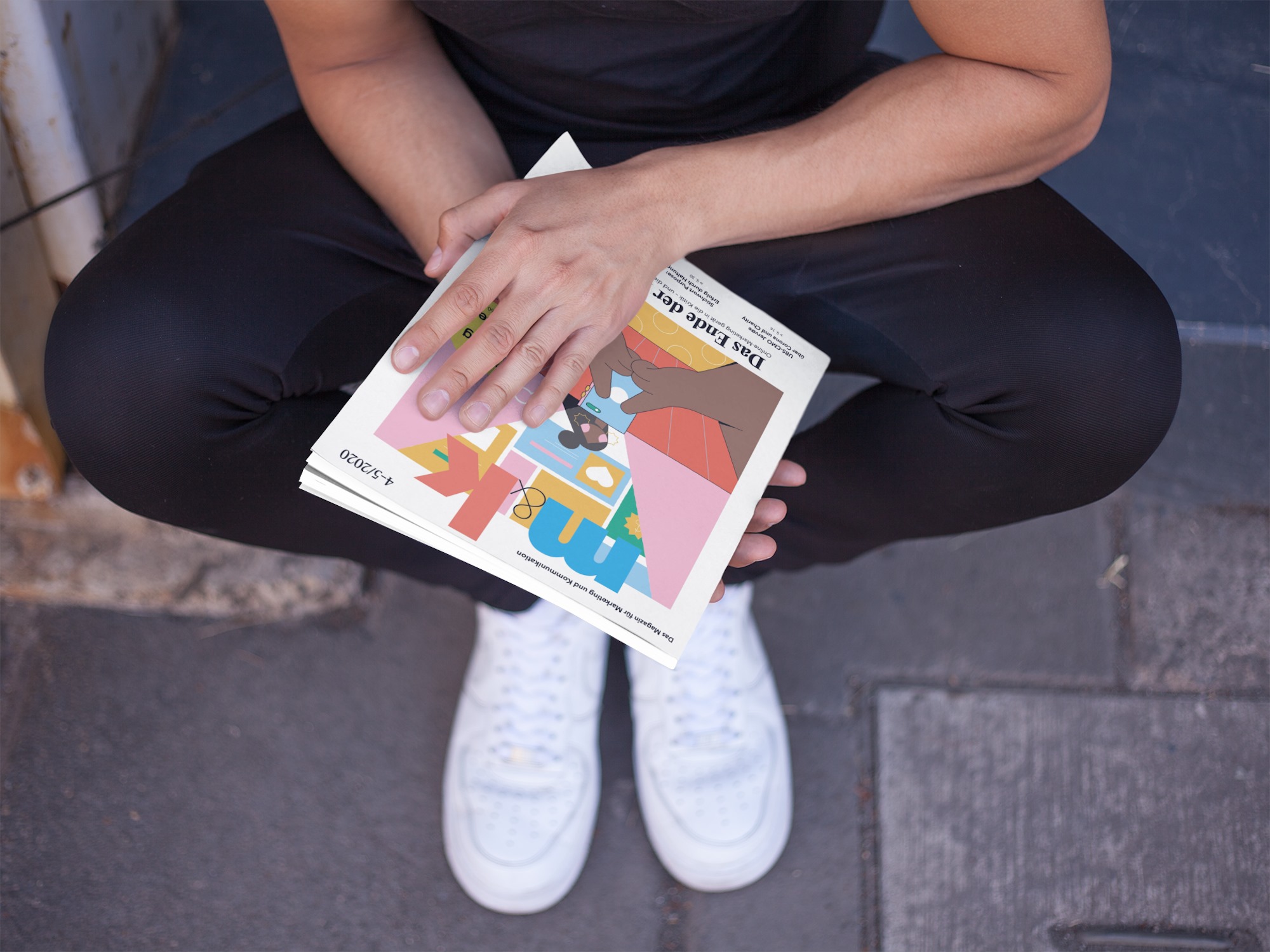
The editorial team at MK Marketing and Communication and Art Director Adrian Hablützel have given the long-standing publication a complete relaunch. «m&k – The Magazine for Marketing and Communication» is the name of the new publication, which will arrive in subscribers’ mailboxes on May 11.

m&k

After months of intensive preparation, today is the day: As of May 11, all subscribers will receive the completely revised version of the title in their office or home office. The change of name to m&k - The magazine for marketing and communication is still the most minor innovation.

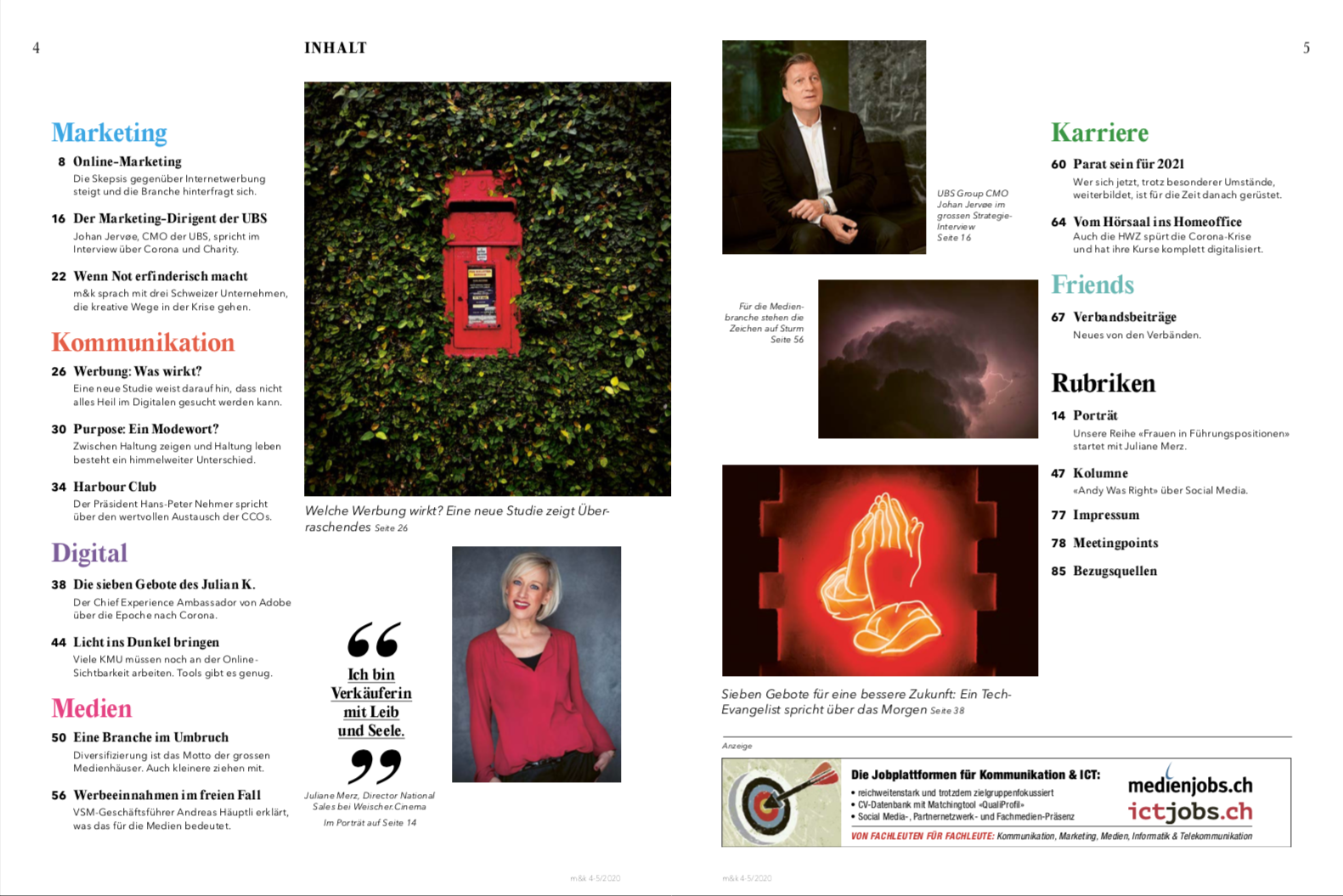
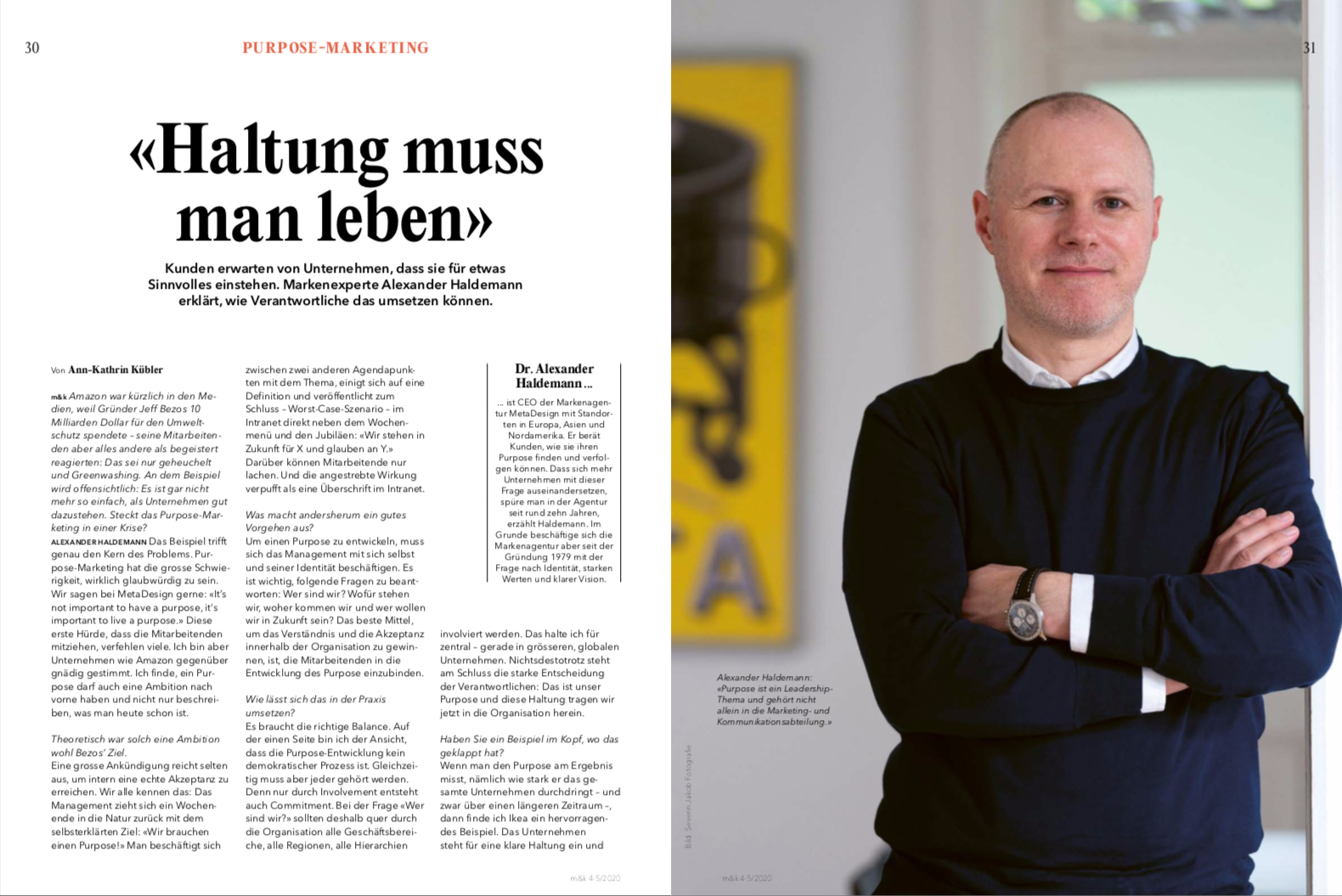
Because together with art director Adrian Hablützel, who has already worked for Annabelle or We parents the editorial team has transformed the previously text-heavy product into a contemporary magazine. Generous space provides the necessary room for more compact but equally informative articles. They are complemented by photo spreads that will be remembered.

m&k

A magazine that informs and is fun

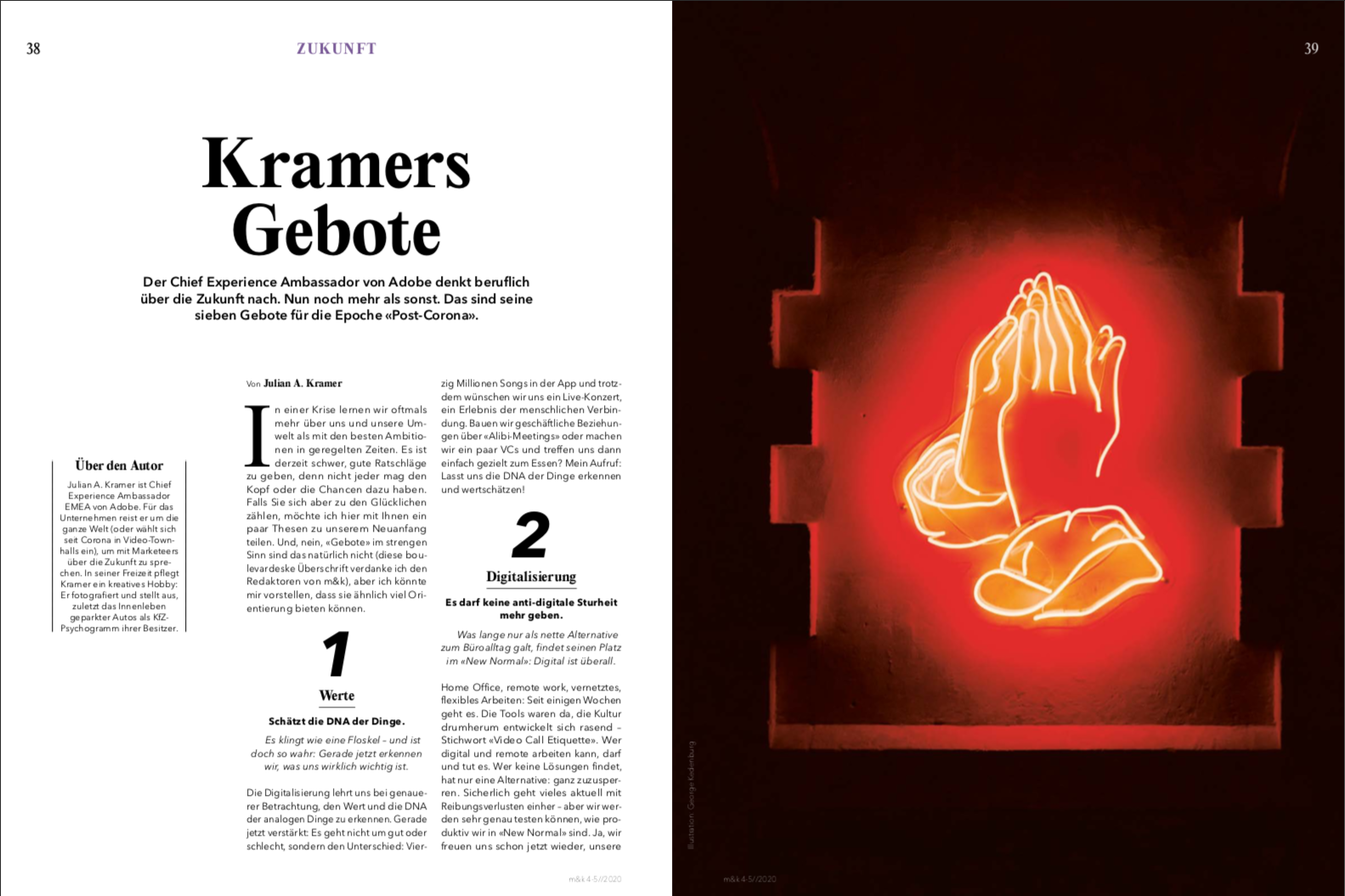
While m&k is of course still a trade journal, the magazine will in future also be fun for people whose daily bread is not earned in marketing or communications. After all, critical reports or in-depth interviews, the m&k The new technology, which will be offered in the future, will also allow us to look beyond our own backyard - and beyond the borders of Switzerland.

What remains unchanged are informative texts for those who want to further their education on the job. But these have also been adapted to the reading habits of our time - so that readers can find what they are looking for more quickly.

m&k

"Immensely pleased with the new m&k".

Anna Kohler, the editor-in-chief of m&k, on the all-round improved magazine: "We show that tradition and modernity can harmonize with each other. Quality and reading pleasure are not contradictions. I am incredibly pleased with the new magazine."

And also Daniel Ettlinger, CEO of the Galledia Group, the m&k says: "Our team has done a great job. The relaunch of the magazine has been a complete success. In the subject area of management and communication, our product range of print magazines, the online platform and the marketing talks has thus been completely renewed and represents a comprehensive high-quality offering for professionals and interested parties."

m&k

For those interested: Here you can get the subscription!

Those who want to convince themselves of the qualities of the "m&k" will find here by the way, all the information about a subscription. The magazine is sent out once a month in combination with "Werbewoche," the industry journal for agencies and Swiss creative professionals - a perfect duo for anyone who wants to stay up to date in the future.

Rod accompanies the new digital appearance of 20 Minuten

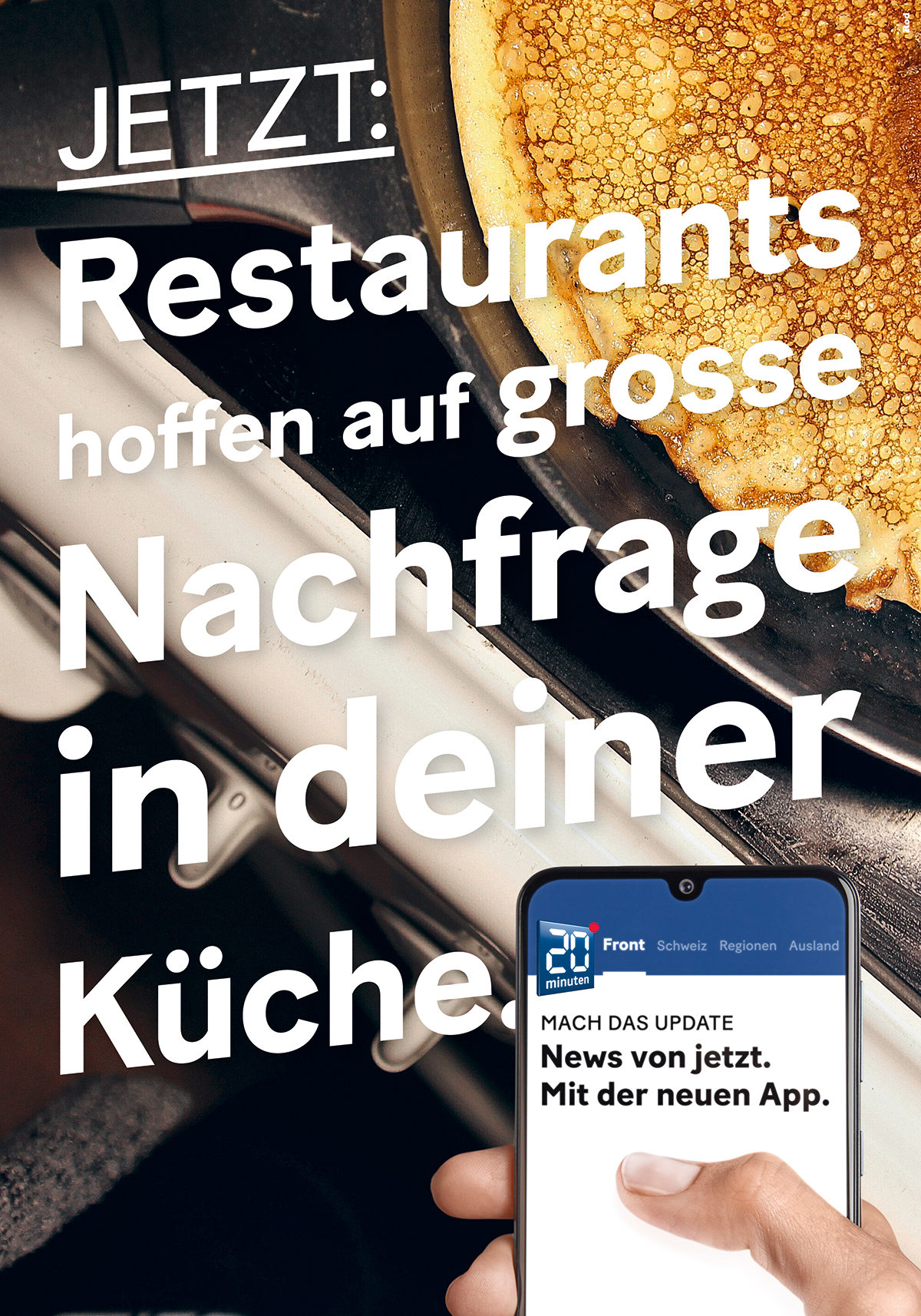
Since April, 20 Minuten has been showcasing a completely revamped digital presence. Rod is supporting the new website and app with a 360-degree campaign that is tailored to the current context.

20 Minuten

Rod's 360-degree campaign is designed to motivate users to download or update the new app. This is because the "News from Now" comes in an even more attractive, contemporary presentation.

The campaign relies heavily on the community's feeling of being "in the thick of things. The cover stories take place in one's own bathroom, in a train compartment or on the balcony. In a playful way, the campaign aims to bring together current events with individual locations where the community consumes the news prepared by 20 Minuten. This also communicates 20 Minuten's claim to provide its audience with the most current and relevant articles, always and everywhere.

"Our new digital presence allows us to connect even more closely with our community
and accompany them through the day with news, radio and video formats. In
Our agile development process gives us the opportunity to provide constructive feedback.
and thus our platform is continuously developing. With the
launch campaign, we have managed to transform our digital DNA into an emotional message.
and to take up the current zeitgeist in a playful way," says Valérie Henzen, Chief Marketing Officer at 20 Minuten.

The campaign has been seen since Wednesday in online spots, online banners, on billboards, advertisements and hanging boxes.

20 Minuten

Responsible at 20 minutesValérie Henzen, Franziska Wiesner. Responsible agency: Rod Communication. Image editing: Rohner Retouch. Photo production hands: Prodigious (Publicis Communications Switzerland). Lithography: Blue Horizon. Production Online Banner: 316tn.

The Corona tracing app will not come into regular use until the end of June at the earliest

The federal government is launching a pilot phase of the corona tracing app next week. The corresponding legal basis is to be adopted by Parliament in the summer session.

Corona

It is therefore clear that the tracing of coronavirus cases via app is unlikely to be used regularly until the end of June at the earliest. The final votes on the matters dealt with in the summer session are expected to take place on June 20.

Parliament called for a legal basis for the proximity tracing app in the extraordinary session this week. It referred a corresponding motion to the Federal Council. The Federal Council will adopt an urgent dispatch for the attention of Parliament by 20 May, as it announced on Friday. It will amend the Epidemics Act accordingly.


Data deleted after three weeks

Prior to this, the app developed by the two Federal Institutes of Technology and the federal government will be tested in a pilot phase. The Federal Council intends to issue a temporary ordinance for this test phase next week. The app is intended to help break chains of infection. It should inform its users if they have been in the vicinity of infected people for too long.

According to the Federal Council, use of the app is voluntary. No personal data or location details of app users are used. All data in the app will be deleted after 21 days. The app will only be used during the containment phase. It complements the contact tracing that the cantons will be carrying out again across the board from next week.


Voluntary registration in restaurants

The Federal Council has also approved the changes to the Covid-19 Ordinance for the opening of restaurants from next Monday. As already communicated, a maximum of four people or parents with children are allowed at a table. All guests must be seated. A distance of two meters or separating elements are required between tables.

In order to enable contact tracing in the restaurants as well, the contact details of one person from each guest group should be recorded. This information is voluntary. The Federal Data Protection Commissioner had already announced this on Thursday following criticism of plans to the contrary. (SDA/swi)

Heads communicates for the Zurich museums

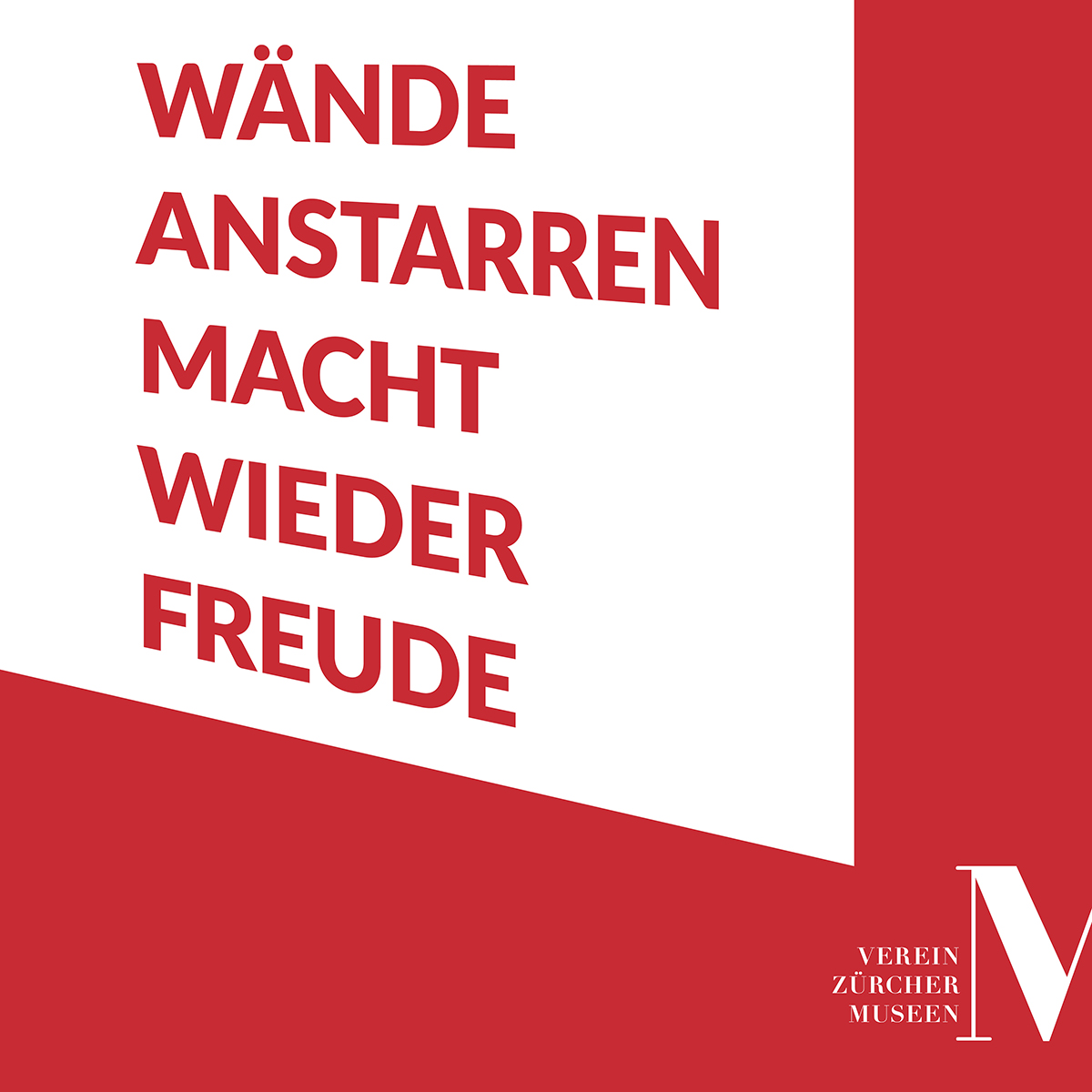
On Monday, Zurich’s museums will also reopen their doors. The agency Heads Corporate Branding aims to fuel the anticipation surrounding this event with an announcement campaign.

Heads

In a pitch for the new image of the Zurich Museums Association, the Zurich agency came out on top. The new image will be on display in the summer. In addition to the numerous museum visitors, the new appearance should also increasingly appeal to a younger audience, which at the moment is more likely to find its way into the exhibition rooms during the successful "Long Night of the Museums".


Reopening after lockdown

On short notice, Heads has now been hired to communicate museum openings after the lockdown as well. How important the missing culture is to the population is shown by a study published on Thursday by Tages-Anzeiger and GDi Gottlieb Duttweiler Institute: What is missed most is meeting friends and relatives (81%), but the second most missed by Zurich residents is cultural events (50%). So it's good that the first museums are opening their doors on Monday.

The subjects will appear in the coming days in Tages-Anzeiger and in the NZZ, on Zurich cultural billboards, and on social media.

Heads

ETH Zurich with a fresh appearance

The Swiss Federal Institute of Technology Zurich has unveiled a refreshed corporate design. The institute’s corporate design team developed it in collaboration with the agency Scholtysik & Partner.

Scholtysik & Partner

As visual habits change over time, University Communications has revised ETH's corporate design, which has been in place since 2013, for all media in recent months. The refreshed corporate design is intended to make the university's image more concise, modern and attractive. It is also intended to ensure consistency and clarity across all channels.

The new appearance of ETH Zurich is a further development of the current design. In future, the logo will be used consistently in black and white. A conscious effort was made to ensure that the old and new designs can coexist for a transitional period. This is also important in view of the current situation: nobody should feel compelled to revise existing media immediately.


Over 500 websites with a new look

The more than 500 ETH websites, which are maintained via the central content management system, also have a new look and feel. In addition to the refreshed design with more white space, consistent use of the ETH font and a general streamlining, work has also been carried out on the functionalities and user-friendliness.

A new main navigation is intended to give users a quicker overview of the content of the entire website and enable easy direct access. The navigation area on the individual content pages has been reduced and the focus is now more on the actual content. In addition, the design of the pages is even better geared towards mobile use.

Another focus of the further development was on accessibility. Findings from an extensive accessibility review were also incorporated into the redesign.


A first step

Refreshing the website is part of the long-term program "Online communication 2022"which has set itself the goal of fundamentally modernizing ETH Zurich's digital communication channels. This goes far beyond the design and is taking place step by step. Over the coming months and years, further innovations are to be implemented on the web on an ongoing basis. The IT Services and University Communications are jointly responsible for the program.

Marketing trends 2020: Has AI arrived in business?

As part of this year’s «AI for Business» conference, which was held virtually, software manufacturer BSI and Ai-Zürich conducted a survey on marketing trends in 2020 and examined whether and how AI is used in everyday work.

Marketingtrends

Everyone is talking about automation and (hyper)personalization thanks to artificial intelligence, but have these trends really arrived in DACH companies? The results indicate that although AI, automation and personalization are very important, most companies are not yet technically equipped for them.


1. personalization and automation are winning the race

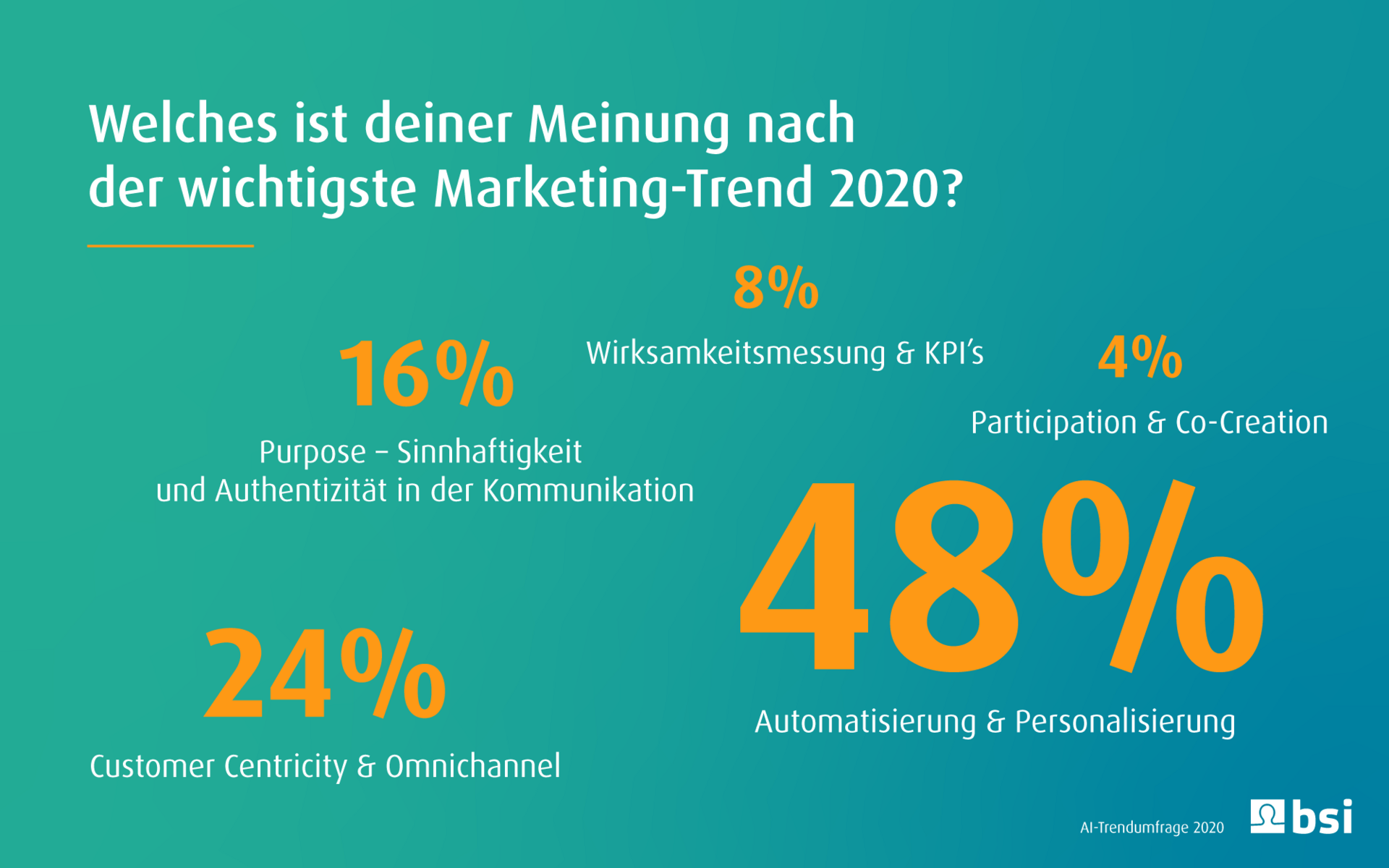
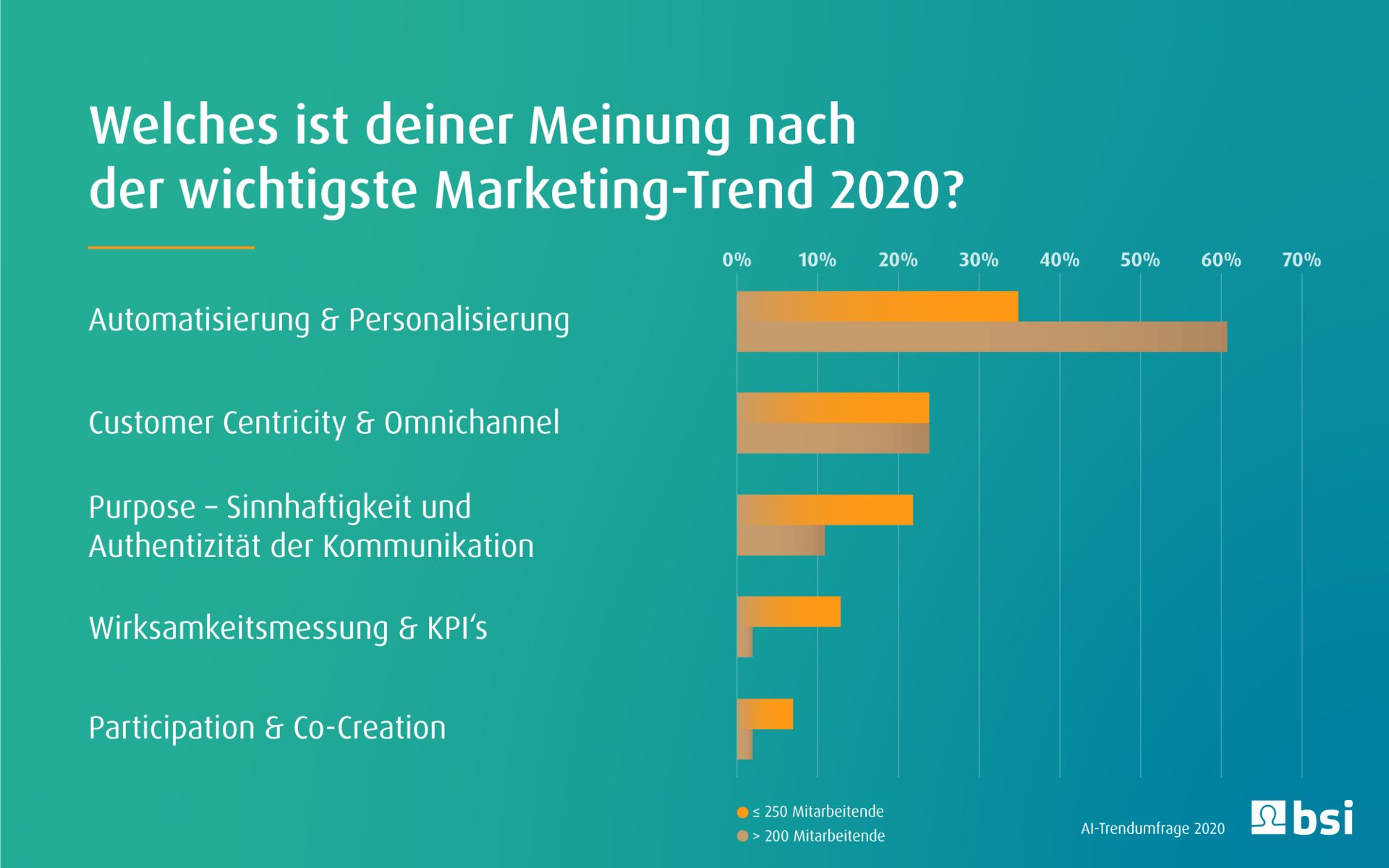
48% of respondents see automation and personalization as the most important marketing trend in 2020, followed by customer centricity and omnichannel (24%), and purpose in the sense of authentic and meaningful customer communication (16%). Only 4% of respondents see the active involvement of customers in marketing (participation & co-creation) as the most important trend.

Marketingtrends

A comparison between SMEs with up to 250 employees and large companies reveals interesting differences: a majority of 61% in large companies see automation as the dominant trend, compared to only 35% in SMEs. The latter consider meaningful, authentic communication to be more important than large companies (22% compared to 11%). One possible explanation: SMEs may have the impression that automation projects are too expensive for them or that the effort is not worth it.

Marketingtrends

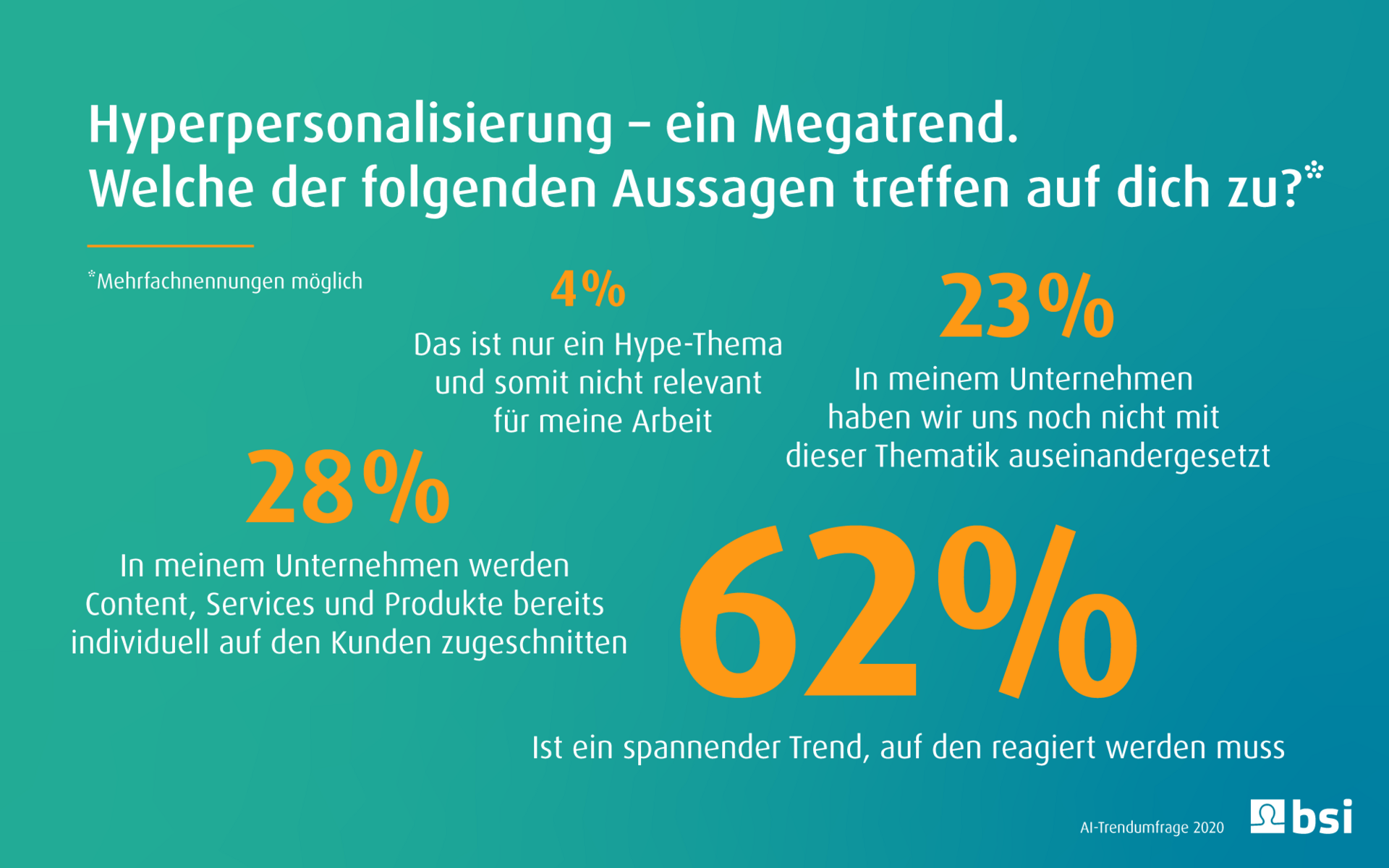
62% of the professionals surveyed see hyper-personalization as an "exciting trend that needs to be responded to", but content, services and products are only actually tailored to the customer in around a third of cases (28%). 23% of companies have not even addressed this trend yet. So there is still some catching up to do here.

Marketingtrends

2. AI enthusiasts hope for support at work

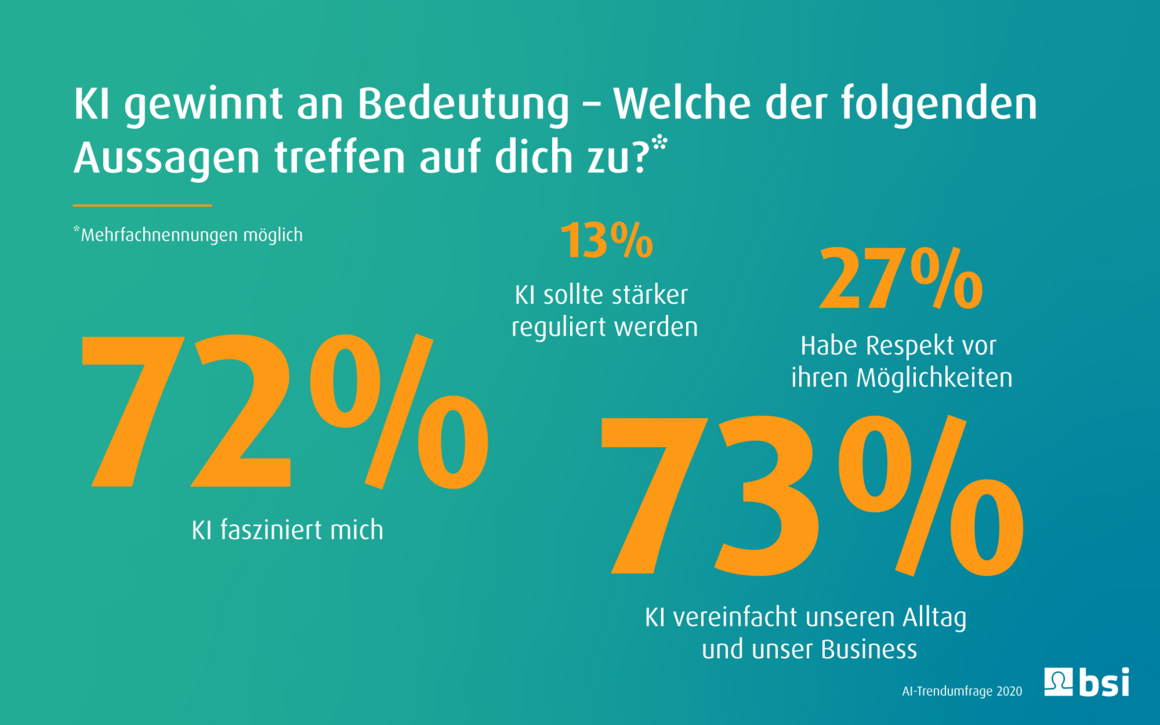
Three out of four experts from marketing and IT are convinced that artificial intelligence offers them added value in their business (73%). However, just under a third have respect for the possibilities of AI (27%) and 13% believe it should be more strictly regulated.

Marketingtrends

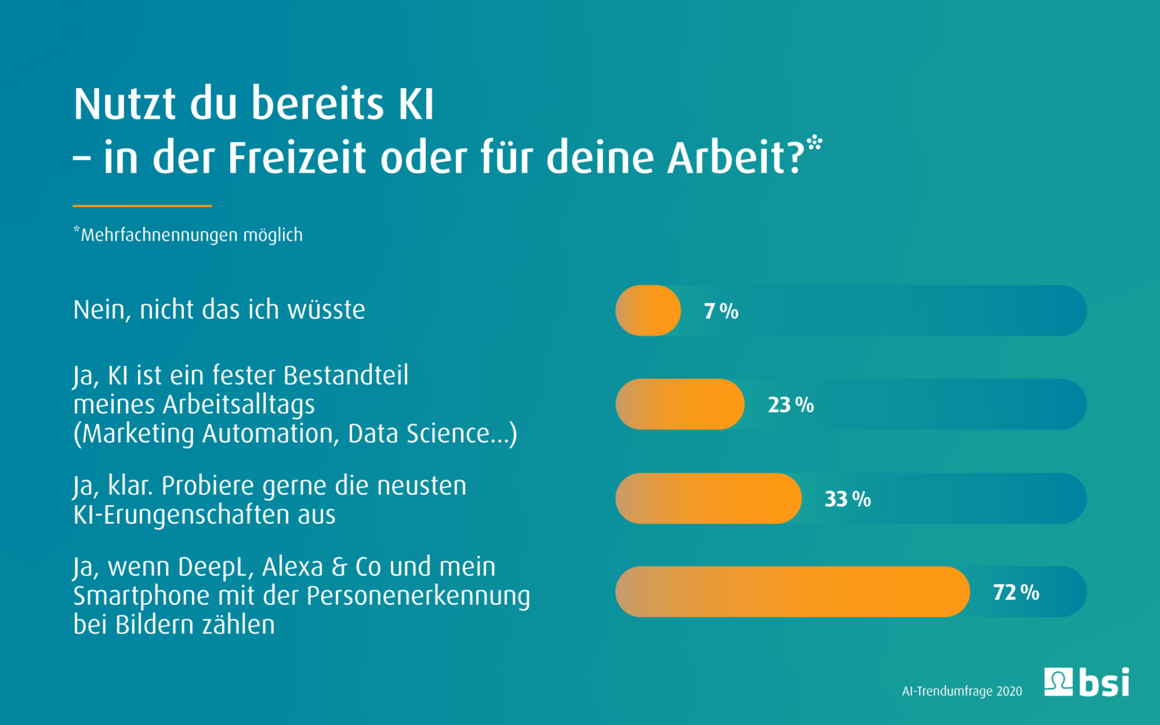
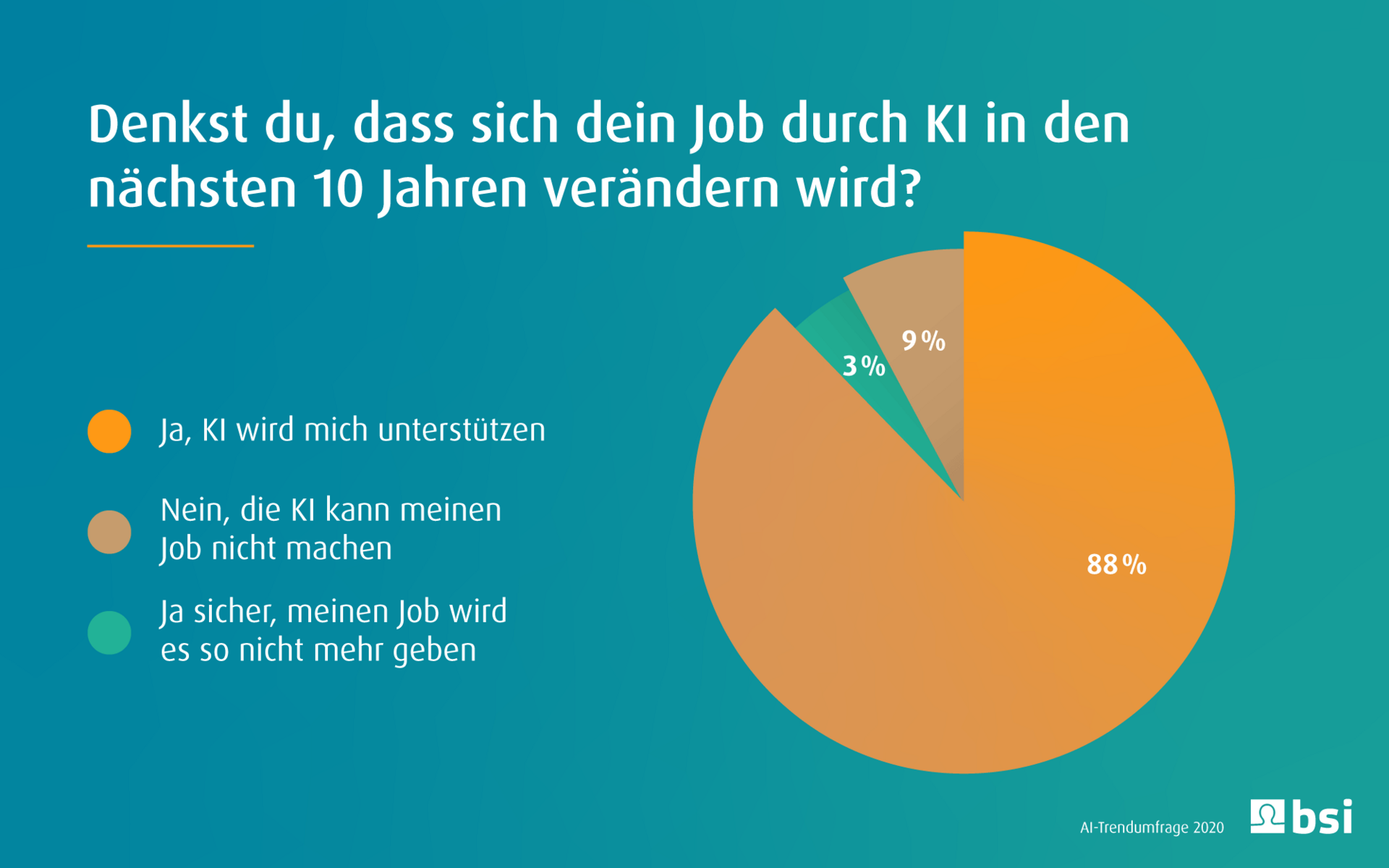
AI is already present in everyday life: 72% of respondents confirmed that they use AI tools such as DeepL, Alexa and people recognition on their smartphone, while 23% of professionals even use AI as an integral part of their work. Only 7% stated that they do not use AI applications at all. When asked whether AI will change their work in the next 10 years, 9% answered in the negative. They are convinced that AI will not be able to do their job. Only 3% fear that their job will no longer exist. The vast majority of respondents (88%), on the other hand, are optimistic and expect AI to support them in their work.

Marketingtrends

"Only a quarter of respondents are already benefiting from AI in their jobs. This confirms me in my mission to make an important contribution to the use of artificial intelligence in DACH companies with Ai-zurich. My team and I want to show professionals from all areas of the company how they can use AI profitably. It is and remains exciting and challenging," says Sophie Hundertmark, founder of Ai-zurich, commenting on the results.

Marketingtrends

3. reality check: marketing automation is still a long way from being established

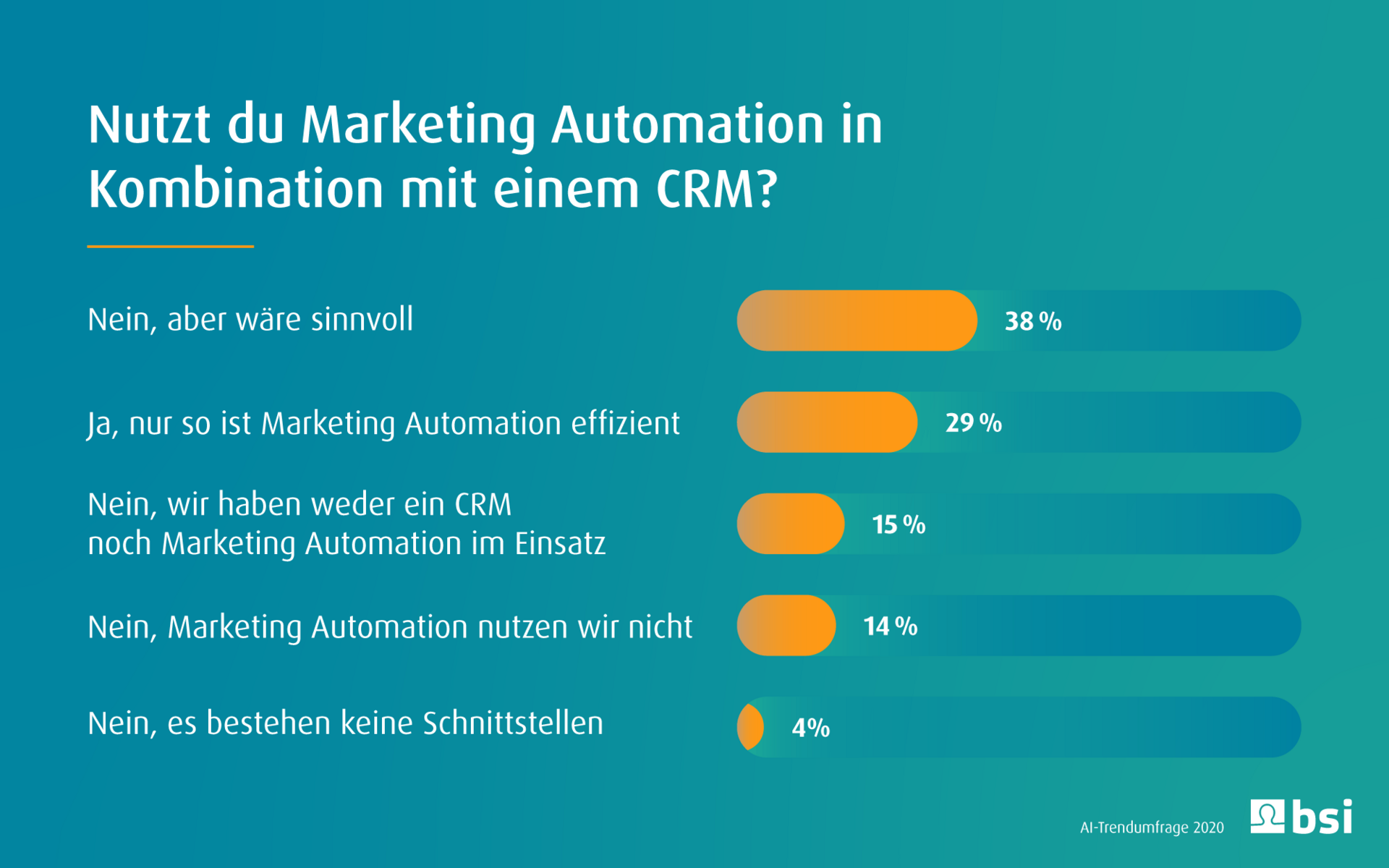
Only just under a third of respondents (29%) already use marketing automation in combination with a CRM. 38% stated that the combination of CRM and marketing automation makes sense, but is not (yet) in place in their company. 14% stated that they do not use marketing automation and roughly the same number have neither a CRM nor marketing automation in use (15%).

Marketingtrends

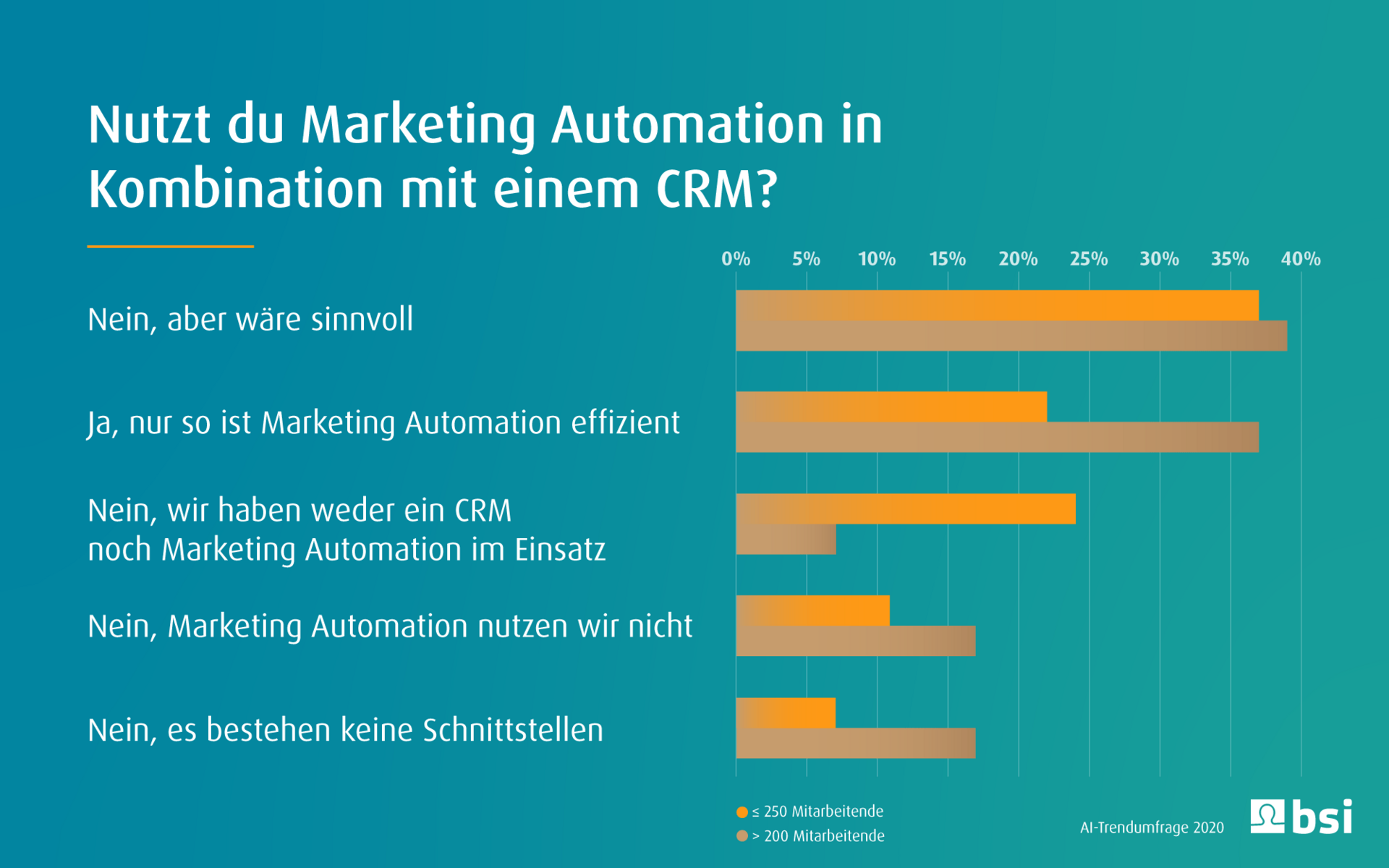
If the size of the company is also taken into account here, it becomes apparent: Around a third of corporate groups use a combination of CRM and marketing automation (37%), while the figure for SMEs is significantly lower (22%). 24% of SMEs use neither CRM nor marketing automation, while only 7% of large companies have to make do without both in lead and customer management.

Marketingtrends

"The prerequisite for automated, personalized and data-driven customer communication is professional data management and a 360-degree customer view. This is not possible without a CRM system. But only in combination with marketing automation and an omnichannel approach can customer and lead management be brought up to a contemporary level," comments Claude Schuler, Marketing Automation Specialist at BSI, on the BSI trend analysis.

The survey sample is made up as follows: 92 participants were surveyed, 28% are from the marketing/communications sector, 25% from the IT sector, 23% are in the management of a company, 7% work in sales, 4% in service and 12% in other areas.

Vaud weekly newspaper Le Régional has to close down

Le Régional, a local, free weekly newspaper in the canton of Vaud, has gone bankrupt. Thirteen journalists and five administrative staff members are losing their jobs.

Wochenzeitung

Director and Editor-in-Chief Stéphanie Simon announced on Wednesday that the newspaper will cease publication with immediate effect. External employees, photographers and a proofreader will also be affected. Simon lamented the lack of support from municipalities in the region and the authorities for the paper, which has been published for 25 years.

According to the media union Impressum, the newspaper, which had already been in difficulties before the coronavirus crisis, was on the road to recovery. However, this was abruptly ended by the coronavirus crisis.

The free newspaper Le Régional was published with a circulation of 127,000 copies. It was distributed from Lausanne to St-Maurice VS. (SDA)

Ferris Bühler Communications tells stories from the home office for Selligent

Ferris Bühler Communications has created a video campaign for the international MarTech provider Selligent Marketing Cloud. In the campaign, the storytelling agency uses humor and wit to show how marketers are struggling with unforeseen problems while working from home.

Ferris Bühler

Following a successful pitch, the Baden-based storytelling agency Ferris Bühler Communications has been supporting Selligent Marketing Cloud, the B2C platform for marketing automation, in the areas of PR, event organization and content production in German-speaking countries since the beginning of April.


The digital struggle

With the coronavirus-related regulation on working from home and the lockdown, many marketers and entrepreneurs are finding that their existing processes and working methods are not necessarily fit enough for the digital age and that it is difficult to maintain customer relationships without physical contact.

Selligent Marketing Cloud has therefore set itself the task of showing marketing managers how their day-to-day work can also be managed digitally and how they can reach their customers on all channels with the right messages. To this end, the MarTech provider cleverly shows funny everyday situations in the home office in the video campaign, emphasizing the advantages of automated, AI-supported marketing activities.


Fast and flexible implementation

Ferris Bühler Communications developed and implemented the video campaign within two weeks - not an easy task in the coronavirus environment. The online campaign is now being used by Selligent Marketing Cloud in several countries in Europe and is being supported by the agency in German-speaking countries with further PR measures.


Responsible at Selligent Marketing CloudSebastian Mengewein (Business Director DACH & Eastern Europe); Alexander Handcock (Senior Director, Global Marketing); Carina Schmitz (Marketing Manager (DACH-PL-BNL). Responsible at Ferris Bühler CommunicationsFerris Bühler, Larissa Eichin, Christine Bohn. Video production: Black Frame Studios.

Marc Blume joins Ginetta

The Zurich-based agency Ginetta is adding experienced UX researcher and methodology specialist Marc Blume to its team

Ginetta

Blume studied psychology in Germany and the USA, specializing in industrial and organizational psychology. From 2001, he led the User Centered Design team at Swisscom Innovations, where he met Ginetta founder Simon Raess. In 2007, he moved to Stimmt, where he first worked as a project manager, later as a methodology specialist. From 2014 to 2020, he taught and researched at the Institute of Marketing Management at ZHAW in Winterthur as a lecturer for Customer Experience Management.

In addition to his position as Senior User Researcher at Ginetta, Blume continues to teach Qualitative User Research in the CAS Service Design & Innovation and the CAS Business Analysis and Methods at the ZHAW. At the University of Applied Sciences in Rapperswil, he also supervises students of the MAS Human Computer Interaction Design (HCID) in their master's theses.

As a psychologist, Blume is always diving deep into the world of the user to explore habits, needs and goals of different application groups. At Ginetta, he will use the findings from his studies to work with designers to create customized user interfaces. He has already been contributing his expertise to initial Ginetta projects since March 1, 2020, such as those for Ikea and Endress+Hauser.

The Corona crisis is changing food retailing

A study by the Institute of Brand Logic shows that the food industry expects the crisis to last 7.3 months. Changes in consumer behavior are cited as the most important consequence, as are concerns about increased price sensitivity among customers.

Institute of Brand Logic

200 decision-makers in German-speaking food retailing (LEH) were asked for their assessments of the corona crisis and its impact on the industry. The scenario study shows: Most companies expect the consequences of the pandemic on their business to continue for several months and, in some cases, to have a long-term impact. Strict hygiene regulations, restrictions on store opening hours and changes in customer behavior pose particular challenges for the food retail sector.


Homogeneous opinion regarding duration and effect

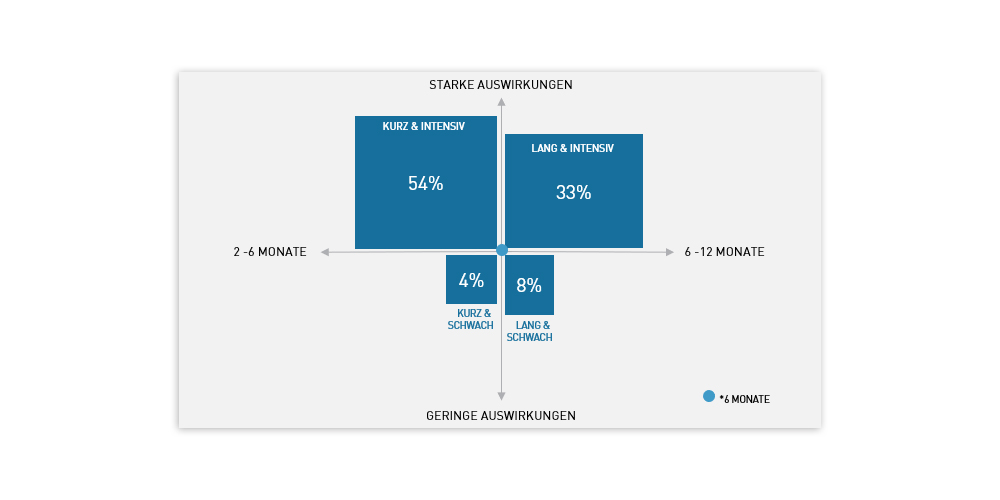
"Overall, our survey shows a relatively homogeneous opinion among the 200 companies surveyed with regard to the challenges caused by the crisis," analyzes study author Markus Webhofer, founder and CEO of the Institute of Brand Logic. For the food retail industry, the duration and intensity of the crisis in particular would determine the economic and operational impact for the sector. "The scenario with the absolute greatest probability is the one with a short duration but intensive impact. Retailers will experience clearly noticeable changes for the foreseeable future, but according to the survey, the majority consider them to be manageable," says Webhofer. On average, respondents expect the crisis to last 7.3 months. However, as many as a quarter expect it to take more than a year for the situation to return to normal.

Institute of Brand Logic

Source: Institute of Brand Logic


Almost all companies surveyed expect strict hygiene regulations to be in place for the entire duration of the crisis. "The high risk of infection from the coronavirus is forcing retailers to take extensive measures to protect customers and employees from infection," says Webhofer. "On the one hand, this causes noticeably higher costs for the companies, but on the other hand, it also has positive effects on the health of the employees - sickness rates are low at the moment as a result."


Changing consumer behavior

80% of the food retailers surveyed state that online demand has increased sharply since the start of the crisis - resulting in massive congestion in online delivery logistics. In the longer term, too, clear consumer trends seem to have emerged that have triggered or intensified the crisis: 64% of the study participants expect weekly shopping to gain in importance, while 55% see the shortest possible travel distances as a trend. In terms of product selection, regional products (65%) and healthy eating (59%) are likely to become even more of a focus for consumers than before.


Increased savings behavior

One concern of most respondents: the crisis is likely to lead to increased savings among consumers and reduce the proportion of disposable household income spent on food. "This will play into the hands of price-aggressive suppliers," says Webhofer. "Companies will have to adapt to increased competition and respond with new strategies." The study results prove that a majority of respondents are already planning to expand e-commerce with omni-channel solutions (74%) and strengthen online marketing (69%). In order to save costs, 78% also want to automate warehouse and logistics processes, and 67% want to enter into cooperative ventures in the supply chain.


Those who use change for their own benefit will profit in the long term

The need to better prepare their own organization for future crises is the order of the day: around three quarters of respondents say they want to be particularly active in this area and establish an efficient crisis management system, introduce digital solutions for more flexible working structures and develop crisis PR strategies. Despite all the Corona-related problems, there is also a positive effect for study author Webhofer: "The crisis has triggered or accelerated changes in companies that will have an impact far beyond the current phase. Those who take advantage of the change and draw the right conclusions for their structures and processes will benefit from it in the long term."

The Institute of Brand Logic is the consulting boutique with offices in Munich, Innsbruck and Vienna. For over 20 years, Brand Logic has accompanied food retailers and established leading retail formats on the market. Brand Logic's clients include Spar Group Austria, DM Drogeriemarkt, Mpreis and others.

The study results are available on the Homepage of the Institute of Brand Logic retrievable.

Greetings from the Home Office - Episode 36: Norbert Rieger, Michel Bognar and Elie Kerbage, Truestory

In the 36th episode of our series «Greetings from the Home Office,» the three Truestory managing directors describe how they are experiencing the crisis from the comfort of their own homes.

Grüsse aus dem Homeoffice

Elie Kerbage is co-founder of the Zurich-based digital creative agency TrueStory, which he runs together with Norbert Rieger and Michel Bognar. The team now comprises ten employees.


Werbewoche.ch: How long have you been in the home office?

Elie Kerbage: Since March 16. I had just returned from vacation. Fortunately, the world was still in order on the alp. Arriving in Zurich was a bit special.


Is your entire agency located in a home office?

Michel Bognar: That's how it is. However, we are now slowly starting to work staggered in the office again - meaning a maximum of three people at a time. This way, we can also ensure compliance with hygiene regulations. With ten employees, this solution fits tiptop.


Did you face any technical problems when setting up your workstation back then?

Norbert Rieger: Compared to the technical challenges we sometimes faced during live streaming or on production sets, setting up the workstation at home was a breeze.


Where have you set up?

Bognar: Depending on the weather and mood in the garden, in the living room or in the office of my apartment. Where I can be flexible, of course, I like to be.

Grüsse aus dem Homeoffice

Michael Bognar, co-founder and co-CEO of Truestory.


What all do you need to be able to do your job?

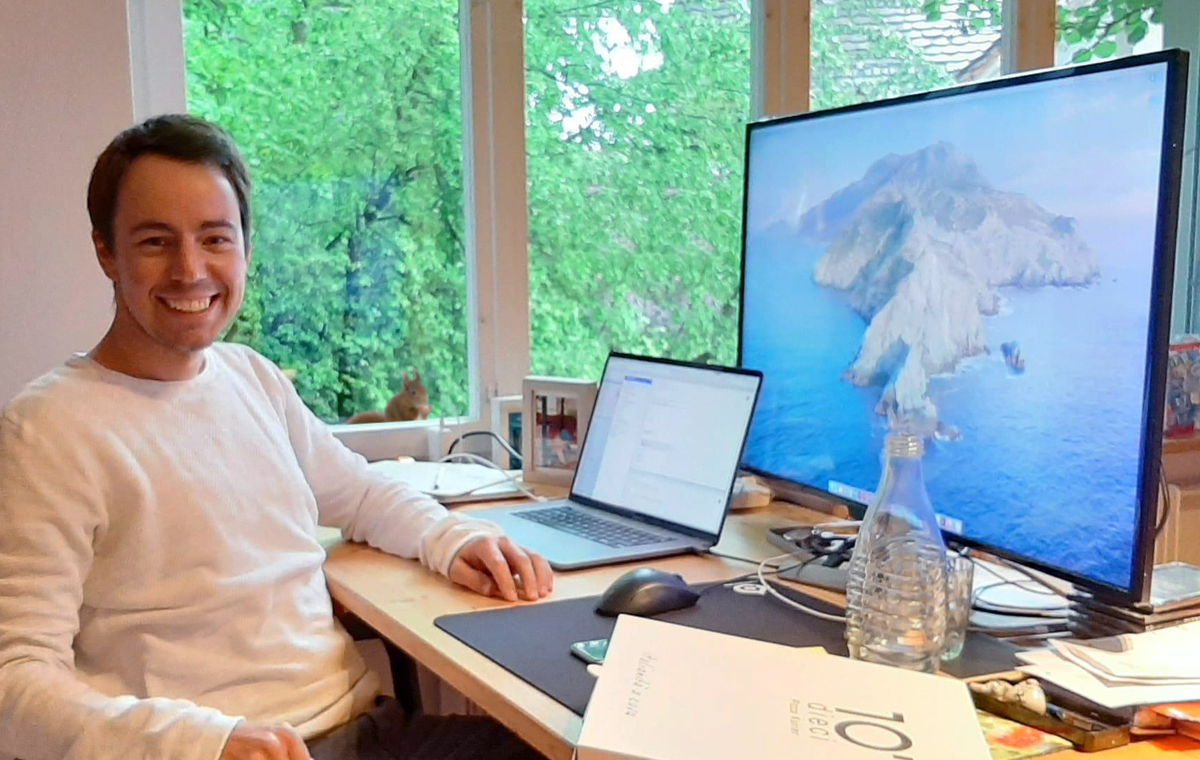
Rieger: Actually, just good ideas, a permanent video call to the team and my laptop. Secondscreen and desk chair certainly help too, but even more so the view of the greenery and the squirrel that passes by the window every day.


Is it difficult to separate yourself enough when the children are at home?

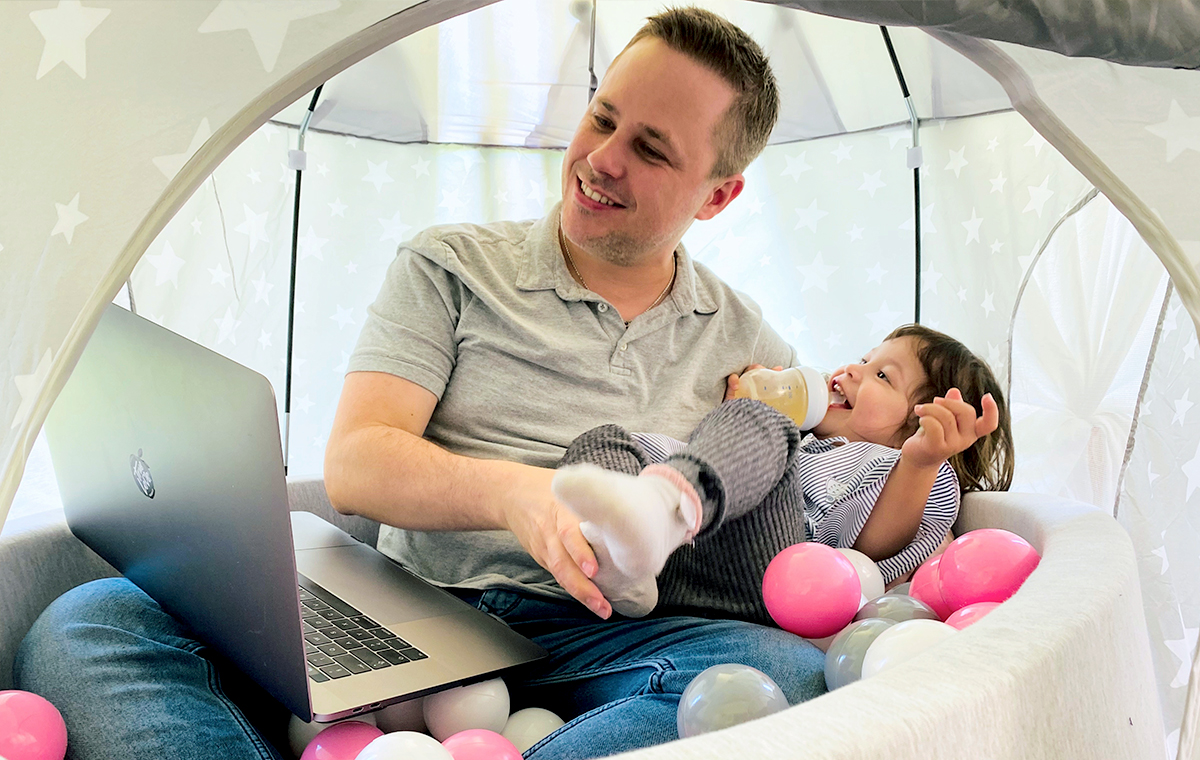
Kerbage: It is impossible to stand out. At least the weather was good all of April, which helped keep the kids busy in the garden. But no employer should be under the illusion that his employees achieve nearly the same level of productivity when there are children - in my case, two toddlers - frolicking around at home. My wife works a 70-percent schedule, and we share work and childcare time as much as possible. That at least helps to get organized to some extent.


Do you have home office experience or is this a first?

Rieger: Since I live in St.Gallen and don't commute to Zurich every day anyway, I had already set up a good workspace at home before Corona. Overall, I work more productively from home, even if I already miss the personal exchange and my ping-pong victories at the agency.


Which processes are difficult compared to the normal everyday life of an agency?

Bognar: Team meetings usually develop a dynamic with emotional interactions. If, on the other hand, during the video call one participant "freezes" every 5 minutes, is distracted by other things in the background or most participants are tired because it is the fifth call of the day, then the team exchange becomes somewhat tedious.


Which jobs go smoothly?

Kerbage: In general, most of the work in our industry goes smoothly in the home office.


Is there anything that even works easier or more productively in the home office?

Rieger: Which has a positive effect on productivity: Because of the quiet environment, I can focus even better than in the hectic day-to-day life at the agency. And: lunch planning goes much faster! What always triggers a long discussion at the agency is now decided for me by my refrigerator.

Grüsse aus dem Homeoffice

Norbert Rieger, Co-Founder and -CEO of Truestory.


What do you do about the ceiling falling on your head?

Bognar: Then I go for a walk with my wife and little daughter - that helps!


Has something like home office jitters started to set in for you?

Kerbage: It depends somewhat on my own mood and that of my children. All in all, I am very grateful that our existence is not threatened. There are enough other SMEs in Switzerland that have to fight for survival. The price of staying at home is very low for us. And if the tantrum does make itself felt, I simply make myself a beer in the late afternoon.


What do you miss most about the physical day-to-day life at the agency?

Rieger: What I miss most is the commute, where I spend almost 4 hours a day on the train and streetcar... No seriously: I miss our insane team, the social exchange, the many laughs, the ping-pong matches and brainstorming sessions. And our comfortably furnished office.


Are you confident that your agency/company will come through the crisis unscathed?

Bognar: We have also lost some orders or they have been postponed indefinitely. This is very unpleasant in terms of responsibility for our employees. However, we now have time for many other things that we have always postponed until now. For example, our new website will go live soon and we are working on some very cool internal projects that we have wanted to do for a long time. So we definitely won't get bored.


As we all know, everything has its positive sides. What is it in your current home office situation?

Kerbage: Without having a guilty conscience, it's possible to live the kind of deceleration that you long for in the busy phases of everyday life at the agency. And even though it's always exhausting with the kids, it's also wonderful to be able to spend more time with them.


When and why did you last laugh in connection with the home office?

Rieger: We were sad when all festivals for this summer were cancelled and a very nice project we had planned for M-Budget in collaboration with JvM/Limmat thus unfortunately falls through. But most of the time I'm laughing. For example about some hilarious videos from previous projects of ours, which I just edited for the website. Have fun watching them.


Even if you don't have a crystal ball: Do you expect the current situation to continue for a long time?

Bognar: I don't think we'll all be really sure until a vaccine is developed.


What would you like to give your colleagues in the industry to take with them through the crisis?

Kerbage: We are all creative and will find one or the other solution to the crisis - everything will be fine.

The coronavirus has society firmly in its grip. Those who can stay at home, stay at home. The advertising, communications and marketing industry also shifted operations to the home office on a large scale in mid-March. With the series "Greetings from the home office", Werbewoche.ch sheds light on everyday working life within the four walls at home.

All episodes at a glance:

get_footer();