Defensive reflexes instead of educational work

The major Swiss publishers are tabooing media research, in Austria they are looking for common ground. By Stephan Russ-Mohl, Head of the European Journalism Observatory at the University of Lugano.

The contrast in the way the media industry and media research interact could hardly be greater: In Switzerland, the two largest print publishers Tamedia and Ringier are keeping quiet - as if they had colluded - about research findings on the state and prospects of journalism presented by 60 media researchers led by Kurt Imhof in their "Yearbook Quality of the Swiss Media". And the president of the Swiss Press Association, Hanspeter Lebrument, had his managing director ranting against the researchers before he and his colleagues had even had a chance to take note of the yearbook's content.

In the neighboring Alpine republic, on the other hand, people are practicing unity. The Association of Austrian Newspaper Publishers recently presented its "Public Value Report" under the catchy title "Added Value", with which it aims to make the wider public aware of the important contribution print media make to media diversity and that the ORF, as a public broadcaster, does not have a monopoly on quality journalism. The authors include the crème de la crème of Austrian journalism and publishing management as well as renowned media researchers. What they have to say is not always comfortable for the publishing industry - for example when Matthias Karmasin encourages media entrepreneurs to adopt more "regulated self-regulation" or his colleague Franzisca Weder from Klagenfurt sees "the true communicative responsibility of media companies and associations in maintaining a public discourse on the values of media products": But the fact that such statements were integrated into the volume can be seen as a sign of willingness to engage in dialog. Another annoyance for newspaper publishers in the demanding market segment in Austria is that state and other public institutions, which are ultimately financed with taxpayers' money, often favor media in their advertising campaigns that do not exactly help quality journalism. The amounts involved in such advertisements are many times higher than the previous direct and indirect press subsidies regulated by law.

Then, in neighboring countries, giants such as Google and Facebook are also a thorn in the side of publishers. Not only do they do good business with their links to content that print companies have financed, but they are now also putting pressure on traditional media providers in the advertising market - and are also shifting their profits to countries where they pay virtually no taxes. Nevertheless, the Austrian Public Value Report is an impressive document of cooperation between the media industry and media research. Perhaps now that the Federal Council has re-established the Federal Media Commission under the chairmanship of media researcher and Vice-Rector of the University of Zurich, Otfried Jarren, Swiss publishers will also realize that academics can sometimes be knowledgeable cooperation partners in solving their problems. Former Press Council President Peter Studer is right: "Trench warfare between publishers who are less critical and more profit-obsessed and sometimes overly normative and rigid academics is slowing down the necessary dialog."

Democratic societies are hardly conceivable without professional journalism that produces "added value" in the form of socially relevant news. However, this is acutely endangered if nobody wants to pay for journalism anymore and, on top of that, advertising revenues are melting away like snow in March. So there is a lot for media policy to do, and not just in Switzerland and Austria. On the other hand, publishers themselves must finally face up to the communicative challenge of "anchoring" the "added value" that solidly researched journalism undoubtedly delivers in the minds of the public. This may be partially successful with advertising and public relations work. However, competent journalism that deals with media and journalism (and also with media research) just as critically as politics, business or sport would always be more credible. P.S.: It has also come this far in the meantime - Austria's publishers of all people have rediscovered Marx's concept of added value with their report, "occupied" it and breathed new meaning into it.
 

A zero round that is not a round

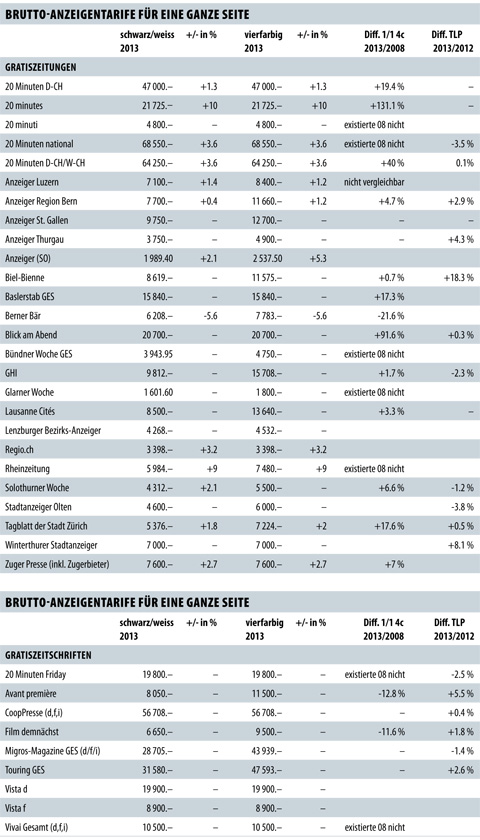
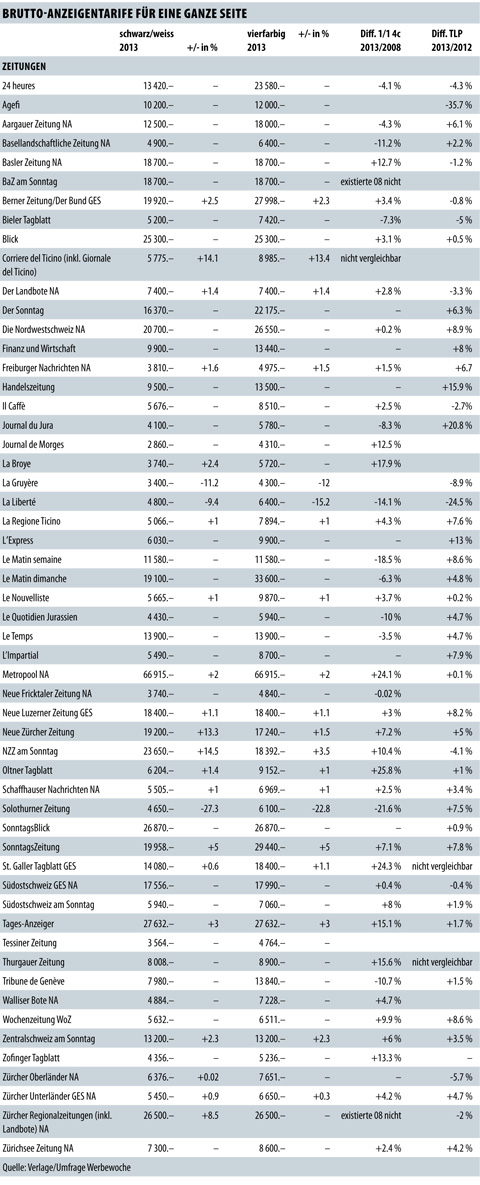
Publishers are more cautious: Only a quarter of their titles dare to openly increase their advertising rates as of 2013. Secret price increases, however, are frequent. This is also evident in a comparison over several years. An article by Markus Knöpfli from the current print edition.

At first glance, this year's round of pay increases for publishers looks almost like a zero round: Entire publishing houses, such as Ringier, the Konsumenteninfo Group, the business press of Axel Springer Schweiz (ASS), all free magazines and most of Tamedia's French-speaking Swiss titles, are foregoing price increases for their full-page fixed formats. Nevertheless, of the 141 titles listed, 35 are raising their page prices as of 2013, while 8 are reducing them. The biggest price increase is being made by the NZZ: Despite lower readership figures, it is increasing the price per four-color ad page by 1.5 percent and is also introducing the standard rate, resulting in a surcharge of 26.4 percent for the black-and-white rate. The NZZ am Sonntag does a similar thing, although it has gained readers: The black-and-white page is now 47.3 percent more expensive.

Uniform tariff for newspapers in vogue

The standard rate is also making inroads elsewhere: A SW ad page at Südostschweiz am Sonntag is therefore 18.9 percent more expensive, and 8.5 percent more expensive at Zurich's regional newspapers. The Bündner Woche is also tending in this direction: it is raising the price of its SW ads by 20.4 percent. Astonishing rate increases can also be found at some program guides: GuideTVCinéma, for example. Although it lost more than a third of its readers after changing its concept and name almost three years ago, it is now marking up its rates by 13.6 percent. Last year, it had still reduced its price. TV2 and TVvier are also increasing their rates (+12.1 %), while readership is falling steadily. A price increase can also be reported from Ticino: Corriere del Ticino will be 13.4 percent more expensive, but because it will integrate Giornale del Popolo from 2013. The increase of +10.7 percent at Beobachter Natur can also be justified by growing reader interest. The situation is different at Alpha, where the 10 percent surcharge seems neither justified nor clever - certainly not in view of the already declining number of job ads.

Two "Tüpflischisser" among the publishers

In addition to the steep ones, there are also small surcharges, but they are all the more curious: The Zürcher Unterländer increases its SW rate by no less than 1 franc (in words: one franc) (+0.02 %) and the Zürcher Oberländer its fixed formats by 5 francs (+0.3 %)! Conversely, however, there are some price reductions that are pouring in: The Plaidoyer trade magazine of the Konsumenteninfo Group is lowering its rate by 50 percent, the Solothurner Zeitung (SZ) is going down by 22.8 percent - roughly in line with the loss of readers - while La Liberté and La Gruyère are charging 15.2 and 12 percent less, respectively, despite reasonably stable performance figures.

Price reduction not for large customers

Speaking of Solothurner Zeitung: Despite exemplary price adjustments to the lower readership figures, it is also a prime example of a hidden price increase - because the page price reduction by more than a quarter is not reflected at all in the tariff for northwestern Switzerland. AZ Medien simply leaves the latter at the previous level - although an 8 percent discount would be justified. In other words, the tariff reduction at Solothurner Zeitung is not passed on to the major customers in northwestern Switzerland. The rate reduction at Solothurner Zeitung is also only half-hearted at another level: it only applies to the fixed format, and at the color millimeter level it is significantly lower, namely just 16.5 percent. Other newspapers are doing the same: La Gruyère and La Liberté are reducing their 4c fixed format, but leaving their color millimeter rate at the previous level.

The TLP shows the hidden truth

Most of the hidden price increases, however, are at the level of the price per thousand readers (TLP): 70 newspapers and magazines, i.e. exactly half of the titles listed, have increased their TLP - either actively by raising the page rate or passively by losing readers - although in many cases there are only small increases (of less than 5 %). Nevertheless, the biggest increase is at TV täglich, where the TLP has risen by 53.9 percent in the space of a year. This can hardly be justified. The German edition of Reader's Digest follows in second place with a TLP increase of 37.5 percent - and TV2 in third place with a TLP increase of 32.8 percent. Other titles with TLP increases in the double-digit percentage range: Stocks (+29.3 %), TVvier (+25.5 %), Journal du Jura (+20.8 %), Reader's Digest (f) (+20 %), Biel-Bienne (+18.3 %), Handelszeitung (+15.9 %), Kulturtipp (+14.3 %), Zeitlupe (+13.7 %), Edelweiss (+13.6 %), Illustré (+13.3 %) and Express (+13 %). Arguably, there are also 25 titles that lower their TLP, but reductions that actually pour in are rare. Only two stand out: Agefi reduces its TLP by 35.7 percent thanks to an increase in readers, La Liberté by 24.5 percent thanks to a price reduction. In third place is La Gruyère with a reduction in the single-digit percentage range: -8.9% All other TLP reductions are below 6 %.

Half costs more than before the crisis

Conclusion: The impression described at the beginning, according to which only a quarter of all listed titles increase their prices and more than half leave their rates at the current level, is definitely not true: Half of the titles increase their prices as of 2013 - either actively or passively, and only 23 titles reduce their prices. If we look at the longer-term price development - for example from 2008, the year before the crisis, the picture is similar: around half of the titles have become more expensive since 2008, either actively or passively, while a quarter have become cheaper - albeit mostly only slightly.

Markus Knöpfli

Corrigendum (20.12.2012)

In the article "Eine Nullrunde, die keine ist" in WW issue 22 (7.12.12), errors need to be corrected. It is incorrect that NZZ, NZZ am Sonntag, Südostschweiz am Sonntag and Bündner Woche are introducing the uniform rate. NZZ and NZZaS are indeed taking a step in this direction by abolishing the fixed formats for bw ads. However, a bw millimeter price still exists. Thus, 1/1 bw now costs CHF 17204 at NZZ, 13.3% more than before, and CHF 18392 (+14.5%) at NZZaS. Südostschweiz am Sonntag and Bündner Woche are a different story: Their sw rates remain unchanged at 5940 and 3943.95 francs respectively.

Tamedia also explains the 10 percent price increase for the job supplement Alpha as follows: "Because Alpha has also been enclosed with the Bund since September 2012, circulation and readership have increased by around 10 percent. The CPM thus remains stable despite the price increase."

tarifrekorde
baz1_0
BATGS02
BATGS03
baz2
Artikel-aus-Printausgabe
 

Omega with new brand ambassador

Chinese golfer Shanshan Feng has recently joined the ranks of OMEGA's brand ambassadors. In addition to her, the list of OMEGA ambassadors includes Greg Norman, Sergio Garcia, and Michelle Wie.

Golf has become enormously popular in China and is enjoying exceptionally strong growth, Omega said in a statement Thursday. It said it is delighted to have the opportunity to celebrate each of Shanshan's successes with her fans in her home country. The brand has been present in China for more than a century. Shanshan Feng's role as brand ambassador should draw even more attention to Omega, especially among the millions of Chinese golf fans, it said.

omega1

"The whole of society needs to understand that the future will be digital"

 Matthias Ehrlich, a member of the Executive Board of United Internet Media AG and a member of the Executive Board of 1&1 Internet AG, discusses the Swiss digital advertising market in an interview with Werbewoche Editor-in-Chief Pierre C. Meier.

WW: How do the digital German and digital Swiss advertising markets differ?
Matthias Ehrlich: In terms of digital usage, Switzerland is one of the leading countries in Europe. Online penetration is high, as is mobile usage, Internet access is fast, and yet there is this "backwardness" of the digital advertising market in Switzerland. Not only in comparison to Germany, but to the whole of Europe.
 
Where does that come from?
What is striking is the unusually high dominance of print, which is backed up by powerful publishing houses. In Germany, too, print and print-based online are very strong because large, very professional publishing constructs were built up after the Second World War: the Burdas, the Springers, the Gruner & Jahrs, right down to the smaller ones like Klambt. It turns out that houses that have a "classic" mainstay and could lose something through online do not necessarily run enthusiastically towards online. This also applies to Switzerland. I would see that as a point in any case. But there is another point. When it became clear how strong online was going to become in the first place, many young people in Germany switched professionally from traditional media to online, thus fertilizing the online world with know-how from the traditional sector - in other words, with the actual understanding of advertising. We mustn't forget that digital is first and foremost just a technology and an infrastructure. Only the knowledge of advertising communication allows the implementation and use of the new possibilities. It seems to me that this change from the traditional to the online sector is not happening in Switzerland. What is striking is the high import of German colleagues into the Swiss online business - even in management positions. It is clear that there is a lack of specialists to really drive online forward. Perhaps the training has not been as massive as in Germany. This may be due to the fact that we Germans are a technology-loving and technology-oriented people. After the poets and thinkers, we are now a country of engineers (laughs). In Internet technology today, you see a lot of things internationally that have been developed in Germany at a very high level.
 
How could online be promoted more?
It is important that the whole of society, the economy, politics and all decision-makers understand that the future will be digital. This does not mean that there will be no more newspapers, nor does it mean that there will be no more TV or radio, but it does mean that a new infrastructure is being laid over the earth with the Internet. Everything is going digital. The way we communicate with consumers is changing. Both in the B2C sector and in B2C. This understanding is a very important social issue, because it determines how successfully you can do business in the future and keep up in purely technical terms. I believe it is an essential competence of a modern industrialized nation to be able to make massive use of the digital infrastructure and to understand how to reach people in a digitized world where they already live in digital communication worlds. This is something that would have to be understood right across Swiss society and the Swiss economy.
 
Are other small countries in Europe further along than we are?
The European and world champions are the small countries. There are studies by McKinsey that examine the impact of digital communications on a country's gross national product. We see that two countries are the global leaders: Finland and Israel. In the case of Israel, we know why: it is a military power and therefore has an enormous amount of technology and technical know-how, and of course uses both on the Internet. The rest of the top ten are mainly Scandinavians, who were very Internet-savvy at a very early stage. These are comparatively small national structures with small, manageable language populations that are much further along in using the Internet. This can also be seen in the Baltic states. These invested a lot of money in their digital infrastructure after they became independent, and it has paid off for them. Austria has similar problems to Switzerland, but is already further along on this path. From our point of view - we are also active in Austria - this discussion started there two years ago.
 
When you talk to Swiss customers, where do you see the inhibition threshold? Is it more of a wait-and-see attitude or is there a lack of belief in the digital future?
Given my age, I'm no longer a digital whiz. In my company, I said very early on that we know a lot about technology, but people in the traditional field know better how to use it and what happens with the customer. It's a balance between "don't follow all the hype", don't just start spinning because something new comes along, but first see what I can use from it and how. A non-judgmental, purely utility-based evaluation of the toolkit and then consistently applying it and getting into learning is important. Last year, I felt that Switzerland was on a roll. It may be that the current economic difficulties and the crisis throughout Europe have caused companies to become very passive and very cautious. People don't want to dare to experiment and they don't want to invest now. Although - and here we could learn from all other countries - it is precisely in crises that such painful change processes are easier to implement. It is easier to explain their necessity to your own employees. You can stand up and say: We're in a crisis, we have to find new ways. Actually, you could use that, but I don't have the feeling that that's happening in Switzerland.
 
Is the tense economic situation in Germany causing online advertising to stagnate or even decline?
In some respects, Germany has been a bit of an island of the blissful. We have a strong domestic economy, but we are seeing the big drivers of the online advertising business, the fast-moving consumer goods companies, seeing their sales slump in the crisis countries of Spain, Italy, Greece, Portugal, and perhaps still in parts of France, because consumers are buying cheaper and non-branded. These losses, together with the rise in raw material prices in some cases, mean that they have giant holes in their balance sheets. What do they do then? They pull some of the money out of Germany. We've been noticing this for two months in the year-end business. Companies are saving money in order to save their balance sheets to some extent. In what is also a dangerous trend for Europe as a whole, there are one or two companies that are beginning to consider whether Europe is still the region where advertising investments should be made in the future, and are perhaps turning their attention back to purely sales-oriented advertising measures. I know some companies that are thinking about withdrawing their long-term investments in brands from Europe in order to invest in countries where a middle class that is just emerging or already exists in some cases, is small in percentage terms but has quite a lot of purchasing power, is hungry for European goods.
 
Do you see any trends in which industries are moving in this direction?
The FMCG companies were very strong. The financial sector has collapsed completely. The financial sector in particular was one of the industries with the highest digital share. In the automotive sector, we still had a boom because the manufacturers fought against the weakening foreign competition with bargain offers and did a lot of advertising for them.
 
Let's move on to another point. In Switzerland, the share of digital advertising among FMCG companies is rather low.
This is a development phase. In Germany, too, online was initially introduced and used purely as a sales medium. To a certain extent, Google keywords were seen as synonymous with online advertising. This is nonsense, of course. In the meantime, it has been proven that digital display advertising works just like print ads and that online moving image formats work just like a TV spot.
 
... but it's the online industry's own fault, because for a long time they were focused on selling the measurable click and left the branding aspect on the side!
That's because many of the protagonists of this online revolution are techies who have earned their money with these clicks. Because image advertising is firmly anchored at the big agencies, the online advertisers are coming over the villages, so to speak. What happens with real-time advertising (RTB) is also a story like that. RTB is a logistical backyard topic that does not decisively advance online advertising in any way. The technology behind it does lower costs, and that's to be applauded, but the branding aspect falls by the wayside. Many online people make the mistake of talking about RTB and the latest tech gimmicks, but fail to compete with TV and print people on the notion of branding. I'm proud that my company has always been very strong on this branding aspect. We invested extremely heavily for a long time without much return on investment. We explained online to colleagues who came from the traditional world, and they taught us traditional advertising in return. We used market research to find out how online advertising works for normal branding or image issues. By means of market studies, we provided the relevant evidence. This paved the way to the large budgets of FMCG companies. One study we helped to conduct led to Procter & Gamble stipulating an internal global online share of 20 percent.
 
... I strongly doubt whether the proportion in Switzerland is 20 percent.
That's a homegrown problem. A big house like Goldbach, which has many years of experience, is proud of the fact that they do audience platforms. They have to drive branding and imaging. The small adnetworks can't do that. If that's not done enough, then nothing happens and a lot of money is left behind. That's why we're now addressing this very issue with our 4Q (For Quality) initiative, which we launched together with our marketing colleagues from Interactive Media and the two digital agencies Pilot and Plan.net.
 
Aren't the advertising agencies also challenged?
You have to see: Online is not a simple medium. It's complex and difficult, and expensive to manage. If you only have a small budget for online and you're also operating in a small market, it means that you can hardly refinance the effort you have to put in compared to the large budgets that are practically booked automatically in print or TV. So there are relatively few agencies that are really pushing the online business. In Germany, we've been fortunate to have three agencies that have made a big splash in online: Xenion, now Carat, Plan.net/Serviceplan and Pilot - all agencies that have their roots in online. These three have lit a fire under the butts of the big, global agencies. But marketers have also been putting on the pressure. And so advertisers suddenly wanted to know more about online advertising.
 
Is the rise in mobile online usage having an impact on the digital advertising market?
Switzerland might be unlucky that by the time the online market could take off, conversion to mobile is already happening, and so the high margins they've had over the last 4-5 years are now being eaten away by the lower monetization in mobile. It will become more and more difficult to take off in online, so Switzerland has to pick up its feet quickly.
 
What more can associations like IAB do for this besides training?
Generally speaking, the online players have to organize themselves across the board. In Germany, there were initially only a few pure online providers, and the main big players were the print and TV online companies. The online colleagues from the print and TV houses always enjoyed the joint work in the online organizations, because in their companies they were always slowed down a bit. In the associations, we were able to push the things that they would have liked to do, too, but were not allowed to do at home or for which they did not get any investment. With the pressure from the market, they were then able to implement these things accordingly. The cooperation in associations such as AGOF or OVK actually built up the online genre in the first place. Without that, it would not have been possible. A strong association that fights for the online genre is crucial. The individual areas such as performance, quality marketers, online agencies, advertisers, etc. are organized in individual sections, and thus we have the entire value chain in the association.  
 
Interview: Pierre C. Meier

pcm

From online to cross-media

The online marketing agency Adisfaction aims to position itself even more strongly as a full-service provider and has brought a second managing director on board to that end.

The online marketing agency Adisfaction, founded in Germany, has been represented in Zurich for five years. Started as a media specialist, Adisfaction has since developed into a full-service provider in online marketing, covering areas such as online PR, e-mail marketing, online monitoring and social media marketing, in addition to media planning and buying. This position is now to be strengthened with the expansion of the management team. With immediate effect, Hendrik van Dyck will be responsible for the agency's fortunes alongside the previous managing director Daniel Hünebeck. Among other things, Van Dyck was responsible for the sale of online advertising for the news portal Blick.ch at the online store Euronics in Germany, then at Tele 2 Switzerland and finally at Ringier, and most recently managed the online division at the Schlieremer media agency Mediaxis.

Van Dyck joins Adisfaction as a cross-media specialist who not only has experience in online marketing and e-commerce, but has also developed many cross-media concepts. "I don't see online as a separate medium, but want to create interfaces to other media genres," says Van Dyck. One of the ways he does this is by extending reach strategies from TV to the online video sector - a topic that is becoming increasingly important with time-shifted TV consumption. In terms of dovetailing different channels, the online marketing experts at Adisfaction have also entered into a strategic collaboration with Condor Films, with whom they have been united under one roof since moving to Zurich Seefeld five months ago. While Condor Films receives support in online marketing, Adisfaction uses its audiovisual expertise for video and web productions, for example for the soundtrack of a flash-animated preroll. Despite all the cross-media concepts, Adisfaction receives many requests for search engine optimization. "Who would have thought a few years ago that we would still be dealing with - in quotation marks - something as boring as search engine marketing in 2012," says Hünebeck. "Everyone would have thought that we would only be creating social media concepts."

The basics should not be neglected, emphasizes the business economist. Even e-mail marketing, which had almost been declared dead, is enjoying great popularity again. And rightly so, says Hünebeck, as long as the potential of the channel is recognized. After all, e-mail marketing is more than just sending out newsletters. Imp
 
In a nutshell
Adisfaction is a full-service agency specializing in online marketing. Its services include consulting, media planning and buying, content marketing/online PR, creation, B2B marketing, performance marketing, e-mail marketing, online monitoring, affiliate marketing and social media marketing. Adisfaction is owner-managed. A twelve-strong team in Zurich works for clients such as Bank Vontobel, Zurich Airport, Travel.ch and UBS.

asf
 

Epica: 14 awards for Swiss creatives

Spillmann Felser Leo Burnett «swept» the most awards for Switzerland at Epica. In addition to SFLB’s gold award, the agency also won five silver and three bronze awards. Wirz also received gold, silver, and bronze awards.

Awards are like gold by the sea at sunset. Everyone is happy to shine. But more and more agencies are wondering where this kind of self-promotion is going to take them. Scholz & Friends in Germany has withdrawn from all competitions for the coming year. Jung von Matt only wants to compete every other year. Such cutbacks are also reflected in the budgets of the growing number of organizers of these creative shows. Epica has accepted the challenge.
 
In its 26th edition, Epica has opened up internationally to continue underpinning its importance as an award with a solid base of entries. "There are more and more award shows in Europe, so we had to find a new profile to continue to have a future ", explains Andrew Rawlins. In 1987, the president of D'Arcy Masius Benton & Bowles DMB&B, an agency with a global presence at the time, founded the Epica competition. After its 25th anniversary in 2011, he has now sold his life's work to Ad Forum. As the global CEO of this organization, Philippe Paget (photo) introduced himself at the jury meetings in Paris. Ad Forum is a partner of most of the authoritative competitions in the global communications industry.
 
At Epica in Paris this year, 3893 submissions from 648 agencies from 62 countries had to be evaluated. 155 ideas came from 12 agencies in Switzerland. The works were evaluated by representatives from the editorial offices of international trade journals such as "Briefing" from Portugal, "Brand News" from Italy, "Marketing Türkiye", "New Moment" from Serbia or "Werbewoche" from Switzerland.
 
 In total, 41 magazines or websites from 34 countries were represented in Paris the week before last. Epica was able to attract six new titles from Canada, India, Singapore, China, Australia and the Philippines in its round. In sync with this global opening, 78 agencies from 18 new countries submitted work for the first time. Entries from the new nations added in 2012 already account for 14 percent of total submissions. Thanks to this opening, the festival was again able to report growth in 2012, despite a 4 percent drop in campaigns from traditional Epica countries. The award ceremony will take place on January 25, 2013 in Ljubljana.

You can see the winning works in the PDFs.
PDF1
PDF2
 
Andreas Panzeri

Bernese plate reloaded

There is a leadership transition at Polyconsult. René Maeder and Jürg Tscharner are stepping down and handing the reins to a team of four who have been actively shaping the direction of Polyconsult for years.

"We want to continue to run the agency in the same spirit as René Maeder and Jürg Tscharner have done in recent years. This became very clear during the takeover talks," says Caroline Bühler. Together with Mike Brodbeck, she is now taking over the co-management. Roger Ghezzi and Silvio Truffer will continue to head up Creation. René Maeder co-founded Polyconsult in 1974. Jürg Tscharner joined a little later. In its 38 years, the Bern-based agency has grown "solidly and steadily" from four to twenty people. Now the former managing directors remain active on the Board of Directors. The four new members of management will own 100 percent of the agency as of January 2013. Polyconsult has a broad base and is active in a wide range of sectors. An important client in the company's development was Peugeot, for example. For Coop, Polyconsult was responsible for the entire development of Naturaplan, from the logo to the launch of the new positioning, even before the big organic wave.
 
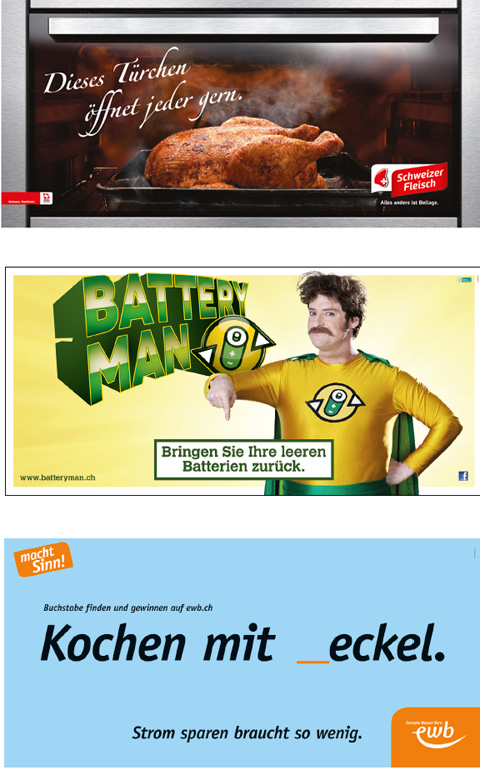
Schweizer Fleisch was added in 1996 and is still managed by Polyconsult today. Initially parts of the budget, then the contract gradually grew. Energie Wasser Bern is also a long-standing customer, as are PostFinance and Swiss Post. "90 percent of our customer base is from the region. Our ambition is not primarily to win the big contracts in Zurich," explains Mike Brodbeck. Nevertheless, Polyconsult has won some interesting pitches in recent years. "You can do just as good communication in Bern as in Zurich," the two CDs Roger Ghezzi and Silvio Truffer are convinced. Polyconsult has recently won Inobat with the "Battery Man" and Reka, for example. Polyconsult is not strongly rooted in ADC. "We focus on customer satisfaction and not on our profile. This is reflected less in cubes than in many long-standing customer relationships," explains Caroline Bühler, who was the first of the new management team to join Polyconsult in 2000.
 
After completing a commercial apprenticeship, Caroline Bühler trained as a marketing planner and then as a marketing manager. This brought her into the agency business at a very early stage. In Geneva, she worked at a specialized agency for luxury goods, then at McCann-Erickson. After a year of "time out on the road", mainly in the East, Far East and Africa, Bühler no longer wanted to look after network clients in a large agency. So she found her "lasting happiness" at Polyconsult. "I immediately felt at home here because I can make a big difference and contribute a lot."

The new quartet

In the new formation, Caroline Bühler and Mike Brodbeck are jointly responsible for the co-management. Brodbeck studied economics in Bern, specializing in marketing. He first entered the field on the customer side in the consumer goods sector. He worked at Nestlé for six years in brand management for Thomy and Maggi. From "Green to Yellow", Brodbeck headed up marketing at Rivella for eight years from 2001. In 2008, he accepted the option to take over Polyconsult in the medium term and manage it independently. "I was tempted by the offer to become an entrepreneur myself in a specialist area that I am very familiar with." The new management team at Polyconsult "ideally complements each other with a wide range of skills". In addition to the two Co-Managing Directors on the consulting side, Roger Ghezzi and Silvio Truffer are equally responsible for creation as CD.

Roger Ghezzi started studying medicine after his A-levels, which he completed after a year - "at least for myself". He was much more interested in working as a copywriter. So Ghezzi attended day school as an advertising assistant and initially found a job at Lowe GGK, albeit in consulting. In 2000, he started working as a copywriter at a small agency in Solothurn and finally at Contexta. Via a stopover, Ghezzi ended up at "der Poly" in 2005. Today he works as CD Concept and Text. Responsibility for clients is divided between him and Silvio Truffer. Silvio Truffer completed an apprenticeship as a graphic designer after completing his preliminary course in Zurich. He also earned his spurs at various agencies on the Limmat before moving to Bern to join Contexta. He later went freelance for three years. "I specialized more in the field of image processing." During this phase, Truffer maintained regular contact with Roger Ghezzi, with whom he became good colleagues at Contexta. When a job became available at Polyconsult, he was hired again in 2008, also with the possible vision that he could one day take over the agency.

Andreas Panzeri

afff
afff2
"The generational change is geared towards continuity. We have all been with the agency for a while and have helped shape it. We want to continue this in the same spirit. We also want to pass this on to our clients as a promise," explains the new management quartet at Polyconsult. After the "amicably settled succession", the picture shows (from left): Former shareholders Jürg Tscharner and René Maeder as well as the new shareholders Mike Brodbeck, Roger Ghezzi, Caroline Bühler and Silvio Truffer.

The Impact Check of Werbewoche

We show how current campaigns are performing with consumers.

In terms of awareness, the Coop Simsala Win ad by the Valencia advertising agency came out on top, followed by the Denner ad by Vizner Borel and the ad for VW, also by Vizner Borel. Pro Juventute from the advertising agency TBWA wins the Uniqueness criterion ahead of the ad for HEKS from Advico Young&Rubicam and the one for Aids-Hilfe Schweiz from Havas Worldwide Zurich. In the Brand Fit criterion, the ad for Gerber-Fondue by the Scholz & Friends agency wins ahead of the ads for Pro Juventute and Aids-Hilfe Schweiz. Gerber-Fondue also comes out on top in terms of likeability, ahead of HEKS and Pro Juventute.

Results Impact Check December 2012 (PDF)
Detailed results impact check December (PDF)

Like the Germans or like the French?

Private marketplaces are one possible solution for encouraging publishers to participate in RTA trading. Will there be an industry-wide solution for this in our market?

The online advertising business is changing fundamentally as the focus shifts from the masses to the individual user. The well-established routine business of media buying, characterized by fixed price lists around thousand-contact prices (CPM), is being replaced by auction processes. The keyword here is Real Time Bidding (RTB). This method was initially used by Google to determine the price of ad words, and there have long been a number of ad exchanges that work according to the same principle. This favors buyers, who can use anonymized profile data to buy advertising for precisely those consumers with whom their message is likely to have the greatest chance of success. Publishers are different. Because the focus is not on quality, but above all on price, they fear falling prices. That is why they do not open up their inventory to automated trading. Game over for so-called Real Time Advertising (RTA)?

No, because the revenue potential associated with RTA is so tempting that providers are now coming forward with solutions that address publishers' concerns. The keyword here is private exchange. Instead of trading inventory on the public marketplace, the Ad Exchanges, transactions are - metaphorically speaking - conducted in separate rooms in the adjoining luxury hotel. Nothing new, just implemented via software. With such exclusive marketplaces, publishers can control exactly how they sell their inventory. It is possible to control very precisely which buyers have access to which inventory and under which conditions. Trading still typically takes place according to RTB methods, which is why such preferential conditions are not granted exclusively to a single buyer, but rather to a small, hand-picked group (see "prioritized bidding" in the adjacent RTA glossary). This allows prices to be kept at the usual level and efficiency gains to be realized at the same time. In addition, buyers and sellers can be sure that the environment for their advertising is right and that ads of questionable origin do not suddenly appear on a premium site simply because they were bought at auction via an open ad exchange.

Providers of SSP solutions in particular have further developed their technologies in order to realize private marketplaces. These include companies such as AppNexus, Admeld (owned by Google), PubMatic and Rubicon Project. According to an overview by Forrester Research from early 2012, not all of them are equally advanced and offer different or differently mature features. Accordingly, there are different implementations on the market: The Weather Channel is the sixth-largest website in the USA with 15 million web clients every day. At this scale, a private exchange can also be implemented on its own in order to optimize the processing of purchase requests and gain insights for future tactics and strategy. The advanced technology of a private exchange is used instead of a conventional sales-side platform. In Europe, for example, the online media group Hi-Media, the European market leader for online advertising and electronic payment transactions on the internet, announced in September 2011 that it would be launching its own ad exchange together with AppNexus.

QuadrantOne is a joint venture between the US publishers Tribune Company, Gannett, Hearst and the New York Times and is therefore comparable to the Premium Publishers Network PPN, which was launched by Tamedia, NZZ and Ringier in March 2012. In contrast to PPN, where RTB trading is to be avoided for as long as possible, QuadrantOne has its own private exchange solution in the form of Q-Exchange. According to a white paper from Admeld, better results can be achieved with RTB than with other sales methods. Thanks to the joint approach, conflicts between the various channels can be reduced on the standardized platform.

La Place Media is a similar joint venture between French publishers that was launched in September 2012 and through which the websites of more than 80 media brands are marketed. As Managing Director Fabien Magalon explained at the time, the various partners had previously gained their own experience with RTB from various providers and came to the conclusion that they could only achieve the necessary market position with a strong alliance. The first goal was to achieve a relevant size in the market, which is currently dominated by Google's Ad Exchange and may also be dominated by Facebook in the future. Individual publishers would have no chance of being recognized alongside each other. In contrast, the combined size is now driving demand. Magalon sees a further advantage in the data that is collected jointly and used for all partners to improve reach quality.

A third plus point is the team of experts that the joint venture makes available to all partners for dealing with the new technology, for example to increase quality and avoid cannibalization. It is well known that people in France are used to centralized procedures, which is why it is not surprising that the minimum prices (floor price) on La Place Media are the same for all participants. The situation is quite different in Germany, where four independent players in the German digital economy launched an alliance for more quality in online advertising under the label 4Q ("for quality") at the end of October 2012. This promptly met with criticism, especially from those who had not been invited. Although not explicitly articulated as such, it became clear that the 4Q initiative does not have much to do with real-time bidding and sees quality as a continuation of the usual procedures. A large RTB coalition based on the French model is therefore not foreseeable in Germany.

At the beginning of November 2012, online marketer InteractiveMedia announced a premium publisher platform for its 60 sites in cooperation with AppNexus, which is set to commence full operations on January 1, 2013. At the same time, the Competence Center "Real Time Advertising in the Digital Media Market" was founded in cooperation with Goethe University Frankfurt am Main. The aim is to scientifically investigate and support the changes in the digital media market through real-time advertising approaches. And at the beginning of December, SpiegelQC, the Spiegel Group's marketing unit, announced the launch of "Premium Private Exchange", emphasizing that RTB is an important pillar of its own premium strategy.

Although individual players among media agencies and marketers in the Swiss advertising market have jumped on the RTB bandwagon, there are currently no concrete initiatives for a joint approach. However, there are increasing signs that the various companies are taking a closer look at the topic of RTA. The coming weeks and months will show whether RTA is to be established here according to the German model (everyone against everyone) or the French model (all together). This raises the question of whether the three small Swiss submarkets in the three national languages are large enough for their own solutions or whether cooperation with foreign partners in the respective language areas might make more sense. Conversely, going it alone with a nationally oriented private exchange solution based on the French model would offer attractive advantages: Automated trading could be set up throughout the country in such a way that the modalities are coordinated with all participants. This would provide publishers with an environment that allows them to enter RTA trading with attractive inventories. To facilitate this, a Swiss RTA solution can rely heavily on the development of know-how and its communication and application. Ultimately, this allows much better data to be obtained, which should be available to all participants.

Christoph J. Walther

twitter_0

RTA Glossary

The term Real Time Bidding is appearing more and more frequently - and it is not least the term "bidding" that is causing publishers to fear a price collapse. This is why the term RTA (Real Time Advertising) is now often used instead of RTB. Although it no longer appears in the name, the principle of determining prices for individual impressions via an auction process in real time still exists. But it does not have to be the main focus. RTA methods can also be used to process bookings at the established fixed prices. However, this is much more efficient than is the case with the previous, often largely manual procedures. Anyone familiarizing themselves with the world of Real Time Advertising will come across a number of English technical terms, which we will briefly describe here and deliberately refrain from attempting to translate.
 
Ad Networks: These companies connect advertisers with websites that want to distribute ads for a fee. Their main function is to aggregate the advertising space of numerous publishers and match it with the demand of advertisers, who can then buy this advertising space in a single place. Ad networks can use special technologies to create added value for both publishers and advertisers. They try to distinguish themselves with better methods for precise targeting, the quality of the publishers they represent and the quality of the advertisers and their campaigns. Unlike marketers (sales houses), ad networks often do not work exclusively.
 
Ad Exchange: Technology platforms that mediate supply and demand for digital advertising space. They stand above the ad networks, as these are among their customers. Their approach is technology-driven and geared towards online trading in real time. Auction processes (bidded buying) are used, which are geared towards individual ad impressions for a specific user. This distinguishes them from the conventional approach, as prices are negotiated based on specific inventory volumes.
 
Private Exchange: A private exchange is an exclusive marketplace through which premium publishers can sell their inventory with full control (see adjacent article).
 
Supply Side Platform (SSP): Technical solutions that enable publishers to offer digital advertising space for real-time trading. They promise efficient, automated and secure access to demand sources and provide insights into the various revenue streams and target groups. They are often referred to as sell-side platforms and are the counterpart to DSPs.
 
Demand Side Platform (DSP): Technical solutions for purchasing digital advertising in real time, whereby target groups can be defined, bids managed and performance measured. This can simplify and accelerate workflows.
 
Trading Desk: The entire organizational superstructure in agencies to buy and optimize target groups from ad networks, ad exchanges, individual SSPs or other correspondingly accessible sources using a DSP solution or their own comparable technology.
 
Data Management Platform, DMP: A technical solution with which data from various sources can be obtained and managed in connection with DSP or SSP so that purchases or offers can be improved.
 
Data Supplier: They collect data about online consumers (or their web browsers), compile it and sell it in anonymized form, often via data exchanges. Such data includes geographical or demographic characteristics, lifestyle, income and consumer behavior.
 
Data Exchange: An online trading platform comparable to ad exchanges, where anonymized data on online consumption can be bought and sold.
 
Targeted Advertising: Advertising messages are delivered individually on the basis of consumer data, with the aim of achieving the best possible match with the target group.
 
Online Contextual Advertising: Advertising is delivered on a website in accordance with its content.
 
Behavioral marketing (behavioral targeting): Target groups are selected using data on consumer behavior.
 
Retargeting: The design and delivery of advertising messages is based on the actions of consumers online. For example, if order forms are filled out on a website but not sent, the consumer is sent appropriately designed advertising messages on other websites to encourage them to complete the order.
 
Price Floor: Minimum prices set by publishers on private exchanges for specific parts of their inventory.
 
Prioritized Bidding: With this technique, publishers on private exchanges can grant certain buyers preferential conditions under certain conditions. In return for a certain price and/or volume, preferential conditions (so-called "first look") are granted for certain inventories. These special conditions are often granted not only to one buyer, but to a selected group. Additional trading features of a publisher on a private exchange (full transparency, narrower target group selections, etc.) are often only available to first-look customers. Prioritized bidding is also referred to as "guaranteed RTB" or "private ad slots".
 
Second Price Auction: An auction process in which the highest bidder only has to pay the price of the second-highest bid. This system is most frequently used in RTA trading.
 
Tagging a Page: The insertion of small program chunks into a website when it is delivered to the user in order to collect data about this visitor and use it later.
 
cjw


Municipalities should create a concept for the use of digital media

Municipalities in the Canton of Zurich are to develop local plans for the use of digital media and information technologies in schools. The Office of Elementary Education has developed an ICT guide that includes a sample template, as the Education Council announced on Wednesday.

The Board of Education wants to promote the integration of ICT information and communication technologies in lessons and schools in the canton of Zurich. In March 2011, it commissioned the primary school office to develop a model solution for a media and ICT concept. Together with the Zurich University of Teacher Education, an ICT guide has now been developed with a sample template for cross-level media and ICT concepts.

The Education Council recommends that the municipalities create an individual local concept with the help of the modular and web-based model concept. The Volksschulamt supports the schools in this process. The concepts should set out development goals, agreements on the use of media and ICT in lessons as well as the rights and duties of all those working at the school in this area. (SDA)

Teaser image: Keystone

Marc-Henri Jobin becomes new Director of the CRFJ

Marc-Henri Jobin will become the new director of the CRFJ, the media training center for French-speaking Switzerland, in Lausanne. He will succeed Eliane Ballif on May 15, 2013.

The CRFJ Board of Trustees elected Jobin as the new director on Monday. This was announced by the CRFJ on Tuesday. Eliane Ballif is retiring after nine years at the helm of the CRFJ.

Marc-Henri Jobin began his career as a business journalist at the French-speaking Swiss business and financial newspaper L'Agefi. For more than 10 years, he headed the French-language editorial department of the Swiss News Agency SDA in Bern. Most recently, he worked as a correspondent and coordinator for Tamedia's news network (24heures.ch, Lematin.ch, Tdg.ch) in Zurich. In recent years, he has also taught at the CRFJ and the University of Geneva. (SDA)


Koch Kommunikation arouses emotions for letters and parcels

Koch Kommunikation was commissioned to develop an emotional visual identity for the Post Offices and Sales division of Swiss Post. The goal was specifically to promote the mailing of A-Post letters and PostPac Priority packages by private individuals.

The subjects are intended to appeal directly to private customers and awaken in them the desire to please someone with a package or a letter, the agency said in a statement on Wednesday. A large picture fundus with emotionally staged situations covers a broad pallet of possible topics. The more than twenty subjects appear in brochures, advertisements, flyers, posters and other POS measures - and on all of the approximately 15,000 Swiss Post letterboxes.

Responsible at Swiss Post, post offices and sales: Andreas Etter (Senior Consultant Marketing Communications), Angela Hächler (Consultant Marketing Communications). Responsible at Koch Communication: Jean-Marc Demeulemeester (creation), Philipp Koch (consulting). Photographer: Michael Sieber.

post1
post2
post3
post4
post5
post6
 

get_footer();