The effect of a subject

Online Eye Tracking: Marketagent Presents a Pilot Test. 

In its November 23 issue, Werbewoche presented a new method of how the previously expensive and technically complex testing of a campaign with eye-tracking can be carried out much more efficiently and cost-effectively online. The concept, developed at the University of Vienna in a spin-off company of Dr. Berger Consult, is offered in Switzerland by the company Marketagent.com. The market research company, which regularly carries out the impact check for Werbewoche, also had a current TBWA subject for McDonald's tested with the new technology as a demonstration for this issue.

The graphics on the right show good results for the "Schwiizer Wuche". Viewers of the poster immediately "pounced" on the contents of the sandwich, paid "hot" attention to the "Schwiizer Wuche" tag and then at least glanced at the side dishes, before clearly wanting to know whether these tasty items were guaranteed to have been delivered from Switzerland. pan

tracking

Freicom goes on the runway with Spühl, CSA

Freicom is teaming up with Spühl and CSA. The Eastern Swiss agency has taken on the communications work for the company’s newly developed Tune 3 tuning machine from the CSA division.

With the message "More perfection", the campaign targets the interest of sports professionals. The new CSA campaign lets various testimonials speak, such as Fritz Züger, originally a service man and later a ski coach, of Bode Miller and Marc Girardelli, among others. In it, the communication makes use of proven Swiss values, which are thus promised by the new tuning machine: Precision, quality and performance that stands up to expectations, the agency said in a statement Thursday.

In addition to creation and graphics, Freicom is responsible for campaign management in the specialist area with advertisements, media work as well as trade fair appearances and digital networking.

Responsible at Spühl, CSA Division: Markus Schawalder (Director Division), Fabienne Basedau (Project Coordination). Responsible at Freicom: Norbert Scheiwiller (overall responsibility), Stefan Rechsteiner (creation), Karin Fagetti (text), Claudia Etter (graphics), Iris Klak (production).

freicom1

Exxtra / Y&R Group Switzerland: Audi Christmas Stars

The Y&R Group has created an Advent calendar giveaway for Audi. The online Advent calendar is designed to make the wait for the holidays go by faster.

Until Christmas, a celebrity with a quiz question is hidden behind every Advent calendar door. If participants guess correctly, they will be entered into a prize draw for a daily prize. The competition was advertised via the Facebook fan page http://www.facebook.com/audiswitzerland and the Audi newsletter. The Advent calendar can also be found on every TV set with Swisscom TV.

Responsible at Audi: Erich Hunold (Head of Marketing Audi), Barbara Wernli (Head of Advertising Audi), Stefanie Koch (Project Manager Advertising Audi), Svenja Lyhs (Project Manager Audi Sponsoring and Events). Responsible at Exxtra/Y&R Group Switzerland: Markus Gut (COO), Daniel Bieri (CD), Sandro Kümin (AD), Florian Tillmann, Kevin Bloch (text), Rafael Tucev (Flash), Paolo Brocco (programming), Susan Baumgartner, Pascal Trütsch, Jürgen Vanicek (consulting), Markenfilm (film production).

yr_Screenshot

Film production as general contractor

Snapfilm by Michael Kindermann produced a complete campaign for Globus with ads, a Christmas catalog, banners, web films - and of course - a TV spot.

WW: What was the job for Globus?
Michael Kindermann: We realized a complete Christmas campaign and delivered a whole package of advertising materials. In addition to the TV spot, gift shop folder, Delicatessa brochure and toy catalog for Globus, we also designed eBoards and ePannels as well as a Web TV version. We acted as campaign producer for all media.
 
Is this a new tendency for customers to go directly to specialists without an advertising agency?
We worked for Globus on a direct order and took responsibility for the entire implementation. Perhaps the tendency is for clients to go to a specialist for the core business in question. They go to an agency for the concept development and creative work and hand over the implementation directly to an appropriate specialist, such as a photographer or film production.
 
What is the advantage?
As a producer of a comprehensive campaign, we can realize everything in a short time from a single source and often in the same environment. In the new age of cross-media, it's certainly worth thinking a bit outside the box. However, it presupposes that the client has people who are familiar with the subject matter and that this is clearly communicated and handed over.
 
After all, there are more and more very well-trained marketing specialists on the customer side.
Yes, that can probably be confirmed. We see the trend with other customers as well: They bring the marketing specialist or advertising specialist directly into the house, they buy the knowledge from a creative agency, and then they increasingly come directly to the photographers, web designers or to us as film production. I don't dare to say whether this is already a trend. But there is a lot on the move.
 
How did the comprehensive order for Globus turn out?
Globus has not made a TV commercial for ten years. This is now the first film, a TV spot for the Christmas season. And the customer needed additional photo subjects as well as other media in moving form. So he was looking for a specialist who could offer everything from a single source. That's how the contact came about. After one day of shooting, we photographed stills for three more days. But technically separate. A director and cameraman for the film area. The other subjects for Globus' Christmas communication measures were taken by three different photographers. Globus also booked them directly, and we organized the shoot on the same set as the film shoot and with the same actors. The ideas for the film and photos were supplied by Globus.
 
Web films are a big trend. Is that also noticeable at Snapfilm?
More and more, when we produce a commercial, we are asked if we can also make a film for the web at the same time. Many campaigns are set up cross-medially, and this requires means that can be used in different media. And of course, the customer prefers to get these films bundled together. Many customers want moving images. But they fear the big budget, and that's where we can show what can also be realized on a smaller scale. That's why we've been offering our "Corporate Web Portrait" for two years now. Here, for a reasonable basic price, you get a web film with the high-quality design of a TV commercial, but shot with a much smaller crew like a reportage. For little money you can realize very nice films or corporate reports for the web.

Interview: Andreas Panzeri

Unbenannt-5_2
Unbenannt-6_5

Freestyler with clear line

They once competed against each other in the halfpipe. For more than ten years, the two former snowboard pros Oliver Brunschwiler and Johannes Eisenhut have been running an agency specializing in international branding and brand communication. The roots from freestyle sports have been a supporting pillar until now.

When snowboarding emerged in the mid-eighties, they thought one day you would rule the world. They were convinced: snowboarding is so cool that soon nobody will ski anymore. They were rebellious. They had to fight their way into the ski lift. There was class warfare with the skiers.
 
The rebels of yesteryear have become seasoned businessmen. Today, around 40 years old and wearing shirts, Oliver Brunschwiler and Johannes Eisenhut sit at the large wooden table in the meeting room of their agency. It is located between two bars on Zurich's Langstrasse. The insurgent is hardly recognizable at first glance. Perhaps in the small pirate flag waving above the screen. Or in the erected action hero dolls that the agency troupe had made by themselves for their clients. Or in the portfolio, where at /Department interdisciplinary poaching and conventions are challenged. Friends and acquaintances say they knew early on that the two professional snowboarders, who traveled the world with the freestyle circus, would one day join forces. Ollie, the practical man, who had completed an apprenticeship as a graphic designer and then worked at various agencies such as Weber, Hodel, Schmid. Johne, who had studied German and communications and was responsible for eleven countries as Marketing Director Europe at Burton Snowboards.
 
In 2000, the time had come. The Internet fashion project Skim.com, which Johne had built up together with the Freitag brothers and led as marketing manager, was suddenly a thing of the past after the Internet bubble burst and an investor went bankrupt. Ollie was working as a freelancer. Both were in Zurich and the moment had come. "If we really start an agency, it won't be a classic one," Ollie said. That wouldn't have fit in with the freestylers. It should be a creation and strategy agency, specialized in branding and international communication. After all, they both knew their way around the international arena.

At home in action sports

The three of us started at full throttle. The contacts from the sports scene proved to be valuable. Many of the colleagues from the past had meanwhile landed in a creative corner or in marketing. And the insight into the product and brand world that both had gained as snowboard professionals was also an advantage. Even as teenagers, the athletes were in direct contact with their sponsors, developing boards, bindings, clothes - and the advertising for them. No federation or manager was around to do the marketing. "We were self-marketers."
 
With two or three clients in its portfolio, /Department was already in the black after just a few months. Even in the first year, several international corporate design projects were implemented - in sports, in youth marketing, and, Langstrasse sends its regards, in the "milieu". For example, the corporate design for Erotic Media, a Beate-Uhse company that wanted to take advantage of the hype surrounding the Kirch Group's IPO to go public itself. In addition, digital projects were a major focus in the early days, which explains the slash in the agency's name. For the mobile phone provider T-Mobile, the agency realized as one of its first projects a digital platform for the sports engagement of the telecom giant. Since the beginning /Department cared for so many international enterprises as well as customers from the sport corner. Among the first were also the Swiss shoe manufacturer Raichle or the then newly founded company Head Snowboards, which /Department positioned in the market. And even today, many customers from the freestyle sector count on the creative. "We know how the action sports industry works."

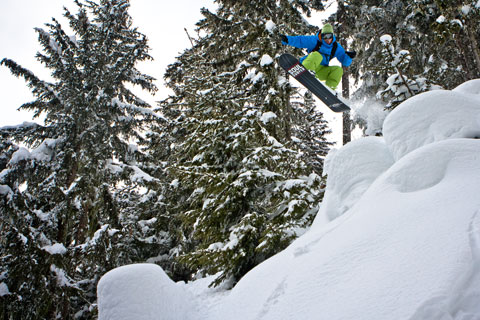
This was also trusted by the jeans manufacturer Levis, which wanted to position itself among skaters and BMXers with its streetwear collection. /Department let the entire appearance of the jeans brand go into black. Analogous to the asphalt, to make it clear that the collection is made for the street. The worldwide hype around action sports gave /Department a boost at the beginning. Freestyle became culturally dominant and spilled over into fashion and gastronomy. "It was a very fertile corner," Johne recalls. And /Department set out to capitalize on that momentum. Over time, however, the range of services became broader and the agency larger. With 15 employees and an international network of 50 people, /Department today sees itself as a 360-degree agency that covers everything from branding and communication, corporate design, and positioning to advertising and event conception. The freestylers have stopped the class war with the skiers. Whether skiing or snowboarding is no longer important. Today, /Department is passionate about advertising Head Skis and recently created a nine spot for the brand that features ski stars like Lindsey Vonn, Ted Ligety and Bode Miller. The creatives seem to have retained the daredevil, the explorer and the "cool". They show this in spots in which world-class skiers play "scissors, stone, paper" against each other. Or with an après-ski party at which someone moonwalks in his ski boots.

Two freestylers and one carver

In addition to clients from the sports sector, /Department now serves many companies that come from other corners. The Graubündner Kantonalbank has been one of them for seven years. The portfolio also includes a number of clients from the Grisons region. Winter sports resorts like Davos Klosters or Lenzerheide or the Hockey Club Davos. In 2013, Ollie and Johne want to make /Department even stronger and broader and have brought in reinforcements for this purpose. Long-time /Department senior art director Toma Perret is back on board as co-owner and creative director. In addition, the creative team is expanding its management team with a consulting partner and managing director. As of January 2013, Jan Maurer joins the agency from Wirz Wietlisbach as co-owner and CEO. Maurer will bring consulting expertise and classic agency craft. He is the carver the freestylers have been missing. "One who drives the straight line," as the two put it. "With Unikat, Jan has built up an agency of comparable size and successfully managed it for over seven years," says Johne. The creatives want to profit from this experience. And Maurer, too, hopes to find the right place at /Department after a turbulent time with several job changes - first at Ikea as marketing manager, then an attempt to build up his own agency, and finally at Wirz Wietlisbach Dialog.
 
Being broadly positioned will pay off for the creatives in the coming months. If only because of the "Graubünden 2022" Olympic bid, for which /Department is responsible for branding, brand image and communication. "In the next two months it will be hot," says Ollie. The appearance of the Winter Olympics with the Graubünden buck on a Swiss cross is already in place. The next step is to convince the people of Graubünden of their commitment with a classic campaign. Because before the bid can be waved through federally, the locals first have to give the green light. "You're working on a brand that is extremely present in the public eye. That's what makes it so exciting," Johne said. "Any Sunday reading, you can tell you're going to have an issue on Monday. It's real-time communication." In the past, they would have boycotted the Olympics. They were hosted by the skiers, after all. But even, the fight is over. Johne now conquers the slopes with telemark skis. "In snowboarding, I only got worse. I wanted something I could get better at," says Johne, "and something that would make you stand out," smiles Ollie.

Isabel Imper

kdw_2

In a nutshell

Johannes Eisenhut, Strategy and Partner, former professional snowboarder, grew up in Switzerland and the USA, studied German Studies/ Communication Sciences at the University of Fribourg and graduated with a PhD in Literary Studies/ Linguistics in Fribourg in 2008. From 1995 to 1998, he was Marketing Director Europe for Burton Snowboards, responsible for eleven countries. Later, together with Daniel and Markus Freitag, he founded the Web 1.0 community Skim.com, for which he was responsible for marketing. He was also publisher and editor of the trade journal "European Snowboard Business Magazine".

Oliver Brunschwiler, Executive Creative Director and Partner, after graphic apprenticeship and commercial diploma he went through the classic agency way. After his career as a snowboard pro and the launch of his own clothing label "Fuse" together with Rod co-owner Oliver Fennel, he joined the brand agency Külling (today: Schneiter Meier). After that, he moved to Weber, Hodel, Schmid, (W,H,S,) in addition to various stations such as Metzgerlehner, and finally worked as a freelance AD beyond the country's borders.

Flowcube: Bernie's and Whitebag.ch at the end of the year

In early December, Flowcube Communications was commissioned to handle public relations activities for the companies Bernie’s and Whitebag.ch. Both mandates include advising management, corporate communications, and product PR.

Flowcube will also act as the external press office for both brands from now on.
 

Tamedia launches Natura magazine

The Swiss media group Tamedia will launch the magazine *Natura* in May 2013. The magazine will be published in German and French and will be included as a supplement in ten regional daily newspapers from Lake Geneva to Lake Zurich.

Editing and sales are now part of the Schweizer Familie team in Zurich. An additional department will be created with six new employees. Barbara Schmutz will take over as head of the department. She has extensive experience as a journalist, text producer and concept developer for various daily newspapers and magazines, including Schweizer Familie and the women's magazine Annabelle, which are also published by Tamedia, according to a Schweizer Familie press release. The sales team is to be supplemented by an area sales manager.

Natura will be published four times a year with 84 pages. The magazine is aimed at anyone who wants to rediscover and enjoy Switzerland, according to a Tamedia press release. Natura shows the beautiful and natural sides of Switzerland, contains new ideas for vacations close to nature, excursions and outdoor activities and whets the appetite for healthy, regional specialties and traditional recipes. It also shows those interested in culture where old customs are still practiced and traditional arts and crafts are cultivated and presents reports on Switzerland's flora and fauna. Tips for the home, kitchen and garden are also part of the program.

The Natura magazine will be enclosed with Tamedia's regional daily newspapers in German- and French-speaking Switzerland and will achieve national coverage with a circulation of 540,000 copies. A total of 1.3 million readers of the following daily newspapers will receive Natura: 24 heures, BO Berner Oberländer, BZ Berner Zeitung, Der Bund, BZ Langenthaler Tagblatt, Tages-Anzeiger, Tribune de Genève, TT Thuner Tagblatt, Zürcher Unterländer and Zürichsee-Zeitung.
 

Picking at the Great Wall of China

Editorial departments should be more accommodating of advertisers’ wishes and be more open to their concerns even in the editorial section. However, what a prominent advertiser of print ads and TV spots demands from the media is also a subject of controversy within the advertising industry.

What Gerhard Schürmann, CEO of the car dealer Emil Frey, said at the Publishers' Congress was explosive: He would like to see more interfaces between editorial contributions and topics offered by advertisers. Why not an interview with a star who talks about cars? The demarcation between editorial and advertising business, defined as the "Chinese wall," would have to be torn down. Dominique von Matt (Jung von Matt/ Limmat), on the other hand, said at the same panel discussion that more important for good advertising is a credible environment that cannot be bought. What do other advertising experts think?
 
Markus Ruf, Creative Director at Ruf Lanz, shares Matts' opinion: "When I look at our press landscape, I get the feeling that there are already some titles that are happy to accommodate Mr. Schürmann's wishes. However, we believe that a clear separation between editorial and advertising business is important, because advertising needs a credible environment. Clients should acquire the attention of the audience - not buy it. They can do this by communicating in a more surprising, entertaining and smart way than others. That's what we do for our clients every day."
 
Peter Marti, owner of Marti.Seiler AG, sees it quite differently: "Marti. Seiler always negotiates editorial support with publishers during media planning. In practice, the weightier the medium, the less this takes place. Greater flexibility would be desirable here. After all, editorial coverage of products need not have a negative impact on editorial quality. In the aforementioned example of an interview with a star about a certain car brand, the only thing that matters is that it meets high journalistic standards. Of course, this also puts the onus on the clients and their agencies. It is up to them to provide the publishers with good ideas and editorially perfectly prepared articles. Or to support them in the production of relevant articles. A well-written driving report is certainly more exciting than a boringly written essay about an unattractive spring exhibition without ideas or stars. Definitely, I believe that the 'Chinese Wall' behind which many editors and journalists hide must be torn down in the spirit of a journalistic spring. And I am not writing here about the 'product pages' on which all publishers, from the NZZ to the Automobil Revue, already place perfumes and travel paraphernalia editorially. I am writing about larger editorial contributions. Dear Dominique, we both grew up in a theological home. I took my first advertising steps with your brother Jean-Rémy. And now, at the media congress, you are talking about a credible, non-buyable editorial environment, which is supposed to be the prerequisite for good advertising. The times of high credibility of the media are over since the financial and political crisis, since Facebook, Twitter and YouTube. Both the editorial teams (e.g., Murdoch wiretapping scandal) and the advertising agencies (e.g., last Renault campaign in Switzerland) have sinned. Credible information is being replaced by fun and entertainment. You can see that, dear Dominique, in the media figures. The question remains whether we both like this development with our clerical background. Well, in the Vatican is also tricked and lied ... and this since 2000 years."
 
René Eugster, owner of Agentur am Flughafen, says: "Basically, nobody buys a newspaper because of the great ads. Just like people don't use the feature film between the commercial breaks to take a piss. Dominique von Matt is absolutely right. Of course, a credible environment for good advertising is more important than ever. But where does that still exist? Maybe in grassroots social media channels, where companies invite dialogue and then get shocked when stakeholders actually take it up? Perhaps there are even negative statements about the brand that the advertising CEO might not like, whereupon he immediately gives the agency the order to censor or declares Facebook to be unsuitable for his company once and for all. Journalism has come under extreme pressure today. Our customers know this, too. Haller wrote in his textbook (a standard work in Swiss master's courses) back in 2005 that around 50 percent of reporting at dpa is based on PR material. In 88 percent of the cases, he said, the core message of the PR template is adopted. So what is this hypocrisy in 2012? Against this background, good advice from an advertiser acting with calculation is certainly not easy. However, we tend to advise our clients to stage good and relevant stories that pay into the brand account. Of course, we also try to penetrate the editorial space - provided that the relevance and the willingness to provide open information exist. In the B2B market or in trade or special interest magazines, this has always been an open secret, because ultimately the ad and the editorial piece want to motivate the same target group to take the same action with the same information. Simply through different approaches. As long as the reporting is honest, accurate and relevant, I still trust a good editor to exercise sound judgment on behalf of their customers/readers. Then the moment has come when we also advise our client to use a media-appropriate individualized, well-staged story in the editorial environment."
 
 
Geri Aebi, CEO of the Wirz Group, has a different opinion: "This is truly an explosive topic that Schürmann is bringing up. I'm sure he speaks from the heart of some of his clients! I myself spent almost 15 years in Austria - a country where the strict separation between editorial and advertising has long since been more or less abolished in many print media. Yes, this non-separation or mixing even forms an essential motive for founding and financing new magazines and newspapers in the first place. From correspondingly painful experience as a reader, but also as an advertiser, I have to say: Tried both, no comparison - please let's preserve and protect editorial independence as long as we can! The compromise solution of the inflation of public reports, which is rampant not least in certain specialist media, is still the lesser evil... Seen in this light, I absolutely agree with Dominique von Matt. Whereby I gladly admit: Depending on the title - and this certainly applies more to special interest magazines than to daily newspapers (and there especially to their "theme" supplements!) - a certain editorial affinity to the products advertised in ads is no longer surprising in this country. At the same time, people leaf through them accordingly and perhaps expect a bit of well-designed entertainment, but certainly not objective information from the relevant articles."
 
Finally the statement of Curdin Janett, CEO Publicis Communications Switzerland: "We fight for consumers' attention. And this is highest where they are interested and involved. In other words, in a high-quality environment. That's why I still consider the separation of editorial and commercial activities to be right and important. If we place our messages in the highest-quality environments, we achieve the best results. Nevertheless, nothing stands in the way of a well-implemented media cooperation with a client - if it is well thought out and well done, it can also be clearly identified as such. If there is added value for consumers, everyone is served." He answered the question of whether the media should be more open in their editorial reporting to products for which advertising is also paid for in the negative, but he does see differences in expectations compared to daily newspapers, magazines and special interest magazines: "In the case of daily newspapers, readers expect independent and interest-free reporting. We should respect this. In the case of consumer magazines with a lifestyle focus, cooperation can be interesting and entertaining for clients and readers - and thus also generate additional benefits for the publisher. Whereby I am still in favor of clear labeling. After all, with a well-crafted story, there's nothing to hide. In the case of special interest magazines, the reader is also aware that the proximity of providers and media in the specific market is higher. But here, too, it's true that anyone who disseminates PR without criticism has no credibility and is therefore of no long-term interest to either the readership or advertisers." Today, publishers and editors-in-chief are confronted with increased demands from the advertising industry and their clients. The "code of conduct" they launched is being put to the test.
 
Pierre C. Meier
(The article first appeared in an abridged version in the media magazine Edito).

The advertising killer syndrome

After initially finding it amusing, the insurance company Sympany is getting on my nerves more and more with its repeated run-ins with this “Passföteli” story. By Theophil Butz, graphic designer, advertising agency owner, source of inspiration, and—for over a year and a half now—also a complainer for *Werbewoche* readers. Please send relevant comments to [email protected]

The point here is that it is not acceptable for advertising to try to use humor and wit to keep the same commercial in the faces of readers and TV viewers for almost two years, with an advertisement as a reminder. Like this apparently complicated life situation with the Passföteli regulations. The movie with the guy who orders the coffee was still funny. This story with this funny Italo is like a bad joke that might make you smile once. But by the tenth time, you don't find the joke but the narrator no longer likeable, but rather annoying.

My theory: I have always preached that after a clever positioning concept and its creative implementation, continuity is the most important thing. But if continuity is implemented in such a way that the same spots and ads are always used over two years, then continuity has been misunderstood. Years ago, an English cigar company had an advertising concept based on the same strategy as Sympany. Motto: Life is complicated, we are the solution. "Hamlet is a cigar called happiness" was their slogan. Year after year, these commercials were shortlisted in Cannes and often picked up a Lion. The concept was also that life is complicated and the product is the solution. In addition to the TV commercial with the conveyor belt at the airport, one film in particular is unforgettable in the industry. There's a man sitting in a photo booth and every time there's a flash, his last five hairs slip into his face. Sorry, Markus Brönnimann, but that reminds me of the Sympany campaign. Regardless of whether I'm going too far out on a limb, one thing is important: the creative difference is miles apart.

A movie episode of Laurel and Hardy (the clock and the beer) or Polanski slashing Jack Nicholson's nose. These are stories that you would like to watch more often. But boring TV commercials that always tell the same joke are counterproductive.

Last week, I had a chat with star filmmaker Ernst Wirz. He shares my view and says: "Make simpler stories, but do a new episode more often."

I often look into the fire. It's always the same concept and yet always different and fascinating. It's also warming. My resolution of the week is that I'm only allowed to write one more column this year. After that, the world will end on 21.12. See you soon, wherever you are. By the way: get a biometric passport. It's completely digital and doesn't have to be done in a fetal box. And it's also completely uncomplicated...

butz-sympany
 

Crome: Gifts to peel

«Creative flashes of inspiration are an advertising agency’s most valuable asset—especially when they work across media.» With this treasure, Crome is thanking its clients, partners, and other loved ones this year.

The agency is staying true to its corporate design and giving away crates of orange ideas for Christmas. "Because Crome's logo, the orange, goes as well with Christmas as Brunsli and mulled wine together," says the agency. Each of these vitamin bombs is wrapped in a nostalgic orange wrapper. The Crome employees are depicted on it. A QR code then takes the recipient to a microsite. Here you can find all the personal orange ideas that each individual "Crömler" was allowed to come up with in a free minute.

y1
y2
y3
y4
y5

Ride Greener is ready for winter

To kick off the winter season, the environmental and climate education campaign Ride Greener is offering a wide range of activities. This winter, Ride Greener aims to contribute to climate protection and is providing specific recommendations for environmentally conscious behavior in the mountains.

With the organization of workshops with young people, the publication of the Ride Greener magazine, a presence at Freestyle.ch and other activities, the still young Ride Greener campaign can look back on a successful first year. In a short space of time, Ride Greener has established itself in the Swiss snowboard and ski scene. "Numerous young people have thought about their actions for the first time and have reconsidered and improved their habits," summarizes Sten Smola, project manager of Ride Greener.

Ride Greener has big plans for the new season. Filming will soon begin on the first CO2-neutral snowboard and ski documentary in the Swiss Alps. The local protagonists of the film feel threatened by the advancing climate change and are therefore looking for an alternative way. "Instead of flying around the world chasing snow, we explore the Alps on our doorstep, travel by public transport and climb the most impressive peaks with our own manpower before tackling spectacular descents and jumps," says Reto Kestenholz, Swiss snowboard legend and Ride Greener Ambassador, about the film content.

Using a specially developed Facebook app, young snowboarders and skiers also have the opportunity to determine their CO2 snowprint for the first time. This allows them to show their friends how hard they are working to stop increasing global warming and prevent future winters with little snow. The app is now available on the Ride Greener Facebook page.

Ride Greener Days for young people in Graubünden

The popular Ride Greener Days will take place for the second time in Laax at the beginning of 2013. During these outdoor days, young winter sports enthusiasts will learn on site what it means to practice sustainable winter sports, correctly assess the avalanche situation off-piste and also observe the wildlife protection zones. The days are led by experienced mountain guides as well as snowboard and ski professionals, and climate education experts from Myclimate are also involved. Ride Greener is also strengthening its collaboration with the non-profit foundation Myclimate in 2012/13.

Green Rider Facebook app "Powder Challenge"

RideGreener1
RideGreener2_Gruender_StenS
Sten Smola, project manager of Ride Greener

RideGreener_3
 

Erdmannpeisker: 24 tips for relaxed holidays

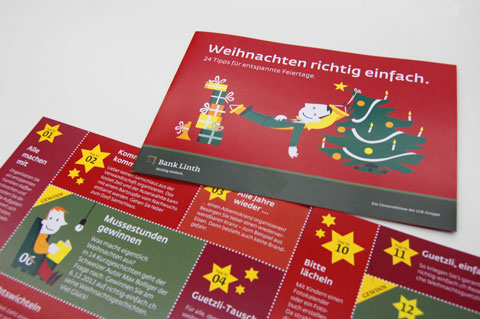
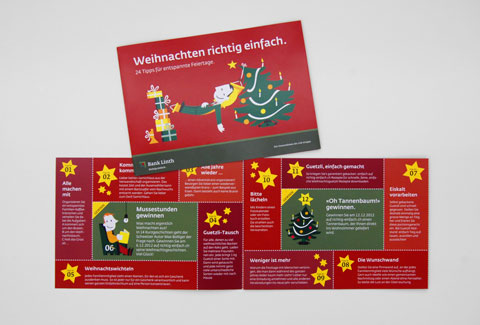
Erdmannpeisker has designed a Christmas card for Bank Linth. This was designed to match the claim " Bank Linth. Really simple ".

On the Christmas card, illustrated in Bank Linth style, the bank from Eastern Switzerland gives 24 tips on the subject of "Christmas made really simple". In addition to tips for a simple and stress-free Christmas, there are also competitions for a ready-made gourmet Christmas menu or a decorated Christmas tree - free delivery. And on the website Correctsimple.ch the lyrics of the best-known Christmas carols are available to download - so that everyone can really sing along to the second verse of "Oh du fröhliche" this year.

The Christmas card was sent to Bank Linth customers together with the personal holiday wishes of the client advisors before the start of Advent.

Responsible at Bank Linth: Armin Diethelm (Head of Corporate Communications), Rosa Sciacca Gübeli (Manager Marketing Services). Responsible at Erdmannpeisker: Gabriel Peisker (CD), Christina Weisser (AD), Selina Helbling, Vera Schär (consulting), Tijn Snoodijk (illustration).

ep_weihnachtskarte1
ep_weihnachtskarte
get_footer();