Armin Müller becomes head of copywriting at the Sonntagszeitung

Armin Müller is returning to the Sonntagszeitung and will become the new head of copywriting and author at Switzerland's highest-circulation Sunday newspaper as of March 1, 2015.

The economist, who trained at the University of St. Gallen and Columbia University in New York, joined the business newspaper Cash in 1991. In 1999, Müller moved to the SonntagsZeitung, where he worked as head of the economics department and, from 2003, as editor and deputy editor-in-chief. After his stint at the SonntagsZeitung, the 54-year-old Müller was Chief Economist at the Handelszeitung from November 2010.

Comet: Christmas in Shoppyland

Komet designed the advertising materials for the Advent promotion of the Shoppyland shopping center and appropriately transformed the Shoppy visual into an Advent calendar door.

As every year, the largest shopping center in the Bern Mittelland region has a particularly large number of attractions to discover in the run-up to Christmas, from Christmas crafts for children to fondue for all and Christmas tree sales. Komet communicates the festive activities. The Advent duck is used as a poster campaign and welcomes visitors on flyers, indoor measures, Facebook and in the form of an Advent calendar as a giveaway in the shopping center.

Shoppy_Plakat_F200_X-Mas-2
Fachpresse_Closeup_Kalender
shoppy_x-mas_fassade

Responsible at Shoppyland: Karl Gorsatt (Center Manager Shoppyland), Rahel Waelti (Marketing & Communication), Diana Weber (Administration). Responsible at Komet: Moritz Staehelin (CD), Joël Weber (AD), Julia Sutter (Text), Simon Schatzmann (Head of Consulting), Sarina Künzli (Consulting).

DQ&A One enters the Swiss market

Effective immediately, DQ&A One is offering its full range of services in Switzerland as well. DQ&A One is a division of the international DQ&A Media Group.

Its services range from consulting on the evaluation and implementation of state-of-the-art digital marketing technologies to the outsourcing of ad services/ad operations for direct customers, agencies and publishers. Clients benefit from over 13 years of experience and a network of over 140 digital experts around the world. DQ&A One is also Google's exclusive partner for its digital marketing platform "Doubleclick" in many countries, according to a statement.

The complexity of today's digital marketing solutions poses major challenges for many companies. Evaluation, implementation and configuration of the right technology have a significant impact on the long-term success of digital advertising campaigns. This is where DQ&A One wants to offer a hand: long-standing experts in digital marketing and the corresponding technologies support advertisers at every step on the way to a holistic view and use of the various channels, placements, data and tools. Together, for example, marketing goals are evaluated, training is conducted, tracking technologies are deployed, attribution models are defined, or optimization algorithms are further developed. "We help advertisers really gain control over their digital marketing investments. The correct collection, interpretation and use of data are key elements in this," says Rick van Boekel, CEO of DQ&A Media Group.

"Managed Service" around the clock

At the same time, DQ&A One also offers the "Managed Service" for all solutions and tools. Companies, agencies and publishers can therefore outsource the technical implementation of campaigns and thus save costs in the areas of ad services and ad operations. At the same time, they benefit from the extensive know-how and permanent availability of over 30 specialized employees as well as a close, long-standing partnership with Google.

TBWA\Zurich has Federer congratulated

Roger Federer congratulates his new number 1 for mobile telephony: TBWA\Zurich created the kick-off ad for the new partnership between Sunrise and the tennis star.

Celebration mood at Sunrise: Not only could Roger Federer be won over as a new brand ambassador (Werbewoche.ch reported), but also first place in the "mobile telephony" category - as can be seen in the current Connect mobile network test (issue 1/2015). Reason enough for Roger Federer to congratulate Sunrise personally on this title victory - with a special dedication: "Congrats to the new #1 from number 076 333 37 37". By the way, whoever calls Roger Federer's Sunrise mobile number can experience something, according to the announcement. This is the first measure developed by TBWA\Zurich as part of the new partnership, with further implementations for TV and print to follow.

LOW_157641_NZZBusCombi_Connect_291x218_df_TP-1
 

Swissôtel's global brand promise

Swissôtel launches the global brand campaign "Live it Well". The starting signal for the concept and media was given by an integrated marketing strategy, followed by an agency evaluation and the development of a global and multimedia campaign concept.

Swissôtel Hotels and Resorts has been an established name in the international hotel industry in the upper segment of business and leisure travel for 33 years. The new management of the hotel chain has been under the leadership of Swiss national Lilian Roten for the past year, who has developed and globally implemented the brand in terms of content, form and various quality certifications (ISO, EFQM, Sustainability Report), design standards and, above all, a consistent guest experience in line with the latest Swiss hotel industry criteria.

In summer 2014, Swissôtel commissioned strategic content marketing to position and revitalize the brand message and the defined brand values among the various internal and external target groups, above all the guests. The advertising campaign that was subsequently conceived and has now been launched in the D/A/CH market and in England, together with the launch event at the Swissôtel Zurich-Oerlikon at the beginning of November, is the starting signal for a worldwide, target group and media-oriented, fully integrated communication on print, online and social media. The brand promise "Live it Well" is at the forefront of the measures planned until 2016 during the launch phase.

230x297_swissotelAZ_full-page_0

"Live it Well" is based on an invitation to guests to enjoy travel and life, safe in the knowledge that with Swissôtel they have found a partner who has built quality from the ground up over the past few years and today creates an environment in which they can enjoy a carefree quality of life.

//www.youtube.com/watch?v=Qd5Cka-00jU

Responsible at Swissôtel Hotels and Resorts: Lilian Roten (Vice President Swissôtel Brand), Daniela Sandau-Jensen (Head of Marketing and Communication), Thiébaut Ossola (Brand Experience).Responsible for strategic content marketing (incl. media relations, print and digital media planning): Martina Anderberg (Mediensatellit) and Marion Willam (Willam Communications). Responsible for the campaign: Dan Pearlman - Sophia Goerner (Head of Strategy), Julien de Repentigny (Design Director), Sandra Fiebranz (Project Management).
 

PWC Study: "Football's Digital Transformation

According to a PwC study, the soccer business has entered the digital age. Personalized content is the new driver of clubs’ return on media investment. Advanced technologies are opening up new business models and growth strategies.

"Football's Digital Transformation - Growth opportunities for football clubs in the digital age" is the name of the study conducted by PWC Switzerland, International Football Arena and Exozet and published on Tuesday. It is dedicated to the transformation of the football business in the digital age. It reflects on a variety of different yet closely intertwined areas of digital progress and highlights their potential impact on the football business.

After the game is before the game: Digital technologies and media enable soccer fans and clubs to communicate with each other far beyond the classic 90 minutes of play. As the technical possibilities increase, so does the demand for more content and a personalized user experience. "Football clubs need to develop new commercial business strategies if they want to remain competitive off the pitch in the digital age," says David Dellea, Head of Sports Business Advisory at PWC Switzerland. "A larger and younger generation of football fans has grown up in the digital world. For them in particular, the digital offering has a decisive influence on whether they become and remain a fan of a club."

Personalized user experience

Football fans leave behind significant amounts of personal data and information in the digital world. When football clubs analyze this data, they get to know each fan better. They also gain a key competitive advantage in the industry by targeting content and personalizing marketing messages and offering relevant products and promotions. On the one hand, this ensures their long-term loyalty to the brand. On the other hand, it allows clubs to increase their revenues by providing cross-selling and up-selling opportunities.

Exclusive data always within reach

Thanks to new devices worn directly on the body, in the future fans will be able to compare their pulse with that of a soccer star, for example, or experience a football match in a completely new way with live commentary from the sidelines. "The market for these devices called wearables is starting to grow right now, they are affordable and the platforms are not yet regulated. With the use of commercial data and information, lucrative business models and marketing strategies for football clubs and players are emerging here," summarizes Frank Zahn, CEO of Exozet.


WS with appetizer for Volkswagen

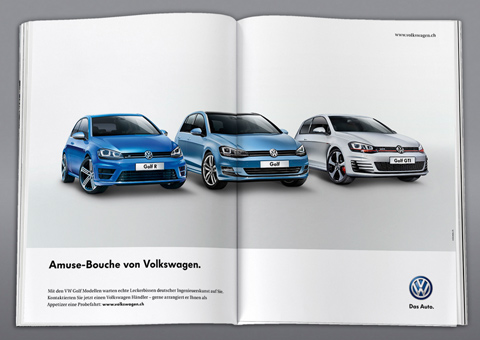
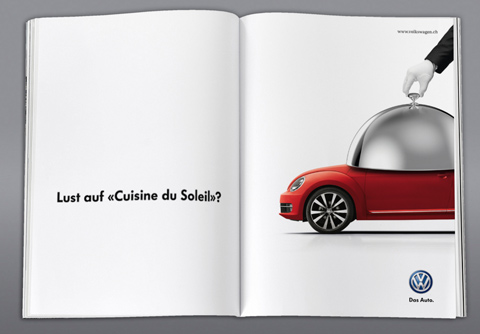
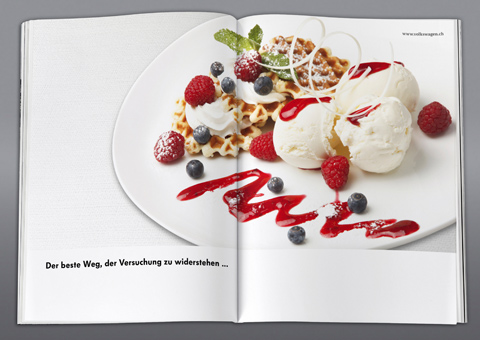
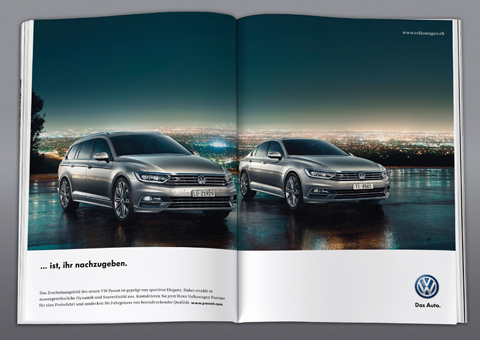
From delightful «amuse-bouches» to «Cuisine du Soleil» and sweet, tempting desserts: WS Kommunikation whipped up some creative dishes for Volkswagen Switzerland in its own creative kitchen.

The agency designed a two-page ad for each of the new issues of the "...Geht aus! magazines (Basel, Ticino, Zurich), each running over two double-page spreads. The aim was not only to tempt the palate in a culinary setting, but also to whet the appetite for the new Volkswagen models.

VW_Anzeige_TIGA_1
VW_Anzeige_TIGA_2
VW_Anzeige_ZHGA_1
VW_Anzeige_ZHGA_2
VW_Anzeige_BSGA_2015_1
VW_Anzeige_BSGA_2015_2

Responsible at Volkswagen Switzerland: Nathalie Mösch (Head of Communications), Sina Neuhaus (Advertising Specialist). Responsible at WS Communication: Reto Meyer (overall responsibility), Markus Stöckli, Joe Werner (creation), Nadine Wolleb (consulting).
 

IGEM Digimonitor: The iPad is an iPet

Among other things, the IGEM Digimonitor shows that most tablets are used primarily at home. Apple leads the market for tablets and smartphones. Time-shifted TV viewing is becoming a habit, but the Internet is rarely accessed via TV sets.

The IGEM Digimonitor, presented on December 2 at the Primetower by the Interest Group for Electronic Media (IGEM), has revealed interesting findings regarding the use of communication and entertainment devices. Conducted in collaboration with Wemf, this study is the only one with this specific scope that is representative of the entire population aged 15 and older, including those who do not use the Internet and individuals in households without a (registered) landline connection.

The iPad is an iPet. Or to put it another way: the tablet computer is a «pet.» 94 percent of respondents in German- and French-speaking Switzerland who use a tablet do so (also) at home. On the other hand, none of the possible locations for use while on the go reaches a usage rate of more than 20 percent. It therefore stands to reason that only a small proportion of all tablets are equipped with a SIM card. Whether with or without a SIM card, Apple is the clear market leader in tablets. More than half of all respondents most frequently use a tablet running the iOS operating system. Among those who are not heads of household, the figure is as high as 70 percent.

Smartphones: iOS Clearly Ahead of Android

iOS also leads the way in the smartphone market. 45 percent of all smartphone users most frequently use an iPhone. Android trails far behind at 34 percent. Among young people, however, the iPhone’s lead is only just under three percentage points, whereas among those over 55, it is more than 15. Other operating systems play virtually no role, accounting for 6 percent. About 15 percent of respondents, however, do not know which operating system their smartphone uses; in French-speaking Switzerland, that figure is even twice as high.

Time-shifted TV is becoming a habit

Nearly 40 percent of the population watches time-shifted TV at least once a week. About a quarter do so occasionally via a desktop PC or laptop. Smartphones and tablets are used significantly less often for time-shifted viewing. When they do use them, tablet users most often say they do so because they don’t own a TV set or because it’s being used by someone else in the household.

Popular Second Screen

More than half of TV viewers now say they use a second screen at least occasionally while watching TV. One-fifth of all TV viewers—and two-fifths of young people—even do so at least once a day. However, they more often consume content that has nothing to do with the TV program currently airing.

Internet use via TV sets is still limited

Just under 12 percent of those who watch TV on a television set access online content on it at least occasionally. That is significantly less than what would be technically possible given the current prevalence of so-called smart TVs.

People listen to the radio more while on the go than anywhere else

More than 80 percent of radio listeners tune in at least occasionally while on the go—whether in the car or on foot. Radio listening at home follows closely behind, at 78 percent. For women, people not in the workforce, and older adults, however, home is the most common place to listen to the radio. Listening on public transportation is particularly popular among young people.

More than a quarter listen to digital radio most often

When it comes to the most commonly used method of listening, analog FM remains in the lead, with just over three-quarters of all radio listeners tuning in via a conventional radio. However, nearly 25 percent listen most often via DAB/DAB+, and 5 percent via online streaming.
 
YouTube is the largest social network

Nearly two-thirds of the population uses YouTube at least occasionally. WhatsApp, Facebook, and Google+ follow. Among people aged 15 to 34, nine out of ten use YouTube at least occasionally, though WhatsApp is not far behind. Among people aged 55 and older, however, YouTube’s usage rate is just under 31 percent. WhatsApp and Facebook are neck and neck here, while Google+ trails far behind in fourth place. Incidentally, Google+ is significantly more popular in French-speaking Switzerland than in German-speaking Switzerland. The Twitter network, which is particularly popular among journalists, is used at least occasionally by just 10 percent of the population, with a significant majority of users being men and young people.

LinkedIn leads the way among business networks

Among business networks, LinkedIn is clearly ahead of Xing among the general population, with 12.5 percent of occasional users. This also holds true for individual age groups. The figures are by far the highest in the middle age group. They are also significantly higher among people with a high level of education.

Facts About the IGEM Digimonitor

The IGEM Digimonitor was developed by the Interest Group for Electronic Media (IGEM) in collaboration with the Working Group for Advertising Media Research (Wemf) and conducted by the Link Institute in Lucerne between early August and early September 2014. It is representative of the entire population in German- and French-speaking Switzerland who can be reached via a private telephone line (landline or mobile). The study results are available free of charge to IGEM members in the form of a standard report. Non-members can purchase the study for 5,000 francs from the IGEM office. More information at Igem.ch.

daily
More than half of the population in German-speaking and French-speaking Switzerland use the Internet, a smartphone, or a desktop computer, listen to the radio, or watch TV every day. A minority use a laptop or notebook, a tablet, or teletext.
 

Marketing goes Big Data: Time bomb for data protection or brave new world?

Marketing seems practically tailor-made for data analysis. But is security being taken into account in the process? An opinion piece by Hans-Günter Börgmann, Managing Director of Iron Mountain Germany.

60 percent of small and medium-sized businesses believe that data analysis is best handled by the marketing department. This was the finding of a recent study¹ conducted by Iron Mountain and PwC. However, another study commissioned by Iron Mountain among marketing directors² paints a different picture: the teams in question are less confident about the success of targeted data analysis.

The following studies paint a similar picture: One Survey According to the Economist Intelligence Unit, one-third of executives believe that the ability to analyze data is the most important skill for marketing professionals in the age of big data. On the other hand, just under half admit that their own teams lack this ability. This is also confirmed by a IBM Study, according to which 82 percent of marketing executives are not sufficiently prepared for the flood of data, and only 59 percent of respondents say they can analyze customer behavior across all channels—for example, for e-commerce or social media. And despite this obvious skills gap, according to IDC Only one in five marketing professionals has received training in data analysis.

Is customer data in safe hands?

In short, there is a high probability that many companies entrust certain teams with important data, even though those teams are ill-equipped or ill-trained to analyze it. According to the Iron Mountain study mentioned at the beginning, marketing teams are increasingly being granted access to sensitive customer data for analysis, but without being held accountable for data security.

The study also found that less than one percent of small and medium-sized companies in Europe believe that responsibility for data security should be assigned to the marketing department. More than half of European companies (48 percent) simply assign responsibility for information risks to the IT security manager.

More Risks Due to Flexibility

Given that marketing departments, in particular, are increasingly adopting flexible work arrangements that allow employees to work from home or while on the go, the issue of data protection and the accountability of marketing staff takes on added significance.
On average, European marketing professionals work from home two to four times a week—more than any other position surveyed in the study. Last year’s Iron Mountain study² also shows that one-third of the marketing employees surveyed take confidential work documents with them to work on them while on the go; one in four throws their documents into the nearest trash can; nearly half send and receive work documents via their personal email accounts, sometimes even over an unsecured Wi-Fi connection (12 percent). However, only one in three employees has access to a secure remote connection or appropriate security guidelines—for example, to handle sensitive data securely while working from home.

All in all, this is a ticking time bomb for data breaches that could go off at any moment.

Good for business intelligence, bad for data protection

Customer information is too valuable to be handled carelessly. The capabilities companies have today for collecting, analyzing, and using information would have been unthinkable just a few years ago: online customer registration, digital communication, social media, and geo- and online tracking now provide companies with unprecedented insights to better understand customers and their needs.

Making such data available company-wide is essential for analyzing it as part of business intelligence and for building long-term customer loyalty in the age of e-commerce and social media. However, employees who handle this data must also know how to protect it. And even more importantly, they must be supported in this effort—for example, through training programs, information campaigns, and the provision of secure mobile work environments (VPN access).

Information management is everyone's business

The days when information management, data protection, and data storage were still handled in the back office by the IT department or the records management team are long gone. Today, this is a business-critical process whose success rests on the shoulders of every employee. That makes it all the more important to close any potential gaps in data security and to make it clear to employees that data breaches can have devastating consequences for the company’s competitiveness, revenue, and reputation. There is only a slight difference between the terms “disclosure” and “leakage”—yet the consequences for data protection could not be more different.

¹ On behalf of Iron Mountain, PwC surveyed senior executives at 600 European and 600 North American companies with 250 to 2,500 employees, as well as 600 companies on both continents with up to 100,000 employees in the following industries: law, finance, pharmaceuticals, insurance, energy, manufacturing, and mechanical engineering. Media release; Abstract; Infographic.

² Opinion Matters for Iron Mountain. The survey was conducted between April 15, 2013, and May 1, 2013. Sample: 5,021 working adults in Germany, the United Kingdom, France, Spain, and the Netherlands. Of these, 1,002 were from Germany.

About Iron Mountain Germany

Iron Mountain
is a leading provider of information storage and management services. Its network of high-security archives spans an area of six million square meters, with more than 1,000 facilities in 36 countries, enabling the company to serve customers quickly and reliably. Iron Mountain’s archiving solutions cover both physical documents and digital data, addressing the entire lifecycle—from secure storage to destruction—to help companies store their documents in compliance with regulations, reduce their storage costs, and mitigate risks. Founded in 1951, Iron Mountain stores and secures billions of pieces of corporate information, including business documents, backup tapes, electronic records, and medical data.
 

Vizner Borel: Christmas is coming to Europaallee

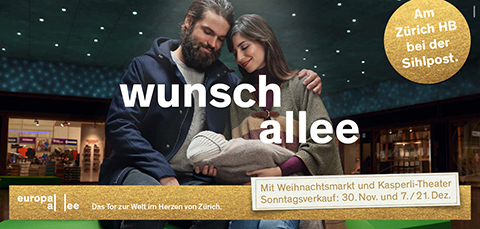
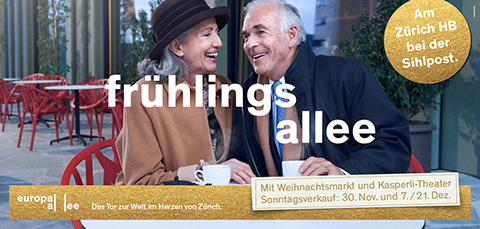
Europallee is once again hosting Christmas activities this year—including a Christmas market. Vizner Borel is promoting the holiday program with a campaign.

Europaallee is celebrating Christmas for the second time this year and has some wonderful surprises in store for visitors of all ages starting in late November. To promote these events and further raise awareness of this location in Zurich’s growing neighborhood, ViznerBorel has developed new poster designs and radio spots, in addition to numerous other advertising measures. The Zurich-based communications agency has been managing the SBB account since spring 2013.

RZ_F12_Plakat_Weihnachten2014-3
RZ_F12_Plakat_Weihnachten2014-4
RZ_F12_Plakat_Weihnachten2014-5

Responsible at SBB Immobilien for Europaallee: Mélanie Crittin. Responsible at Vizner Borel: Lajos Vizner, Guillaume Borel (Overall Responsibility), Eveline Jakob (Consulting), Florian Steiner (Art Direction), John Leuppi (Copy), Rainer Schaer (Photography), JBW Media (Media).
 

27 Swiss entries on the shortlists

The Eurobest advertising festival, which opened its doors on December 1, has announced the shortlists for 14 categories—27 entries from Switzerland made the cut.

More than 2,000 communicators from agencies and companies are currently meeting at the advertising festival in Helsinki. Over the next few days, they can look forward to a packed program that will feature more than 90 speakers, while the juries will evaluate a total of 4,811 submissions and present the best with an award.

A total of 27 entries from Switzerland made it onto the shortlists of the following categories:

Branded Content & Entertainment
1x Jung von Matt/Limmat with Pro Infirmis
1x FCB Zurich with MTV Mobile/Sunrise

Film
1x Jung von Matt/Limmat with Pro Infirmis

Interactive
1x Servicplan Suisse with BMW Soundtree

Media
2x Jung von Matt/Limmat with Pro Infirmis
1x Mediaschneider/Heimat with Swisscom

Outdoor
5x Publicis with L'Oréal
4x Y&R with Teleclub

PR
1x JWT with Mazda

Print
3x Publicis with L'Oréal
3x Leo Burnett with Slow Food

Promo & Activation
2x Jung von Matt with Pro Infirmis
1x Leo Burnett with Bio Suisse

The shortlists of 14 categories can now be viewed online Eurobest.com. Germany is currently leading with 174 shortlists achieved. It is followed by France and Great Britain.

The Eurobest Festival has been held for over 20 years and has over 4,000 contestants every year. This year, the festival will take place from December 1 to 3, 2014 at the "Finlandia Hall" in Helsinki, Finland. Publicitas is the Swiss representative of the festivals "Eurobest Festival of Creativity", "Cannes Lions" and "Lions Health", "Dubai Lynx" and "Spikes Asia".

"Direct Mail unaddressed" new in MA Strategy

As of Thursday, November 26, 2014, the MA Strategy has included the metric «unaddressed direct mail» for the first time, placing it in direct competition with other media categories such as print, radio, TV, movie theaters, billboards, and the Internet.

Of all individuals in the population (6.422 million), 50.3 percent belong to the core user group for this advertising medium. For Direct Mail Company, this high figure is encouraging, but hardly surprising. According to a press release, a similar figure in this range had already been generated in the WEMF-audited Demoscope study on unaddressed direct mail. When compared with other media types and categories, this figure gains even greater significance—a single campaign is sufficient to achieve this reach. In contrast, with other media types and categories, various publications, websites, or broadcasters must be booked to generate such a figure.


get_footer();