Media obligated

A new "Code of Conduct" is intended to facilitate trusting cooperation between advertising clients, media agencies, media and their marketers in the Swiss media business. The paper was formulated by the Swiss Advertising Client Association (SWA).

Unbenannt-7_53

Download Code of Conduct (German, PDF)
Download Code de conduite (French, PDF)

The SWA has already made various principles, sample contracts and recommendations for the Swiss advertising market available on its website. Now the new "Code of Conduct" also sets out what behavior is desired from clients in the advertising market.

For example, the SWA "Code" stipulates that agencies must be remunerated fairly and appropriately by advertising clients in accordance with the services agreed and provided, or that media agencies are obliged to fulfill the objectives of the advertising client who commissioned them. This means that they must remain neutral, offer objective advice and not allow themselves to be influenced by third parties. Compensation or benefits must be billed transparently.

The SWA's paper is intended to serve as a guide for the association's members. A similar recommendation for conduct was launched several years ago by the German organization Werbungtreibende im Markenverband (OWM).

Anne-Friederike Heinrich


"Advertisers must pay their agencies fairly"

Unbenannt-8_47

Four questions for Roland Ehrler, Director of the SWA, about the new "Code of Conduct".

WW: Roland Ehrler, why have you formulated a code of conduct for advertising clients, media agencies and media as well as their marketers? Is the market not working fairly and transparently?
Roland Ehrler: We attach great importance to a transparent approach in the cooperation between all parties involved in the media business. It is important that advertising clients pay their agencies fairly and that all reimbursements are disclosed.

Why are you coming up with the paper now?
The topic had been on our agenda for some time. When I took up my post as Director of the SWA at the end of 2012, I said that I considered transparency to be extremely important and that I preferred to help shape it rather than wait and see. The "Code" is one of the concrete results of my two-year term of office.

The "Code" is not a contract that your members have to sign, but merely a thesis paper that you can adhere to - or not. What effect do you think the code will have?
It is an important guide for our members, the media agencies and media providers. The advertising market will decide to what extent this position will prevail. However, we believe in these principles and hope for a lot of support from the market.

The "Code" is about performance-related remuneration, neutral advice and the provision of contractually agreed services. Are these not self-evident?
If that is the case, then everyone will agree with us. However, we have simply had repeated requests from our members and it was now time to manifest our already known positions with this paper.

Interview: Anne-Friederike Heinrich

In a nutshell

The Swiss Advertising Clients Association (SWA) has represented the interests of well-known Swiss companies in the advertising market since 1950. Today, its 160 members represent around 75 percent of the Swiss advertising market with a total volume of around five billion Swiss francs. One of the association's most important goals is to create attractive framework conditions for its members' market activities.
 

Digital video gains, TV dominates

How is video consumption—the so-called “viewing landscape”—changing? This is a question many marketing professionals are asking themselves, particularly in light of new streaming services such as Netflix. To better assess potential trends and developments, it’s often helpful to look at other countries.

This article therefore shows the findings of the current "Cross-Platform Report" from the USA and the Australian Online and On Demand Study, both of which are based on data from the market research company Nielsen.

The American study paints an interesting picture that is characterized by three key factors. Firstly, it confirms once again that consumers are spending more and more time with electronic media. US adults now use electronic media for an average of 10 hours and 47 minutes a day. Compared to the previous year, the daily media usage time has thus increased by 21 minutes and even by 36 minutes compared to 2012. Secondly, the figures from the USA document that digital video usage - i.e. image consumption via PC/laptop, smartphone or tablet - is increasing significantly. 18 to 34-year-olds now spend an average of 35 minutes a day on digital video, compared to 23 minutes in the previous year (+53%) and just 19 minutes in 2012. However, digital video is also on the rise in other age cohorts. Two years ago, 35- to 49-year-olds only spent an average of 13 minutes a day with such content, in 2013 it was 14 minutes, today the usage time is 26 minutes (+80% compared to the previous year).

Even the slightly older generation of 50 to 64-year-olds, who are generally said to have a lower digital affinity, are increasingly using digital video. Their consumption has risen from 9 minutes in 2012 to 11 minutes in 2013 and now 19 minutes (+60%). Thirdly, it is interesting in this context that the consumption of TV content on the TV set (live and time-shifted) continues to be very stable and remains dominant in absolute terms. Although TV usage among 18 to 34-year-olds has fallen slightly by 5 minutes a day compared to the previous year (-2%), at an average of 4 hours and 17 minutes it is still 7.3 times higher than digital video usage. Among 35 to 49-year-olds, this ratio is even 11.4 (4 hours and 57 minutes of TV per day, -1% compared to 2013). At 6 hours and 12 minutes a day on average (-2%), 50 to 64-year-olds watch TV for almost 20 times as long as they use digital video.

An overall picture that is confirmed by the data from Down Under. According to the online and on-demand study, 50 percent of Australian online users now use the internet to watch TV content, which is 7 percent more than in 2012. However, consumers still tend to use the corresponding services occasionally and in addition to traditional TV. Only 5% of users watch missed TV programs online every day, while a further 14% use catch-up TV a few times a week. Even those Australian consumers who use internet-based services to watch television watch conventional TV for significantly longer. On average, their live TV consumption is 11.6 hours per week, which is 4.5 times longer than the time spent with video-on-demand offerings (2.6 hours per week, including catch-up TV).

Clemens Koob

Unbenannt-37_0

Key Facts
- Consumers are spending more and more time with the
electronic media. The daily usage time is
10h:47m (+21m compared to 2013/USA).
- Digital video usage is clearly on the rise. Among 18 to 34-year-olds
is 35m per day (+53% compared to 2013), for the 35 to
49-year-olds at 26m (+80%), and among 50- to 64-year-olds
at 19m (+60% / all USA).
- TV usage on the TV set is very stable and dominates
 

13 questions for... Peter van der Touw

13 Questions for Peter van der Touw, CEO of Notch Interactive.

1. what would you most like to promote?
For the next James Bond film.

2. who is the most fun lunch partner?
My father (84). At every meeting, he gives me a reading folder full of articles on technological, economic and social trends. Pleasant inspiration for my everyday life.

3. the best testimonial ever?
John Lydon (ex-singer of the Sex Pistols) for Countrylife British Butter. What a surprising image transfer.

4. Has your media behavior changed in the last three years? If yes, how?
That's a rhetorical question, isn't it?

5. if you had not become an advertiser - what then?
I don't see myself as an advertiser. Rather as a discoverer and craftsman in the age of digital transformation.

6. what is for you the current biggest challenge for advertising?
Brands need to have an engaging dialog with their target audience. Or with Walt Disney: "Do what you do so well that they will want to see it again and bring their friends."
 
7. what do you think about owned media?
Better than Paid Media, less exciting than Earned Media.

8. what is impossible for you to do without?
History in all forms. On History Channel, as an audio book, as a historical novel.

9. what advertising should be banned?
Political Advertising.

10. can you tell us a little secret?
I'm part of the dropout tribe.

11. What inspired you to enter the advertising/communications industry?
Anno 1994 I was excited about the unlimited possibilities of the internet. Today I am even more so.

12. what are you determined to achieve?
We want to be one of the leading agencies in Switzerland and are well on the way to achieving this.

13. which websites do you regularly use for private or professional purposes?
There are a lot of them. Especially shopping sites.

Thomas Häusermann

Syndicom becomes "Blue Community

Syndicom was the first non-profit organization in Switzerland to join the international "Blue Community" initiative. This was launched in Canada and campaigns for access to clean drinking water as a human right and a public good.

For Syndicom, a strong and secure basic public service is key, as the media and communications trade union writes on joining. The exchange of information and data via the postal and telecommunications networks is vital for our modern society. Meanwhile, many people live in conditions in which the much more existential supply of sufficient and clean drinking water is not guaranteed. In 2010, the UN General Assembly therefore declared access to water to be a human right. This is where the "Blue Community" comes in, which aims to preserve water as a public good for all. A central demand of the international initiative is that the water supply in all countries is and remains the responsibility of the public sector. This is the only way to ensure that all people have or maintain unhindered access to drinking water.

By joining the "Blue Community", Syndicom is supporting this cause and is committed to upholding five principles. In addition to the political commitment already mentioned, the initiative calls for the responsible use of water as a resource, the promotion of the use of drinking water from the public supply and support for other countries in maintaining and expanding public drinking water supplies.
 

Television: Breakout from the living room

The digitization of television broadcasting is leading to significant changes in viewing habits. This is shown by the IGEM-digiMonitor, released on December 2 by the Interest Group for Electronic Media (IGEM) and the WEMF.

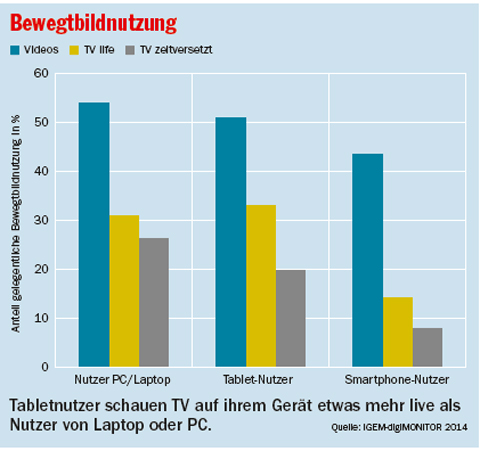
TV programs have finally broken out of the living room. Today, they can be accessed via almost any device and at virtually any time. This is one of the reasons why 90 percent of the population in German- and French-speaking Switzerland watch TV at least once a week via some kind of device. 18 percent do so via their PC or laptop, half as many still via a tablet, and a third as many via smartphone. Of those who use the internet on a smartphone, as many as 14 percent say they watch live TV programs via streaming. This behavior is significantly more popular in French-speaking Switzerland and in the young age group. Among those who access the internet via a tablet, around a third say they watch live TV. Here, there are only significant downward deviations in the 55+ age group. The use of live TV is slightly lower among those who do so via PC or laptop (see chart "Moving picture use") PC or laptop most often serve as a second device because the normal TV set is used by other people. When it comes to watching TV via a tablet, this argument takes second place. Here, it is primarily a matter of being able to watch TV in places or rooms where no TV set is available. The few who watch TV via smartphone do so far most often on the move. But those who have a choice clearly prefer the classic TV set. Among young people, however, a good 15 percent say they prefer to watch TV via laptop or PC.

64 percent of boys also see foreign

Virtually all respondents watch TV at home at least occasionally. Which is hardly surprising. But 42 percent also watch TV with friends and acquaintances. Among boys between the ages of 15 and 34, the figure is as high as 64 percent, while only a good quarter of people aged 55 and older watch TV. But here, too, attention is not always focused on what's happening on the screen. Because the TV set has received competition from the screens of laptops, tablets and smartphones. Around 44 percent use such a second screen at least once a week in parallel to watching TV. Among boys aged 15 to 34, the figure is even more than two-thirds. 40 percent of boys even do this practically every day. However, content related to the TV program being broadcast is rarely found on these second screens. And this is the case in practically all segments of the population. What we already know from the Mediapulse TV panel is that time-shifted use of TV programs is becoming increasingly popular. This is primarily due to the fact that it is becoming easier and easier to use. With Swisscom TV 2.0 plus, more than 250 programs can be used up to 7 days after their first broadcast, without having to make any prior arrangements. As an article by Luca Bringold in the new Media Trend Journal (to be published shortly before Christmas) shows, this is resulting in a major change in usage behavior.

Young people very often watch TV time-shifted

The IGEM-digiMonitor shows that in August/September 2014, just under 40 percent of the population in German and French-speaking Switzerland said they watch time-shifted TV at least once a week. Among young people, the figure is even well over half. Around one-fifth of those who use the Internet via a tablet watch time-shifted TV on it. More than a third of them do this because they do not have a TV set. Those who use the Internet via a smartphone, on the other hand, watch significantly less time-shifted TV. As with live TV consumption on the small screen, the proportion here is also significantly higher in French-speaking Switzerland and among young people. In the use of video on demand, computers are very popular in all sizes. Around a third of the population watches such a video at least once a week on YouTube, an online video store or as a podcast (see "Video on demand usage" chart). The fact that usage via smartphones is higher than via tablet is due to the fact that there are more smartphones than tablets. If you take the effective users of the corresponding devices, the tablet is slightly ahead of the smartphone. If we combine live and time-shifted TV, it becomes clear that usage via alternative devices is still rather low. However, the corresponding chart shows that 18 percent of the total population state that they watch live or time-shifted TV on a PC or laptop at least once a week (see chart "TV usage live or time-shifted via alternative devices").

Ueli Custer

Unbenannt-37-2
Unbenannt-37c
 

Farner: Rebranding for Wincasa

Categories

Uncategorized

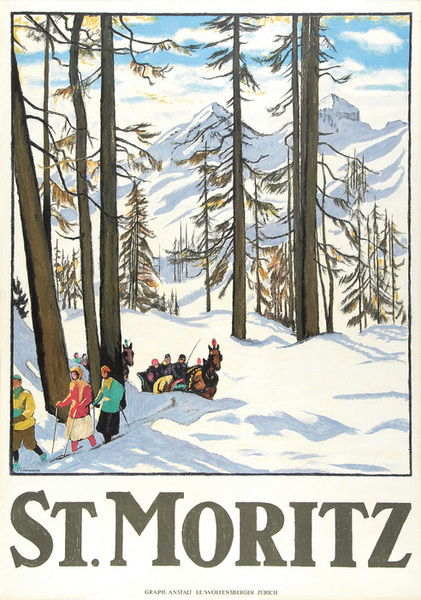
Poster auction: national and international artists

The fifth poster auction, presented by Germann Auction House, is dedicated to the «150 Years of Winter Tourism» event.

Overall, a comprehensive range of national posters is on offer, including icons of Swiss poster art such as the typography poster, for example "Der Buchdruck" by Niklaus Stoecklin from 1922. But international rarities are also represented, including some from the Russian Constructivist period (El Lissitzki or Rodchenko). Collectors and enthusiasts with a smaller budget have the opportunity to acquire beautiful and often rare posters in the area of fashion, merchandise or drinks posters.

The range of 218 posters includes 100 tourism posters, including unique winter sports posters from the canton of Graubünden, the Bernese Oberland and Valais. Particular attention will be paid to posters from Zurich, including rare lithographs depicting the city, such as Otto Baumberger's "Zurich - The Metropolis of Switzerland" from 1928. The auction will also feature posters with sought-after subjects from well-known Zurich businesses, such as Otto Morach's second poster for "Welti-Furrer" or Paul Frey's "Grand Café Odeon" from 1915. Some of these stone lithographs come from the collection of Hans Sachs.

The auction date is this Saturday, December 6, 2014, from 2 pm. Viewing will continue until Friday, December 5, from 10 am to 7 pm.

Auction catalog

Objekt_0_324595_00_415x600
Objekt_0_324601_00_428x600
Objekt_0_324603_00_428x600
Objekt_0_324611_00_421x600
Objekt_0_324602_00_428x600

Bucherdtp.ch: Website for PLS parking guidance system

The PLS Lucerne Parking Guidance System has had a new website for about four weeks. The Stans-based agency Bucherdtp.ch was responsible for the concept and design.

PLS Parking Guidance System Lucerne ensures that the number of free parking spaces in the respective parking garages is displayed on the display boards in the city of Lucerne. This avoids unnecessary search traffic and drivers can quickly find a free parking space. With the new website this service has been further improved: The streamlined website shows online users all of Lucerne's parking garages at a glance in map or list form, as well as the available parking spaces in real time. The color-coded division into the three zones North, South and Allmend/Messe provides an optimal overview. Once the desired parking garage has been selected, it can be accessed directly using the Google Maps route planning function integrated into the new website.

PLS_Medienuebersicht_mitSchatten-2

The company's existing corporate design was fully adopted by Bucherdtp.ch and integrated into the design of the website. The monolingual website is responsive throughout and was programmed with the latest version of the content management system Contrexx 3 - by Comvation in Thun.

Responsible at Parkleitsystem Luzern: Christine Waldmeier (Head of Marketing and Projects). Responsible at Bucherdtp.ch: Pascal Bucher (Owner / Art Director); Janine Totz (Head of Design); Ramon Wenger (Programming, Contrexx CMS).


Stefan Schärer becomes new CEO of Moneyhouse

Stefan Schärer will become CEO of the business information service Moneyhouse effective January 1, 2015. The portal, which attracts over 2.7 million visitors per month, was acquired by the NZZ Media Group in early 2014.

As agreed when Moneyhouse was acquired by the NZZ Media Group, Michael Schuler, founder and former Managing Director, is stepping down from operational management. However, he will remain associated with the company and will be involved in the further geographical expansion of Moneyhouse. "We are delighted to have gained a competent, experienced online manager in Stefan Schärer, who as Managing Director of ImmoScout24 has demonstrated very convincingly how to successfully develop a portal," says Frank-Rainer Nitschke, Head of New Business.

Stefan SchärerStefan Schärer has been working in the online business for 15 years, during which time he has helped build up the online marketer Omnimedia AG for Ringier Digital and developed ImmoScout24 into the leading real estate marketplace over the last five years. He studied economics at the University of Zurich and was a member of the Swiss national handball team for 12 years.

Made Marketing: Stand realized for Pro Infirmis

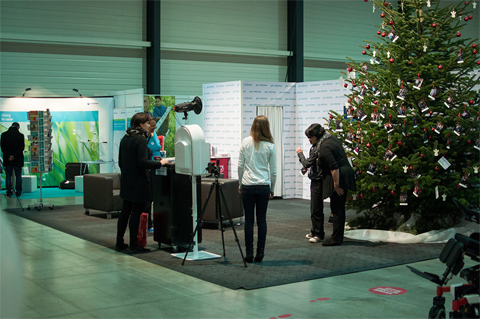
For the first time in the history of the Swiss Handicap trade show, Pro Infirmis, the largest professional organization for people with disabilities, participated in the event in Lucerne. The booth was designed and built by Made Marketing.

The eye-catcher was the 4-metre high Christmas tree, which not only spread festive cheer, but also served as a photo backdrop. The self-timer photos taken by visitors were personalized with wishes and hung on the tree. Some of the wishes could already be fulfilled at the weekend or are still being fulfilled by Pro Infirmis.

proinfirmis-baum

The theme of the Pro Infirmis stand was the 2013 campaign "Who's perfect?", which had already caused a sensation over the course of the current year and had been viewed and shared millions of times on social media channels. Pro Infirmis is also planning to take part in Swiss Handicap next year. The focus will then be on the new campaign, which will be presented to the general public in the next few days.

proinfirmis-stand

Responsible at Pro Infirmis: Mark Zumbühl (Head of Marketing/Communications), Bettina Konetschnig (Communications). Responsible at Made Marketing: Beda Steinacher (concept/graphics), Curdin Decasper (organization/implementation).
 

Leo Burnett: Pick your own profits

Win what you’ve chosen yourself. Leo Burnett Switzerland is launching a Christmas promotion for Sihlcity that leaves nothing to be desired.

Sihlcity is known for its particularly festive atmosphere during the Christmas season. You can also find everything you need for the festive season here. All that's missing are heaps of fulfilled wishes. Leo Burnett Switzerland is taking care of this with an unusual promotion: every day in December, you can win what you have chosen yourself in Sihlcity. Simply take a photo of the desired item and send it to Sihlcity by MMS. The "The best Christmas ever" campaign will be advertised on TV, in print, on the radio, on the web and at the POS.

//www.youtube.com/watch?v=zDsj02PPsGE

//www.youtube.com/watch?v=FNDBBKUaTC0

//www.youtube.com/watch?v=MX3d30zszdY

Responsible at Sihlcity: Jörg Engeler (Center Manager), Mara Bonorand, Vanessa Welti (Marketing and Communications). Responsible at Leo Burnett Switzerland: Barbara Hartmann, Anna Leudolph, Pablo Schencke (creation), Johannes Raggio (ECD), Isabelle Meier, Nadine Stüssi, Ingrid Zumkehr (consulting), Erasmo Palomba (Artbuying/FFF), Plan B Film (film production), Dominik Locher (director), Jingle Jungle (sound studio), Shauna Lynn Panczyszyn (illustration).

Teil.ch: Turning the world upside down for Foxtrail

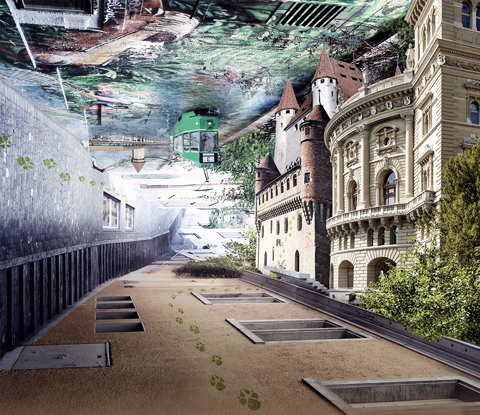
The Zurich-based communications agency Teil.ch has turned Swiss cities upside down for Foxtrail's new advertising campaign.

To be able to solve all the puzzles on the exciting trails of the popular group and leisure experience, you also have to direct your gaze to places you would otherwise simply walk past. This offers the chance to discover a supposedly familiar city from a completely new angle. The key visual plays with this idea and creates an unusual and exciting environment through the mix of different angles. According to the press release, this should make people want to dive into the adventurous world of Foxtrail. The ads will be used throughout Switzerland in 2015.

foxtrail_keyvisual
foxtrail_keyvisual_v2_1600
foxtrail_inserat

Responsible at Swisscovery: Thomas Bösiger (Head of Marketing & Sales), Christina Hanke (Operations Director). Responsible at Teil.ch: Martin Zeiter (Creative Direction), Alain Zeiter (Consulting).

get_footer();