Basler Zeitung now published as Zweibundzeitung

The Basler Zeitung (BaZ) has given itself a new look at the start of the year: Instead of four sections as before, the BaZ will now be published with two sections.

baslerzeitung2

The reduction to two volumes will make the Basler Zeitung clearer, more compact and more practical, according to the first issue of the new year published on Saturday. However, there will be no cutbacks in the editorial content. With the changeover, Basler Zeitung says it is following an international trend. As a result of the decline in advertisements, the total volume has decreased in recent years, and many newspapers are now published with only two or three bundles. As a two-volume newspaper, BaZ has a new sequence of sections: The first bundle now also includes the business and culture sections, in addition to the front page, the two topic pages and the Switzerland and International sections. The second bundle focuses on regional events and sports. (SDA)

City of Lucerne tests the acceptance of digital advertising posters

Digital billboards may be installed at eleven locations on public property in the city of Lucerne. In 2016, two digital billboard sites will be set up at Bahnhofplatz and Löwenplatz as part of a pilot program.

If the trial is successful, digital billboards will be installed at nine further locations, the city council announced in a report to parliament on Monday. The market for outdoor advertising is undergoing major change. Paper posters are increasingly being replaced by illuminated posters. The so-called city posters are being considered for digitalization. These are illuminated and show advertising on one side and the city map on the other. The digital posters must comply with the regulations on the protection of the townscape and traffic safety. Films may not be shown. The motifs must change in a calm rhythm and the differences between light and dark must be minimal. From 2016 to 2024, APG SGA Allgemeine Plakatgesellschaft will no longer be responsible for digital posters and other billboards on public land in the city of Lucerne, but Clear Channel Switzerland. This company had public invitation to tender made the more attractive offer. The contract still has to be approved by the city parliament.

More income expected

Around 600 paper posters, illuminated posters and poster sites at bus stops are affected by the new poster contract. The tendering process for the new category of small posters was canceled because, according to the city council, no convincing offer was received. The city is considering awarding the small posters by private treaty. The expiring contract brought the city annual revenues of CHF 1.2 million. With the new contract, the city is expecting income of up to CHF 2 million. Clear Channel is not allowed to put up posters that violate any applicable laws. Furthermore, the posters may not offend religious or moral feelings or human dignity, be gender-discriminatory or advertise addictive substances or consumer credit. (SDA/hae)

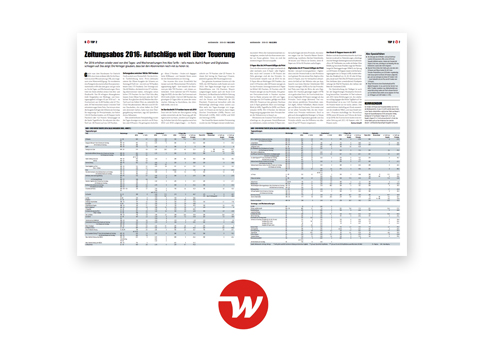
Newspaper subscriptions 2016: surcharges far above inflation

As of 2016, two out of three daily and weekly newspapers are once again increasing their subscription rates - in some cases massively. E-paper and digital subscriptions are also increasing. This shows that Publishers believe that there is still a lot to be gained from subscribers.

If the Federal Statistical Office (FSO) is to be believed, households experienced negative inflation this year (-1%), i.e. an overall reduction in the price of goods. However, this does not apply at all to at least one category of the statistical consumer basket of goods: daily and weekly newspapers. This is because many of them are once again increasing their subscription and newsstand rates. Of the 93 subscription offers surveyed (including double subscriptions to weekday and Sunday editions), 62 are increasing their rates as of 2016 - by an average of CHF 14.28 or 4.7 percent. 28 titles waived this. And two titles are even reducing their price. One is the Zofingen edition of Schweiz am Sonntag: it is reducing the price of its annual print subscription, which previously cost CHF 134.30, by 30 centimes (not francs!) or -0.2 percent. Basel's TagesWoche is more generous: it is reducing its subscription rate by -46 percent to CHF 120.

Newspaper subscriptions between 188 and 700 francs

But back to the normal case: the most significant increase in the price of the annual print subscription is for the Olten edition of Schweiz am Sonntag (CHaS) - it will be 74 francs more expensive (now 173 francs). The background: AZ Medien, which recently took over OT completely, was already charging CHF 173 for the CHaS solo subscription, but allowed its Olten partners to set their own rates. AZ Medien is now also equalizing the subscription rate in the Olten area, at least for new CHaS subscribers. An interim solution has been agreed with the 50 or so households in Olten that already subscribed to CHaS solo, says AZ spokeswoman Anina Räbsamen.

The Tages-Anzeiger has the second-highest price increase, namely CHF 30 or 6 percent. By contrast, the Willisauer- and Seetaler Boten and Zentralschweiz am Sonntag have the lowest mark-ups - just CHF 2.

The most expensive subscription for a single title is still the western Swiss business daily Agéfi, where subscribers pay CHF 700 per year - unchanged for years. Close behind at CHF 675 is the NZZ, which has not increased its subscription rate for the first time since 2010. And at CHF 188, the cheapest (5-day) subscription is that of the Romansh newspaper La Quotidiana, which also remains the same.

On average 73 francs more expensive than in 2010

Incidentally, the fact that newspaper subscription rates develop completely differently to inflation applies not only in the short term, but also in the long term. Almost all newspaper subscriptions increased between 2010 and 2016 - by an average of CHF 73 or 22%. During this period, inflation was 0 percent, at least according to the BfS inflation calculator.

The biggest outlier was the NZZ, which costs CHF 163 more than in 2010, followed by the Tages-Anzeiger with a price difference of CHF 154. The Bund (CHF 114), Basellandschaftliche Zeitung (CHF 105), Zürcher Unterländer and Finanz und Wirtschaft (CHF 100 each) have also seen a massive increase. In percentage terms, however, the order is somewhat different: The Tages-Anzeiger is at the top here with a total of +41 percent, followed by Zürcher Unterländer (+34%), Finanz und Wirtschaft (+33%), NZZ (+32%) and NZZ am Sonntag (+31%).

Publishers have repeatedly communicated the reason for this sharp price increase: If advertising revenues fall, subscribers will simply be asked to pay more. After all, they are the second most important source of income.

E-paper subscription: up to 54 percent cheaper than print

However, subscribers are increasingly dropping out or switching to e-paper or digital subscriptions. This is also because the latter are cheaper than the print subscription in 93 percent of cases. As of 2016, the average price for an e-paper subscription on weekdays is CHF 291, which is CHF 113 or 28% less than for a print subscription. On Sundays, an e-paper costs an average of CHF 165, CHF 55 or 33 percent less than the print subscription. The biggest price differences in francs are Le Matin semaine at CHF 220 and Tages-Anzeiger at CHF 214, followed by Blick (CHF 204.50). Blick and SonntagsBlick (54% each), TagesWoche (50%) and Matin semaine (45%) offer the biggest percentage discount on the e-paper. Volksstimme in Sissach offers the smallest discount of CHF 4 compared to the print subscription.

However, at least a dozen titles are preparing to reduce the large price differences by charging more for e-papers than for print subscriptions. Tamedia's ZürichseeZeitung, Landbote, Zürcher Unterländer, 24 heures and Tribune de Genève are the most daring in this respect, with their e-papers adding between 50 and 92 francs.

Digital subscription: up to 87 percent cheaper than print

The differences between digital subscriptions and print subscriptions are even greater: for a pure non-replica subscription (without e-paper), i.e. for continuously updated articles on the website or via app, you pay CHF 344 less (-82%) for the Zürcher Unterländer than for the print subscription. In second place is Blick, which sells its digital subscription for CHF 331 less (-87%) than the print version. On average, a digital subscription costs 29 percent less than a print subscription. However, some (smaller) titles make no price difference, namely Agéfi, Höfner Volksblatt, March Anzeiger and Bote der Urschweiz. And again, it is mainly Tamedia titles that reduce the difference to the print subscription. But there is also the opposite strategy: Le Temps has lowered one of its digital subscriptions and increased the print subscription, widening the difference from 25 to 37 percent.

43 centimes more expensive at the kiosk than in 2011

That leaves the retail tariffs: Here, too, there are currently changes, although publishers are more cautious in this respect. "Only" 28 titles now cost more than before. The Werdenberger & Obertoggenburger (W&O) is daring to increase its price by one franc, a jump of 40 percent. The Saturday edition of Le Temps will be 60 centimes more expensive (+14%). Others are increasing their newsstand rates by 10, 20, 30 or 50 centimes, which amounts to 2 to 20 percent depending on the title. The highest (but unchanged) newsstand price is charged by WoZ (CHF 6), the lowest by Bote der Urschweiz (CHF 1.80).

Publishers' restraint can also be seen in the longer-term newsstand price development. As many as 14 titles have not made any increases since 2011. The Bieler Tagblatt, on the other hand, had the biggest impact: It is now CHF 1.20 or 44 percent more expensive in single copy sales than six years ago. The second-highest increase at the newsstand was recorded by the aforementioned W&O, and there were further 1-franc increases at Nouvelliste (35%) and 24 heures and Tribune de Genève (both (31%). On average, a single newspaper has cost 43 centimes or 13 percent more since 2011.

Markus Knöpfli

Unbenannt-9_89
The table "Subscription and kiosk rates 2016" accompanying the article can be found in the current print edition of Werbewochde (23/2015). To the subscriptions

Subscription specialties and curiosities

- The AZ Medien newspapers and the Neue Luzerner Zeitung are leaving it open as to whether they will introduce a paywall in 2016. The Giornale del Popolo is different: it has one, but it is voluntary. How it will work, however, has not been disclosed.

- Some titles also increase their rates during the year: 24 heures and Tribune announced a print subscription price increase of 20 francs for 2015, added another 20 francs at the end of January and are now charging another 20 francs more - an increase of 60 francs or 13 percent within a year.

- Some titles have a retail price for digital editions. This is now also the case with BaZ, where you have to pay 1 franc. This is probably the first time that a title in this area has also raised its price: The Walliser Bote is increasing its digital EV price by 30 centimes to CHF 2.80 (+12%).

- In most cases, the print subscription also includes access to the e-paper and other digital editions. Not so with La Liberté: if you subscribe to print, you only get print. If you also want the e-paper, you have to pay an additional 14 francs. However, you can also have the e-paper on its own and then pay 267 francs, i.e. 34% less than for the print subscription.

- Several e-paper subscriptions are now significantly cheaper than they were six years ago, including those of the Nordwestschweiz titles, Quotidiana, Boten der Urschweiz and Tages-Anzeiger. For example, the Tages-Anzeiger e-paper now costs CHF 84 less than in 2011, while the Zofinger Tagblatt has even reduced its price by CHF 95.

Update: SRF picks up on reporting from Advertising Week

Change of ownership at Maurer + Salzmann

The Winterthur-based company Maurer + Salzmann will undergo a change in ownership effective January 1, 2016. The majority of the shares will be transferred to four long-time employees, and the company will be led by Andreas Künzli as CEO and majority shareholder.

Maurer + Salzmann has been based in Winterthur for decades and is active in various areas of communication. Until the end of 2015, the company belonged to the Wigra Group. As of January 1, 2016, it recorded a change of ownership. Four long-time employees - Andreas Künzli, Nadine Boksberger, Frank Günthardt and Martina Bundi - are taking over the majority of shares in the company. The SME is managed by Andreas Künzli as CEO and majority shareholder and employs twelve people.

Unbenannt-12_71
Andreas Künzli, new CEO Maurer + Salzmann

Maurer + Salzmann owns the wholly owned subsidiary Zomag in Wetzikon. Both companies are active in trade fair and event organization and organize the Winti Mäss, the Wohga Winterthur, the KMU Forum Region Winterthur, the ZOM Züri Oberland Mäss, the Zürcher Oberland spring fair "wohnen&genuss", the KMU Forum Zürcher Oberland and the popular Schlager-Zelt Zürcher Oberland. Furthermore, Maurer + Salzmann has been active as a marketer of transit advertising for over 15 years. Last year, the company won a tender from the Zürcher Verkehrsverbund. In addition to the two previous market areas, M+S AG has been offering four more since January 1, 2016. With the exception of the city of Zurich, the new public transport advertising field of activity covers all Zurich sales areas. For this purpose, a new 80 percent position was created as of January 1, 2016.

Andreas Künzli, new CEO of Maurer + Salzmann, looks to the future with pride and optimism. "We carry out our work with passion, are rooted in the relevant regions and maintain an active network. By taking over the majority of shares, we are setting another sign for our passionate efforts over all these many years," says Künzli. "Together with a strong team, we will continue to develop our trade shows, events as well as transit advertising with a lot of heart and soul," Künzli is convinced.
 

Coffee industry: technology instead of marketing

Coffee drinkers have become more discerning since coffee capsules shook up the market. Companies are now responding: After relying on marketing for a long time, they are increasingly investing in innovation in their quest for the perfect cup of coffee.

The products being launched on the market today are increasingly based on new technologies, says Chahan Yeretzian, professor at the Zurich University of Applied Sciences (ZHAW) in Wädenswil. In his eight years at the ZHAW, the scientist has built up an international competence center for coffee. For many years, research in the coffee industry led a shadowy existence. The industry was mainly based on clever marketing and packaging. Today, things are different. The processors are putting science at the heart of coffee, as Yeretzian says. Research and development are thriving in the sector, even if not a huge amount of money is being invested compared to the returns in the coffee industry.

The scientists in Wädenswil have secured numerous research contracts. They are working with roasting companies on ways to improve the grinding process and with coffee machine manufacturers on the extraction of coffee. The Zurich university is also investigating how the quality of the water affects the coffee, as Yeretzian explains. Capsule producers from South America, Australia and Europe are also among his customers. The ZHAW is also working with producers in Bolivia and India to improve green coffee. (SDA)

Toyota gives Google and Apple the cold shoulder

Toyota is one of the few major car manufacturers that continues to oppose giving Google and Apple access to its vehicles' entertainment systems.

The Japanese company announced on Monday that it would rely on software from Ford instead of integrating smartphones with Google's Android Auto or Apple's CarPlay. Ford itself, on the other hand, gave up its resistance to the systems from Google and Apple a few hours earlier and announced their integration into newer vehicles at the CES electronics trade fair in Las Vegas. At the same time, its own "AppLink" system, on which Toyota's "SmartDeviceLink" is also based, will also continue to be used. There is controversy in the automotive industry as to whether manufacturers could lose out on future business with data and services as a result of a greater role for smartphone heavyweights in cars. Toyota has so far referred to unspecified security concerns about the use of software from Apple and Google. The Japanese car giant wants to connect its vehicles with each other so that they can warn each other of accidents, for example, via cloud servers. Toyota wants to install a standardized communication module in its vehicles worldwide by 2019. Initially, there will be different technologies in individual regions. (SDA)

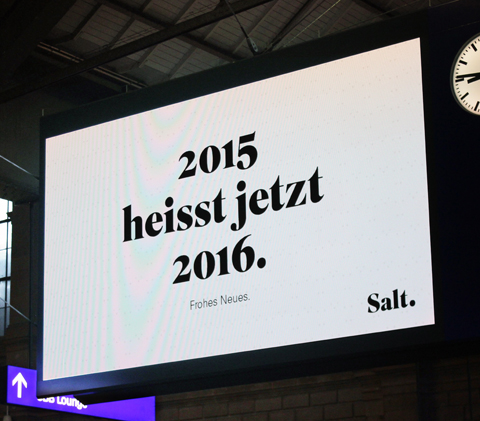
Publicis: Salt salutes the turn of the year

Orange is now called Salt. In line with the Swiss mobile carrier’s rebranding, Publicis developed a New Year’s greeting in the Salt style.

That's it.

SALT_Neujahr_2
SALT_Neujahr

Responsible at Salt: Sabine Kuszli (Director Brand & Marketing Communications). Responsible at Publicis: Thomas Wildberger (CCO); Lorenz Clormann, Patrick Suter (CD); Marvin Hugentobler (AD); Manuela Schikor (Consulting).
 

Crossmedia Award: Submit now

For the twelfth time, the Goldbach Group is honoring innovative campaigns that combine cross-media content in a convincing and original way. Concept developers and designers can submit their campaigns from January 5 to February 19, 2016.

Submissions can be made via Crossmedia-award.ch. For the twelfth time in a row, the Goldbach Group is presenting the Crossmedia Award, endowed with CHF 10,000, to honor outstanding ideas and their campaign implementation. In addition to gold, silver and bronze, the special "Best in" prizes are also awarded to campaigns with pioneering networking of the cross-media sub-areas of mobile, social media and video. As in previous years, all awards influence the creative ranking of Werbewoche. Werbewoche is the media partner of the awards.

Campaigns can be launched under Crossmedia-award.ch be submitted. They are then assessed by independent specialists and advertising experts.

The twelve-member jury, headed by Marco Taborelli, includes:

Andreas Dürr, Goldbach Interactive Switzerland
Karin Estermann, Content&Form Communications
Peter Felser, Serviceplan Suisse
Carlos Friedrich, Möbel Pfister
Markus Gut, Y&R Group Switzerland
Roman Hirsbrunner, Jung von Matt/Limmat
Sonja Hofstetter, ÖKK
Curdin Janett, Publicis Communications Switzerland
Stephan Küng, The whole Media
Maurizio Rugghia, Serranetga
Thomas Städeli, Wirz Advertising
Rolf Suter, media law firm

The campaigns that secure a place on the shortlist will be announced on April 8, 2016. The award ceremony will take place on April 21, 2016 at Komplex 457 in Zurich.
 

Seco examines OECD demand for privatization of Swisscom

SECO is reviewing the OECD's call for the privatization of telecommunications giant Swisscom. The goal is to determine whether the federal government's ownership strategy still meets today's requirements, says SECO Director Marie-Gabrielle Ineichen-Fleisch in an interview.

Ineichen-Fleisch told the NZZ am Sonntag that the State Secretariat for Economic Affairs (Seco) will address this question in its new growth strategy for 2016 to 2020. According to the head of Seco, Swisscom is a well-managed company. However, Switzerland must ensure that it does not miss out on the step towards the digitalization of the economy. "We have to ask ourselves: Is Swisscom in a position to do this quickly and agilely enough in its traditional area of telecommunications? And at what cost?" According to Ineichen-Fleisch, the federal government must also ask itself whether there are any conflicts of interest for it as the owner if state-owned companies expand into new digital companies outside of their public service mandate. With this statement, the Seco Director is implicitly referring to the new advertising platform that Swisscom wants to operate together with the media companies Ringier and SRG.

Majority of the Confederation provides a talking point

"According to the OECD, it is at least difficult to prove that a state-owned company is faster and more efficient than a private company," Ineichen-Fleisch points out. In a recent report by the Organization for Economic Cooperation and Development (OECD), Swisscom came off badly. As a former monopolist, it still enjoys advantages and thus slows down competition, was the criticism. In this context, the OECD even called for the complete privatization of the industry leader. Swisscom CEO Urs Schäppi rejected this in mid-December. "Swisscom is not a state-owned company, but a listed company with a market capitalization of CHF 26 billion," he said in an interview with the
Sonntagszeitung. Although the Confederation has a narrow majority, a look at the strategic goals shows that the majority owner is giving Swisscom entrepreneurial freedom. (SDA)

Last but not least: Füdligate

The Young CVP Zurich has got itself into hot water with a not-so-Christian advertising slogan.

Although the term "advertising subject" is somewhat exaggerated. Rather, the subject that caused a brief outcry over the holidays was an attempt at an original Facebook header. The young, Christian political friends from Zurich wanted to show that they are in favor of the Gotthard renovation tunnel. In other words: for the famous second tube. As is well known, this will not be opened at the same time, but will replace the first tube during its renovation. Otherwise, it could happen that Ticino is suddenly cut off from the rest of Switzerland and can only be reached by mule over the pass.

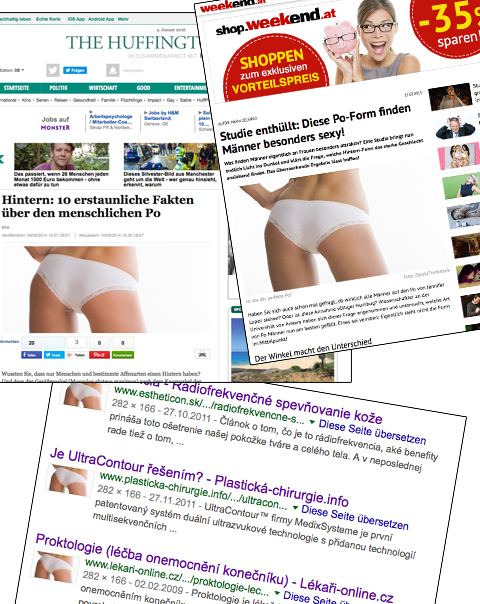
The subject chosen by the Young CVP for the visualization is anything but Christian. Not that a woman's bottom is anything wicked, but in combination with the slogan, the theme and... "this is wrong in so many ways"!

Unbenannt-8_95

With this campaign, the Young CVP has joined the now long list of young parties that provoke attention at low cost with bare skin and other clumsy actions. With success. All it takes is a photo of a young person and a slogan - which, on balance, is not at all unoriginal - to attract attention. Blick.ch to be mentioned prominently. And on Twitter to trigger the obligatory shitstorm. So now we know that there is a Young CVP in Zurich and that it even has its own opinion. In contrast to the young Greens the young Christians didn't even have to undress themselves. That was done by the unknown Füdli model, who has already achieved considerable fame on the Internet - including appearances in the Huffington Post and on Weekend.at. You've guessed it: The underpants of offense don't really exist! It's impressive what you can do with Photoshop! (hae) 

Unbenannt-11_78
  

Spina's Civil Voices lets Bruno Manser live on

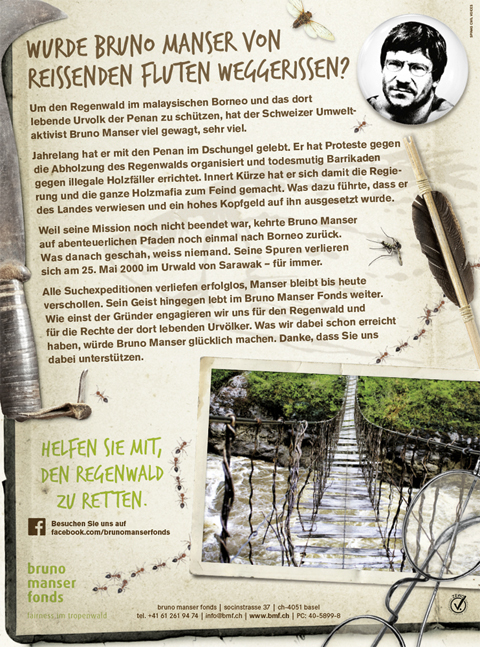
To protect the rainforest on the Malaysian island of Borneo, Swiss environmental activist Bruno Manser took great risks. Spinas Civil Voices created a print campaign for the Bruno Manser Fund.

For years, Manser lived in the jungle and fought hand and foot and with words against the corrupt state and the logging mafia. Until May 22, 2000, when Bruno Manser disappeared forever without a trace in the jungles of Borneo. Even though Bruno Manser lost his life, his fighting spirit was not lost. Today, the Bruno Manser Fund, which he founded, continues his life's work with the same commitment. In order to become even more effective in the future, the Bruno Manser Fund has now joined forces with the Spinas Civil Voices agency. This collaboration has now resulted in a print campaign that will be used throughout Switzerland in the next few days.

Unbenannt-5_123
Unbenannt-6_122
Unbenannt-7_120

Responsible at Bruno Manser Fund: Lukas Straumann (Managing Director), Valentine Vogel (Fundraising). Responsible at Spina's Civil Voices: Matthias Freuler & Stephan Huwiler (creation); Hannes Aeschlimann (graphics); Sandra Wittwer (consulting).


Denz Digital and Bedruckbar become Form

The long-established Bern-based company Denz Digital and its subsidiary Bedruckbar will operate under the name Form and with a new brand identity starting in January 2016.

The focus has shifted, according to the company's statement: where classic prepress used to dominate, the emphasis is now on solutions for store design, trade show presentations, displays and decorative materials. "We are creative doers who give new shape to our customers' wishes," says Managing Director Stefan Ingold. "In the process, printed 2D solutions are increasingly being supplemented or replaced by a three-dimensional design - our new name also expresses this." Three-dimensional: that can mean producing a snowy landscape out of Styrofoam for a product launch in the store, designing furniture out of cardboard for a trade show appearance, or having your own company logo lasered into a rolling pin as an attention-grabbing gadget. Over 45 employees - photographers, polygraphs, advertising technicians, IT specialists and more - work on solutions for advertising and brand experiences in an area of over 3,000 square meters. Customers receive everything from a single source, from consulting to design and implementation to delivery. As a result, according to the company's statement, Form can offer "a uniquely broad and cohesive range of services and products in Switzerland in the areas of prepress, special printing on a wide variety of materials, surface finishing, furnishing POS, trade show booths and theater construction, as well as logistical and IT services."

get_footer();