Over 23,000 signatures against cutbacks in RTS religion broadcasts

A petition against cuts to religious programs on French-speaking Swiss radio and television (RTS) has been signed over 23,000 times. RTS described the cost-cutting measures on Friday as 'unavoidable«.

The support committee chose drastic words at a media conference in Lausanne on Friday. There was talk of an "amputation" or even a "decapitation" of the religion programs of radio and television. RTS wants to reduce the budget for these broadcasts from 2.8 million francs to 1.6 million. The response to the petition exceeded all expectations, said Jean-François Mayer, historian of religion and member of the committee. Ada Marra, an SP national councilor from Vaud, and Dominique de Buman, a CVP national councilor from Fribourg, also support the committee.

Savings measures "unavoidable

RTS still reacted on Friday and confirmed its intention to continue broadcasting religion programs. In view of a savings program of more than ten million francs at RTS, cost-cutting measures were "unavoidable". Other areas such as music, youth programs or the purchase of films or series as well as technology and administration are also affected. French-speaking Swiss television has proposed to its partners, such as the Reformed organization Médias-pro and its Catholic counterpart Cath-info, that a mixed working group be set up. A decision on the 2017 programming lineup will be made by the end of June 2016. (SDA)

New LZ collects over 4 million francs for the first time

The LZ Christmas campaign set a new record. Readers of the Neue Luzerner Zeitung and its regional editions donated over four million Swiss francs to help people in Central Switzerland.

This is the 20th time that LZ Medien has held the LZ Christmas campaign. The money raised benefits individuals and families from the region who are in need. A total of 4'228'779 francs was raised - more than ever before and almost ten percent more than last year's record figure. "I am overwhelmed by the result," Erwin Bachmann, president of the LZ Christmas Campaign Foundation, expressed his delight in a statement. "Especially because the record value came about on our anniversary. The LZ Christmas Campaign is more firmly anchored in our region than ever. The solidarity of Central Swiss for Central Switzerland is terrific and unique. I am especially happy with the people we were able to help."

A total of 15'318 private individuals and companies have donated as part of the LZ Christmas campaign, and 3095 requests for help have been received. The advisory board has already been able to approve assistance to individuals or families in Central Switzerland in 2883 cases. It consists of social experts working on a voluntary basis, carefully examines all requests for help and guarantees that the donations are used effectively.

Indispensable for the region

What the LZ Christmas campaign means for the region is shown by countless feedbacks from people, but also from the social institutions that submit the requests. It is emphasized again and again how unbureaucratic, fast and targeted the donor funds reach those in need. The account remains open all year round, and donations will be used immediately for the next collection campaign, which will start next November. Since its inception in 1996, the LZ Christmas campaign has collected a total of over 39.8 million Swiss francs, making it the most successful collection campaign by a Swiss daily newspaper.

Charlie Hebdo sells well in French-speaking Switzerland, but not very well

The special edition of the French satirical newspaper Charlie Hebdo one year after the Islamist attack is selling well in French-speaking Switzerland. However, demand is not as brisk as it was in January 2015 for the first issue shortly after the attack in Paris.

The 20,000 copies ordered for French-speaking Switzerland, which have been on sale since Wednesday, should be able to meet demand, according to the French-speaking Swiss kiosk chain Naville Presse. No current figures were available for German-speaking Switzerland. A year ago, Valora only distributed a total of around 500 copies to kiosks there. In French-speaking Switzerland, 750 copies of Charlie Hebdo were on sale before the attacks on January 7, 2015. In France, where one million copies went on sale on Wednesday, there were no longer long queues at newsstands - unlike a year ago. The special edition of the weekly newspaper with a god as an armed perpetrator on the cover comprises 32 pages instead of the usual 16. It is a reminder of the terrorist attack a year ago (Werbewoche.ch reported).

An Islamist hit squad attacked the editorial offices of Charlie Hebdo on January 7, 2015 (Werbewoche.ch reported). On the two following days, a policewoman was also shot dead and a kosher food supermarket was attacked. The terrorists killed a total of 17 people over the three days, including the influential cartoonists of the satirical newspaper. The three Islamists were also killed. (SDA)

Unbenannt-7_121

Last but not least: Deer gone Wild

The U.S. insurance company Farmers covers almost any kind of damage. For example, if deer have a pool party and destroy the pool in the process.

But the deer prefer to celebrate in the dark. As befits a deer, they freeze in the headlights - as we know from road traffic. And that's the whole story of the TV commercial "Hall of Claims: Stag Pool Party" created by the RPA agency. Incidentally, Farmers is the third-largest personal and liability insurance company in the United States. Since 1998, it has belonged to the Zurich Insurance Group based in Zurich - Kreis geschlossen. (hae)

https://www.youtube.com/watch?v=3oFi5BbxzJs

Fake press release about alleged Matterhorn legal dispute causes confusion

According to a press release issued on Tuesday, a legal dispute is said to have arisen between Toblerone and Zermatt Tourism. However, the press release is a forgery.

The screenshot of a press release of the food giant Mondelez International allegedly published on Presseportal.de via OTS (and not to be found there at any time) pretends that the Toblerone manufacturer wants to enforce the exclusive right for the depiction of the Matterhorn in a protected logo "in order to make the typical word/figurative mark of Toblerone even more unique". The company said it was benefiting from the first implementation steps of the TTIP transatlantic free trade agreement between Europe and the United States. Both Toblerone and Zermatt Tourism use an image of the Matterhorn in their logos.

zermatt-toblerone_0

One had, so the alleged communication, therefore already on 2 January legal steps against Zermatt tourism initiated.

Unbenannt-3_116
pm

"False and invented"

At Zermatt Tourism on Tuesday evening, when asked by Werbewoche, they know nothing about a pending lawsuit and take the at first glance authentic-looking message with humor. The image of the mountain is not legally protectable anyway - that one knows from experience. Edith Zweifel, media spokesperson for Zermatt Tourism: "Time and again it happens that the Matterhorn is used or even abused for one's own profiling. Unfortunately, this is the downside of such a symbolic mountain."

At the request of Werbewoche, Mondelez International distances itself "explicitly and in every respect" from the announcement. "This message was neither published by Mondelez International, nor do the contents correspond to the truth. The claim that there is a legal dispute about the sole right to depict the Matterhorn or that Mondelez intends to claim the sole right to depict the Matterhorn as a logo is false and fabricated," the company clarifies.

The assumption is that the false report was spread for political reasons and leaked to various media in order to be able to point to possible consequences of the TTIP after any reporting at the dissolution. Resistance to the planned agreement is particularly strong in Germany and Austria. The negotiation process is described in German media as non-transparent, the agreement is criticized by numerous NPOs and left-wing parties, in some cases massively. Among other things, there are fears that TTIP could make large international corporations even more powerful, for example by giving them the right to sue states in private arbitration courts.

Not a new phenomenon

Fake press releases being circulated is not a new phenomenon - at least in neighboring countries. Last October, for example, the German press agency DPA fell for an alleged press release from Ryanair and spread the news that the airline was transporting refugees without visa checks from Greece to other EU countries and would pay the fine of 3,000 euros per passenger, since airlines are not allowed to take passengers to EU countries without a valid visa. Also about refugees was a fake press release of the Free University Union, which was sent to German media shortly before Christmas. The text announced that the university was converting vacant school rooms into residential accommodation and would open them to refugees on January 6. Other victims of fake media releases last year were the Leipzig Police Department, Aixtron, NDR Program Director Frank Beckmann and the Swedish energy group Vattenfall. (hae)

Leo Burnett new lead agency for Rivella

Following an in-depth evaluation, Rivella has selected Leo Burnett Switzerland as its new lead agency partner.

"It makes us proud to be able to shape such a traditional and popular Swiss brand in the future," said Andy Stäheli, CEO of Leo Burnett, in a statement Thursday. The first works of the newly developed brand campaign will be seen in spring 2016.

Riv_Rot_PET_50cl_WT_n_10
 

NZZ Netz takes over marketing of Telebasel.ch

At the start of the year, NZZ-Netz will take over the national digital marketing for Telebasel’s new online portal, which is set to launch at the end of January.

NZZ-Netz, the online advertising marketer of the NZZ Media Group, is integrating Telebasel.ch's advertising inventory into its advertising products at the start of the year. On January 28, 2016, Telebasel will launch its news portal, thus transforming itself from a classic regional television station into a digital media provider on various channels. Dominik Prétôt, CEO of Telebasel: "The fact that NZZ Netz, the leading online marketer, has included us in its premium package makes us happy and is proof of the potential of our news portal." Telebasel is in charge of the new portal's regional advertising customers. NZZ Netz is responsible for national marketing, expanding its position in the greater Basel area, according to a statement. "Thanks to Telebasel's news portal, we can market this important economic area of Switzerland even better," Remo Baumeler, Head of Digital Advertising at NZZ Netz.
 

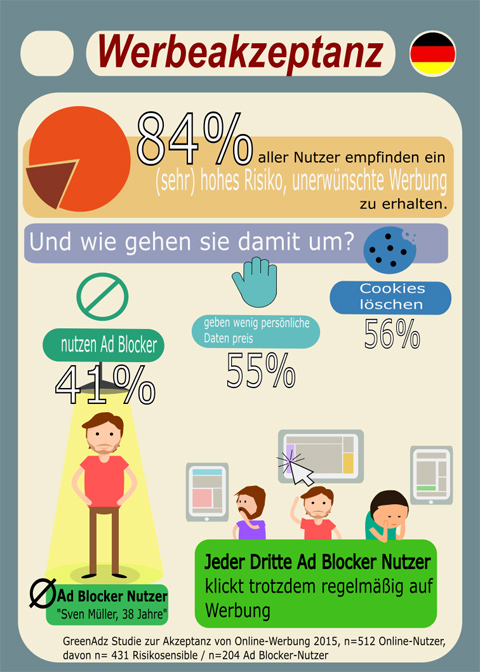
Study: Ad blocking is becoming mainstream, but offers opportunities for good creation

According to a representative online user survey, unwanted advertising is just as unpopular as spam. Despite a high ad-blocker adoption rate of 40 percent, one in three ad-blocker users regularly clicks on online ads.

The study was carried out by on the acceptance of online advertising and the use of ad blockers the Hamburg-based market research company Greenads. The most important results at a glance:

Perceived risk of unwanted advertising higher than the risk of viruses

84% of users consider receiving unwanted advertising to be at least a high risk when using the internet in general. This puts advertising ahead of the perceived risk of email spam (83%), data misuse (82%) or computer infection by viruses (64%).

Unbenannt-2_115

Ad blockers establish themselves

In addition to the traditional methods of firewalls and anti-virus software (85%), a total of 40% of respondents stated that they use an ad blocker to protect themselves from the risks. This brings the prevalence of an ad blocker closer to that of deleting cookies (56%) and the considered disclosure of personal data (55%). Based on the socio-demographic data, it can also be deduced that ad blocker users do not exhibit stereotypical characteristics, but can be found in the broad masses. "Ad blocking is moving mainstream", as the IAB UK stated in the Ad Blocking FAQs published in October last year.

"Sven Müller, 38 years old" represents the ad blocker mainstream

But what does the ad blocker mainstream look like? This much is clear: an ad blocker plugin is not a tool specifically for tech nerds in their 20s, but is widely distributed across all socio-demographic characteristics. The average ad blocker user can be described as male (59 percent), with an above-average formal education and an average age of 38. The study has christened him Sven Müller: He is effectively the big brother of the average social media user "Christian Müller, 36 years old" published by Jung von Matt and Facebook in a joint study.

Ad blocker users do click on advertising - but it has to be good

Good news for advertisers: marketing decision-makers worried about the high prevalence of ad blockers can nevertheless breathe a sigh of relief, as the Greenadz study shows: According to the study, one in three ad blocker users still regularly click on ads. But only on advertising that they accept on sites that they trust. Sandra Gärtner, Managing Director, Greenadz, explains the results: "With 5,000 advertising messages hitting every consumer every day, annoying, slowing down and irrelevant online advertising in particular gets on users' nerves. A high prevalence of ad blockers is only a logical consequence. However, the high willingness to click even among ad blocker users is an indication that there is a good chance of winning back users' favor - with good creation and high relevance and in environments in which it can exploit its full potential."

About the study:

The study was conducted on the basis of 512 online users in April 2015, recruited via Lightspeed GMI's online access panel, representative according to socio-demographics and cross-quotated according to age and gender. Further results include the most popular incentives for online surveys, acceptance of online advertising and the prevalence of ad blockers.
 

Change in the management of Schaerer und Partner

Marco Canonica, a partner and member of the executive board at Schaerer und Partner, is pursuing a new career path. He will be leaving the Baden-based full-service agency in mid-January 2016 after seven years.

The 44-year-old intends to take on a new professional challenge in the new year after taking some time out, as detailed in a press release. Andi Schaerer, Marco Canonica (photo) and Sandra Kohler will continue to work together on some projects on a mandate basis. Andi Schaerer: "I would like to thank Marco Canonica for the excellent collaboration over the last few years. We have implemented some very successful projects together and further expanded the agency." The agency will continue to be managed by the two current partners Andi Schaerer and Sandra Kohler.
 

Five challenges for CRM in 2016

Nikolaus von Graeve, CEO of the German agency Rabbit E-Marketing, identifies five key challenges that companies must overcome in 2016 to implement CRM-based communication.

Well-maintained customer data is essential for personalized communication across all online and offline channels. Most companies treat their CRM system as a central repository for customer data, such as contact information or transaction details. But data alone does not result in a personalized customer approach. According to Nikolaus von Graeve, these five challenges must be overcome in the new year:

Challenge Number 1: The Human Factor

Especially in B2B companies, sales representatives are the most important channel of communication in the field. The information gathered during customer meetings must either be entered manually into the CRM system or transferred directly to the database via a mobile app. This requires trained employees who know which data must be recorded for further communication.

Challenge Number 2: Structured Data

People often confuse the mere possession of customer data with knowledge about the customer. The key is to store data from various sources and make it available in such a way that it can be processed automatically and the right conclusions can be drawn from it.

Challenge Number 3: Your Own Data

Instead of relying on third-party data, it is advisable to focus primarily on communication channels where companies are allowed to retain and reuse the data they collect themselves—for example, from email marketing or website analytics. This gives companies two key benefits: direct access to customers and data on their interests and preferences—such as purchasing and browsing behavior. This data can be used to gain valuable insights for personalized communication.

Challenge No. 4: Communication Strategies

The next step is to use these data-driven insights to develop and implement communication strategies. Anyone who wants to succeed in data-driven marketing and sales must not only collect and organize data, but also refine it through targeted actions.

Challenge Number 5: System Integration

The CRM system must be integrated with the rest of the data infrastructure and connected to a campaign management tool or similar software. Marketing automation makes it possible to control which customer receives what content, when, how often, and through which channel.

Unbenannt-4_131
To tailor their approach to individual customers, companies must centrally consolidate their customer data from all communication channels.

Digital expert Nikolaus von Graeve: «Digitalization is giving rise to new sales and communication channels, which in turn leads to more touchpoints with customers. However, a 360-degree view of the customer cannot be achieved overnight. Companies should first set short-term, medium-term, and long-term communication goals, assess their existing technical infrastructure and data, and only then begin developing a strategy for one-to-one multichannel communication.»


Netflix goes Bollywood

The online video rental service Netflix is expanding its business to India. The service is now available there for $7.50 a month, the U.S. company announced on Wednesday.

Netflix is thus expanding into a country with a population of 1.3 billion, where broadband expansion is picking up massively and a fifth of the population is online. Company CEO Reed Hastings said at the CES computer trade show in Las Vegas that about half of U.S. households are Netflix customers. With growth slowing in its home U.S. market, the producer of series such as "House of Cards" and "Better Call Saul" is relying on growth in its international business. By the end of 2016, Netflix aims to be available in 200 countries. (SDA)

Goldbach: Vera Tschan new Team Leader Communication

Vera Tschan has been leading the Goldbach Group's communications team since early January 2016.

Vera Tschan has worked at Goldbach for four years, starting in summer 2014 as Marketing and Communication Manager. Since the beginning of 2016, she has been responsible as Team Leader Communication for the technical implementation of Group Communication and those various companies that belong to Goldbach.

Goldbach-Group_Vera-Tschan

Vera Tschan is a part-time student of journalism and organizational communication at the Zurich University of Applied Sciences. She got her start in media work while still at school, back then at Telebasel as a member of the editorial broadcast design team. Vera Tschan heads the Group Communications team and is the contact person for communications at Goldbach Audience, Goldbach Digital Services and Swiss Radioworld.
 

get_footer();