Ruf Lanz for SMP: The dairy cow strapped to the snowboard
Ruf Lanz has created new visuals for the Swiss Milk Producers (SMP) campaign. This time, in keeping with the season, Lovely the dairy cow takes off as a snowboarder.
Editorial
-
November 20, 2009
"Milk. Your natural fitness program" is the nutritional message of the current campaign by Swiss milk producers. The subjects with Lovely in the leading role are now being used on posters and advertisements.
Responsible at the Swiss Milk Producers SMP: Charlotte Hofstetter (Head of Marketing), Martin Rüst (Head of Advertising & Media), Daniel Muriel, (Project Manager Advertising Milk). Responsible at Ruf Lanz: Danielle Lanz, Markus Ruf (CD), Lorenz Clormann (AD), Dennis Maitzen (consulting). Visual effects: UPP Prague.
Who speaks, manipulates
Speech is one of the most important human abilities. Words can heal—or hurt more than a sword. And they have the power to guide our thoughts and actions. How language manipulates us—and how we use language to manipulate others.
Editorial
-
November 20, 2009
Language is omnipresent in our everyday lives. "Most professions have long since developed into language professions; in almost all sectors, 50 percent of everyday life revolves around language," says Petra Korte, a professor of education, rhetoric trainer and leader of seminars on the topic of "Language and Manipulation." "Service providers and project managers, sales people and salespeople are constantly in contact with customers; they communicate incessantly." In contrast to classic language professions such as journalist, advertiser or politician, however, these speakers are rarely aware of the importance of language. They use it primarily as a functional means of communication. At the same time, language can inspire trust and sympathy, it can wrap people up and make them compliant. Its power reaches so far that it can make us believe that we absolutely need a product, an experience or an experience, although this is not the case at all. In short: language is a first-class manipulation tool. This makes it an important tool in the advertising and communications industry. Manipulation is not abuse Despite its effectiveness, however, language is rarely used consciously and purposefully. Petra Korte observes in her rhetoric training courses that many people even have trouble admitting that language has more functions than the mere exchange of information: "Many people are not even aware that they are not only trying to reach others intellectually with language, but also to move them emotionally. Engineers, for example, have a hard time with this realization. But at the latest when they want to promote their project to the management, it's no longer about informing, but about convincing. And for that, they need old artifices from rhetoric." If the engineers are clever, they provide the management with convincing arguments for their design - the Greek "argumentos" means "reason to move"; so the engineers give the decision-makers reasons to move themselves. Blick would headline this process: "Engineers manipulate management". And would be absolutely right. Because rhetorically used language manipulates the recipients of statements and arguments. When we speak of manipulation, we usually mean the deliberate and targeted influencing of people without their knowledge and against their will, including the use of distorted representations and lies. But Petra Korte doesn't want the term to be understood in such a one-sidedly negative way: "Of course, anyone who is skilled at it can lie perfectly well with language," she says, "but by manipulation I simply mean 'influencing listeners and readers through language'. And that always happens when we express ourselves. We can't help but speak rhetorically and thus manipulatively, because our language contains many forms that are rhetorical by origin, for example, repetitions or three-steps like 'sun, moon and stars' or 'father, mother, child.'" Speaking is rhetorical, and rhetoric manipulates. Consequently, everyone who speaks manipulates, and everyone who hears is manipulated. But that alone is no cause for concern. For there are two kinds of linguistic manipulation: On the one hand, words can be used to persuade people to think and act. Such linguistic influences are not automatically negative; after all, one can also skillfully tell the truth and thus win people over to noble goals such as the protection of children or tolerance. On the other hand, it is possible to deliberately deceive people by using terms with one-sided connotations, false pretenses and lies, and to manipulate them into doing things they would not normally do. This is the dangerous kind of linguistic manipulation. Rhetoric is advertising Marketing and advertising use rhetorical means to create incentives to buy. Ads and commercials, for example, often follow a pattern that the great orators of antiquity already used: They raise a question at the beginning, create suspense, arouse expectations, and deliver the resolution as late as possible - so that the recipient sticks with it until the end and stores the brand message in addition to the product information. But it's not just the structure of the spots, the advertisers' language is also rhetorical. "Of course it's influencing consumers if I repeatedly talk about customer benefits, profit and gain in a commercial," says Korte. "But I wouldn't judge that as manipulation in the pejorative sense. It's rhetorically legitimate and very effective when it comes to awakening needs. And that, after all, is what advertising is all about." The use of rhetorical means is always advisable when it is a matter of convincing people who would otherwise not be so sympathetic. One strategic linguistic trick is the yes-but strategy: If you want to refute the theses of your interlocutor, you first agree with him and confirm his considerations, and then strike back with a well-founded "but. This is also how the currently much-discussed IV poster campaign works: "Disabled people never work 100 percent - because they only know 120% commitment." Advertising may and must intervene in our thinking in such a way and control it. Who speaks, acts The fact that we can manipulate and be manipulated linguistically is testimony to the power of language. "He who speaks, acts," said linguist Ferdinand de Saussure. Whoever hears, also acts in the best case. Word workers, marketers and politicians take advantage of this. Very creatively and quite legitimately. It becomes critical when linguistic manipulation has a negative effect. For example, terms can creep into our use of language that do not simply label people or facts, but subtly assign negative evaluations to them, which in turn affect our attitude toward these people or facts. Korte brings up the example of "asylum seeker - asylum seeker." The politically correct term is asylum seeker; those who say "asylant" are using a right-wing populist fighting term from the 1980s and 1990s. "Interestingly, people from all educational backgrounds use this discriminatory word," Korte has observed, "even those who have no trouble at all politically with asylum seekers." Language labels not only the thing or person being talked about, but also the speaker. Language betrays thoughts, attitudes and stances: Whoever speaks of "asylum seeker" places himself in a politically right-wing corner. And language shapes thoughts, attitudes and attitudes: Language use affects our structures of consciousness. This is precisely where linguistic manipulation becomes dangerous: What is repeated often enough, we eventually believe to be true. The word "asylum seeker" has been repeated so often that the politically colored term has been able to take root in everyday language, wrapped in the cloak of correctness. This explains why even well-educated, politically neutral people use the term "asylum seeker." Neither do they realize that they have been linguistically manipulated, nor that by using the word themselves they are manipulating their interlocutors. "That's exactly the problem," Korte says. "It's hard to pinpoint the point in the manipulation of language where a speaker is trying to manipulate the consciousness of his listeners to the point where they no longer notice what he's saying to them. Actually, adult, mature listeners might be expected to check the terms that reach their ears. But they don't." Words have charisma Crisis" is another example of linguistic manipulation. "Major processes of change have existed since time immemorial; every now and then, the systems of order in our society break down. We know that," says Korte. "Nevertheless, we talk about the crisis of the century and the millennium and thus conjure up the problem in the first place. At the beginning of the recession, daily newspapers used the term up to 50 times, on the front page alone." That's scary. Because the mere mention of the word "crisis" sets off an alarm in our heads, which in turn creates a crisis inside us. The crisis makes a crisis makes a crisis. Our negative state of mind then paralyzes us to such an extent that we can no longer mobilize any forces to work our way out of the economic doldrums. Until we realize that everything is not so bad. When the newspapers write that things are looking up again, we already feel better. And then, in our relief, we forget that the consequences of the development are yet to come. "This recklessness can also end badly again," Korte emphasizes. Impressive proof of the interaction between the mental state of a culture and its language. Enjoy language A prudent use of words is of great importance, beyond linguistic ambitions. This applies to private individuals, but to an even greater extent to multipliers and people with a role model function, for example press people and politicians. Marketers and advertisers can also be expected to use language sensitively. However, fewer and fewer people today are prudent in their everyday use of language. Beautiful speech and rhetoric have lost their importance, foreign languages are not learned for the joy of sound and word pictures, but for simple communication, mostly with business partners. Even the discussion about migrants learning the language of their new homeland is not about teaching the cultural constituent, but about simply making oneself understood in everyday life. "The playful, creative, sensitive use of language can already be formed in school in dealing with literature, in dealing with metaphors, ambiguities, meters," says Korte. "Unfortunately, arts subjects are becoming more and more devalued. So, of course, no sensitivity for the subtleties of language develops." The increasing importance of technical means of communication is forcing this development: In e-mails, the absence of salutations and greetings is almost part of good manners, and in text messages it is curtly said "there" instead of "I'm here now," "lol" instead of "that makes me laugh," or "HDL" instead of "I love you." Even precise expressions are no longer necessary: Anyone who fears being misunderstood simply places a smiley. That way, nothing can go wrong. "Because awareness of language has receded so much today, it is also much easier to manipulate with language," Korte warns. "Because if the majority of people use language unconsciously, those who use it consciously can easily exert influence. We should listen carefully and learn to communicate in everyday life about the way we talk to each other. We are perfectly allowed to tell our counterpart that his choice of words irritates us or that we don't want people to talk to us that way. If you want a critical, democratic public, you also have to examine your language." Anne-Friederike Wilhelm
BMB: Let mountains speak for Stöckli again
The BMB advertising agency is continuing to run the TV campaign for Stöckli Outdoor Sports. The two talking mountains will appear in numerous ad blocks to mark the start of the winter season.
Editorial
-
November 20, 2009
Three short spots appear in each occupied advertising block. The series of spots with a total duration of 30 seconds is interrupted by spots from other advertisers. The campaign is now running on SF1, SF2 and SFinfo.
Responsible at Stöckli Swiss Sports: Beni Stöckli (CEO) and Adrian Albrecht (Head of Marketing). Responsible at BMB: Flavio Meroni and Markus Rottmann (creation), Christian Baertschi and Marion Schwager (consulting). Production: Heinrich Reinacher (Markenfilm Switzerland). Animation: Animationsfabrik, Hamburg. Director: Kay Woitas. Media: Caroline Nünlist and Andreas Leuzinger (ZipMedia GmbH, Zurich).
Scholz & Friends: International for Emmi
The Zurich-based agency Friends prevailed over three competitors in the pitch for Emmi’s international account. The agency will now be responsible for the international brand communications of Switzerland’s leading dairy products provider.
Editorial
-
November 20, 2009
The agency's Europe-wide marketing and communication tasks will focus on strategic and creative support for the relaunch of an Emmi brand. The communication measures are to be implemented successively in core European markets over the course of 2010.
Star TV and the advertising week: Making Of Sony Ericsson
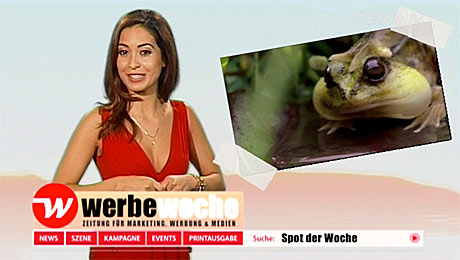
Star TV is showing the making of Sony Ericsson "Satio" this Saturday and Sunday in the magazine "Die Werbewoche". Next weekend, the making of the Migrolino campaign will be presented.
Editorial
-
November 20, 2009
Since the end of September, Star TV has been offering Swiss creatives a new platform in collaboration with Werbewoche. Each weekend, the "spots of the week" are presented in moderated reports. There are also "making-of" reports on current productions, sideways glances at the international scene, reviews of history and interviews with studio guests. Broadcast times: Saturday 9:30 am and 6:30 pm Sunday 9:30 am and 6:30 pm
Basel West realizes new Swissbau magazine
New magazine as an appetizer for the largest Swiss construction and real estate trade fair.
Editorial
-
November 20, 2009
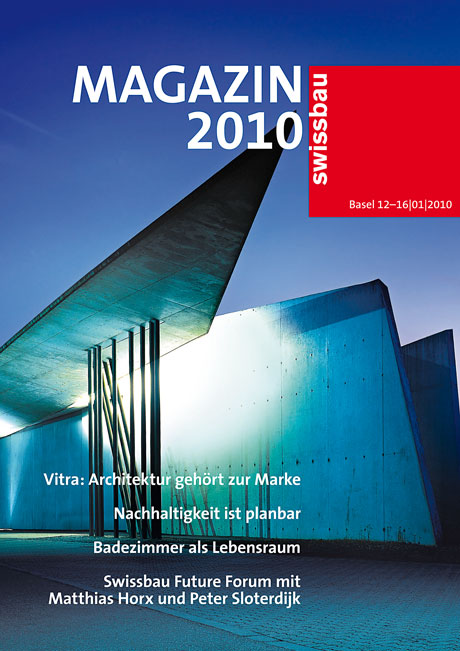
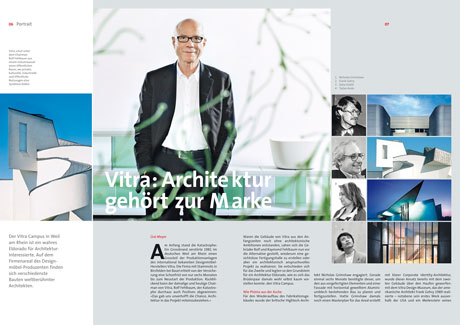
Swissbau wants to strengthen communication with its trade fair visitors and is publishing its own magazine, which appeared for the first time at the beginning of November. As the most important Swiss trade fair for the construction and real estate industry, Swissbau wants to document its thematic leadership and at the same time draw attention to a few highlights and premieres that will make the trade fair even more attractive. The magazine addresses current topics in the industry with a focus on sustainability and shows future trends in the areas of planning, climate architecture, the life cycle of real estate, energy, interior design, urban development and vocational training. A portrait of the Vitra Campus serves as an illustration. In an interview, trend researcher Matthias Horx highlights the demands that growing mobility will place on architecture. Markus Siegenthaler
Striking
This time, *Werbewoche* took notice of a promotional stunt by the small company Smeyers, as well as the current Pro Juventute campaign.
Editorial
-
November 20, 2009
Where Advertising Isn't Just Any Old Thing Eight people, four branches, and countless ideas—that’s Smeyers. The small real estate management company turned heads at SME Day in St. Gallen with a zesty marketing stunt: a tube of mustard topped with the tagline, «If you care about your real estate portfolio, we’d be happy to add our two cents.» That really hits the spot. As is well known, people from St. Gallen don’t mess around when it comes to mustard—at least not near their bratwurst. This biting campaign is therefore likely to stick in their minds even more than it does with the average bratwurst eater. www.smeyers.ch
Fundraising Campaign and Practical Help for Teenage Problems Contemporary issues facing children and adolescents are brought to life in the latest campaign for Pro Juventute. The campaign was created by the agency Effac for Communication. It depicts bullying, computer addiction, and sex in the settings where they occur, using a striking visual language. The question posed in each scenario—addressed directly to the viewer—is answered by the tagline «Here for you!».
Media Trend Journal: How the printed daily press has a future
The press is under pressure in both the consumer and advertising markets. And this pressure is only partly due to the economic crisis. While the economic crisis will (hopefully) pass, the structural crisis in both of these markets will intensify. Ueli Custer
Rose d'Or: Rolf Probala becomes new festival director
Rolf Probala will become the new director of the Rose d’Or. The Lucerne native will take over as festival director from Urban Frye, who is stepping down after three years in the role.
Editorial
-
November 20, 2009
Rolf Probala worked for Swiss Television SF for nine years, most recently as head of "Tagesschau", after which he was head of communications at ETH Zurich. In 2008, he managed Ringier's 175th anniversary with over 30 events in ten countries, including two major events at the KKL Lucerne. In the last two years, Probala has built up a group-wide academy for Ringier. The Rose d'Or Awards are among the most prestigious prizes in the television sector. In 2010, the festival celebrates its 50th anniversary in Lucerne. It will now take place in the fall from September 18 to 22, and the awards will be presented on September 22 at the KKL Lucerne. The awards will continue to be overseen by the advisory board chaired by BBC representative David Liddiment and supported operationally by the existing core team of Nora Kradolfer, Séghira Farhi and Dina Baenninger. As Competition Manager, the latter will continue to oversee the international competition, which will be launched at the beginning of December with the "Call for Entries".
Charisma as strong as a bear
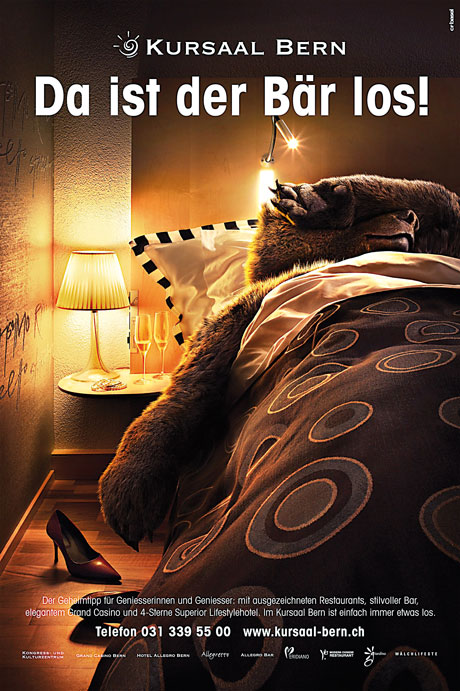
The Kursaal Bern advertises with a new brand strategy from cR Basel.
Editorial
-
November 20, 2009
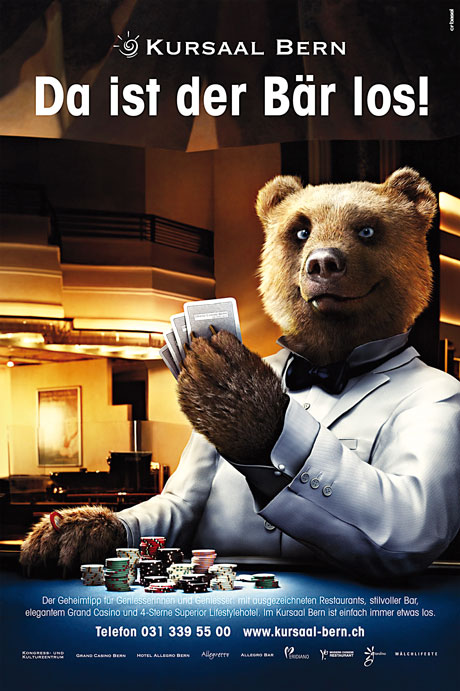
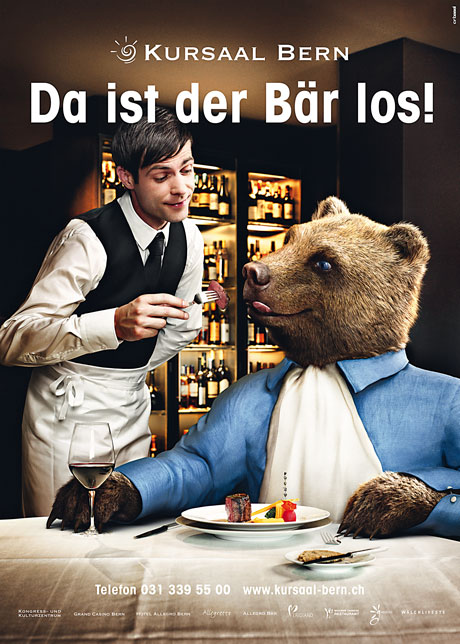
The Kursaal Bern is about to embark on a project of the century. With the renovation of the 50-year-old arena, the city of Bern will once again have "the most attractive congress center in Switzerland", as Director Patrik Scherrer promises. The logistics and kitchen will also be brought up to date. "We are thus launching a significant development step for our company - with a distinctive architecture and a renewed appearance of the Kursaal Bern in the cityscape." The company is prepared to invest 30 million francs in this project. The arena will thus be adapted to meet today's requirements for international congresses and events. The foyers will be tripled in size and reoriented towards the city and the Bernese Alps. At the same time, this will create crossing-free routes for 2,000 congress and casino visitors a day. As part of this further development, the Kursaal also wants to take a step forward with its brand management. New values have been defined and a new brand strategy developed. The decision was made in favor of the umbrella brand "Kursaal Bern", one brand for all services offered. Communication for the Kursaal has been managed by cR Basel for four years. The mandate started strategically with the realignment of the brand architecture and became increasingly comprehensive, as Senior Account Director Thomas Fux is pleased to report. The claim "Kursaal Bern: The bear is on the loose" was developed as the overarching message. However, the traditional heraldic animal is not meant to be a cuddly teddy bear, a profane dancing bear or even a lurid beast. "He is a charismatic personality who represents the values of Kursaal Bern, such as friendliness, honesty, openness and dynamism," says Patrik Scherrer. Strategic Director Daniel Bürgi from cR is confident "that this bear will become a cult figure". As an ambassador, the new bear is intended to attract guests from the local area as well as from the wider field of incentive tourism to the Kursaal. The grumpy mascot must appeal to men and women alike. If you take a closer look, you will discover that the still nameless Urs cannot deny a certain resemblance to George Clooney or Daniel Craig, at least around the eyes. Andreas Panzeri The Kursaal is a traditional Bernese establishment and is as much a part of Bern as the Bundeshaus, the cathedral or the River Aare. And so is the bear. That is why the Bernese heraldic animal is the new ambassador of the Kursaal Bern. Whether gastronomy, casino, hotel or congress - the bear represents the entire diversity of the offer.
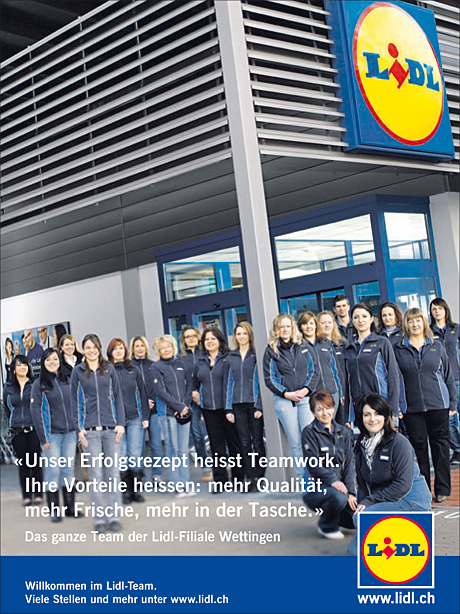
Lidl lets employees have their say
Lidl Switzerland has launched a campaign that gives the discount store's employees a chance to speak out. The ad campaign will be featured starting this coming Sunday.
Editorial
-
November 20, 2009
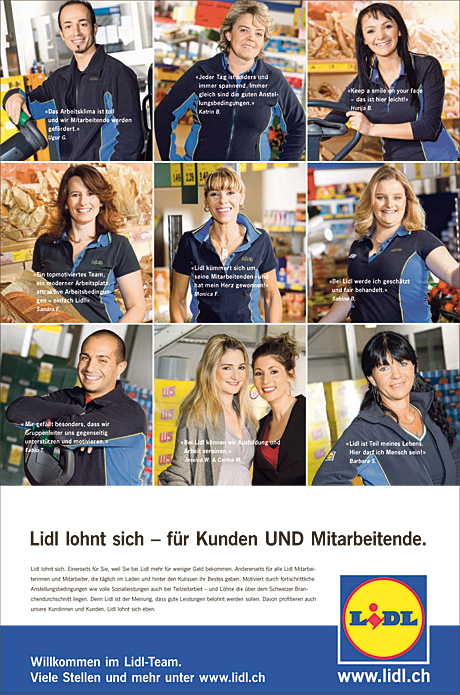
The employee campaign will be launched on Sunday, November 22, 2009, in various Swiss Sunday newspapers and a free newspaper. In it, employees express their personal experiences and impressions at the discounter in statements they have written themselves. The campaign was conceived mainly in-house. For the realization, the store chain received support from the Aarau agency Baldinger & Baldinger, as Paloma Martino from Lidl Switzerland said in response to an inquiry from Werbewoche.
Responsible at Lidl Switzerland: Andreas Pohl (Executive Board Chairman), Silja Drack (Human Resources Manager), Viviane Artho and Gisela Schoch (Employee & Social Affairs Officer), Michael Schneider (Advertising Manager). Responsible at Baldinger & Baldinger: Vital Baldinger (CD), Asha Husmann (graphics), Roland Perrelet (consulting), Christian Herzog (production), Samuel Wimmer (photo).
The cursed public
The state government is undermining the implementation of the principle of public access. Op-ed by Hans Stutz, freelance journalist.
Editorial
-
November 20, 2009
What Blocher Christoph can do, Maurer Ueli also wants to be able to do: publicly berate publishers, editors and journalists. Delivered in the best local luxury hotel, where the Congress of Swiss Publishers is always held. Five years ago, Blocher claimed that, as a Federal Councillor and entrepreneur, he knew how much we "depend on unvarnished reporting". He then went on to outline, more or less in the style of a program outline, which topics (excessive government spending, migration) the media should cover and how (according to the SVP program, possibly Weltwoche). Blocher now has a favorite as his microphone holder, while Maurer Ueli still runs to any microphone that is put in front of him for professional reasons. A few weeks ago, he complained to the publishers that the media were bungling things. Above all, however, they were not controlling the "powerful and the power". It sounded as if a leftist or a bourgeois radical democrat was singing the praises of transparency and control of power. But was it really meant that way? Mr. Federal Councillor has a lot to say. Together with his six colleagues, he is at the head of an apparatus in which several hundred people deal with the public on a daily basis, be it through media releases, be it by deliberately spreading indiscretions, be it by ignoring or delaying answers to unwanted questions. The principle of public access has been in force for over three years: everyone has the right to inspect official documents and to obtain information from the authorities about the content of official documents. Of course there are exceptions. But overall - at least that's what it looks like - it would be a useful tool, including for media professionals. But what does the reality look like? For example, when a member of the media asks Maurer's (formerly Schmid's) DDPS department for information about the military rank of some men who have been convicted of violent crimes. For years, the DDPS has always answered questions about the military rank of members of the armed forces promptly and quickly. But this time, it suddenly says, data protection, no information. The rejected person invokes the principle of publicity and lodges a complaint with the Data Protection Commissioner - as stipulated by law. According to the law, the data protection officer should make a decision within thirty days to ensure that the requested information is not no longer up to date. But nine months later, there has still been no decision. The reason: the Federal Council has not approved the necessary staff for the Data Protection Commissioner (according to the dispatch, 300 to 350 full-time equivalents), and a single person must - at present - handle the entire complaints process. In plain language: the federal government is torpedoing the implementation of the principle of public access. And, according to reports from the federal administration - under the seal of secrecy, of course - they do not want the publicity principle to become better known among citizens or media professionals. After the publishers' congress, Maurer Ueli was able to look confidently at the newspapers the next day. They published the DDPS chief's scolding of the media without contradiction. Asked by Peter Wanner's Sonntag about his criticism, Maurer even claimed that he had never really been criticized in the first nine months of his time in office. And then added: "Criticism always helps you to improve." Mr. Federal Councillor, we also know where! And the costs remained comparatively low, not even one percent of a fighter jet!