Author: admin
Allink.creative realizes campaign for the Six Telekurs Regulations Roadshow
The Zurich agency Allink.creative has developed a cross-media campaign for the Six Telekurs Regulations Roadshow. The campaign focuses on the people in the financial industry who have to comply with laws and regulations.
The campaign's key visual consists of a human pyramid, which communicates structure, cohesion and an overview. The theme of the "pyramid" runs through the entire campaign. The basis is a microsite where interested parties can obtain information and register. This is advertised worldwide through print advertising in the trade press and business journals. In the online area, attention is drawn to the microsite by web banners and newsletters.
In addition to the visual appearance, Allink.creative was also responsible for the branding at the event as well as the layout of the comprehensive regulations brochure and the design of the giveaway.
Responsible at SIX Telekurs: Christa Schwarz (Head of Marketing
Communications), Sara Ueberi (Event Manager Marketing Communications,
Esther Zollinger (Marketing Communications). Responsible at Allink.creative: David Zangger (Creative Direction), Mike Walder (Consulting), Ron Kirchheimer (Project Management Online), Roswitha Brülisauer (Graphics), Monika Jagodzinski (Image Editing).


Fair prices for quality journalism
Nine Things Publishers Should Do—or Avoid Doing—to Help Ensure the Survival of Quality Journalism in the Age of Web 2.0. Op-ed by Stephan Russ-Mohl, Director of the European Journalism Observatory at the University of Lugano.
Because people in day-to-day business are in danger of losing sight of the forest for the trees, Murdoch's initiative is an opportunity to suggest nine things from the media researcher's ivory tower vantage point that publishers should do or not do in order to help quality journalism survive in the age of Web 2.0.
1: Publishers should not give away content online that they want to sell in print.
2: You should not trust that journalism can be financed 100 percent or even predominantly from advertising. Advertising may migrate to the Internet with the public, but not necessarily to the news sites - and above all, the mass business with classified ads will foreseeably collapse online in Switzerland too. Craigslist and Kijiji send their regards.
3: Publishers should pass on price advantages that result from online distribution to users. If you can save on the costs of printing, paper and delivery, you should let customers who do without the printed product share in the savings. An online subscription should therefore cost at most half as much as a print subscription. Murdoch's price for the online version of the Times is therefore too expensive!
4: Up-to-date, in-depth information is valuable and precious. If there are hundreds of new articles in a newspaper that costs two or three francs, it is absurd to charge just as much for individual old articles that readers want to fish out of the electronic archive. That is perceived as usury.
5: Quality-conscious publishers should close the floodgates for PR rather than opening them further by downsizing their editorial teams. After all, those responsible for communication on the other side are also cool calculators: why pay for expensive advertising when you can get many messages across to your target groups cheaply and credibly via editorial content?
6: Publishers should not invest in advertising and PR for their companies, brands and products without providing journalistic platforms on which media and journalistic products are reported and discussed. Without them, PR in particular comes to nothing. Quality awareness among audiences and thus also willingness to pay for media products is generated - if at all - by reliable information about media and journalism.
7: Cutting back on media journalism may be in the healthy personal interests of the media powers that be. After all, as a publisher or editor-in-chief, you don't want to be put on the spot in the same way that your own editorial team pillories politicians and CEOs from other sectors on a daily basis. However, anyone who pursues their own interests too dashingly is behaving negligently towards their own company and industry. How many fewer cars would premium suppliers such as Daimler, BMW, Audi or Porsche sell if there were no automotive websites, no motor press and no Formula 1 coverage? And another thing: we know from politicians that they usually rely more on newspaper and TV reports for information than on their ministries, research departments and secret services. Perhaps not only the public, but also editors-in-chief and media managers would benefit from solid journalistic information about the media business and their own competitors - they would poke around less in the fog and repeat fewer mistakes that have already cost a lot of money elsewhere.
8: Even though the Netzeitung has just been discontinued in Germany: Publishers who lay off qualified journalists today must expect to encounter some of them again tomorrow as competitors. The barriers to market entry in online journalism are low. And those who only operate online, i.e. who do not have to deal with printing technology, distribution logistics, works councils and trade unions, are more agile than the big tankers.
9: However, there is one supertanker that publishers have so far vastly underestimated, just as they have long underestimated Google and Craigslist: On the web, where all media are converging and news websites will have to offer podcasts and videos in addition to texts and images in the future, public broadcasting is becoming an overpowering competitor. Publishers also need more media journalism in order to achieve a fairer distribution of these billions in fees: less for sports rights, soap operas and Gottschalk shows, which can also be financed via private television; more public money for quality journalism. However, these funds should then no longer benefit just one provider, but the entire journalistic "ecosystem": regardless of whether this involves financing correspondent posts for the NZZ in Afghanistan or Iraq or investigative research by Südostschweiz or the St. Galler Tagblatt in the respective canton.
The expert in the media
Last week in the "Last but not least" section on Werbewoche.ch:
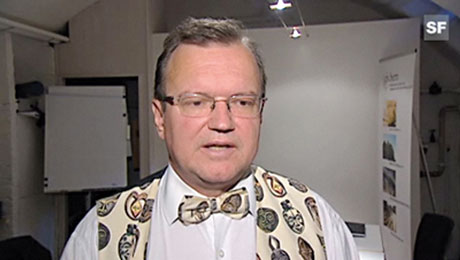
Here's the test:
The likeable-looking man is the political scientist Claude Longchamp, who heads the JRC Bern Institute (Research for Politics, Communication and Society) and makes a prediction about the upcoming vote on the Swiss television news program.
As the article shows, his outfit is camouflage. Longchamp looks confident in front of the camera and his choice of clothes ensures that his appearance attracts the necessary attention. A style consultant, completely superfluous. The more authentic, the better. And by the way: a little pep can't do the show any harm.
After the catastrophic miscalculation by political forecasting guru Longchamp on the anti-minaret initiative, it is unlikely that we would write a similarly benevolent commentary again today. However, the fact that such ill-informed voting forecasts are only relativized by their authors afterwards is not only unpleasant, but also reflects extremely badly on the entire forecasting profession.
The credibility of referendum forecasts will tend towards zero in future, as this year's flop prediction will be remembered for a long time to come. Swiss television will also have to consider how to deal with voting forecasts in future. Unfortunately, such misjudgements are not entirely harmless.
Whether Claude Lonchamp's somewhat more conservative style of dress would improve his credibility in the future remains to be seen.
PCM

Dissolution of Media Sales RMS: Personnel changes
Now that the previous head of Ringier's central online marketing unit Media Sales RMS, Ueli Weber, has moved back to Publigroupe, further changes are taking place. As the publisher writes, Patrick Baumberger, who was responsible for the sales management of Media Sales, is taking over new projects in the digital sector under the leadership of Thomas Trüb.
Striking
Among other things, *Werbewoche* took note this time of a new study by Neo@Ogilvy that analyzes the factors contributing to success for online marketers.
Freelance advertising account executive Kilian Gasser has founded a limited liability company (GmbH) under the name «Kilian Gasser Medienvermarktung,» based in Altdorf, to replace his previous sole proprietorship. As part of the reorganization, the corporate design was revamped by illustrator and graphic designer Samuel Jordi, and the two websites, Kiliangasser.ch and Medienvermarktung.ch, were completely redesigned and implemented by media designer Barbara Hiltbrunner Bissig. Gasser continues to manage accounts for the WOZ, including the Ökopool office, the Unia member newspaper *Work*, and the magazine of the Tenants’ Association. Starting in 2010, he will also manage *Zeitlupe* for Pro Senectute together with Adelheid Kaegi.
The Compass Points the Way to Success
A new study by Neo@Ogilvy analyzes the factors that contribute to success for online marketers. To this end, the researchers surveyed relevant companies in Switzerland, Germany, and Austria. The study reveals that price competition is gradually losing importance. Greater emphasis is being placed on quality and the use of innovative technologies.
Risk assessment - an opportunity for your company
Since 2008, public limited companies and limited liability companies have been required to carry out a risk assessment. But many companies find this difficult. By Michael Krampf, lic. iur., lawyer, legal expert and editor at the Beobachter Advisory Center.
Many entrepreneurs feel the same way as Andreas W., if they have finally been able to bring themselves to carry out a risk analysis. But many see it as nothing more than a legal paper tiger. Wrongly, because the analysis has several advantages:
- Sharpening risk awareness: Entrepreneurs often only become aware of risks that they were previously unaware of during the analysis.
- Optimization of insurance cover: Only those who know their risks can assess against which they need insurance at all. It is therefore possible that a company has unnecessary insurance or insurance that excludes an existing risk even though it exists.
- Avoidance of benefit reductions: Anyone who fails to take suitable measures to avoid or limit risks must expect a reduction in benefits in the event of a claim.
Ideally, you should commission a neutral insurance consultant to screen your company for potential risks. You will need to invest a few days and a few thousand francs for this. If you are not prepared to do this and the circumstances in your company are manageable, a simplified assessment will suffice. Sit down with a specialist trustee who knows your industry inside out. If this is not possible, carry out the analysis with your own trustee. It is important that you can discuss the matter with someone who knows your business and who is also prepared to ask you critical questions.
Together with the trustee, you go through the possible risks using a checklist or you use software that is available for a few hundred francs. The analysis takes a few hours the first time you carry it out. Later, you only need to check whether the current situation still corresponds to the risk catalog. One hour is enough for this.
Book tip
Book set OR and ZGB for everyday use
Get authoritative answers to your everyday or specific legal questions: complete legal texts with reader-friendly commentaries, court rulings and many examples.
Revised and updated edition September 2008
Beobachter-Buchverlag,
ISBN 978-3-85569-409-9,
2 volumes bound in a set
only Fr. 99.-


The Beobachter's new service: competent legal advice for SMEs and their employees. 6 months for only Fr. 99.- (introductory price).
You can reach the legal experts Monday to Friday from 9 a.m. to 1 p.m. on 043 444 54 09. You also have full access to the advice platform Helponline.ch and an Beobachter magazine every 14 days. The price also includes a gift: the standard work for SMEs from Beobachter-Buchverlag,
"How to get your money", worth CHF 48.
Order the consulting subscription for SMEs at: www.werbewoche.ch or by phone: 0800 83 0800.
Mission imaginable
We could all use some solutions for the 21st century. Toto Ghali and Nico Tschanz already have them: Their agency, 21solutions, films in operating rooms, at conferences, and at sporting events, and uses the footage to produce highly professional films for medical professionals and sports enthusiasts.
The agency's mainstay is called Lifestyles. For a year now, 21solutions has been producing lifestyle films under this name, especially about extreme sports. It's less about understanding and learning, and more about experiencing. And of course about image. For Zurich's Mascotte, the agency recently organized the European premiere of an internationally eagerly awaited mountain bike film. For the film, 21solutions' chief cameraman accompanied a mountain bike professional to Liguria. They filmed his freeride from the mountain to the village from a helicopter. The material resulted in a cult film, with which the Mascotte thrilled the mountain bike scene in October - and which is perfect as an eye-catcher for outdoor fairs or sports stores. But there is also a quieter way: An atmospheric film about a golf tournament in Lenzerheide inspires enthusiasm for the sport on the patchy grass and is a nice memory for the tournament participants. 21solutions also produces such high-quality image films, for example, for the tourism and travel industry, for hotels and resorts.
Passion and expertise
Toto Ghali's high affinity for the lifestyle industry stems from his time as an extreme half-piper. At 22, he began traveling the world. In Asia, he spent five years working in the import and export of toys and sporting goods, then spent two years working for an EU foundation that promotes quality education in orthopedics. "I observed that films and medical education were moving more and more into the digital realm," Ghali says. "Besides, there are only a few players in the medical device industry promoting their implants. So I came up with the idea of combining high-level videos and medical education and founded 21solutions." As a producer with expertise in medical technology, Ghali is predestined to translate complex issues into coherent images, uninfluenced by the interests of individual companies. That is why 21solutions is also considered a quality assurance provider in medical technology information.
Ghali's partner is Nico Tschanz. Tschanz studied business informatics and earned his doctorate with a thesis on "Business Models in Internet and E-Business". He knows the web like the back of his hand and has in-depth knowledge of online marketing. At 21solutions, Tschanz is the expert for zeros and ones and therefore the right contact person when it comes to integrating videos and the Internet. His knowledge is central to the agency's success, because e-learning is no longer a dream in the medical industry, but routine. "Movies are becoming more and more important on the Internet," says Tschanz. "Our customers have a high demand for movies, because their target group exchanges information very actively via specialist portals and platforms such as YouTube and Facebook. The requirements and expectations are therefore increasing rapidly. Finally, the brand widths are also right, as are the devices down to the trouser pocket. That's why we can finally use the power of the moving image for professional information, image building and training." Seen in this light, 21solutions could confidently be called 22solutions, because the agency has its nose close to the wind of the future.
The agency team also includes four other employees: renowned cameraman Matteo Attanasio is the head of production. He has shot films for Red Bull, MTV and Vox-Tours and knows his way around not only camera technology and pre- and post-production, but also lifestyle: in 1994 he was European champion in half-pipe skating. Behind the second and third 21solutions cameras are Philipp Hermann and Cesar Andrade, and Annina Walker is responsible for visual design in 2D and 3D as well as illustrations. "With these people, we are perfectly positioned," Tschanz says. "Each of us is an expert in his or her field with a good name in the industry. Not every camera team gets to go into an operating room - ours does." Their high level of professionalism is the small agency's most important asset. After all, the six film experts compete with no less a claim than to revolutionize the world of medical technology with their videos. In doing so, they also want to set themes. Toto Ghali, for example, would like to launch a nationwide mammography campaign that raises awareness of how important early detection of breast cancer is. 21solutions also wants to set new standards in the leisure industry. "Our goal is to get into the pocket of every user with multimedia content," says Tschanz, pointing out the agency's vision. With its know-how, 21solutions is also a good choice for agencies looking for a partner for specialized film productions.
Scalpel and skateboard
From the outside, the combination of clinical-white high-tech medicine with wild, adrenaline-fueled extreme sports seems pretty weird. But on closer inspection, this combination is convincing: Both areas are about fascination, peak performance, determination, self-conviction - and professionalism. "21solutions is like Schumacher," says Ghali. "We're highly specialized in one area, and we want to build on that specialization." The agency doesn't want to produce shaky and blurry YouTube films for the masses, but videos for the best in their industry. For example, they shoot image films for hotels exclusively for top resorts. "There's a lot of filming going on today," Tschanz emphasizes. "We clearly stand out from this crowd. We don't produce our films with amateurs, but with professionals, both in medicine and in the lifestyle sector. We demand the highest quality from all our movies and clips, regardless of whether we shoot them for Medvisual or for Lifestyles." Nevertheless, such a film production does not have to run into the millions. 21solutions can produce a short clip for as little as 3,000 Swiss francs.
21solutions has only invested around 165,000 Swiss francs in its production equipment such as cameras, green and blue screens. The agency prefers to rent highly specialized equipment rather than buy it. In this way, it always works with the latest equipment. When projects require it, 21solutions also hires additional personnel. "We can draw on a pool of about 60 freelancers," Ghali says. "Half of them have a medical technology background."
An important part of 21solutions' work is consulting with clients. Before sophisticated and at the same time exciting films about heliskiing or a particularly complicated operation can be made, Tschanz and Ghali first have to develop an idea for it. The path from idea to finished film varies in length. At the beginning of each assignment, 21solutions clarifies with its client what goal he is pursuing with the film. Does he want to document a congress or an event, does he want a product film, a further education video or a lifestyle clip? "With every order, we have two options," explains Ghali. "Either we implement our client's idea, or we develop a concept ourselves for how best to prepare the message to be conveyed. We're very strong at that." Word of quality gets around: although the six heads have only been on the market for fifteen months, they already no longer need to acquire in the medical technology sector. Nevertheless, they are happy about every customer who wants to exploit the potential of video films on all technical channels. Tschanz and Ghali hope that business will develop as well in "Lifestyles. It is not unlikely that this hope will be fulfilled.
Anne-Friederike Wilhelm
> To the lifestyle video

Toto Ghali (38) was born in Marseille, married to a German artist and father of a four-year-old daughter. "I have lived in many countries," he says. "But in business terms, Switzerland is my dream country."

The Coca-Cola Christmas truck travels through Switzerland again
The festively illuminated Coca-Cola Christmas truck is touring Switzerland again just in time for the Advent season. In addition, a stage program provides entertainment.

Inapa: Marco Giuoco becomes new CEO
Marco Giuoco will take over as chief operating officer of Inapa Switzerland effective January 1, 2010. The 44-year-old economist has headed the Sales & Marketing division at the paper manufacturer since July 2008.
Contract Media: Two new mandates, new office manager
Contract Media has added two new clients. The Zurich-based communications agency’s portfolio now includes Phonak Switzerland and the German numismatic company Fritz Rudolf Künker. In addition, Stella Zeco has joined the team as office manager.
The Contract Media team has also expanded. Stella Zeco has joined the team as Office Manager. After studying business administration at the University of St. Gallen, she worked as Media Relations Officer at Zurich Financial Services for seven years.
Ruf Lanz for SMP: Lovely sent down the bobsleigh run
The latest commercial from Ruf Lanz for Swiss Milk Producers (SMP) is set to premiere in the coming days. In it, Lovely the dairy cow recklessly hurtles down the Olympic bobsled run in St. Moritz, making a top skeleton athlete look pretty bad in the process.

Responsible at the Swiss Milk Producers SMP: Charlotte Hofstetter (Head of Marketing), Martin Rüst (Head of Advertising & Media). Responsible at Ruf Lanz: Danielle Lanz, Markus Ruf (CD), Lorenz Clormann (AD), Thomas Schöb, Andreas Hornung (text), Dennis Maitzen (consulting). Production: Markenfilm Switzerland. Marc Schölermann (director), Frank Sprung (camera), Marko Strihic (editor), Uli Scheper (producer). Postproduction: UPP. Alex Kirschner (sound design).