As you have seen in the press, Springer Science+Business Media Group was sold last week to EQT, a private equity investor from Sweden, and GIC, a co-investor from Singapore.
Editorial
-
December 16, 2009
As you have seen in the press, Springer Science+Business Media Group was sold last week to EQT, a private equity investor from Sweden, and GIC, a co-investor from Singapore. Springer Business Media Schweiz AG (SBM) is separating from the Springer Group. The previous managing director Eleonore E. Droux is taking over Springer Business Media Schweiz AG as publisher together with a group of investors. The activities of SBM will continue under the name Medien&Medizin Verlag AG. All employees will be retained and the location at Neugasse 10 in Zurich will remain unchanged. In addition to Werbewoche and Media Trend Journal, Medien&Medizin Verlag's portfolio includes seven medical magazines, including Hausarzt Praxis. Pierre C. Meier continues as Editor-in-Chief of Werbewoche and Media Trend Journal. Séverine Bonini is responsible for editing the medical magazines.
Top of the week: Energy adjusts program
As part of the planned transfer of the license, Energy Zürich is launching the previously announced expansion of its news and programming offerings. The editorial and on-air teams will be expanded.
Editorial
-
December 16, 2009
As part of the planned license transfer, Energy Zurich is initiating the announced expansion of its information and programme offerings. The editorial team and presenters will be strengthened. The editorial offering during prime time in the morning, at midday and in the evening will be expanded. The license application submitted by Giuseppe Scaglione for RMC provides for eleven positions in the news area, as Energy Managing Director Dani Büchi told the news agency SDA when asked. This is the orientation. In addition, a comprehensive quality assurance system will be introduced that meets the requirements of the new license, the company announced on Monday. Energy Zurich will also refrain from broadcasting speed camera warnings, which will no longer be permitted under the new license from January 1, 2010. Speed camera reports will be removed from the program with immediate effect. It is hoped to receive approval from the Uvek for the transfer of the RMC license before the end of this year, the statement continues. Energy Zurich will continue to broadcast from the Uetliberg without interruption.
Choose the campaign of the year
For the "Campaign of the Year" award, the editorial staff of *Werbewoche* has selected twelve advertising campaigns.
It's that time again. This issue of Werbewoche contains three Werbewoche classics. The creative ranking, the presentation of the candidates for Advertiser of the Year 2010 and the vote for Campaign of the Year.
Editorial
-
December 16, 2009
It's that time again. This issue of Werbewoche contains three Werbewoche classics. The creative ranking, the presentation of the candidates for Advertiser of the Year 2010 and the vote for Campaign of the Year. Werbewoche's creative ranking is about the creative performance of agencies that have won awards in national and international competitions. The selection of the competitions and their corresponding weighting was made in collaboration with a delegation from the Art Directors Club of Switzerland. The ranking is based on the self-declarations of the participating agencies. In individual cases, the editorial team made corrections based on the official rankings of the creative competitions. Six personalities from the Swiss advertising scene were selected by the election committee, consisting of former male and female advertisers of the year. This year, two female candidates also made it onto the list. One of the nominees has decided not to take part in the election. Advertising Week subscribers can now choose their favorite from five nominees. They will receive the corresponding voting form next week. On February 4, one of the candidates will then receive the coveted Advertising Week Egon at Lakeside in Zurich. The editors of Werbewoche have selected twelve advertising campaigns for the Campaign of the Year award. They are all campaigns that appeared in at least one language region this year and had a significant advertising impact. The readers of Werbewoche and the viewers of Star TV can vote for the advertising campaign of the year from these twelve campaigns. The winner of the Campaign of the Year award will also be honored at the Egon Awards on February 4. The next printed edition of Werbewoche will be published on January 21, 2010. Until December 23 and from January 4, you will find regular news from the communications and media industry on Werbewoche.ch. We wish you, dear readers, a wonderful and peaceful time over the Christmas period and a successful and exciting 2010.
Eleonore E. Droux, Business management.
Pierre C. Meier, Editor-in-Chief Advertising Week.
Matter & Gretener counteracts an unhealthy development with ISPM
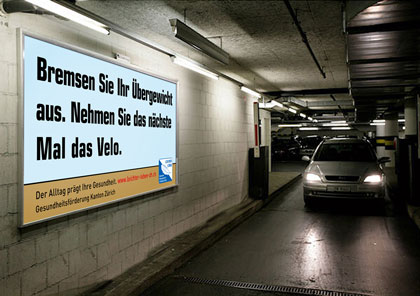
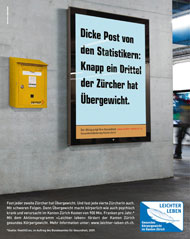
With the «Live Lighter» action program—which includes measures in the areas of sports, daily physical activity, nutrition, education, and child-friendly transportation planning—the Government Council of the Canton of Zurich aims to halt the trend toward obesity. In addition, an awareness campaign is being launched, developed by Matter & Gretener on behalf of the Institute of Social and Preventive Medicine at the University of Zurich.
Editorial
-
December 16, 2009
The campaign uses punchy headlines to make it clear to the people of Zurich that being overweight is not just a question of aesthetics, but also affects their health. Tips are also given on how to integrate more exercise into everyday life and eat more healthily. The "Leichter leben" campaign is running until further notice and comprises a wide range of measures and media. These include advertisements, posters, TV commercials, rail posters, carrier bags and push posters. Non-traditional measures are also used. For example, there are announcements in Coop Pronto stores asking shoppers to look at the floor from time to time. It could be that there is still a kilo or two of excess weight lying around that customers have lost through healthy eating. Responsible at the Institute of Social and Preventive Medicine at the University of Zurich: Roland Stähli, Annett Jucker, David Fäh. Responsible at Matter & Gretener: Daniel Matter (Creative Direction), Dominik Imseng (Text), Urs Hartmann (Art Direction), Julia Batzlen (Graphics), Marcus Gretener, Simone Frei (Consulting). Photography: Stefan Minder.
Maxomedia lets Santa's sleigh ride on Sbb.ch
Anyone browsing Sbb.ch during the Advent season will be surprised by Santa and his reindeer: Santa Claus flies through a winter landscape in his sleigh and drops gift packages along the way during his fast-paced ride. The scene is part of the new SBB Christmas contest, «Follow Santa,» created and produced by Maxomedia.
Editorial
-
December 16, 2009
The aim of the game is to collect as many of the colored "packages" as possible that Santa drops from the sleigh on the various SBB sides. Anyone who finds ten gift packages of the same color will be entered into the prize draw - for example a 2nd class GA or an SBB travel agency voucher worth 1000 francs. "Santa verfolgen" is a technically complex game that works with sticky ads. Maxomedia is responsible for the conception and implementation of the game. Responsible at SBB: Daniel Schwarz (overall responsibility), Sabine Walther (responsible for marketing communication), Matthias Schmid and Stefanie Kunz (e-business).
Texts for websites: Better a lot than a little
The amount of text on a website is a recurring topic of discussion, as website operators often believe that people don't read online.
Editorial
-
December 16, 2009
So they limit the text to the absolute minimum without considering the consequences. 90%: All purchasing decisions are made online Before deciding on a TV, skis, wine, or a vacation destination, 90 percent of consumers do their research online—regardless of whether they ultimately buy the product online or in a store. As the operator of a commercial website, what conclusions should you draw from this statement? Visitors come to your site because they’re evaluating a product and have noticed your offering. On the website, they’re now looking for information that will help them form an opinion and make a purchase decision. This information can only be conveyed through text and images. Convincing Someone with a Sales Pitch Savvy salespeople engage consumers based on their individual needs right on the homepage and guide them to a page that provides the relevant information. Now you can position yourself as a knowledgeable advisor who understands your customers’ objections and reservations, addresses them, and presents clear, compelling arguments. Of course, on this page you clearly present the product’s benefits and highlight how your offer stands out from the competition. Testimonials and customer logos help build trust in your offer. Once you’ve succeeded in convincing the visitor to your website, your offer will be the preferred choice. Now they’re ready to act on the call to action—whether that’s downloading a brochure, subscribing to a newsletter, finding the nearest dealer, requesting a quote, or even purchasing the product. The more interested the visitor is, the greater their need for information Visitors will only be willing to read the text on your page if it appeals to them—no matter how long the text is. However, they will only read it if the text contains relevant information (not just self-promotion), is easy to read, and is organized into many short sections with meaningful headings. The headings help visitors scan the content of your page and pick out the information that’s relevant to them. Use images and videos in a way that clarifies the text’s messages and draws the visitor’s attention to key points. And don’t forget to include a «call to action» that encourages convinced visitors to take action. Imre Sinka, Dotpulse Web Agency AG
Who will be Advertiser of the Year?
Advertising Week subscribers can vote for the winner of the new Egon Cup on February 4.
Editorial
-
December 16, 2009
Geri Aebi, CEO Wirz Werbung, co-owner Wirz Group During his business studies, Geri Aebi discovered "that copywriting for agencies is more profitable than delivering parcels to the post office". That's why he tried his hand at copywriting after graduating from university. After four successful years at Aebi & Partner, he wanted to go abroad for a year or two. That turned into 15, 12 of them at GGK Vienna. First as a CD, before his business knowledge caught up with him again and Aebi became Managing Director in 1997. This not very common CEO combination of business economist and creative proved to be a personal formula for success even after his return to Switzerland: 2002 CEO Wirz Werbung, 2005 MBO Wirz Group, 2008 Chairman of the Wirz Group Management Board. He has also been a member of the ADC and BSW board for several years. Geri Aebi sees his honorable nomination less as recognition for 2009 per se, but rather for his long-term successful work at Wirz. And as he has always seen himself as a "player-coach", the "Advertiser of the Year" award is therefore also for his fantastic team, "without whom neither the financial nor the creative turnaround of the agency would have been possible". Wirz has been "back in business" for around three years now. With 12 to 15 pitches a year, almost every second one is won. In 2009, Aebi and his crew were of course particularly pleased with the "big win" for the Migros advertising campaign and the top rankings in the Media Research Top 500 customer survey.
Regula Fecker, partner and co-founder of Rod Kommunikation After graduating from high school and completing an internship at a PR agency, Regula Fecker joined Honegger/von Matt in 1998 as a 20-year-old consultant, where she learned her trade with clients such as Disaronno and Winston. Over the years, she developed a growing interest in people, their behavioral patterns, how they relate to brands and how they react to communication. The move to strategic planning enabled her to pursue this interest more intensively. In 2003, Regula Fecker left Switzerland to continue her education at the Miami Ad School. She graduated from the "Bootcamp for Account Planning" as the first non-American to top her class. This was followed by a job offer from TBWA\CHIAT\DAY New York and TBWA\ Berlin, where she headed up Strategic Planning. She then returned to Switzerland, again to Jung von Matt/Limmat. In 2007, she founded the Rod Kommunikation agency in Zurich-Enge with art director Oliver Fennel and PR consultant David Schärer. Catherine Mühlemann, former head of MTV Central Europe, is a member of Rod's board of directors. Two and a half years after its foundation, the agency is regarded as a creative and strategic "hot store" with 16 employees and clients such as 20 Minuten, Ikea, Bell, Hotelplan, Médecins Sans Frontières and Sanitas. In 2008, Rod was named "Newcomer Agency of the Year" in the German-speaking world.
Markus Gut, CCO Young & Rubicam Group The relocation of the Young & Rubicam Group to Zurich's Westend was an important sign of the new start, which Markus Gut was able to master as CCO together with his CEO Andreas Widmer. In the spirit of optimism at Hardturmstrasse, Y&R was able to acquire many new clients and pitches even in these generally difficult times. This led the Y&R Group to first place in Werbewoche's creative ranking in 2008. A success that was also topped in 2009. Markus Gut had already regularly achieved similar results at Publicis, where he held the same role as chief creative officer for eight years. Several hundred creative awards have reliably earned Markus Gut a nomination for "Advertiser of the Year" every year since 2003. He is also a regular juror at international festivals. Markus Gut lectures at Sawi, at the ADC/BSW creative school and at the HSG St. Gallen. Since this year, he has been a member of the ADC's four-member presidium. His private passions include his own wine and the award-winning grappa from his Al Mulinetto in Gordoba. As a co-initiator, the creative is also planning a restaurant at Greifensee based on Jean Nouvel's building at Expo.02.
Alexander Jaggy, CD and partner Jung von Matt/Limmat The year got off to a brilliant start for the creative director and partner of Jung von Matt/Limmat: after winning the prestigious Migros account, Alexander Jaggy and his team managed to bring home a Cannes Lion after just 100 days - the first for Migros in 14 years. Jaggy is the mastermind behind the campaign featuring the popular Migros chicken. The crowning glory of a very varied career. He joined BBDO as a copywriter in 1990 immediately after graduating as a commercial clerk. He then moved to the legendary GGK. In 1994, he moved to Germany. First to Springer & Jacoby, then to Jung von Matt. In 1999, he moved to London to help set up the international office for Springer & Jacoby. In 2001, he returned to Switzerland to launch Jung von Matt/Limmat. In eight years, Jaggy has shaped the agency in Zurich into a commercially and creatively successful company: In a survey of the 500 largest advertising clients, Jung von Matt/Limmat was voted Switzerland's best agency for the 7th time in a row. Alexander Jaggy successfully completed his MBA in August. His thesis is entitled "Unpredictability" and deals with real-time management. He is a member of the ADC Switzerland executive committee. He is also a member of the ADC for Germany and a member of the English D&AD. Alexander Jaggy is married and has three children.
Marion Marxer, Member of the Executive Board Jung von Matt/Limmat Marion Marxer has headed the Digital Media and Dialog divisions at Jung von Matt/Limmat since December 2009 and is also a member of the Executive Board. She will continue to ensure a significant upturn in Jung von Matt's rapidly growing web division. Marion Marxer has 15 years of experience in all communication disciplines and most recently worked at Publicis. She joined the company in 2005 as Senior Brand Director. Important clients included Swisscom, PostFinance and Migros. In 2007, she became Managing Partner and a member of the Executive Board. In just two years, Marxer built up the digital communication division at Publicis from 0 to 20 employees and also integrated .nemos into the in-house online agency Modem. Marion Marxer studied marketing in the USA and earned an MBA with her thesis on "Digital Impact on Media and Society". Her most important awards include a Cannes Cyber Lion shortlist for Chocolat Frey, the Crossmedia Award Gold for Migros M'8 and Silver for Migros' favorite products. In her private life, the advertising expert is involved in organizing the annual "tweakfest" festival for digital culture and lifestyle.
Opportunities for Communication in Times Like These
This was the tenth time the HarbourClub Symposium was held.
Editorial
-
December 16, 2009
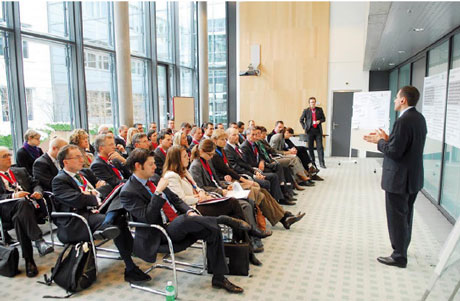
The event was outstanding and one of the best I’ve ever attended. Probably also because the topics and content perfectly matched my needs. »And because the speakers and breakout sessions were of such high quality,” said Natalie Waltmann, Head of the General Secretariat, Media Office & Internal Communications at Coop, praising the tenth HarburClub Symposium. This report highlights two of a total of eight excellent presentations. Prof. Claudia Mast of the University of Hohenheim in Stuttgart presented the results of her annual DAX-Kom survey. The survey reveals that there is a great deal of uncertainty within communications departments regarding which messages and content should be communicated. This is because management itself does not know where the company is headed. The central thesis was: The good times are not coming back; the current crisis is a new reality that communications and management must address. While external communication in recent years has focused on optimizing communication channels, Claudia Mast says the priority now is to bring content back to the forefront. When it comes to internal communication, great importance is placed on conveying corporate values, brand values, and mission statements. (Download the full study here: https://media.uni-hohenheim.de/studie_daxkom.html ) 7 Tips for Brand Management During a Recession Dominique von Matt, co-owner and managing director of the communications agency Jung von Matt/Limmat, began with a quote from Friedrich von Logau: «In times of danger and great distress, the middle path leads to death.» Only clear decisions in communication lead to success in uncertain times, according to von Matt. Since media consumption generally increases during crises—and with it, a brand’s visibility—crises present seven opportunities for communication: – Capitalizing on the quality promise: The banking crisis presented a unique opportunity for communication—at that very moment, consumers were asking themselves whether their current bank was still the right choice. In this situation, banks could have used their own quality promises to attract customers—an opportunity that was only exploited to a limited extent. – Focus on added value: Consumers are increasingly paying attention to quality and sustainability. Moral and ethical values, in particular, are gaining prominence. Differentiating oneself through ethical added value is not only possible but is of central importance. – Go where the purchasing power is: to people over 50 who are full of zest for life and willing to spend their money, since they no longer belong to the war/savings generation. – Communicate online: There are no extra costs—quite the opposite. The web helps consumers save money, and you have a wide range of potential influencers. -Branded Entertainment: Consumers have no problem with your brand name appearing in funny YouTube ads—as long as the brand aligns with the ad’s value proposition. Furthermore, the days of single-media communication are over: campaigns, online games, music (videos), and more—all of this merges into a cross-media offering. – Turn your brand into a cultural icon: That way, it will remain irreplaceable even in a crisis (e.g., the iPod’s white earbuds). – Go with your gut: because when things get complicated, your gut feeling is what matters most. The HarbourClub Visits Swisscom in Worblaufen Well over thirty HarbourClub members and another hundred participants had traveled to Worblaufen, Swisscom’s headquarters, on December 1 amid a snowstorm. Of course, Carsten Schloter, CEO and host, was also in attendance. In his presentation, he argued that a Corporate Communications Officer would be ineffective without influence over corporate culture. Like the insights from the other presentations and the four outstanding breakout sessions—all organized by HarbourClub members—this statement sparked lively discussions among the participants, as the strong practical focus is a hallmark of HarbourClub symposia. And so the sponsors are also integrated into this concept. Not only were their logos featured at the event, but they all made substantive contributions as well—for example, by creating an accompanying website, conducting studies, publishing materials, or designing the breakout sessions. The Board of Directors extends its thanks to Argus der Presse, the Linkgroup, the Swiss Public Relations Institute, and the agencies Amoeba, Enzaim Communications, and Prime Communications. The eleventh HarbourClub Symposium will take place on November 18, 2010, in Zurich. Andreas Jäggi and Ansgar Thiessen HarbourClub The HarbourClub offers its members—communications directors at major Swiss companies and organizations—a platform for sharing personal experiences. Founded in 2000, the club also aims to advance the professionalization of the «corporate communications» function and to highlight its importance. Once a year, the HarbourClub organizes a public symposium on the current state of corporate communications in Switzerland. www.harbourclub.ch
New Hires in Radio Top's Sales Department
Peter Isler will become the new client advisor at the private radio station Radio Top. He will take up his position in early January 2010.
Editorial
-
December 16, 2009
Peter Isler worked for several years at IP Multimedia as an account manager for Energy Zürich. Prior to that, he worked as an event manager at Star TV, as well as at Belcom for Radio 24 and TeleZüri. After a stint in the insurance industry, he is now returning to the world of media. Starting January 4, 2010, he will join the sales team in Winterthur at Radio Top, where he will primarily serve clients in the Zurich/Schaffhausen area. supervise.
2010 is set to become the year of the eReader
To this end, the major Swiss publishing houses are collaborating with Swisscom.
Editorial
-
December 16, 2009
For media pioneer Roger Fidler, one thing has long been clear: In the 21st century, newspapers will be produced as interactive editions designed to be read on mobile devices. He outlined this vision as early as 1981 at a conference of leading editors in the United States. In the early 1990s, he founded the Information Design Laboratory, where he developed concrete concepts and prototypes for the tablet newspaper that are still groundbreaking today. But he was ahead of his time—way ahead of his time. Fast forward to the present: The smartphone boom, led by Apple’s iPhone (see article on page 26), and the success of Amazon’s Kindle have brought Roger Fidler’s vision a huge step closer to reality. And although new devices for the e-newspaper have been announced time and again in recent years, repeatedly delayed, and then failed to catch on in the market, many industry experts are predicting a golden age for e-reading gadgets in 2010. Pilot project to begin in 2010 Switzerland doesn’t want to be left behind, so the major publishing houses (Ringier, Tamedia, Edipresse, the NZZ Group, and the book publisher Orell Füssli) and Swisscom have launched a collaboration (internal project name: «Code-X»). The goal is to «be the first platform offering up-to-date Swiss content» and thus create «a truly Swiss customer experience,» according to the initial announcement in November. For now, this alliance among newspaper publishers seems to be working well, as investigative journalists are now receiving coordinated responses—a first in the media landscape. The previously rival publishers demonstrate self-awareness in this regard: «None of the partners would be large enough on its own to undertake such a project.» Beyond that, however, there is little concrete information: The goal is a solution that «works on various platforms regardless of device,» that «is also open to all other interested publishers,» and that is intended to «establish certain standards.» A pilot project in 2010 will show whether—and which—e-reader solutions will catch on or flop among the Swiss, who are typically gadget enthusiasts. The various announcements of prototypes and partnerships demonstrate one thing above all: three entire industries—consumer electronics, telecommunications, and media—have long since embarked on a race to secure the best starting positions in this future market. After all, the stakes are high—very high: Technology companies are betting on weaning publishers off their traditional distribution media and channels. Whoever can establish a foothold in this new market first will have the best long-term prospects. That’s why Amazon sells e-books for $9.99, even though publishers list them at $17.99. The strategy seems to be paying off: Although Amazon hasn’t yet released sales figures for the Kindle, demand is clearly exceeding all expectations. And the device is catching on in the U.S. not only among younger tech enthusiasts but also among an older, supposedly paper-loving audience, since it allows users to easily enlarge the text and adjust it to their declining eyesight. The success of e-readers in America should give publishers, printers, and distributors pause for thought: In a New York Times interview, Amazon founder Jeffrey P. Bezos stated that for every 100 physical books sold, 48 electronic editions are sold, provided the titles are available in that format. And he expressed confidence that e-books would soon outsell traditional books. Just as the compact disc, introduced in 1982, dealt the vinyl gramophone record a fatal commercial blow after only a few years, e-readers could checkmate paper. In both cases, the issue is the physical medium for content, and most consumers don’t care about that: they simply choose the solution that offers the most overall benefits. And soon, only a handful of enthusiasts will still yearn for the supposedly «warmer» sound of vinyl records or the «tactile experience» of paper—and they’ll continue to be catered to in specialty stores. When will the breakthrough come? But it remains to be seen when e-readers will make their big breakthrough. The wish list—especially from newspaper publishers—is long: While the screens on today’s devices, with a diagonal of 15 cm, are suitable for books, they are not suitable for news content; furthermore, they cannot display colors or videos. New, better display technologies are on the horizon, but it’s hard to estimate when they’ll reach mass production. Another issue is the tension between supported (open) file formats on the one hand and payment systems and digital rights management (DRM) on the other. For example, PDF files are difficult to view on the Kindle. It is also not possible to easily transfer content from one device to another (for example, to share articles with family members while reading the Sunday newspaper). It is also uncertain whether consumers will accept e-readers as a middle ground between smartphones and netbooks/laptops. According to data from an American consulting firm, more consumers today read e-books on cell phones and PCs than on e-readers. Since these devices are good enough for many people, there will soon be not only more and more e-reader apps for smartphones and PCs, but also for game consoles such as the Sony PSP and Nintendo DS. e-readers vs. print circulation It’s becoming clear: e-readers can no longer be dismissed as a pipe dream. But for publishers, they could easily turn out to be Trojan horses. Although publishing industry representatives, both in personal conversations and in their joint statement, firmly reject the idea that print editions will come to an end—even in the long term— But investments in e-readers ultimately come at the expense of profitable print circulations. Once new digital distribution channels have eroded print’s profit margins, the remaining print circulation will come up against the fixed-cost barrier. Then, as industry insiders speculate, newspaper publishers could quickly switch entirely to e-reader editions, which could be financed within a year using the savings from print costs. But what role will publishers still play then? Will they have to settle for being mere information providers with a 30 percent share, as Amazon currently offers? Or will they dominate the e-reader platforms to such an extent that they can continue to set the rates for advertisers and readers? The Swiss-Concordian publishers« alliance with Swisscom is likely to face a severe test soon. Speaking to Radio DRS, Swisscom project manager Britta Reinhardt not only criticized the 80 metric tons of newsprint consumed daily in Switzerland, but also stated plainly: »The network is there, and by digitizing the content, we can eliminate the distribution of today’s print newspapers.” Just as publishers are losing readers, telecom giants must replace declining landline revenues with new business areas. This is where e-readers come in handy, as they allow companies to earn money not only from the networks but also from additional services such as billing. But the “Blue Giant” must be able to quickly roll out and capture the e-reader market in Switzerland. That’s because Swisscom’s competitor Orange began gaining experience in France last year with its Read&Go platform and, in partnership with publishers, offers newspaper content—including advertising—via subscription there. Such foreign offerings can easily be introduced to the Swiss market, as demonstrated by the Amazon Kindle, whose data communications are handled worldwide by the U.S. telecommunications company AT&T. For example, French book publishers will prefer to distribute their e-books in French-speaking Switzerland via the Orange platform and will only partner with Swisscom if the latter holds a dominant market position in the domestic e-reader business. Publishers need to invest To compete with foreign competitors—who are traditionally strong anyway—publishers must also invest in the e-reader business. They need to invest in new production processes to create the appropriate data formats (EPUB), in new products (such as the separate sale of individual sections or special reports), and in new marketing and sales strategies. And above all, in content—in more daily editions, more multimedia, and more interactivity. Just as with mobile devices, e-readers should not simply be viewed as an extension of online or print media, but must be understood and managed as distinct media genres in their own right. This is nothing new: Roger Fidler demonstrated such concepts in practice as early as 15 years ago. But are Swiss publishers willing to do this, or can they only succeed if they also collaborate on content? Christoph J. Walther
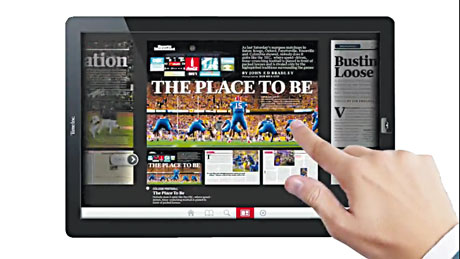
There are many rumors about an Apple tablet—maybe it looks like this: like a jumbo-sized iPhone. The U.S. media company Time Inc. demonstrated in a concept study for its flagship sports magazine, Sports Illustrated, how publications could be consumed on such a device (video on YouTube: http://bit.ly/tabletdemo).
Jung von Matt/Limmat: When the Child Is No Longer a Child
The Zurich-based agency Jung von Matt/Limmat has launched a new campaign for Fritz + Fränzi magazine. The campaign is designed specifically to build on the momentum of the previous campaign and boost the magazine's subscription sales.
Editorial
-
December 16, 2009
To parents, their son will always be their “little bear” and their daughter will always be their “sweet cereal,” even when they’re no longer quite so innocent. The new campaign for Fritz + Fränzi picks up on this theme and highlights the contrast between childish pet names and teenage behavior with charming illustrations. Because young people face individual challenges, these should also be illustrated individually. That’s why three designs were created, each by a different illustrator. The creative team at Jung von Matt was able to bring on board illustrators from New York, London, and Buenos Aires for the project, each of whom brought one of the themes to life. The images can now be seen in advertisements and on posters throughout German-speaking Switzerland. Contact at Fritz + Fränzi: Ellen Ringier (Chair of the Board of Trustees), Thomas Schlickenrieder (Publishing Director). Responsible at Jung von Matt/Limmat: Tom Seinige, Alexander Jaggy (Creative Direction), Alexander Holtz (Copy), Inken Rohweder (Art Direction), Adrian Merz (Graphic Design), Ariane Sonderegger (Consulting) Erasmo Palomba (Art Buying), Kristiana Pärn (Rabbit Illustration), Kate Sutton (Bear Illustration), Laura Varsky (Mouse Illustration).