Vizeum Switzerland is the media agency for New Yorker from 2010
Starting next year, the Zurich-based agency Vizeum Switzerland will manage media for the fashion company New Yorker through its international network.
Editorial
-
December 16, 2009
The agency has been working in the field of communications and media consulting since 2003 and is part of Aegis Media. "We are delighted to be able to realize the media work for this fascinating young fashion company from next year," says Sekan Kee, Managing Director Vizeum Switzerland.
Striking
This time, *Werbewoche* highlighted five books, including ones on controversial posters in Switzerland, strategic idea management in marketing, advertising, media, and design, and «Artistic Research.».
Editorial
-
December 16, 2009
Illegally Good Controversial posters provoke and shock—and stick in people’s minds. Too much bare skin, statements critical of religion or politics, or other missteps divide public opinion and often result in a ban. This book brings together subjects that were controversial or banned in their day into a richly illustrated collection. The posters are organized chronologically, contemporary reactions are described, and background information is provided. The compilation is supplemented by information on controversial art, music, and literature. Readers also learn about the legal regulations and guidelines governing poster display in Switzerland and how other countries deal with controversial topics depicted on posters. The volume accompanies the exhibition of the same name by the Basel Poster Collection at the Basel School of Design (through the end of January 2010). Rolf Thalmann: Not Like That! Controversial Posters in Switzerland, 1883–2009, 256 pages, 58 francs.
Ideas in Book Form Everyone is creative and capable of coming up with good ideas. But to do so, they must learn how to awaken and capture dormant ideas. This idea book aims to inspire readers to discover new ideas, write them down, and put them to use in their daily lives. The book includes more than sixty chapters on creativity, as well as numerous quotes from luminaries such as Albert Einstein and IKEA founder Ingvar Kamprad. At the end of each chapter is a practical exercise designed to help readers tap into their creative resources. Blank pages in the book also encourage readers to jot down their own ideas, observations, and sketches. Fredrik Härén: The Idea Book, 304 pages, 51 francs Attention: Free Gifts! The first three people to send us an email will receive a free copy of our idea book. Simply send an email with your address and the keyword «Idea Book» to [email protected]. You can also order the book through us this way. Art Comes from Research «Artistic research» is a new discipline in which artists act as researchers and present the results of their investigations in the form of artistic works. This practice is now well established at European art schools and is gradually gaining traction in the research community. How does artistic research differ from «mere» art? What contribution can it make to the worlds of art and research? These questions are addressed by musicians, visual artists, designers, writers, and performance experts from Australia, Germany, the United Kingdom, the Netherlands, Norway, Sweden, and Switzerland. Zurich University of the Arts (ZHdK) et al.: Art and Artistic Research, 464 pages, 49.90 francs
Breaking Down Mental Barriers The new book by bestselling author and creative coach Mario Pricken, *Clou*, advocates for strategic idea management in marketing, advertising, media, and design. This richly illustrated volume dispels the myths of the bubbling wellspring of ideas and the one true, great idea, and uses more than 180 examples to illustrate the importance of a strategic approach to ideas. Those who let go of the irrational desire to avoid the mistakes they will make in the future can pursue flashes of inspiration with greater energy. Pricken analyzes creative culture and leadership in the creative industry, explains how to build a creative department, how to lead creative teams to consistent peak performance, and what perfect collaboration between client and contractor looks like. Mario Pricken: Clou. Strategic Idea Management in Marketing, Advertising, Media, and Design. How Innovative Think Tanks Harness the Alchemy of Creativity, 320 pages, 83 francs
Three Wishes at Once What does it mean when a director demands precision? And what if a painter wants to be precise? How does music become light, and what makes it mathematics? When does a heart surgeon act consistently, and when does a conservator? Artists, molecular biologists, musicians, physicians, and conservators discussed such questions between 2005 and 2007 at three symposia organized by the «Bern Institute for Transdisciplinarity Y.» To ensure that these fascinating contributions to the discussion are not lost, this three-volume book brings together all opinions and statements on the three qualities—precision, lightness, and consistency—as well as observations on their manifestation in art and science. Florian Dombois et al.: Precise. Simple. Consistent. A Triple Encounter Between the Arts and Sciences, 240 pages, 38 francs
Something new in the east
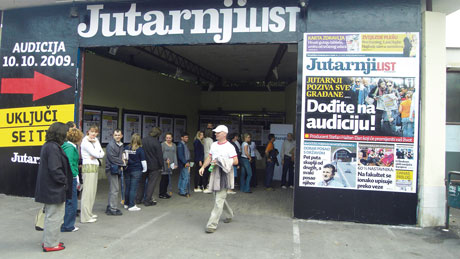
Through a cross-media campaign, Goldbach Media is giving the Croatian people a voice and boosting sales of the daily newspaper Jutarnji list. The campaign is making waves across the country and is a major success in terms of PR—and democracy.
Editorial
-
December 16, 2009
We listen to you," promises the Zagreb-based, nationally published daily newspaper Jutarnji list (German: Morgenblatt) to its readers. This is something completely new for Croats. The concerns of the people have never been particularly relevant in this communist country. Until now. However, nobody had thought of a milestone for democracy when the Croatian media company Europress Holding (EPH) commissioned a sensational cross-media campaign for its largest daily newspaper Jutarnji list from the Goldbach Media Group in spring 2009. EPH wanted a cross-media campaign from a single source that would touch people in Croatia and mobilize readers. It was to be placed in print media, on television, on the Internet and on the mobile channel and include editorial articles, above- and below-the-line advertising, outdoor campaigns and events. Project manager Stefan Halter, Head of Crossmedia at Goldbach Media Group, focused on two key questions when developing the campaign: What are the needs of the Croatian population? And: What is the role of a newspaper in a country like Croatia? Only if people see a newspaper as their mouthpiece will they identify with it and remain loyal readers. These considerations gave rise to the "MoyaHrvatska - My Croatia" campaign. It enables all residents of the country to make suggestions for improving their living conditions in front of the camera and thus stand up for a more liveable Croatia. And all under the label of Jutarnji list. Hope for a better life In order to encourage as many people as possible to get involved, EPH promised to disseminate relevant proposals to the public and to campaign vehemently for their realization - a novelty, not only in the Croatian media landscape. The close cooperation between the advertising department and editors is also new. "In most cases, the goals of the promotion department do not coincide with those of the editorial team," says Halter. "Instead of working together, they often argue about whose interests are more important. With this interdisciplinary project, however, everyone is pulling in the same direction." The campaign runs in several phases: In October, Jutarnji list reported in its print and online editions about a casting in Zagreb, which was about suggestions for improving the country. Although the background to the casting is secret, anyone living in Croatia can take part. This arouses curiosity: the newspaper's phones are already ringing off the hook in the morning, with hundreds of people applying to take part. "We had to change the rented casting location because it was far too small," says Halter. "And the very next day, we couldn't accept any more participants." Well-known personalities from the country, such as basketball superstar Vlado Sola, Who Wants to Be a Millionaire presenter Tarik Filopovic and Croatia's head of government Jadranka Kosor, also register for the casting. She appears at the audition surrounded by security guards. "The editorial team and management of Jutarnji list were initially unsure whether they should use the country's political leader for the campaign," reports Halter. "But then they realized that nothing better could have happened." Rumors about the casting spread like wildfire, with rival newspaper Vecernji list (German: Abendblatt) completely in the dark and fueling speculation. Finally having your say During the casting, 300 people are selected to be photographed and filmed by the My Croatia team in a large Zagreb cinema the following Saturday. The speakers stand in front of a waving Croatian flag as they make their statements and succinctly summarize in one sentence what needs to change in Croatia: "We need a better healthcare system", "More women in business", "The 2026 FIFA World Cup in Croatia" or "Stop firing teachers - we need education". The recording of all the statements takes a total of twelve hours. The next day, Jutarnji list reports on the filming on a double page in its high-reach Sunday edition and reveals the idea behind the campaign. One day later, Stefan Halter and Jutarnji list select twelve participants from the casting. They are the testimonials for the TV commercials, which are broadcast nationwide in prime time on the country's biggest TV stations RTL and Nova just under a week later. At the same time, Jutarnji list begins with articles on all facets of the campaign, with coverage running for several weeks. The advertising campaign will run in parallel on television and in newspapers: advertisements will be placed in EPH's entire print portfolio to draw attention to "MoyaHrvatska - My Croatia". The advertisements are flanked by editorial articles. In one issue, Jutarnji list also announces that it will broadcast the TV commercial with Prime Minister Jadranka Kosor in the evening during prime time. In this spot, Kosor calls for people to listen carefully to what they have to say and praises the campaign. Achieving a lot with the masses A few days later, Jutarnji list reports on the contributions to the discussion on Mojahrvatska.jutarnji.hrThe website set up especially for the campaign. There, interested parties can watch the TV spots, read all the statements, create rankings and vote on the wishes of their fellow citizens. In addition, those who did not have the opportunity to comment on the state of the country during the casting can make their demands and suggestions for Croatia on the website. "These opportunities are being actively used," says Halter. "The website has had 100,000 visits between October and today, and users have formulated around 500 suggestions." But isn't something else missing? Exactly: the cross-media package now also includes social media. Of course, "MoyaHrvatska - My Croatia" has a Facebook page and also participates in Twitter twittering via @Jutarnji. There are currently around 15,600 fans on the Facebook page and the newspaper's Twitter account has over 2,000 followers. The next step in the project at the beginning of 2010 will be to select the ten most relevant demands from the population from all the proposals submitted. "People will be able to vote electronically on which ten ideas are the most important and urgent for them," says Halter. The package of wishes will later be processed in the Jutarnji list. It will also be passed on to the Croatian government with a request to take the concerns into account and implement the proposals. Jutarnji list and Goldbach have not decided in advance how long this phase will last. "As with all other phases, we will make it dependent on how the Croats react and participate, as well as on what opportunities we see for journalistic coverage of the events," says Halter. It will be interesting to see what the tabloid will actually achieve in the country. The campaign has already achieved two things: it has shaken up the Croats and given them hope that they can improve their living conditions through their own efforts. And Jutarnji list is on everyone's lips. Anne-Friederike Wilhelm Online The TV spots and background reports on the campaign on YouTube: www.youtube.com, keyword "Jutarnji list" The campaign on Facebook: www.facebook.com/mojahrvatska?v=wall
Eastern expansion at Goldbach Media The Küsnacht-based media company Goldbach Media has been strengthening its commitment in Eastern Europe for some time now: in March 2008, the company took over online marketers in Slovenia and Croatia, and in December 2008 Goldbach acquired a majority stake in Falk Interactive LLC in St. Petersburg, Russia. The integrated cross-media campaign for Jutarnji list is a further move in the context of this eastward expansion.
Flop of the week: Cancellation of concession decisions
The Federal Administrative Court's ruling to annul the license decisions has been received differently by the media companies concerned. The initiators Günter Heuberger, Roger Schawinski and Stefan Bühler, Schawinski's partner in the planned Radio Südost, are delighted - AZ Medien is taking it calmly.
Editorial
-
December 16, 2009
The Federal Administrative Court's ruling to annul the license decisions has been received differently by the media companies concerned. The initiators Günter Heuberger, Roger Schawinski and Stefan Bühler, Schawinski's partner in the planned Radio Südost, are delighted - AZ Medien is taking it calmly. Bühler is confident of cracking the Graubünden media monopoly of the Südostschweiz Group. Now, he says, the Uvek must examine the question of abuse of the media group's dominant position when reassessing the award of the concession. When awarding the license to Radio Grischa, which belongs to the Südostschweiz Group, the aspect of diversity of opinion and offerings in the broadcast area had been completely ignored. Schawinski sees the ruling as a setback for the Federal Office of Communications (Bakom). He sees the Federal Administrative Court as confirming his most important argument - diversity of opinion. Both in Graubünden and in Aargau, the publishers were clearly in dominant positions, as Schawinski told the news agency SDA when asked.
Milk mobile markets
Even if smartphones are now gaining in importance in our country, they will only have a very modest share of the media mix in the next few years.
Editorial
-
December 16, 2009
Smartphones have been booming since Apple announced the iPhone in 2007 and it officially went on sale in Switzerland last year. Market leader Swisscom sold around 267,000 iPhones between July 11, 2008 and June 31, 2009 and reports that one in five cell phones sold last year was a smartphone, twice as many as in 2007. Competitor Orange does not disclose sales figures for the iPhone on request, but confirms the trend. And Sunrise notes that more than half of its customers have a subscription contract for high-speed data traffic (UMTS). The industry estimates that around one million smartphones will be in use in Switzerland by the end of the year. 10 percent on weekdays, 20 percent on Sundays Media companies have not overlooked this trend and have made their websites fit for mobile devices in recent years. Because mobile screens are much smaller and data transmission is much more expensive, websites have to be stripped of visual ballast, which can be largely automated with modern software. As a result, mobile surfing is rapidly becoming a mainstream phenomenon: Marc Lamarche, responsible for mobile at Edipresse, reports monthly growth of 10 percent with currently 2 million page views and 200,000 visitors. On weekdays, mobile traffic at LeMatin.ch accounts for 10 percent of web traffic and on Sundays even a fifth. According to the Ringier press office, Blick mobil recorded 336,943 visits with 2.3 million page views in September 2009. At NZZ Online, Michael Näf, Head of Product Management NZZ Online, registers 320,000 mobile visits with 1 million page impressions per month. Apps are winning the race However, mobile websites are a thing of the past in the Internet world - mobile applications are the order of the day: small programs, so-called apps, which can be downloaded and installed on the smartphone. As with the iPhone, Apple has a dominant position in this business. On September 28, the 2 billionth download of an application was reported, of which there are over 85,000 in the App Store. Such applications can be free or have a price tag, with 30 percent of the price remaining in Apple's coffers. Since this summer, it has also been possible to sell subscriptions in paid applications, for example for additional content such as new levels in games or additional cities in city guides or to subscribe to further issues of a magazine. Swiss publishers have also jumped on this bandwagon: 20 Minuten and Blick have it, Tagi and the other Newsnetz titles have it anyway, and NZZ is testing it and wants to start next, the Aargauer Zeitung has it, as do various SRG business units - they all offer iPhone customers free applications so that they can access their content as easily and conveniently as possible while on the move. Such applications not only offer news in text and images, but also videos and radio programs. When there is breaking news, text messages are displayed and anyone who wants to can take part in surveys, consult event calendars, horoscopes, television programs or advertisements. News can be downloaded at home or in the office via WLAN so that it can be read on the move without a data connection, which is often still expensive. Marc Lamarche from Edipresse reveals usage figures that show where the journey is heading: The number of visits via an iPhone application are three (Le Matin and 24 heures) to four times (Tribune de Genève) higher than via the mobile websites. Three to five and a half times more pages are called up, but this can be attributed to the fact that the application program calls them up without the user ever looking at them. For Mike A. Weber, Head of Mobile Business at AdLink Media, it is clear that apps are much better received by the public than the corresponding offers on mobile browsers, as they are simpler and easier to use. While newer advertising formats, such as interstitials or splash sites, are only used in isolated cases, advertisements via image banners are accepted here and do not trigger any negative reactions from the audience. Patrik Rauch from Mindshare (GroupM) assumes that pure, classic display advertising without the corresponding benefits will only appeal to mobile users to a limited extent. Intelligent communication concepts such as location-based services, which are tailored to the mobile user, are needed for success. With the handbrake on Despite the boom in smartphones, publishers are not yet earning any money with them. Although better prices are paid for advertising on mobile devices than on the Internet, Ringier, for example, is still "very slow" in terms of ad sales, according to press spokesman Stefan Hackh. And he goes on to analyze: "Interestingly, it is not due to traffic, but on the one hand to the ignorance of advertising customers and on the other hand to the problem that advertisers can place a banner, but lack the mobile website to do so." At the NZZ, Michael Näf has observed "lively demand from the advertising market" and also notes: "However, booking behavior is still reserved." Marc Lamarche from Edipresse shares this assessment, but he knows: "Advertisers who have worked with us are very satisfied with the campaigns", because the results in the mobile area are currently higher than those in the conventional web. Roger Keller from Zed digital (ZenithOptimedia) also confirms that customers are still unwilling to invest in a new advertising channel, especially as the focus of efforts does not allow for test runs in difficult economic times. In his opinion, the offers of the mobile platforms have recently become "more attractive than ever". The cross-media packages are particularly interesting in purchasing. Patrik Rauch is of a different opinion: "The prices of the providers, mainly the publishing houses, seem too high and unfounded to us." Rauch is certain that lower prices will be better able to encourage advertisers to experiment. Mobile data hole The development of the mobile advertising market in Switzerland is also hindered by the lack of industry data. Says Patrik Rauch: "Unfortunately, it is difficult to obtain meaningful and usable data in Switzerland." And Roger Keller echoes this sentiment: "We would like to see reliable data from all providers available here, as is usual in other media, ideally obtained from neutral third parties." Only marketers have data on the mobile advertising market today, as Mike Weber from AdLink confirms. It is based on ad management, which is managed for the major content providers, but is not published "for reasons of data protection and the exclusion of competitors". Simon Morton, CEO of Admazing, is therefore clear: "To improve the data situation, we need the cooperation of publishers and the commitment of organizations such as the IAB and Netmetrix". However, it is doubtful whether Switzerland will succeed in establishing market standards and reliable metrics for planning in the industry next year and thus catch up with other countries such as Germany. Although Rolf Schmitz, Managing Director of NET-Metrix AG, confirms that the company is looking into measuring mobile Internet usage, he adds: "However, we are still at a very early stage in our deliberations." Profitable payment applications? In contrast to the everything-is-free Internet, there are billing models for mobile, which is why the reader market is also being targeted. Everyone agrees that there is no money to be made from consumers with simple news and that higher-quality offers are needed. An obvious case in point is the Ringier financial portal Cash with a paid application for real-time quotes (share prices on Swiss stock exchanges in real time) and price alerts for portfolios. At 20 Minuten, online boss Hansi Voigt reveals: "We have various paid subscription applications in the pipeline. The 20 Minuten paid apps will either offer very individual benefits or a "very spectacular service". However, the basic app will remain free. Newsnetz boss Peter Wälty is also thinking about mobile paid applications and can imagine offering the content of the SonntagsZeitung and the magazine for three issues for CHF 4.40, with the option of subscribing to further issues. Meanwhile, Marc Lamarche has already launched two paid applications for the general public in June this year, which make restaurant information from the 24 heures and Tribune de Genève restaurant editorial teams in Vaud and Geneva easily accessible on the move. By September, they had been sold 900 and 1,300 times for CHF 9.90 each - which means that the earnings potential for payment applications has been explored for the time being. Christoph J. Walther
Pragmatic solution: Wemad There is no data. This is the complaint of media planners in Switzerland when it comes to the booming multimedia communication on mobile devices. An "official" solution from the WEMF is not in sight for the time being - and it will be difficult to achieve given the imponderables of the mobile Internet. To provide the media industry with its lifeblood, reach data, we have launched WEmad (www.wemad.org). Anyone who operates a mobile website, offers apps and soon wants to get involved in the eReader business can quickly and inexpensively document the reach figures they have collected themselves and thus create credible industry-wide comparability. This benefits everyone: website operators as well as advertisers looking for access to attractive target groups. The name, WEmad, says it all (and is not a reference to the zeitgeist): While "mad" stands for Mobile Audience Data, i.e. the topic, WE emphasizes the collaborative approach of the solution. Above all, WE also stands for the contemporary mechanisms of social networks, with which the best possible data quality is to be achieved. Site operators can not only enter their data on WEmad, but also explain how it was obtained. Which tools were used and how? Was the data additionally processed, for example by adjusting it for internal use? Other WEmad users can evaluate and comment on the reported figures. The result is a very pragmatic industry solution that can at least achieve a good approximation. And that is certainly better than nothing at all (especially as it is free to use). WEmad is currently online as an operational alpha version. Over the course of the coming year, the functionality will be continuously expanded in a beta phase, with as much feedback from the industry as possible being incorporated. Once a suitable version has been achieved, it will be available in all national languages instead of just in English, as is currently the case. We will publish the results of the WEmad survey for the first time in our January 21, 2010 issue, taking into account all responses received by January 11. We hope that readers of Advertising Week will respond favorably to this initiative and support its further development.
SRG Board of Directors gives green light for media convergence project
On Wednesday, the national Board of Directors of SRG Deutschschweiz approved the overall concept for the merger of Schweizer Radio DRS and Schweizer Fernsehen SF into a polymedial media company. A final decision on the planned merger is to be made in June 2010.
Editorial
-
December 16, 2009
It is planned that the merger of radio and television will be completed on January 1, 2011. In July 2010, a regional director will be elected to head the SRG.D company. The Executive Board will consist of eight to nine people. These are the two editors-in-chief of radio and television and the heads of the programming, entertainment, culture and sport departments as well as the heads of the merged support areas. Television and radio will continue to form the backbone. The new Programmes department, which will combine the radio stations DRS 1, DRS 3, DRS Musikwelle, Virus and Swiss Pop as well as TV program planning and overarching areas such as multimedia central services and design, will be given a high priority. According to the press release, this department will significantly shape SRG.D's presence in the public market. Radio and television will each have an information department. These will be located in Bern and Zurich respectively. In the core journalistic area, internal competition is desirable for media policy reasons. However, the online editorial teams of the two information departments will work closely together and will be partially merged. The SF Culture department will also be merged with the SR DRS2 department, as will the two radio and television sports departments. The children's editorial department will be assigned to the Entertainment department. A joint area for the production of radio and television programs will be created and the IT areas integrated into it. In addition, the communications/marketing and finance support areas will be merged. The synergy effects in this area will amount to around five million francs. Around 20 to 30 full-time positions are expected to be cut. With the "Convergence and Efficiency" project, radio, television and online are to work together more closely in all language regions under one management. German-speaking Switzerland will implement media convergence in 2011, following implementation in Romansh-speaking Switzerland in 2006, Italian-speaking Switzerland since 2008 and French-speaking Switzerland from 2010.
The performer
Stephanie Strobel is the point person for Quisma in Switzerland. As Head of Sales Switzerland for this new agency within the Swiss GroupM, she aims to further advance performance marketing among clients and in the market in collaboration with the other agencies.
Editorial
-
December 16, 2009
We see it every day in our own media behavior: Due to the shift in information flows, the Internet will play an increasingly important role. The entire society is online today, the net constantly offers sophisticated possibilities - and for the first time in the history of advertising, measurability and transparency is no longer a wish, but is becoming an increasingly perfected reality. Stephanie Strobel is therefore convinced: online marketing still has great potential. For a few weeks now, the newly appointed Head of Sales Switzerland has been on the road for Quisma, pushing performance-oriented marketing further with clients as well as in the market. Quisma is the youngest specialist agency in the GroupM group. As part of its international expansion, the online marketing agency opened its first office in Switzerland in September. Just as already at several locations in Germany as well as in Austria the disciplines search machine marketing, search machine optimization, Affiliate marketing and with QuismaX also risk-free Display Advertising are to be offered here. "For GroupM, the founding of Quisma Switzerland is a further consistent step in the expansion of digital in-house expertise around the agencies Maxus, Mediacom, Mediaedge:cia and Mindshare in the Swiss market," explains Volker Straube, CEO of GroupM Switzerland. Holistic enlightenment With the new branch, Quisma now has a direct local presence in all relevant German-speaking markets in Europe in order to offer both customers and partner agencies the "best possible personal support". Stephanie Strobel, a very experienced online professional, was recruited to set up the Swiss branch. Her last station was the European marketing headquarters of -Google in Dublin. Now Stephanie Strobel is once again delighted to be involved in the expansion of a successful company from the very beginning and to be able to take responsibility for the expansion. "In the Swiss market, performance marketing is perhaps not yet as widespread as in other markets. I therefore see my most important role as continuing to expand this area," says Strobel. In a first phase, the new Head of Sales wants to offer workshops at customers' sites, for example, where Quisma will provide more detailed information about the latest developments. "When planning strategy concepts for 2010, performance marketing should be an integrative part within the overall marketing messages, so that many actions can also cross-fertilize each other." Strobel therefore wants to awaken understanding and even more interest in performance marketing on the customer side, as well as offer holistic communication aspects on the market together with his colleagues. "Our USP is certainly the many years of experience that the colleagues have gathered in the various areas. Thanks to the affiliation with the GroupM parent company, it is possible that Quisma can now cover the performance areas and the entire media planning from a single source." The decisive factor here is that, especially in times of lower budgets, it is becoming increasingly important to be able to show clients the most accurate possible measurements of their communication measures. Stephanie Strobel knew how to make use of all these possibilities surrounding the "fascinating world of computers" back in the pioneering years of the Internet. After graduating from high school in Germany, she traveled across Australia for six months. There, in 1997, she had her first e-mail address at Hotmail. "That was my first encounter with the World Wide Web - and ideal for keeping in touch with my people back home from Australia thanks to the Internet cafés that had just sprung up." Back home, she briefly started studying at the Angell Academy for Tourism in Freiburg. But the wanderlust could not be completely tamed despite this subject, and Strobel traveled to England for another two years. At the University of Brighton, she studied MWL with a focus on marketing and tourism. What she appreciated about the small but fine university was that it was very practice-oriented with concrete projects. "There were a lot of presentations and case studies." For her own thesis, Stephanie Strobel chose to research "whether tourism can be a way to fund research in Antarctica." In retrospect, her theses proved to be a rather accurate look into the future. She was already able to gather many results thanks to the methods of the Internet. Because 2002 was not an easy year job-wise, Strobel returned to Germany for three years after graduating. In Hamburg, she gained her first experience of online marketing at an agency. She then moved to a PR agency. After additional training in strategy and customer relationship management, she was able to expand her knowledge in practice with major brands such as Unilever and Knorr. This period also saw her first steps with Adwords campaigns. Found on Google Fascinated by these new possibilities, she also once sent her resume with application letter to Google. At first, nothing happened, but after six months, the world's largest search engine and the curious marketing woman found each other. Stephanie Strobel was once again allowed to pack her bags head over heels and moved to Dub¬lin. At Google's European headquarters, she was responsible for setting up and developing the Adwords department. Here she was able to learn the new methods from scratch. Later, Strobel became team leader for Germany, Austria and Switzerland. Working in the midst of the young Google community with the most curious and best specialists from all over the world certainly gave Stephanie Strobel the decisive kick in her professional advancement during her four years at Google. The exchange directly in the heart of online marketing also brought her into contact with many agencies and finally with those responsible at GroupM. At first, they developed projects together. Later, it appealed to her to be able to take on responsibility herself, rather than just consulting. "Quisma, as part of GroupM, works with many leading companies. That opened up great opportunities for me," Strobel says of her move to the agency. More than at her job at Google, her life now revolves around holistic communications with different service areas. That's why she didn't have to think twice about switching to Quisma. And for the move from World Wide Dublin to tiny Switzerland? "Zurich offers everything and is located in such a way that you can get everywhere immediately," laughs Stephanie Strobel. And she is already looking forward to skiing, the lake right in front of her office, the many and also cosmopolitan cultural offerings in the city, and an apartment in the village of Höngg. Andreas Panzeri
The brand time bomb is ticking
London, November 26, 2009: The advertising industry is put to the test at the Battle of Big Thinking. Twenty-four speakers each have exactly 15 minutes to present a big idea. Whether it’s planning, marketing, or mobile thinking, the audience votes immediately in each category to decide who is the most convincing. At the end of the day, the overall winner is chosen. This year marks the fourth edition of the event.
Editorial
-
December 16, 2009
We hear about the reinvention of the advertising agency, the defusing of the brand time bomb and rescue methods for social media. Not a bad way to sum up a year that just 12 months ago the Economist magazine was simply calling "Oh shit". The good news first: there is absolutely no moaning about the financial crisis. The self-deprecating British common sense is: flat is the new up. The main thing is that the curve no longer goes down. If you don't lose, you've already won. Significantly, the agency model is being reinvented by the customer. Nokia's marketing director, Will Harris, is tired of working with different agencies that are at war with each other. But he also doesn't want to be dependent on a single partner who can never be the best in every discipline. Solution: people instead of agencies. Three or four experts from each agency are invited to come together to form a new virtual entity. This is no longer called an agency, but a "magazine". Launch January 1. Every Friday is the editorial meeting of this "magazine". There, everyone decides together what will be published next week and what will be the topic of conversation. An event, a commercial, an online vote, a music hit? Creation is interdisciplinary, the only goal is to stay in the conversation. Media planning no longer exists. There's no need for research anyway if everything happens in real time. Sounds visionary. Only cynics rumor: a dying model (from the publishing industry) for a dying brand (from the pre-iPhone era). Will that work out well? Social ideas are needed The focus has simply shifted from creative agencies to the media discussion. Here, of course, social media takes center stage. The hope is as great as the fear. Will Facebook even exist in a year's time? In 2007, Second Life was predicted to have a great future, but today it has been abandoned. The offices of the advertising agencies BBH or Leo Burnett, who were the first to be there, are empty, desolate, sunk into insignificance. Everyone agrees that the biggest threat to social media is advertising itself. The step from being followed to being followed is micro. Nobody wants a million followers on Twitter if, instead of interested contemporaries, they are just Fanta, Gala Käsli, Zurich Insurance or other brands that want to sell you something. Paying bloggers to post opinions in forums is considered outright hijacking and is radically rejected. The problem with social media starts with the word "media". This implies buying and paying. Wrong. We don't need social media ideas. We need social ideas. Ideas that interest people and connect brands in an interesting way, says Amelia Torode, Head of Strategy at VCCP. Social media is real time. Brands experience a revival Over 50 percent of all Twitter messages on a topic are usually generated in the first hour. But what everyone calls viral, says Claus Moseholm from GoViral, is not free. Not even almost. Viral is simply a mechanic. Just as expensive as any other idea that is based on a relevant insight and cleverly brings great content to the people. Is "free space thinking", i.e. Skype, Flickr, Xing and Wikipedia, a business model? Yes, says Mike Bartlett, Director of Product Strategy at Skype. If the solution is freemium. Give a little free, whet the appetite, then charge for premium services. It works like the freebies in perfumeries used to. That's why Murdoch is not given much credit for his paid-only content in the Wall Street Journal. Mobile marketing is more critical than ever. Hold your cell phone up in the air. Now hand it briefly to the person sitting next to you. With this little test, Scott Seaburn, Head of Mobile at Ogilvy, makes it tangible that there is probably nothing more personal. The laptop is getting smaller and smaller, merging with the cell phone to become a mobile brain that can dock anywhere or beam to the wall. Innovation Thinking takes augmented reality one step further. John Willshire, Head of Innovation at PHD, believes that we will soon be shaping something with our hands in the air, which will be captured by a webcam and then spit out by the printer in three dimensions. When advertising is the most threatening spectre, when the media plan is the most horrible misunderstanding, the product itself takes center stage again. An iPhone has the talking point built right in. Like any ingenious invention. But not every product can be brilliant. And who knows in advance whether it will be a hit? You might think that market research could help us with this. But it doesn't. Methods such as focus groups, which have hardly changed in three decades (!), do not capture today's social phenomena in any way. While cell phones and computers have been invented in the last 30 years, research methodology has practically come to a standstill. Depressing. Only one half of the brain, the rational half, can still be questioned. Today, thanks to neuroscience, it has been proven that this rational hemisphere is the right one, but not the right one, because it is not the decisive one, as decisions are not made there. The brain doesn't want to think every time, it takes far too much energy. The brain wants to be unburdened, people want nothing more than to be able to make emotional decisions. This is why brands are experiencing a real revival. As the word suggests, brands mark products so that our brains no longer have to think. Brands are emotional, people love that. No wonder strategic planning is more important today than ever before. However, brands are threatened with extinction in a very curious way. Namely through advertising itself. Guy Murphy, Worldwide Planning Director at JWT, can show from 30,000 interviews worldwide that the Dutch only like to spend a few minutes a day with brands, whereas Indians and Asians prefer to spend hours. If we brand consultants in the developed markets carry on like this, the brand bomb threatens to implode. Worse still. What are we exporting to Asia? Exactly this kind of consulting. And what does Asia export to us? Toys. Instead of destroying the market for brands in Asia with our way of advising brands, it would be better to learn from the optimism of the Asians. Namely the playful approach to brands. The brand as a sexy toy is fun - and will also save the survival of the brand in our country. The model for this is software that is used to develop a play figure for each brand. It can be produced in three dimensions, for the CEO's desk. The Black Eyed Peas' latest hit sings "Tonight is going to be a good night. A good good night." Social optimism is in. Not defeatism. Consequently, Guy Murphy wins with his highly optimistic, playful redefinition of the brand. The Biggest Thinker of them all 2009 is: a Global Planner. Pascal Schaub, Chief Strategic Officer, Saatchi & Saatchi 3 words we should remember for 2010 Twitticide: Someone deletes their Twitter account. Flow: Life flows seamlessly the way I want it to. Social idea: An idea that interests people and makes brands interesting.
Overall winner 2009: Guy Murphy, Worldwide Planning Director at JWT.
Streuplan: Office opened in Basel
The Streuplan agency is now also available in the border triangle. The Zurich-based agency has opened an office in Basel. The branch is managed by Christoph Oertli.
Editorial
-
December 16, 2009
Christoph Oertli was a partner of the Basel advertising agency WOMM for ten years. According to Thomas Back, Managing Director of the Below the Line agency, this step is the logical consequence to drive the expansion forward. The first successes have already been achieved: Two new customers from the region were acquired within a short space of time.
Will the Zürichsee-Zeitung be sold?
Theodor Gut, chairman of the board of directors of the Zürichsee-Zeitung, is considering selling parts of the company. However, selling the entire Zürichsee Medien is not an option.
Editorial
-
December 16, 2009
Zürichsee Medien has been owned by the Gut family for around 100 years. Now it is a question of succession planning. One of several options is the sale of parts of the company, as Theodor Gut emphasizes to the magazine Klartext. The Tages-Anzeiger wrote this on Wednesday. Klartext is now speculating about possible buyers. According to the magazine, the NZZ Group and Tamedia could be potential buyers. NZZ already holds 40 percent of Zürichsee Medien via its subsidiary Freie Presse Holding.
Christa Klein leaves Tele Top
News and talk presenter Christa Klein, who has helped shape the image of Tele Top for 10 years, is leaving the regional broadcaster at the end of January 2010. The station is thus losing an employee who has been with Tele Top since its inception.
Editorial
-
December 16, 2009
After more than 20 years in the media, Christa Klein is expanding her independence. She will continue to work as a presenter in the event sector with her company Evor. However, Christa Klein explains that it is not out of the question that she will appear as a presenter for project-related radio or television programs. Christa Klein began her career as a presenter in 1987 at Radio Thurgau, then became a presenter at Radio Top in 1998 and has been presenting news and talk programs at Tele Top since 1999.
"Lonely watches"
Wirz and Markenfilm Schweiz are helping the Salvation Army.
Editorial
-
December 16, 2009
Every year in the run-up to Christmas, the Salvation Army's well-known collection pots are set up at around 40 locations in Switzerland. The proceeds are used to finance local social services and, in the major cities, Christmas parties for people in need. To ensure that as many people as possible once again have a heart and a donation for the poor this year, the Salvation Army has decided to rely on the help of Wirz Werbung for fundraising. The result of this collaboration can now be seen on SF1, SF2 and TSR1. The unusually contemplative spot was filmed together with twelve real homeless people in their "place of residence". Spread over a series of cuts, they each sing a few bars of a slightly rewritten version of the Christmas carol "Silent Night". It is easy to hear how loneliness becomes an issue for many homeless people, especially in these days around the "holy season". The words "lonely waking", which are usually sung thoughtlessly, suddenly take on a tangible meaning in the sense of "I no longer belong" when combined with impressive images. Matthias Freuler and Thomas Kurzmeyer, the motivators and responsible CD at Wirz, are delighted that this film could be realized in such a professional manner at all, thanks primarily to the team around Markenfilm Schweiz and the director Michi Fueter. Everyone involved realized this extraordinary Salvation Army commercial "in one freezing cold and endless night for a pittance". The camera was directed by Filip Zumbrunn. The actors in this documentary spot were selected with the help of the Salvation Army. Although singing Christmas carols is not necessarily part of their repertoire, all the homeless people bravely and obviously interested in the elaborate technique took part. For Thomas Kurzmeyer, it was particularly important that the people featured in the film "should not lose their dignity". Andreas Panzeri