Google stops self-censorship in China - authorities continue to censor
Google has stopped self-censoring in China. Visitors to Google China are redirected to Hong Kong, where the internet giant was already providing uncensored content in simplified Chinese. However, search functionality remains restricted. Chinese authorities appear to be continuing Google’s self-censorship.
Editorial
-
March 23, 2010
We are aware that China could block access at any time, writes Google's legal counsel David Drummond in the company blog. This is exactly what happened. Certain search terms are already blocked by the Chinese firewall, according to Netzwoche.ch. For this reason, an information page has been set up to show the availability of individual services. The Chinese authorities sharply criticized Google's decision, as reported by the NZZ. According to a report by the official Xinhua news agency, an official from the Internet authority said that Google's decision to stop filtering search results violates written commitments that the company made when it entered the Chinese market. Google had announced on January 12 that it would no longer bow to the Chinese authorities' censorship requirements for Internet searches.
Contexta: Remembering the best after death
Contexta has launched a campaign for the nonprofit My Happy End. The campaign aims to encourage Swiss citizens to consider charitable causes when drafting their wills.
Editorial
-
March 23, 2010
My Happy End is an association of ten charitable organizations: Amnesty International, Greenpeace Switzerland, Salvation Army, Médecins Sans Frontières, SOS Children's Villages Switzerland Foundation, Swiss Air-Rescue Rega, Pestalozzi Children's Village Foundation, Terre des hommes - Children's Aid, World Without Mines and WWF Switzerland. The campaign realized by Contexta dramatizes death as an actual happy ending - with a gathering of all organizations and the numerous beneficiaries at the donor's grave. The aim is to show that anyone who includes a charitable organization in their will is doing something good after their death and will thus be remembered by a large number of people (and animals). All measures refer to the internet platform Myhappyend.org. This provides guidance for anyone wishing to include charitable organizations in their estate.
Responsible at the My Happy End association: Beatrice Gallin (Management). Responsible on agency side: Overall responsibility: Contexta AG Werbeagentur bsw, Bern. Online: Atfront ag, Zurich. Media: MediaPlus, Berne. Media relations: Maurer Partner Communications AG, Bern. Film production: Solid&Hallerfilm, Zurich. Director: Rainer Binz. Photography: Jonathan Heyer. Picture editing: Patrik Rohner.
Condor Corporate: Anniversary film for KPMG Switzerland
To mark KPMG's 100th anniversary in Switzerland, Condor Corporate produced an anniversary film. The film is intended to illustrate the history of the auditing and consulting firm in a fresh way.
Editorial
-
March 23, 2010
Further audiovisual activities are also planned as part of the anniversary year, which Condor Corporate will implement.
Responsible at KPMG: Dominique Morel (Brand & Communication), Valentina Rota (CEO Office). Responsible at Condor Corporate: Olivier Egli (concept/director).
Last but not least: Advertising bans as a panacea
In connection with the new Prevention Act, there is also—as one might expect—a debate about advertising bans. Does alcohol advertising influence consumption among young people? Does advertising even have an effect? And if so, should it be banned? As is well known, opinions are divided on this issue…
Editorial
-
March 23, 2010
The usual approach: Both supporters and opponents of advertising bans come up with studies. You can always find a study that supports your own point of view. Regardless of whether alcohol advertising has an influence on consumption, the following question arises: the advertised product, alcoholic beverages, are already banned for under 16 or under 18-year-olds. The effectiveness of the ban is - to put it mildly - limited. So why target advertising as well? In the hope that a ban on advertising would be more effective? Isn't the environment in which young people live decisive for consumption? It's just that banning advertising is a lot easier.
Google Adwords: Purchase of brand names compliant with EU law
In the dispute over the use of brand names, the internet giant has achieved a partial victory. The European Court of Justice ruled that Google may allow companies to appear in the ad column in search results by purchasing brand names.
Editorial
-
March 23, 2010
However, the internet user must be able to clearly recognize the manufacturer or provider of the advertised goods or services - for example, whether or not it is an advertisement from the manufacturer of the branded product entered by the internet user, the EU judges ruled on Tuesday in Luxembourg. When searching for one or more keywords, the Google search function displays the websites that seem to match the words most closely. Google also offers a referencing service called "AdWords" for a fee. This allows a department store, for example, to pay Google for its advertising to appear in the ads section when a brand name is searched for. In France, major brand manufacturers such as Louis Vuitton and Thonet had taken legal action against this, pointing out that counterfeiters could also offer their cheap goods thanks to the use of well-known brand names. However, the highest EU judges emphasized that Vuitton could sue the supplier of the counterfeit goods as a next step. It would then be up to the French judiciary to clarify whether Google had deliberately allowed advertisements from manufacturers of counterfeit goods.
Parliamentary committees want new model for press funding
The Committees on Political Affairs (SPK) of the National Council and the Council of States would like to see the press supported by means other than—as has been the case until now—reduced postal rates. A new model is now to be developed.
Editorial
-
March 23, 2010
The Council of States committee had serious doubts as to whether a better model could be found, as the parliamentary services announced on Tuesday. However, in view of the current crisis in the press market, the committee considered it sensible for Parliament to stay on the ball. Under the current model, the Confederation covers part of the costs incurred by Swiss Post for the delivery of subscription newspapers at a reduced price. In 2007, Parliament decided that the Confederation should contribute a total of 30 million a year.
Account: Scholz & Friends wins Fressnapf
Scholz & Friends Basel has won the Fressnapf communications account in Switzerland. The agency prevailed in a pitch.
Editorial
-
March 23, 2010
With the future communication concept, Fressnapf is to be positioned even more as a pet supplies provider with competent and professional advice and the image is to be strengthened away from the discounter to the competent specialist store. The communication concept will be implemented together with the agency and Initiative's media specialists over the next few months.
Hear visibly
From Switzerland to the world: Metzgerlehner has developed a campaign for Phonak that strikes the perfect balance between art, education, and advertising.
Editorial
-
March 23, 2010
The Hear the World initiative has just been awarded the 2010 Marketing Trophy. The campaign developed by Metzgerlehner worldwide partners for the initiative is based on portraits of world-famous stars photographed by Bryan Adams. You can read more about the continuation of the campaign in the next print edition of Werbewoche, which will be published on Thursday.
Last but not least: Tally remains sexy
Tally Weijl is known for its sexy advertising. Sometimes it’s so provocative that it gets banned. Now, after seven years, the fashion label is saying goodbye to its previous slogan. «Totally sexy» is becoming «totally tally.» But the Tally Girl still loves making a grand entrance!
Editorial
-
March 23, 2010
"Everyone knows that Tally Weijl stands for sexy fashion. It is no longer necessary to state this explicitly," says a media spokesperson, explaining the change in strategy. The latest motif confirms that Tally Weijl will continue to advertise its fashion with sexy subjects. It shows the Tally girl on an airplane wing. She has declared the wing of the airplane her exclusive sun terrace. She simply enjoys attracting attention and being admired. "She lies there and sunbathes as if there were nothing more normal in the world," according to a press release. She is accompanied by her best friend and faithful companion, the bunny. The work was created by the Parisian agency BETC Luxe. From now on, the tally girl will also be exuding her irresistible charm in all major cities in this country - "totally tally".
(Image: Tally Weijl)
Prime: New faces in consulting
The Prime agency is expanding its consulting expertise in the areas of editorial services and corporate publishing. Catharina Bujnoch and Martina Peyer join the corporate communications team as editors and consultants.
Editorial
-
March 23, 2010
Catharina Bujnoch will serve as project manager for various companies in the information technology and energy industries. Previously, the 46-year-old worked as Senior Consultant Corporate Communications at the Swisscom Group. Before entering PR, she spent more than ten years as an editor, journalist and ghostwriter on IT topics as well as science and research. Catharina Bujnoch holds an M.A. degree in American Studies, Romance Studies, and Linguistics, and has pursued in-service training at Maz.
Martina Peyer works as an editor and consultant primarily for clients from industry and the energy sector. Before joining Prime, the 34-year-old was responsible for internal communications for Corporate & Institutional Banking Switzerland at UBS. She had previously gained experience in PR and advertising for several years at various agencies. Martina Peyer has been active as a freelance journalist and photographer for around ten years and continues to do so today. Martina Peyer holds a lic. phil. I in journalism, film studies and art history and completed her education with a diploma as PR editor SPRI.
New appearance for Basler ProgrammZeitung
ProgrammZeitung is celebrating its 250th issue with a new design and additional content. Different fonts, column widths and white spaces as well as four colors throughout are intended to give the April issue of the culture magazine an airy, spring-like feel.
Editorial
-
March 23, 2010
Additional editorial sections also provide an insight into cultural policy, urban development and literature as well as cultural life in Alsace. The main topic in April is the cultural magazine Du with its current references to Basel. The relaunch will be celebrated on Friday, March 26, with a public aperitif in the editorial offices. Urs Dillier is responsible for the new layout. For 23 years, the independent cultural magazine has been providing the Basel region with information on cultural events between Aarau and Freiburg i.Br. The ProgrammZeitung illuminates and promotes cultural activities in front of and behind the scenes, provides a platform for event organizers and offers those interested in culture an overview and orientation in the rich cultural offerings of the region.
Free trees cut down
Due to the discontinuation of Le Matin bleu, the free share has fallen for the first time. Despite this, the total number of contacts for the titles analyzed by Media Trend Journal has only decreased marginally.
Editorial
-
March 23, 2010
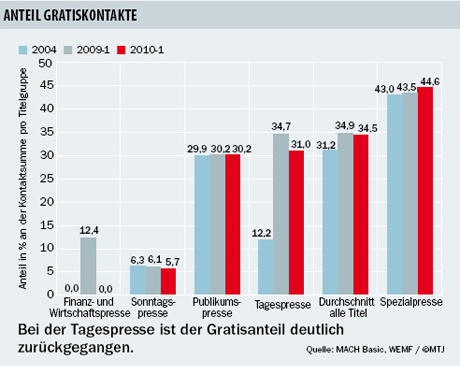
The fact that even free newspapers do not grow to the sky was made drastically clear in 2009. No fewer than four free daily newspapers (Cash, .ch, Le Matin bleu and News) were discontinued. However, only the discontinuation of Cash and Le Matin bleu had an impact on the development of contact totals. This is because the other two titles were only reported once each. As the concept was already outdated by the time the corresponding figures were published, these short-term blossoms in the Swiss newspaper landscape were immediately deleted and are not included in the long-term analysis. As the chart "Proportion of free contacts" shows, the proportion of free contacts across all title groups has only fallen very marginally compared to 2009-1 (from 34.9% to 34.5%). This is because the free share of the specialty press continues to grow and has now reached a record 44.6%. The publications of the two major distributors Migros and Coop are making the biggest contribution to this. The only significant decline in the free share is in the daily press, where it has fallen from 34.7% to 31% (more on this in the article "Losses are free" from page 8). And of course also in the business press, where it is now back to 0 following the discontinuation of Cash.
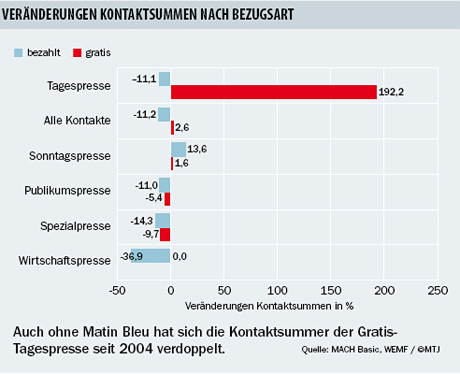
Fewer paid contacts However, the above-mentioned increase in the free share of the special press is only due to the fact that the free contact total has fallen less sharply than the paid contact total since 2004 (see chart "Change in contact totals by subscription type"). The same effect also applies to the general press. Overall, the total number of contacts generated by free titles (excluding regional free weekly newspapers) has increased by 2.6% since 2004, while paid contacts have fallen by 11.2%. Paid contacts in the daily and general press have also fallen by practically the same amount. In contrast, free contacts in the daily press have practically doubled since 2004. In contrast, the business press has lost 36.9 percent of its (paid) contacts in the same period. This is primarily due to the discontinuation of the weekly newspaper Cash. In the Sunday press, free contacts only play a role in Ticino. Thanks to the new regional titles, the number of paid contacts has increased by 13.6 percent since 2004.
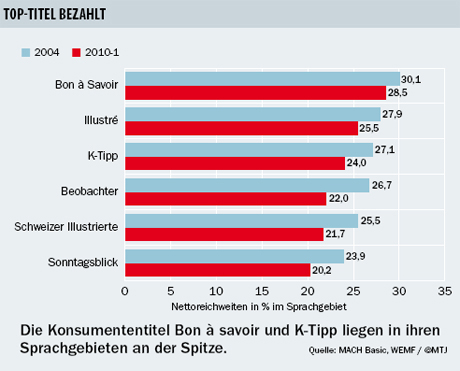
Just one more reader millionaire The strong position of free publications in the reader market somewhat overshadows the paid-for titles. To provide an overview of the overall offering, the "Top paid titles" chart lists the individual titles that are sold as subscriptions or individual sales and still achieve a reach of at least 20 percent. These are still the same titles as six months ago. However, SonntagsBlick is on the verge of falling out of the overview. The massive and consistently significant loss of reach is also clearly visible The strong position of the two Konsumenteninfo titles, which are the leaders in their respective language regions (not least thanks to the low subscription price), is also remarkable. For the second time in a row, KTipp is the only subscription title in Switzerland to reach more than one million readers. Until two years ago, however, this was still the norm. Back then, titles such as SonntagsBlick and Schweizer Illustrierte also reached over one million readers.
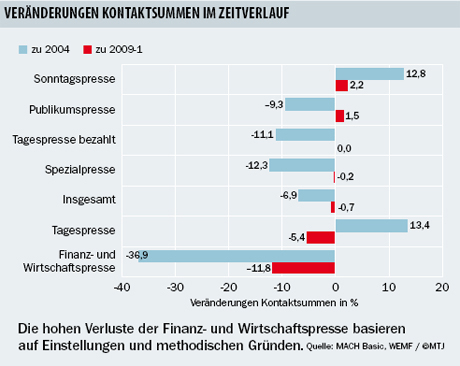
Paid daily press keeps its contact total If the reference type is not taken into account, the Sunday press is one of the two winners in a long-term comparison with an increase of 12.8% (see chart "Change in contact totals over time"). However, the Sunday press has shown that the system of purely telephone surveys has its limits. This is because respondents in Central Switzerland were not really able to distinguish between Zentralschweiz am Sonntag and SonntagsZeitung. For this reason, the new MACH 3 will support the telephone survey with appropriate display material.
At 13.4%, the daily press increased slightly more than the Sunday press - but only if the free titles are included. Apart from the aforementioned business press, the specialty and general press also suffered significant losses compared to 2004. Compared to the previous year, it is noticeable that the daily press lost 5.4 percent overall, while the paid daily press was able to maintain its contact total exactly the same. The high loss of the business press is solely due to the loss of daily cash. By contrast, the titles that continue to be published increased their total contacts by 0.7 percent. And if the weekly newspaper Cash is also excluded from the long-term comparison, the loss of the business press is reduced to 18.8 percent, which is mainly due to the methodical losses of Bilanz/Bilan. If these titles are also excluded, it becomes clear that the other titles have actually increased by 6.4 percent compared to 2004. This shows once again how important it is to pay attention to the details when making long-term comparisons (see also basic information, below).
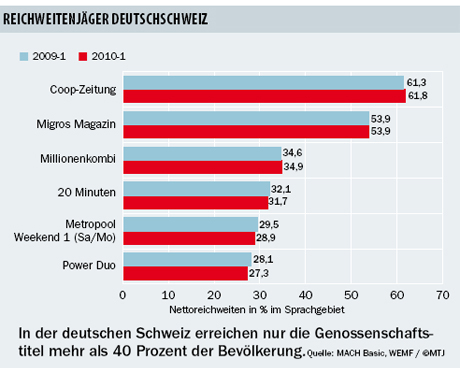
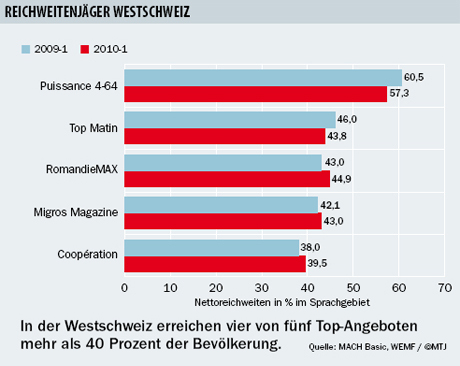
Major distributors only dominate in German-speaking Switzerland The charts "Reach hunter German-speaking Switzerland" and "Reach hunter French-speaking Switzerland" provide an overview of all high-reach offerings in all title categories. They show two completely different pictures. While in German-speaking Switzerland the two titles of the major distributors Migros and Coop occupy the lonely first and second places, in French-speaking Switzerland combinations occupy the top three places. Only behind them are the two titles from the major distributors. Coopération, in fifth place, fell just short of the 40 percent mark. In the German-speaking part of Switzerland, on the other hand, only the two major distributors exceeded the 40 percent mark.
Ueli Custer
Basic information In principle, only significant changes are commented on in the MACH Basic report, so gains and losses within the confidence interval are not an issue. Significance is calculated by Wemf using the t-test. The evaluations are based on the contact figures of all daily newspapers published at least five times a week (excluding large circulations), all consumer, financial, business and specialty press titles. Local and regional weekly titles are not included. The following conditions apply to the comparison of group values:
The contact totals form the basis.
Titles listed for the first time are only included in the comparison if they are new to the market.
The values from previous years of discontinued titles are included.
Values of titles that continue to appear but are no longer (or not fully) reported are not included.
The basis for the long-term comparisons is the year 2004, because from MACH Basic 2004 onwards the extrapolations are based on the 2000 census. The values for 2005, 2006-2, 2007-2, 2008-2 and 2009-2 were each adjusted to the updated census. This increases the population in the respective evaluations accordingly. If the number of readers remains the same, the range is reduced as a result. Compared to 2004, the population has grown by 5.7 percent. In order to keep pace with population growth alone, the number of readers must have increased by at least 5.7 percent compared to 2004. To avoid these pitfalls, the MTJ calculates all relative deviations of individual titles on the basis of the reach values, which are calculated directly from the sample. Contact totals are generally only used for group evaluations.