S&W Werbeagentur packaged for Geberit International
The plumbing technology company Geberit has based this year's annual report on Geberit product packaging. Geberit commissioned the S&W advertising agency to design it.
Editorial
-
March 24, 2010
The slogan "Know How installed" is presented in the t throughout the entire production cycle, from packaging engineering expertise during development to recyclable product packaging made of corrugated cardboard. Responsible at Geberit International: Roman Sidler (Head of Corporate Communications), Anke Wolf (Project Manager Corporate Communications). Responsible at S&W Werbeagentur: Martin Perini (Concept and Consulting), Urs Wiezel (CD), Jörg Krummenacher (AD). Photos: Scanderbegsauer Photography, Zurich.
Werbewoche editor Anne-Friederike Wilhelm on grooming white mold.
Editorial
-
March 24, 2010
Spring, time to clear the air. Your language also needs a good airing out or a 60-degree wash. Above all, throw out the words into which everything that is even remotely relevant has been crammed like an old wardrobe. Although they are often particularly correct, they are not conducive to comprehension. Nor do they make reading fun. Why is it called "teacher training" instead of "teacher education"? A few years ago, a few emancipists raged and nobody dared to revive the unbent term after the storm. In order to satisfy female and male students, students were transformed into male students. The frontal emancipation is now over. So can we talk to each other sensibly again? The "Klappe" has also been hit: it is no longer a film competition, but a moving image competition. Of course that's more correct with all the formats that technical progress has brought us. But it still sounds stupid. On the other hand, how nice is exaggeration. "Zoo animals" become "monkey, tiger and giraffe" - because it sounds better and evokes images in the reader. Nobody is gripped by a text that meticulously lists all the zoo animals: "Customers, cooperation partners, clients, franchisees, shareholders, residents and employees are delighted." The reader less so. A brisk ride on a white horse What is a result situation? The result is the situation you find yourself in. Or a market environment. The market is the environment. Good heavens! Or the word combat action: Logically, a combat is an action. What else is it? And a bit of a quibble, but still true: brand essence. What is the core of a Brand? A brand is a brand is a brand. If it is good. And then it is also its own core. Impairment of speech I'm all for treating marginalized groups with care - I'm a member of a few myself (woman, reverse parking pro, iPhone denier ...). But what is the point of the misleading obfuscation "visually challenged" if "blind" is meant? You can no longer visually challenge a blind person. Or "differently abled" for "mentally handicapped"? Anyone who turns "disabled" into "people with disabilities" is not only crippling the language, but apparently also considers it possible that disabled people could be something other than human. Unspeakable. So, get out the rags and do some spring cleaning in your letter storage: dust off, purge, de-soak.
The advertising week on Star TV: "Manor Lifestyle"
In today's issue of *Werbewoche*, Star TV will show, starting at 7:30 p.m., how Manor's brand identity is being realigned with its brand promise, «Donnons du style à la vie.».
Editorial
-
March 24, 2010
The lifestyle orientation and thus the strategic further development of Manor are presented in the latest TV commercial and in the "making-of" in a way that touches the senses.
And as usual, the latest TV spots and a highlight from the Cannes reel can be seen. Exclusively on Star TV or stream at any time on www.startv.ch. Advertising week on Star TV: New every Thursday at 19:30 on Star TV.
Elephant wedding: Ringier and Axel Springer bundle their activities in Eastern Europe
Ringier and Axel Springer are merging their operations in five Eastern European countries into a new company, in which they will each hold a 50 percent stake. This will create one of Eastern Europe's leading media companies, headquartered in Zurich.
Editorial
-
March 24, 2010
Axel Springer is contributing the business of its subsidiaries in Poland, the Czech Republic and Hungary to the joint venture, while Ringier is contributing its business in Serbia, Slovakia, the Czech Republic and Hungary. The two companies are thus significantly expanding their strong position with more than 100 print titles and over 70 online offerings in these growth markets. With its comprehensive portfolio, the joint company will become the clear market leader for tabloid newspapers and magazines in the entire region. Soon fit for the stock market "For both companies, this partnership is an excellent basis for significantly expanding the journalistic core business with five market-leading tabloid newspapers in attractive growth markets, and an optimal prerequisite for further expansion in the digital business of the future," says Mathias Döpfner, CEO of Axel Springer AG. And Christian Unger, CEO of Ringier AG, emphasizes: "Ringier AG as an independent company with a 177-year tradition, strong brands and a distinctive culture of values meets a partner at eye level who fits in with us to a high degree. Together, we are so strongly positioned in the individual markets that we will be able to go public with the new company and shape the future of the emerging media markets in Eastern Europe."
Market leader in tabloid newspapers and magazines The Board of Directors, chaired by Ralph Büchi, President Axel Springer International, is made up of two representatives each from Ringier and Axel Springer. The joint company will be managed by Florian Fels (42), currently CEO Central Europe of Ringier AG. Ringier and Axel Springer have continuously expanded their activities in the media markets of Eastern Europe in recent decades and have a large number of leading titles in their segments, particularly in the tabloid and magazine sectors. The activities of Axel Springer and Ringier in Eastern Europe are highly complementary. Both companies complement each other, both in terms of their content expertise and their strategic interests. Together, they are now seizing the growth opportunities associated with the digital transformation, which offer additional development prospects, particularly for the employees of Ringier and Axel Springer in Poland, the Czech Republic, Hungary, Slovakia and Serbia, under the leadership of the management team that will remain in charge. Online marketing When asked what the new operation meant for Zanox, a company in which Springer holds 52.5% and Publigroupe 47.5%, Döpfner said at the media conference: "We believe in the model of performance-based online marketing and have had very positive experiences with it. Thanks to the follow-up investments in the UK with Digital Window and Buy-at, we have already achieved European market leadership with Zanox. This business is still very much underrepresented in Eastern European countries. When the time is right, we will certainly discuss with our co-shareholders whether such a business model could also be very attractive in Eastern Europe." (afw/PCM)
Long live the memory
Contexta and 10 nonprofit organizations are raising awareness about bequests.
Editorial
-
March 24, 2010
In Switzerland, 28.5 billion Swiss francs are bequeathed every year. Ten major charitable organizations have joined forces to form the My Happy End association with the aim of encouraging people to think about good causes when making a will: Amnesty International, Greenpeace Switzerland, Salvation Army, Médecins Sans Frontières, SOS Children's Villages Switzerland Foundation, Swiss Air-Rescue Rega, Pestalozzi Children's Village Foundation, Terre des hommes - Children's Aid, World Without Mines and WWF Switzerland. Anyone who includes one of these organizations in their will does good beyond their death and will be remembered by a large number of people. This is the message that Contexta has implemented for the association. The campaign dramatizes the death as an actual happy ending - with a touching gathering of all the organizations and the numerous beneficiaries at the donor's grave. They all keep the deceased in fond memory and impressively demonstrate the impact of his legacy. All measures refer to the internet platform www.myhappyend.org. This offers comprehensive guidance for anyone wishing to include charitable organizations in their estate. pan
To the point: constraint
More than a year ago, the discussion began about an additional Swiss television culture channel. In a sense, it was to become a Swiss Arte with the aim of promoting cohesion between the individual language regions.
Editorial
-
March 24, 2010
Dubbed or subtitled contributions about culture and education, which the SRG stations SF, TSR and TSI have already shown, were to be broadcast on a special channel. Behind the idea were people with an affinity for culture around Bernard Cathomas, the former director of Romansh radio and television RTR. The idea understandably aroused little enthusiasm among SRG's top management. On the one hand, financial reasons spoke against a channel expansion, but conceptual reasons also spoke against it. Armin Walpen was of the opinion that such a special interest channel would rather contribute to the ghettoization of culture. Arte, for example, had a market share of less than 1 percent, and 3sat a mere 1.1 percent. Rainer Stadler wrote in the NZZ at the time: "We can assume that the discussion about a culture channel will quickly peter out. It is unlikely to make waves beyond the culture-savvy milieus." Unfortunately, this hope was deceptive, because now politics has intervened. Council of States member Theo Maissen (CVP, Graubünden) and National Council member Hans Stöckli (SP, Bern) have submitted motions for a cross-linguistic television channel in the federal parliament with broad support. The Federal Council is instructed to urge the SRG, in order to promote national understanding between the language regions, "to realize a Swiss television channel that recycles programs already broadcast and broadcasts them subtitled or dubbed in the respective other national languages." Why on earth do we need a separate TV channel for this, one that would only be used marginally? Wouldn't it make much more sense to broadcast current reports and unusual productions from the individual broadcasting areas in the respective other language areas in the appropriate program compartments? As, for example, Kassensturz did at the beginning of the year. This would solve the problem of ghettoization and the additional costs would be negligible. Perhaps, in addition to the planned convergence of radio and television, the SRG should also think more deeply about a joint clearing house for the exchange of individual contributions between the language regions. And this should be done before politics sets up new nonsensical SRG rules. Pierre C. Meier, Editor-in-Chief [email protected]
Control advertising effect
What is the potential of your advertising efforts?
Editorial
-
March 24, 2010
Objectively assess advertising success Advertising success is when advertising objectives are achieved. For a subject to be effective, the target group must perceive its message quickly and accurately. Every month, advertising effectiveness researcher Patrik Zwahlen evaluates the persuasive potential and visualization quality of five selected advertising subjects exclusively for Werbewoche - and thus provides an objective assessment of their advertising success. Analysis with method This brief analysis assesses the communication performance of advertisements using the two metrics "persuasion potential" and "visualization quality". To determine the persuasion potential, Zwahlen first formulates measurable goals such as "sell more", "become better known" or "reduce the frequency of accidents". In order for such goals to be achieved, the subject needs a credible Reason for effect that corresponds to the message. After defining a plausible objective for each ad, the message is recorded in writing in an uncoded form. A green arrow means that the subject is convincing, a red arrow means that it is not. With the visualization quality, Zwahlen provides an assessment of whether the message is perceived quickly and without wasted coverage. A green arrow indicates that the ad communicates quickly and without errors. If the subject is marked with a red arrow, misunderstandings and misinterpretations are to be expected.
Communication performance of the HSLU display Adopted advertising goal: Behavioral campaign, increase this year's enrollment numbers. Assumed reason for effect: Because readers recognize that the Lucerne University of Applied Sciences and Arts provides the knowledge they need to solve the puzzle posed by the advertisement, the advertising objective is achieved. Background knowledge: Incomprehensible advertising The opinion that even incomprehensible advertising can have an effect is widespread. The only question is what kind of effect we are talking about. When I talk about advertising impact here, I'm always talking about the final effect, in our case the contacting of potential students with the Lucerne University of Applied Sciences and Arts, and of course the increase in enrolment figures. The assumption that incomprehensible advertising can also have an effect comes from people who are convinced that the effect of advertising cannot be proven due to too many influencing factors, and certainly not for each individual advertising measure. In fact, advertising impact can only be assessed if the communication performance of each individual advertising measure is known. Because each strategy should preferably influence exactly one target variable, all advertising measures of a strategy must also hit the same mark. Accordingly, incomprehensible advertising is the opposite of target-oriented, business-oriented action and is therefore impossible to control and manage. Unintelligible or misleading means nothing other than that the message of a subject is not understood. However, misunderstanding also means that neither the context (e.g. open day) nor the sender's information help to ensure correct understanding. An "anti-target" is achieved with the misunderstanding. The lack of understanding can be shown as scatter loss - and in monetary units. Misunderstandings are bad luck if they are used to promote the competition. They are unfortunate if they result in legal fees. And they are money thrown away if all you remember is helplessness. Many readers love puzzles, but only if they can be solved in a short space of time. I have never seen a perplexed face that could laugh heartily at its own incomprehension. On the other hand, a convincing story attracts attention, is remembered and does what advertising is supposed to do: Achieve goals. And fortunately, this is also easy to measure.
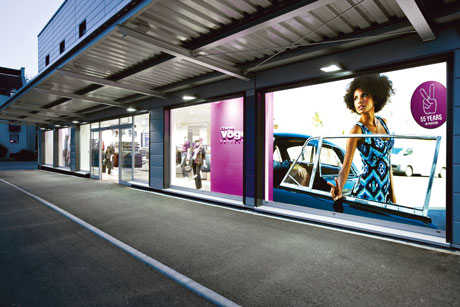
Publicis has launched a comprehensive branding campaign to mark Charles Vögele's 55th anniversary. A new flagship store is opening in Zurich this week.
Editorial
-
March 24, 2010
Since mid-February 2009, a new spirit has been bringing fresh ideas to the tradition-steeped fashion house. André Maeder, who had already worked in purchasing at Vögele in the 1990s, returned to the Swiss chain's headquarters in Pfäffikon after an international career in the fashion world. Maeder worked at Harrods in London as well as being a board member at Hugo Boss since 2004. For the top label, he was responsible for the global licensing business, in addition to overall management of Hugo Boss in North and South America and Japan. In a highly competitive market, Vögele is expected to continue to grow - despite more competitors in Switzerland and, at the same time, 2 percent lower sales for the industry as a whole last year. Zurich-based Publicis with the team of CD Sacha Moser won the mandate for an international campaign in a Europe-wide pitch. The campaign will be implemented cross-medially from Germany to Poland. At the heart of the campaign are five spots by Danish star director Jonas Arnby. In them, people like you and me feel so comfortable in their own skin that they let themselves be carried away by spontaneous catwalks. "Awakening on all levels" The newly appointed CEO André Maeder on Vögele's new dress. WW:According to new figures, there is a cutthroat market in the fashion business in Switzerland. What strategy does Charles Vögele have to face up to this competition? André Maeder: Charles Vögele is embarking on a new era at all levels. The measures introduced along the entire value chain are realigning the company. As far as the Group's visual image is concerned, since autumn 2009 we have adjusted the marketing mix, emotionalized advertising and introduced a new store design. Charles Vögele has increased its annual collections from 4 to 8. What changes and effort does that mean logistically? To enable the collection rhythm to be doubled as early as fall 2010, purchasing was divided into three areas according to core competencies in order to speed up the processes. Brand Management creates all the collections, Sourcing takes care of their procurement, and Merchandise Management allocates the clothes to the stores. On March 25, a new store concept will be launched with a flagship store in Zurich. What can we already reveal about this concept? The new generation no longer has much in common with the previous store design. The brands are staged centrally on the sales floor in shop-in-shop style and radiate out to the core departments. New product carriers for lay-flat goods can be found in place of round stands. In the spirit of "less is more," merchandise pressure has been reduced. The accessory shares are to be increased to 10 percent. How important is this expansion? It's no secret that accessories are one of the most significant growth drivers for fashion companies. Bags, scarves and shoes are the "pièce de résistance" of any wardrobe. Some chains with cheaper offers are making an unmistakable impact on the Swiss market. What do you think of this trend and what do you, for your part, want to use to win customers away from stores like H&M or C&A? So far, the two big German Texil discounters Takko and Kik have not been active in the Swiss market. But we see them as innovative competitors in our other markets. Our goal is to occupy the market niche between H&M and C&A. Migros has increased its stake in Charles Vögele to over 15 percent. What could be the reason for this? Migros is therefore our largest shareholder. Why it is invested in our company, you have to ask Migros itself. How and where does Charles Vögele intend to grow further abroad? Our primary aim is to further expand our strong positions in the main markets of Switzerland, Germany, and Austria. Smaller store formats with location-specific sub-ranges promise further potential. Furthermore, e-commerce will be developed as an additional sales channel in 2011. What do you personally like about Publicis' new advertising for the Charles Vögele brand? The four TV spots are fresh and cheeky - just like Charles Vögele's new spirit. The image campaign for the Group's 55th anniversary has a high recognition value and can be used in an ideal cross-media way. This comes across particularly well on our newly designed website. Interview: Andreas Panzeri
André Maeder.
AY&R honored at The Cup
Advico Young&Rubicam was honored at the International The Cup Awards Show.
Editorial
-
March 24, 2010
The award was presented for the campaign for the Sonntags Zeitung, which has already won several awards. The agency received an award in category 14 - Best of communication media and publications.
The renovation is moving forward. The agency dd com is promoting the opening of the new women's department.
Editorial
-
March 24, 2010
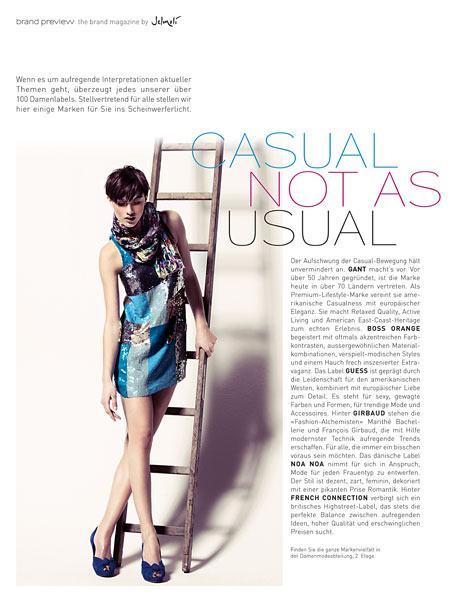
Jelmoli is currently opening "one of the most beautiful and attractive" women's fashion departments in Switzerland in Zurich. More than 100 well-known global fashion brands such as Burberry, Gabriele Strehle/Strenesse Blue, Patrizia Pepe and LIU JO will be presented on the second floor on over 300 square meters. The Zurich communications agency dd com, which has been working for Jelmoli since the beginning of 2009, has realized a comprehensive campaign. The agency, led by Daniel Müri and Jean Pierre Kuhn, has been supporting Jelmoli since the management decided to initiate a repositioning about a year ago. The aim of this reorientation was to make Jelmoli the leading shopping destination in the Zurich region. In terms of brand offering, store design and product presentation, Jelmoli is taking its lead from the leading European department stores. Various changes were necessary to achieve this goal. The department store has been undergoing remodeling since July 2009. This work will be completed in October 2010 and Jelmoli will then have a completely new look. The fascination and magic of Jelmoli already lie not in the individual brands, but in the "Community of Brands". High-quality brands are united under one roof and lead to a "unique brand experience", as the traditional shopping center in the heart of Zurich is convinced. In the process of this realignment since summer 2009, the name Jelmoli was supplemented with "The House of Brands" in collaboration with dd com. A dedicated fashion magazine was also launched. For the recently launched campaign with various means, dd com is working with the current winners of the Elite Model Look Competition Switzerland and the other "clan" of Ursula Knecht and her option. The photos were taken by Sven Bänziger. pan
Hear visibly
From Switzerland to the world: Metzgerlehner has developed a campaign for Phonak that strikes the perfect balance between art, education, and advertising.
Editorial
-
March 24, 2010
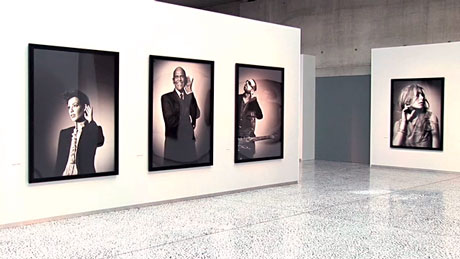
People with poor eyesight go to the ophthalmologist and have glasses prescribed. These are now accepted as a fashion accessory without any problems. The situation is somewhat different with hearing aids: They are a visible sign of hearing loss. Among the population, hearing loss is often associated with frailty and old age. Hearing loss is still one of the biggest taboos in our society. This is despite the fact that 16 percent of the world's population, or 500 million people, are affected. Hearing loss is no longer just a problem for the 70-plus generation. Due to the increasing noise levels in leisure and work, hearing loss now affects all age groups. By 2015, there are expected to be more than 700 million hearing-impaired people worldwide. However, they still wait an average of around seven years before seeking professional help. Phonak, a technical pioneer in the industry and global market leader for hearing aids, therefore established the Hear the World Foundation in 2006 and launched the initiative of the same name. Since then, a campaign from Switzerland has been going around the world. And this year it has also received the highest recognition here. The Hear the World initiative has just been awarded the 2010 Marketing Trophy in the large company category. The campaign developed by Metzgerlehner worldwide partners for the initiative is based on portraits of world-famous stars photographed by Bryan Adams. The agency won the contract for Hear the World in a pitch, after Metzgerlehner had already been entrusted with various communication tasks for the founder of the foundation Phonak. Phonak products are sold almost worldwide. The question for communication was therefore: How do you achieve an international presence without a correspondingly large budget? The answer lies in an interesting implementation of the message for the international media. The Hear the World Foundation not only provides meaningful information about the importance of and possible dangers to hearing. It also provides significant support for projects in developing countries. Hearing-impaired children in a poorer world should at least be able to experience their sounds as richly as we do - thanks to the latest Phonak technology. Metzgerlehner's task was to publicize this in a stylish and effective way. The fact that two prominent testimonials had already been engaged - Plácido Domingo and the Vienna Philharmonic Orchestra - was a given. The advertisers from Erlenbach were convinced by the idea that Hear the World should be staged with the simple gesture - key visual "hand behind the ear" - and continued with as many celebrities as possible. Strategist Marco Lehner, CD Felix Dammann and Account Director Silvan Metzger chose pop artist Bryan Adams as the most suitable photographer for these celebrity portraits because he is a recognized name in both the world of music and photography. After a long creative meeting in Erlenbach, the artist in London was contacted by e-mail late at night. Bryan Adams accepted the same night. "A stroke of luck, because Adams was not only immediately convinced by the theme and the idea of the campaign. He is also friends with all the personalities in the music and acting world," reports Silvan Metzger enthusiastically. Thanks to such exclusive contacts, more than 40 top-class stars have now put their hands to their ears for Hear the World. With so many celebrities, Metzgerlehner has also succeeded in involving the international media, especially the lifestyle media, as grateful multipliers for Hear the World. By the last measurement in September 2009, 526 million press contacts had been generated internationally via these channels, in the USA with media such as the New York Times, Financial Times, USA Today and Vanity Fair. In Germany, everyone from Spiegel and Gala to Bild am Sonntag reported on Bryan Adams' pictures. In addition, all major TV stations in both the USA and Europe have responded to the foundation's idea. Online, the campaign has generated an estimated 2.3 billion contacts to date. Almost 700,000 people have learned about Phonak's commitment at events and promotions. The magazine accompanying the initiative has a circulation of 320,000 copies. The campaign is being implemented worldwide by Phonak's national companies. The campaign comprises a whole host of measures. These include the aforementioned magazine, which reports four times a year on topics that focus on hearing and lifestyle. An exhibition of the initiative's ambassadors photographed by Bryan Adams has so far been shown in New York, Berlin, London and Zurich. At each exhibition, original photographs are auctioned off for the benefit of the Hear the World Foundation. In addition to other promotions, the Hear the World Foundation was also involved as a partner at the Montreux Jazz Festival - in keeping with the cause. The interactive information platform www.hear-the-world.com offers practical information on the topic as well as a hearing test. And Hear the World is not about to go quiet. The project will continue to make itself heard in the true sense of the word. Andreas Panzeri
Bryan Adams.
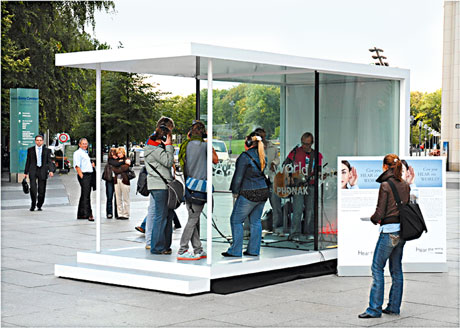
At events and promotional events, passers-by can test in front of this special box what life would sound like without hearing. A rock band plays in this glass box in total soundproofing.
Free trees cut down
Due to the discontinuation of Le Matin bleu, the free share has fallen for the first time. Despite this, the total number of contacts for the titles analyzed by Media Trend Journal has only decreased marginally.
Editorial
-
March 24, 2010
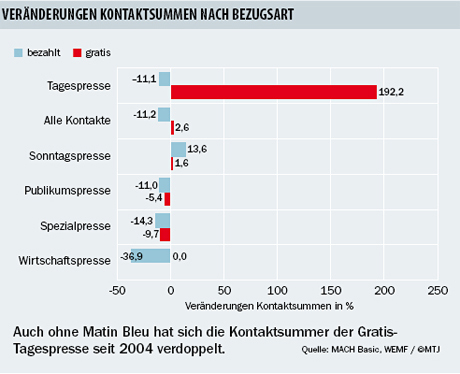
The fact that even free newspapers do not grow to the sky was made drastically clear in 2009. No fewer than four free daily newspapers (Cash, .ch, Le Matin bleu and News) were discontinued. However, only the discontinuation of Cash and Le Matin bleu had an impact on the development of contact totals. This is because the other two titles were only reported once each. As the concept was already outdated by the time the corresponding figures were published, these short-term blossoms in the Swiss newspaper landscape were immediately deleted and are not included in the long-term analysis. As the chart "Proportion of free contacts" shows, the proportion of free contacts across all title groups has only fallen very marginally compared to 2009-1 (from 34.9% to 34.5%). This is because the free share of the specialty press continues to grow and has now reached a record 44.6%. The publications of the two major distributors Migros and Coop are making the biggest contribution to this. The only significant decline in the free share is in the daily press, where it has fallen from 34.7% to 31% (more on this in the article "Losses are free" from page 8). And of course also in the business press, where it is now back to 0 following the discontinuation of Cash.
Fewer paid contacts However, the above-mentioned increase in the free share of the special press is only due to the fact that the free contact total has fallen less sharply than the paid contact total since 2004 (see chart "Change in contact totals by subscription type"). The same effect also applies to the general press. Overall, the total number of contacts generated by free titles (excluding regional free weekly newspapers) has increased by 2.6% since 2004, while paid contacts have fallen by 11.2%. Paid contacts in the daily and general press have also fallen by practically the same amount. In contrast, free contacts in the daily press have practically doubled since 2004. In contrast, the business press has lost 36.9 percent of its (paid) contacts in the same period. This is primarily due to the discontinuation of the weekly newspaper Cash. In the Sunday press, free contacts only play a role in Ticino. Thanks to the new regional titles, the number of paid contacts has increased by 13.6 percent since 2004.
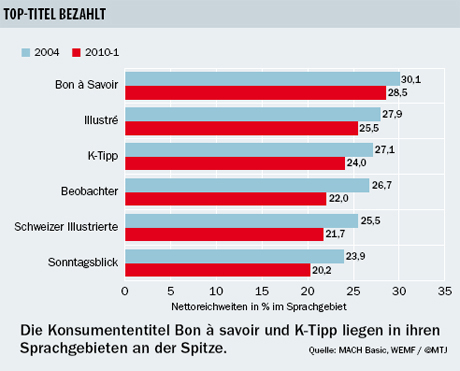
Just one more reader millionaire The strong position of free publications in the reader market somewhat overshadows the paid-for titles. To provide an overview of the overall offering, the "Top paid titles" chart lists the individual titles that are sold as subscriptions or individual sales and still achieve a reach of at least 20 percent. These are still the same titles as six months ago. However, SonntagsBlick is on the verge of falling out of the overview. The massive and consistently significant loss of reach is also clearly visible The strong position of the two Konsumenteninfo titles, which are the leaders in their respective language regions (not least thanks to the low subscription price), is also remarkable. For the second time in a row, KTipp is the only subscription title in Switzerland to reach more than one million readers. Until two years ago, however, this was still the norm. Back then, titles such as SonntagsBlick and Schweizer Illustrierte also reached over one million readers.
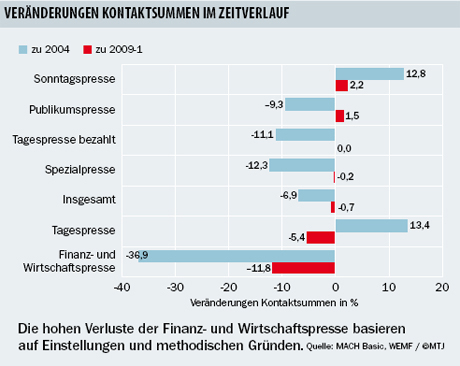
Paid daily press keeps its contact total If the reference type is not taken into account, the Sunday press is one of the two winners in a long-term comparison with an increase of 12.8% (see chart "Change in contact totals over time"). However, the Sunday press has shown that the system of purely telephone surveys has its limits. This is because respondents in Central Switzerland were not really able to distinguish between Zentralschweiz am Sonntag and SonntagsZeitung. For this reason, the new MACH 3 will support the telephone survey with appropriate display material.
At 13.4%, the daily press increased slightly more than the Sunday press - but only if the free titles are included. Apart from the aforementioned business press, the specialty and general press also suffered significant losses compared to 2004. Compared to the previous year, it is noticeable that the daily press lost 5.4 percent overall, while the paid daily press was able to maintain its contact total exactly the same. The high loss of the business press is solely due to the loss of daily cash. By contrast, the titles that continue to be published increased their total contacts by 0.7 percent. And if the weekly newspaper Cash is also excluded from the long-term comparison, the loss of the business press is reduced to 18.8 percent, which is mainly due to the methodical losses of Bilanz/Bilan. If these titles are also excluded, it becomes clear that the other titles have actually increased by 6.4 percent compared to 2004. This shows once again how important it is to pay attention to the details when making long-term comparisons (see also basic information, below).
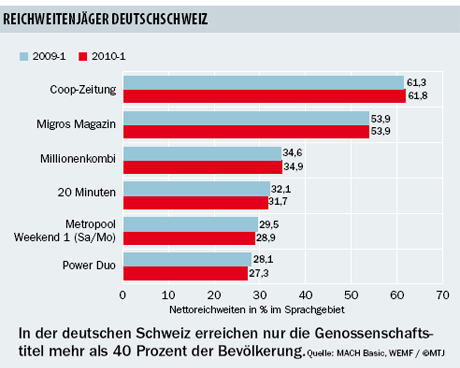
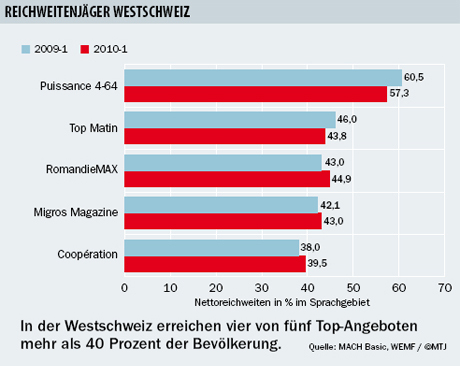
Major distributors only dominate in German-speaking Switzerland The charts "Reach hunter German-speaking Switzerland" and "Reach hunter French-speaking Switzerland" provide an overview of all high-reach offerings in all title categories. They show two completely different pictures. While in German-speaking Switzerland the two titles of the major distributors Migros and Coop occupy the lonely first and second places, in French-speaking Switzerland combinations occupy the top three places. Only behind them are the two titles from the major distributors. Coopération, in fifth place, fell just short of the 40 percent mark. In the German-speaking part of Switzerland, on the other hand, only the two major distributors exceeded the 40 percent mark.
Ueli Custer
Basic information In principle, only significant changes are commented on in the MACH Basic report, so gains and losses within the confidence interval are not an issue. Significance is calculated by Wemf using the t-test. The evaluations are based on the contact figures of all daily newspapers published at least five times a week (excluding large circulations), all consumer, financial, business and specialty press titles. Local and regional weekly titles are not included. The following conditions apply to the comparison of group values:
The contact totals form the basis.
Titles listed for the first time are only included in the comparison if they are new to the market.
The values from previous years of discontinued titles are included.
Values of titles that continue to appear but are no longer (or not fully) reported are not included.
The basis for the long-term comparisons is the year 2004, because from MACH Basic 2004 onwards the extrapolations are based on the 2000 census. The values for 2005, 2006-2, 2007-2, 2008-2 and 2009-2 were each adjusted to the updated census. This increases the population in the respective evaluations accordingly. If the number of readers remains the same, the range is reduced as a result. Compared to 2004, the population has grown by 5.7 percent. In order to keep pace with population growth alone, the number of readers must have increased by at least 5.7 percent compared to 2004. To avoid these pitfalls, the MTJ calculates all relative deviations of individual titles on the basis of the reach values, which are calculated directly from the sample. Contact totals are generally only used for group evaluations.