BSSM: New appearance for Extra

The BSSM agency has created a new brand identity for Extra Express Transport Logistik.

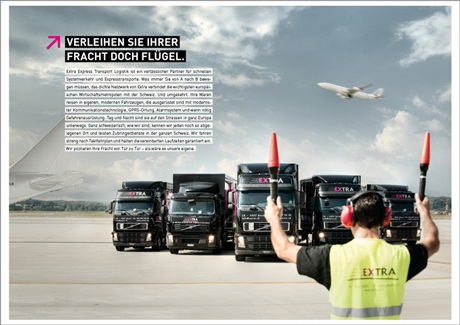
Extra Express Transport Logistik, headquartered in Pratteln and with a subsidiary in Belgium, connects the most important European economic centers with Switzerland and vice versa. The BSSM advertising agency is repositioning Extra as the airline of the road, piloting customers' freight from door to door - as if it were its own. The new appearance starts with the brochure in various languages, is then expanded by the website and rounded off with further communication measures.
Responsible at Extra Express Transport Logistik AG, Pratteln: Beat Schweighauser (overall responsibility). Responsible at BSSM Werbeagentur AG, Basel: Urs Schneider (CD), Text: Hannes Müller (text), Daniel Bard (AD), Markus Binggeli (consulting). Photographer: Tobias Sutter.
1290581001_img100325_transport1
1290581001_img100325_transport2
img100325_transport3

Ruf Lanz for Lienhardt & Partner Privatbank Zürich: 18 new subjects submitted for selection

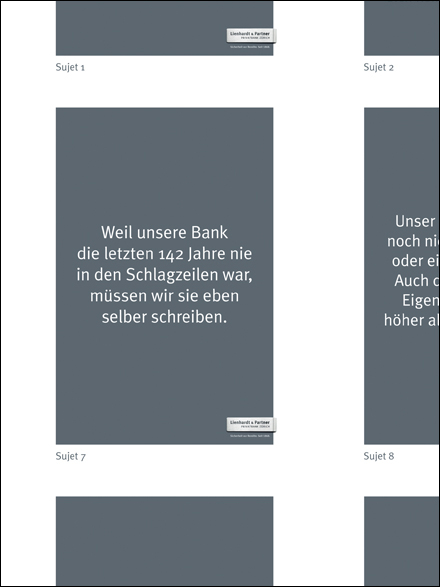
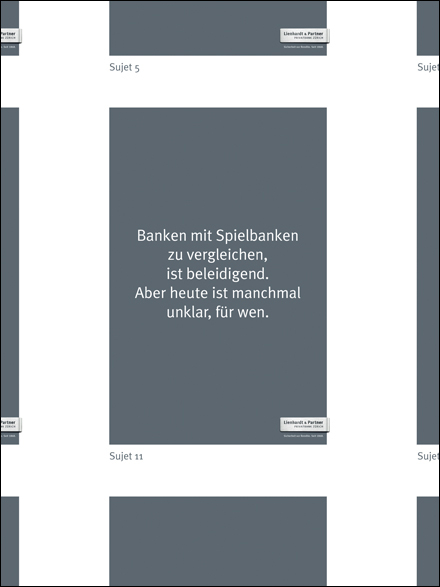
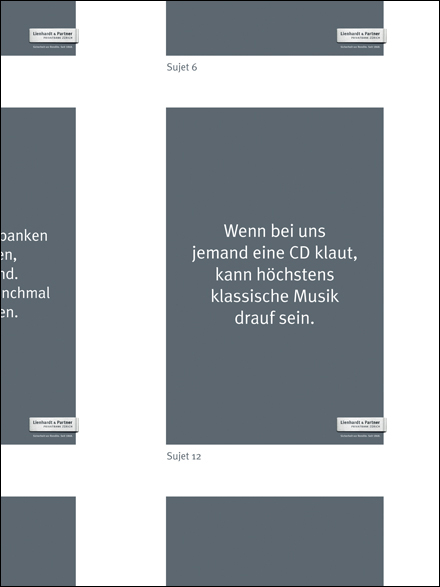
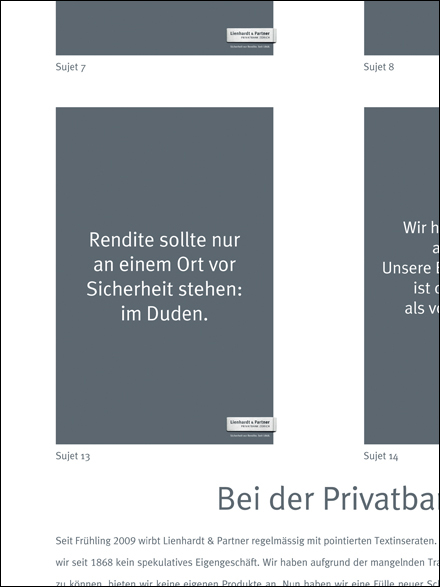
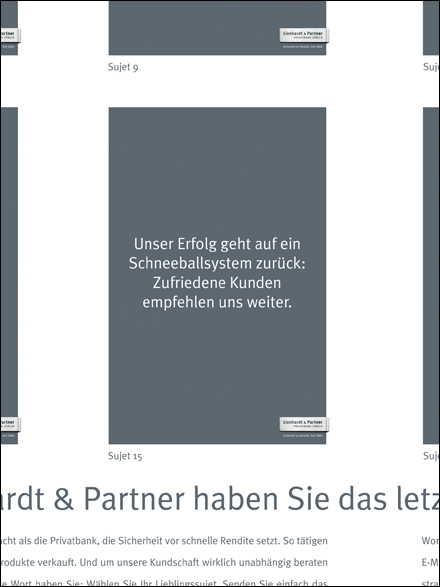
The Ruf Lanz agency has created new ad campaigns for Lienhardt & Partner Privatbank Zurich.

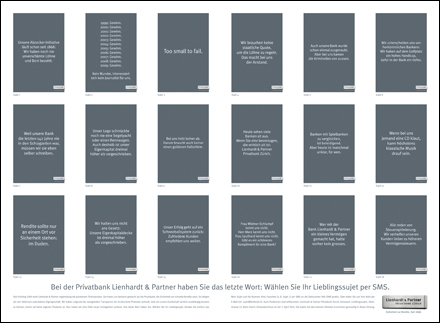
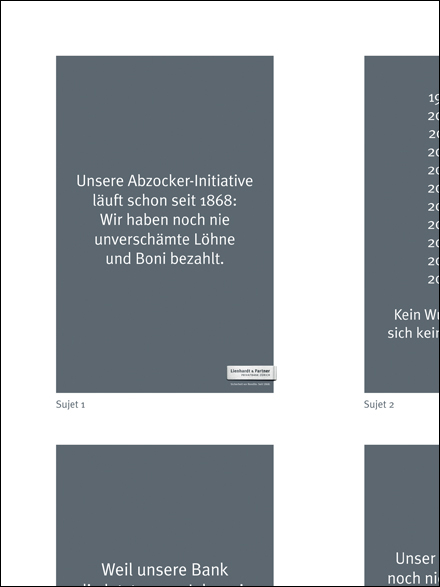
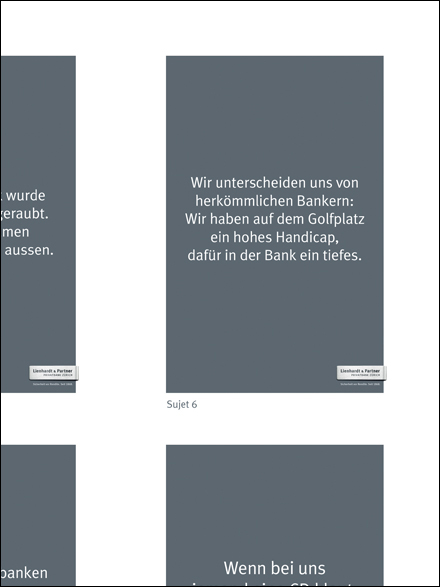
Ruf Lanz has been raising the profile of Lienhardt & Partner since spring 2009 with a pointed campaign. It was the only banking campaign to receive an award from the Art Directors Club Switzerland for its texts. For the launch of the 2010 campaign, Ruf Lanz is presenting no less than 18 new text subjects on double-page ads in the business press, which also include current affairs: from the rip-off initiative to equity capital cover to CD theft.
Readers have the final say - and can vote by text message, e-mail or good old postcard. The subjects that garner the most votes will appear on a full-page spread in the coming weeks.
1290581001_img100325_ruflanz1
1290581001_img100325_ruflanz2
1290581001_img100325_ruflanz3
1290581001_img100325_ruflanz4
1290581001_img100325_ruflanz5
1290581001_img100325_ruflanz6
1290581001_img100325_ruflanz7
1290581001_img100325_ruflanz8
img100325_ruflanz9

Jung von Matt/Limmat: New subjects developed for Max Shoes

The Jung von Matt/Limmat agency has created new ad campaigns for Max Shoes. The campaign promotes the new men's shoe collection.

This spring, Max Shoes and Jung von Matt/Limmat remain true to their shoe fetish, according to a press release from the agency. After the cowgirls riding a rodeo on shoes and the kimono beauties tied up by men's shoes, a French maid cleaning shoes now adorns the subjects as an eye-catcher. The young woman in the harmonious work clothes uses a feather duster and vacuum cleaner to ensure that the elegant business shoes for the fashion-conscious man are always clean and shiny in the eye of the beholder. The motifs have been on display since the beginning of March.
Responsible at Max Shoes: Daniel Widmer (Head of Marketing), Edi Westphale (Head of Communications), René Minder (Head of Sales Organization Max Shoes). Responsible at Jung von Matt/Limmat: Lukas Frei, Alexander Jaggy (Creative Direction), David Hanselmann (Art Direction), Matthias Fürst (Graphics), Martin Samsel, Jasmin Schmid, Jil Rottmann (Consulting), Ilonka Galliard, Erasmo Palomba (Art Buying), Kristian Schuller (Photography).
1290581000_img100325_maxshoes2
1290581000_img100325_maxshoes1

Theologian becomes Head of Group Communications at Roche

Stephan Feldhaus, who holds a doctorate in theology, will become the new Head of Group Communications at Roche and will join the extended Group Executive Committee. He succeeds Per-Olof Attinger, who will become Head of the CEO Office and Secretary to the Group Executive Committee effective June 1.

Born in 1962, the new Head of Communications will take up his post on August 1, as the Basel-based pharmaceutical company announced on Thursday, according to SDA. Feldhaus completed his theology studies in Munich with a doctorate and has worked in communications for over 15 years, most recently at Siemens.

L'Impartial: Articles on website will be subject to payment

Starting in 2011, articles on the websites of the Neuchâtel daily newspapers L’Impartial and L’Express will require a subscription.

Jacques Richard from the French media group Groupe Hersant Média told the news agency SDA that the reason for this step was that the advertising displayed was not sufficient to finance the Internet. Richard confirmed a report on French-speaking Swiss radio on Wednesday. The wrong path was taken back then, he said. Nowadays, advertising is far from covering its costs. The inspiration came from Le Temps and La Liberté.
On the website of the Fribourg daily newspaper La Liberté, for example, only the title and a few additional sentences can be seen. Anyone who wants to read the whole article and therefore clicks on the headline is informed that they have to pay for it.
On this side of the Sense, news on the Internet is still free: "As far as we know, no newspaper in German-speaking Switzerland has yet introduced this model," Catherine Müller from the management of the Swiss Press Association told SDA. But of course considerations are being made as to where paid content could work.

Regional broadcasters may continue to report from football and ice hockey stadiums

Swiss local television stations may continue to report on football and ice hockey matches, even if SRG has an exclusive right to do so.

The public broadcaster has agreed this with the private stations. The private broadcasters will be allowed to report on football and ice hockey matches for a maximum of three minutes. In return, they will be granted access to the stadiums or may use SRG's exclusive images, as stated in a press release issued by the two parties on Thursday, according to SDA. This agreement is in line with previous practice, from which SRG wanted to deviate.
Although it still made its images available to the local stations, it no longer wanted them to be recorded in the stadium itself without restriction. SRG took its request to the Federal Supreme Court, but was not successful. With the agreement announced on Thursday, the TV stations are implementing the ruling of the highest court.

The dilemma of old and new media

When it comes to the question of an economically viable future, there is no significant difference between traditional and new media. Both face the same dilemma: the success of these communication channels stands or falls with their content. However, revenue models for producing quality journalism are still lacking, according to one of the conclusions of the study «The State of The News Media.» Guest column by Josefa Haas, Director of the Media Institute.

Every year it is a treasure trove, the report on the state of the news media, The State of The News Media (www.stateofthemedia.org). It is published by the Pew Project for Excellence in Journalism. The report endeavors to provide a transparent presentation of the development of all media sectors in the USA. It provides interesting insights in an impartial manner. The results of the American media market cannot be transferred one-to-one to Swiss conditions due to the structural differences. However, the following trends should give food for thought:
- The report soberly states: online journalism has not yet found a sustainable revenue model. 79 percent of online users state that they never or very rarely click on advertising. Adequate platforms and billing systems still need to be developed for readers to pay for content directly.
- Even the best of the new media sites still have a limited ability to produce content.
- Traditional media content still attracts the most readers: 80 percent of traffic from news and information sites is concentrated on the top seven percent of sites. Of these, 67 percent are linked to traditional media. New media sites, on the other hand, are rarely among the top sites. 13 percent are pure aggregators that obtain their content from traditional media. Only 14 percent produce original researched content and are not content with commentary alone. The analysis of more than one million blogs and social media sites shows that 80 percent of their links lead to traditional American media.
- Readers are increasingly confronted with arguments and less with information. The proportion of investigative journalism is decreasing, but the number of comments and discussions is increasing. Around 70 percent of Americans now experience this focus on debate as a flood of partisan content.
- The online platforms are dependent on the content of the traditional media. According to the authors of the study, they are therefore also affected by the massive reduction in editorial budgets. In the last three years, 43 percent of revenues for newspapers in the USA, including online, have been lost. Since 2000, annual investment in reporting and editing has fallen by 30 percent to 4.4 billion dollars. In contrast, only 141 million dollars have been generated from non-profit initiatives that finance journalism.
The report on the "State of News Media" therefore concludes that the fate of the old and new media is closely linked. Ultimately, the question is: who finances journalistic research and reporting? Discussion platforms without the basis of independent, transparent and fact-oriented reports promote an unbalanced flood of opinion and mood-oriented information. The study observes a rapid increase in interest-driven platforms.
Pro-Am model for information
As users will be very topic-oriented in the future, the authors suggest that new forms of cooperation between traditional and new media must be found. The combination of traditional journalism with user contributions is also a solution for citizen platforms. In terms of content, contributions should focus on solving problems and improving the community. A good model for cooperation between professional and amateur journalism, also known as pro-am, needs to be found in the future. However, the rules of the game still need to be formulated.
The questions that the report raises on the basis of the data must also be asked in Switzerland: How is the relationship between interest-driven and independent journalism developing? What are the effects of the increasing dominance of opinion pieces over factual and evidence-based content? How are responsible citizens being addressed and where are they being manipulated for political, economic and ideological reasons? And who will ensure that independent and transparent journalism remains economically viable in the future?
The public and the media industry will jointly define which media this country will have in the future. Journalistic services are the central pillar of communication. It is therefore important to define these by means of clear professional standards, to secure their production financially and to create platforms that enable fair access.

Wunderman promotes Microsoft's online services

Wundermann developed a campaign for Microsoft promoting its «Online Services» server solutions.

With Exchange Online, SharePoint Online, Office Communications Online and Office Live Meeting, companies receive the most important solutions in the area of communication and collaboration. This is the message that Wunderman has condensed and implemented for the mainly online campaign.
The campaign runs for six months and focuses on the products Exchange Online, Sharepoint Online and the Office Communication Suite.
1290581005_img100324_wunderman1

http://www.microsoft.com/emea/cloudservices/ch/de/bpos/
http://www.wunderman.ch

Spinas|Gemperle: Starting signal for the three-year Helvetas water campaign

The Swiss development organization Helvetas has set a goal of providing one million people with access to clean water by 2013. To achieve this goal, Spinas|Gemperle is running a three-year campaign to raise donations.

At the heart of the campaign are drinking glasses, which are dramatized in a different way in each subject. Each one represents a different problem caused by the lack of water supply. And in each motif, Helvetas presents appropriate solutions.
The campaign is being launched with the TV commercial "Schoppen", which focuses on the inadequate disposal of wastewater and its alarming consequences. Two advertisements accompany the campaign launch. Further commercials and motifs will follow every six months. The campaign is supported by Geberit.
Responsible at Helvetas: Stefan Stolle (Head of Communications and Fundraising), Matthias Herfeldt (Team Leader Communications). Responsible at Spinas|Gemperle: Lorenz Spinas (CD), Miriam Fischer/Andrea Reinhart (concept/AD), Susi Kammergruber (concept/text), Conny Geibel (consulting), Jyri Pasanen (director), Rosas'n'Co Films (production).

Spot 1
Spot 2

1290581004_img100324_helvetas1
1290581004_img100324_helvetas2

BE Grand Council: No editorial articles in official gazettes

The Grand Council of Bern has passed an amendment to the Municipal Act prohibiting editorially prepared articles and commentaries in official gazettes.

However, municipalities can publish information in supplements or in the non-official section of the gazette. The Grand Council passed the controversial provision on Tuesday. The discussion on supplements was mainly about competition with paid daily newspapers. According to SDA, the Council rejected a proposal that the official gazette should not contain loose inserts by 105 votes to 26.
Against the will of the government, the Grand Council decided that the cantonal and federal authorities or the national churches would have to pay for their publications in future. Previously, announcements had to be published free of charge. On Wednesday, the Council passed the law without further debate by 105 votes to 12.

Hear visibly

From Switzerland to the world: Metzgerlehner has developed a campaign for Phonak that strikes the perfect balance between art, education, and advertising.

People with poor eyesight go to the ophthalmologist and have glasses prescribed. These are now accepted as a fashion accessory without any problems. The situation is somewhat different with hearing aids: They are a visible sign of hearing loss. Among the population, hearing loss is often associated with frailty and old age. Hearing loss is still one of the biggest taboos in our society. This is despite the fact that 16 percent of the world's population, or 500 million people, are affected. Hearing loss is no longer just a problem for the 70-plus generation. Due to the increasing noise levels in leisure and work, hearing loss now affects all age groups. By 2015, there are expected to be more than 700 million hearing-impaired people worldwide. However, they still wait an average of around seven years before seeking professional help. Phonak, a technical pioneer in the industry and global market leader for hearing aids, therefore established the Hear the World Foundation in 2006 and launched the initiative of the same name.
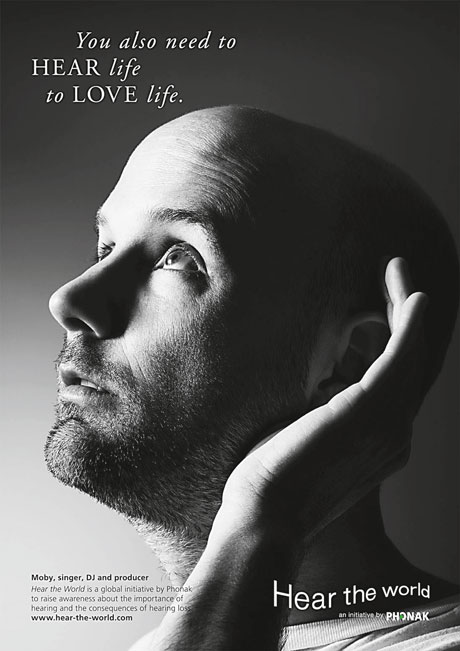
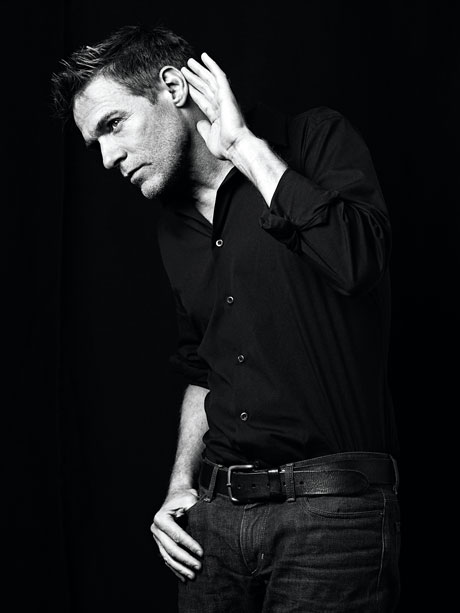
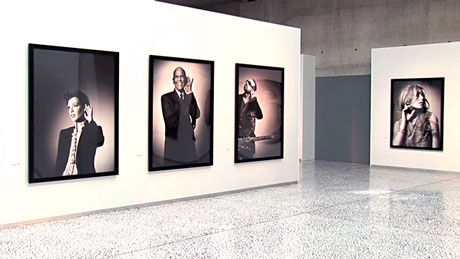
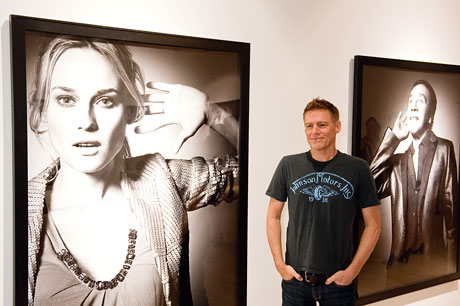
Since then, a campaign from Switzerland has been going around the world. And this year it has also received the highest recognition here. The Hear the World initiative has just been awarded the 2010 Marketing Trophy in the large company category. The campaign developed by Metzgerlehner worldwide partners for the initiative is based on portraits of world-famous stars photographed by Bryan Adams.
The agency won the contract for Hear the World in a pitch, after Metzgerlehner had already been entrusted with various communication tasks for the founder of the foundation Phonak.
Phonak products are sold almost worldwide. The question for communication was therefore: How do you achieve an international presence without a correspondingly large budget? The answer lies in an interesting implementation of the message for the international media. The Hear the World Foundation not only provides meaningful information about the importance of and possible dangers to hearing. It also provides significant support for projects in developing countries. Hearing-impaired children in a poorer world should at least be able to experience their sounds as richly as we do - thanks to the latest Phonak technology.
Metzgerlehner's task was to publicize this in a stylish and effective way. The fact that two prominent testimonials had already been engaged - Plácido Domingo and the Vienna Philharmonic Orchestra - was a given.
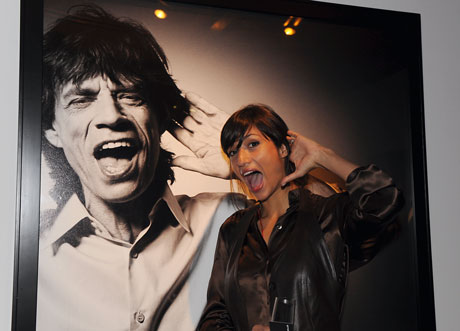
The advertisers from Erlenbach were convinced by the idea that Hear the World should be staged with the simple gesture - key visual "hand behind the ear" - and continued with as many celebrities as possible. Strategist Marco Lehner, CD Felix Dammann and Account Director Silvan Metzger chose pop artist Bryan Adams as the most suitable photographer for these celebrity portraits because he is a recognized name in both the world of music and photography. After a long creative meeting in Erlenbach, the artist in London was contacted by e-mail late at night. Bryan Adams accepted the same night. "A stroke of luck, because Adams was not only immediately convinced by the theme and the idea of the campaign. He is also friends with all the personalities in the music and acting world," reports Silvan Metzger enthusiastically. Thanks to such exclusive contacts, more than 40 top-class stars have now put their hands to their ears for Hear the World.
With so many celebrities, Metzgerlehner has also succeeded in involving the international media, especially the lifestyle media, as grateful multipliers for Hear the World. By the last measurement in September 2009, 526 million press contacts had been generated internationally via these channels, in the USA with media such as the New York Times, Financial Times, USA Today and Vanity Fair. In Germany, everyone from Spiegel and Gala to Bild am Sonntag reported on Bryan Adams' pictures. In addition, all major TV stations in both the USA and Europe have responded to the foundation's idea. Online, the campaign has generated an estimated 2.3 billion contacts to date. Almost 700,000 people have learned about Phonak's commitment at events and promotions. The magazine accompanying the initiative has a circulation of 320,000 copies.
The campaign is being implemented worldwide by Phonak's national companies. The campaign comprises a whole host of measures. These include the aforementioned magazine, which reports four times a year on topics that focus on hearing and lifestyle. An exhibition of the initiative's ambassadors photographed by Bryan Adams has so far been shown in New York, Berlin, London and Zurich. At each exhibition, original photographs are auctioned off for the benefit of the Hear the World Foundation. In addition to other promotions, the Hear the World Foundation was also involved as a partner at the Montreux Jazz Festival - in keeping with the cause.
The interactive information platform www.hear-the-world.com offers practical information on the topic as well as a hearing test. And Hear the World is not about to go quiet. The project will continue to make itself heard in the true sense of the word.
Andreas Panzeri
(This article comes from the current issue of Werbewoche.)
1290581002_img100324_phonak4
1290581002_img100324_phonak3
1290581002_img100324_phonak2
1290581002_img100324_phonak1
1290581002_img100324_phonak5
Bryan Adams.
1290581002_img100324_phonak6
1290581002_img100324_phonak7
1290581002_img100324
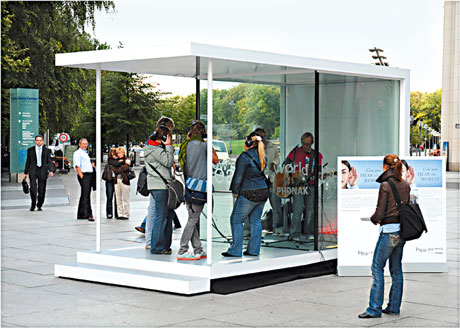
At events and promotional events, passers-by can test in front of this special box what life would sound like without hearing. A rock band plays in this glass box in total soundproofing.

Competence for convergence

Those with crisis experience know this: While some focus on damage control, others are already securing the best positions for the next upswing. In the battered media industry, those who do this most effectively are the ones who engage with options and requirements in a professional setting—ideally at the Media Institute, with its continuing education programs in media management. By Josefa Haas, Director of the Media Institute.

The light at the end of the tunnel is in sight, and at the same time many media people are coming out of their state of shock. The media industry needs to reinvent itself: The best of digital media must be combined with the success factors of traditional media. The self-confidence of content producers has been seriously shaken in recent years: Search engines make use of their services and monetize them through advertising revenue. The crisis has shown: This calculation does not work out for everyone. Content producers are faced with a large selection of distribution channels and therefore also revenue channels. Publishing experts cannot cope with today's tasks using yesterday's recipes. Media experts and media managers must now deal with the diversity of business models in order to successfully manage the complexity of tomorrow. They are expanding their skills in order to solve the challenging tasks of the convergent media world.
Linking digital and traditional media
The Media Institute has been training publishing and media specialists on behalf of the Swiss Press Association for over twenty years. It systematically reviews the strengths of existing programs and links them to the requirements of tomorrow's media industry. The focus is on the development of journalistic media, their production and distribution as well as their positioning in the user and advertising market. The courses systematically deal with the production and value creation process. Press, radio, television and online are covered in all their forms. The Media Institute takes a consistent 360-degree view of the multimedia world.
Participants in the Media Institute's events come from all media companies and interfaces in the media industry. Lifelong learning is a matter of course for them: all generations of the media industry can be found on the courses. They attend the courses, conferences and seminars in order to deal efficiently with current developments. At the Media Institute, they are not confronted with a corporate culture, school or consultancy philosophy. Instead, they gain an insight into the various strategies and their implementation. In a short space of time, these encounters with professionals offer a wide range of experiences that can be incorporated into their own professional activities the next day.
Problem-solving skills in a complex environment
Job profiles in the media industry are being redefined: Technological innovations are changing production processes and task portfolios. The launch of new products, reorganizations and cost-cutting projects, mergers of media companies and the introduction of newsrooms demand a great willingness for interdisciplinary cooperation. Openness, innovation, speed and professional and communication skills are required from all those involved. Those who have trained in these requirements in an inter-company course are well positioned. The Media Manager course, which starts at the end of August, offers the ideal framework for the systematic development of skills that are essential for solving problems in a complex environment.
From professionals for professionals
The change affects the Media Institute itself. Thanks to its good networking with the Swiss media industry and international specialist bodies, it is able to continuously map current developments and anticipate innovations. During the Epiphany Conference and the Trend Conferences, topics such as newsroom, paid content, social web, semantic search, digital distribution platforms and media law are discussed in depth by high-profile speakers. Studies on media trends and media budgets provide exclusive data. The publication of dossiers, association and specialist publications documents the debates on the development of the media industry.
The Media Institute has continuously updated its training and further education courses and made them more flexible: The Media Specialist and Media Manager courses conclude with federal examinations. The higher vocational training model corresponds to the requirement profiles of the industry and the expectations of the course participants. Experienced professionals from the fields of editing, production, distribution and marketing meet here to discuss current concepts and applications in the media industry with lecturers from the sector. They have a wide variety of educational backgrounds, from apprenticeships to university degrees. Many have already completed various training courses. They are used to constantly adapting their educational backpacks to current requirements. The examinations are geared towards the skills that are required of managers in their day-to-day work. The qualification profiles are described in detail in the guidelines. By obtaining the federal certificate or the federal diploma, they hold an important trump card in their hands: as media professionals, they have proven their commitment, knowledge and competence.
Flexible solutions
Those who wish to further their education in individual areas can attend the course modules individually. The course sections "Media offer and production", "Media marketing" and "Management in media companies" can now be completed with a certificate. Seminars such as "Media industry compact", "Entry into the publishing industry", "Management task, what now" and sales training round off the offer. The Media Institute offers flexible solutions that are tailored to individual needs.
Josefa Haas
get_footer();