> To the animation Credits Sound design: Corporate Sound AG, Basel Sound-Director: Peter Philippe Weiss Motion Design & Post Production: boutiq, Zurich Creative Directors: Philipp Zünd, Mike Huber 3-D artists: Michael Aerni, Joey Jones, Abe Liman
Swap Zurich country for Thurgau
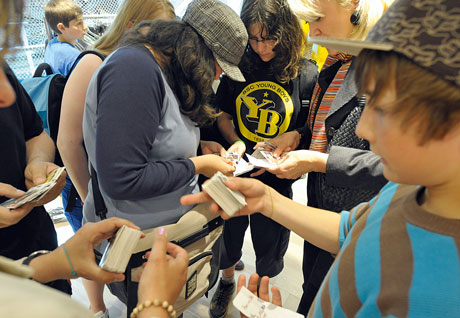
The deal between Tamedia, NZZ, and the Gut family comes at just the right time, riding the wave of Panini fever surrounding the 2010 World Cup. Finally, everything everyone has always wanted but couldn’t achieve is coming together. Trading makes it happen.
Editorial
-
April 21, 2010
A look back: When the shareholders of the Thurgauer Zeitung (TZ) announced the sale of their publishing house to Tamedia, the publisher of the Tages-Anzeiger, at the beginning of September 2005, the St. Galler Tagblatt (SGT) was very upset. The St. Galler Verlag, a subsidiary of the NZZ Group, had also negotiated with the TZ about cooperation in the print and advertising sector and later even about integration into the SGT headline system. "In the end, the Zurich bidder was surprisingly awarded the contract - but not for a cooperation model, but for a complete takeover," the SGT sobered up the day after the deal was announced. The government council of the canton of Thurgau also regretted the takeover of the Thurgauer Zeitung by Zurich-based Tamedia. This means that a media company with a long tradition is losing its independence. However, it sees the takeover by Tamedia as an opportunity, as the Frauenfeld site could be expanded as a result and the canton would continue to be served by two cantonal daily newspapers. In a weekly interview with Werbewoche in April 2006, Daniel Hofer, then Director of Publishing and Production and member of the Executive Board at Neue Zürcher Zeitung AG since January 2006, answered the question of whether NZZ would swap its holdings around Lake Zurich for the Thurgauer Zeitung: "Swapping Thurgau for these holdings is absolutely not a topic of conversation for me. On the contrary: the regional newspapers and the NZZ are a very good match and complement each other to provide a very attractive product offering for readers in the greater Zurich area". Now, four years later, everything is different. How did this come about? Last December, Thedi Gut, Chairman of the Board of Directors of Zürichsee Medien AG, told the magazine Klartext that the Zürichsee-Zeitung was up for sale: "It's about the succession plan; I'm now 62 years old. The Board of Directors and the family have decided that we want to have this succession plan worked out by next summer." At the end of January, Thedi Gut confirmed to Werbewoche: "Zürichsee Medien AG is a family-owned stock corporation. No one in the family is willing to succeed me. We on the Board of Directors have therefore decided to examine various options for this succession plan. One of these options is to offer part of Zürichsee Medien AG, namely Zürichsee-Druckerei and our majority stake in Zürichsee-Zeitung, on the market." When asked whether Freie Presse Holding does not have a pre-emptive right to the 60 percent share of Zürichsee Medien AG in Zürichsee Presse AG, Gut said: "They have a pre-emptive right to this 60 percent, but only if we sell it alone. That's how it's worded in the contracts." Gut continued: "We have a clear idea of what Zürichsee Medien AG - the parent company - should look like in five to ten years' time. We do not want a unilateral sale of our 60 percent stake in Zürichsee Presse AG, in which only NZZ would be a possible buyer. Such a sale would not solve our internal family problems. We are therefore not even considering this option." The NZZ was correspondingly miffed. Albert Polo Stäheli, CEO of the NZZ Group, told Werbewoche: "As a long-standing partner of Zürichsee Presse AG, we are astonished by the actions of Zürichsee Medien AG. Both partners in Zürichsee Presse AG have a contractual right of first refusal and pre-emptive right to the other's shareholding. Whether this right of first refusal and right of first refusal can be circumvented by the now chosen construct of a subholding with the addition of prepress services will have to be clarified by the lawyers." Two months later, Conrad Meyer, Chairman of the Board of Directors of the NZZ Group, was interviewed in his own newspaper. When asked by the journalist what he had to say about Thedi Gut's bidding competition, Meyer said: "We hold 40 percent of Zürichsee Presse AG. A right of first refusal was agreed at the time of purchase. At the time, we assumed that it would come into effect when Zürichsee Presse was sold. Now, however, the effectiveness of this right is to be undermined with a legal construction. We don't think that's extremely nice." Then last week came the big surprise. The media companies NZZ Media Group and Tamedia agreed to swap their regional newspaper holdings in the cantons of Thurgau and Zurich. The Gut publishing family and FPH Freie Presse Holding are selling their stakes in the Zurich regional newspapers Zürcher Unterländer, Zürichsee-Zeitung and Zürcher Oberländer to Tamedia. Tamedia wants to introduce the "Bern model" in the canton of Zurich with two newspapers under one publishing umbrella. It is not yet clear who will participate. In addition to the regional newspapers, negotiations are also being held with the Winterthurer Landbote, which is 20 percent owned by Tamedia, and the independent Schaffhauser Nachrichten, as Martin Kall, Chairman of the Management Board, told the media in Zurich. Where these negotiations will lead is completely open. A decision should be made by the end of the year. Tamedia has two newspapers in mind that are journalistically different, Kall continued. He described the "Bern model" as a "clever model". Something like this should also be possible in the canton of Zurich. This should create more advantageous economic prospects for the daily newspapers involved. This also applies to advertising sales, where such a combination (with or without Tages-Anzeiger) could possibly meet with interest. The question arises as to how Kall will deal with the fact that the Zürcher Unterländer and Zürichsee-Zeitung are currently marketed by Publigroupe. Kall is not necessarily a friend of Publigroupe and is instead focusing on its own marketing. The conditions offered by the Lausanne marketer would have to be very favorable for Kall to change his mind. FPH Freie Presse Holding AG, a subsidiary of the NZZ media group, is taking over Tamedia's 100 percent stake in Huber & Co, the publisher of the Thurgauer Zeitung. The Thurgauer Zeitung will be integrated into Tagblatt Medien from the beginning of 2011. The combination of the Thurgauer Zeitung with the Thurgau edition of the Tagblatt is intended to create a journalistically strong and economically viable voice for the whole of Thurgau. And everyone is happy. Except for the Thurgau government: "Newspaper diversity was desirable, but now there is only one newspaper in the canton," said Claudius Graf, President of the Thurgau government. Who cares? Pierre C. Meier
An agency goes on tour
Numéro 10 is launching the Tool-Box and offering strategic services, training courses, and workshops directly to customers.
Editorial
-
April 21, 2010
Everyone is talking about buzz and viral marketing. But what's behind it? Last fall, the advertising agency Numéro 10, together with its dynamic communication unit BUZZILLA, held three events in Zurich, Bern and Lausanne to explain how the new mechanisms of "dynamic advertising" work. Numéro 10 has noticed a great demand for such offers in response to its smart film "Attack of the Buzz". "Many new customers showed interest in our ideas. However, knowledge about the possibilities of dynamic advertising is often still very abstract," says Gilles Aeby. The event with the film was a door opener; now that the door is open, it is important to offer something that meets the interests and needs of customers. The CEO of Numéro 10 and lecturer in buzz, viral, social media and guerrilla marketing at Sawi now wants to "go even deeper into the heart of the disciplines". The agency is going on tour and visiting potential clients to offer specific training courses for their marketing departments. These workshops allow companies to get a better grip on their brand and communication strategy. Clients are also sensitized to the disciplines of dynamic communication and social networks. Markets and trends develop very quickly. However, many customers are too absorbed in their daily business to be able to follow the trends themselves - and, above all, to interpret them correctly. As the specialists in the industry, Aeby and his team now want to make their knowledge more public. "We no longer hide away in the office, but go out to customers to work out the new trends and ideas with them." Numéro 10 has developed a special toolbox as the basis for these workshops, which is now available online via the newly launched website www.numero10.ch. Numéro 10's new program includes strategic services with the Brand Box and Trend Box. The Buzz Box and Social Box are available for further training and the Creative Box for workshops. All five packages are offered at fixed prices for a wide range of topics. The customer knows exactly what they are buying and at what price. This provides total cost transparency. "There is great interest in branding, trends, dynamic advertising and social media. The market demands new ideas. But people still don't know how to deal with buzz and guerrilla. That's why many marketers are reluctant to invest in such campaigns," says Gilles Aeby. With the toolbox, he now wants to offer the necessary decision-making aids. Before potential customers decide on guerrilla or a viral campaign, they can test whether such methods actually fit in with their company and brand philosophy. The agency's strategists do not simply pull the solutions out of a drawer, but prepare for each workshop individually - tailored to the needs of the client and their industry. A workshop was recently attended by 100 people who were to be informed about their company's new communication in general. "The topic is kept flat," explains Client Service Director Cendrine Gafner. Normally, ten people from the marketing department attend such workshops. The training course for dynamic communication is called the Buzz Box. Such a meeting lasts half a day with theory and practice and costs a fixed CHF 5,000. The Buzz Box is a training tool for buzz, viral and guerrilla marketing. After the workshop, clients are able to give the agency a much more meaningful briefing on how to proceed. "The client feels more at ease. They know where there is potential for their communication." The client is involved and therefore believes in the idea. And they will also have a much more personal contact at the agency in future. If the customer believes in the approaches gained after the workshop, these can be developed further. Numéro offers 10 different modules formatted according to a proven standard. Some no longer function as workshops, but can be purchased as service tools, with prices ranging from CHF 5,000 to CHF 35,000, as declared in the catalog. The brand box, for example, is used to develop brand identity. A brand review analyzes and compares the brand in the competitive environment. The values sought for a positioning are defined here. ¨ The Trend Box links the brand with the latest trends. Numéro 10 works together with external institutes for the Trend Box. Here the customer is informed about the latest trends and results. International monitoring is also offered. A social box optimizes a company's presence on social media. The Creative Box is again organized as a workshop. Here, new approaches for a mixed campaign are to be developed together with the customer using a specific method. "We want to make it clear to clients how classic and dynamic can be efficiently developed and combined together." Ultimately, this is the strategic strength of Numéro 10: buzz, viral, social media, guerrilla and a classic campaign should harmonize and support each other. In the workshop with the Creative Box module, more thrust is developed in the search for ideas for a company. Numbers also play an important role when working with the toolbox. Until now, many customers had no indication of how dynamic advertising could be measured. "There was a lack of background for reliable points of comparison." However, with over 40 dynamic campaigns that Numéro 10 has already implemented, such values are now tangible for expert interpretation. "The ideas of guerrilla are often still very wild. But with all our campaigns, we have learned what works and what doesn't." Andreas Panzeri Gilles Aeby, strategist and CEO, has been the sole owner of Numéro 10 in Bremgarten, Bern, since this spring. Cendrine Gafner has been appointed to the Executive Board and continues to act as Client Service Director. With a French-speaking and a German-speaking Swiss member of the management board, the agency is now organized more bilingually, which perfectly embodies the agency's philosophy. Numéro 10 offers classic communication and has also specialized in dynamic advertising - buzz, viral, guerrilla - with its own BUZZILLA unit.
With its new website, Numéro 10 is also launching a web radio station "with sunny music and international podcasts on various communication topics". Every month, around 10 podcasts will be broadcast in rotation. The new site also features a blog about the best international cases in classic advertising, buzz and viral as well as the latest guerrilla campaigns. The website and blog are linked to the Numéro 10 platforms on Facebook, Twitter and Netvibes.
The advertising week on Star TV: Making of "Swiss Weeks at McDonalds"
On Thursday at 7:45 p.m., Star TV will follow director Patrick Senn as he films the «Swiss Weeks at McDonald’s» commercial trilogy.
Editorial
-
April 21, 2010
In the "Spot of the week" section, you can see how the creative agency TBWA/Zurich combines regional burger specialties with a rather special drive-in ordering method.
You can see this, as well as the current commercials, on Star TV or stream them at any time on www.startv.ch. Advertising week on Star TV: New every Thursday at 19:30 on Star TV.
Mario Aldrovandi leaves Lobster Studios
After more than four years, Mario Aldrovandi is stepping down as CEO and Chairman of the Board of Directors, effective immediately.
Editorial
-
April 21, 2010
The reason for this is that the management and shareholders have different ideas about the company's strategy. The new Managing Director of Lobster Studios is André Eichholzer.
Unvarnished bedtime stories from crumpled underwear
For 150 years, we’ve been enjoying a healthy, restful sleep thanks to Bico mattresses. But beyond its beds, the Swiss market leader has always been wide awake when it came to developing new products—products that also called for a fresh, dynamic brand identity. Now, WVC in Bubikon has designed a completely new visual identity for Bico.
Editorial
-
April 21, 2010
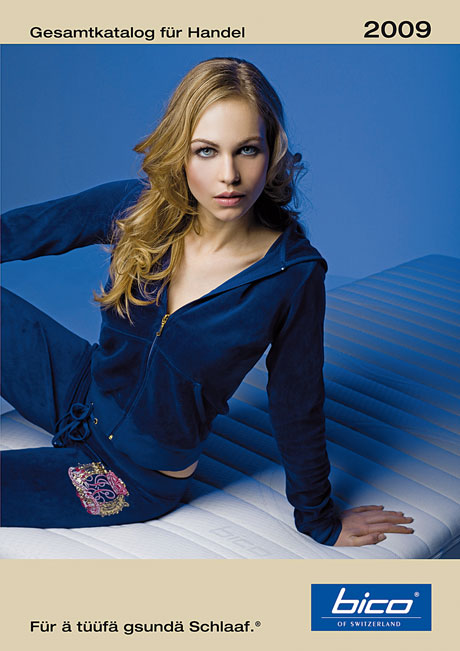
We spend around a third of our lives sleeping. Since its foundation in 1861, Bico in Schänis has therefore been committed to guaranteeing quality and innovation as a knowledge leader in the field of healthy sleeping comfort. This has not only helped the company to become the market leader. With its slogan "Für ä tüüfä gsundä Schlaaf" (For healthy sleep), which has been popular for decades, Bico has also made it into the charts of the most popular claims in Swiss advertising. A promise that is obviously being heard. The Swiss market leader in the premium mattress sector enjoys a high level of trust among consumers. Awareness of Bico is over 90 percent supported and 50 percent unsupported. In earlier years, the twins in advertising, which had almost become popular, certainly contributed to this. An advertisement with the Eden trio was later also located in this area of comedy and slapstick. Until recently, Bico relied on "ambassador" Sabrina Knechtli, the 2007 Swiss Miss runner-up, for communication materials such as trade catalogs and consumer brochures. But not only a Miss, but also a visual language inevitably gets the label "ex" one morning. Following a presentation in summer 2009, WVC Communications was commissioned with the relaunch of the Bico brand. The focus was on repositioning through a new visual language. WVC developed alternative communication concepts that still aimed to support the authenticity of the core message "Für ä tüüfä gsundä Schlaaf" and to position the Bico brand as a leading premium brand. Warm and safe WVC therefore asked itself whether the previous visual language with a made-up and elegantly styled Miss could continue to optimally support the message of "healthy sleep" and thus the trust in and sympathy for the brand. The answer was no and WVC has since developed various visual worlds that focus on a more authentic statement. Natural sleeping, unadulterated and genuine is now visualized without make-up and styling, unshaven and with tousled hair. In crumpled bed linen, of course. Used pyjamas were also attributes for the new photo style, as CD Kurt Wettstein explains. A minimum of light conjures up a homely and cozy atmosphere. The implementation in black and white is a further step towards an unmistakable visual world that will be clearly recognized as the new Bico world in the future. The new appearance was shown in a marketing research analysis and was given the edge over all competitors, as consultant Yves Seiler reveals. The design generated statements such as "It feels warm and cozy" or "The people look like they sleep really well". The comment "Simply normal. Fits in with Bico. No big fashion frippery" confirms WVC's considerations. The entire photo shoot was carried out in-house at WVC. This also included the casting of the exclusively amateur models, the photographs by Kurt Wettstein himself and the image processing by Roger Sommerhalder. The current catalog is available in stores. Posters and advertisements have also been produced. Various POS materials are available and have already confirmed at initial trade fair appearances that the new visual language is understood. "A bold step and the right decision by the management." Andreas Panzeri
Creative - necessarily
Tatort is the name of the young Bernese design and communications agency that has already made over 50 small and large clients happy in the last two years. Founder Diobe Daniel Wyss and his partner Francisco Rojas shoot fast, sharp and right on target. That's why most of their clients return to the «scene of the crime».
Editorial
-
April 21, 2010
Diobe Wyss (40) was born in Cameroon. His father went to Central Africa as a missionary in the 1960s, giving his son a sunny start in life. When Diobe was two years old, the family returned to Switzerland, where Diobe grew up and went to school with three siblings in Bern-West. "We lived in a block on the 13th floor there," Wyss says. "After our experiences in the Cameroonian bush, the distance from the ground did us good." It took Diobe Wyss a little time to figure out that he was an advertiser. However, he has been full of ideas, passion and drive for a lifetime. As a boy, Wyss dreamed of becoming a bus driver. The "Gummitram" simply fascinates him. After school, however, he heads for an apprenticeship as an electronics technician and, due to a lack of apprenticeships, starts a mechanic apprenticeship. "That was a good time, because even as a child I liked to tinker a lot. But even though I made the organ pipes of Basel Cathedral sound again and my Töffli could rival a Vespa, I soon realized that the mechanic's job was not my world," he says. So Wyss tried studying microtechnology at the Bern University of Applied Sciences for Technology and Information Technology. But: "That wasn't it either. I didn't just want to do something with my hands, but also with people." Wyss is the scion of a family of teachers and pastors. So it stands to reason that he would also go in this direction. He completed a teaching degree and worked for several years as an educator, in adult education and as a teacher of German as a foreign language. Among other things, Wyss gets a handle on an eighth-grade problem class in Burgdorf as a young teacher and passes as a home tutor for a Swiss family on an Indonesian island in East Kalimantan. "My time in Indonesia had a big impact on me," Wyss says. "I learned that all people are equal and that you can communicate with each other without speaking the same language." Wyss is also successful as a teacher because he follows a clear line and doesn't pretend. "Clarity, authenticity, a lot of humor and a certain cheekiness are also essential for my work as an advertiser and designer now," he is convinced. Any caliber welcome Wyss has been working in the advertising industry since 2000: at the age of 30, he made his debut as a copywriter and concept developer at Fruitcake, an agency in Bern. "Together with my current partner Francisco Rojas, I worked for big clients and learned a lot about how the advertising industry and the agency business work." Wyss and Rojas receive a lot of positive feedback on their work, so that the idea to continue the success story under their own direction arises as if by itself. However, it takes another eight years for this wish to come true: First, Wyss works as a freelance copywriter and designer in the studio community zwei 13 in the "Berner Zentrum für Kulturproduktion Progr" (Bern Center for Cultural Production) and gets involved again as a ¬teacher and trainer. Finally, in 2008, he founds the design and communications agency Tatort. The agency is not called Tatort because Wyss has a penchant for violent acts. Rather, to acts in general: "A crime scene is a place where something happens - that doesn't have to be negative," explains the agency boss. "We wanted to have a name that stands out from the crowd, that polarizes and stays in the memory. It also had to raise questions and provide something to talk about. Crime Scene is a good door opener." Consequently, Wyss and his collaborators call themselves "perpetrators," and they refer to their work as "deeds." Wyss and his fellow perpetrators provide their clients with everything that has to do with communication: from business cards to corporate design, from PR texts to posters and advertisements to guerrilla campaigns, from complete websites to brochures and magazines. Tatort is also the right contact for illustrations: Francisco Rojas is known for his ballpoint pen portraits and caricatures. In the act Tatort is particularly strong in the development of CI/CD, whether it's the Wölkchen logo and lettering for the architecture firm Freiluft, a complete campaign for the City of Bern's Directorate of Safety, Environment and Energy, or the CD for Bären Haustechnik, a subsidiary of Energie Wasser Bern ewb. "We find the right worms for all fish and develop spot-on concepts for both the big and the small," Wyss emphasizes. "It's not only the big deeds, but also the small ones that make us successful." The fact that the "perpetrators" take on even the smallest jobs doesn't mean that two creative people muddle around with their private ideas and take the work as it comes. Tatort's clients quickly notice that, too. Wyss and Rojas are professionals - perhaps precisely because they are jack-of-all-trades. They combine a wide range of skills and a broad horizon with in-depth knowledge of how marketing, advertising and design work. What comes out is convincing. One example: In Bern, bears are omnipresent. That increases the danger of thinking the subject through ad nauseam. Several bears also appear in Wyss's and Rojas's works. But one does not get tired of them. It's no coincidence that the agency, which is only two years old, has already won several pitches against large, established agencies. Wyss and Rojas' business approach shows that they have a clear view of their customers' needs: "When we make an offer, we usually provide initial design proposals free of charge," says Wyss. "After all, the end result should not be numbers, but a logo, a magazine or a poster. It's hard for our customers to imagine what that might look like if they're only presented with numbers." Of course, such preliminary work involves a certain risk, and the "perpetrators" are well aware of this: "Of course, we don't present a finished concept, that would be unwise. Anyone interested in our work should simply get an idea of what we can do. So far, we've done well with that." Creative blood With this story Tatort was able to convince the University of Fribourg, Energie Wasser Bern ewb, the association Swiss¬cycling, the city of Bern, Comedia Bern, the mountain railroads Oeschinensee, the Laserinstitut Thun, the city of Bülach, the medical association VSAO and the electric bike manufacturer Biketec in Huttwil. Among others. Tatort's customer base even includes a client from Germany who works for the automotive industry, high-profile fashion labels and renowned publishing houses. Many clients come to Tatort on recommendation. Or Wyss acquires them cold. Currently, his heart is particularly set on product design for organic food, which the agency has developed for the Schönenbühl mill, a project of the Burgergemeinde Bern. "Now all we need is a major distributor in our portfolio," says Wyss with a wink. Currently, Wyss, Rojas and their freelancer are working on eight projects in parallel. They are passionate about what they do. If that's not enough, they have a large network of experts from various disciplines behind them. What's more, the "doers" have a simple secret to success: "We do take our time, because ideas aren't born overnight, at least not in the quality we strive for," says Wyss. "But when the idea is there, Francisco and I work hand in hand and very expeditiously." That's why, on top of all the creative work, the two newly minted dads manage to be there for their family. And neither one nor the other is just on the side. They attach great importance to that. "We usually develop our ideas together; one lays the egg, the other hatches it," Wyss says. "The first sketches are usually created on the scene with paper and pencil." For economic reasons, the perpetrators have a clear division of labor: Wyss handles client relations and copy and concept; Rojas handles design. Tatort has its own clear and simple visual language, but equally has a great deal of variety: "We can also come across completely differently, depending on what our customer wants," Wyss emphasizes. Tatort has not yet set a thematic focus, but it is slowly crystallizing: With its projects for Swisscycling, Pro Velo Bern, Biketec, Bioschwand Münsingen and the Directorate for Safety, Environment and Energy of the City of Bern, the agency is vigorously establishing itself in the cycling scene and building up an expertise in the topic of sustainability. A development that clearly points to the future. That is a fact. Anne-Friederike Wilhelm
Axel Springer: Good development in the advertising market
Europe's largest newspaper group increased its earnings before interest, taxes, and depreciation by 48 percent to 119 million euros in the first quarter. EBITA for the same period last year was 80 million euros.
Editorial
-
April 21, 2010
In the first three months, sales increased by seven percent to just under 664 million euros. In comparison: revenues in the same period of the previous year amounted to 620 million euros. The jump in profits was due to an upturn in the advertising market, particularly in March, as well as a tough cost-cutting program, as the Handelsblatt cites company information. However, the Axel Springer media group will not publish its complete balance sheet until May 11.
European Newspaper Congress: Start on Sunday - with record participation
The decision was made today at 11 a.m.: The European Newspaper Congress will now take place in Vienna from April 25 to 27 after all.
Editorial
-
April 21, 2010
Due to the Europe-wide flight bans caused by the volcanic eruption in Iceland, it was unclear until today whether the largest European newspaper congress would have to be postponed. Now that the situation seems to have returned to normal in the last 24 hours, the program can be implemented. This was announced on the press portal on Wednesday. One of the major problems had been whether the speakers from all parts of Europe could get to Vienna in time. Even if the situation were to deteriorate significantly again by Sunday, alternatives for travel from distant countries have largely been found. 600 editors-in-chief, department heads, media managers and junior executives have registered for the 11th European Newspaper Congress. This is once again more than in previous years. The program kicks off on Sunday evening with the traditional Heurige, hosted by the editors-in-chief and the management of the press. The "European Publishers Forum" will open the newspaper congress in the ballroom of Vienna City Hall on Monday. This is taking place for the second time this year. The focus will be on the question "How can journalism remain financially viable?" In the evening, Europe's Newspaper Makers of the Year will be honored. Tuesday starts with the "European Editors Forum" with the general topic "How independent is journalism?" under the direction of Press Editor-in-Chief Michael Fleischhacker. This year, the European Newspaper Congress will focus on local journalism. Exceptional creators from all over Europe will present their concepts and ideas. The European Newspaper Congress is organized by the media publishing house Oberauer and the German newspaper designer Norbert Küpper. Sponsors are the City of Vienna, JTI/Austria Tabak and Vienna Insurance. The media partner is Die Presse.
Advico Young&Rubicam: With Sportplausch Wider on a rampage
Ay&R has produced new radio spots for Sportplausch Wider to mark the start of the biking season.
Editorial
-
April 21, 2010
While the cars are stuck in traffic jams or in front of one of the countless roadworks, the bikes whizz past left and right. Because on a bike you can afford a riding style which, if transferred to a car, would lead to veritable road rage. This is shown in the commercial, with the tip for car drivers: "Off to Sportplausch Wider in Wallisellen and switch to a bike yourself." Spot Mountain Bike Spot Racing Bike Responsible at Sportplausch Wider: Peter Wider. Responsible at AY&R: Markus Gut (CCO), Martin Stulz (text), Oliver Glutz (AD), Selmi Tonstudio (production).
Flop of the week: Volcano gives Friends a hard time
Actually, the commercial that the Hamburg-based agency Scholz & Friends recently produced for Siemens is harmless—if it weren't for Eyjafjallajökull. The Icelandic volcano threw a wrench in the advertisers' plans.
Editorial
-
April 21, 2010
Due to the effects of the volcanic eruption, the latest commercial from Scholz & Friends is attracting more attention than the Friends would like. The commercial begins with a volcano spewing ash. The film also provides the solution to the problem: simply vacuum up everything with the new vacuum cleaner from Siemens. It's actually funny, but Eyjafjallajökull is now the advertisers' undoing. The commercial is cynical, they say. But honestly, nobody could have guessed that the Icelandic volcano would paralyze half of Europe. Unfortunate coincidence? Unfortunately, this is not the first time that a Scholz & Friends campaign has been caught up in current events. The Berlin branch was confronted with a similar situation in January. At the time, the agency had just launched its campaign for the German Confederation of Skilled Crafts (ZDH) when the earth shook in Haiti. The images from the image spot showed how the world was literally crumbling apart.
What companies can learn from the Facebook war between Greenpeace and Nestlé
Through the «Give Rainforests a Break» campaign, Greenpeace’s digital activists put pressure on Nestlé. Nestlé was caught off guard by the campaign and reacted inappropriately. What can companies learn from this case?
Editorial
-
April 21, 2010
In mid-March 2010, Greenpeace infiltrated the KitKat Facebook fan site with around 730,000 fans to get the "Give rainforests a break" campaign rolling. The campaign aims to get the corporation to stop using palm oil, which is obtained by clearing rainforest that serves as a habitat for endangered orangutans, in the production of KitKat. The outrage of the community was great. It was not only expressed on the KitKat and Nestlé fan pages, but also on other fan pages, Twitter and blogs. As a result, Nestlé got carried away with reactions that strengthened the community's commitment even further. Every company must be aware that it cannot fully control its presence on social networks. It must therefore be prepared for a possible escalation. Be prepared Every company has weak points and must therefore reckon with coordinated, organized attacks from critics on social networks. The power lies with the communities. Facebook fan pages can be infiltrated by critics for their own purposes. It is therefore advisable to work with PR experts to prepare action plans for any escalation. Social media monitoring Social media monitoring identifies, monitors and analyzes posts about a product or company on social networks (user-generated content, UGC). For most companies, the free social media monitoring tools are sufficient*. The paid tools take over the transparent processing of positive and negative posts as well as the identification of opinion leaders according to geographical and demographic criteria. It almost looks like Nestlé didn't do any social media monitoring and thus wasn't prepared for the escalation. React consciously If negative sentiment escalates, the company can counteract this process without repeating the mistakes Nestlé has made: - Censorship of comments and images on Nestlé and KitKat fan pages was a provocation to the community, fueling further reactions and thus accelerating the spread of the campaign - Shutting down the Greenpeace spot on YouTube for copyright infringement was a call for the community to keep sharing the spot - Nestlé's announcement that it will not process palm oil obtained by cutting down rainforests by 2015 has given the community the impression that consumer concerns are not being taken seriously enough - Nestlé only reacted 3-4 days after the launch of the Greenpeace campaign with a PR message to the Facebook community, giving free rein to speculation - Nestlé has failed to take a timely stand on the campaign with a broad public and put the facts on the table. This has allowed the Greenpeace campaign to reach the media unfiltered A company that uses social networks as a marketing tool must be aware that it is entering an environment that is controlled by the community. Image cultivation and control require special attention. Imre Sinka, dotpulse Webagentur AG > Links to the social monitoring tools as well as to the Greenpeace campaign.