Tamedia with significant decline in sales

Tamedia reported a significant decline in revenue in 2009. The media company attributes this almost exclusively to lower advertising revenue. Advertising revenue fell by 21.7 percent in 2009 to 410.8 million Swiss francs (previous year: 524.4 million Swiss francs).

Sales totaled CHF 766 million, which is CHF 124.1 million less than in the previous year. At the bottom line, Tamedia still earned CHF 46.7 million. This is 55.8 percent or 59.1 million francs less than in 2008.
There were significant losses for the regional daily newspapers. Sales fell by 18.6 percent to CHF 491.5 million. The decline is primarily due to the high sales losses of Berner Zeitung, Sonntagszeitung and the Tages-Anzeiger job supplements. The cost-cutting measures taken in the course of the year only took effect at the end of 2009.
However, thanks to the positive development of the magazines and online media as well as various cost-cutting measures, Tamedia achieved a satisfactory result last year, the Group announced. The Magazines division closed the past year with a 6.8 percent lower turnover of CHF 93.9 million. However, thanks to stable sales at Annabelle and the specialist media Agrar and a positive earnings trend at Schweizer Familie, the operating result rose by 3.2 percent to CHF 11.8 million despite investments in 20 Minuten Friday.
Electronic media sales increased by 8.7% year-on-year to CHF 91.2 million. While revenue from radio and TV activities declined, online revenue increased significantly, in particular due to the growth of 20minuten.ch, Homegate.ch and Newsnetz as well as the acquisition of Search.ch.
Despite a slight economic recovery, Tamedia expects advertising revenues in the newspaper and magazine media categories to decline in the current year. The company does not expect an actual turnaround until the end of the year or the following year. imp


To the point: Nothing is impossible

If the Zurich newspaper swap has taught us anything, it’s this: Anything is possible, even the improbable. Everything always sounds great (for now!). Competitors become partners, and partners become competitors.

In the course of the restructuring of the Swiss press landscape, which will certainly continue, it can be assumed that this will also apply in the future.
It seems that for many top people in media companies, the Thirty-Six Stratagems, which are attributed to the Chinese general Tan Daoji, are part of their basic training. And why not, since the art of cunning in war is highly valued in Chinese culture, and the advice from Machiavelli's "The Prince" can also be put to good use in business strategies.
Here is a selection of the Thirty-Six Stratagems that can be wonderfully applied to the media industry:
- Deceive the emperor and cross the sea
- Exploit a fire for a robbery
- Noise in the East, Attack in the West
- Secretly marching to Chencang
- Hide the dagger behind the smile
- Lure the tiger from the mountain to the plain
- Throw down a brick to obtain jade
- Ally with the distant enemy to attack neighbors
- Scold the acacia tree while pointing to the mulberry tree
- Lure to the roof, and then pull away the ladder
- Decorate drought trees with artificial flowers
So what does this mean for the Swiss media landscape? For reasons of space, let's limit ourselves to the German-speaking part of Switzerland and let our imagination run wild.
The Basler Zeitung could cooperate with the Mittelland¬zeitung. However, such a cooperation with the NZZ or even Weltwoche would also be conceivable. The Mittellandzeitung allies itself with the NZZ or cooperates with Tamedia. The Schaffhauser Nachrichten cooperates with the Zürcher Landzeitungen or resists Tamedia's wooing and prefers to team up with the NZZ. Or they resist the enticements from Zurich and for the time being remain the small Gallic village (Asterix sends his regards!).
Whether these cooperations result in shareholdings or even takeovers remains to be seen. Perhaps there is also no need for prior cooperations as a fig leaf, but rather direct action is taken. Always remember: Nothing is impossible. And if something still seems impossible to you, then delve into the Thirty-Six Stratagems.
Pierre C. Meier, Editor-in-Chief
[email protected]

Brainfood that really inspires

To keep your mind and body in top shape for the exam: Nutritionist Spahr explains which foods are best for keeping your brain sharp.

Ms. Spahr, how much does nutrition influence concentration and performance on exams?
Corinne Spahr: You can't make your brain smarter with targeted nutrition. Or to put it bluntly: You can't eat smart with brain food. But nutrition is one of the relevant pieces of the puzzle when it comes to performing as well as possible on an exam. In general, you need to know that the brain, unlike the muscles and the liver, can store practically no energy. The brain is dependent on a constant supply of energy in order to be able to perform. But it is also choosy: It can only be driven to peak performance in the short term in the form of glucose (dextrose). A lack of glucose can lead to a drop in performance or loss of concentration.
So it's all very simple then: bunker up with glucose and keep topping it up. Right?
Unfortunately, it's not that simple. Just like caffeine, a short-term performance booster, glucose also has to be taken into account: a quick high is followed by a low. It is better to consume something that provides a continuous supply of energy than to fill up on such empty energy.
What are you thinking about?
The favorites for a powerful brain come from three groups. First, there are the carbohydrates, such as dark breads, crispbread, flake mixes, but also vegetables, salads and fruits of all kinds. Far too few people think about the group of proteins. Milk and dairy products such as yogurt, quark, kefir, but also meat, fish and eggs stimulate the brain. From the group of fats I would like to mention rapeseed oil, olive oil, flaxseed and nuts.
Not all of it can be taken to an exam. Let's take a look at this in concrete terms: How should a good exam day start?
With an optimal breakfast. You should be careful not to overindulge in carbohydrates. Too much bread with butter and spread tends to make you sleepy. If bread, then dark varieties. Dried meat, cheese or an egg, for example, make you awake.
There is a class of workers who never eat breakfast at all. What do these people do?
You should eat at least something small. Often only once a glass of milk helps and for this should eat a larger Znüni.
What do you eat during the exam or during breaks?
For example, you can take a sandwich with you, for example with dried meat. Fruits, vegetable sticks or a protein-rich bar are also suitable for keeping the brain active. And of course, don't forget to drink enough. Instead of soft drinks, drink water, diluted fruit juices, herbal and fruit teas, or water flavored with syrup.
Examinees often have a space problem, their desks thick with papers. What would the best possible brain food small pack look like?
A water bottle, plus a banana. Or a Tuttifrutti. Or pieces of fruit bread.
What dietary sins should you avoid on an exam day?
The biggest dietary sin is to think there is one. However, a plate of pasta is probably less sensible on exam day. Especially if the pasta is served with a greasy sauce, it blocks the mind and body. Also unfavorable are sausages, French fries, greasy pizzas, puff pastry and cake dough or too many soft drinks. There is nothing wrong with something sweet after a light lunch, such as a chocolate bar. During the exam, as during the entire training period, it is important not to become a stress eater. Many people think they are rewarding themselves for their hard work with a big plate of pasta with a heavy sauce. But for the body, this is more of a burden than a reward.
Advertising likes to suggest that energy drinks provide the optimum kick. Right?
Due to the high caffeine content, this may be true in the short term. However, the high sugar content also has an equally short-term effect: performance is ramped up quickly - and then drops again immediately.
Likewise, we are told that green tea or soft drinks with green tea extracts have a performance-enhancing effect. Is this true?
Similar to energy drinks or coffee, we see a quick effect here - but one that also quickly wears off again. Green tea contains caffeine, formerly also referred to as tein, teein or thein in connection with tea. Most of the health-promoting effects of green tea are attributed to the catechins. They belong to the group of polyphenols, secondary plant compounds that have various effects such as anti-inflammatory, immune system boosting, etc. Catechins are also the substances that give the tea its bitter taste.
Based on your recommendations, how smart is it to suddenly eat and drink things you can't stand otherwise in the days leading up to the exam or on exam day?
I do not recommend that. What doesn't suit you can have a negative effect on your psyche. You can also ask yourself whether it will do any good to switch to a healthier diet in the days before the exam. I think that does less good than once you fundamentally consider approaching your health management more holistically. Well-being and performance - physically and mentally - is always a triad of nutrition, exercise and rest.
1290580961_img100421_corinnespahr
Corinne Spahr.

The Impact Check of Werbewoche

We show how current campaigns are performing with consumers.

In terms of awareness, the Charles Vögele campaign by Publicis ranks first, followed by the Rivella ad by Erdmannpeisker and the ad for Max Shoes by the advertising agency Jung von Matt. The Rivella ad ranks first in the “Uniqueness” category, followed by the Max Shoes ad and the ad for the Dermatological Laser Institute by the advertising agency Tatort Kommunikation. In the “Brand Fit” category, the ad for Max Shoes takes first place, ahead of Rivella and the ad for Steps by Migros. In the “Likeability” category, Max Shoes also comes out on top, ahead of Rivella and the ad for the Dermatological Laser Institute.
> Results at a glance
> Detailed results

Question and methodology
Method: Computer Assisted Web Interviews (CAWI).
Instrument: Online interviews via the Marketagent.com reSEARCH platform.
Target group: web-active people from German-speaking Switzerland between the ages of 14 and 59.
Sample size: n = 500 net interviews, random selection by quota.
Survey period: April 7, 2010–April 14, 2010.
Questions:
- We introduced you to some ads at the beginning of today's survey.
Which of these ads do you remember? Please name the advertising companies or the brands advertised. (Awareness)
- In your opinion, to what extent do these ads stand out from other advertising in newspapers, magazines and journals? Please rate each from 1 (= lifts
does not stand out at all) to 6 (= stands out very strongly). (Uniqueness)
- To what extent do these ads fit the image you have of the respective brands/companies? Please rate each from 1 (= does not fit my image of this brand at all) to 6 (= fits my image of this brand very well). (Brand Fit)
- To what extent do you like the following ads? Please rate each from
1 (= I do not like at all) to 6 (= I like very much). (Likeability)
The values printed are in each case the top box ratings "stands out very strongly", "fits very well with my image of the brand", "I like it very much".
The author of the representative «Impact-Check» study is Marketagent.com Switzerland, a company specializing in online market and opinion research, which has an ISO-certified panel of 20,000 respondents in German-speaking and French-speaking Switzerland. Marketagent.com Switzerland is a subsidiary of the leading Austrian market research company Marketagent.com online reSEARCH GmbH and the Swiss communications agency Contract Media AG.

Top of the week: Listings up again for the first time in two years

In March 2010, advertising revenue rose by 2.9 percent compared with the previous year, reaching 162.5 million francs. The situation in the advertising market eased significantly in March.

In January, the decline was 16.5 percent, in February it was 1.5 percent. In the first three months of the current year, advertising revenues thus amounted to CHF 382.2 million. This corresponds to a decline of 4.3 percent compared to the same quarter of the previous year, as announced by Wemf AG für Werbemedienforschung. Job advertisements continued to decline in March. They fell by 7.8 percent. The decline in real estate advertisements amounted to 12.8 percent. Commercial advertisements increased by 5.2 percent. Brochure inserts also recorded an increase. All print media categories benefited from the higher advertising volume, with the exception of the Sunday press (-12.0%) and the trade press (-8.3%). The regional weekly press recorded the highest increase at 16.8%, followed by the financial and business press (+8.5%) and the daily press and general press (+6% each).

Last but not least: Apple's latest marketing stunt is a drunk employee

Rumors and information about new devices are constantly circulating on the Internet before they are officially announced. It seems that this new marketing strategy has once again passed Apple by.

The whole world now knows about the new iPhone, which wasn't actually due to be unveiled until June. This is despite the fact that Apple is considered one of the most secretive computer companies in the world. Apple has the internet portal Gizmodo.com to thank for the device's fame. They present the prototype on their homepage and actually have the real device, as the Tages-Anzeiger writes on Wednesday. Since the incident, the number of hits on Gizmodo.com has increased tenfold. The makers of the website paid the finder of the prototype just 5,000 dollars for it. As the New York Times writes, Apple has already demanded the return of the device in a letter. Apple developer Gray Powell is said to have left the device in a restaurant on March 18 because he had drunk too much beer to notice the loss. Would Apple really leave its new iPhone in the hands of an employee so that he could get peacefully drunk near San Francisco? Or is this rather a moderately successful marketing stunt by Apple?

Metzgerlehner: Wild campaign for new "Lucerne Rustico

Emmi’s new «Luzerner Rustico» is already on store shelves. Metzgerlehner Worldwide Partners is handling the campaign for the product.

With advertisements, F12/F200 posters and various BTL measures, the latter ensures that the "Luzerner Rustico" is on everyone's lips.
Responsible at Emmi Switzerland, Lucerne/LU: Ivo Arnold (Brand Manager). Responsible at Metzgerlehner Worldwide Partners, Erlenbach/ZH: Felix Dammann (Creative Direction), Marco Lehner (Strategy), John Leuppi, Patrick Meyer (Text), Christoph Schiess (Art Direction), Priska Senn, Rebekka Hofstetter (Consulting), Ursula Trottmann (Desktop Publishing), Giovanni Bucca (Production). Responsible at Zipmedia: Nadine Müller (Media).
1290580960_img100421_rustico1
1290580960_img100421_rustico2
img100421_rustico3

Ziegler Papier: Launch Z-Evolution at Ipex Birmingham

Ziegler Papier is bringing a new product to its booth at Ipex in Birmingham: Z-Evolution. It is set to be unveiled at Ipex.

Z-Evolution is a high-performance inkjet paper coated online on both sides that has been specially developed for use in drop-on-demand printing systems. It will be demonstrated live in action at Ipex on corresponding systems from all major manufacturers of inkjet printing systems. Ipex is an international trade fair for the paper converting industry taking place from May 18-25.
Z-Evolution is particularly suitable for use in transpromotional printing, for printing school books and for direct mailing. Thanks to its color density and low show-through, it can also be used very well in low basis weights. Its coating allows 4-color offset printing and reduces ink consumption in inkjet printing by fixing immediately to the paper surface. Z-Evolution is suitable for high-performance finishing directly after printing, with high water and smudge resistance, according to the company. Its high whiteness enables strong contrasts and photorealistic images
Ziegler Papier can be found at Ipex at its own stand, number C118 in Hall 12.

Oliver Prange leaves Denon Group - new CEO

Maurice A. Nyffeler will become the new CEO of the Denon Group, a subsidiary of Publigroupe, which includes Persönlich Verlags AG in addition to its corporate publishing operations. The current CEO, Oliver Prange, will leave the company at the end of June to focus on the editorial development of Du Kulturmedien.

Maurice Nyffeler has worked for Publigroupe CEO Hans-Peter Rohner in the role of Executive Assistant to the CEO & Chairman since 2008. Prior to this, he worked for the consulting and services company Web2com, which also belongs to Publigroupe, as Head of Sales and member of the Executive Board. The now 36-year-old began his career in French-speaking Switzerland at IP Multimedia.

Net-Metrix Profiles 2010-1: Search.ch and Bluewin at the top

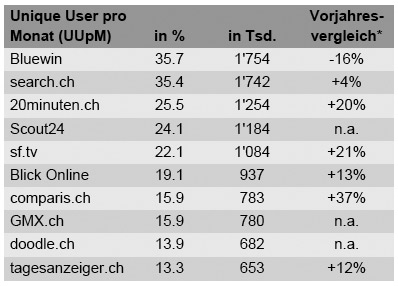
The seventh edition of Net-Metrix-Profile was published on Tuesday. According to the Internet usage study, Search.ch saw month-over-month growth and achieved nearly the same reach as the leader, Swisscom’s Bluewin.

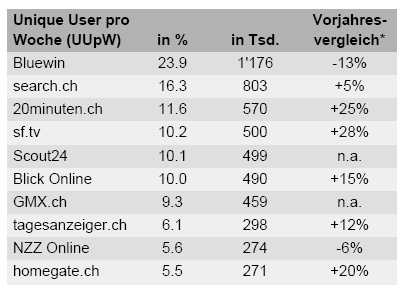
Bluewin's monthly reach of around 1.754 million unique users (UU) was 16 percent down on the previous year. Compared with the previous year, Search.ch achieved a reach of 1.742 UU, around 4 percent higher. The situation is different in terms of weekly reach: Bluewin leads the way with 1,176 UU. Search.ch, on the other hand, has a much lower reach of 803,000 UU.

Monthly reach: Top 10 websites in Net-Metrix-Profile 2010-1

1290580964_img100420_metrix1

Weekly reach: Top 10 websites in Net-Metrix-Profile 2010-1

1290580964_img100420_metrix2

Source: Net Metrix Profiles 2010-1
Basis: 42,665 cases
* Comparison of 4th quarter 2009 (Net-Metrix-Profile 2010-1) with 4th quarter 2008 (Net-Metrix-Profile 2009-1)

Y&R: The online presence tightened up for Thomy

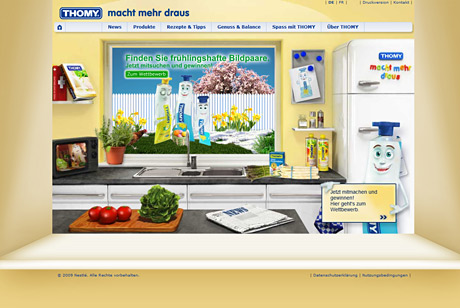
The Y&R Group has redesigned and expanded Thomy's website. Drawing on the visual style of the TV commercials produced by Advico, the site was designed to include, among other things, a collection of tips and recipes as well as a detailed product catalog.

In keeping with the seasonality of the traditional Swiss brand's products, the seasonal page combines current food topics with an interactive element and a competition. For the asparagus season, for example, an online game was created in which pairs of pictures of mayonnaises and sauces have to be uncovered.

Responsible at Nestlé: Marie-Eve Poget (project management), Ulrike Henning (consulting), Susanne Demierre & Sandra Voland (content), Christophe Comte (technical concept). Responsible at the Y&R Group: Martin Sauter (Consulting), Matthias Nöthiger (Project Management), Christian Erni (Creative Director), Isabelle Hauser (Design), Isabel Bischoff (Design & Flash Animation), Christos Margaris (3D Rendering), Matthias Rambold (IT Consulting), Lukas Stieger (Application Programming), Michael Höhn (Flash Programming).

1290580964_img100420_thomy

DRS: SRG Basel generally in favor of studio relocation

SRG Region Basel supports the relocation of the Basel radio studio from Bruderholz to a location closer to the city. At its general meeting on Monday evening, it adopted a declaration of intent that expresses its fundamental support for the relocation.

The declaration of intent was submitted by the board of the regional sponsorship cooperative. It was approved by a large majority with only a few votes against. With the declaration, the cooperative, as owner of the site and grantor of the building rights to SRG, is legally paving the way for the relocation of the studio. However, "nothing has yet been decided" about the relocation itself, as Rudolf Matter, Editor-in-Chief of Schweizer Radio DRS, stated at the meeting. However, SRG is interested, especially as the current studio building on Bruderholz is also in need of renovation, and this would be "relatively expensive".
Matter explained the SRG's convergence project. However, he also had to listen to critical comments from Christoph Brutschin, member of the Basel cantonal government, Anita Fetz, member of the Council of States (SP/BS) and Peter Malama, member of the National Council (FDP/BS). Brutschin supported the demand of the governments of both Basel for a Basel "SRG media campus" for society, science and culture. Matter pointed out that decisions by the Board of Directors on the Basel location were not scheduled until June. However, Basel will remain a main studio location like Bern and Zurich and will also retain culture, albeit together with the Zurich television location. However, it is not yet clear where the science department will go.

get_footer();