6th Award Corporate Communications: Regula Fecker new member of the jury

The 6th round of the Corporate Communications Award has begun. This year, we are once again seeking innovative communication concepts and their implementations.

The communication services realized in 2010 must integrate at least three disciplines in the sense of corporate communications. The "Prize for Integrated Communication" is awarded to communication managers from agencies, companies/SMEs and other organizations who communicate in a strategically integrated, creative and innovative way and thus have a lasting impact on various dialogue groups. The coveted trophies, the "Communicators", will be awarded this year in mid-September in Zurich. According to a press release, the Award-CC project team has gained the Zurich University of Applied Sciences HWZ as a new educational partner. Publicitas Publimedia, Traductor, Ticketino and Schellenberg Druck are now involved in the Award-CC.
The current Advertiser of the Year 2010, Regula Fecker, will also be a new member of the expert jury. In addition, Cyril Meier from the HWZ Zurich School of Business will also be judging the dossiers.
The jury's evaluation criteria, the specifications for the concepts to be submitted and the other conditions of participation can be found on the Award CC website. Award applications can be submitted online with immediate effect. The communication dossiers must then be submitted by the end of July 2010. The award ceremony will take place on September 15. Award-cc.ch.

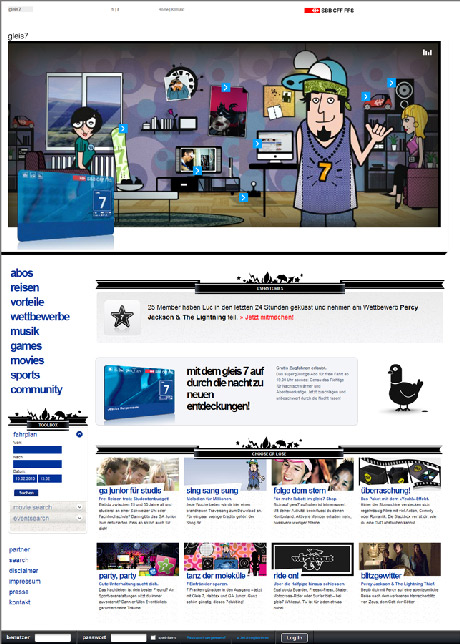
Maxomedia gives Gleis7.ch a new face

Four years after the last relaunch, version 3.0 of Gleis7.ch is now live. The agency Maxomedia is responsible for the concept and implementation of the new website.

This time, the newly launched platform is all about the most popular topic among 16 to 25-year-old site visitors: freedom. According to the agency, the abstract concept has been interpreted to suit the target group: the newly created Gleis7.ch flat-sharing community serves as a creative hook. It is inhabited by 7Frank, who is already familiar from the old platform, and his two new flatmates Gabi Junior and Hannah Freestyle. The three testimonials guide visitors through the various sections of the site: places where something can be experienced and benefited from. The integration of Facebook Connect also makes it easier to register and take part in competitions.
Gleis7.ch was launched in 2003 as an online youth platform for the "Gleis 7" public transport season ticket. Today, young Gleis7, Halbtax and Generalabo customers and future rail passengers form a community with over 300,000 registered members. Maxomedia has been fully responsible for the development and implementation of the site since its launch.
1290580957_img100422_gleis1
1290580957_img100422_gleis2
1290580958_img100422_gleis3
1290580958_img100422_gleis4
1290580958_img100422_gleis5

Last but not least: When ratings success robs freedom

On June 7, the remaining contestants from the tenth "Big Brother" season broadcast on RTL 2 were supposed to be released into the wild.

Life could finally have resumed its usual course, the time in the container with 24-hour surveillance and bitch alarms would have been over. But everything turned out differently: due to the ratings success, RTL unceremoniously moved the season finale forward 63 days. For better or worse, the candidates will now have to live in the TV flat share for around two months longer. And this is only because everything just fits together in this season: The residents, their stories and this year's concept. At least that's what Endemol Germany Managing Director Marcus Wolter thinks. The fact is, however, that the current German season - for whatever reason - is attracting an above-average number of people to the television, while the show was canceled in many other countries a short or long time ago. Too bad for the contestants on the RTL show. But somehow the pity is limited. After all, you don't take part in it.

Competition Commission prohibits merger of Orange and Sunrise

The Competition Commission has blocked the merger of the telecommunications companies France Télécom (Orange) and Sunrise Communications. Together with Swisscom, the merged company would have established a collective dominant position in the mobile communications market. In addition, the most active network operator in the market would have been forced out of the market.

As part of the proposed merger, Sunrise was to be integrated into France Télécom (Orange). The in-depth examination of the mobile telephony markets revealed that the merger would leave only two mobile telephony companies with their own network in Switzerland, writes the Competition Commission in a press release issued on Thursday. "This would give them a collective dominant position that could eliminate effective competition and would not be disciplined by any market entries," it said. As a result, the merged company and Swisscom would no longer compete effectively: it would be more advantageous for both companies to maintain a relatively high price level than to attack the competitor's position in order to gain market share.
The synergies that should benefit the end customer are also not significant enough to outweigh the expected competitive disadvantages. The investigation had not revealed any synergies that would promote competition and from which consumers would benefit. In addition, it was not possible to identify any targeted conditions that could have dispelled the Competition Commission's competition law concerns.
"Although the merger would create a larger company than Swisscom, it would also create a situation in which neither company would have sufficient incentives to compete." Furthermore, as the ComCo considers it very unlikely that another mobile telephony company with its own network would enter the market after the merger, there would only be two nationwide network operators in Switzerland. With three providers, however, there is still a certain competitive dynamic in the Swiss mobile telephony market and it remains open to innovation.
For these reasons, the Competition Commission has prohibited the proposed merger. France Telecom and TDC will now examine the various options for the next steps, the companies announced in a press release.

Catholic Church launches image campaign a week late

The Catholic Church's image campaign is starting a week late after it came under massive criticism and was revised. Despite all the cases of abuse, it is focusing on "More good news".

The posters and documents were sent to around 2,000 Catholic parishes in Switzerland on Tuesday, said Simon Spengler, spokesman for the Bishops' Conference, to the news agency SDA. They should have gone into the post a week earlier, but were revised because the "good news" came at the worst possible time for the Church in times of "bad news" about cases of abuse.
According to Spengler, the following points were changed: the sermon by former Auxiliary Bishop Peter Henrici, the intercessions and the accompanying letter by Einsiedeln Abbot Martin Werlen. They were all supplemented with statements and references to the abuse cases. An accompanying letter also explains why the Church is sticking to the campaign despite these circumstances.
As the Bishops' Conference writes in a press release, the campaign as part of the annual Media Sunday on May 16 is intended to "encourage critical reflection on the media and also face up to criticism itself". However, it is not limited to posters and church services - after all, it is not about image, but about action. On the campaign website, the church therefore wants to collect good news from good deeds "and thus set a small counterweight to the media world, which measures the value of news by conflicts and scandals".

Eurovision TV Summit: Deltenre pleads for public service TV with a profile

Ingrid Deltenre opened the Eurovision TV Summit in Lucerne on Wednesday with an impassioned plea for public television. Investments in quality, innovation and a dialog with the audience are necessary to gain trust.

For the Director General of the European Broadcasting Union EBU, public service media will continue to be needed in the future. It plays an important role in ensuring social cohesion, said Deltenre at the start of the meeting of public broadcasters. The greater TV choice for viewers and the increasing pressure on the financing and independence of television stations are a challenge. The question for public television is therefore how to gain the trust of the audience.
For Deltenre, this requires a distinctive, unmistakable program. In concrete terms, this means investing in quality, innovation and establishing a dialog with the audience. The individual broadcasting stations can rely on the EBU to support them, Deltenre continued. She was confident that, by working together, it would be possible to make "the good popular and the popular good" and thus put the trust of the TV audience on a solid footing for the future.

The iPad and advertising

Pierre C. Meier, editor-in-chief of *Werbewoche*, on the iPad, the media's new darling.

Everyone is talking about the iPad. The new must-have from Apple doesn't just fascinate technology freaks - they are even more critical and complain that the new wonder apple has no USB port, lacks a camera and can't be used to make phone calls. As if anyone would need an iPad to take photos or make phone calls. It would also look pretty silly to hold an A4-sized, 600 gram device to your ear or use it to take snapshots for a digital photo album. The Apple fan community and publishing managers, on the other hand, are delighted. They are hoping that the new device will achieve a breakthrough in paid content for the printed press. It is very possible that this could succeed, as the integration of text, images, film, sound and interactivity is very tempting.
Anyone who has ever played around with one of the new apps from Paris-Match or Sports Illustrated is thrilled and realizes that a new fascinating dimension of media consumption is coming our way. Alongside the nostalgic rustling of paper in a printed newspaper or magazine, there is now the fascination of a new media reality. Being able to access attractive media content anytime and anywhere with a stylish gadget that not only looks good on the go, but also on the designer sofa, is a lot of fun. And that should be worth something to many media users.
Media apps also open up new possibilities for advertising. The path from the classic ad to additional product information to a movie and registration for a test drive, for example, is now just a snap of the fingers for automotive advertising. The more attractive the media content will be in the future, the more attractive the advertising will have to be, otherwise it will fall off and no longer be noticed. It is therefore to be hoped that advertising agencies will very quickly familiarize themselves with the possibilities of the new medium. If not, what happened with many new media at the time would happen: agencies were overtaken by new specialized providers and missed out on the business. This was the case with direct advertising and continued with online advertising. Perhaps they are smarter today. One would hope so.

Südostschweiz Medien posts positive result

Südostschweiz Medien in Chur ended the difficult year of 2009 with a slightly positive result. The Graubünden-based media company reported an annual profit of 300,000 francs.

The 2009 media year was characterized by declining advertising revenues, as the company announced on Wednesday. Turnover fell by CHF 5.1 million to CHF 127 million, while earnings before interest, taxes, depreciation and amortization (EBITA) fell by CHF 1.3 million to CHF 5.1 million. Südostschweiz Presse und Print and Südostschweiz Publicitas closed the year with an overall operating result that was CHF 3.4 million lower.
According to the company, last year was dominated by preparations for the new media building. The new building will be constructed in Chur and is expected to be occupied in mid-2012. It will be used to implement what is known as media convergence, the collaboration between print, online, radio and television. Over the past two years, the print business has also been concentrated in Chur, and the Samedan, Arosa, Maienfeld and Bonaduz branches have been closed. The magazine Terra Grischuna, a stake in Ergo Use Swiss and a medical magazine publisher with 26 employees were newly integrated into Südostschweiz Medien. The participation in the national online network News 1 was dissolved.
Südostschweiz Medien has been able to maintain employment at around 1,000 jobs for three years. Some of the old jobs have been lost. They have been compensated for by new jobs in the digital world.

«… would like to take this opportunity to inform you that …»

Outdated phrasing and dry clichés turn every letter into an impersonal form letter. Tips on how to make a great impression on your customers. By Gabriela Baumgartner, lic. iur., LL.M., editor and labor law specialist at the Beobachter Advisory Center.

Clichés are a nuisance. For your customers and for you. These meaningless, cumbersome phrases waste your customers« time because they convey no important information. Whether you »don’t want to miss out on something« is just as irrelevant to your customers as the fact that you feel »relieved« by returning certain documents. You also don’t need to tell your business partner at the beginning of a letter that you’re about to share something with them (»In this regard, we would like to inform you that…”). When your recipient is looking at your email or holding your letter in their hands, what they want to know above all else is what you have to say. As long as you use such clichés in your letters instead of your own fresh phrasing, your messages will end up unnoticed in the trash—or, in the worst case, leave the customer with the impression that they’re being fobbed off with a few standard phrases rather than being courted as a customer.
Get to the point!
The way we express ourselves in writing has changed significantly since the advent of electronic communication. Today, people are writing more than ever before. To ensure your messages stand out from the crowd and catch the recipient’s attention, they must be concise, direct, and free of clichés. Your customer shouldn’t have to wade through cumbersome phrasing, endless nested sentences, and incomprehensible jargon to get your message. Their time is too valuable for that. Avoid complicated, bureaucratic introductions. Get to the point—as quickly as possible. Don’t focus on your own procedure («In response to your letter…»); instead, put your customer at the center by addressing them directly («Thank you very much for your prompt reply»). At the end of the letter, don’t make a distant request for «acknowledgment»; instead, close with a clear statement («Thank you for letting us know by the end of the week»). And don’t be afraid that your directness might come across as rude. A personal closing will leave a favorable impression on your customer. Perhaps instead of ending your next letter with «Best regards,» you could try «Warm regards from foggy Zurich» or «Early summer greetings»?
You can remove these phrases from your vocabulary:
– We hope these documents have been helpful, and we look forward to hearing from you. Better: Do you have any questions about our offer? You can reach our consulting department …
– We would like to let you know … Better: Your order has arrived. Please let us know when we can deliver it.
– Regarding your call, we can tell you … Better: Let’s get back to our phone conversation. We will … your order
– We would like to take this opportunity to thank you. Better: We would like to thank you for the pleasant collaboration.
– We thank you for your efforts. Better: Thank you very much for arranging this replacement shipment as quickly as possible.
– We would like to remind you that … Better: Thank you for letting us know by Friday. Or: Perhaps you didn't realize that we are still waiting for your response.
– For your information, you will receive … Better: Enclosed, you will find the requested …
Book tip
«Write Like a Pro»: 180 Letter and Contract Templates for Everyday Business in Switzerland, Beobachter Guide, 315 pages, CHF 58.–, ISBN 978 3 85569 421 1.
About the Author: Gabriela Baumgartner is a lawyer and editor at the Beobachter Counseling Center and the author of various non-fiction books on writing. In addition to her work at the Beobachter, she leads writing seminars, including some for the Kaufmännischer Verband.
1290580962_img100421_beobachter
Do you need legal advice?
The Beobachter Consulting Center offers you and your employees expert advice by telephone on legal issues concerning your company - 6 months for only Fr. 99.-. Order the consulting package for SMEs at
www.beobachter.ch/kmu or 0800 83 0800.

Journalism as an "ecosystem"

A large portion of the advertising revenue that has traditionally funded newsrooms will, in the foreseeable future, flow either to search engines like Google or to social networks like Facebook or YouTube. Other once-lucrative advertising markets are disappearing entirely because, for example, online classified ads have long been available for free. Op-ed by Stephan Russ-Mohl, director of the European Journalism Observatory at the University of Lugano.

There was therefore much talk of wishful thinking when media experts discussed the future of journalism at an international conference in Vienna. The workshop was organized by Medienhaus Wien together with the Swiss School of Journalism MAZ and the European Journalism Observatory at the University of Lugano.
Phil Meyer, the grand seigneur of US journalism research, is hoping for donations from his fellow countrymen and philanthropic activities such as Pro Publica, a patronage initiative that has just won its first Pulitzer Prize for its journalistic-investigative achievements. Alan Rusbridger, who as editor-in-chief of the Guardian is one of the pioneers of high-quality online journalism, on the other hand, hopes that subsidies will save journalism as a last resort - although it remains to be seen whether the state should reach directly into the empty pockets of citizens who are already groaning under high tax and debt burdens or redistribute the fee money for public broadcasting if the traditional income of publishers from their print media continues to dry up.
Meanwhile, the Project for Excellence in Journalism has calculated in its new annual report that newspaper newsrooms in the USA alone have shrunk by 15,000 journalists in the last three years - that is more than a quarter of all jobs that still existed in 2007. Since then, publishers have saved 1.6 billion dollars in staff costs in their newsrooms. Let's not kid ourselves: The existence of the journalism "ecosystem" is under threat, because even the best newsrooms are dependent on the input of a thousand and one other newsrooms.
Such massive cuts can neither be absorbed by citizen "journalism" (what an absurd neologism: would you confide in a run-of-the-mill citizen lawyer or a citizen doctor?) nor by donations or subsidies. As far as donations are concerned, a quick look at the statistics is enough. The share of charitable donations in the social product of western industrialized countries is in the per mille range. Only in the USA did it reach just under two percent - but that was before the crisis. It is unlikely that the willingness to donate will increase drastically just because journalism is bleeding to death. And for a variety of reasons, patrons such as Bill Gates, as well as average earners, are unlikely to shift their charitable and philanthropic activities significantly to support journalists in need, instead of - let's say - promoting malaria research or helping the earthquake victims in Haiti.
State subsidies, on the other hand, would exacerbate the problems of journalism rather than solve them. Those on the drip lose their independence. And anyone who compares the comparatively lean editorial teams of the NZZ, FAZ, Guardian or CNN with those of the SRG, ARD or the BBC should at least have an idea that state-subsidized quality journalism does not come cheap.
Which is why I can only counter Meyer and Rusbridger with my own wishful thinking: instead of putting everything online for free that they still want to sell in print, may publishers finally convince their online readers - as Le Monde, Le Figaro, the Times and soon the New York Times are trying to do - that journalistic quality and independence cannot be had for free in the long term. (Another dirty word: the "paywall" - no chocolatier or watch manufacturer would think of talking about a "paywall", or even a "wall", simply because they expect their customers to pay a fair and appropriate price for the goods they supply).
What will journalism look like in 2020? The answer will ultimately depend on whether media professionals succeed in changing the public's willingness to pay - but, if you please, in the form of flat rates, online subscriptions or micropayments to boost the self-confidence of editorial teams, rather than donations, which would have to be begged for and which are just as volatile as the advertising market in times of crisis.
Since sophisticated, research-intensive journalism is "only" about a small market segment, the chances are not so bad that this could succeed with skillful, creative and determined persuasion. However, there is now a lack of platforms in Switzerland for communicating what is needed - "journalistically" and not just in the form of PR and advertising, which are far less credible. The New York Times is doing things differently, indeed in an exemplary manner: through continuous, detailed reporting in the editorial section on the newspaper crisis, it has prepared its readers for the fact that high-quality journalism will no longer be available for free.
(PS "Media professionals": I also deliberately chose this hideous, gender-neutral word monster, which is popular in Switzerland, because in this case it is about a communicative "joint task" of journalists and media managers - across the "Chinese Wall", which is in danger of collapsing anyway and should actually separate editorial staff and publishers. Even PR people and advertisers should join in and realize that credible journalism is also crucial for their communication success - whether as a sparring partner or as an advertising environment).

Striking

This time, *Werbewoche* took note of the graduates of the Media Manager course at the Swiss Press Media Institute, as well as an ideas competition designed to promote the Swiss National Music Festival in St. Gallen.

Top Grade for Festland
The Swiss National Music Festival will take place in St. Gallen in June 2011. The organizers are holding a public ideas contest to raise awareness of the event. The concept that resonated most with the jury was «Auftakt»: two enormous eighth notes constructed from an old double gas tank near the music stage. The winning idea was conceived by the Festland agency in St. Gallen.
1290580961_img100421_festland
Media Manager 2010
The following individuals have successfully completed the Media Manager course at the Swiss Press Media Institute: Andrea Bütler-Hufschmid, Neue Luzerner Zeitung AG, Roman Häring, Publicitas Publimedia AG, Christian Hug, Pfister AG, Henrik Jasek, Publicitas AG, André Dummermuth, Publicitas Publimag AG, Tanja Laube, AZ Medien AG, Roman Spirig, Radio Central, Sabrina Wägli, Axel Springer Schweiz AG (from left). Not pictured: Ruedi Minger, Verlag Finanz und Wirtschaft AG; Harry Stöckler, rva Druck und Medien AG. Werbewoche extends its congratulations!
1290580961_img100421_gruppe

Ringier with massive profit slump in 2009

Ringier reported a massive drop in annual profit in 2009. Annual profit after taxes fell by 72.4 percent to 17.2 million Swiss francs. In 2009, the media group generated revenue of 1.3 billion Swiss francs. Compared to the record year of 2008, this represents a decline of 15.6 percent.

Digital revenue fell from CHF 130.5 million in the previous year to CHF 112.3 million. However, revenue from the individual products increased almost across the board. The Blick.ch news portal, for example, generated a profit. The share of digital revenue in total revenue increased to 8.7 percent.
On the Swiss market, the company suffered a 9.5% drop in sales. In Eastern Europe, sales fell by 20.5% and in Asia by 25.9%.
The weak currencies in Eastern Europe - particularly in the Czech Republic and Slovakia - had an additional negative impact. Business was particularly poor in Romania and best in Serbia.
Despite the slump in profits, Group CEO Christian Unger is "highly satisfied". Not many companies can cope with such a drop in turnover, says Unger. Thanks to savings programs introduced at an early stage - expenses fell by 13.4 percent - the break-even point was maintained. Ringier has cut 681 jobs worldwide, 328 of them in Switzerland alone. The company currently employs 7448 people, 3082 of them in Switzerland.
According to Unger, there are still no signs of recovery in the major markets this year. He does see the first glimmers of hope in the small Asian market. Overall, however, the Group CEO does not expect to see an upward trend until the end of the year at the earliest.
According to Chairman of the Board of Directors Michael Ringier, the number of journalistic jobs is also likely to increase again. The major investments of CHF 97 million - including in the newsroom - also show that the Group believes in the future of print media. Ringier also assured that it was investing in the quality of journalism. imp
get_footer();