Last but not least: Osama's involuntary debut as a testimonial
British Airways had actually intended to use its corporate magazine simply to promote easy check-in via iPhone. But somehow, things went awry.
Editorial
-
June 3, 2010
The boarding pass depicted was none other than the globally wanted Osama Bin Laden - and according to Tagesanzeiger.ch/Newsnetz, his name also adorned the fictitious card. Incidentally, this was issued for October 26 to an undisclosed destination airport. The terrorist leader was allocated seat C in row seven in first class. The airline apologized via Twitter with the words "Sorry for the error". They are working on finding out how this could have happened. Really extremely stupid - or perhaps simply a stupid prank by an employee whose days at British Airways are probably numbered after any exposure...
Angelink: Michael Vogel is the new online consultant
Angelink has strengthened its team with Michael Vogel, who has been leading the agency's online marketing projects as a consultant since June.
Editorial
-
June 3, 2010
With his arrival, Angelink will place even greater emphasis on social media in particular, the agency writes in a press release. The 26-year-old is a trained mediamatician. He is currently completing a three-year course at the higher technical college for media economics and media management at the Bern School of Design. As a consultant for classic advertising measures, the communications planner Veruschka Müller has joined Angelink.
BCP 2010: The future of print media and digital developments in the CP market
This year's BCP Congress 2010, titled «Smart Content – All Media: Integration in Corporate Publishing,» will showcase the industry's latest trends and innovations.
Editorial
-
June 3, 2010
Under the patronage of Federal Minister of Economics Rainer Brüderle, international speakers will discuss the future of print media and digital developments in the CP market on June 30. Bernd Buchholz, Gruner & Jahr and Johan Peter Paludan, The Copenhagen Institute for Futures Studies, will be joined by Simon Kelly from Story Worldwide in New York. In the CP case slot, companies such as Deutsche Post, Adobe, Infiniti and FC St. Pauli will present their communication projects. In the afternoon, there will also be a parallel series of lectures on printing and finishing as well as corporate TV. Following the BCP Congress, the gold award winners of Europe's largest CP competition will be honored at the Corporate Publishers' Night. The jury has selected a total of 34 gold prize winners from over 600 submitted publications. There are two winners in each of three categories. Registration forms for the congress and award ceremony as well as the program are available on the Internet at www.bcp-award.com.
Sensational success for Walker's Greenpeace video
Nearly 500,000 views on YouTube in just 10 days: The viral video ’Der Zonenplan« by the Walker agency (Zurich/Shanghai) for Greenpeace is breaking all records and has already reached No. 1 on the global YouTube charts in the »Charity« category.
Editorial
-
June 3, 2010
On May 25, passers-by on Zurich's Bellevue were astonished when dozens of people suddenly collapsed next to them as if dead. Fortunately, the supposed victims of a nuclear disaster were only extras in a flash mob by Pius Walker's advertising agency. Greenpeace wants to use the horror spot to warn against the construction of further nuclear power plants in Switzerland. The background to this is a planned referendum in 2013. The scene is one of several that feature film director Alain Gsponer ("Lila, Lila") shot with a total of 120 extras on the same day. The footage was immediately edited together with an already assembled music track and was uploaded to YouTube the same evening. Around 300 clicks were generated by the next morning, as Martin Arnold from the Walker advertising agency explains. This was soon followed by the "Atom" explosion with over 100,000 clicks in one day. This catapulted the film "Der Zonenplan" or "Flasmob1000" to first place in the weekly YouTube charts in the "Community Engagement" category. Meanwhile, the Swiss film is still number 3 of the month in this category and the 69th most viewed video on YouTube worldwide. The sensational click rates of the film were also worth a story on Bild Online today. There you are not only directed to the website Sichererstrom.ch linked by Greenpeace Switzerland. Urs Wittwer, one of the people responsible for the campaign, can also explain: "The film deliberately plays on people's emotions, but we only present the facts. In any case, 90 percent of user reactions are positive." Andreas Panzeri
Flop of the week: Further job cuts at AZ Medien
AZ Medien is cutting a further 25 jobs this year. There will be 6 redundancies and 15 positions will no longer be filled following departures. AZ Medien had already cut a total of 95 jobs in the two previous years.
Editorial
-
June 2, 2010
The majority of the jobs will be lost in the editorial offices and publishing houses of the daily newspapers and magazines. Company spokeswoman Eva Keller confirmed a report by the media portal Persönlich to the news agency SDA on Tuesday. There are also reductions in workloads and early retirements, Keller said. The reductions had already been announced at the end of March. AZ Medien posted a loss of CHF 14.8 million in the 2009 financial year. According to Peter Wanner's media company, it is aiming for a "black zero" in the current year. The media union Comedia criticized in a press release on Tuesday that the employees had not been consulted. There is no real social plan. A "climate of uncertainty" has prevailed in the companies for months.
Milo Rau receives Eastern Switzerland Media Prize
Berlin-based author Milou Rau received the 2010 Eastern Switzerland Media Award on Wednesday for his «Saiten» feature—one month after his theater project about the St. Gallen teacher murder was canceled due to public pressure.
Editorial
-
June 2, 2010
Rau pursued the claim of "publicity as a space for debate" in his project "The St. Gallen Teacher Murder" commissioned by the St. Gallen Theater. Based on documentary research, the director of the International Institute of Political Murder IIPM wanted to shed light on the consequences of the events of 1999. The murder of a St. Gallen teacher still moves the population today. The mere announcement of the "Theatrical Exhibition" triggered a storm of indignation. The theater management bowed to the massive pressure and removed the play from the repertoire. With his project, Rau wanted to spark a discussion about how we deal with history. In April last year, the journalist reported on his research for the theater and film project "The Last Days of the Ceausescus" in the eastern Swiss culture magazine "Saiten". The jury of the Eastern Switzerland Media Prize found this to be "a gripping and differentiated report on the state of Romania, whose controversially judged past determines the present and immediate future of the country" and awarded Milo Rau the reportage prize. His research is extensive, thorough and unbiased. "Anyone who sets out to do research, wherever they go, near or far, should first read a text like this one by Milo Rau," said the jury, which shortlisted four of the 43 entries in the reportage category. The Eastern Switzerland Media Prize was awarded for the tenth time on Wednesday in the categories of television report, press photography, reportage/background, radio report and daily text. The prize money for each category is CHF 5,000. The television jury awarded the prize to "Kleine Winterreise" by Eveline Falk, a portrait for SF DRS about the actress Stephanie Glaser. The photo prize went to Tagblatt photographer Carolie Wenger for her portrait series "Tattoo- Menschen". Riccarda Simonett (Regionaljournal Graubünden of Swiss Radio DRS) accompanied the American photographer Julia Calfee for her radio report "The last songs of the glacier" on the Rheinwaldhorn above Vals. The Eastern Switzerland Media Prize in the daily text category went to Roger Berhalter and Katja Fischer from the St. Galler Tagblatt for a "beer idea": the two Zoom editors compared eight types of beer in a blind test.
Travel on the rise
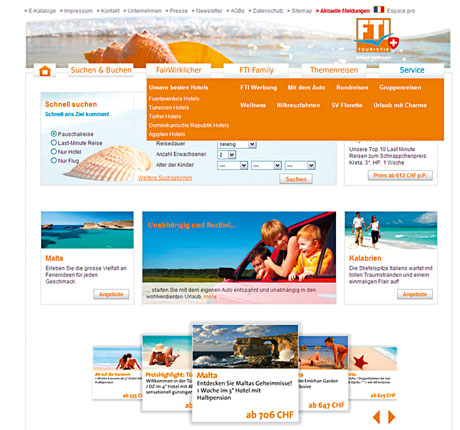
In 2008, the Zurich-based digital marketing agency Adisfaction won the online marketing account for the travel provider FTI Switzerland. After two years of work and a boost in revenue for FTI, the agency is now also taking over online marketing for FTI Austria and the car rental company Drive FTI.
Editorial
-
June 2, 2010
A major boost in sales - there can be no better conclusion for online marketing. The Zurich-based digital marketing agency Adisfaction has more than fulfilled the mandate of tour operator FTI Switzerland. FTI's aim was to significantly increase its sales on the Swiss tourism market with online marketing. In a pitch, the company chose Adisfaction as the right partner for this project. "The fact that we can offer search engine and media marketing from a single source obviously convinced FTI," says Daniel Hünebeck, Managing Director of Adisfaction. "We also know the specifics of the Swiss market, not only in terms of language, but also in terms of travel destinations." After all, there are different travel passions from country to country, and not every country flies to the same destinations. Adisfaction took the path to success in several steps: First, the agency focused on Google. "We put together Adwords and have used it to feed several Google accounts to date," says Hünebeck. Google keywords or Adwords are keywords that are found exactly or similarly when searching in Google. The Adwords are defined word by word and then linked to the offer to be advertised. At FTI, for example, these are terms and combinations of terms such as "Caribbean trip", "Antalya Hotel", "Hotel Club Paradiso", "Cala Ratjada" or even "Turkey cheap travel", "Book Canary Islands holidays online", "Family vacations Mallorca" and similar. Online media and performance marketing "We were able to take over adword lists with countries and hotel names from FTI's German parent company," reports Hünebeck, "but of course we had to adapt them to the Swiss market. The more detailed the Adword lists are, the greater the success." A Google account contains 100 so-called campaigns, each on one topic, for example winter or summer destinations. The campaigns in turn contain individual ad groups - for example "Rhodes vacations", "Greek islands vacations" or "Rhodes last minute" - as well as the list of keywords that trigger the placement of the ads. Adisfaction has so far created 150,000 keywords in six Google accounts. In the second step, Hünebeck and his colleague Alexander Tysl approached selected Swiss media: "We placed advertorials with special offers and brief information about the travel destination on Bluewin and on the travel pages of 20-Minuten-Online, classic banners on MSN and a booking mask on Blick.ch," reports Hünebeck. On the homepage of Blick-Online, Adisfaction prominently placed a booking window in the top right-hand corner with the look and feel of Blick. Here, readers could enter their desired destination and a time period and were forwarded directly to the Fti.ch booking screen. But placing banners, advertorials and booking masks is not everything - you also have to maintain them and switch them off quickly if necessary: "If a hotel is fully booked, an attack happens somewhere or, as recently, a volcanic eruption makes travel difficult or impossible, then of course we have to make sure that no offer advertises this destination," emphasizes Hünebeck. What Adisfaction does is therefore not only technically demanding, but also in terms of content. And it only works because the agency thinks its way into its client's business. How to book a trip ... FTI and Adisfaction monitor the benefits of all marketing measures very closely: Is a trip booked or not after clicking on the banner or booking screen? This tracking is carried out by specialized software that delivers detailed results. However, foresight is required when evaluating the data. After all, a click on a banner or advertorial rarely leads directly to a purchase - which does not automatically mean that they are superfluous. This is because users who have previously clicked on a banner or a booking form often search Google later for similar offers or often even specifically for the provider of the previously seen offer. This is understandable: People who book a trip first get inspiration, for example from an offer. Then they discuss their plans with colleagues or family. And only then do they actually book. "This is typical booking behavior," emphasizes Hünebeck. "The strength of media marketing is branding and the initiation of a purchase. The strength of Adwords is clearly sales. The fact that this works better with Adwords is also due to the fact that, unlike with media marketing, the interest comes from the user at this moment. But: If you don't book the whole thing, no one will search for your offers or your company name. If you want to be successful with online marketing, you should therefore always combine all channels." Hünebeck obviously knows the score: the campaign that Adisfaction designed and implemented for FTI exceeded the travel company's targets by a double-digit percentage. Adisfaction will now also implement Google Adwords for FTI's Austrian subsidiary and the company's car rental division, Drive FTI. Anne-Friederike Wilhelm
Two invisible but dangerous scissors
The reduction in editorial staff goes hand in hand with a sharp increase in PR managers at companies, associations and authorities. A dangerous situation. Guest commentary by Karl Lüönd, freelance journalist and author.
Editorial
-
June 2, 2010
The print media crisis has sharpened our focus on survival strategies, at least in theory. It is becoming increasingly clear that two tracks are diverging: the free publicity of the quickly made and quickly discarded consumer papers - and the immersion in the local and/or the qualitative. The market confirms that both have a chance. The continuing success of 20 Minuten and the progress of Blick am Abend confirm the one assertion, while the stable situation of many B titles in the regions, as well as conspicuous success stories such as Hamburger Zeit, confirm the other. In an uncomfortable position are the papers that until now have wanted to be for everyone: the larger A titles, daily newspapers that have felt responsible for both the universe and the immediate surroundings plus the most important (i.e. most newsworthy) subject areas, from cars to fashion to vacations and real estate, with the same claim to exclusivity. Here, the cost-cutting measures that the editorial offices are forced to implement already look like acts of desperation, and they are primarily at the expense of freelance journalists - not because this is where the biggest problem or the most savings potential lies, but because this is where savings can be made most easily and, above all, most quickly. Even in the best houses, fees have been cut by up to two thirds! How is this supposed to go together? On the one hand, the insight that only deepening and individualization are suitable in the long term to differentiate the convenience product from the quality paper, on the other hand, the clear-cutting in the very places where the paper would be particularly strong and storm-proof. The other gap has long since opened up in human resources. Hardly a week goes by without the departure of journalists from the media to interest-based communication (read: PR, corporate publishing, press spokespeople, etc.) being reported. Andreas Durisch (SonntagsZeitung) has become a PR consultant, Annette Bundi (Tages-Anzeiger) now speaks for President Leuthard, Roland Schlumpf (Tages-Anzeiger) has joined Interpharma, Susanne Mühlemann (Bilanz) is going to Swiss. You can already tell from these names: The managers who are now taking advantage of the favorable opportunity to help themselves in the editorial offices are like Oscar Wilde: they have very simple tastes, they always go for the better ... Now there are certainly good arguments for such changes, and as we all know, you only know a zoo once you have lived on both sides of the bars. But something else gives food for thought: In most larger editorial offices, jobs have been cut by 15 to 40 percent in the last three years. If you had asked me five years ago, I would have easily said that you could save 10 to 15 percent of capacity in every newsroom through better organization (or free it up for clever projects). In the meantime, the "fat" is long gone, and it is happily being cut into the living. On the other hand, the communications industry is growing unrestrainedly and investing accordingly. Not only listed companies, but also SMEs (especially knowledge-based and internationally active companies with products and services that require explanation), as well as public institutions (from the police to art galleries), associations, aid organizations, public authorities, etc., have feudal communications departments. I recently met someone who is responsible for professional communications for the schools in a Zurich conurbation (still working 50% for the time being). A medium-sized Swiss business association has seven people working in communications. Ten years ago, one was enough. The two Zurich universities of applied sciences alone currently produce around 200 communication specialists per year. The consequence is clear: the media editorial offices, which should actually be filtering and processing the (often very useful!) input from interest group communication, are becoming weaker and weaker - the interest group representatives, on the other hand, are arming themselves like world champions. On the media side, there is a growing willingness to make do with the ready-to-cook convenience products from the PR kitchens - and at the same time, they actually wanted to secure their future through in-depth research and their own efforts.
SFLB writes for Sunrise "The funniest dialogs since text messages"
The SFLB launched a Sunrise promotion this spring. Because it was so successful, it is now being repeated—with new commercials.
Editorial
-
June 2, 2010
Anyone who takes out a Sunrise flat surf mobile subscription by July 31 can send SMS and MMS free of charge for 1 year. The campaign is also being continued. With 4 new TV films, a cinema spot as well as advertisements and posters. Once again, SMS dialogs are shown, as they are sent when they no longer cost anything. In other words, a lot is written, but not necessarily a lot is said. Responsible at Sunrise: Priska Cavelti-Heger (Director Marketing Communication), Peter Schilde, Tiffany Gaggia (Marketing Communication Manager). Responsible at SFLB: Peter Brönnimann, Martin Spillmann, Diana Rossi, Friederike Coninx (creation), Flurin Hardt, Rebecca Krausse (consulting), Suzana Kovacevic (TV production). Production: Ultra Images. Online: Plan.Net. Media: Mediatonic. 1. cinema spot "Live SMS":
2. "Härzchäferli":
3. "Icg vermessed ich":
4. "Two guys":
5. "Very - the sequel":
Caught the eye: Which sponsors are best remembered?
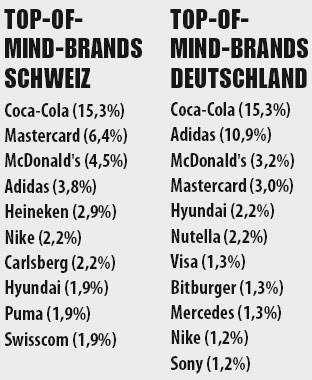
As part of a multi-topic survey, the market research firm Marketagent.com examined spontaneous advertising recall of the sponsors of past soccer World Cups in Germany, Austria, and Switzerland. A total of 2,033 internet users from the three countries, aged 14 to 65, were surveyed.
Editorial
-
June 2, 2010
The question was: "Let's move on to the topic of sponsorship. The FIFA World Cup is sponsored by various companies. Which companies do you remember as sponsors of past World Cups?" Within the unaided question, the top-of-mind results show the answer that is remembered first and is therefore also the most present. > To the detailed results (web code)
Advertising Week on Star TV: "Cannes Lions 2009 - Review of award-winning commercials"
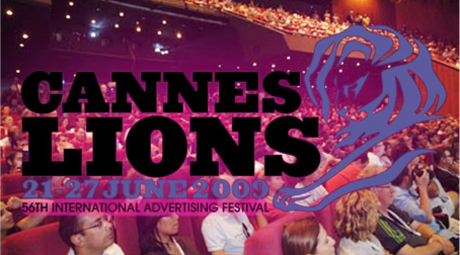
On Thursday at 7:45 p.m., Star TV will bring last year’s Cannes Lions back to life. From June 20 to 26, the International Advertising Festival will take place in Cannes for the 57th time.
Editorial
-
June 2, 2010
In honor of this annual award ceremony, Werbewoche reviews a selection of the winners from 2009. You can see a summary of the "Eye-catching" section, as well as a never-before-seen "Gold Spot" as the crowning glory, exclusively on Star TV or as a stream on Startv.ch.
Advertising week on Star TV: New every Thursday at 19:45 on Startv.ch.
Swiss Dialog Marketing Awards 2010
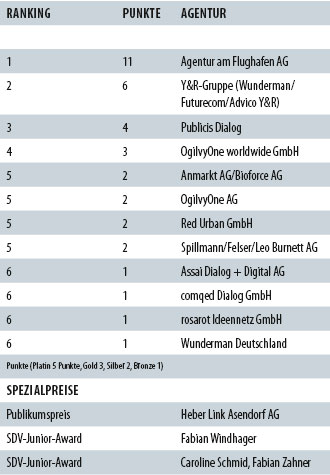
On May 28, «the gods of dialogue marketing» were honored at the Kongresshaus in Zurich. A total of 3 gold, 5 silver, and 12 bronze awards were presented.
Editorial
-
June 2, 2010
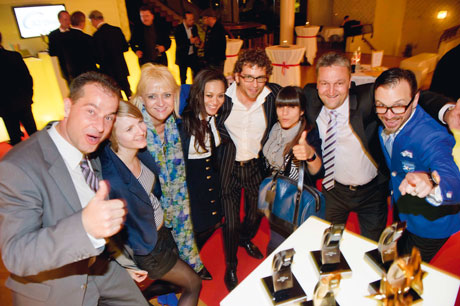
Four awards went to the agency at the airport, which leads the award ranking, ahead of Publicis Dialog with three awards and the agencies OgilvyOne and the Y&R Group with two awards each. Three awards went to agencies from Germany. After tough discussions, the jury under Chairman Guido Wietlisbach decided not to present an award in the category "Printed, non-personalized advertising materials" this year. In doing so, it is sending out a signal about the quality of the Swiss Dialog Marketing Award and calling on agencies and clients to submit the best quality work in this category again next year. The Platinum Award Whoever wins the Platinum Award patronized by Swiss Post is at the top of the Dialogue Gods for a year. The responsibility placed on the jury was correspondingly great. In the end, the agency at the airport was chosen for the mailing "When a newsletter becomes a shopping bag". The Audience Award As part of the dialog marketing exhibition, several works were selected as contenders for the public award. In the subsequent e-voting, two works went head-to-head. In the end, the Heber Link Asendorf agency from Winterthur came out on top. Significantly, the title of their work was: "Hitting the nail on the head". The Junior Award The SDV Junior Award was presented for the first time in 2010. The aim was nothing less than to generate communication ideas for the 2011 Dialog Marketing Award. The young talents had their heads spinning and submitted exciting work. The jury found it correspondingly difficult to make a decision in this category. As a result, two juniors received an award. In keeping with the motto of the SDV Juniorsclub, each received a "fadegraaden" boxing glove. The winners' brochure with all the entries can be downloaded as a PDF from the website www.dm-preis.ch. The Swiss Dialogue Marketing Prize was once again organized by Marc Zehnder, Kleistermeister Eventsolutions, in 2010. pan
The agency at the airport is the winner of the year.