DRS digital supports sale of Zürichsee Presse to Tamedia

Zürichsee Medien is selling Zürichsee Presse to Tamedia. DRS digital supported the sale with a virtual data room.

The Swiss communications and media company Zürichsee Medien focuses its business activities on newspapers, printing, magazines, radio and real estate. The group of companies also includes the regional newspaper publisher Zürichsee Presse, which has a 160-year history. With the sale of Zürichsee Presse to Tamedia, Zürichsee Medien is divesting itself of the newspaper business in order to make a clear succession plan for the family business, according to Presseportal.ch.
Ernst & Young accompanied the transaction as lead M&A advisor, while DRS digital provided the platform for conducting the due diligence with a virtual data room. DRS digital's virtual data room is designed to allow the various parties to exchange data securely across company boundaries.
The ADC Yearbook 2010 is also an art book

On June 1, the opening reception for the 2010 ADC Yearbook was held at the Nicola von Senger Gallery in Zurich. The ADC also broke new ground with the book’s design.

Two books have been published. They were conceived and designed by Studio Achermann in Zurich. As usual, the first volume pays tribute to the outstanding advertising campaigns of the year. In the second volume, an artist from outside the industry puts his personal view on paper. This is Beni Bischof, who is regarded as one of the most active, enterprising and productive artists of the younger generation. His works for the ADC were also available for purchase at the vernissage.

Last but not least: Maxomedia takes you to San Francisco with Swiss and flowers in your hair

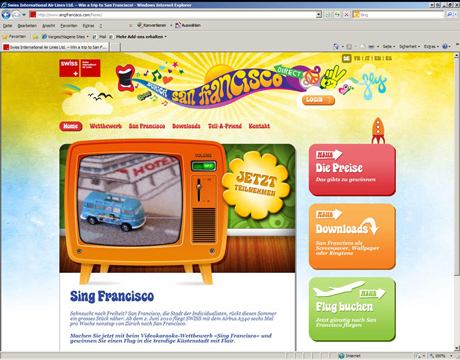
Starting June 2, 2010, the Swiss airline Swiss will fly directly from Zurich to San Francisco six times a week. “Time for peace and love,” thought Maxomedia, and to promote the new destination, they created a website with a colorful flower-power look:

The core element of the website is the "Sing Francisco" karaoke competition. Music-loving San Francisco fans perform their own original version of Scott McKenzie's global hit "If you're going to San Francisco". Woodstock sends its regards. And of course there's also something to win: A direct flight with Swiss to the trendy coastal city - in Economy and Business Class. Participants film their own song with a webcam and post it via livestream or YouTube upload on the website. Anyone who doesn't suddenly put flowers in their hair and start singing has definitely missed out.

The "Sing Francisco" website implemented by Maxomedia and Swiss serves as a target element for various accompanying communication measures to promote the new destination. Maxomedia is responsible for the concept and implementation of the site.
1290580882_img100602_singfrancisco
Responsible at Swiss International Air Lines: Parand Rohani (Manager Online Marketing), Alexander Strehler (Online Marketing).

Balance sheet shifting: Ex-Vivendi boss Messier in court

Jean-Marie Messier, the former head of the now-split media conglomerate Vivendi-Universal, is facing legal charges. On Wednesday, he was charged with spreading false information, stock price manipulation, and breach of trust at the Paris Criminal Court.

During the stock market and internet boom at the turn of the century, the manager allegedly lied to his shareholders about the high level of debt following the takeover of the Canadian media group Seagram and bought up massive amounts of shares in his own company in contravention of the applicable regulations. At the end of the 1990s, Messier transformed the former water supplier into a media group through acquisitions, including the famous Universal film studios. The resulting debts of 35 billion euros brought the group to the brink of insolvency. Messier was dismissed in July 2002.
The trial is scheduled to last until June 25. Jean-Marie Messier - known as J2M for short in France - faces up to five years in prison and a heavy fine. However, the Paris public prosecutor's office had actually wanted to close the case. However, the investigating judge in charge, who has the final say, insisted on a trial.
In addition to Messier, five other former Vivendi Universal managers and a financial advisor have now been charged in Paris. Vivendi Universal had to embark on a tough austerity course after the Messier era. Following the sale of its film and entertainment division, the group is now known simply as Vivendi. Its areas of activity are mobile telephony, pay TV, music and video games.

Top of the week: New Swiss TV channel Joiz

A new television channel will go on air in German-speaking Switzerland on February 1, 2011. It is called Joiz and is aimed at viewers aged between 15 and 30.

The channel combines its program with applications on the Internet and cell phones. Many young people use the Internet and TV at the same time, and Joiz now aims to bring the two media closer together. For example, viewers will be able to record a presentation on the station's homepage. The initiators are Kurt Schaad and Alexander Mazzara, as the NZZ am Sonntag writes. The company was co-founded by multimedia expert Peter Schulz, who now acts as Technical Director.
The Federal Office of Communications will decide in the next few months whether the cable network operator Cablecom must include the channel in the analog network. Cablecom does not want to include the channel in the analog network. The company 7 Screens has therefore submitted an application to the Federal Office of Communications (OFCOM) for a switch-on order. It is to be hoped that such an innovative product could be realized without too many administrative obstacles.

Customer loyalty made easy

As is well known, good business relationships ensure a company’s long-term success—provided that purchasing behavior is rewarded with small gestures of appreciation and that contact is maintained on a regular basis.

Customer magazines, newsletters and Christmas presents have long since become commonplace - but what about birthday greetings? FO-Smartprint, a division of FO Print & Media AG, in collaboration with Cyberfactory AG, has discovered a need in this area and developed a suitable tool. The time and effort that some companies have previously invested in sending greeting cards to their customers has now come to an end. The B-to-B solution smartmailer.ch is the first tool on the market that guarantees customer loyalty at the touch of a button.
www.smartmailer.ch at a glance
- Postcard format A5
- Image personalized front
- Diverse selection of subjects
- Customized text on the back
- Company logo on the back
- Signature on the back
- Automatic addressing
- Delivery on your birthday
Tickets (one year) Prices (per ticket*)
1000 copies CHF 6.10/card
2500 copies CHF 4.10/card
5000 copies CHF 3.70/card
*Prices incl. printing & postage

Survey: advertising sales fell sharply in 2009

Advertising revenues in Switzerland slumped by 11.4 percent to CHF 5.13 billion in 2009. In the crisis year 2009, the advertising revenues of media companies fell back to the level of 2003

The survey is based on a survey of Swiss media houses and broadcasting companies, but also takes cinema and trade fair advertising into account. It was carried out by the Foundation for Advertising Statistics. The survey does not include websites as an advertising medium, as the Foundation announced in Zurich on Wednesday. Swiss franc expenditure on traditional advertising and sponsorship is measured.
Paid titles lost almost a quarter of their revenues in 2009. In the business and financial press, revenue even fell by around 35 percent. The cut in advertising budgets resulted in almost 29 percent less revenue for the Sunday press. Advertisements in the trade and specialty press fell by 17 and 12 percent respectively, as the foundation announced in Zurich on Wednesday.
A total of CHF 5.13 billion was spent on advertising in Switzerland last year. This is 11.4 percent less than in 2008 and the biggest decline since 1982, according to the Foundation for Advertising Statistics. At 37.3 percent or CHF 1.92 billion, the biggest slice of the cake went to the print media, as it always has. However, the share of printed media in total sales fell below 40 percent for the first time. The decline was also clearly evident in free media, which lost around 13 percent. However, the statistics also show the disappearance of titles such as Punkt.ch, News and Le Matin Bleu. The crisis was most dramatic for job advertisements: The print media still took in 192 million francs from advertisements for job vacancies, 45 percent less than in the previous year. This means that income was even lower than in the weak years of 2002 and 2003.
The electronic media fared better: TV advertising and sponsorship brought in CHF 595 million for the TV stations, just 5% less than in 2008. However, the decline only affected the public broadcasters. The private Swiss stations recorded an increase, while the foreign private stations remained the same.
Radio stations, meanwhile, gained 3% and increased their income to 135 million francs. There was a decline in cinema advertising for the third time in a row: investments in cinema advertising fell by 13% to CHF 26 million.

Eventagentur.ch makes services and virtual products of Swisscom SME visible

How do you explain complex technical services and products in the telecommunications industry? It was precisely this core challenge that served as the starting point for the event agency to create various sales and consulting tools, which are initially being used in the Swisscom SME Shop channel and at standalone sales events.

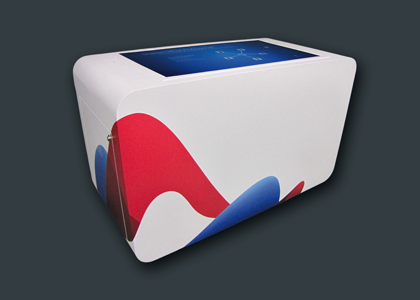
For example, the 3-D screen, which displays objects in front of the screen without additional glasses. This attracts the viewer's attention while simultaneously conveying information. At the multi-touch screen, they can then get advice. This so-called "Experience" station is able to recognize physically existing devices in your vicinity and - like in a virtual instruction manual - visually display all specifications. At the same time, current subscription rates and promotions can be displayed in real time. In addition, all communication media such as image and advertising films, sales brochures and websites are displayed on the 46 inch screen.
1290580884_img100602_swisscomtool1
Particularly highlighted are the services of Swisscom KMU: Hosted Services and Mobile Office, whose benefits and functions can now be visibly presented. Swisscom SME is thus able to present all products and services interactively at the POS in a modern yet easy-to-understand way and to include them in the advisory discussion. As a suplément, the film specialists from Boutiq animated a 90-second film "A brief history of communication". The film dramatizes the rapid development of technologies and stimulates reflection.
The new tools will be used in the store channel throughout Switzerland. Parallel to this, additional events will be held to present the new sales tools.
About the film
Responsible at Swisscom: Giuseppe Luciano (Head of Marketing Communication SME); Barbara Sahli (Communication & Fundraising). Responsible at Eventagentur.ch: Elmar Schäfer (Managing Director), Conrad Eigenmann (Consulting/Project Management). Responsible at Lüscher & Hirschmüller: Christian Hirschmüller (Planning). Responsible at planBmedia: Dominique Schärer (CEO). Remo Rodondi.
Responsible at Boutiq: Philipp Zünd (Director), Martin Fuchs (Concept), Daniel Wyss (Post Supervision), Sebastian Harms, Pascal Schelbli, Christoph Gabathuler (Motion Artists), Alex Kirschner (Composer).

Media Trend Journal: 5.1 billion Swiss francs net advertising revenue in 2009

Last year, total net advertising revenue amounted to CHF 5.134 billion, which was 11.4 percent below the previous year's level. The negative economic trend is thus also having an impact on the advertising market.

Brand poster: Over 100 new Swiss brands

The 2nd edition of the brand poster shows the changing Swiss brand landscape. The map now includes over 430 Swiss brands.

In the first year since its launch in June 2009, a lot has changed on the map of Swiss trademarks. Over 100 new brands and numerous changes can be found on the second edition of the complete overview of all relevant brands of Swiss origin, once again demonstrating the relevance of such a reference work.
Since its first publication, Markenplakat.ch has been running smoothly. The overview prompted numerous brands not yet listed to contact the initiators Evoq, HTP St.Gallen and Update. The great response led to the inclusion of a total of 126 new brands, which means that the map now contains over 430 Swiss brands, according to a Markenplakat press release. Names such as Sarasin, Merkur, LeShop.ch, Tamedia and Le Gruyere can now also be discovered on the brand landscape.
In contrast to the first edition, the additional information about all the Swiss brands depicted can now no longer be found on the posters, but in the interactive online version on the website. The website was redeveloped in collaboration with Update and now offers the opportunity to move around the virtual landscape in the same way as you would on Google Maps. A range of additional information about all the brands shown, such as ownership, daily brand news or slogans in cooperation with slogans.de, can now be called up or researched using search and filter functions.
The 2nd edition of the Swiss brand poster was published on May 27, 2010 on the occasion of the Swiss Brand Congress "Tag der Marke" in Bern and can now be ordered via the website.
img100602_markenplakat

To the point: Mea Culpa

When you read newspapers as a journalist, it happens that you think you would have liked to have written this or that story yourself or have had it in your paper. As editor-in-chief, this often happens with a commentary or a column.

You then have two options: Either you declare your annoyance and reprimand your editors under the motto "We could have thought of that", whereby the "we" actually means "you sleeping caps", or you take yourself by the nose and get even more annoyed.
I admit, last week I was very annoyed and I am still annoyed. In his weekly media column in the Weltwoche, my dear colleague Kurt W. "Zimmi" Zimmermann addressed something that really should have appeared in our magazine. It is about the case of Hans-Peter Rohner, Chairman of the Board and CEO of the advertising mediator Publigroupe, and his non-election as SRG Director General. The fact that Werbewoche is only published every 14 days and therefore could not have featured the topic last week is nothing more than a helpless attempt at justification. It could have been published online. Online first, that is!
Zimmi's columns are actually always worth reading. Often they are sweeping, often they are polemical - both of which suit Weltwoche - often they miss the mark a bit, but they are always amusing. From time to time they also hit a sore spot. This was the case last week.
It is not only about the in itself unbelievable story that Rohner, as Chairman of the Board and CEO of Publigroupe, a company that is undergoing a fundamental and extremely difficult and delicate restructuring phase - of which no one can say today whether it will succeed - has himself put forward as a candidate for the post of SRG Director General. And then, after the election defeat, still laments that the selection criteria had changed. You can read what the whole story means for Rohner's internal and external credibility at Weltwoche.ch.
The second point that Zimmi raises - and that annoyed me even more - is the fact that, with one exception (Zimmi was wrong!), none of the otherwise so clever media observers has addressed this scandal. Neither my dear journalist colleagues nor the media scientists, who are usually available for a pithy statement, nor the scene bloggers have commented on the topic. As I said, there was one exception in the run-up to the election: The SonntagsZeitung ran an article on the topic, but not as its own opinion, rather diplomatically hidden behind the statements of a dismissed Publigroupe executive.
Actually incomprehensible! Mea culpa or perhaps also nostra culpa?
Pierre C. Meier, Editor-in-Chief
[email protected]
get_footer();