Migros is the strongest brand in Switzerland
Die Young & Rubicam Gruppe hat den neuen BrandAsset Valuator vorgestellt. In der grössten Markenstudie der Schweiz wird mit der Migros erstmals auch «die stärkste Marke der Schweiz» publik gemacht. Dazu kommt an den Tag: In der Krise besinnen sich die Schweizer auf ihre traditionellen Werte und Tugenden. Aber Internet ist bei allen Generation zum wichtigsten Medium geworden.


The largest brand study in Switzerland is based on a database of over 1100 brands and conducts around 1000 intensive surveys via the market research institute GfK. Consumers between the ages of 18 and 74 are scanned. The survey analyzes 128 different values. The study was launched in 1995 and has been conducted annually since 2006. This year, for the first time - due to the modern curiosity of today's media - "the strongest brand in Switzerland" is also being calculated. Migros has made it. It has become the strongest brand in three out of four dimensions, such as "likeability". Only in the area of "differentiation" did the - extremely multi-layered - company fail to score any super points.
Competitors Coop and Denner are not among the top 20, but Coop has been catching up by around 10 places every year since Hansueli Loosli took the lead, as Caspar Coppetti, Chief Strategy Officer Y&R Group, was able to explain as head of the Valuator study. In addition, Migros sells many more products under its own orange brand, whereas at Coop, consumer favor is spread across an almost unmanageable number of branded products on the shelves.
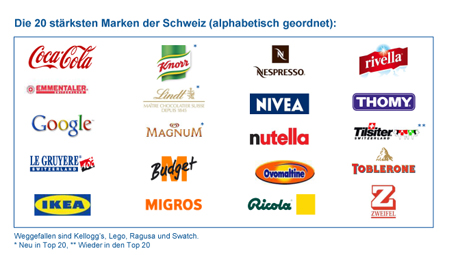
Before Migros in the current study, Nespresso and Google were the big climbers in the last research. Tilsiter fell out at the time and is now back in. A "yo-yo" brand was Swatch, which was in last year and is now out again. Ragusa, Lego and Kellog's are also currently out. Only a few foreign brands such as Coca Cola, Ikea and Nivea can hold their own against the Swiss power brands. Knorr and Magnum are newcomers. From Switzerland, the traditional brand Lindt also made it into the top 20 brands.
"All the brands in the top 100 are very strong brands. Anyone who makes it into the top 20 is considered a superbrand in Switzerland," said Urs Krucker, Project Manager Customer Insight. It is striking that 15 of the top 20 brands are food brands. This is logical, as we come into contact with them every day when shopping. Bank logos are also on the rise again. Here, regional banks are performing better as brands than the globally active ones. PostFinance is clearly on the rise.
CCO Markus Gut was able to read from the study just how efficient anti-cyclical advertising can actually be, using Axa Winterthur as an example. The insurance company increased its budgets by 33% during the last crisis and was able to increase its brand strength by a third.
Far removed from the status they still had "in the good old days", car brands are valued today. Modern citizens no longer define themselves by a Mercedes or BMW. Brands that are rated more attractively are SBB or Mobility.
A return to Swiss virtues
The study shows a synchronized trend: not only Swiss brands are very popular with Swiss consumers. Swiss values are also more in demand than ever. "The need for security has increased and the willingness to take risks has decreased," says Coppetti. When it comes to Swiss values, there is a return to traditional Swiss virtues such as duty, diligence and reliability as well as community and family values. The "mainstream" type currently has the best chances. The "reformer" is having a hard time at the moment. This critical type of person has the lowest scores in the current study since the introduction of the Valuator. However, it is reassuring to note that environmental awareness and sustainable responsibility in consumption have already become generally demanded "mainstream" today.
The financial crisis and political attacks from abroad made for turbulent times last year. In response, the Swiss seem to be returning to Swiss values and virtues. According to Valuator, security in the community is becoming more important than in previous years. Family, security and home are once again more central concerns for the Swiss. Agreement that married couples should have children is on the rise (+5% agreement), as is agreement that a woman is "only happy and fulfilled" if she can provide her family with a harmonious home (+8% agreement). Duty, diligence and reliability are also values and virtues that are gaining in importance among the Swiss population.
The return to these values also explains part of Migros' success. The orange M stands for community values, carries many local products in its range and also offers a crisis-resistant price/performance ratio.
As expected, downaging is also on trend. The most important brands for people over 50 in their respective categories are Mini, Ikea and Danone, which are otherwise classified as youthful.
As expected, the Internet is the most important medium
The Internet is the most important medium for the Swiss, followed by cell phones, TV and radio. This is shown by the results of the largest Swiss brand study, BrandAsset Valuator by the Young & Rubicam Group. In Switzerland, 44.6 percent of respondents rate the Internet as "very important" from a personal perspective, closely followed by cell phones (44.0), TV (35.6) and radio (29.9). With the rapid spread of the mobile Internet, the two media are increasingly merging: More and more Swiss people are constantly online.
However, there is a clear generation gap when it comes to internet use. While 61.3% of 18-34 year olds consider the internet to be very important, the figure for 34-64 year olds is 36.4%. In the over 64 year old segment, the internet is only very important for 26.0%. It should also be noted that the Internet is increasingly combining all the functions of other media. You can read your newspaper, watch TV or listen to music online via your computer.
The crisis calls for relevant information. Infotainment is losing some of its importance. Media brands that stand for journalistic quality, such as Tages-Anzeiger, NZZ am Sonntag, SonntagsZeitung or Finanz und Wirtschaft, have therefore benefited from the crisis. Blick or 20 Minuten are perceived as "less important" or are stagnating. Several digital brands are outperforming established brands. The Google and Bluewin portals as well as the social media platforms YouTube and Facebook and the iPhone are finally establishing themselves as cross-generational digital power brands.
Andreas Panzeri