Ancillary costs - a minor matter?

Why it’s also in the best interest of commercial tenants to carefully review their utility bills. By Patrick Strub, lic. iur., attorney, legal expert, and editor at the Beobachter Advisory Center.

Our credit balance: CHF 2 865. Please transfer the amount within 30 days." This or something similar is often the short end of the long service charge statement. Business tenants are also well advised to take a closer look at the statement - and always check the rental agreement as well. This is because only items that have been contractually excluded as service charges must be paid - everything else is considered to be included in the net rent. The courts are strict with landlords: unclear clauses such as "All ancillary costs shall be borne by the tenant" or vague terms such as "operating costs" are simply irrelevant. Nor is a reference to the General Terms and Conditions of Contract of any use: It must be clear to tenants from the tenancy agreement itself which ancillary cost items they must pay in addition to the rent. Otherwise, they are deemed to be included in the net rent and are not owed additionally.
Common service charge items for commercial properties are, in particular, heating and hot water, caretaking and environmental work, monitoring of the property, elevator, air conditioning, water and waste water, waste disposal and general electricity. In addition to the contractually agreed items, a surcharge may be made for administrative expenses for the service charge settlement - even if this is not expressly stated in the contract. What the arbitration authorities and rental courts accept under this heading is not entirely uniform. In most parts of Switzerland, it is three percent of the total service charge.
However, not everything can simply be passed on to the tenant at will. Only services (by the landlord or a third party) that are related to the use of the property can be ancillary costs, but not: repairs, investments, insurance premiums (exception: insurance that relates exclusively to the heating system), property taxes, public charges and development fees. If, for example, a rental agreement provides for building insurance premiums as an ancillary cost item, this is simply irrelevant.
The landlord must settle those ancillary cost items that are owed on account (or - more rarely - on account without payments on account) in accordance with the rental agreement once a year. If the payments on account were higher in total than the service charges actually incurred, the landlord must repay the difference to the tenant. Conversely, the landlord may charge the difference - regardless of how high it is. However, a landlord who knowingly entices his tenants with excessively low amounts on account when the contract is concluded will not be able to enforce a high additional claim. In such a case, it is important that the tenants defend themselves against the first service charge bill.
In the event of disputes about ancillary costs, the conciliation authority (known as the rental office in the canton of Berne) is responsible - as is always the case when it comes to the rental of immovable property. The procedure is also free of charge for business tenants.

Book tip:
Service charge settlement, reference interest rate, maintenance or termination: This Beobachter standard work shows in an easy-to-understand way how to proceed correctly in every situation and creates the ideal basis for a better relationship between tenants and landlords. With numerous tips, examples and sample letters.
7th, expanded and updated edition 2010, 256 pages, Fr. 34.-.

1290580859_img100616_mietrecht
Do you need legal advice?
The Beobachter Consulting Center offers you and your employees expert advice by telephone on legal issues concerning your company - 6 months for only Fr. 99.-. Order the consulting package for SMEs at
www.beobachter.ch/kmu or 0800 83 0800.


Cavegnwerbung develops WM customer giveaway for Setaprint

To ensure that everything runs smoothly even during leisure time, the printing company Setaprint is giving away a World Cup soccer ball to customers and suppliers. The giveaway was developed by the agency Cavegnwerbung.

As a sign of high flexibility, the print shop is giving away a beach volleyball to all customers for whom football is of little interest.
Responsible at Setaprint: Pierre Marti (overall responsibility). Responsible at Cavegnwerbung: Markus Cavegn (art direction), Markus Rottmann (text), Daniel Soldenhoff (graphics). Production: KOI GmbH/ Christinger Partner.
1290580858_img100616_setaball

New look for KZEI

Die Marketing- und Kommunikationsagentur Heber.Link.Asendorf realisiert für den Kantonalverband Zürcher Elektro-Installationsfirmen KZEI den Neuauftritt. Dies umfasst neues Logo, Slogan, Text, Bilderwelt und Internetauftritt.

The new website is being realized in collaboration with the web communications agency Internezzo from Rotkreuz. The website will be implemented using the Typo3 content management system. The entire project will be completed by the end of 2010.
Heber.Link.Asendorf is responsible for the overall management of the project. In a selection phase, Heber.Link.Asendorf developed various logo variants and two web designs. After a presentation to the entire board, Heber.Link.Asendorf was awarded the contract to realize the new image.
www.heberlink-asendorf.ch
www.kzei.ch
www.internezzo.ch

The compulsion for merciless transparency

The Internet creates a level of transparency that cannot be controlled. This poses a major challenge for all forms of communication. Guest commentary by Kaspar Loeb, CEO of the Swiss advertising agency Saatchi & Saatchi.

Let's imagine for a moment that we were the agency handling BP's fat budget worldwide. Let's further imagine that we had a client on the phone in a full-blown panic, begging us to do something so that the greasy oil spill doesn't pollute the brand forever and make the beautiful new sunflower logo look very old forever.
Apart from the fact that in many companies, communication is only really taken seriously when the Perfect Storm is already roaring, we would probably suggest one of the now well-known "mea culpa campaigns" to defuse the situation, in which BP apologizes profusely for the harm it is doing to thousands of people and to nature. And it would not work.
The public cannot be controlled
First, the credibility of these apology orgies has been severely damaged by the public, at the latest since the appearances of celebrities such as Bill Clinton or Tiger Woods in their tank tops, and second, the World Wide Web creates a transparency and publicity that cannot be controlled and can hardly be steered. On Facebook, a community of 140,000 members has already been formed, who are calling on people to stop filling up with BP fuel and to avoid all of its products under the name "Boycott BP. On Twitter, there is a fake feed called "BP Global PR," where 50,000 activists post satirical posts mocking BP's attempts to downplay the environmental disaster. Sourly, a BP spokesman commented on this unwanted PR, saying, "It's a shame, but obviously people have a right to express their opinions in this way." Better, he would have said, they take that right.
The words of BP CEO Tony Hayward, who tearfully declared in an interview that he wanted his former life back, were not very helpful either. He had to respond to the ensuing storm of protest with a humble apology on Facebook.
Companies are forced to be transparent
While everyone has been talking about the "transparent citizen" for years, legal entities are now also being forced to be more transparent than ever before. The life camera from the bottom of the sea shows billions of people worldwide the extent of the disaster in the Gulf of Mexico every second. Appeasing comments from the safe shore miss their mark when the documented reality underwater speaks a different language.
One of the greatest entrepreneurs of the last few years, who until now preferred to only communicate publicly, or rather preach, when he presented another ingenious, innovative product at an Apple trade fair, has recognized the signs of the times and made a surprising about-face in recent weeks. In the past, Steve Jobs usually only granted the New York Times or the Wall Street Journal the grace of sharing his insights with the public. But since the negative headlines threatened to take some of the freshness out of the nibbled apple, Jobs suddenly began to answer customer mails directly, and in a way that would make a PR expert who was intent on harmony and balance break out in a cold sweat. For example, he asked a customer who was complaining about the late delivery of the iPad in Europe whether he was "crazy," only to explain that Apple only wants a perfect launch and therefore only delivers when the organization is really ready. And a blogger got his fat when he complained that Apple was restricting freedom on the net through its rigid rules. "What freedom are you talking about?", Jobs snapped at him. "The freedom to download porn or programs that drain your battery?"
Brand images become verifiable
Companies, entrepreneurs and managers may accept that the brands for which they are responsible become a transparent vessel that allows the audience to choose which of them they want to identify with and which they do not. A DNA becomes visible that either matches one's own DNA or does not. And we professional communicators better adjust to ensure that our official messages are in line with the brand image, which in the future will be based less on wishes and more on verifiable reality.

Vuvuzeli, vuvuzela, football is wonderful

"Werbewoche" editor Anne-Friederike Wilhelm on soccer as a bridge between cultures. Or maybe not.

It was clear that you can still learn something from Africa. Especially when it comes to enjoyment and volume. After all the discussions about whether open viewing without sound can be fun at all, it's now back to the noise: the noise of the vuvuzela. Vuvu-what? The vuvuzela is what we used to call a trumpet. Only a little longer and louder. It is trumpet-shaped, up to one meter long and originally made of horn or sheet metal, but since its discovery by football fans it has increasingly been made of plastic. The noise it produces sounds like the trumpeting of the Sabu that has escaped at Knie.
I know a lot about musical instruments: I know that a dulcimer doesn't necessarily belong in the kitchen. I know the piano, guitar, violin and flute, as well as the tamburica, cymbal and nun's fart (they really exist!). But vuvuzela - never heard of it. Most people will have. But the media talk and write about the instrument, whose name is already a sound, as if knowledge of its existence is part of general education. So let's do something about it: Vuvuzela is Zulu, in Setswana the trumpet is sometimes also called Lepatata (the potatoes?!?), according to Wikipedia. And it is a typical symbol of South African football. One thing is certain: If the average European doesn't turn the sound off while watching football or vacuum on the side, their ears will simply fall off thanks to the vuvuzela concert. Anyone who can hold out for 90 minutes needs a cochlear implant - or a psychiatrist: "Doctor, I can hear voices!" Actually, it's just tinnitus.
Weird sounds in the penalty area
We could have guessed that football is louder in Africa than in this country. If we want a World Cup in Africa in the middle of the (African) winter, we have to accept the fact that they're trumpeting like elephants down there. Töröööööööööööööööööhh. But the real problem is this: The Swiss' chances of becoming world champions have never been as good as this year (!). But our boys are not immune to the eardrum terror of the vuvuzela. The horn is banned in Swiss stadiums - not because of the potential noise pollution, but because it could be used as a baton. And because it could never be used as a trumpet, Frei and his cohorts couldn't get used to the elephantine sound.
But there's one good thing about it: if our national team surprisingly doesn't become world champions, at least it has nothing to do with the players not scoring. The vuvuzela is to blame. And Sepp Blatter, of course. After all, he could have had the World Cup played in the Lijerica country of Dalmatia. The lijerica is much quieter than the gadulka, which is not loud either. What's more, the Lijerica is played sitting down. And if you sit down, you don't cheer so wildly. Which is good. After all, those at the back want to see something too.

The agony of numbers

Unternehmensrechnung, Rechnungswesen: Für viele Youngsters, die sich in den Feldern von Marketing und Verkauf weiterbilden, sind das Reizwörter. Wichtig ist das Zahlenwerk aber für jeden, der kompetent mitreden will im Betrieb. Und es gibt Lernstrategien, damit man besser klarkommt in der Welt der Firmenfinanzen.

A murmur went through the hall. When the subject of grades in the new subject of corporate accounting came up at the marketing and sales managers' graduation ceremonies last year, some people shuddered as they remembered the two hours of the written exam, when financing and coverage ratios were the topic, when EBITDA, Swiss GAP or US GAAP were the trump cards. Difficult hours. Which was also reflected in the average grade. The average grade of the marketing managers was always above a 4 in all subjects, but corporate accounting was at the bottom with a 3.7. And the same subject was also at the bottom of the hit list for sales managers with a 3.6. This suggests that people who know their way around the world of sales and marketing and want to further their education are more likely to have a flair for brand building, concepts and presentations than for the intricate figures that make balance sheets and income statements work.
Join the discussion at eye level
Thomas Schefer was the best sales manager in 2009 when it came to business accounting, achieving a 4.5 in the subject. For him, Schefer says, it was probably the most difficult task, but nevertheless not a daunting subject, as he has always calculated prices throughout his career: "I'm very interested in the subject," says the newly qualified sales manager, but doesn't make a murder pit out of his heart. "Of course, I enjoy sales itself much more." Schefer knows that business accounting is a problem for many candidates, probably also because there can only be one correct answer in this numerical subject at the end, but you can also score points with creativity in sales concepts and case studies.
Schefer is convinced of the necessity of the subject: "Anyone who aspires to a managerial position in particular should be absolutely fluent in this subject. Sales managers must be able to lead a team or a department. And that also means that they have to have all the figures under control, because the management is constantly asking about them." Last but not least, it's also about being able to communicate competently with colleagues from other departments, so you have to be able to read and interpret balance sheets and income statements.
These are also the words of Alois Fecker, Head of Corporate Accounting for Sales Managers and Head of Accounting/Controlling for Marketing Specialists: "These subjects are about being able to have a competent say on the management board of your own company." The breadth and depth of the subject matter is tailored to the needs of industry professionals: "We don't want to turn young sales and marketing professionals into controllers or accountants with this subject. It's simply about strengthening knowledge of the interrelationships in the economic and financial area." Fecker feels that many exam candidates approach the topics of corporate accounting and bookkeeping in a very negative way. "It would be better to see the benefits and engage with the subject in a positive way."
Going on a research trip in your own company
Jürg Kaltenrieder is also aware of the worries that young people have with the number-heavy subjects. With his company Marketingfox, the lecturer for communication subjects for marketing and sales specialists helps candidates prepare for their exams: "Business accounting and accounting are among the subjects that are downloaded the most from my website." The candidates download summaries, case studies, checklists and solutions to case studies. Kaltenrieder doesn't see any major differences between men and women: "If you compare the basic interest in the subject, women seem to be more reluctant." But when it comes to the results, things look equally difficult for women and men. "The main problem," says Kaltenrieder, "is probably that marketers and sales experts are less confronted with the world of EBITDA and the quick ratio due to their basic orientation and professional nature." As a result, what is perceived as unpleasant is postponed. What can be done to gain access to the world of financial figures in good time?
"There are no universal recipes or standard solutions," says Thomas Schefer. But the tendency to put off unpleasant things until shortly before the exam needs to be countered early on: "It would be better to consistently repeat everything you've just heard after every lesson," even if it's only half an hour a week. "That would be perfect," says Head of Department Fecker. Jürg Kaltenrieder remembers how he also resisted the subject as a budding marketing specialist. His approach at the time: "I simply thought about what it would be like if I had my own company and what figures would be important to me then." If you have a lot of direct contact with corporate customers in your job, you can also make it your business to find out how solvent they are, pick out a "favorite customer", so to speak, and follow them on their EBIT path.
However, constantly raking up figures on your own can also be quite a lonely business. Kaltenrieder therefore invites his students to explain topics from corporate accounting and financial accounting to each other - "because you have to find your own words that way and generally more is retained".
However, Fecker, Schefer and Kaltenrieder find the best solution to be the one that is also the most obvious: to get in touch with their own company. "Why," asks Thomas Schefer, "not simply approach the head of finance at your company and ask for an insight into the company's figures? That would be the most direct line."
"A very good solution," says Fecker. The subject leader thinks little of the idea of some candidates to turn the two-hour business accounting subject into one with four hours and thus reduce the time pressure: "This would not solve the fundamental problem - on the contrary: even more material would be packed in, which would push the candidates, who feel particularly challenged by this subject matter, even further to their limits." This would probably do little to give marketers and sales professionals more confidence in numbers.
Bridging the gap between finance and marketing/sales
If a deeper understanding of corporate accounting, of the world of numbers, helps marketers to better understand the world of financiers, the reverse is also possible. Namely, that those who are in the driver's seat in corporate finance have a better understanding of the way marketers think. Often enough, there is a rift between the two departments. To put it bluntly, on the one side you see the approach of counting peas, of carefully managing liquid assets - and on the other the hunger for market share, the desire for differentiation, the will to engage in activities that cause a stir at the point of sale or in public, the work on the image, on the brand in general. Especially when the latter cannot be calculated down to the last franc, people in the finance department tend to get nervous. Because the actions and the often not immediately visible success of those working on the brand cannot be entered into the existing accounting framework. Michael Dunn, CEO of the global marketing consultancy Prophet, is familiar with this challenge. In a recent interview, Dunn said that "marketing needs to talk more to finance - and vice versa". And, addressing his own guild: "In fact, marketers today can no longer afford not to provide an answer to the question of the payback of their activity."
So if you want to negotiate at eye level with your colleagues or your superiors in management, you would do well to understand the figures of corporate finance. Even if ingenious marketing activities can never be financially translated into expenditure and income to the third decimal place. Of course, Dunn also sees this very clearly and pointed out that the path to inspiration cannot be analyzed without gaps. Dunn said: "You can't calculate a strong idea down to the last centime, otherwise you're sucking all the blood out of it, so to speak."
Andreas Güntert

Illustrious testimonials

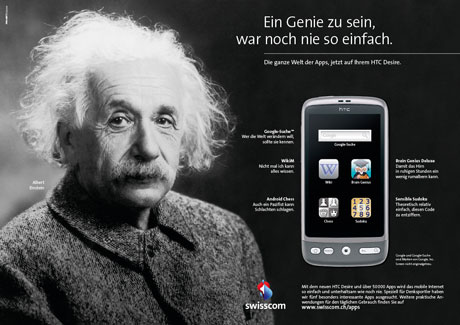
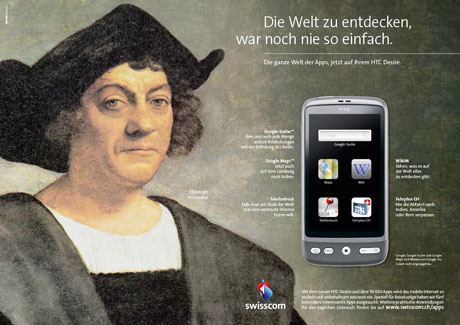
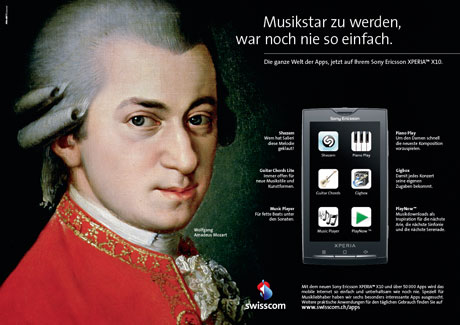
Jung von Matt/Limmat zeigt für Swisscom: Mobil online zu sein, war noch nie so einfach.

Swisscom is once again pushing communication for the mobile Internet this year. Jung von Matt/Limmat has developed a campaign for this purpose. ¬This is primarily aimed at consumers who still find the mobile Internet too complicated. Yet the mobile Internet is particularly easy to use via apps. This is why the apps are the focus of the communication alongside the practical end devices. CD Alexander Jaggy's team used historical personalities as testimonials, whose pioneering work would be child's play today with the help of the mobile Internet. The apps and their functions are presented to the reader from the point of view of the personalities and their ease of use is explained. Mahatma Gandhi, Christopher Columbus, Wolfgang Ama¬deus Mozart and Giacomo Casanova, among others, explain the mobile Internet. The motifs have been on air throughout Switzerland as advertisements, posters, at the POS and as Internet banners since the end of May. Pan
1290580859_img100616_swisscom1
1290580859_img100616_swisscom2
1290580859_img100616_swisscom3
1290580859_img100616_swisscom4
1290580859_img100616_swisscom5

Rush of fans on Internet TV paralyzes the Internet

Various Internet TV providers were unable to keep their promise of serving up live World Cup football in perfect quality on the screen at the touch of a button. Providers such as Zattoo and Wilmaa were unable to cope with the large crowds without glitches.

When the opening match of the World Cup kicked off last week, the servers were unable to cope with the enormous demand from fans and went down in some cases. At Zattoo.com, the pioneer of online television, many users were unable to log in at all. At competitor Wilmaa.com, too, the picture sometimes remained static for several minutes. According to Handelsblatt, Nick Brambring from Zattoo admits that they have been working hard to solve the problem and have been successful. The acid test now comes with the match between Switzerland and Spain, for which Zattoo expects peak capacities of up to 100,000 viewers.
On the other hand, the start of the World Cup went without incident for the live streaming service of Swiss television SF, according to Walter Bachmann, Head of the Multimedia Center. However, their viewer numbers were also lower. SF's Internet TV service has so far reached its peak with 120,00 simultaneous users during the match between Denmark and the Netherlands.
www.handelszeitung.ch

Swiss ideas on all channels

SRG SSR idée suisse has published its latest annual report in a printed and a digital version for the first time. The Zurich agency Heusser Communicates conceived and realized the double publication.

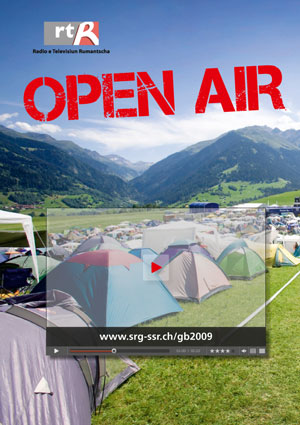
The red play button on the front page of the SRG Annual Report 2009 makes it clear that more information awaits after the click. Anyone holding the printed version of the 156-page report in their hands will receive important and exciting information about SRG's radio, television and multimedia offerings and about the company's social and societal commitment after an illustrated introduction. This is followed by the obligatory figures section. The agency has summarized the most important figures, data and facts once again in a handy extra booklet for your pocket, which is glued into the print version and integrated into the online version as a PDF.
The online version is a copy of the printed version, but has a few gadgets: In the print version, for example, a double-page spread provides information about the Lumnezia Open Air, while online readers can click on a button on the same page to watch an SF report on the festival. Readers can jump directly from the online table of contents to the selected chapters and can also search for terms. The tables, which are classic in print, are animated online and only appear before the reader's eyes. And links are placed in the continuous text of the online version that lead directly to the offers outside of the annual report that the text revolves around. Readers can browse through the online version in exactly the same way as the printed annual report, but instead of using a wet index finger, they use a mouse. In the printed version, play buttons on images and color-coded links indicate that the online version contains additional material in the relevant places.
Interlocking in perfection
"SRG didn't want to do without the printed annual report, but definitely wanted to offer an online version - after all, the company stands for media convergence," explains Thomas Heusser, Managing Director of Heusser Communicates. "We decided against creating a separate website for the annual report because that would have meant a completely different concept in terms of design, structure and navigation. The costs and time involved would have increased significantly as a result. Instead, we developed a convergent concept for print and online that combines the advantages of both media." However, simply producing an analogue annual report and digitizing it would not have met the requirements of SRG and the agency. The dovetailing of analog and digital had to be considered from the outset.
"We have animated and linked the online version of the SRG annual report and integrated videos and sound. Of course, there are many other ways to add gadgets to the online report," says Heusser. "For example, you could add short video statements to the pictures of the members of the Executive Board presented at the back. However, you have to be careful not to overload the online version of a magazine or annual report," warns Heusser. "It's not always good to include everything you can."
The double page layout was realized with additional costs of around 15 percent. This was mainly due to the programming and implementation of the online version. As SRG was able to draw on a large pool of video and audio material, no additional costs were incurred for the creation of multimedia content. With the two versions, SRG perfectly serves its broad target group and also makes exciting material available to all fee payers. The online version is already available to the public, the print version will be sent out in the next few days.
Anne-Friederike Wilhelm
1290580860_img100616_srg2
1290580860_img100616_srg1
1290580860_img100616_srg3
1290580860_img100616_srg4
1290580860_img100616_srg5

Kassensturz terminates cooperation with K-Tipp

Swiss television network SF is no longer collaborating with the consumer magazine K-Tipp. SF reviewed the partnership over the past few months and concluded that it was no longer appropriate.

In the Internet age, Kassensturz is no longer dependent on collaboration with a print product, SF editor-in-chief Hansruedi Schoch said in the press release. However, occasional collaboration is still possible and desirable.
www.sda.ch

The advertising week on Star TV: "KARGO and the Swiss Cancer League - The beautiful sun and sun protection"

Today, Thursday, at 19:45, Star TV brings the sun to the day. In the form of a beautiful blonde, it's hard to resist the temptation. On behalf of the Swiss Cancer League, the Bernese communications agency KARGO is drawing attention to the dangers of UV radiation with a refreshing prevention spot.

A look behind the scenes promises exciting images and action.
The advertising week on Star TV: Every Thursday at 19:45 on Star TV or as a stream on Startv.ch.
img100616_startv06

Personnel changes at Media Focus

Reto Feurer will become the new sales manager at Media Focus, where he will report directly to Jens Windel, managing director of Media Focus. Michel Bächtiger has joined the Product Management division.

Reto Feurer took over responsibility for sales on May 1, 2010. The Zurich native, who trained as a federal sales manager, worked at Migros Presse for over four years - most recently as deputy publishing director - and brings experience in the areas of customer service, acquisitions and publishing projects to his new role.
Michel Bächtiger joined Marketing Manager Kevin Schnell's team in the Product Management department at the beginning of June. He will primarily deal with media-specific issues in the management of advertising data and creations. Bächtiger has been familiar with the media industry since his apprenticeship at the former Micom Carat.
www.mediafocus.ch
get_footer();