Contexta: Football fever with Appenzeller cheese

Die Agentur Contexta hat für Appenzeller Käse eine an die Fussball-WM angelehnte Kampagne realisiert.

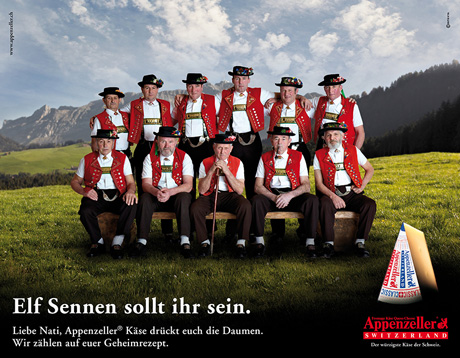
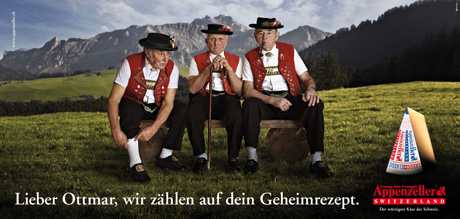
Always keep it tight - for over 700 years, this tactic has been the Appenzellers' recipe for success: they don't reveal the secret of their spicy taste. Just as little as Ottmar Hitzfeld reveals the secret of his success. Just in time for the World Cup, Contexta is now getting the Appenzell team to cheer on the athletes on posters, advertisements, banners, radio spots and other online advertising media. In their usual buttoned-up manner, the eleven Appenzellers support the Swiss national team. On the Internet, the Alpine dairymen even let themselves be carried away to a la-ola - a unique outburst of emotion from the otherwise rather reserved Alpine dairymen.
> To the radio spot
Responsible at SO Appenzeller Käse GmbH: Christoph Kempter, Director. Responsible agency: Contexta AG, advertising agency BSW, Bern. Photo: Caspar Martig. Media: MediaPlus AG, Bern.
1290580853_img100616_appenzeller3
1290580853_img100616_appenzeller2

Successful first half-year for Publicis Switzerland

Die Zürcher Agentur Publicis schaut auf ein erfolgreiches erstes Halbjahr 2010 mit vielen neuen Kunden zurück.

After Publicis announced in January 2010 that it had won the Europe-wide umbrella brand account for Charles Vögele Mode, it has now been awarded four further international mandates, according to a statement: Vetrotech, the world's leading supplier of refractory glass with production sites in Switzerland, the UK, America and Asia, has awarded its budget for the development of its overall global presence to Publicis Zurich following an agency evaluation. The sanitary technology company Geberit is also having its B-to-B communications for 35 countries developed and managed by Zurich's Stadelhoferstrasse following an agency evaluation.
The traditional Swiss brand Jura, which has a global presence with sales companies in Germany, Austria, Spain, the Netherlands, the USA, the UK and Southeast Asia, is working with Publicis for its umbrella brand and product communications. Another new mandate comes from the Swiss Formula 1 racing team Sauber: The launch of the exclusive "Sauber Club One" will be presented to an audience of millions worldwide, including on the bodies of Sauber racing cars.
However, Publicis was also able to toast the winning of important national mandates in recent weeks, according to the statement. These are the cigarette brand Winston (JTI) and the Swiss Bankers Association.
Publicis Dialog also expanded its client portfolio in the first half of 2010. For Cirque de Soleil, Publicis Dialog is handling all communications and lead generation for the September and October 2010 performances in Zurich. New clients also include Elektrizitätswerke des Kantons Zürich, for whom an emotionally viable and involving campaign was developed.
The new campaigns that Publicis was able to develop for existing clients, such as the new appearances of PostFinance, Chocolat Frey and Schweizer Illustrierte, also contributed to the successful business performance. Publicis is also very satisfied with the intensified integration of the various communication disciplines. For example, the in-house digital unit Publicis Modem was an integral part of the team and integrated into the overall development for almost all new business wins.
This dream start to 2010 has enabled Publicis to expand its workforce. And the search for further employees is underway, it is said - Publicis should be able to report further gains in the coming weeks.

USA and UK hardest hit by newspaper crisis

Die Situation auf dem Zeitungsmarkt bleibt weiterhin angespannt. Vor allem in den USA und Großbritannien sind die Verlage in den vergangenen Jahren mit massiven Auflagenrückgängen konfrontiert.

According to an OECD report cited by Pressetext, the two markets have suffered the sharpest declines. The British market has lost 25 percent of its circulation since 2007 and the US market 30 percent. Other nations that have been hit hard by the newspaper crisis are Greece (minus 20 percent), Italy (minus 18 percent) and Canada (minus 17 percent), according to the study. Overall, 20 out of 30 OECD countries had to contend with circulation losses during the period under review. Growth in the international newspaper market has weakened continuously since 2004 until it reached virtually zero in 2007. Only the developing countries recorded growth in some cases.
Unsurprisingly, the newspaper crisis also led to staff cuts. Publishers in the USA, the UK, the Netherlands and Spain were particularly affected. In the ten years between 1997 and 2007, for example, the number of employees in the newspaper industry in the USA fell from 403,355 to 356,943 - a drop of twelve percent. Since then, however, the situation has worsened. In the fall of 2009, for example, the New York Times had to cut 100 journalist jobs.
Positive impetus forecast for 2010
Despite the ongoing tense situation, the OECD report also signals hope for a slight recovery in the newspaper market. Positive impetus is also forecast for 2010. This is also confirmed by the latest figures from the US market, according to which the declines in recent months have slowed somewhat. It is also apparent that specialized titles are performing slightly better online than general newspapers. Print and the Internet are not a contradiction in terms. Web offerings are more of a supplement than a replacement for traditional print news.

Suspicion of surreptitious advertising: Fifa interrogates Dutch women

Eine Gruppe Holländerinnen bestimmt zur Zeit die Schlagzeilen in Südafrika. Die Blondinen waren der Fifa beim Spiel der Oranjes gegen Dänemark aufgefallen.

36 female football fans from Holland have attracted the attention of World Cup officials at the Soccer City Stadium in Johannesburg with their uniform and conspicuous behavior. They are now world-famous as the "Beer Babes". As the daily newspaper "The Star" reports according to Tages-Anzeiger.ch, 40 stewards intervened because the boisterous Dutch women all wore identically styled mini shirts from the beer brand Bavaria during the Netherlands' match against Denmark.
The orange mini-shirts did not bear the Bavaria emblem, but were marketed by the company and are recognizable to insiders as a Bavaria company product. The 36 young women were detained for three hours and questioned about whether they worked for the company, among other things. The police announced that they would continue the investigation. The interrogations took place in the offices of the football association Fifa, which is organizing the World Cup.
FIFA explained that the young women had been "instrumentalized for a marketing campaign" by the brewery company. The brewery giant Budweiser is the only beer producer allowed to advertise in the World Cup stadiums.

IAB Europe publishes white paper "Brand Advertising and Digital

The Brand Advertising Committee (Committee on Brand Advertising on the Internet) of the Interactive Advertising Bureau Europe has published its white paper, «Brand Advertising and Digital.».

The collection is required reading for all those involved in digital brand advertising, according to a release Thursday. The white paper is one of the first projects of the IAB Europe panel on brand advertising online. The goal of the publication is to support and promote online as a media and media platform for branding, as well as to provide information about the strengths and benefits of online for brand advertisers.
Based on the advertising industry's strong demand for more detailed information, research and case studies that demonstrate the strengths of digital media for brand advertising online, the report offers a holistic look at the topics of performance measurement, formats, targeting and audience engagement, and cross-media, as well as valuable insights into how digital campaigns can support brand communications. The findings draw on insights, analysis and experience from recognized market players, advertisers, market research companies and industry service providers.
The white paper is now available at Iabeurope.eu available for download.

"Sappi European Printers of the Year": Gold for Switzerland

In the «Sappi European Printers of the Year» competition, printers from all over Europe compete for awards in various print product categories. This year, participants from five countries, including Switzerland, won gold.

The "Zenith-Maxi 2009" general catalog was awarded a gold medal in the catalog category. The catalog submitted by the Courvoisier printing company was printed on "Mega" paper from Antalis.

Altenrhein, we have no problem

Raketenstart eines neuen Swiss-Marketing-Regionalclubs: Innert weniger Wochen hat der Ostschweizer Werber, Ausbildungsleiter und Dozent René Eugster (iQ Management Center) die Sektion iQ Swiss Marketing vom Boden gebracht.

The man has always set the thrust to maximum power. René Eugster is not only Creative Director of the agency at the airport in Altenrhein SG, but also owner, principal and lecturer of the IQ Management Center at the same location. In the latter capacity, Eugster and his team have helped around 300 young talents to pass their exams over the past few years, and have also helped marketing specialists, sales specialists and sales managers to take wing, in addition to technical business people. If an advertising and school captain wants to acquire new students and also take care of his wife, family and tennis souplesse, one might expect him to say: "Give me a break. But Eugster doesn't say that. He says, "Let's start a new regional club for Swiss Marketing." Even better, he doesn't just say it. He does it. More precisely: Eugster has already done it.
Fast and strong start
On May 25, the iQ Swiss Marketing club was founded in Altenrhein. Eugster quickly found a good number of former students, and with this alumni potential, the youngest Swiss Marketing regional club - it is the 35th in the country - was able to get started right away with 50 members. For Swiss Marketing President Uwe Tännler, who was there in Altenrhein on the day of the club's founding, this was a great thing: "I've never seen a new regional club ramp up so quickly and so strongly." Just two months after an initial contact with Eugster on the matter, he says, the club was already a fact. According to Eugster, in the latest regional club of Swiss Marketing, the professional exchange and also the mutual acquaintance of the respective companies should play a major role. Which Tännler finds to be exactly the right way to go: "Know-how transfer, networking, continuing education - our values are lived out in this new regional club!"
Keep dual principle high
Eugster initially justifies the take-off of iQ Swiss Marketing - as with the school, iQ also stands for "intelligence quotient" - mischievously: "Instead of always organizing class reunions of alumni, we'd rather found a club right away and equip it with a strong value proposition: to multiply the positive felt!" But of course, there's a lot more to it than that: "We have to do something to preserve and promote our profession," says the iQ captain, "especially in view of increasing academization, it is important to promote the original Helvetic dual professional principle. Because this has brought us a long way." Just how far and in what concrete creative power was shown on May 25 at the airport in eastern Switzerland. Altenrhein, do we have a problem? No. Definitely not!
1290580859_img100616_swissmarketing
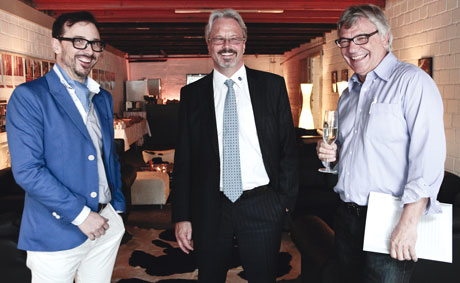
Push, concoct, take off: René Eugster, Agency at the Airport, Uwe Tännler, President Swiss Marketing, Charly Müller, Swiss Marketing Group Coach Eastern Switzerland (from left to right).

The old man and the more

Toby E. Rodes is likely the longest-serving PR consultant in the German-speaking world. Born in 1919 as a German with partly Jewish roots, he has lived through and helped shape a turbulent era—as a soldier and a communications professional. Now nearly 91 years old, Rodes still works as a consultant at his Basel-based marketing and PR agency, which he founded in 1966. He also works as a journalist and an author.

There is not much that Toby E. Rodes has not been or is not: office worker, ski instructor, officer, company founder, company boss, diplomat, journalist, author, management consultant, PR expert, as well as founder and member of numerous national and international PR societies and institutions - to stay within the Swiss borders, for example, the BPRA, the SPRG, the NPRG and the SPRI. In addition, Rodes has been a speaker and examiner at SAWI and an expert for the Swiss Fairness Commission. But borders do not do justice to Rodes: during his long life he has worked in 30 countries in more than 45 cities with five languages. He has lived and worked out of Basel since 1956. Rodes has two "homes," New York and Basel. He sees himself as an American European, which he also accentuates with the subtitle of his autobiography published last year.
Rodes was born in Frankfurt am Main in 1919 to a German-English mother and an American-German father. At the age of eleven, he wanted to become a great conductor like Toscanini or Bruno Walter. "It was clear to me early on that I wanted to communicate - and communicating musically would have been my lifelong dream," Rodes says. The boy learns to play the violin, flute and saxophone and invests a large part of his sack money in attending classical concerts. In 1934, he is disappointed to discover that he does not have an absolute ear. "I realized that at best I would make it as a coffeehouse bandmaster, but not as a creative conductor," Rodes recalls. "That wasn't enough for me." The boy says goodbye to his dream. But his love of music continues to accompany Rodes: Later, he plays music with his wife and friends, and today there is a radio on his desk that he quickly switches on when he is overcome by the desire for music.
Gut feeling and independence
At the age of 14, Rodes goes to Switzerland alone because he is angry about an anti-Semitic lecture at his school. A feeling deep in his gut tells him that bad things are developing in his homeland. Rodes graduates from an English college on Lake Geneva, then studies international finance and law in London and New York. In 1937, Rodes, who at that time was still called Rosenthal, changed his last name. This was not only to get rid of his German past: "I wanted to live like an American without being handicapped by old Europe. And I wanted to exist for myself. My grandfather was a famous painter whose paintings hang in many important museums around the world. He painted a picture of Bach that everyone knows. My father was the head of the largest European construction company, Philipp Holzmann. My mother, Olivia Veit, was a celebrated actress before she married. I didn't feel pressured by my background, but I didn't want to remain the little grandson or son either." New name, new life.
Rodes gets his first job in America at the Bank of the Manhattan Company - as a bellhop in uniform. "I was quickly pulled off the elevator, though, and put in the foreign department when they realized I knew languages the bankers didn't," he recounts with a grin. "So I started doing French and German translations and communicating internationally."
String puller in the old homeland
Rodes is regarded worldwide as a professional for PR on the international stage. With his flair for people and his distinctive communication skills, he has helped shape many political and economic decisions at the international level. As an officer in the U.S. Army, he is assigned to the psychological warfare division, Psy War, in 1942. He receives training in psychological warfare and passes interpreting exams in English, French, German, Italian and Spanish. As the only German-speaking officer with American ancestry, he has a key function in the American Psy War actions, for example in the production and distribution of leaflets. Furthermore, he is instructed by the commanding general to read everything his comrades write and to report if it does not conform to the given policy. An enormous trust in the competence of the only 23-year-old.
After the end of the war in 1945 and 1946, Rodes, as a U.S. major on the "Information Control" command staff, shares responsibility for establishing a democratic press in Germany, for example by censoring German media: "We wanted to ensure the separation of propaganda and information," Rodes reports. "Anyone who did not adhere to this separation had to expect sanctions." In 1946, Rodes returned to the New York export company American Near East Corp. for four years, where he had already worked from 1939 to 1942. In 1950, the U.S. occupation agency OMGUS hires him as press spokesman for the U.S. city commander in Berlin. The CIA tried to poach him from this post. Rodes declined with thanks: "In a secret conversation, they suggested that I sign a four-year contract - and then I would be told six months later whether I would be taken on," Rodes recalls. "I didn't like that style."
Reconstruction needs information
In the same year, Rodes was offered by the State Department to head the information department of the Marshall Plan in Germany, the U.S. program for the economic and cultural reconstruction of the completely destroyed country. Rodes is immediately on board. "We wanted to help Germany catch up quickly with the postwar era," he reports. "We saw a big task in informing the population about the economy and novelties in the rest of the world. Germany had been isolated for too long and deliberately disinformed by Goebbels."
Rodes' employees dub about 200 American films about new technologies, provide film projection equipment, organize educational events and exhibitions. In 1950, Rodes is instrumental in planning the "Berlinale" international film festival. His greatest coup came when, after the suppression of the June 17 Uprising in 1953, a special issue of the weekly supplement of the newspaper "Neues Deutschland" was smuggled into East Berlin and circulated there: Photos of the uprising are printed in the magazine. The Russians search for the enemy of the state. To no avail. For Rodes, this action is still his most exciting communications project today.
Design all along the line
In addition to communication and music, Rodes had a third great passion: furniture and design. As a member of the board of the design furniture manufacturer Knoll Ass. and head of Knoll International, he helped shape the furniture taste of the 1950s and 1960s. He also appears as a juror in design competitions and publishes as a trade journalist in relevant magazines and daily newspapers - incidentally, to this day. In 1955, Rodes changed careers again: He became a member of the supervisory board of the famous American PR agency JKPR Julius Klein. JKPR is known for handling explosive international PR assignments in business and politics. Among other things, the agency was involved in the talks between Ben Gurion and Konrad Adenauer and worked for the German government. Parallel to his involvement with JKPR, Rodes founded his own agency, Toby E. Rodes International Communications & Marketing Consultancy, or Terag. Rodes specializes in international marketing and communications consulting as well as project planning and execution. His first client is Vitra-Hermann-Miller, at the time one of the leading representatives of modern design in the U.S. - and Rodes' most important ex-competitor.
Terag develops brilliantly: Rodes looks after a number of illustrious names in the furniture and design industry all over the world, for example De Sede, Mobilier International, Erpo, Flötotto, the Finnish Furniture Export Association or Elan, but also clients such as Rado, Glas-Trösch, the international lottery organization, Feldschlösschen, the Rietberg Museum or the Scottish Earl of Bute, who accompanied the expansion of his weaving mill with PR. Between 1967 and 1988, the number of agency employees increased to six, after which Rodes worked with up to twelve employees in the meantime. "I've often thought about quitting," Rodes admits. "But so far it hasn't worked out." Since 2005, however, he has shared his office with Patricia D. Trenkler, who worked closely with him as an intern for Feldschlösschen. She is to be Rode's successor. The beginning of quitting. But: "As long as something is stirring in my head, I don't want to sit at home or lie in bed, twiddling my thumbs and playing the pensioner," Rodes makes clear. His wife, the physiotherapist Dr. Waltraud Elisabeth Rodes-Bauer, inventor of the combination therapy laser acupuncture and physiotherapy, is also still fully engaged in her profession at the age of almost 70. So it may be a while yet before Rodes finally takes her leave of the PR stage.
No life without communication
"Communication among living beings is at the heart of our world. Without communication, there is no life," Rodes writes in his autobiography. From a person who places such a high priority on exchanges with one another, one would like to know how he sees the future of marketing and PR. "I don't know," is the simple answer. "PR has the task of building mutual trust. That also means behaving accordingly. But the new means of communication don't necessarily make it easier to exchange ideas with one another in a spirit of trust. The quality of communication has declined. Because everything is faster. And because we have too few communicators who are not just the long arm of their bosses. We have to counteract this with sound training."
Rodes is open to new communication possibilities: In 1966, he bought the IBM ballpoint typewriter that had just come onto the market, later a telex, then a fax. He also familiarized himself with PCs and cell phones, and considers the Internet to be the most important development in the communications industry. Nevertheless: "The fatal consequences of inadequate communication in the electronic age are much more serious than in earlier eras. The globalization of electronics has meant that it is no longer possible to communicate in a targeted manner. This means that you have to be prepared for information aimed at target group A to be received by target group B, to be knowingly distorted, and to be communicated incorrectly," warns Rodes. "Genuine communication, however, presupposes a dialogue based on understanding. And the will to compromise." This more in communication often does not succeed, because time pressure and purposeful talking past each other characterize today's communication. Most e-mails bear witness to such haste and inattention to the communication partner.
If communication is to work, it is important that people approach each other with respect, take time for each other and allow their counterpart's opinion to be valid. Anyone who wants a dialogue must not only speak, but also be able to take himself and his feelings back and listen. That's one of many things you can learn from Rodes. Rodes communicated fully in this way throughout his life. It allowed him to be true to his resolution, "You have to be able to look in the mirror in the morning without throwing up."
Anne-Friederike Wilhelm

> Pictures from the book "Once America and Back

In a nutshell
Toby E. Rodes
* 1919 as Toby E. Rosenthal in Frankfurt on the Main
1934 - 1936 Fisher Institute, Chateau d'Arvel, Territet Montreux
1936 London School of Economics, London
1937 Acquisition of American citizenship and change of last name
1938 - 1942 Studied International Finance and Law, New York
1938/39 Bank of the Manhattan Company, New York
1939 - 1942 American Near East Corporation, New York, Cairo, Tel Aviv, Paris, Geneva, Zurich, Casablanca, Oran
1942 - 1946 U.S. Military Service
1942 - 1945 Department of Psychological Warfare, Germany
1944 Radio Luxembourg, appearances as "Italian" major, secret station 1212
1945/46 U.S. Major on Allied Command Staff "Information Control".
1946 - 1950 second time American Near East Corp./Anec Trading Co.
1950 Press spokesman for the U.S. city commander, Berlin
1951 - 1955 Senior PR Officer of the Marshall Plan, Bonn
1956 - 1966 Knoll Ass. and Knoll International, New York, Basel, Frankfurt, Vaduz, Paris, London, Milan, Rome, Vienna
1955 -1975 JKPR Julius Klein, Chicago, New York, Los Angeles
since 1966 Terag, Basel
2005 Receipt of the Wilhelm Leuschner Medal, highest award of the German state of Hesse

Reading tips
Toby E. Rodes (2009): Once in America and back: memoirs of an American European. 230 pages. Verlag Huber Frauenfeld/Stuttgart/Vienna. 49.90 francs.

1290580858_img100616_buch
Toby E. Rodes (2005): 11 theses on communication. 175 pp. Author Publisher. 38 francs.

To the point: interference guaranteed

SRG has been operating at a loss since 2006. While the loss in 2009 was 46.6 million francs, it is expected to rise to 75 million francs this year. One of the reasons is the additional costs associated with the Winter Olympics and the World Cup.

Last year, operating income amounted to 1.56 billion Swiss francs, which is actually not exactly low. The loss figures signal the need for action. Saving is the order of the day. SRG points out that several rounds of savings have been made since 2005, which would correspond to a sustainable volume of 100 million francs. That may be true, but in any other company, savings must also be made when either revenues fall or expenses rise. So the sympathy is limited.
The fact that SRG sees the main causes of its desolate situation in factors that it cannot influence is shocking. This was stated in the financial report that it submitted to the Federal Council at the end of November 2009. It talks about inflation, disproportionately rising costs for sports broadcasting rights, the rapid pace of technological development, the slump in advertising, and general demographic and sociopolitical developments. If I may say so, this line of argument does not exactly bear witness to a business-oriented approach. No company, no matter in which industry, can simply say that external circumstances have unfortunately developed in such a way that nothing can actually be done. A company manager who did this would not only be the laughing stock of the media, he would also be punished and have to vacate his post.
Now, it may be conceded that this cannot be seen so narrowly in the case of a public company that has to fulfill a performance mandate with its public service. That may be so.
But a little more tact would be in order. The salary increase for the departing general manager belongs in this chapter.
No wonder there is resistance in parliament. The National Council wants to disempower the Federal Council, which has set radio and television fees until now. A parliamentary initiative to this effect was accepted. In the future, parliament will set the level of fees. We can prepare ourselves for something here. There will be no end to the party-political bickering, and it is to be feared that parliament will use the leverage of fees to interfere in programming. Cheers then!
Pierre C. Meier, Editor-in-Chief
[email protected]

Advico Young&Rubicam develops fundraising campaign for Goldau Nature and Animal Park

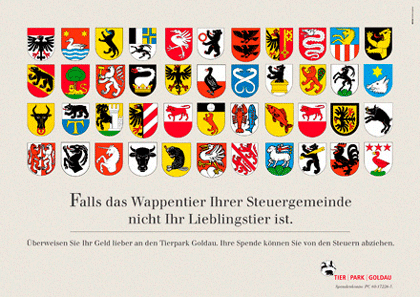
Native wild animals can be found not only in the Goldau Nature and Animal Park but also on numerous cantonal and municipal coats of arms - in other words, where you have to pay your taxes. And because nobody likes to pay a lot of money to the tax office, the zoo's new donation campaign shows how you can save taxes and do good at the same time.

The campaign's message is therefore: simply donate to the zoo and deduct the amount from your taxes.
The campaign developed by Advico Young&Rubicam is being used in the form of posters and advertisements.
Responsible at Goldau Nature and Animal Park: Anna Baumann (Director), Karin Leemann Gisler (Marketing/Communications). Responsible at Advico Young&Rubicam: Markus Gut (overall responsibility), Dominik Oberwiler (CD), Thomas Schöb (ECD), Lukas Wietlisbach (AD), Julia Brandstätter (text), Tanja Mezan (consulting) .
1290580860_img100616_tierpark1

Flop of the week: Negligent naivety

On Monday morning, the news portal Tagesanzeiger.ch/Newsnetz published the police photos of Hannibal Gaddafi. The photos had been printed in the *Tribune de Genève* following Gaddafi's arrest last September.

A Geneva court ruled on April 12 that Gaddafi's personality had been violated by the publication. On Monday, the Tribune article, including police photos, was again clearly visible on the news network for a good hour. Gaddafi's likeness was then made unrecognizable. As editor-in-chief Peter Wälty told the news agency SDA on request, the image served as the basis for the corresponding article. The picture merely illustrates an article "which deals with the topic of freedom of the press and protection of sources". However, Wälty does not believe that the publication will have any legal consequences. "We didn't show the pictures", emphasized the editor-in-chief, but "the reporting in its entirety". The Tribune de Genève had already mistakenly published a facsimile of the disputed article on its website for a short time on Sunday.

Kick & Fly - the football game for all fans

Futurecom kicked the soccer ball to South Africa for SportXX.

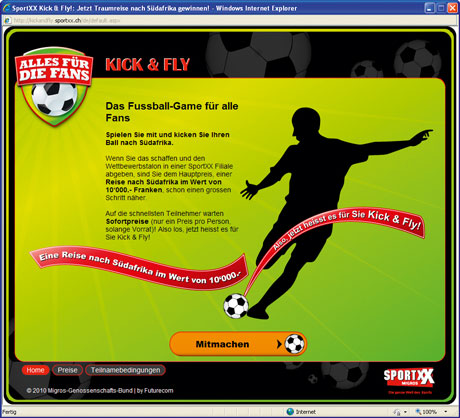
In keeping with the current football theme, Futurecom was commissioned by SportXX to create an online activity. The claim for the Migros subsidiary was to promise: "Everything for the fans". The agency passed the ball to the users and developed the "Kick & Fly" game.
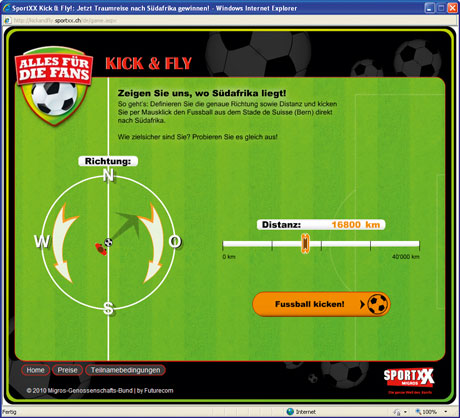
Anyone who manages to kick a football virtually to South Africa can win a dream trip to South Africa with a bit of luck. The challenge lies in the fact that the user has to define for themselves in which direction and how far they want to kick the ball to get to South Africa.
Once the user has managed to guide their shot to South Africa, they can fill in a competition form, hand it in at a SportXX store and enter the prize draw for the dream trip worth CHF 10,000. There were also instant prizes for the fastest people to hand in their entries at a branch - a reason for some fans to cheer ahead of the World Cup.
Futurecom is responsible for the entire development of the online activity - from conception to realization. The game will be advertised in the Migros newsletter and with banners on the Migros website and the SportXX website. pan
1290580859_img100616_futurecom1
1290580859_img100616_futurecom2
img100616_futurecom3
get_footer();