Weber Harbeke Partners advertises Löwenbräu Black

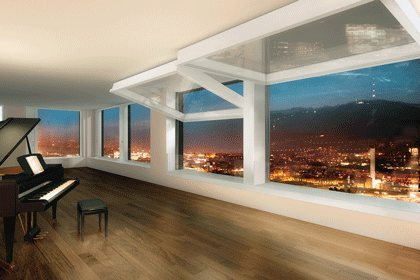
On the site of the former Löwenbräu brewery in Zurich, a limited number of apartments are being built in various new parts of the building, including a 20-storey tower that will rise above the existing brick building. The Zurich advertising agency Weber Harbeke Partners was selected in an agency evaluation for the marketing. The first works can now be seen.

In keeping with the colors of the new buildings, the apartments are called Löwenbräu Black, the museum building Löwenbräu White and the office building Löwenbräu Red. There is a saying in the real estate industry that three things are important for a property: 1. the location, 2. the location and 3. the location. This is why the location in the middle of the former Kreis 5 industrial area was first of all made palatable to potential buyers.
The sales documents are divided into four parts. The "Neighborhood" brochure, the centerpiece, celebrates Kreis 5 with photos by Susanne Völlm and draws parallels to cities around the world. The "Project" and "Plans" brochures offer detailed architectural visualizations with all the important information about the condominiums. The fourth brochure deals exclusively with the "Penthouse" and is distributed exclusively to a select clientele. The website www.loewenbraeu-black.ch gives a first visual impression of the project.
1290580858_img100616_loewenbraeu1

Control advertising effect

What is the potential of your advertising efforts?

Objectively assess advertising success
Advertising success is when advertising objectives are achieved. For a subject to be effective, the target group must perceive its message quickly and accurately. Every two weeks, advertising effectiveness researcher Patrik Zwahlen assesses the persuasive potential and visualization quality of five selected advertising subjects exclusively for Advertising Week, thus providing an objective assessment of your advertising success.
Analysis with method
This brief analysis assesses the communication performance of advertisements with the help of the two metrics "persuasive potential" and "visualization quality". To determine the persuasive potential, Zwahlen first formulates measurable goals such as "sell more," "become better known," or "reduce the frequency of accidents. In order to achieve such goals, the subject needs a credible reason for impact that corresponds to the message. After defining a plausible goal for each ad, the message is unencrypted and written down. A green arrow means that the subject is convincing; a red arrow means that it is not.
With the visualization quality, Zwahlen provides an assessment of whether the message is perceived quickly and without wasted coverage. A green arrow indicates that the ad communicates quickly and without errors. If the subject is marked with a red arrow, misunderstandings and misinterpretations are to be expected.
> Results at a glance (PDF)
> Detailed Results (PDF)

The correlation of status and weight

Push ?n? Pull has found a meaningful visual world for the Inselspital's annual report.

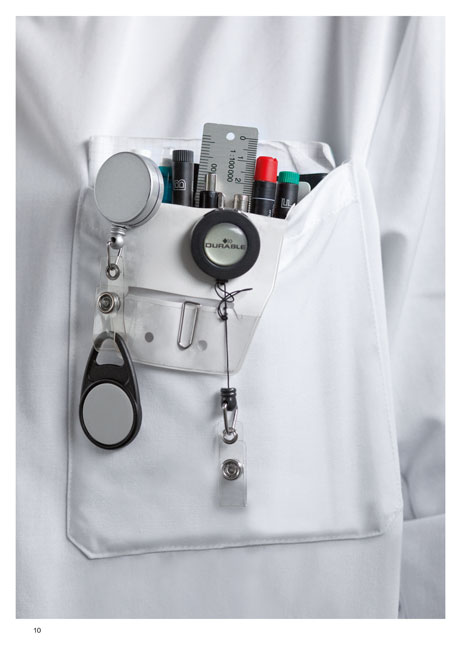
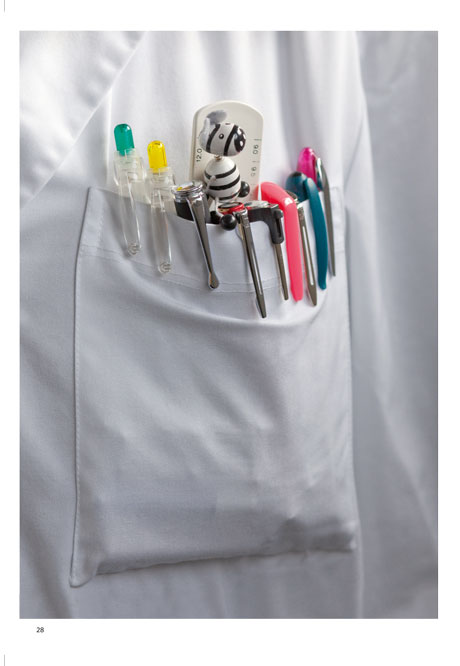
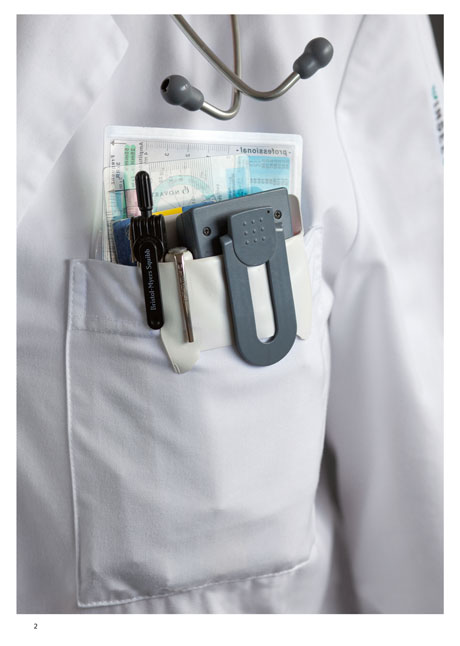
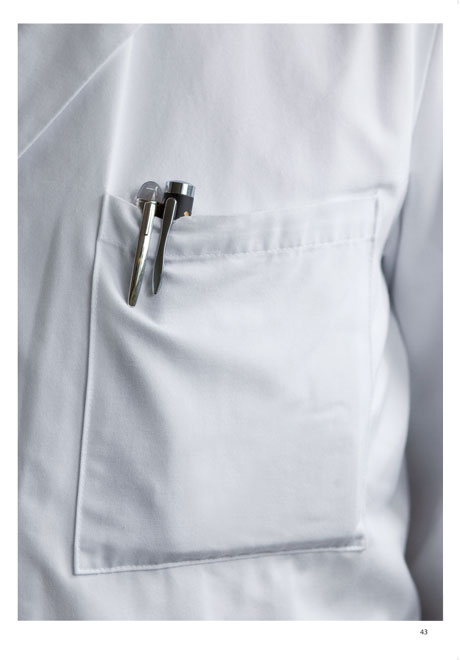
What pockets carry is fascinating and interesting. This also applies to the contents of pockets on doctors' professional coats.
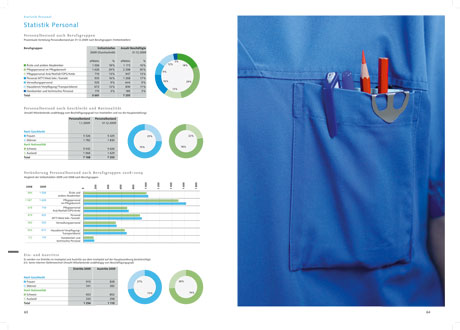
In the current annual report of Inselspital Bern, this fact was implemented in the imagery. The Push 'n' Pull agency derived the actual image idea from a study published in the British Medical Journal by three ward doctors at Edinburgh University Hospital. It was about the "correlation between the weight of doctors' coats and the status of their wearers". They found that the higher the rank of the doctor, the less diagnostic equipment they carried and that the hodgepodge of utensils with which the pockets were filled made the gowns weigh up to 3.5 kilograms.
"We limited ourselves to taking anonymous breast pockets of spontaneously portrayed doctors and nursing staff," explains Jürg Zysset, CD at the Agency for Integrated Communication in Bern. Which pockets belong to which employees is revealed at the end of the annual report with a small series of portraits. Anyone who wants to can thus see that the results of the study also apply to the staff of the University Hospital.
"With this imagery, we are deliberately trying to set ourselves apart from the boring and arbitrary hospital images that we often find in the corresponding brochures and annual reports and to give the Inselspital an independent and unmistakable corporate imagery," says Nadine Fontana, AD at Push 'n' Pull. The image concept "the other portrait" will be continued over the next two years, with the specific image idea changing every year.
Andreas Panzeri
1290580860_img100616_insel1
Head doctor or nurse? The bag can give it away.
1290580860_img100616_insel2
1290580860_img100616_insel3
1290580860_img100616_insel4
1290580860_img100616_insel5
1290580860_img100616_insel6

Acquittal for journalist at Lucerne High Court

Like the first instance, the High Court has acquitted a journalist of the charge of unfair competition. The Lucerne journalist had not provided misleading information in her article about a hotel for sale.

In 2005, the journalist reported in the Neue Luzerner Zeitung on the fate of a panorama hotel in Kriens. After several changes of ownership, the hotel was up for sale again. In the second paragraph after the subheading "Property auctioned", the author wrote that the owner had run out of steam. The person concerned complained that this suggested he was insolvent. He therefore sued for unfair competition and demanded a fine of at least ten daily rates.
In the ruling published on Wednesday, the High Court came to the conclusion that the contested sentence could not be understood in any other way than that the current owner had not been able to run the hotel profitably either. This statement on business success was certainly market-relevant for the company. However, in the overall context, it was clear that the author was not talking about insolvency or bankruptcy. She had also not used the titles manipulatively.
www.sda.ch

Pass it on!

Word-of-mouth marketing isn’t on everyone’s lips just yet, but it’s gaining momentum. After all, a good recommendation from a friend is a stronger incentive to buy than even the funniest poster or the best promotion. Specialized agencies know how to get word-of-mouth marketing rolling.

What do you do when you can't decide where to go on your next trip? You ask a good colleague if they can recommend a destination. And if you don't know whether your next camera should be a Canon or a Nikon? Then ask someone in the know if they can recommend one of the two. It's simple. A study by Nielsen in 47 countries shows that 78 percent of consumers trust the recommendations of other consumers. And if you don't know anyone who can give you a good tip? Then ask a buzzer.
Buzzers are people like you and me who test products and share their opinions about them. Opinion does not mean adulation as in undercover marketing in blogs, but honestly: What is good? What is bad? What could be done better? The buzzers don't get paid for their ratings. This guarantees unbiased statements. However, the testers have the privilege of scrutinizing products and services that are not yet on the market. This allows them to help improve the product if necessary. In addition, their opinion is in demand, and that is always a good feeling. Because opinion is power.
The power of opinion
Maggi, for example, wanted to launch a new ready-made product for preparing chicken thighs in Switzerland at the beginning of the year: The thighs are placed in a roasting bag together with a ready-made mixture and then baked in the oven. The dish is ready after an hour. Maggi had the product tested by buzzers. They told the company that the chicken tastes good and the oven stays clean - which is good. They also found that the bag turns black during baking - which is not good. The discoloration unsettled the test consumers, perhaps the black bag is poisonous. Maggi was able to respond to this point of criticism before the market launch. Otherwise the product might not have been sold without the company even knowing why.
But Maggi received even more input: one buzzer pointed out that she found the dish perfect when she was expecting her husband and sons for dinner, but wanted to go to the gym quickly: chicken in the oven, wife in the gym, finished meal in the oven, boys happy, wife too. What a sales argument for Maggi! An entire marketing campaign could be built on this. In addition, the enthusiastic buzzer will pass on her tip (and a product sample, which is part of the buzzer equipment) to her fitness colleagues. This is how word-of-mouth (WoM) marketing works, as the experts say.
Buzz for pudding
The use of product testers is nothing new. Back in the 1960s, the German pudding magnate Dr. Oetker sent out packets of pudding powder and baking mixes to find out from experienced housewives what they thought of the products. The evaluation was carried out via a questionnaire sent by post, and the results were used exclusively by the company's development department to continuously improve pudding, ready-made cakes and the like and adapt them to the wishes of the customers.
The key difference between buzzing and the Dr. Oetker pudding test is that the reviews not only help the company to improve its products, but also serve as a guide for other consumers before they make a purchase decision. In addition, there is a lot of online buzz these days. However, the Internet should not be overestimated, as the majority of recommendations are made offline - in the living room for your father or at a party for your best colleague. Only around ten percent of the conversations we have are online. However, this percentage is slightly higher for younger target groups.
Pioneer Maggi
At the beginning of the year, Maggi was the first company to use buzzers in Switzerland. Bosch is now following suit and having its new cordless drill tested by professional craftsmen. Testing products before they are launched not only works for mass products, but also in the professional segment. A B2B campaign in which companies evaluate other companies and their products and services is just as conceivable as buzzing about financial services, swimming pools or doctors. There are no limits to word-of-mouth marketing. In Germany, even the dating portal Elitepartner.de and the online backup service Jamby are buzzing.
If you want to buzz, you have to register with your personal data. For example, only buzzers who identify themselves as professional tradespeople can take part in the current Bosch campaign. Like Maggi's "Chicken Search", the Bosch campaign is managed by Buzzer, Europe's first word-of-mouth marketing agency with headquarters in Amsterdam. The agency carefully selects the buzzers who are invited to test the products. Anyone who is registered as a tester of a product undertakes to make their opinion known. "If the Buzzers are new and have no experience, we coach them a little so that they know what it's all about," explains Willem Sodderland, founder and CEO of Buzzer. "But most buzzers quickly realize that we are interested in honest statements and that we need their feedback."
Testing with fun
The product testers naturally receive the product they are supposed to test. But the agency does even more to ensure that testing is really fun and delivers useful results: Sodderland and his team christened the Maggi campaign "chicken testing", for example. They then put together a package - the so-called buzz kit (photo above right) - that not only contained the ready meal, but also a "chicken testing manual" that instructs the tester and in which he can record his results, cotton swabs to check whether the oven stays clean during preparation, as well as several sets that the tester can pass on to his friends: "Try it." Buzzer has also put together a buzz kit for Bosch's cordless screwdriver.
In Switzerland, more than 1000 consumers have already registered as buzzers. Critics accuse them of being advertising pillars on two legs. However, numerous posts on Facebook and in blogs prove that the testers see themselves quite differently: "Total nonsense," writes Buzzer Jennifer on Facebook, for example. "Anyone who doesn't want advice isn't being harassed." And Manuela says: "Why shouldn't I recommend things that I think are good?" Sodderland's agency relies on precisely this attitude. With success. Buzzer looks after clients such as Procter&Gamble, L'Oréal, Heineken, Philips, Tschibo, Jumbo, Unilever, American Express, Nestlé and Universal Music and is currently working on building up a client base in Switzerland. The agency has already implemented over 100 campaigns in the Netherlands and Germany. Designing and managing a buzzing campaign costs significantly less than a poster campaign. In addition, their success is easier to measure. Compelling arguments.
The rebirth of the regular customer
Buzzing is a matter of trust. Companies trust buzzers with their products, buzzers trust companies and the agency providing them and give their honest opinion on products and services. Each side takes the other seriously - no longer a matter of course between producer and consumer. The fact that sellers and buyers have the opportunity to enter into a relationship with each other even before the retail sector could revolutionize marketing and advertising. Consumers today are flooded with advertising promises and tempting offers, which creates a certain resistance to advertising messages. At the same time, loyalty to companies and brands is dwindling. What counts first and foremost is the price. Tomorrow, however, buzzing could turn consumers back into fans of companies and brands who reach for a product because it comes from a certain company. And because they have already tested it. Or because their best colleague recommended it.
Anne-Friederike Wilhelm

In a nutshell
Buzzer is the first word-of-mouth marketing
agency in Europe. Buzzer was founded in 2004, is headquartered in Amsterdam and is active in the Netherlands, Germany and Switzerland. In 2009, the agency was one of the winners in the Connected
Customer is one of the finalists of the Marketing Excellence Awards of the Dutch Marketing Association NIMA. In Switzerland, Buzzer is represented by the Kreuzlingen-based agency Valueadnetwork.

img100616_buzzer

Axel Springer/Ringier - Joint Venture: Joint investment in Eastern Europe

Axel Springer still sees a lot of potential in the digital media sector in Eastern Europe. Together with Ringier, a three-digit million sum is now to be invested there.

The company wants to step on the gas and create the corresponding supply, both through organic growth and acquisitions. Axel Springer's Chief Financial Officer, Lothar Lanz, said this in an interview with Finanz und Wirtschaft. The investment is expected to be in the low to mid three-digit million range.
They are very happy to be able to invest in Eastern Europe together with Ringier, Lanz continued. However, there are no further plans for cooperation beyond this. Lanz sees the planned IPO for the joint venture with Ringier taking place in the next three to five years. The new company will be one of the largest media companies operating in Eastern Europe. However, the development of the overall economy and the company must also be kept in mind.
www.handelszeitung.ch

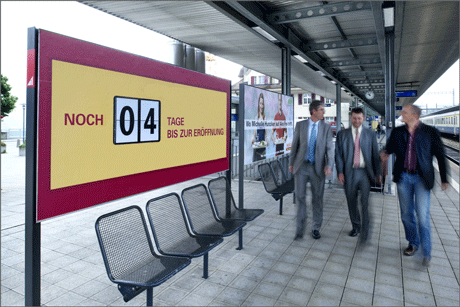
Agency01 starts the countdown for SLF Spiez

With the support of APG, the Bern advertising agency 01 has created posters that function as a countdown.

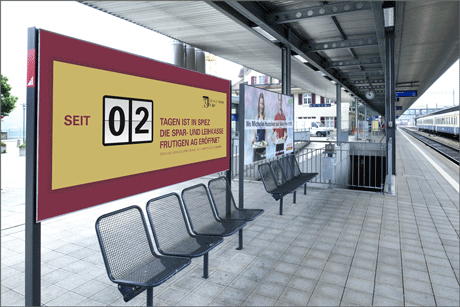
The campaign was designed for the market entry of Spar- und Leihkasse Frutigen in Spiez. It started exactly 13 days before the opening. In the process, 78 poster sites in the greater Spiez/Thun area were covered daily. First as a countdown - after the opening as a countup.
The poster campaign was flanked by advertisements and numerous below-the-line measures.
Responsible at Agentur01: Daniel Tobler (consulting), Urs Bänninger (creation). Responsible at Spar- und Leihkasse Frutigen: Bruno von Allmen, Daniel Kuhn.
1290580860_img100616_spiez1
1290580860_ig100616_spiez2

Striking

This time, the *Werbewoche* editorial team took notice of the new Barry beer as well as a new service for advertisers.

Barry's New Little Barrel
Barry is arguably the most famous St. Bernard. He lends his name to the new Barry beer from the Müller Brewery in Baden. In return, the brewery has committed to donating 50 rappen to the «Fondation Barry» for every 10-pack sold. For the past five years, the foundation has been caring for the 32 dogs—who have saved the lives of over 40 people in the past—that are still with them today. Barry beer is available at Coop in Northwestern Switzerland as well as at all Manor stores. This lager is lightly hopped but full of character—just like a real St. Bernard.
1290580857_img100616_aufgefallen_barry

New Service for Advertisers
Ökopool is the green advertising consortium of WOZ, Hochparterre, Nebelspalter, and Surprise. It reaches 489,000 people interested in environmental issues all at once. The advertising director is Kilian Gasser. Ruf Lanz is responsible for communicating the pool’s strengths. The ads show how Ökopool disposes of the «quirky» promotional gifts that are often given out by other media outlets.

1290580857_img100616_aufgefallen1
1290580857_img100616_aufgefallen2
1290580857_img100616_aufgefallen3

Aust buys news channel N24 from ProSiebenSat.1

The German television group ProSiebenSat.1 has found a buyer for the loss-making news channel. The contract was awarded to a consortium of bidders led by N24 management and former *Der Spiegel* editor-in-chief Stefan Aust.

The TV Group will incur costs of up to EUR 41 million and write-downs of up to EUR 12 million in the second quarter as a result of N24 leaving the Group. This was announced by ProSiebenSat.1 on Wednesday. The partners also agreed that the Group's stations will initially continue to be supplied with news by N24 until 2016.
www.sda.ch

Media Focus: Higher advertising expenditure in May

Thanks to the improved economic situation, more money is flowing into advertising again. Advertising spending rose in May 2010 for the fourth consecutive month.

Last month, a total of CHF 377 million gross was spent on advertising in newspapers, television and other advertising media. This was announced by the market research company Media Focus on Wednesday. Since the beginning of 2010, the advertising volume has risen by 6.1% compared to the same period last year.
In May, only billboards saw less advertising than in the previous year. However, out-of-home advertising also recorded growth over the first five months.
www.mediafocus.ch

Top of the week: A blessing for all football-stricken women

The World Cup is the ultimate media spectacle. One bold Swiss TV station is standing up to this craze: Star TV has declared itself a «World Cup-free zone» and is offering an alternative lineup for all women fed up with soccer.

Paul Grau, owner and managing director of Star TV, is convinced that there are only two ways for a television station to make a name for itself during the World Cup: either with outstanding, seamless coverage of the major event or with clear counter-programming. The Swiss private broadcaster has opted for the second strategy: from June 11 to July 11, Star TV will be broadcasting the most spectacular background reports from top films such as "Miss Undercover" and "Casablanca" during prime time. "Of course, family squabbles are inevitable," smiles Paul Grau, "but we know that almost every household now has a second or even a third set. So the only question is who gets to occupy the box seat in the living room?"

Eclat multiple awards

The Eclat agency has received several awards this year for its work, including three nominations for the German Design Award.

The agency for brand consulting and communication design was nominated for the Design Award of the Federal Republic of Germany with three annual reports, and three further annual reports won the IF Communication Design award 2010.
The 2008 annual reports of Basellandschaftliche Kantonalbank, Orell Füssli Holding and BKW FMB Energie, which were conceived and designed by Eclat, have been nominated for the Design Award Germany. The judging will take place in spring 2011.
The winners of an IF Communication Design award 2010 are the 2009 annual report of BLKB: "Leading by example", the 2009 annual report of Baloise Holding: "Diary of security" and the 2009 annual report of Straumann: "A different story".
www.eclat.ch
get_footer();