Maxomedia promotes new iPhone app from Jobscout24

With the new iPhone application from Jobscout24, job offers can now also be found on the move. Maxomedia has implemented various communication measures for the app.

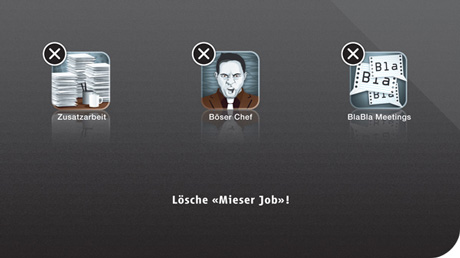
The design of the measures is based on the already familiar iPhone app symbols and icons, according to a press release. The subjects are deliberately reduced in design and represent problem factors that every employee has encountered at some point in their professional life. A nasty boss, extra work and tedious blah-blah meetings can be clicked away and are intended to get to the heart of the application's benefits: Job hunting has never been easier. The measures include online and mobile banners as well as print ads.
According to the press release, Jobscout24 is the first Swiss job platform to offer such a service. Maxomedia is responsible for the concept and implementation of the measures.
Responsible at JobScout24: Sabrina Candita (Head of Marketing JobScout24).
1290580854_img1000616_app1
1290580854_img100616_app2
img100616_app3

Salewa Switzerland: Stefan Schiesser is the new PR Manager

Stefan Schiesser has been in charge of public relations for Salewa Switzerland since June 2010.

The 30-year-old comes from the canton of Glarus and is also studying tourism at the HTW Chur, specializing in marketing and corporate communications. He has already gained work experience as a freelance journalist for several newspapers, according to a press release issued on Thursday. He is very much looking forward to becoming part of the Salewa team and representing the company externally, said Schiesser about the new challenge.

Cooperation between 20 Minuten and Sunrise in the mobile sector

The 20 Minuten media group and the telecommunications company Sunrise are working on the launch of a joint mobile service.

The 20 Minuten media network currently comprises the commuter newspapers 20 Minuten and 20 minutes, the magazine 20 Minuten Friday, the websites 20 Minuten and 20 Minutes Online as well as various mobile applications. According to the press release, the details of the offer are currently being worked out by a joint project team.

Weibel Communication moves location and strengthens team

Weibel Communication is celebrating its 20th anniversary this year and is taking the opportunity to move into new offices on Seestrasse in Zollikon from July 2010. The PR agency has also recruited new staff.

The move from Egg to Zurich/Zollikon is scheduled for the beginning of July, according to a press release from the agency. Weibel Communication will move to the top floor of the office building at Seestrasse 17 in 8702 Zollikon. The telephone and fax numbers, e-mail and web address will remain unchanged.
The expansion of important mandates and the acquisition of new clients have enabled Weibel Communication to further strengthen the team, the press release continues: Alain Gozzer is the new Senior Consultant. He graduated from the Swiss Hotel Management School in Lucerne (SHL) after completing his commercial secondary school in Zurich and gained his first professional experience in various hotels and at the smart Center Zurich-Wallisellen. He entered the PR sector in 2000, when he worked for three years as PR project manager at Grasshopper Football. In 2004, he moved to Mövenpick Hotels & Resorts Management as PR Assistant and advanced to Corporate Director of Public Relations during his five years there. Alain Gozzer joined the Weibel Communication agency at the beginning of April and, as a senior consultant, is mainly responsible for mandates in the hotel and fashion sectors. At the end of the year, he will also complete his Master's degree in Communication Management at Lucerne University of Applied Sciences and Arts.
1290580854_img100617_weibel

Digital Life Index: Digitalization is increasingly shaping Switzerland

For the third time, Publicis and Microsoft are collaborating to conduct the Digital Life Index. This representative, semi-annual study on the role of digital media and technologies in everyday life in Switzerland makes it clear that the Internet and digitalization in general continue to gain ground unabated.

Digitalization no longer only describes new possibilities, but also brings about a profound transformation of our everyday lives. The Digital Life Index (DLI) is made up of five areas: Shopping, Communication, Information, Appreciation & Entertainment. The DLI has been rising constantly since the survey began. Compared to the last measurement, the Digital Life Index has risen by 7 percent and currently stands at just under 36 percent.
The most impressive manifestation of digitalization is in the everyday lives of the youngest: among 15-19 year olds, the overall index across all areas is 49%. Compared to the over 50s (23%), this is more than twice as high a level of digitalization.
While information procurement recorded the highest increase in the last measurement period, the areas of online shopping and communication currently have the highest growth rates. Compared to the last survey in fall 2009, the proportion of people who have shopped online in the last month has increased by almost 20%. This means that the "digital shopping" sub-index now stands at 44%. The 30-49 age group in particular is responsible for this increase. Significantly more than half of this age group had already made at least one online purchase in the four weeks prior to the survey, which corresponds to an increase of 24% compared to the last survey. Among the over-50s, around a quarter had already shopped online in the previous month.
The study also shows which product categories are mainly purchased online today. As in the previous surveys, the leading category here is entertainment (music, ringtones, films, games, etc.): Just under a sixth of all respondents have made such purchases online, followed by clothing, electronic devices and travel, as well as flight and train tickets. Online shopping for clothing recorded the largest increase: Whereas in the first two surveys, around 5% of respondents bought clothes online, this figure has now doubled to 10%.
Newspapers and television inform older people, young people rely on the Internet
In the population as a whole, newspapers are still the most important source of information for daily current affairs, ahead of television, the internet and radio, but there are clear differences between the age groups. While newspapers and TV are still clearly the information sources of choice for the over 50s, the Internet is already cited as the most important source of information for 15-19 year olds almost as often as newspapers (namely by 50%) and therefore more often than television (28%). Among 20-29 year olds, the Internet is already as important as television in this context (38%), but newspapers remain the most important daily source of information in this age group (52%).
Significant differences between income brackets and genders
Across all areas of DLI, men have a significantly higher level of digitalization than women. The differences are clearest when looking at gender-specific information behavior (for two out of five men, a digital information source is now the most important medium for finding out about daily current affairs, while this is only the case for around a quarter of women).
The gender differences are particularly narrow in the area of entertainment. Here, men show only a slightly greater preference for digital than women. The dependence of the degree of digitalization on income is also clear. Unsurprisingly, the proportion of people who shop online is higher among high-income earners. However, the corresponding trend in the areas of communication and information is striking. For example, almost twice as many people in the group with over CHF 9,000. gross household income communicated via digital tools on the day before the survey (82 percent) than in the group of people with an income of up to CHF 6,000 (45 percent).
For young people, social networks are more important than email
Compared to 6% in the first and 10% in the second survey, 12% of all people in the current study had already used social networks for communication on the day before the survey. It is particularly the youngest Swiss people whose lives would be unthinkable without social networks: Just under half of 15-19-year-olds state that they communicated via social networks on the day before the survey. That is almost twice as many as used email the day before. This corresponds to a growth rate of 60 percent compared to the last survey. Among the older age groups, email remains the digital means of communication of choice for the time being.
> To the detailed results

SFLB: New campaign developed for Tages-Anzeiger

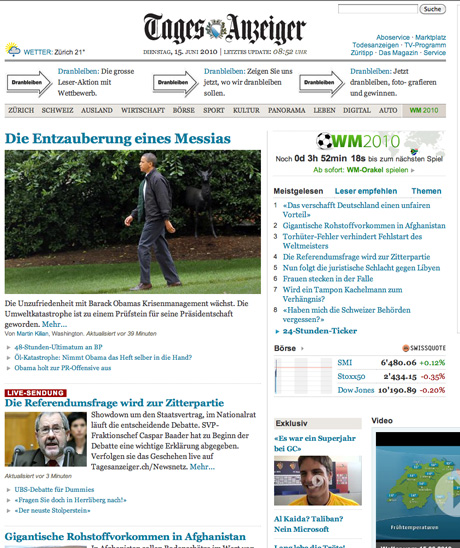
The SFLB agency has developed a new campaign for the *Tages-Anzeiger* that encourages readers to suggest which topics the newspaper should continue to cover.

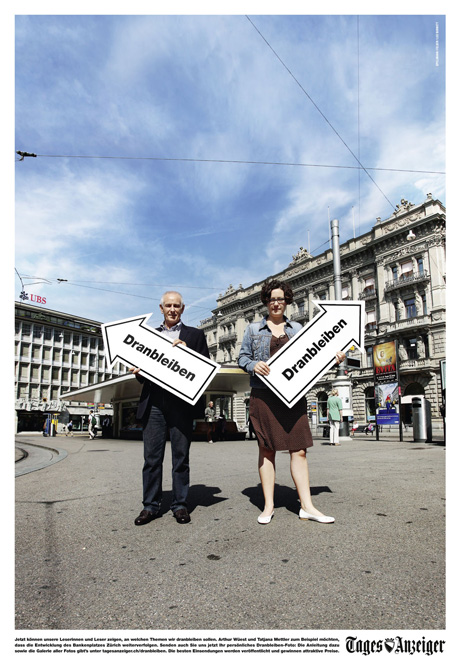
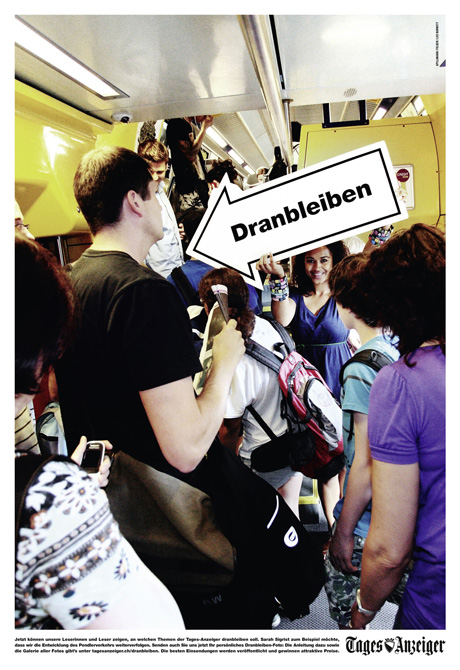
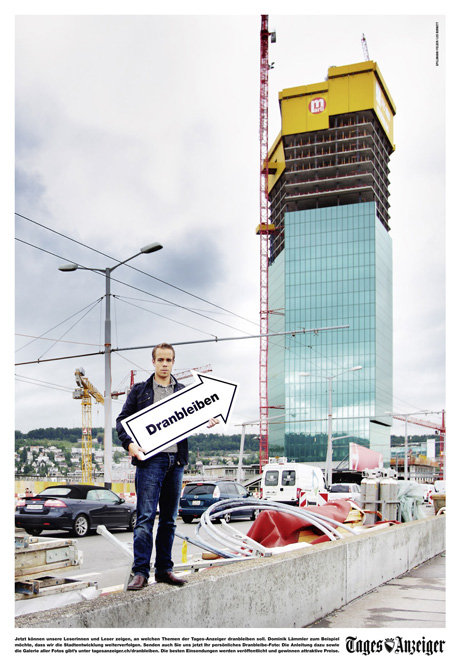
For more than 15 years, the Tages-Anzeiger's motto has been "Stay tuned". Now, for the first time, readers can show which topics they want the Tages-Anzeiger to keep up with. The cross-media and interactive campaign was developed by Spillmann/Felser/Leo Burnett and was created in close cooperation between the agency, the publishing side, the editorial team and the web specialists at Newsnetz.
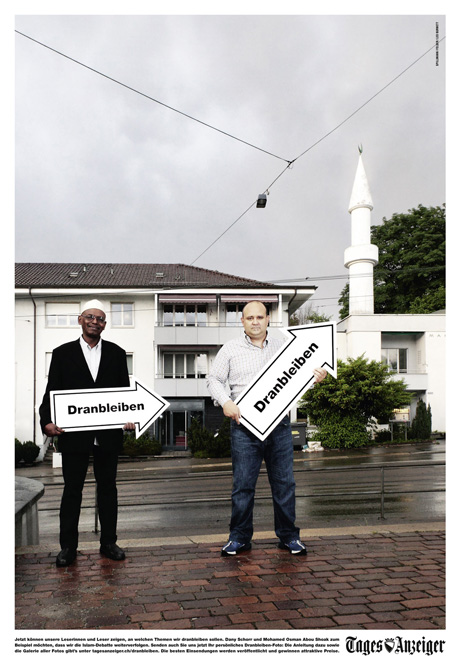
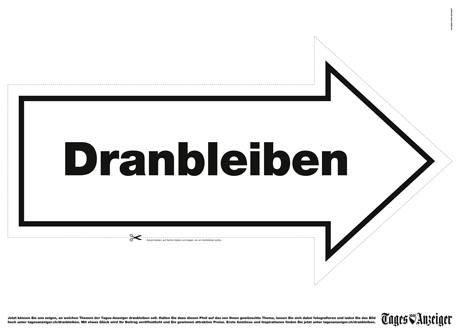
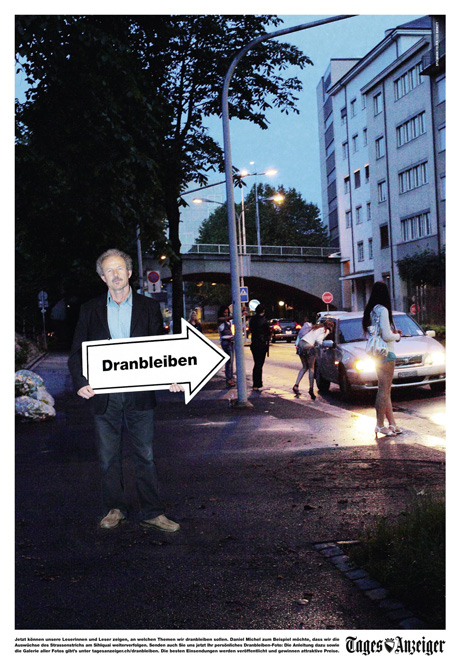
The campaign kicked off with a double-sided advertisement featuring just an arrow with the words "Stay tuned". The idea behind it: Readers can cut out the arrow and then use it for a "stay tuned" photo. For those who don't want to cut it out, the Tages-Anzeiger has had over 3000 "Dranbleiben-Pfeile" made of cardboard over the next few weeks. A velomobile will be distributing these arrows in the canton of Zurich over the next few weeks. The "Dranbleiben-Pfeil" can also be collected free of charge from the local editorial offices and the main editorial office of the Tages-Anzeiger.
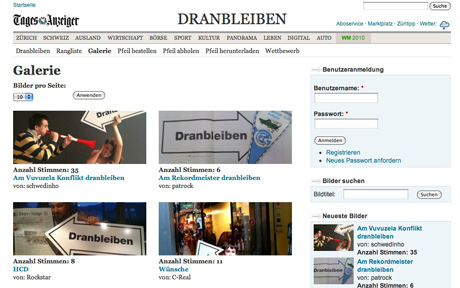
Readers who would like to take part in the campaign and give the Tages-Anzeiger an incentive to keep going can send their pictures to Tagesanzeiger.ch/stay tuned upload. Pictures can also be commented on and rated on this site. The best pictures will be published in the Tages-Anzeiger and will take part in a competition.
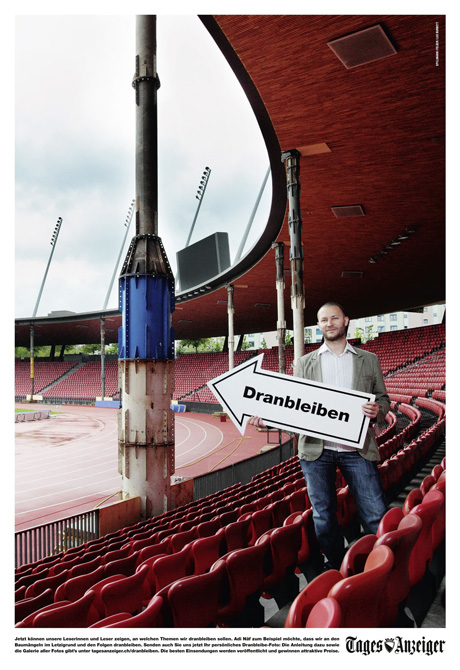
Advertisements in the Tamedia titles, among others, draw attention to the campaign. In each of these, a reader is shown with the "stay tuned arrow". For example, a reader pointing at the roof supports in Letzigrund wants the Tages-Anzeiger to "stay on top of the consequences of the construction defects in Letzi". Over the next few days and weeks, many more subjects will appear in which readers are invited to send their wishes, ideas and suggestions to the Tages-Anzeiger.
In addition to advertisements, a TV spot on Tele Züri and banners draw attention to the reader campaign. The "stay tuned arrows" will also be distributed at various local events.

Responsible at the Tages-Anzeiger: Marcel Tappeiner (Publishing Director), Cyril Hänggi (Brand Communications). Responsible at Spillmann/Felser/Leo Burnett: Dana Wirz (AD), Peter Brönnimann (CreativCD), Sylvia Kohler, Andy Stäheli (consulting); Fabian Unternährer (photo), Niklas Fruth (online).

1290580854_tagi1
1290580854_tagi2
1290580854_tagi3
1290580854_tagi4
1290580854_tagi5
1290580854_tagi6
1290580854_tagi7
1290580854_tagi8
1290580854_tagi9
1290580854_tagi10

Faspo establishes branch office in Vienna

Der Fachverband Sponsoring (Faspo), die zentrale Interessenvertretung der Sponsoringwirtschaft in Deutschland, Österreich und der Schweiz, ist seit 1. Juni 2010 mit einer separaten Geschäftsstelle in Wien vertreten.

In addition to its headquarters in Hamburg and the Swiss office in Winterthur headed by Vice President Jean-Baptiste Felten (Felten & Cie.), the association now also has a local presence throughout the German-speaking region, according to a press release issued on Thursday.

Sunrise: Oliver Steil replaces Christoph Brand as CEO

Christoph Brand is leaving Sunrise following the failed merger between Sunrise and Orange. Oliver Steil is taking over as head of the Swiss telecommunications company effective immediately. The German executive is replacing Brand after four years as CEO.

Brand had actually planned to leave the company after the merger of Sunrise and Orange. Orange Switzerland boss Thomas Sieber was intended to head the new company. However, the ban on the merger by the Competition Commission (Weko) put a spanner in the works for Brand. Now, after almost four years, he wants to leave Sunrise at his own request and take on a new challenge.
As of October 15, 2010, the 40-year-old Bernese will become CEO and shareholder of St. Gallen-based Adcubum, which develops standard software for the insurance industry. In addition to expanding its offering for health insurers, the company intends to expand in the non-life business, as Adcubum announced on the same day, according to SDA.
"The optimum time has come"
Following the successful realignment and positioning of Sunrise as the largest private telecommunications provider in Switzerland, now is the ideal time to hand over his position to new hands, Brand was quoted as saying in a press release on Thursday. Under Brand, Sunrise had turned the corner after years of decline and returned to growth. In 2009, the subsidiary of the Danish telecoms group TDC reached the CHF 2 billion turnover mark for the first time in five years. The number of customers rose from 2.17 million in 2006 to 2.86 million at the end of March 2010. The market share in mobile telephony grew to over 20 percent.
Brand's successor will be Oliver Steil (photo). The 38-year-old worked at Debitel for two and a half years, where he rose to become the head of Germany's third-largest telecommunications company. However, the former McKinsey manager did not stay at the top for long. One year after his appointment, Steil left abruptly in October 2008. According to SDA, Debitel's scanty communiqué at the time spoke of the immediate "termination of his employment contract by mutual agreement". German media doubted this: In a press interview with Steil, it had become clear that there had been discord within the group.
(Image: Keystone)

Wirz: Strategic partnership with Censhare

Wirz ist mit dem Lösungsabieter für Informations- und Prozessmanagement Censhare eine strategische Partnerschaft eingegangen.

Publishing processes are complex, but are becoming increasingly important, the agency writes in a press release. Large companies in particular are confronted with enormous challenges - for example, when it comes to managing and working with marketing content such as images, texts, prices, video and audio files as efficiently as possible.
Linear publishing workflows are slowly but surely becoming a thing of the past. Dynamic publishing is the most effective answer to the question of how quality can be guaranteed in prepress, how processes can be mapped digitally and managed transparently, and ultimately how work can be done faster and more cost-effectively. Dynamic publishing means bundling communication projects into a holistic, strategic process. All materials for print, web and mobile are developed and ultimately produced from a single system.
According to the agency, Wirz's partnership with Censhare means that in future - in addition to using the system for selected customers - Wirz will work with Censhare's specialists to compile the tool for use in different ways and contribute knowledge for ongoing further development.

Last but not least: How a Lena cover became a World Cup anthem

It was actually supposed to be just a parody of Germany's new rising star, Lena: A group of students from Münster called themselves "Uwu Lena" and rewrote the Eurovision Song Contest winner's song into a little soccer ditty.

Without further ado, "Satellite" became "Schland oh Schland". They shot a video for it - the filming is said to have taken an hour - and published the video clip on a specially created website Schlandrut.de. Within a short time, dozens of copies ended up on YouTube, where the clips were clicked on so often that Stefan Raab and the music publisher EMI, which owns the rights to the original song, became aware of the fake version. But why sue the students if you can make a big profit from it, they soon thought, and signed the four boys under contract. Incidentally, Schland is the abbreviation for Germany and goes back to a snippet of words that Stefan Raab used in his TV show "TV-Total".

Station realizes online store for Heineken Switzerland

The Zurich-based agency Station has developed an online store for Heineken Switzerland.

From the legendary Heineken Pitcher to the unique "BeerTender" dispensing system, visitors will find everything a Heineken heart desires, according to a press release.
Heineken has prepared something special for footballers: the UCL configurator creates a personalized official Heineken Uefa Champions League shirt. All stations are responsible for the concept and production of the Stores responsible.
Responsible at Heineken Switzerland: Nina Pastascheck (project management). Responsible at Station: Patman (CD), Pascal Su (project management), Mike Fischer (design), Luisa Low Pew, Lukas Von Blarer, Simon Schönenberger (production).

Radio 105 with its own CD

Um den Senderclaim «Today’s Best Music» zu unterstreichen, hat sich die Marketingabteilung von 105 etwas Besonderes einfallen lassen: Unter dem Titel «Best of 105 NOW» wurde das Beste aus dem 105-Programm in eine CD verpackt.

The best music from Radio 105 has been mixed by the 105 producers and combined with the best comedy elements from the radio program, according to a press release. The "Best of 105" CD is not available to buy, but can only be obtained from Radio 105 and over 500 CD hot-spot partners.
Radio 105's biggest hot-spot partner for this promotion is Valora, according to the press release. The CD will be distributed at every K Kiosk branch from June 25. The promotion will be advertised with trailers on Radio 105, Internet advertising and advertisements in the most important newspapers and magazines.
The free CD can also be ordered via SMS (simply send an SMS with the text BEST OF 105 and your full address to 92266).
get_footer();