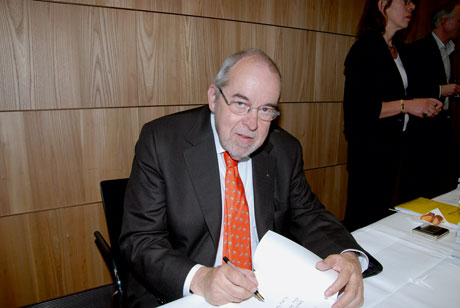
Karl Lüönd doesn't like words of praise too much. He says something like: "Yes, it has always been my goal to hear the obituary for me during my lifetime."
I'll try anyway: Karl Lüönd is misunderstood by those who harbor prejudices and never had the chance - or didn't take the opportunity - to get to know him personally. That's why I'm introducing him a little and, as he likes to do, I've gone in search of a picture from the animal world.
Karl Lüönd, the journalistFor example, he often says to me: You don't just have to lay eggs, you also have to cluck. The image may suit me, but Karl? He lays a lot of eggs - and he sells them well.
How about the hunting dog? A familiar image for Karl Lüönd, for decades. Not just as a hunter. No. In his first employment contract with the Luzerner Tagblatt, it literally says: "Karl Lüönd is employed as a hunting dog."
But is this really the most apt image from the animal kingdom?
In one of his columns, Karl Lüönd himself chooses the image of brown hares for journalists. Because they are so conservative and do not adapt well to new conditions, they are threatened with extinction, just like the brown hare. Karl Lüönd may be a journalist, no one will deny that, but he is not a hare. No. He changes and is always up to date. "There is a human right to change" is one of his life mottos.
That leaves us with the wild boar. It is clever, stubborn and strong. It plows where those directly affected usually don't like it. And it is a delicacy. Asterix and Obelix already knew that.
But if you don't know it, you won't recognize it. Just like you can misjudge Karl Lüönd if you don't know him. He knows the wild boar and knows that the comparison means the highest esteem.
When I got to know Karl Lüönd and told colleagues about him, they often said: What, you work with Karl Lüönd, Karl Lüönd is a lecturer at the MAZ? The Kari Lüönd?
I only knew one at the time. Karl Lüönd, that is. And I confess that I approached him with a certain skepticism, his name was associated with Ursula Koch, Walter Frey, Züri Leu and Züri Woche. We weren't on the same political stage.
But from the very first meeting, he wins me over. I get to know one of the most independent people, a person without barriers of thought, without ideological barriers, a person who doesn't think in pigeonholes - and is even less willing to be pigeonholed.
I now know several different Karl Lüönds, including, of course, Karl Lüönd, the journalist. His professional career began early, at the Kollegi in Altdorf. His first job - in Lucerne, as we now know - was as a hunting dog for the Tagblatt newspaper, which was close to the FDP. He later became the Central Switzerland correspondent for the Tages-Anzeiger, before spending seven years at Blick as a manager and chief reporter, writing series such as espionage and treason in Switzerland. He then became editor-in-chief of Züri Leu and Züri Woche, where he was also co-editor. He is currently editor-in-chief of Jagd und Natur and publisher of Schweizer Journalist.
Journalist Lüönd has a profound knowledge of the media and a good memory to boot. This helps him to link things together and place them in the history of the media - a gift that is unfortunately all too rare. He writes extremely quickly - I don't know of anyone faster - and yet he formulates things vividly. For example: "Newspapers are like cat food: the person who eats it is not the same as the person who pays for it."
Karl Lüönd, the book authorThen there is Karl Lüönd, the book author. Dozens of Karl Lüönd's books can be found in bookshops. Biographies such as those of Emil Frei, Kuoni, Ringier and Gottlieb Duttweiler, but also small witty works such as "Hagenbuchs Tierleben", written by one Hubert Hagenbuch...
The combination of these two Karls, the journalist and the author, is the subject of his latest work "Die Macht und die Ehrlichkeit" (Power and Honesty). Over 200 pages of columns from the media circus - portraits, analyses, commentaries and full-blown historical essays - were published between 1999 and 2009 in daily and weekly newspapers and magazines.
They show Karl Lüönd's main journalistic interests: Journalism, politics, history. And surprisingly, only in passing: hunting. You can feel it through and through: He loves his profession. And that is why he criticizes it and is sometimes so ruthless in his treatment of it and thus of journalists and publishers.
One chapter in the book is called "Insulting journalists". It runs for 14 pages and is subtitled: "Why it is so easy to lie to truth fanatics." Another is called "Facade cleaners and corpse painters". This is about too much closeness, embedding, PR and journalism. And again and again about the power of interpretation. He criticizes the incompetence of many journalists, speaks of "political amoebas" in editorial offices and says that it is by no means surprising that "journalists have a social prestige like brothel pianists".
You can also read sentences like: "They used to call it corruption. Today they call it journalism." Or: "The core problem is that instead of craftsmanship - taking a close look, doubting, checking, probing - opinions are hastily produced. As a result, the reflex for attractive but cross-cutting and therefore 'forbidden' topics is lost."
His columns are always clever. And often, very often, they also make you smile. For example, when he describes the media industry under the title "The doctrine of the schnitzel and the calf". Behind this is, among other things, a plea for freelancers and the fair treatment of them. "I am always amazed at how often our publishers buy calves and how pettily some haggle over schnitzel prices."
However, his columns are also a treasure trove of Swiss media history and equally wonderful images of the times. In 2007, for example, he describes his thoughts on the possibilities of the laptop. He explains in detail and with fascination how he works in Ticino and his conversation partner can read emails in Bulgaria on his phone. "With a special program, he can pull them out of the air."
And finally, the columns are always also language lessons. Sensual and evocative at the same time. He comments on the often-heard phrase "...so and so many more boat people are missing": "As if anyone in this terrible world would miss boat people."
As if anyone in this terrible world would miss boat people - that's Karl Lüönd, THE Karl Lüönd.
Karl Lüönd, the inspiring friendThere is also the lecturer, consultant and networker, the hunter, aesthete and great art collector. And of course: Karl Lüönd, the inspiring, reliable friend. Anyone who convinces him, with an idea or as a person, he opens all doors to, passes on his knowledge, shares his concerns and offers constructive criticism in the very best sense. When he receives an inquiry, he first asks himself three questions: Does it make sense? Is it fun? Does it make a difference? If he can answer two of these three questions in the affirmative, he is interested in the task.
Fortunately for us, he was interested in doing the new book with Mirjam Engler from Ruegger Verlag. And it was fun. Or is there something???
The book is almost like a direct encounter with Karl Lüönd: stimulating, instructive and entertaining at the same time. Supported by Nico's fine caricatures and Constantin Seibt's portrait - a typical Seibt portrait - it is a great pleasure to read.
And ultimately the book proves one thing: there is only one Karl Lüönd, THE Karl Lüönd, the thoroughbred journalist who has lost none of his passion even after more than forty years in the profession. He lives to write. More than he writes to live.
Thank you, dear Karl, for hunting and digging up delicacies for us and for giving us this book with and thanks to Miriam Engler.
I'll end with an appeal by Karl Wittgenstein, whom Karl Lüönd likes: "What you can't talk about, you have to keep quiet about."
I'll keep quiet now. And give the last word to our author. And he replies to Wittgenstein: "But who listens when someone is silent?"
KARL LÜÖND
Power and honesty Columns from the media circus with drawings by Nico and a portrait of the author by Constantin Seibt.
Size: 232 pages, paperback
Price: Fr. 28.00
ISBN no.: 978-3-7253-0947-4
Publisher Ruegger Zurich
Brilliantly informed, ruthlessly open and with sarcastic wit: for years, Karl Lüönd has been writing Swiss media history(ies) with the experience of four decades as a reporter, editor-in-chief and publisher. At the same time, his work demonstrates what the real way out of the crisis in journalism would be: independence, expertise, contextual knowledge, comprehensibility, pleasure in reading. In a word: journalistic quality.
In this book, indiscreet portraits of Beat Curti to Jürg Marquard alternate with historical essays of lasting value, for example on the true story of how the free daily newspapers came about. Star reporter Constantin Seibt introduces the multi-award-winning author in a portrait afterword, and Nico caricatures the circumstances to the point of recognizability.
Gift for our readersWe are giving away five copies of the new book by our columnist Karl Lüönd. Send an e-mail to
[email protected] with the subject "Book" and you will be entered into the prize draw. There is no legal recourse.