20 Minuten and Plan.Net Suisse: Triple Ad launched

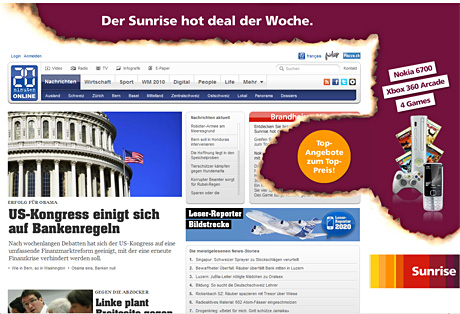
20 Minuten Online hat für Sunrise das erste Triple Ad in der Schweiz lanciert. Dieses verbindet die drei klassischen Werbeformate Leaderboard, Skyscraper und Rectangle zu einer zusammenhängenden Werbefläche. Die Umsetzung und Realisation übernahm dabei die Agenturgruppe Plan.Net Suisse.

The new format can be booked in every section of 20minuten.ch or 20minutes.ch. With 1.254 million unique users per month, 20 Minuten Online is the news portal with the widest reach in Switzerland (source: Net-Metrix-Profile 2010-1). In May 2010, Net-Metrix-Audit reported 2.044 million unique clients and over 140 million page impressions for 20 Minuten Online.

> To the Triple Ad on 20min.ch

1290580825_img100705_triplead

After the decision - before the tussle

The SRG has a documented financial need, but license fees will not be raised. This was decided by the Federal Council. Comments on a biased campaign and a contradictory decision. Op-ed by Hans Stutz, freelance journalist.

The print media campaign against the SRG and its supreme chieftain was unmistakable but unsurprising: the writers simply repeated what they have been saying for years. SRG = colossus, put on fat, go on a diet. An autocratic boss with princely salaries and a business off-roader, huge savings potential.
The two rounds of cuts that SRG employees - similar to their colleagues in the print media - have already had to endure in recent years have mostly gone unmentioned. Also unmentioned was the fact that Tamedia CEO Martin Kall, who heads a company with less turnover and fewer employees, receives more than double Walpen's annual salary, over 1.3 million, both in 2008 and 2009. Or that a member of the Board of Directors like Iwan Rickenbacher (part-time) has around 240,000 francs a year credited to his account. All this can be read in the annual report of Tamedia, which - because it is listed on the stock exchange - is obliged to be transparent. The other media companies, however, keep as much under wraps as possible. Speaking of which: how much does Michael Ringier actually get paid out each year? SRG critics pay little attention to such questions, but they do pay attention to the details of SRG. And as a result, Walpen's additional expenses (27,000 francs) are being stylized into an uproar that is supposed to last an entire Sunday. Or very loosely based on Bertolt Brecht: the distribution battle also distorts journalistic perception. The extent to which Armin Walpen's policy was right, almost right or completely wrong can remain an open question.
Shortly before the midsummer solstice, the Federal Council has now made its decision and, as is often the case with controversial deals, the result is contradictory. The national government recognizes an additional financial requirement of around 10 percent of the total SRG budget. However, it still refuses to increase the fees. This is a decision that media professionals - and not just those working for SRG - will have to pay for. SRG is to save 58 million a year. The calculation is simple: less money for SRG and therefore the industry as a whole, poorer working conditions and earning opportunities for media professionals as a whole. In concrete terms: less money for SRG means job cuts and a reduction in contracts for freelancers.
So do the publishers and SRG critics now have what they want, a weakened SRG? Partly yes, partly no. Another decision is more far-reaching: the Federal Council is allowing SRG to advertise online as well as on TV. Bitter for the publishers. The national government justifies the decision with the withheld fees. Or as the media release puts it. "As there are limits to the financing of fees, at least partial commercial financing of the online presence must also be considered." However, one wonders what the seven from the Federal Palace were thinking. Before a definitive decision is made on opening up and the modalities are determined, they expect the SRG to approach publishers and look for a solution "that allows all parties involved to operate under appropriate framework conditions in the online sector".
With respect, how is that supposed to work? And what happens if the SRG and publishers cannot reach an agreement? Will the Federal Council then go back on its decision and still approve a (moderate) fee increase? Whatever happens, the wrangling will continue at first, and journalistic oblique shots are to be expected. As a precautionary measure, publishers and SRG critics should be reminded that around 50 million of the SRG fee money goes to licensed private broadcasters (radio and television). Mostly operated by those publishers who would like to see a weak SRG. And what service do the private broadcasters provide for this money? Only if you don't take the facts too seriously can you claim that the private broadcasters provide a satisfactory local "public service".

The guest commentary was published in the current print edition of Werbewoche on July 1.

Valencia: Web presence of Storyworld.ch realized

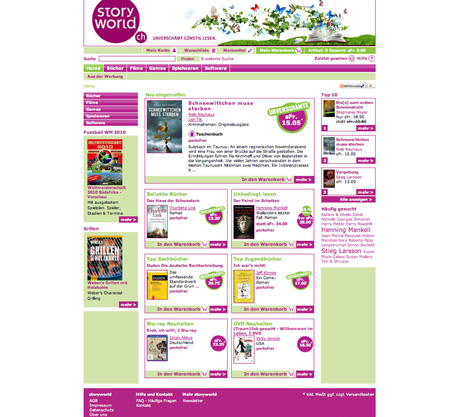
The new online bookstore Storyworld.ch has been online for several weeks now. Valencia Kommunikation was entrusted with the web discounter’s communications campaign.

Valencia has been the emergence of Storyworld.ch from the very beginning and helped to develop its appearance, from the definition of the brand model and the corporate design to the naming and claim. The starting point was the strategic positioning of the company as a Swiss and low-priced service provider with a female main target group of middle age. Based on this positioning, a corporate design with a soft and fresh color code was created. As an overarching visual, a reading world was designed that can be adapted to different formats, growing out of a book and taking over the reader's surroundings. Advertisements and Internet banners are used as advertising media for the launch and prelaunch campaigns. Storyworld.ch has been online since June 2010.

Responsible at Storyworld.ch: Maurice Marzolf, Managing Director. Responsible at Valencia Communication: Michael Gerber (CD), Simone Perez (SAD), Beatrice Ketterlin, Carlo Tagliavini (AD), Zoe Gunzenhauser (JAD), Guillermo Garcia, Sebastian Refardt (concept/text), Esther Weber, Frédérique Mathys, Claudia Ferrari (consulting), Marco Fritz (PA).

1290580825_img100705_storyworld3
1290580825_img100705_storyworld1
1290580825_img100705_storyworld2

Futurecom: Swiss Olympic acquired as a customer

Futurecom won a pitch presentation organized by Swiss Olympic. The agency was commissioned to redesign the Coolandclean.ch website, both visually and structurally.

"Cool and clean" is the largest national prevention program in sport. The sponsors are Swiss Olympic, the Federal Office of Sport (Baspo) and the Federal Office of Public Health (FOPH).

SFLB: Getting through everyday life with Sanello despite bladder weakness

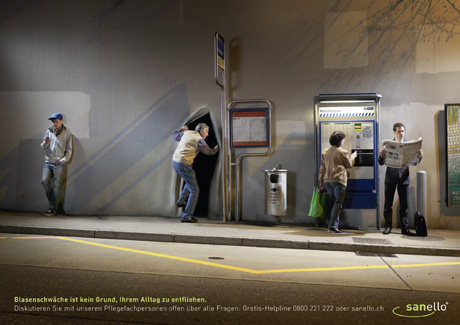
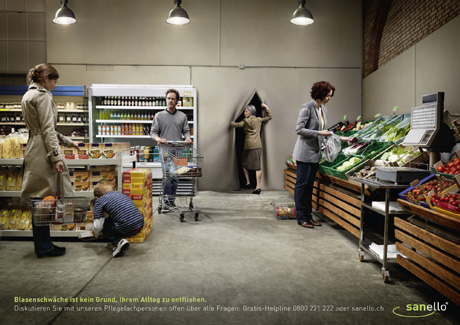
The creatives at Spillmann/Felser/Leo Burnett have created a new campaign for Sanello. It aims to show that the service center is the ideal partner for staying independent and in the middle of life despite bladder weakness.

The campaign addresses what those affected often wish for: To be able to leave their familiar life in a hurry through longed-for emergency exits. After all, bladder weakness is still a taboo subject in our society. Advertisements, an image brochure, a flyer and a completely revised website were created. All measures are now in use.

Responsible at Sanello: Mathias Weber (Head of Sales Homecare), Edeltraud Bernardini (Homecare Service Manager). Responsible at Spillmann/Felser/Leo Burnett: Moritz Stillhard, Oli Kreienbühl (AD), Katja Wölfel (text), Patrick Suter, Martin Spillmann (CD), Ivana Giannakis, Pam Hügli (consulting), Sabine Bechtel (art buying); photo: Holger Pooten; responsible at update AG/Internet implementation: Fabienne Widmer (project manager).

1290580825_img100705_sanello1
1290580826_img100705_sanello2
1290580826_img100705_sanello3

Swiss Post takes over Geneva press specialist

Swiss Post is expanding its services for French-language publishers in Switzerland and abroad. Swiss Post International, the division responsible for cross-border mail and parcel delivery, will acquire Edigroup—a company specializing in the marketing and distribution of press publications—effective July 1, 2010.

Edigroup consists of a total of four companies. Two of them are based in Chêne-Bourg, Geneva, and market and distribute newspapers, periodicals and magazines and manage readers' subscription and address data. A third company, based in Gaillard near the Swiss border, represents foreign publishers in France and distributes press products. A fourth company in Brussels, Belgium, is responsible for the promotion, distribution and subscription management of magazines. Edigroup generated sales of CHF 14.7 million in the 2008/2009 financial year. The partners have agreed not to disclose the purchase price.

Dachcom.ch: New brand made known for Coltène/Whaledent

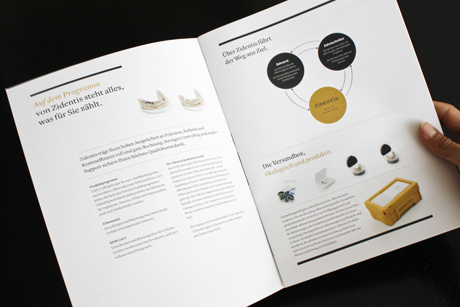
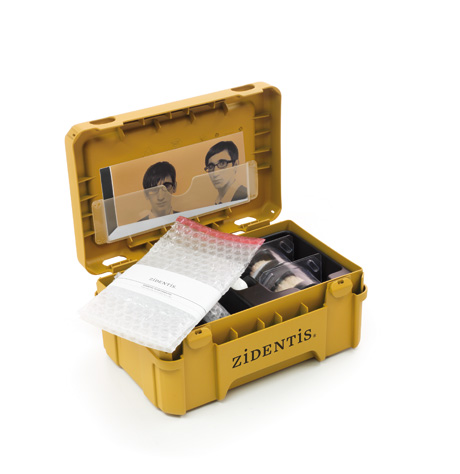
The agency Dachcom.ch was commissioned by its client, Coltène/Whaledent, to handle the international launch of the new service «Zidentis.» The company is active in the development, manufacture, and distribution of dental consumables and small devices.

The development of the "Zidentis - digital performance, dental perfection" brand and the market launch campaign are based on a dialog-oriented key visual: two heads that clearly divide the role play of the two main target groups, dentists and dental technicians. A multi-stage direct mail concept picks up the dialog with both decision-makers. The wording has a slightly provocative undertone and the value proposition "Invest nothing, benefit fully".

Responsible at Coltène/Whaledent: Thomas Mettler (Project Management), Jörg Weis (Marketing Management). Responsible at Dachcom.ch: Bernd Leisner (text/concept), Simon Schädler (AD/graphic design), Otto Gmeiner, René Frommelt (consulting).

1290580827_img100705_dachcom1
1290580827_img100705_zidentis2
1290580827_img100705_zidentis3
1290580827_img100705_zidentis4
1290580827_img100705_zidentis5

Scatter plan: Nivea products launched into space

Nivea launched the new product line "Nivea for Men Silver Protect". Streuplan realized a poster campaign for this.

The posters focus on the products. The aim is to make the technological leap clear. For example, the Nivea products are sent into space.

Responsible at Beiersdorf: Daniel Münster (Group Brand Manager), Lukas Bucheli (Brand Manager). Responsible at Streuplan: Christoph Oertli (overall responsibility), Caroline Schmid (AD), Sabrina Hardegger (consulting), Hans-Jörg F. Walter (photography).

img100705_nivea

New weather presenter on Tele Südostschweiz

Miriam Fausch, a host at Tele Südostschweiz, is taking maternity leave. She will be stepping away from the screen for about three months and handing over hosting duties for the weather program to Andrea Berry.

Andrea Berry has been working for Tele Südostschweiz for eight years - but mainly behind the camera. As head of direction, Berry is responsible for the broadcast layout and has contributed a great deal to the new look of the local station, especially in the past year. In the past few weeks, she underwent intensive moderation training. Together with her colleague Marco Nüssli, Andrea Berry will now present the weather from southeastern Switzerland, Sargans and Glarus.
www.telesuedostschweiz.ch

Hesskisssulzersutter creates ad campaign for Zunzún

Hesskisssulzersutter created two ads for the Zunzún association featuring the hummingbird from the logo. The design was developed in close collaboration with Luiz Rodriguez Noa, a young Cuban artist and graphic designer from Havana.

The aim of the mini-campaign, which will mainly be seen in the weekly newspaper, is to generate attention for Zunzún's project work in Cuba and, of course, to increase the income from donations. Further subjects are to follow.
Zunzúncito is the name given in Cuba to the smallest bird in the world, a species of hummingbird native only to the largest Caribbean island. Due to its size and delicacy, the Zunzún is regarded beyond Cuba as a symbol of the vulnerability of the child. Zunzún is also the name of a new non-profit Swiss association. Its aim is to provide direct and indirect material and non-material support for children and young people in Cuba. With the contributions of its patrons, Zunzún finances a series of projects in marginal neighborhoods of Havana that promote local development and the social integration of children and young people.
1290580827_img100704_zunzunhesskiss1
1290580827_img100704_zunzunhesskiss2

Half-year figures for TV usage

In Switzerland, regional television is only watched for a short time. The audience zaps away again after a maximum of 15 minutes. The regional channels were only able to capture a fraction of the approximately 216 minutes of daily television consumption in German-speaking Switzerland.

The Basel station Telebasel achieved the highest market share with two percent. An average of 111,000 people watch regional television for 14.5 minutes per day on the Rhine bend. These were the first half-year figures for 2010 from Publica Data, a public limited company of the Mediapulse Foundation for Media Research.
Tele 1 in Central Switzerland, Tele M1, Tele Bielingue in Biel, Telebärn, Canal 9 in Valais and Teleticino also achieved market shares of one percent or more. The regional television station Tele Top has the smallest market share with 0.2 percent. However, the station has a strong competitor in Tele Züri, which achieved a market share of 1.2 percent in the whole of German-speaking Switzerland, as the SDA writes. However, the station does not appear in the regional television statistics published by Publica Data on Saturday, as it does not have a federal license.
The half-year statistics on regional television broadcasters from Publica Data and Mediapuls have been published for the first time. The research institute covers all thirteen regional television stations that have received a license from the Federal Office of Communications (OFCOM). All other television stations are recorded in general statistics.
In the first half of 2010, Swiss television channel SF1 was the frontrunner in German-speaking Switzerland with a market share of 20.2%. It is followed by SF2 with a market share of 11.9% and the German private channel RTL with 6.6%.
percent.
www.publicadata.ch

Swiss journalist President of the Japan Correspondents

The new president of the Foreign Correspondents' Club of Japan (FCCJ) is Swiss foreign correspondent Georges Baumgartner. Only one other Swiss journalist has ever presided over this prestigious club before him.

Baumgartner was elected president on Thursday. The club announced this on its website. He works in Japan for RTS radio and television in French-speaking Switzerland as well as for French radio. Baumgartner was responsible for the club's finances between 2000 and 2005.
The Foreign Correspondents Club of Japan FCCJ is one of the most prestigious press clubs in the world alongside the National Press Club in Washington. In 1962, the then Japan correspondent of the NZZ, Fritz Steck, was the first Swiss president of the club. The FCCJ has over 2,000 members. The 350 journalists include Pulitzer Prize winners, as the SDA writes. The club, which was founded after the Second World War in 1945, employs around 100 people.
www.sda.ch
get_footer();