Möbel Pfister has commissioned Walker to create a new TV commercial. The ad is intended to highlight the fact that the furniture retailer also delivers and assembles furniture on Saturdays.
Editorial
-
August 11, 2010
The commercial exaggerates where it can lead if you have to leave your workplace to pick up the sofa you ordered. Responsible at Walker: Carlos Friedrich (Head of Marketing Communication), Gianne Holmgren (Head of Advertising), Marianne Kohler (Styling), Pius Walker (Creative Direction), Martin Arnold, Heinz Helle (Text), Golf Nuntawat, Steffi Huber (Art Direction), Cornelia Nünlist, Lisa Binkert (Consulting).
Pierre C. Meier, editor-in-chief of *Werbewoche*, on being forced to listen to the radio while stuck in traffic.
Editorial
-
August 11, 2010
The first Monday after the summer vacation. The traffic planners, or whoever is responsible for the roadworks signalization on the national roads, have decided to give the A 3 freeway between Wädenswil and Richterswil a single lane of traffic in each direction just as the vacations come to an end. This comes after the same construction site had been open to two lanes in both directions for around six months. Small cause, big effect: the traffic jam stretched from Richterswil to Horgen. Time spent in the traffic jam: 50 minutes. Number of kilometers covered: 15. Great, especially when you think that the same picture will probably be seen in the evening - just in the opposite direction. Standing still in a traffic jam allows you to listen to the radio undisturbed. Radio 1 - the radio for adults. For those who are not familiar with the Radio 1 program: There are so-called morning columns. As it says on the homepage, "distinguished opinion leaders analyze the topic of the hour in a pointed way." The whole thing is an interesting idea - the contributions are often funny and exciting. The opinion makers are usually Patrik Müller, editor-in-chief of the Sonntag newspaper, ex-Zurich staple Elmar Ledergeber, Roger Köppel from Weltwoche, my colleague Matthias Ackeret from Persönlich and Regula Stämpfli, the Brussels-based political scientist from Bern who expresses herself on all channels. Regula Stämpfli's turn always comes on Monday. Today is no exception. For months, she has regularly picked on Federal Councillor Merz. Some may say rightly so, others may have taken offence, but columns are supposed to polarize. But what the sharp-tongued lady let loose on the airwaves today was simply a step too far. If Merz wasn't a public figure, he could have easily sued for defamation and would have been vindicated. Stämpfli bit into her favorite opponent like an attack dog - I'll politely leave out the female form for now. But it wasn't just about Merz, everyone got their comeuppance in a typical Stämpfli all-round attack: the Federal Council, the FDP, the banks. All their bogeymen were dutifully dealt with. I don't know whether such an emotional outburst is really appreciated by the audience. Even if they are not in a traffic jam. Even the Bernese accent, which many people consider charming, couldn't change that, and the balancing manner of morning show presenter Marc Jäggi was equally unsuccessful. Switch to Radio 24, where Ufsteller - Zurich's "most popular morning show with Patrick Hässig" - is on. The Radio 24 morning game "Toast Hässig", in which Ufsteller presenter Patrick Hässig competes against one of his listeners, is over. It's the turn of Bea Petri's make-up tips. It's all about powder, loose and firm. And how best to apply the stuff. Patrick Hässig rambles on about shaving brushes, Bea Petri corrects him and now I finally know what the make-up brushes are made of: the finest goat hair from the neck. Oh, how good a little banality feels.
SF: Paddy Kälin becomes presenter of the Sportlounge program
Paddy Kälin will be the new presenter of the Sportlounge program. He previously worked as a presenter and editor specializing in football and alpine skiing as well as a presenter of the Sportaktuell programme for Swiss television SF.
Editorial
-
August 11, 2010
Kälin replaces Regula Späni, who left SF at her own request at the end of May. Kälin will alternate with Steffi Buchli in presenting the background program on topics from the world of sport, as SF announced on Wednesday. The Herisau native will make his first appearance on Sportlounge on September 20. He will continue to present the Sportaktuell program. Kälin has worked in the sports editorial team since 2000.
After the summer break, the Sportlounge will be slightly different. The original monothematic focus will be expanded. The discussion section will now be supplemented by two longer background contributions, as the report continues. www.sf.tv www.sda.ch
India's 26-euro tablet PC
India is challenging the American cultural brand with a mini-computer for 26 euros. However, there is still no manufacturer to produce the device, which looks similar to Apple.
Editorial
-
August 11, 2010
The tablet PC was developed at Indian universities on behalf of the government. Now the small, portable computer is to be produced in millions of units, but a manufacturer is still missing. However, several manufacturers from China and Taiwan have already expressed great interest, according to Handelsblatt from the Ministry of Education. So far, experts at market researcher Gartner have given the iPad a two-year head start. This is because competitors would not be able to quickly put together Apple's package of apps, intuitive user guidance, design and touch-sensitive screen. However, India does not want to wait that long with its version. The plan is to launch the low-cost iPad version in the spring. www.handelsblatt.com
Art and advertising in a creative dialog
Die Migros hat in Marin-Epagnier ein kunstvoll gestyltes Einkaufscenter gebaut. Die Werber von Numéro 10 haben zur Eröffnung eine stilistisch passende Kunstaktion lanciert.
Editorial
-
August 11, 2010
The Marin Center was rebuilt for months without having to stop selling. Customers are now rewarded for their patience with a particularly attractive shopping temple. It is even marketed in advertising as a "Palais des Beaux Arts". The large Migros shopping center, Marin-Centre, was opened in 1981 and was one of the first of its kind in Switzerland. Marin comes from the old French Marens, meaning marshland, and refers to the agglomeration of Neuchâtel. With 41 stores and 1,700 parking spaces, Marin aims to remain Migros' leading center in the region. Following a design competition, the location has now been remodeled according to the ideas of Bauart Architekten und Planer AG. The metallic pixel facades are an outstanding stylistic element. These have also inspired Numéro 10 to create a continuous key visual for the entire communication. Gilles Aeby's agency won the contract in a pitch. Buzz marketing ideas form an important element within the measures. Numéro 10 planned the campaign in three successive phases. These started in June with a guerrilla prelude. This was followed in July by an event in the center. After the summer vacations, the campaign will continue with a classic campaign until the end of the year. Palais des Beaux Arts Numéro 10's basic idea was to declare the shopping center an art museum, or "Palais des Beaux Arts" in the regional language. The first guerrilla campaign made use of artistic provocation by marking 200 different objects in the region with a sign saying "This is not a statue", "This is not a bench" or "This is not a prohibition sign". The first posters, which used exactly the same look to invite people to an event at the new "Palais des Beaux Arts", then provided some clarification. There, seven painters from Paris worked for a week on a joint mural. The final phase is now the classic campaign. Here, the posters in the "Palais des Beaux Arts" promise a wide variety of arts of living such as a new "art de plaire" with the most important fashion labels, "art de savourer" with the delights of Denner and Migros, "art de vivre" with the most useful services and "art de flâner" with a selection of restaurants. The subjects were of course not photographed by an advertiser, but by an art photographer. Andreas Panzeri
Guerrilla campaign inspired by an art happening with 200 unicacts as stickers and sandwich posters inviting people to an event at the "Palace des Beaux Arts":
Happy New Year!
Unikat führt mit Ikea eine neue Zeitrechnung ein.
Editorial
-
August 11, 2010
The Chinese celebrate New Year in January, the ancient Romans did it in March, the Celts in November and Ikea will soon be celebrating in September. This is when the new Ikea catalog is published, a publication that has now surpassed the circulation of the Bible. One could therefore stylize this event on Wikipedia or other encyclopedias as a historical date. But that would probably be too much of an epic for a company "that wants nothing more than to offer good design at attractive prices in good quality for as many consumers as possible", according to Jan Maurer, the new Head of Marketing at Ikea Switzerland. Ikea's designers develop over 1000 new furnishing objects every year - and these in turn will be featured in the new Ikea catalog from September and thus also in all Swiss furniture stores at the same time. In addition, the Swedish furniture store is constantly optimizing existing products. Here too, the innovative company is turning the principle of supply and demand on its head: popular products that are bought frequently do not become more expensive, as the trivial economy teaches us, but cheaper, because they can be produced more efficiently thanks to high quantities. This advantage is passed on to Ikea's customers with a lot of Swedish charm. This is the background to the news campaign that Ikea is currently launching. In a large-scale outdoor campaign, the new year's products are being highlighted in a striking way. Consumers can discover them before they are displayed, and not just in pictures. Unikat has realized the first poster campaign in Switzerland "where the target group can solve the teaser themselves", as CD Daniel Meier is pleased to say. The experience of discovery is taken out of the furniture store and into the public space - with the aim of encouraging as many consumers as possible to visit the seven furniture stores throughout Switzerland. Andreas Panzeri
The Impact Check of Werbewoche
We show how current campaigns are performing with consumers.
Editorial
-
August 11, 2010
In the “Awareness” category, the campaign for Migros Magazin by the advertising agency Jung von Matt/Limmat is the undisputed leader, followed by the ad for Appenzeller by Contexta and the ad for GE Money Bank by the advertising agency Comqed Dialog. The ad for Battery Bag by Wirz tops the “Uniqueness” category, closely followed in second place by Insieme from the advertising agency Hesskisssulzersutter. Third place goes to the ad for Migros Magazine. In the “Brand Fit” category, Appenzeller takes first place, ahead of the tied ads for Insieme and the ad for Floralp by the advertising agency SFLB. In terms of “Likeability,” Battery Bag comes in first, ahead of Migros Magazin and Insieme. > Results at a glance > Detailed results
Question and methodology Method: Computer Assisted Web Interviews (CAWI). Instrument: Online interviews via the Marketagent.com reSEARCH platform. Target group: web-active people from German-speaking Switzerland between the ages of 14 and 59. Sample size: n = 500 net interviews, random selection by quota. Survey period: July 20, 2010–July 28, 2010. Questions: - We introduced you to some ads at the beginning of today's survey. Which of these ads do you remember? Please name the advertising companies or the brands advertised. (Awareness) – In your opinion, to what extent do these ads stand out from other advertisements in newspapers, magazines, and periodicals? Please rate each on a scale from 1 (= does not stand out at all) to 6 (= stands out very strongly). (Uniqueness) - To what extent do these ads fit the image you have of the respective brands/companies? Please rate each from 1 (= does not fit my image of this brand at all) to 6 (= fits my image of this brand very well). (Brand Fit) - To what extent do you like the following ads? Please rate each from 1 (= I do not like at all) to 6 (= I like very much). (Likeability) The values printed are in each case the top box ratings "stands out very strongly", "fits very well with my image of the brand", "I like it very much". The author of the representative «Impact-Check» study is Marketagent.com Switzerland, a company specializing in online market and opinion research, which has an ISO-certified panel of 20,000 respondents in German-speaking and French-speaking Switzerland. Marketagent.com Switzerland is a subsidiary of the leading Austrian market research company Marketagent.com online reSEARCH GmbH and the Swiss communications agency Contract Media AG.
"Fresh in the head" with Airwaves
Webguerillas is now designing and managing the German-language Facebook presence for the chewing gum brand Airwaves. The agency will be launching various campaigns and competitions in future.
Editorial
-
August 11, 2010
The task and goal of the Webguerillas is to win new fans for Airwaves' Facebook presence. Under the motto "Fresh in the head", they moderate the fan page and entertain users with content and promotions relating to brain teasers, chewing gum enjoyment and leisure activities. The first major campaign on the Facebook page is the "Airwaves Fresh Friends" prize draw. There are a total of eight large Airwaves supply packs to be won - each consisting of 600 individual packs. Prerequisite: Each fan must activate a total of nine of their Facebook friends to take a place on their virtual Airwaves pack. Only when all nine places have been taken by Facebook friends will the Airwaves fan be entered into the weekly prize draw. Each winner gets to choose their favorite flavor. The campaign will last a total of four weeks. Another planned measure includes the opportunity to test a new flavor before its market launch.
TBS Identity hat eine Serie von Maskottchen für das Zürcher Theater Spektakel entdeckt.
Editorial
-
August 11, 2010
From August 19 to September 5, hundreds of thousands of people will once again make a pilgrimage to the Landiwiese in Zurich. This year's Theater Spektakel focuses on East and Southeast Asia. TBS Identity is staging the advertising and has also drawn stylistic inspiration from this cultural area. CD Daniel Leber and AD Kathrin Treml have rediscovered the tradition of the Kaijus ("mysterious beasts"). Japan's animistic mythology is also the origin of the primordial monster Godzilla, which has since wreaked havoc not only in numerous films, but also in comics and art galleries in modern-day Japan. It was a stroke of luck for the creatives that the Zurich rock musician and restaurateur Martin Stricker collects Kaijus. Photographer Hans-Jörg Walter staged six Kaijus from Stricker's collection. The subjects were used by TBS Identity for posters, advertisements, web banners, an e-board for Zurich main station and as the cover of the program newspaper and pocket. The website Theaterspektakel.ch, designed by TBS Identity, also showcases this year's campaign motif. pan
The master of clicks
In 2007, Daniel Hünebeck brought the Swiss branch of the German online marketing agency Adisfaction to Zurich. He found success with Google AdWords, intelligent banners, and clever online marketing tools, some of which the agency developed itself. Swiss companies are not yet fully tapping into the potential of online marketing—but the tide is turning.
Editorial
-
August 11, 2010
Advertorials, Google Adwords and banners are the world of Daniel Hünebeck (33) and his colleague Alexander Tysl (28). Bank Vontobel and Künzler-Bachmann-Verlag, Zurich Airport and travel provider FTI have already noticed this and had Adisfaction build them effective online advertising tools. "The world of online marketing is very complex and evolving at breakneck speed," says Hünebeck. "You can't expect a client's marketing department, which already handles print, TV, radio, point-of-sale and outdoor advertising, to also be familiar with the various marketing tools that can be used online. We guide our client through the world of online advertising and find exactly the form of advertising that suits them." Even for a purely online agency like Adisfaction, it can be difficult to keep track of everything. "We manage that by specializing," Hünebeck explains. "One is responsible for email marketing, another for mobile marketing, a third is an expert in B2B or performance marketing, social media or monitoring." Screws to success Many companies already know exactly what they want when they commission Adisfaction. This simplifies the work of online marketers - at least at first glance. But Hünebeck and Tysl always look twice: "Sometimes we are asked to develop a banner, but then realize that the company would be better off running an advertorial or optimizing its newsletter. Then we work with the client to develop a strategy that is optimal for their goals." Other companies don't pay much attention to online activities for decades. And then, all of a sudden, it has to happen very quickly: Hünebeck and Tysl have often created an advertorial or a banner from scratch within eight hours. "But that only works if the customer and provider work very closely with us," says Hünebeck. "It's a great feeling to see the result of your work online the very next day. For our customer, too." Hünebeck sees himself as a consultant and partner to his clients. "Close cooperation and a trusting relationship with our customers is very important to us," he emphasizes. "We are more than an outsourced online marketing department that implements campaigns. That's because we have an eye for the big picture and attach great importance to dovetailing a company's individual advertising tools, such as print campaigns, newsletters or banners. Right now, we're discussing with some clients how to make their successful print campaign just as effective online." Many measures that Adis¬faction implements do not even require a budget increase, for example the optimization of search engines or websites. Hünebeck: "There are customers who are surprised that contact requests via advertising on Google are missing. But if you want to generate contacts, you can't just leave it at linking your website. He must, for example, place his telephone number or a contact form prominently on the website. It's often enough to turn small adjusting screws to make a big difference." Moving forward in a roundabout way Hünebeck was born in eastern Germany in 1976 and grew up in the Ruhr region. After school, he trained as a bank clerk. "The apprenticeship was extremely sales-heavy," he says. "I quickly realized that I wasn't going to do this 'fund banging' thing my whole life." Commerzbank gives Hünebeck the chance to study business administration alongside his apprenticeship. He jumped at the chance. When Hünebeck is finished with his apprenticeship and studies, the New Economy is just at its peak. "I was very interested in the new market and the stock market," he recalls. "So I applied to Wallstreet online as a product developer." There, Hünebeck experiences two and a half instructive years: on the first day of work, he sees for the first time in his life, in the first week he learns HTML, and finally he develops new sections, tools and advertising concepts for the Internet site. At the same time, Hünebeck completes a degree in computer science, because he works a lot with programmers and wants to gain insight into their work. Hünebeck is also in the thick of things when the Internet bubble bursts: "I was one of the last 150 employees hired at Wallstreet online," he reports. "Then the headcount went down quarter by quarter until we were down to ten people. I went through it all, from the top to the bottom." 2003 is time for a break. Hünebeck goes on a trip, six months through Central America. Back home, he looks for a job: "Online could be, but didn't necessarily have to be. In the end, I became a consultant in a restructuring consultancy, because I had just experienced a restructuring process live." Hünebeck uses the experience of waiting from quarter to quarter as an employee for the sword of Damocles to come down to support companies and employees when things go south. "The job was exhausting, but incredibly exciting," he says. "I dealt with banks, credit departments and businesses ranging from CD producers to bed and door manufacturers to gyms." In 2005, the question of the next professional step comes up. Hünebeck does not want to become a controller. He does a marketing and PR internship at MTV in New York. Hünebeck: "That was the direction I was looking for. It was cool to suddenly work in a company that makes 20 percent profit and turns everything it touches into gold. It was clear to me then: I want to get back into media." Give us a call Hünebeck talks on the phone with Stefan Swertz, his former boss and mentor at Wallstreet online. Swertz founded the agency Edynamix, now Adisfaction AG, in 2002. And is looking for employees. Hünebeck joined the company and started as a media planner at its German headquarters in Meerbusch. Less than a year later, he takes over the commercial management of the company and the management of the newly opened branch in Switzerland. He wins Bank Vontobel as his first client. "Before setting up the Swiss branch, we did a 'Tour de Suisse' and asked Swiss online professionals from Cash and Financial Media whether they thought a branch of Adisfaction had a chance," Hünebeck says. "They all said, 'We need an agency with your know-how here'." That assessment has been borne out: In the last three years, Adisfaction Switzerland has acquired more than 30 clients of distinction, some of whom have long been regular customers. Banks in particular are among the agency's clients, but also tourism companies, e-commerce and B2B providers. "It's important to us that we understand our clients' business, no matter what industry they operate in," Hünebeck emphasizes. "Of course, it takes time to get to grips with the products and services. But the success is then all the greater." And what are Hünebeck's plans for Adisfaction Switzerland for the next year or two? In any case, he wants to further expand the Swiss location: "Growth yes, but only organically," Hünebeck emphasizes. "We have a few new customers on our doorstep, so we're hiring a new employee in September. However, it is not easy to find qualified applicants. Switzerland lacks specialists in this profession." Still. Anne-Friederike Wilhelm
Tops of the week
The business publications *Bilan* and *Finanz und Wirtschaft* are launching a nationwide luxury magazine. Also: As part of its “International Weekly” initiative, The New York Times is publishing a weekly “best-of” edition in cooperation with daily newspapers in over 25 countries. The Tages-Anzeiger (TA) has joined The New York Times’ international network and will exclusively publish the Swiss edition as a weekly supplement to the TA.
Editorial
-
August 11, 2010
Top1: Bilan and Finanz und Wirtschaft bring luxury magazines together The business media Bilan and Finanz und Wirtschaft are launching a nationwide luxury magazine. The two magazines Luxes par Bilan and Deluxe will be merged into a joint publication under the title Luxe at the end of November 2010. As an independent magazine published in French and German, Luxe will offer its readers news from the fields of watches, cars, fashion, new technologies, travel and wellness. Luxe Finanz und Wirtschaft in Zurich will be managed by Konrad Koch, who is currently responsible for Deluxe. Luxe par Bilan in Geneva will be managed by Emmanuel Grandjean, who will join the team in September 2010. The quarterly magazine will be distributed throughout Switzerland, to subscribers of both publications as well as in newsagents. With a circulation of 65,000, of which 20,000 are in French and 45,000 in German, it reaches over 240,000 readers. The first issue will be published in French on November 24 and in German on November 27. Top 2: NYT: International Weekly is added to the Tages-Anzeiger As the International Weekly, the New York Times publishes a weekly best-of edition in cooperation with daily newspapers in over 25 countries. The Tages-Anzeiger (TA) has joined the international network of the New York Times and will exclusively publish the Swiss edition as a weekly supplement to the TA. The newspaper supplement consists of original articles from the current editions of the New York Times on the topics of world politics, culture, life and trends. The first issue of the English-language supplement in the layout of the New York Times will be published on Monday, September 6. According to co-editor-in-chief Res Strehle, the partnership will further strengthen the Tages-Anzeiger's journalistic offering. Advertising customers will also be offered a high-quality advertising environment, says advertising manager Andy Bürki. After the Standard in Vienna and the Süddeutsche Zeitung in Munich, the Tages-Anzeiger is the third partner in the German-speaking region. The three newspapers have already been working closely together for some time in the area of international marketing.
The revenge of the packaging
ViznerBorel dramatizes the dangers of littering for the IGSU.
Editorial
-
August 11, 2010
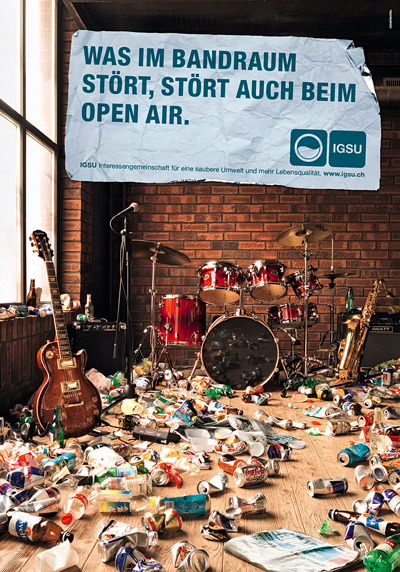
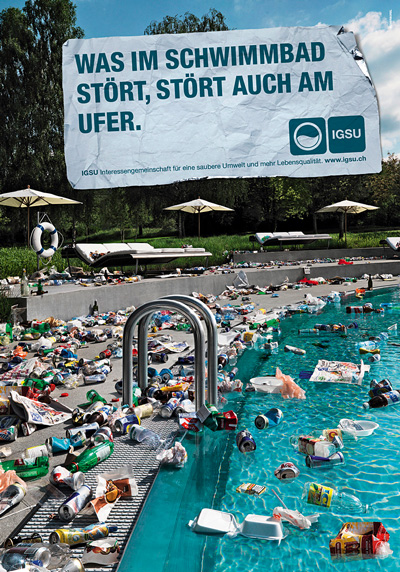
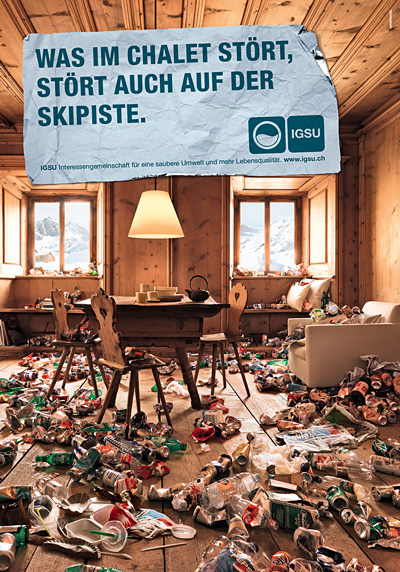
ViznerBorel is not pointing a finger at young people, who, according to statistics, are among the main culprits of littering, but a very nasty monster. The tongue-in-cheek but otherwise unmistakably clear campaign shows us how careless littering will inevitably come back to haunt us. ViznerBorel developed the subjects specifically for use in schools, on the Internet and in other media relevant to the target group of young people. At the same time, as part of its long-standing commitment to the interest group for a clean environment, the agency has designed a series of follow-up subjects for the ongoing campaign, which are also aimed at a general audience. For around seven years, the IGSU has been successfully pursuing the goal of preventing the careless discarding of waste in public spaces. With the anti-littering ambassadors, the "IGSU Anti-Littering Contest" and other innovative measures, the IGSU has achieved a high level of acceptance and attention for this sensitive social problem. The IGSU was founded in May 2007 by the recycling companies IGORA-Genossenschaft für Aluminium-Recycling and PET-Recycling Schweiz. These two private-sector organizations have been working together to combat littering since 2004. In the meantime, an open platform has emerged in the fight against littering and further partners from consumer-related areas and the recycling industry have been won over for further joint measures. The current campaign can be seen nationally on posters, advertisements and on the Internet. pan