Fairness Commission: size matters

According to the Price Disclosure Ordinance, mandatory information in commercial communications must be simple and clearly legible. This includes a font size that can be read without magnification. The Fair Trading Commission recently had to address such a case.

A consumer was interested in the leasing conditions of a car because of an advertisement in the Sunday press. However, these were reproduced in a font size that could not be read without a magnifying glass. The consumer complained about this to the Fair Trading Commission, which upheld his complaint. Although there are currently no specific standards for font size, the general rules of the Price Indication Ordinance (PBV) can be used as an analogy. Article 14 (1) states that the information must be clear - and therefore clearly legible.
The Commission criticizes the leasing conditions as being clearly too small. It writes: "The general rule is that in commercial communication, information must be presented in such a size that it can be perceived with the average attention that an average addressee would pay to the corresponding advertising medium."
In the case in question, however, this was not the case, said the First Chamber of the Commission. "A sufficiently clear indication within the meaning of Art. 14 para. 1 PBV can therefore no longer be affirmed." The respondent has admitted that it made a mistake, has accepted the complaint and will refrain from using this type of communication of mandatory information (so-called leagel lines) in future.

www.lauterkeit.ch
www.faire-werbung.ch
www.pieroschaefer.ch

Axel Springer: Pino Luppino takes over as Area Sales Manager for Consumer Media

Ab dem 1. September 2010 wird Pino Luppino neuer Gebietsverkaufsleiter der Publikumsmedien von Axel Springer Schweiz für die Regionen Zürich Nord, Ostschweiz, Tessin sowie das angrenzende Ausland.

Pino Luppino comes from Corriere del Ticino, where he most recently worked as Key Account Manager for German-speaking and French-speaking Switzerland. He previously worked for Axel Springer Switzerland's specialist media for the customer magazine "Panorama Raiffeisen" and for various magazines, according to a statement from Axel Springer Switzerland.

www.axelspringer.ch

New talents

Snap Film and Pumpkin want to work together to support young directors.

The links between the two Zurich film productions Pumpkin and Snap have already played out several times in the past. They help each other out with personnel and technology and also have offices just a few meters away from each other. "Nevertheless, it makes sense for each company to offer its core competencies to customers independently in different niches," explains Michael Kindermann from Snap Film. However, the two companies, which have been successful for some time, now want to work together to promote the "next generation". Pumpkinsnap is the name of the "smart alliance", through which fresh names from the "young filmmaker" scene will get their chance in advertising in future. One of the first directors in the portfolio is Alexandra Fi-sher. The UCLA graduate completed her Master's degree in Hollywood and also made several short films there. After winning a "Student Emmy" from the Director's Guild of America, she has now been entrusted by Pumpkinsnap with two first films for Migros and Caotina. Other names on the showreel of the "smart alliance" are Tolga Dilsiz, Laurin Merz, Pierre Monard, Ramon-Pedro and Alain Gsponer. The Swiss director, who lives in Berlin, attracted attention last year with Martin Suter's "Lila, Lila" and won various awards for "Das wahre Leben". Luzius Rueedi also has feature film experience. Michael Kindermann produced "Sunny Hill" with him last year. However, it is difficult for potential customers to deduce the style of a commercial from such a work. That is why Kindermann has now developed the idea for a fictitious reference object. For the invented beer brand "Shelby's", Luzius Rueedi was able to show, with great technical effort, what kind of commercials he could offer in the future. "Caveman" Siegmund Tischendorf plays a leading role and the film was shot in Berlin and Zurich.
Andreas Panzeri
img100825_snappumpkin

Visual language

Cavegnwerbung is launching Modissa's new website.

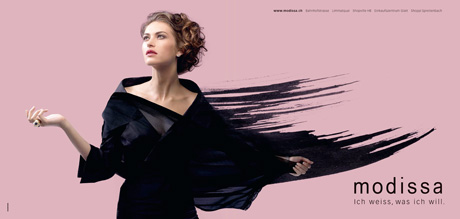
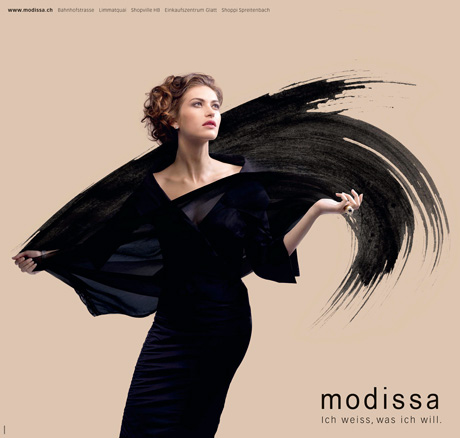
Billboards are often packed with messages. That's why Markus Cavegn wanted to develop "a contrary message" for Modissa: Pictures instead of lots of words. After the agency Cavegnwerbung won a pitch this spring, the strategic repositioning is now being implemented. Under the motto "Fashion instead of lifestyle", Modissa as a brand is to be brought back into the classic fashion world. Women in their mid-thirties do not change their tastes with every trend, but are looking for the style of great fashion. The subjects of the proven creative team around Markus Cavegn with Markus Rottmann, Chris Burkhard, Daniel Soldenhoff, Julien Vonier and Nora Fehr stage the path of fashion from the studio to the catwalk, from the design sketch to the evening dress. The claim "I know what I want" focuses on the style awareness of customers who want to set themselves apart from the youthful fashion world. pan
1290580770_img100825_modissa1
1290580770_img100825_modissa2
img100825_modissa3

German government: freedom of the press to be strengthened

Die deutsche Regierung will Medienleute stärker vor dem Staatsanwalt schützen und auf diese Weise Pressefreiheit stärken. Einen entsprechenden Gesetzesentwurf beschloss das Kabinett am Mittwoch in Berlin.

This draft stipulates that journalists can no longer be prosecuted for aiding and abetting the betrayal of secrets if they publish material that has been leaked to them. The planned amendment is an addition to a paragraph in the Criminal Code. This paragraph threatens public officials who betray an official secret with a prison sentence of up to five years. However, according to the SDA, this paragraph is also used by the public prosecutor's office to take action against the media.
In future, a new paragraph will exclude the use of "aiding and abetting betrayal of secrets". This means that journalists will no longer be liable to prosecution if they publish material that has been leaked to them.

www.sda.ch

Küttel Laubacher awakens a passion for collecting cork

In collaboration with the Albert Reichmuth Wine House, the young advertising agency Küttel Laubacher in Wohlen has developed an informational and collection campaign to raise awareness among the wine shop’s customers about cork recycling in general and, in particular, to highlight that Albert Reichmuth is one of only two official cork collection points in the city of Zurich.

The centerpiece of the campaign is a reusable cork collection bag made of cotton, which is sent free of charge to customers and interested parties to encourage them to collect old corks. The most important information about cork recycling and how to use the collection bag is printed on the cardboard envelope. The mailing was accompanied by detailed information in the April issue of the Reichmuth customer journal "Weinklang".
According to the agency, the return rate for old corks at Weinhaus Albert Reichmuth increased by over 15 percent shortly after the campaign. The collection bag can be ordered free of charge while stocks last.
Responsible at Küttel Laubacher Werbeagentur: André Laubacher, Raphaël Surber. Responsible at Albert Reichmuth: Adrian Lüthi, Managing Director.

www.kuettel-laubacher.ch
www.reichmuth.ch

Express ideas

Making ideas possible is Outbox's expertise. Printing expert Michael Kampos and his team find the best, cheapest or fastest print shop for advertising agencies and direct customers.

Many customers have already given Michael Kampos feedback that they consider Outbox "the greatest printer in the world." "We have never had a deadline bottleneck. We always have a supplier who can step into the breach," explains Michael Kampos. After seven years in the market, the founder of Outbox can now draw from a portfolio of around 500 suppliers. With these, the intermediary agency can always offer a solution for print jobs of any kind, even with an unusual idea. "I think of it as a big wall with 500 drawers. If the customer wants something specific, I can just pull out the solution."
Outbox connects projects with the most suitable partner in each case. "We are to be looked at like a print shop with the largest offering in Switzerland. That makes us strong. Our competencies are comparable to those of a general contractor in the construction industry or broker in insurance. It's just that this form of service is not yet as well known in our industry," says Kampos, explaining his business model.
Outbox sells solutions in this sense. Advertisers or direct clients often contact the agency, explain their budget and time horizon, as well as their more or less clear idea of their desired product. Outbox's team then shows what is possible with that budget and in the requested time frame. "We never want to have to say no - unlike a print shop that can only offer its standard services," says the boss.
The resourceful service provider came up with the idea of a commercial agency for print jobs because he himself worked in various print shops for 17 years. "It always bothered me when I had to tell a customer: it's not possible!" Often it was due to the size of the print shop. A small one can't print every format, or at a large one the machines weren't free. Maybe they secretly went to the competition because they didn't want to lose the customer. In the end, this game of hide-and-seek no longer satisfied Kampos. "Today, I no longer make a secret of our partners. The address of our suppliers is indeed our know-how. But when it comes to closing, we often play with our cards on the table. Our customers can even come along to the print shop for fine-tuning," says Kampos, explaining his much more open business policy today.
He founded his Outbox in May 2003. In the meantime, the company with offices in Bern and Zurich already employs ten people. All of them have previously gained a wide variety of experience in the printing trade, in prepress or lettering. Michael Kampos himself completed an apprenticeship as a reprographic printer. That was twenty years ago, when the printing industry was in the process of switching from manual work to computers. Today, the range of services has become even broader with the printing world of digitization, which is almost impossible to keep track of. And because he could never find all these possibilities in a single company, Kampos finally founded Outbox. "Here we can offer a solution for any production, no matter how unusual."
Many of these orders are placed with individual partners. "However, projects where we have to coordinate between several partners are also very exciting." Advertising agencies in particular have very original ideas in this area, for which Kampos can use all his imagination in finding a solution. "As print experts, we know a lot more suppliers than a creative director." With direct clients, it's more about finding a free deadline or budget issues. Here, Outbox is "completely neutral" in scanning the entire market.
Around 98 percent of Outbox's orders are processed in Switzerland. "Our printing industry is the most highly developed in all of Europe." Only for large orders does Outbox sometimes have to move to nearby Germany when it needs to find a free press at short notice for runs of up to several million. In addition to the quality, Kampos also appreciates the much shorter time horizons for processing the often multi-stage orders in Switzerland.
Most ideas are still realized on paper. However, the range is getting wider and wider, especially since new gimmicks are constantly being discovered in laser printing. Outbox has divided the offer into four different categories: Standard printed matter, packaging, lettering and textile printing, which also includes embroidery. In addition, there is a fifth area, the special productions with constantly newly discovered innovations.
Current examples include an asphalt film with three-dimensional-looking photos, as Outbox was able to use at the last Tour de Suisse. Even in the rain, the bicycles rode absolutely safely over the advertising-effective stickers. Lenticulars or "wiggle pictures" are also in vogue. This season, the "gift packets" in the shop windows of Mobiliar Insurance, which were built and printed by Outbox, attracted attention in three dimensions. A lot of tinkering is behind the ducks for Bern's Shoppy-Land. The 15,000 printed balloons had to be able to fly upright correctly, something that various balloon manufacturers have failed at. The big challenge in terms of coordination was a large banner made of a grid. The 14 x 4 meter wide advertising medium had to be prepared, printed and hung in just two days.
Kampos regularly visits the relevant trade fairs throughout Europe for his new discoveries. Conversely, it is also the partner companies that report their latest developments to him.
In addition to its wide range, another core competency of Outbox is price optimization. "We very often manage to surprise customers by getting better conditions out of them by placing the order in the right way." Outbox's employees know the market and its technical conditions. "Many small jobs are placed in printers that are too big and vice versa," Kampos knows.
As a result of the economic situation, Outbox has also noticed a trend towards shorter runs - but with a clearer target group. People have been talking about personalized printed matter for a long time. In the meantime, individualization has also been added. "There is more targeted advertising today. More different mailings to a few, more individualized." High-quality printed envelopes - delivered in runs of just ten to particularly valued customers.
Michael Kampos sees web solutions as competition for his idea in the printing industry. Certainly a viable solution for certain standardized jobs. Here, however, the customer finds neither advice nor a guarantee for the actual desired end product.
Outbox, which provides advice on a personal basis, has now more than doubled its annual turnover from 1.5 million francs at the start. The profit is again generated from discounts that arise thanks to cooperation with interested suppliers. In this sense, Outbox's consultants are also inexpensive "sales representatives" for the approximately 500 participating print shops.
In this constellation, it is not apparent to a customer at first glance what competencies lie dormant behind Outbox's specialists. "You only see an office with us and no machines. That's where it sometimes takes a bit of trust." The greatest pride for Michael Kampos is therefore when, after seven years as an intermediary, he can enjoy this trust again and again with an initial order. A project where the customer doesn't contact a print shop first, but comes straight to Outbox for advice.

Andreas Panzeri

Costs, dates
Someone has a good idea, but does not know how to implement the order. Outbox analyzes the market for its customers, offers the best solution and coordinates the projects from the idea to printing and distribution. The agency with offices in Bern and Zurich is the contact for standard printed matter, lettering, packaging and special productions.

Publicis: I love ZH, BE, GR, SG, VS, GE…

Publicis hat für die Aids-Hilfe Schweiz ein T-Shirt-Klassiker neu interpretiert.

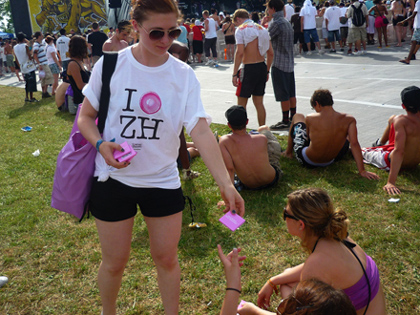
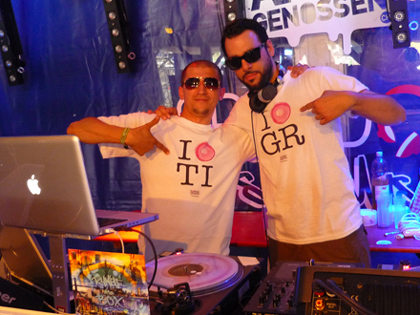
Mitarbeiter der regionalen Aids-Hilfen bringen im Sommer an den Festival präventiv Präservative unter die Besucher – gekleidet in T-Shirts in Anlehnung an den Klassiker «I love NY». Zusätzliche Aufmerksamkeit erregten auch DJ’s und Festivalbesucher, die sich die T-Shirts überstülpten.
Verantwortlich bei der Aids-Hilfe Schweiz: Silvia Schorta (Abteilungsleiterin Kommunikation & Fundraising). Verantwortlich bei Publicis: Martin Denecke (CD), Cyrill Wirz (Text), Thomas Berger (AD), Martin Schlatter (Beratung).
1290580768_img100825_ahs1
1290580768_img100825_ahs2

No Watergate in Paris

No French president resigns over a scandal involving revelations. Certainly not Sarkozy. But something has changed: In the latest political scandal, an online newspaper has supplanted the traditional press. Op-ed by Jürg Altwegg, Geneva correspondent for the Frankfurter Allgemeine Zeitung.

Paris is not Washington, and there is no Watergate on the Seine. Otherwise, both Mitterrand and Sarkozy would have had to resign - as victims of the journalist Edwy Plenel. His latest prank: he started the scandal surrounding Liliane Bettencourt and the minister Eric Woerth. He published the wiretap logs on his internet portal Mediapart, which show that the richest French woman handed over envelopes containing money to the politician. Woerth's wife worked in asset management for Oréal's majority shareholder and her boss received the Foreign Legion from Monsieur le Ministre. In return for the cash, there were tax rebates and leniency in the prosecution of tax evasion. The state is also interested in the events surrounding the Bettencourt family because the elderly lady gave her gigolo more than a billion. The daughter wants to place her under guardianship - the process is underway.
The state affair has been smouldering for weeks. Plenel adds to it almost daily, even on Sundays. On August 15, when the summer doldrums reach their culmination and the news level tends towards zero, he publishes another adventurous story about the minister. He had cheated on a bank loan to finance an election campaign. With grotesque details. On Monday, they were in almost every newspaper.
No vacation for Edwy Plenel. He has a reputation as a fanatic. His journalistic career began at the far-left newspaper Rouge. Like many members of his generation, Edwy Plenel was a Trotskyist - the influence of these far-left networks in the Parisian media is still palpable. Plenel worked at Le Monde for two and a half decades and became number two. With the Greenpeace affair in the 1980s, he put Mitterrand in trouble and forced the defense minister Charles Hernu to resign. Mitterrand had Plenel's phone tapped for fear of private, not political, revelations about his illegitimate daughter.
Edwy Plenel had to resign from Monde due to ideological differences and his justified reservations about the ruinous expansion strategy. With his handsome severance pay, he founded the online newspaper Mediapart in 2008, which was voted the best info portal of 2010. Renowned journalists who lost their jobs due to the press crisis are also on board - experienced editors in early retirement. The financial balance has not yet been found. But Mediapart now has 30,000 paying users - and the trend is rising. The next step is to get into the black.
Following the revelations, the ruling party has sponsored links on Google in order to better sell its own point of view. Denying, lying, denigrating and marking certainty of victory is the slogan. The Internet, and Mediapart in particular, have been slandered across the board as fascist. But this ploy no longer works. The anger of the people that unfolds on the Internet is only growing and can no longer be controlled. In the face of systematic lies, rumors - such as the one about Mitterrand's double life - have all too often proved to be true.
Politicians and the media, whose closeness and collusion undermine the credibility of all, are rightly nervous. The current affair represents a turning point in the history of French journalism. There are several reputable internet portals such as Mediapart, Rue.89 and others. More than in other European countries. Their success also has to do with the failure of the traditional press. They do their research and have no fear of contact. And a minority is prepared to pay for this.
This is what Edwy Plenel was hoping for and betting on when he founded Mediapart. He recently called Sarkozy a "constitutional delinquent". The government describes its most dangerous critic as a "veritable delinquent of journalism". Plenel can only be pleased. After his forced departure from the tabloid, he has returned to his favorite role in the new medium: me against the president.

"bulletin" on the iPad: The showpiece from Lake Zurich

Eine Geschichte über Bewegung. Und was resultiert, wenn der innovative Chef eines Kundenmagazins mit einer innovativen Gestaltungsagentur die Grenzen auslotet: eine Premiere mit Zürcher Know-how.

Sometimes little is needed. For example, courageous clients who challenge and encourage. And curious doers who can suffer and want to achieve. Without both, what has been followed with great interest, considerable scepticism and ultimately appreciative applause in professional circles would not be a reality today: the Swiss corporate communications agency Arnold Inhalt und Form (AIF) was the first company in the world to produce an iPad version of a customer magazine using the K4 editorial system from Vjoon and Adobe software. The world's oldest banking publication, Credit Suisse's "bulletin", has been available free of charge as a multimedia magazine in the iTunes App Store since the beginning of August. Swiss clients and service providers played a key role.
Daniel Huber, Head of External Publications at Credit Suisse and Editor-in-Chief of the internationally award-winning client magazine "bulletin", remembers the first discussions about the latest issue focusing on "movement" very well: "In the beginning, the editorial team and agency shared a fascination for the new iPad medium. Then there was the will to become part of this new media channel as quickly as possible and to gain experience as quickly as possible in the sense of learning by doing." AIF, which has been working for "bulletin" for more than 12 years, did not need to be asked twice. Agency founder Urs Arnold: "As a leader in the market, we have always had an icebreaker function. Now, too, we wanted to exploit the latest technological developments and develop a commercially viable solution that works in terms of production technology."
The result is a magazine that is more than just a magazine: the printed version has been set in motion on several levels - through extensions that connect it with the digital world. The customer magazine traces movement from the mobile use of smartphones to the eternal topic of perpetual motion to the physical, human movement of the hunters, a combative wearer of two prosthetic arms and a pioneering dancer. The cover is enriched with augmented reality - Zurich personal trainer Dave Dollé sprints off as soon as you hold the cover in front of a computer webcam. QR tags lead directly to videos after being photographed with a smartphone. And pages of the customer magazine photographed with "Kooaba Paperboy", the print version of which is published five times a year in four languages and with a total circulation of 148,050 copies, are provided with links that can be followed and managed on a smartphone or computer.
That's already plenty. But by no means everything.
For the first time - outside the USA - AIF used Adobe's digital magazine publishing technology (DMP) for the latest issue of "bulletin", which, in conjunction with Vjoon's K4 editorial system, creates the conditions for commercial production of the apps and for the use of iPads in corporate publishing. Only the editors of the American technology and design magazine "Wired" had previously created an iPad version of their own magazine using the same technology - the creators of AIF risked the first attempt at later commercial use in editorial publishing and corporate publishing with some daring. "bulletin" editor-in-chief Huber confirms: "The biggest difficulty is probably that there is currently no clear indication of the direction in which user behavior will develop. Which functionalities will be perceived as useful and which will be dismissed as superfluous gimmicks? We are of the opinion that a pure reading app is not enough and that we have to offer a certain added value with the 'bulletin' app. In this respect, we were able to rely on a rich pool of ideas from the editorial team at AIF."
Under the project management of Senior Art Director and CIO Lukas Huggenberg, the company based in Stäfa on Lake Zurich explored all the possibilities - and produced a result that is convincing in terms of content. From now on, the integration of K4 with DMP will enable the fast and uncomplicated implementation of professional digital magazines. The iPad version conceived and designed by AIF includes all the texts from the "bulletin" focus section, the business section and the leader interview from the international English edition. Multimedia functions such as animations, videos, picture galleries and hyperlinks to websites have been added wherever appropriate and possible. Graphics have been made even easier to understand with animations, and you can even have an article read aloud. In contrast to many digital versions of magazines already available in the App Store, which have been transferred virtually 1:1 from the printed magazine to the iPad, "bulletin" has a layout that is fully optimized for the medium and offers excellent readability in both the vertical and horizontal versions.
In order for AIF to make the transition from a printed edition to a mobile iPad application - with sophisticated content and design - in the shortest possible time, the company had to rely on the cooperation of Adobe, Vjoon and its Swiss integrator Topix. Topix, based in eastern Switzerland, was also enthusiastic about the cooperation with the Zurich-based company. CEO Dieter Herzmann: "When the right people work together, something can be achieved. Because I believe that this is the case with AIF, Topix and Vjoon, we met for a kick-off meeting in Hamburg. Four weeks later, a good product is now available."
AIF has been working with the K4 editing system from Vjoon for years. The Hamburg-based company uses the publishing system to structure workflows for all connected users and to control the production process for any number of different objects such as layouts, articles, text files, photos, tables and films as well as for different output channels such as print, web, iPad and smartphones. In feedback rounds, AIF was repeatedly able to point out potential for optimization in K4 to Vjoon. The editorial system now allows parallel work on print, online and iPad output and ensures that users have access to the full range of Adobe Creative Suite. Efficient workflows and automated processes in the background ensure a smooth and uncomplicated workflow.
So the system is in place. What is needed now is a change in people's minds. In the minds of editors, communicators and designers. A banal detail: one layout used to be enough - for the printed edition. In future, three layouts will be needed: the print version and two variants for the digital version - portrait and landscape. Lateral thinking will therefore be required in editorial offices in future, as AIF CEO Urs Arnold also discovered when implementing the "bulletin" app: "It requires a different editorial way of thinking. You have to know what you want to do on the iPad right from the kick-off, which results in different editorial meetings. We suddenly have content that we communicate on different levels and in an interlinked way: with the printed magazine, with the iPad, with the smartphone, on the web. The normal page mirror has had its day." And: the procurement of content and knowledge about data sources will become essential, perfect research will determine the quality of digital editions in future - in addition to innovative design - which will encounter similar problems to publications on the World Wide Web in the past. Huggenberg: "The question of image usage is once again a major issue for apps. The image banks are not yet ready with the licensing models for their images for the new medium and have no idea how many downloads there will be: It could be 100, but it could also be a million."
Even if the K4 editorial system enables publishers and publishing agencies to structure the workflows for all connected users and to control the production process for any number of different objects and for the various output channels, the designers will still have to keep an eye on their traditional profession in the face of all the technology.
And what is the driving force behind this new development - for Vjoon, for Adobe, for AIF? Urs Arnold is convinced: "A new market is opening up - that's the driving force." On the Internet, consumers can hardly be encouraged to pay for content. Although "bulletin" on the iPad is free of charge, Apple in Cupertino is registering a nice increase in sales of paid content: in its second attempt, the provision of competent and high-quality information for a fee seems to be working after all.
Florian Caprez
An interesting distribution model
After around ten days, the iPad "bulletin" download statistics have taken off. Fueled by blogs, tweets and classic PR, the app was downloaded over 2500 times from iTunes App Stores in over
downloaded in 60 countries. To date, it has been installed around 17,000 times on an iPad, a good half of them outside the USA, the "home country" of the iPad. As a result, it was at times among the top 10 most downloaded free apps in Switzerland and among the 50 most downloaded apps in the USA, Canada, Singapore, Hong Kong, China and other countries.
If one compares the print run of the international edition of "bulletin" (20,000) with the increasing number of downloads worldwide, it is foreseeable that the number of magazines consumed digitally will probably exceed the number read in paper form. If we now also take into account that a good proportion of consumers are to be found in countries to which the postal delivery of printed magazines is expensive and takes a long time, a highly interesting distribution model becomes apparent: worldwide, simultaneous availability as a pull medium, without expenditure on logistics and contact costs, which decrease with every download. Exclusively qualified contacts without loss of distribution costs and consciously desired by the potential reader - the "bulletin" shows the way.
1290580769_img100825_arnold
Urs Arnold, founder and managing director of Arnold Inhalt und Form.

Last flap on 31. 8.

The Swissfilm Association is once again announcing the Edi Film Award.

The countdown is on for the award ceremony for the best Swiss commissioned films on November 4 in Zurich's Schiffbau. Spots, trailers, educational films, image films, music clips or multimedia interactive moving images can be submitted for the Edi until August 31. Further details can be found at www.edinet.ch. A special jury will also award prizes for direction, screenplay, music or visual effects, for example. There will also be an audience vote around the shortlist.

Media change in recent years

In einem Kurzfilm zeigen Studenten von der Uni Zürich, wie stark das Internet hierzulande den Medienkonsum verändert hat.

Students at the Institute of Mass Communication and Media Research at the University of Zurich have compiled facts about media change in Switzerland in the form of a short film. The figures show that the individual need for information is increasingly being satisfied on the Internet. The online editions of the five largest daily newspapers have doubled their readership since 2008. During the same period, the respective print editions have lost 10 percent of their readership. This trend can also be seen in advertising. In 2009, advertising expenditure on the Internet rose by 38%, while it fell by 20% in the print media.
A wealth of further information, well packaged in informative snacks, is presented in the following short film:
About the film

www.20min.ch

get_footer();