Who will be Newcomer 2010?

The «Yearbook of Advertising» is once again looking for exciting projects and new agencies.

The joy was immense, and the echo in various media made the agency known to an even wider public. In January 2009, Zurich-based Rod Kommunikation was named Newcomer of the Year by the "Yearbook of Advertising". The yearbook's jury came to the unanimous conclusion that Rod deserved this accolade due to the quality of its creative work and entrepreneurial success. Two years previously, it was Pius Walker and his "smallest advertising agency in the world". The former Krieg, Schlupp, Springer & Jacoby in 2006 and Spillmann Felser Leo Burnett or Hesskiss in even earlier times were also once newcomers. Now the competition is open again.
The "Jahrbuch der Werbung" is calling on all agencies founded after January 1, 2008 to apply online at www.jdw.de by October 29. An exceptional portfolio, a convincing brand presence and steady economic growth are prerequisites for free participation in the newcomer competition. The winners will be presented at the award ceremony on February 3, 2011 in Berlin and prominently featured in the "Jahrbuch der Werbung 2011". Since 1991, an illustrious jury has selected one newly founded agency from Germany and one winner from Austria and Switzerland, the two countries competing together. Last year's winner from Germany was Lukas Lindemann Rosinski.
The yearbook published by the German Econ Verlag is now in its 48th edition. The book is edited by Helmut Thoma, Willi Schalk and Peter Strahlendorf. Werbewoche editor-in-chief Pierre C. Meier is a member of the jury from Switzerland.
The submission period for all agencies and companies from German-speaking countries that would like to publish their campaigns in the yearbook and also apply with their best work for a Megaphone, the yearbook's highest award, also runs from September 1 to October 11. This application can be made at www.jdw.de/wettbewerb. Work submitted by September 13 can benefit from an early bird discount. Pan

"Yearbook of advertising" online
The current edition of the "Jahrbuch der Werbung", volume 2010 (volume 47) is now available in an online version. In addition to improved performance compared to the previous year, the new version also offers an optimized search for campaigns, agencies and people. Sharing and bookmark functions have also been added. With the publication of the 2010 version, the years 2006 to 2009 will also be available online. The "Jahrbuch der Werbung Online" can be accessed directly via the link Online.jdw.de and about Jdw.com.

Jung von Matt/Limmat films for Migros Chocolate and the wild chickens

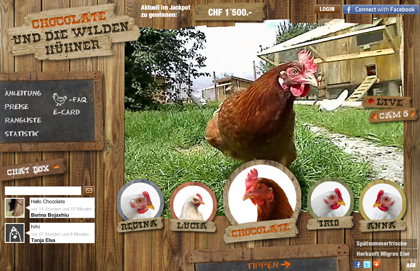
Chicken Chocolate is a familiar face in the Migros TV commercials. Now, in the egg-laying trivia game developed by Jung von Matt for the new campaign, she shows that, despite her fame, she’s still just a regular chicken.

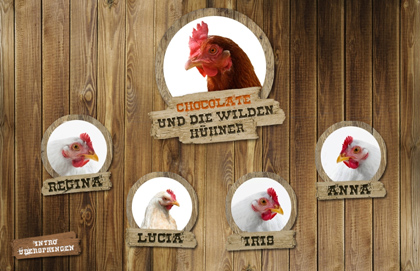
Together with the four white hens Regina, Lucia, Iris and Anna, she lives for four weeks in a chicken coop near Bern - watched by five live-stream webcams. Players now have to guess which hen will lay an egg first each day in the live prediction game to win prizes worth over 15,000 francs. They can also guess the exact time at which Chocolate will lay her daily egg. Players can follow the action at any time via the live cams and cheer live to see whether the chickens stick to their predictions. The exact time of laying is recorded using RFID technology, which registers exactly when an egg slides out of the nest box.
The online game is filmed in a barn at a Migros delivery company. The chicken coop is used for presentation and training purposes, already exists in this form and was only slightly adapted for the betting game for technical reasons.
Responsible at Migros: Daniel Hasenfratz (project management). Responsible at Jung von Matt/Limmat: Michael Rottmann (CD), Bruno Manser (art direction), Thomas Engeli, Christian Schnellmann (text), Deluxx Development (technical implementation), Daniel Nessler (consulting), Anja Schatz (screen design), Erasmo Palomba (art buying).
1290580771_img100825_eierlegen1
1290580771_img100825_eierlegen2

Leone Ming awarded with the Red Dot Aaward 2010

The Leone Ming agency received the «Red Dot» seal of quality at the Red Dot Design Award for the outstanding design of its in-house direct mail campaign. Fifteen jurors from around the world reviewed 6,369 submissions from 44 countries.

The red dot award-winning Lion Calendar features twelve authentic portraits from the Leone Ming agency. Each calendar page illustrates how people become true calendar beauties.
Responsible at Leone Ming: Leone Ming (concept), Christine Böhmwalder (design), Manuela Pia Fuchs (text). Photography: Roland Korner (Close up, Triesen). Lithography: Sabine Goller, Christian Buchberger (Prepair, Schaan). Printing: BVD Druck & Verlag, Schaan.

www.leoneming.com

To the point: Better late than never

Ringier's plans for a private TV station (see also "Top 1 of the Week") aren't really all that surprising. Countless projects have been floating around in people's minds for many years now.

From the Blick news program on its own station, which was considered at one point, to people programs or soccer magazines or cooperations and acquisitions with and from existing stations, everything has probably been thought of before. Everything was discarded, and the company went its own unspectacular way.
For years, Ringier has exercised distinguished restraint in the field of television. While television projects, conceived and not realized, were realized left and right with a lot of money and soon discontinued or bought with even more money and then redimensioned, Ringier has quietly become one of the most important Swiss private television producers.
Many successful programs in recent years can be attributed to the TV makers from Dufourstrasse. They were extremely successful, but never made a big fuss about it and, above all, never felt the need to boost their ego by founding their own TV station.
This sober restraint was probably one of the reasons for the success to date. There were no high infrastructure costs to contend with, no laborious negotiations with regulatory authorities, and the tough daily battle for advertising customers could be left to others. You were in the fortunate position of being able to concentrate on making successful broadcasts. And they even made nice money doing it.
Now a new era seems to have dawned. With the expansion of the publishing house in the direction of entertainment, the planned establishment of its own channel is only logical. Only a channel of one's own allows the unbroken exploitation of the revenue chain from concert tickets to television broadcasts, from cooking shows to rösti raffles. By being able to use one's own media to transport the messages, one controls the communication and thus increases the success factors.
Two things are to be hoped for: First, that the new station can really be realized after it has passed through the unfathomable decision-making mills of Dufourstrasse, and second, that the joy and enthusiasm for making television do not fall by the wayside in the whole thing.
Pierre C. Meier, Editor-in-Chief
[email protected]

A tooth gap is waiting for you

"Werbewoche" editor Anne-Friederike Wilhelm on the frustration of being greeted by ridiculous posters after the holidays.

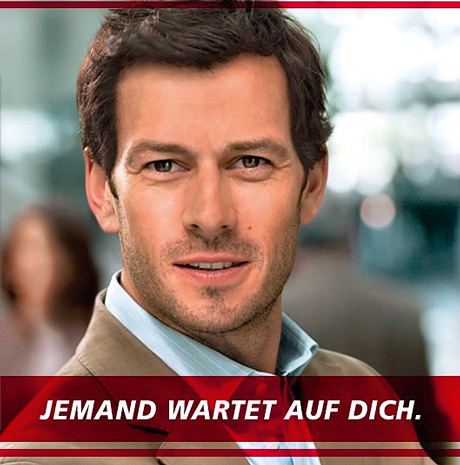
I have seen whales. Deer at close range, cariboos, otters and sea lions. And a young bear. I saw the Rockies, covered in snow, deep gorges, raging waterfalls and the vast ocean. And I was looking forward to being home again. Back in Zurich, brutally jetlagged, I see: advertising. "Someone is waiting for you", claims heart matchmaker Parship. Blimey, am I too late again?
The person, a wannabe dentist or unsuccessful young entrepreneur, smiles at me so smugly and kindly from the wine-red poster that I get all dizzy and the greasy airplane muffin comes back. If there's anything worse than all the turbulence put together, it's this. In the arrivals hall, an I-could-be-the-successful-beautiful-and-rich-woman-at-your-side lady grins down at me. Relieved, I realize that I'm not meant to be - and firmly grasp the hand of my loved one.
But the suffering is not over yet. "Foreigners? Vote!" I read on the next attempt to spread a message. Are foreigners now allowed to vote in Switzerland? Thanks to the SVP? Got it through in just three weeks? The next morning it dawns on me that this red, white and black poster is just further proof that SVP supporters travel from Obwalden and Nidwalden to the big wide world at least once in their lives
should. Or at least from Obwalden to Nidwalden or from Nidwalden to Obwalden. Then they would realize that everyone is a foreigner. Almost everywhere. And often in the neighboring canton.
Welcome back
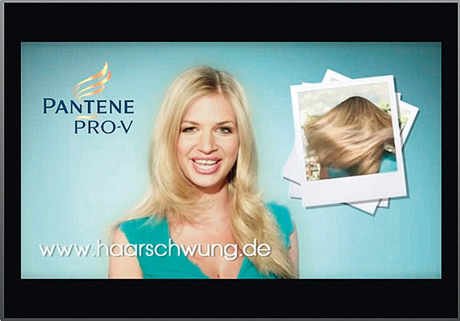
A day later, the GMX mailbox: Alongside a number of spam messages, a toothy blonde smiles at me from an advertising button. Contrary to what I first thought, she wasn't advertising for the "Dentist in Germany" (another stupid ad that's plastered all over streetcars), but for a Pantene Pro-V shampoo. Only on second glance do I realize that Lotte has really pretty hair - at least compared to her teeth. And then you can also take part in a hair swing contest. That's great. I try it straight away and strain my economy class tense neck. Oh great. Welcome back!
My God, advertisers, can't you really think of a subject that doesn't make me want to go away again after the vacations? Think of the poor people who have to look at your posters and advertisements. Yes, there: Hotelplan has made it very easy for itself with its palm beach photo, but at least the message is right: "75 years of vacations". I could really do with that now. Or I could just go back to Bern in between. Because of the bears.
1290580771_img100825_aufgespiesst2
1290580771_img100825_aufgespiesst1

My home is my castle

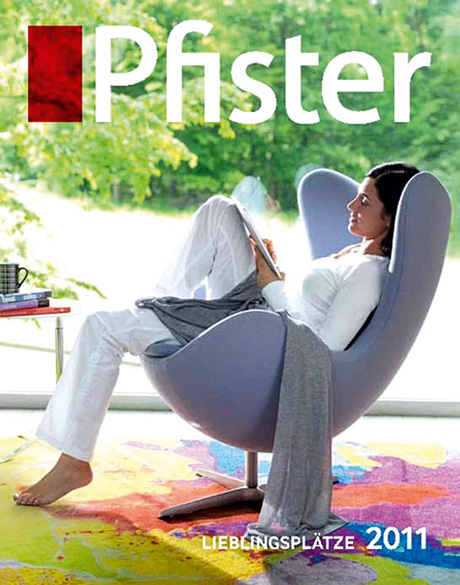
Weber Harbeke Partners designed a 244-page catalog for the furniture store Pfister.

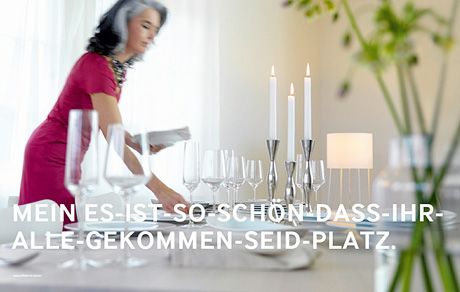
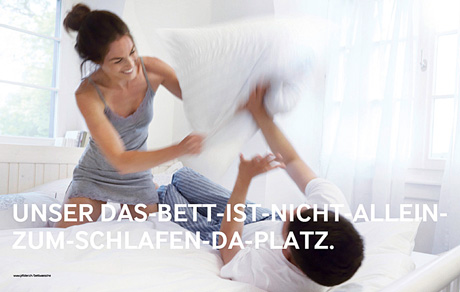
Under the title "Favorite Places", Pfister's new main catalog promises what we are all looking for, namely happiness at home. As Switzerland's leading specialist furniture retailer, Pfister is committed to "offering the right individual furnishing solution for everyone". Over 100,000 items for every style and every budget can be found in 20 stores - from furniture to curtains and accessories. Pfister has "the largest selection of oriental carpets in Europe". But selection and accessibility are only two important steps to happiness at home. That's why Pfister offers even more. It starts with a free home consultation and continues with delivery, installation and disposal, right through to a made-to-measure service and the new sleep competence centers. The creative minds at Weber Harbeke Partners have implemented happiness at home in the "Favorite Places" concept, which runs through the entire catalog. The atmospheric images by photographer Andrea Diglas show people who have created their own personal favorite place with furniture and accessories from Pfister. The 244-page publication is distributed to over one million Swiss households. pan
1290580769_img100825_pfister1
1290580770_img100825_pfister2
1290580770_img100825_pfister3
img100825_pfister4

Swiss Light Festival

The Zurich Light Festival gives Switzerland a major national event for young and old. The festival is held annually for eleven days in the first half of November and is expected to amaze and delight over 100,000 visitors and locals every day.

The art and culture event is set to become a seasonal highlight for Switzerland in the run-up to Christmas. Willi Gyger, initiator and owner of the organizing Wigra Group, attaches great importance to ensuring that the event, which is largely independent of the weather, causes minimal noise pollution and environmental impact. He is also convinced that there will be no alcohol, drug or waste problems. The event is also intended to demonstrate how the requirements of a 2000-watt society can be met with state-of-the-art, low-consumption lighting technology. The concept also envisages including not only the city center with its beautiful buildings and the lake, but also larger neighborhood centers and parks, according to a press release from the Wigra Group.
At the festival, 80 to 100 light installations, performances and exhibitions will unite the various aspects of art, culture, entertainment and technology - without any significant emissions. It is expected that over 90 percent of visitors will use public transport to get to the festival and travel to the various outlying districts, the press release continues.
The festival consists of three complementary pillars: on the one hand art & culture, on the other hand the increasingly important public entertainment and the aspect of science & technology. Regionally and internationally renowned artists and lighting designers will "illuminate" Zurich with their installations and make the city on the Limmat the "European City of Light" alongside Lyon and several other cities. In addition to the installations, light performances will take place daily. Other cultural institutions such as the theaters, the Kunsthaus and the opera are of course invited to take part in the festival with their own programs.
The Wigra Group is supported by an advisory board with well-known representatives from the business community, Zurich Tourism, the hotel industry, SBB, regional location promotion and experienced event partner companies. In order to hold the first event in November 2011, a definitive permit must be issued by the City of Zurich by the end of October and a definitive commitment from one of the potential main sponsors is still required.
An article about the festival will appear in the print edition of Werbewoche shortly before the festival.

www.zurichlightfestival.ch
www.zlf.ch
www.wigra.com

Tops of the week

Ringier is planning its own national TV program with entertainment shows, series and TV films, and UBS's new image campaign in Switzerland was launched this Sunday under the motto "We will not rest".

Ringier: National entertainment channel planned
Ringier is planning its own national TV program with entertainment shows, series and TV films. Ringier intends to decide in the first half of 2011 whether and when the project will be implemented. The plan is for a program that would be distributed both analog and digitally. Large parts of the Group are involved, including Blick and the Zurich radio station Energy. 3+ shows that it is possible to operate a commercially successful entertainment channel in Switzerland, Marco Castellaneta, Managing Director of Ringier Entertainment, told the SonntagsZeitung. The timing is ideal, especially as SRG says it wants to focus more on public service and information offerings in future. The reorganization of Ringier's TV division must also be seen in this context. As of November 1, all television activities will be brought together under one roof and one management. The newly created "Television" division is affiliated to Ringier Entertainment. It will be headed by Corinna Scholz, who is moving to Ringier from the management of Schweizer Fernsehen.
UBS: new campaign, new sponsorship
UBS's new image campaign in Switzerland was launched this Sunday under the motto "We will not rest". Le Corbusier, mountaineer Evelyne Binsack and Peter Monteverdi are among those promoting the big bank. The campaign, which was developed in collaboration with the agency Publicis, will initially run on television, the Internet and in print media until the end of the year. On Monday, the major bank then announced its global sponsorship commitment to Formula 1. The partnership will be officially launched at the Singapore Grand Prix at the end of September. According to Group CEO Oswald Grübel, the partnership fits in perfectly with the new campaign. Formula 1 is the ideal partner because it is equally represented in Europe, Asia/Pacific, the Middle East and Latin America. In return, UBS will be present at the Formula 1 races with its brand and offer its clients exclusive events. The parties have agreed not to disclose the amount or duration of the commitment. Credit Suisse once supported Peter Sauber in the premier class of motorsport. Grübel, who sits on the Board of Directors of BMW-Sauber, was also the driving force behind this commitment.

New wide world

QR codes, Kooaba image recognition, augmented reality - does that mean anything to you? The three technologies make it possible, for example, to order concert tickets directly via a poster or advertisement, to furnish your home with virtual furniture on a trial basis or to make a 3D house grow out of a brick before your eyes. Cool! But how "augmented reality" works and what it can do is still far from common knowledge. Werbewoche has found out what is possible and what is coming.

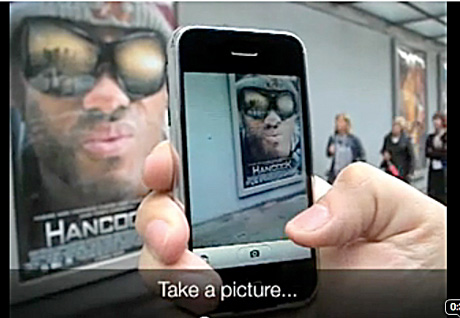
You are walking through the main station and see a poster advertising your favorite band's next concert. Wow! Are there any tickets left? You quickly take a photo of the subject with the Kooaba application and know within seconds that there are still tickets available, that the weather will be fine on the day of the event and that it will only take you fifteen minutes to get from home to the venue. Tip-top - and the ticket is bought.
What has been part of everyday life in Japan and China since the late 1990s and has been commonplace in the USA and Canada for several years is only just beginning to emerge in Switzerland: Smart ads and augmented reality (AR). Ads and posters are backed up with background information or booking tools that can be used to book tickets here and now, arrange a test drive in a new car model, take part in a competition or calculate whether the advertised insurance would be cheaper than the current one. Three technologies currently make it possible to provide such additional information behind image data: the classic quick response code (QR code), the challenger, the image recognition software Kooaba, and the latest trend, AR with image recognition.
The ugly box
Here in Germany, QR codes have been appearing sporadically for around three years. The black and white box images are an advanced form of barcode. They encode information such as URLs and telephone numbers. If you want to decode a QR code, all you need is software on your cell phone that can be downloaded free of charge from the Internet. The decoding software is already programmed into many cell phones. When the code is photographed, the software immediately provides the stored data, for example a link or an SMS text. The user does not need to be online for this. Because QR codes can be decoded by anyone using the freeware, they are referred to as "open taggs" - as opposed to encrypted beetaggs, which are used for B2B applications. Unfortunately, QR codes are not particularly attractive. "That could be one of the reasons why they haven't caught on yet," speculates Bruno Mettler, founder and CEO of the Zurich agency for interactive experiences, Vanija. "Anyone promoting a new Audi in high gloss doesn't want to see a foreign object on their poster." The below-the-line agency Streuplan launched its first campaign with QR codes back in 2008. However, it was not a success. "The response rate was alarmingly low," says Managing Director Thomas Back, "even though we were addressing a young, technology-savvy target group and there was a prize on offer. QR codes have three weak points: The user has to download software, you have to explain the mechanism to them and MMS are expensive." Streuplan was probably simply too far ahead of its time. After the belly landing, Back decided against further experiments with QR codes.
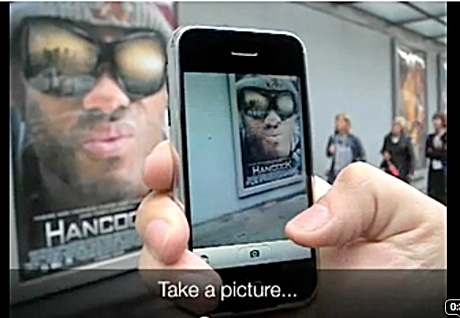
The image recognition software Kooaba, which was developed by a spin-off from ETH Zurich, makes it far easier to find the new technologies attractive. Anyone who uses this software to feed advertising or editorial articles does not have to decorate them with ugly code. Only a small icon in the form of a lens reveals that the viewer can expect something else behind the subject or article. If you want to see what's behind it, you need to have Kooaba on your smartphone. If they then take a photo of a subject or a newspaper article, they receive the information stored in the Kooaba database for the image directly on their display without any further intermediate step. This could be further links, additional photos for a report, a competition or an ordering tool. Kooaba is being pushed by the widespread use of smartphones. "With the new smartphones, using the Internet is not only quick and easy, it is also already covered by a flat rate in most contracts," says Bruno Mettler. "If you have to pay three francs a minute without a flat rate to get additional information via QR code, you'd rather check the Internet at home. But if it costs nothing to take a quick photo of a subject and get more information, people are happy to use the service. Last year, I wouldn't necessarily have recommended Kooaba. Today, smartphones, especially iPhones, are so widespread that the technology can be used very well with certain target groups." Thomas Back from Streuplan also gives Kooaba a good chance: "Imagine you're sitting in a gourmet restaurant with a great woman. The bottle of wine arrives, the lady disappears to the toilet. You take a photo of the label on the wine bottle and can then score points with your extensive knowledge of the wine." In fact, Kooaba unfolds its potential above all in everyday situations.
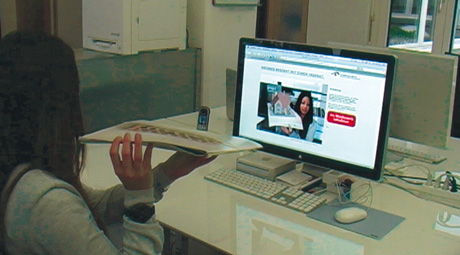
QR codes and Kooaba provide additional information on image data. Augmented reality goes one step further: it adds an additional dimension to reality. AR applications require a camera, either in the smartphone or on the computer. It takes a live video image of the subject, which is held in front of the camera. Software then creates a grid of the two-dimensional image and uses it to calculate the two- or three-dimensional representation of the subject. For example, the current issue of the Credit Suisse customer magazine Bulletin is all about movement. The cover picture shows the former Swiss track and field athlete Dave Dollé on a treadmill. If you hold the page in front of the camera, Dollé is jogging on the magazine. If you tilt the magazine to the left or right, the runner "feels" the resulting slope or incline and runs faster or slower. How does this work? The software recognizes the inclination of the image grid and calculates how much the athlete needs to speed up or slow down. The application was programmed by Vanija. The production of such gadgets is very complex: Dave Dollé, for example, not only had to be photographed for the cover, but also filmed in front of a green screen. The more complex AR applications are, the clearer and more sophisticated the concept behind them has to be.
Switzerland as a trendsetter
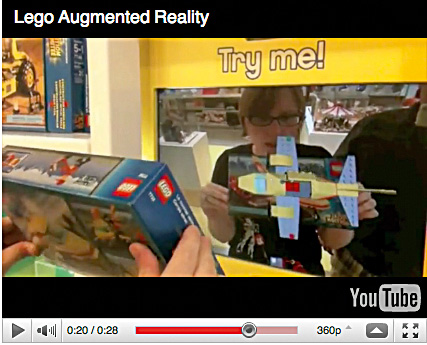
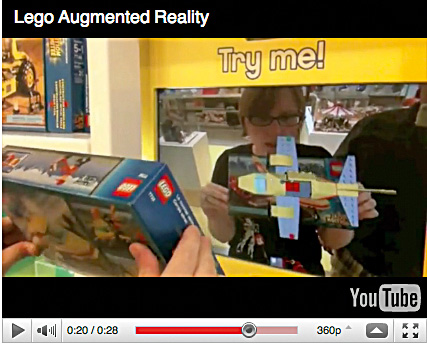
Lego, Shiseido, Adidas, Nike, Audi, Mini and BMW have already attracted international attention with AR campaigns and applications. At Lego, you can look at the contents of the packaging at the point of sale, while Shiseido enables a make-up session on screen so that women can see how mascara, blusher and other products look before they make a purchase. Since the beginning of the year, Switzerland has increasingly seen editorial articles, advertisements and posters in which a QR code or the Kooaba icon reveal that the article or subject alone is not everything. Although Switzerland lags far behind China, Japan and America, it is a pioneer in the use of new technologies throughout Europe. This is mainly due to the fact that smartphones, which are needed to use QR codes and Kooaba, are very widespread in Switzerland: Around 15 percent of Swiss people use an iPhone, compared to just one in twenty in Germany. A perfect basis for Switzerland to become a pioneer in the use of AR technologies.
The Swiss Press Association is the augmented reality pioneer in the Swiss advertising and communications industry. At the beginning of the year, the association launched the first Swiss campaign to use all three technologies. Anyone who photographs the subjects of the "Das-kann-nur-ein-Inserat" campaign, created by Contexta graphic designer Manuel Rohrer, or holds them up to the webcam, is in for a surprise: a brick becomes a three-dimensional house, an egg becomes a dinosaur. In this way, the association conveys the message that "great things begin with an advertisement". The subjects do not offer any added value beyond this insight - but in retrospect, the first steps always seem insufficient. "The Swiss Press Association has shown a great deal of courage by using the three technologies," emphasizes Bruno Mettler. "Kooaba and AR in particular are still very young technologies that are only just emerging. The association's campaign is the first and largest in the world to make such broad use of these types of technologies." The association wants to go a big step further with the next call for entries for Das-kann-nur-ein-Inserat. Toni Vetterli, Head of Marketing at the Swiss Press Association: "In the new, adapted calls for entries for the 2011 competition, we will focus on overcoming media disruption, for example through the three different technologies. The fact that posters and advertisements have the potential to trigger action is the core theme of our competition. QR codes, Kooaba and AR support this message perfectly."
Developments in recent months show a clear trend: from an initial gimmick, smart ads and AR have long since developed into a good way of offering customers and consumers real added value and differentiating themselves from the competition. Advertising is becoming a service. Much of this is still a dream of the future, but you can already hear it. Hansres Emch, Key Account Manager at LD-Media, is certain: "Optical tags have great potential. An advertisement that is not dialogized, a poster that is not interactive, has no chance in the future."
Expansion of reality
Publicitas Publimedia has also recognized this. The company has been offering its customers kooa-based print ads since June. "Print is alive. Print ads are taking on a new dimension," says Cesare Patella, Head of Media Service and Research at Publicitas Publimedia. "The needs of national and supra-regional advertising companies today go far beyond traditional planning and processing. Today, individual, target group-specific special forms of advertising are increasingly in demand. With Smart Ads, we are expanding our existing range of services in the area of planning and campaign handling and covering the current needs of advertising clients." Although Publicitas Publimedia has only been on the market with this service for a short time, it has already been able to develop concepts for a number of interested parties. "Our offer is being followed with great interest," says Patella.
Coming up with new applications for Kooaba and AR is not difficult. But because almost any gimmick is possible, the ideas quickly become adventurous. That's why implementing everything that works has never been good advice. Especially when it comes to technical gimmicks, the question of added value, the benefit that the consumer derives from the extension of reality, should be at the forefront. Patella agrees: "Smart ads are worthwhile for product and service campaigns that are intended to trigger an immediate action in the consumer. They then increase the chances of contact and response. However, the key questions should always be: Is the campaign fun or can it generate excitement? Does it offer the user real added value? What's in it for them if they show that they are interested in a product or service by taking a picture?" The added value for the advertising client must also be kept in mind. After all, they don't just want to entertain their customers, they want to make a profit first and foremost. "Smart ads also have advantages for the advertiser," emphasizes Patella. "They can make direct contact with the target group, individually define campaign options, measure the response, generate customer data and gain strategic marketing insights. This transforms contact opportunities into real customer response rates."
Between gimmick and added value
Kooaba and AR are still in their infancy worldwide - and the transition from a gadget for freaks to a useful extension is still fluid. Which side the interactive business card belongs on, with which the Namics agency is making its first forays into augmented reality, is left to personal judgment: If you hold the business card of Namics CEO Jürg Stuker in front of the webcam, you suddenly have the boss himself standing on your hand. "Of course, the business card is still a gimmick at the moment," says Dominik Ruckli, Junior Art Director at Namics and initiator of the idea. "For us, it's primarily a marketing tool. We want to get our foot in the door of AR and show that we can do this. This is how we create a wow effect that sticks in people's minds."
"Technologies are currently being pushed even though relevant content is not quite there yet," says Mettler about the Swiss status quo. "In the future, it will become even more important to have a clear concept and to store meaningful data so that real added value is created." This is when interactivity becomes exciting. The free newspaper 20 Minuten, for example, regularly uses Kooaba to provide its readers with additional images or film sequences for articles. More and more Kooaba icons are also appearing in Blick, Weltwoche and NZZ am Sonntag. "All industries that need to provide content need to get to grips with these technologies," says Emch from LD-Media. "Kooaba offers great opportunities for print, for the packaging industry, but also for manufacturers of operating instructions, for example."
But LD-Media goes much further. Because even beyond advertising and media, reality-enhancing technologies offer fascinating possibilities: Emch and his colleagues have created a kooa-based potato stick pack, as sold in every supermarket. Anyone who takes a photo of the packet with their smartphone can take part in a competition and receive nutritional and diabetic information about the product as well as various recipe suggestions directly on their cell phone. Completely google-free. If you select one of the recipes, all you have to do is enter the number of people to be served and you will receive a shopping list compiled accordingly. They are also guided by their smartphone to the shelves where the ingredients are stored. "The packaging becomes the medium," says Emch. "But it's important that the concept behind the use of Kooaba and Taggs is right. This also means that there is always short, medium and long-term content to ensure a lasting effect. I call this symbiosis of print and mobile devices information kinetics." LD-Media's "enhanced" potato stick pack is not yet in the stores. But it can't be too much longer, Emch hopes.
Everyday life as a user interface
The use of Kooaba and AR is conceivable in various areas. Passionate city explorers will probably love the following idea: you are standing in the middle of an unfamiliar city and want to know whether there is a bus or streetcar nearby, where a restaurant is, the nearest doctor or the nearest shoe store. No problem. Your cell phone registers where you are and quickly provides you with the information you need. Mind you, this is not science fiction, but a reality thanks to the Wikitude and Layar applications.
One AR application that is already proving useful is the furnishing app that Vanija programmed for Möbel Pfister. Anyone who wants to redesign their living room simply takes a photo of the room with the iPhone app, selects the desired furniture and then moves it around the room until the furnishings are to their liking. Atelier Pfister is the first iPhone app of its kind in the world. Gone are the days of furnishing a room with scaled paper cut-outs as a test ...
Service in the third dimension
There are also exciting areas of application for augmented reality in industry. Vanija also developed an application for railroad manufacturer Bombardier. The company has developed an engine for locomotives in which individual parts can be removed and replaced on a modular basis. This reduces downtimes. The engineers struggled to explain to their sales staff how the engine works - and the sales staff in turn found it difficult to make the whole thing plausible to potential customers. Now all the salespeople have to do is hold an image of the engine in front of the webcam and the design is assembled in three dimensions in front of the prospective customer's eyes. The engine can be rotated and turned, viewed from all sides and from the inside. For Bombardier, the investment of around 40,000 francs for the AR tool has long since paid off.
Kooaba certainly has the greatest potential for the advertising and communications industry at the moment. However, this technology is still far from mainstream. "I see the most important area of application for Kooaba in posters," says Mettler. "You can take advertisements home with you and look up what interests you on the Internet. Posters, on the other hand, are fleeting. You walk past them and can't take the information with you unless you write it down. It's easier to take a photo of the poster and immediately get all the information you want or book tickets directly." Posters such as those for the Orange Openair cinema on the Zürichhorn are predestined for such applications: seen, program and weather checked, tickets ordered. The information needed for this service is already available on the Internet. The only difference is that it is now pre-selected by the time and the user's current location and brought together in a web application that is optimized for display on a smartphone.
Smart ads and AR are not the, but certainly important forms of advertising of the future. Cesare Patella from Publicitas Publimedia agrees: "Smart ads are a new type of technology alongside others that will come onto the market and present advertising clients with new, creative challenges. But the direction is set with smart ads.
Supply and demand will come closer together. In future, we will also offer smart forms of advertising in the classifieds market and in other areas." Bruno Mettler estimates that in around three or four years, most posters and advertisements will be backed by Kooaba: "Kooaba is suitable for widespread use in many areas in order to provide users with additional information and services quickly and easily. Kooaba applications are less complex and less expensive than AR applications. AR is more suitable for emotionalizing products or services and offering consumers special playful experiences in small doses so that tomorrow they will still remember what they saw today. Agencies will have to keep up with this. Their customers are demanding it."
Anne-Friederike Wilhelm
> Film "Only an advertisement can do that"

http://vimeo.com/14360223

http://vimeo.com/14360804

1290580771_img100825_top2_2
1290580771_img100825_top2_1
1290580771_img100825_top2_3

Radiopool founded by leading private radio stations in the Basel, Bern and Zurich metropolitan areas

Die sechs führenden Privatradios der Metropolen Basel, Bern und Zürich gründen einen gemeinsamen Radiowerbepool. Der neue Pool besteht aus Radio Basilisk, Radio Basel, Energy Bern, Capital FM, Radio 24 und Energy Zürich.

Advertising customers can now address the three strongest economic metropolitan areas in German-speaking Switzerland with one booking. The stations affiliated to the new pool have terminated their contracts with the Swiss Radio Pool, according to a statement from the private radio stations involved. Together, the six partner stations reach a total of 848,000 listeners every day. Details such as the advertising rates of the new radio advertising pool will be announced at the end of October 2010.

www.basilisk.ch
www.radiobasel.ch
www.belcom.ch
www.espacemedia.ch
www.energy.ch

Caught the eye: Swiss exports in the car business

A campaign by Euro RSCG Zurich, which serves as an international template for print and poster adaptations, caught the eye of Werbewoche this time.

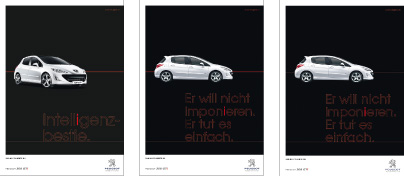
For the launch of the latest GTI from Peugeot, Euro RSCG Zurich created a campaign that dramatizes the USP of the new model: namely that the Peugeot 308 GTI is the most French of all GTIs on the market. A "cultivated sports car that is able to combine performance with elegance".
The Swiss campaign has now also been well received at the headquarters of the global car manufacturer. It was therefore decided to make the Swiss campaign available internationally as a template for print and poster adaptations, as Euro RSCG in Zurich is pleased to report.
1290580768_img100825_aufgefallen
get_footer();