Ringier: Management buyout of Cicero and Monopol in Germany

Ringier is divesting itself of Cicero and Monopol in Germany: Cicero Editor-in-Chief Christoph Schwennicke and Alexander Marguier, Deputy Editor-in-Chief of Cicero, will take over the two publications as part of a management buyout effective May 1, 2016.

Since the founding of Cicero twelve years ago and the subsequent acquisition of Monopol in 2006, Ringier's small publishing unit in Germany has failed to operate profitably, the media company wrote in a statement Wednesday.

Unbenannt-8_98

Various options for a fundamental realignment of the two quality titles were therefore examined. A solution was found with the handover of Cicero and Monopol to the Cicero management crew. Editor-in-Chief Christoph Schwennicke and his Deputy Editor-in-Chief Alexander Marguier will take over the two magazines and the assets associated with their operation as of May 1, 2016, and transfer them to their newly founded Res Publica Verlags GmbH with initial financial support from Ringier. The declared goal is to consolidate both titles - in print and online - financially in the medium term and to lead them into a successful future in the long term.

Unbenannt-7_128
Editor-in-Chief Christoph Schwennicke (Image: Cicero.de)

Holger Liebs, Editor-in-Chief of Monopol, and Anne Sasse, Co-Managing Director of Ringier Publishing in Germany, are leaving the company to pursue a new direction. Co-Managing Director Thorsten Thierhoff will support the new company in the operational publishing business until 2017.

The audience advertising business of the two magazines will be transferred to the service provider IQ Media Marketing in Düsseldorf as of February 18, 2016. By exploiting synergies in marketing and in conjunction with lower costs at the same time, the advertising business is to be made more profitable. The art market for Monopol from Berlin will continue to be operated independently. The outsourcing will lead to several redundancies in the advertising department in Munich and in Berlin.

Jobs will also be cut in the editorial departments. The staff reductions are still the responsibility of the previous shareholder Ringier. According to the announcement, Ringier will endeavor to cushion these redundancies socially with fair severance offers. Ringier CEO Marc Walder: "Selling or even discontinuing the two titles would certainly have been more cost-effective - but it would also have been a solution without imagination or journalistic heart. I am therefore very pleased about this path now taken; it secures the long-term existence of these high-quality products in the accustomed journalistic quality."


Neue LZ: Editor-in-Chief Thomas Bornhauser leaves post after 20 years

Thomas Bornhauser has been editor-in-chief of the Neue Luzerner Zeitung, the largest daily newspaper in Central Switzerland, for 20 years. This makes him a rare figure in the Swiss media landscape. Now, at the age of 60, he is stepping down from this position.

The regional titles Neue Luzerner Zeitung and St. Galler Tagblatt are given a joint editor-in-chief at the behest of the owner NZZ (Werbewoche.ch reported). Thomas Bornhauser has decided to step down from the chief post in Lucerne as part of the reorganization, according to a statement from the NZZ media group on Wednesday.

Bornhauser intends to continue writing for the Neue Luzerner Zeitung. The details of this are not yet known. A date for the replacement has not yet been set, an NZZ spokeswoman said on request. In a transitional phase, he will continue to manage the business as editor-in-chief for the time being. Bornhauser has been at the helm of the Neue Luzerner Zeitung, which resulted from the merger of Luzerner Neuste Nachrichten and Luzerner Zeitung, since 1996. He successfully steered the civic-liberal newspaper through economically turbulent times for two decades.

Loyal readers

The only remaining regional daily newspaper in Lucerne has been able to count on a more or less loyal readership. Despite crumbling circulation, readership figures have been more stable in comparison with other Swiss-German dailies. The Neue Luzerner Zeitung, with its regional editions for Zug, Obwalden, Nidwalden and Uri, reaches around 294'000 readers. According to Wemf-Bulletin, the circulation is 122'401 copies. The editor-in-chief rarely took to the keys himself. Among other things, he commented on important votes and published a short, trenchant column every week in the Sunday edition of Zentralschweiz am Sonntag under the heading "Meine Woche" ("My Week").

Criticism of "campaigns

Bornhauser also had to listen to criticism from time to time. On several occasions, displeasure was expressed about his allegedly "authoritarian management style. In addition, the only remaining daily newspaper in Lucerne was occasionally accused of "campaign journalism," for example against an economics faculty at the University of Lucerne. Bornhauser, who lives in Zug, studied economics and international relations. Before his appointment as editor-in-chief, he worked for several years as an editor in various departments. From 1980 to 1983, Bornhauser worked as foreign editor at the Luzerner Tagblatt, then as foreign editor and sports editor at the Luzerner Neusten Nachrichten and finally as domestic editor at the NZZ. After a stint as head of information and press spokesman at the Association of Swiss Engineering Industries, he was editor-in-chief of the Luzerner Zeitung from 1993 until its merger two years later. (SDA)

Last but not least: Ready for vacation

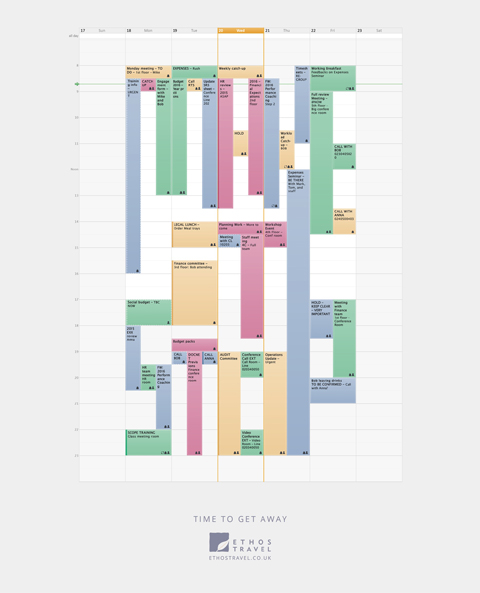
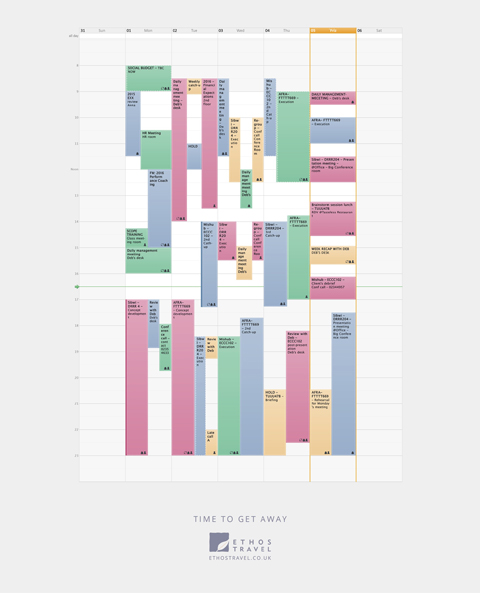
When even your calendar is screaming, «Fuck this life!», it’s time to make a change. Or at least go on vacation.

This may not be the most sustainable solution, but it is at least a temporary one. And with recharged batteries, the chances of making it through to the next well-deserved vacation after your return are relatively good. McCann London's campaign for Ethos Travel shows when it's time to book. Ethos is a travel provider specializing in Southeast Asia that attaches great importance to ethically sound and sustainable arrangements. (hae)

endthishell
fuckmylife
makeitstop
helpmegod
savemenow
 

Schaffhausen tourism to be financed according to the performance principle

In future, a consistent performance principle should apply to the services offered by the Schaffhausen tourism organization. This is the recommendation of the Schaffhauserland Tourism Task Force in its final report.

It proposes an overnight tax of CHF 2.50 and a cantonal contribution of CHF 250,000 for public services. The current system of cantonal and communal contributions is to be replaced by payments according to performance. Public service must be discussed with the canton and municipalities, said the head of the task force, Thomas Hollenstein, to the media on Wednesday. It must be clarified what services politicians want in the future and what is financed cantonally and what locally. One thing is certain, however: the current services cannot be maintained without cantonal funding.

Unbenannt-9_94

"Performance according to the order principle"

Until now, the canton has paid CHF 450,000 annually to Schaffhauserland Tourismus (SHLT). However, the contribution was discontinued because voters rejected the bill for a new tourism law last October. In the meantime, however, the cantonal council has referred a popular motion to the cantonal government calling for a new bill to be drawn up. The task force proposes a reduced cantonal contribution of CHF 250,000 and an accommodation tax of CHF 2.50 per overnight stay. Instead of demanding obligatory contributions from the municipalities, the task force recommends concluding individual cost-covering service agreements with the three "tourist hotspots" of Schaffhausen, Neuhausen am Rheinfall and Stein am Rhein. In addition, these three municipalities should each contribute CHF 40,000 per year to supra-regional marketing. The remaining municipalities are to be offered a service package based on the "order principle".

Business plan with two variants

The task force has reviewed all key financial figures and identified an imbalance, particularly in the Tourist Offices and in the 1400 or so guided tours conducted each year. While the Info Shop at the Rhine Falls is profitable, the Tourist Office in Schaffhausen is in the red. A new service agreement needs to be drawn up with the city, said Hollenstein. The Tourist Office at Herrenacker has developed into a contact point for Schaffhausen residents. A new service agreement should also be concluded with the Tourist Office in Stein am Rhein and local funding increased. The guided tours offered by SHLT also do not cover their costs. Prices have therefore been increased by 30 percent. SHLT has taken various immediate measures for 2016. Among other things, jobs were cut and cooperation agreements were terminated. The opening hours of the tourist offices in Stein am Rhein and Schaffhausen were reduced, image advertising was scaled back and French print products were discontinued. There are also plans to set up a project group before the referendum on the new tourism law. This group is to draw up a business plan in two versions: for a "yes" in the referendum and for a "no". "The voters need to know what will happen," emphasized Hollenstein. This plan B was missing in the last vote. (SDA)

Five advertiser trends that publishers should be aware of in 2016

From content promotion to dynamic ads to targeting ad-block users—five advertising trends that publishers should be aware of in 2016, according to the native and performance network Ligatus.

New advertising formats, growing adblock user numbers and constantly changing competitors such as Facebook - the online marketing industry is in a constant state of flux for publishers. If you want to stay ahead of brands, you not only have to offer premium reach, but also keep pace technically and creatively. To help publishers impress their advertisers in 2016, Ligatus has identified five advertiser trends to look out for at the start of the year.

Native advertising becomes programmatic: Real-time advertising is also finding its way into the native sector. The demand for native forms of advertising is constantly increasing on the advertising customer side. In order to meet this demand, publishers must be technically equipped accordingly and also offer native formats programmatically via their SSP in the future. This trend is foreseeable, even if it has not yet been implemented by most technical service providers and platforms.

Content marketing is gaining in importance: In 2015, content marketing in German marketing departments revolved around which channels are best suited for storytelling, which strategy is promising and which effects can be achieved from a user perspective. A rather small budget remained for content promotion, which was primarily distributed across social media channels. In 2016, the budget pots for content marketing are growing and content created is to be promoted across a wide reach. Publishers who integrate formats for content promotion will gain new access to branding and performance budgets.

Advertising forms become dynamic with little effort: Marketers have wanted good cross-media advertising spaces for years. Particularly in view of the fact that mobile is becoming increasingly relevant, publishers must finally catch up in 2016. To do this, they should design advertising spaces in such a way that just a few creatives are enough to play out a campaign in the best possible way on a wide variety of devices and channels, whether on desktop and mobile sites or within an app.

Adblock users become the target group: Intrusive advertising formats, irrelevance and unappealing creatives have driven the spread of adblockers. According to Pagefair, there are 18 million adblock users in Germany alone (as of August 2015). With the help of technical solutions that enable ad delivery to adblock users, publishers can not only show them discreet advertising in 2016, but also offer explicit targeting. Test campaigns have shown that these users are less banner-blind and just as receptive to advertising messages as non-blocking users.

Native and moving image form a unit: Native advertising and video advertising were among the trending topics for advertisers in 2015. In 2016, they are merging: instead of sales-oriented advertising videos, brands are increasingly delivering moving image content that tells a story with added value for the user. Previously, this was where the user focus ended and video formats often imposed themselves on the user. In 2016, advertisers are therefore requesting video advertising formats that are not obtrusive and provide the user with a positive user experience, from outstream to integration in a lightbox.

Ligatus is (according to its own statement) "Europe's No. 1 native and performance network". The wholly owned subsidiary of Gruner + Jahr specializes in direct response campaigns and content promotion for mobile and desktop.
 

Exxtra: The alpine life in the blood

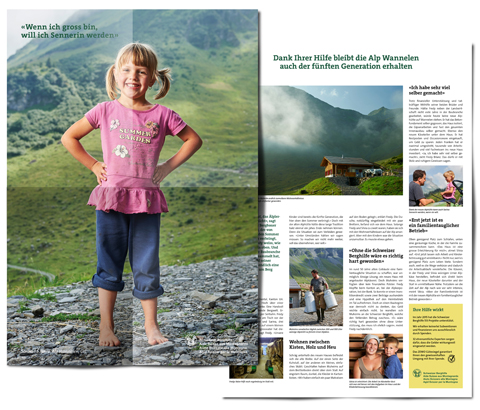
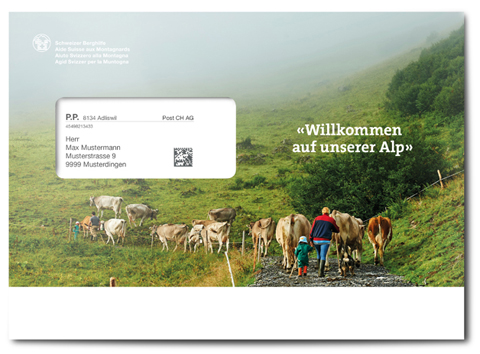
Exxtra created a fundraising email campaign for Swiss Mountain Aid. The campaign centers on five-year-old Sarina.

Only revitalized mountains are well cared for mountains. That is why Swiss Mountain Aid supports projects that improve the living conditions and future prospects of the mountain population.
For example, the Muheim family of mountain farmers was able to build a new alpine hut with its own cheese dairy on the Wannelen Alp in the canton of Uri. It was this conversion that made the farm suitable for families: the hard day-to-day work has become easier and the farm is now also well positioned for the fifth generation. After all, five-year-old Sarina, who features prominently on the cover of the current donation mailing, would perhaps one day like to follow in the footsteps of her great-great-grandfather, who acquired the alp in 1913 - and become a dairymaid.

Berghilfe-Mailing-2016-02-17-t

With the support of donors, nothing stands in the way of this career aspiration - and the Swiss mountains will continue to be managed in the future by dedicated people who have the Älpler lifestyle in their blood from an early age.

Berghilfe-Mailing-2016-02-17

Responsible at Swiss Mountain Aid: Rudolf Streuli (donations), Ivo Torelli (communication). Responsible at Exxtra (Member of Y&R Group Switzerland): Christoph Hänsli (AD), Julia Brandstätter (text), Edi Walker (consulting); Yannick Andrea, (photography), Beat Wirz (text).

Christian Greder becomes partner of Medianovis

Christian Greder, member of the management board of Medianovis, is now also a partner of the consulting firm for content marketing and corporate media.

The former business journalist has been Head of Journalism at Medianovis since 2015 and supports clients in the development and implementation of multimedia content strategies. "Christian Greder's broad communications expertise has made him an excellent addition to the team. We are delighted that he will also be taking on entrepreneurial responsibility in the future," explains René Grossenbacher, Chairman of the Board of Directors and founder of Medianovis. At the same time, Medianovis is strengthening its Board of Directors with Rudolf Greder. According to the press release, the former CEO and founder of the dental trading company Unor will significantly expand the company's expertise and network of contacts in the industry and medtech sector.

With Havas Worldwide Genève, Geneva Animal Welfare continues to look to the future

Abandoned animals often have a difficult past. But above all, they have a future. That is the message that the Geneva animal welfare organization SPA Genève aims to convey in its campaign, in collaboration with Havas Worldwide Genève.

The campaign launched last year is now being followed by the second phase, in which Geneva Animal Protection is showcasing its successes. Since the start of the campaign last summer, people who had adopted an animal from Geneva Animal Protection were able to send in a photo of themselves and their animal to be featured as an illustration on a tarot card. The idea was very well received and Geneva Animal Protection received many photos, some accompanied by moving stories. To convince those still hesitant to adopt that adopting an animal can be a wonderful story, all the pictures and stories were published on the Website of the SPA Genève were published. In a competition, three pairs were selected from the many entries to be depicted as illustrations on tarot cards. These three tarot subjects can now be found again in the continuation of the print and poster campaign.

Havas_Geneve_SPA_Geneve_Dog
Havas_Geneve_SPA_Geneve_Cat
Havas_Geneve_SPA_Geneve_Rabbit
Havas_Geneve_SPA_Geneve_Web

Responsible at Havas Worldwide Genève: Gabriel Mauron (Creative Director), Thibaud Genevois (Copy writer), Pierre-Olivier Gardello, Simeon Brandner (ADs), Caroline Prince (Consulting), Alexis Mouthon (Strategic Planning). Illustration: Yeaaah! Studio. Photo processing lithography: Scan Graphic. Media Agency: Mediatonic.
 

Voting campaigns support advertising spending in January

The upcoming referendums have led to stable advertising spending in January. While many companies cut back on their advertising spending compared to the same month last year, more money was invested in political campaigns due to the referendum campaigns.

819'100 francs were invested in campaigns for the renovation of the Gotthard road tunnel, 55 percent of which went to the Yes campaign. This was reported by the market research institute Media Focus on Tuesday. In the referendum campaign around the enforcement initiative, 737'400 francs were put in January. Here, however, a stronger imbalance between opponents and supporters is evident: two-thirds of the expenditure was spent on the Yes campaign. In total, advertising worth 327.4 million francs was sold - but discounts are not included in this figure.

Advertising pressure thus declined by 0.3 percent compared with January 2015, according to the market research institute Media Focus. In ten sectors, advertising pressure was down on the previous year. Less advertising was seen above all in the construction, industry and furnishings sectors. But companies also spent less on advertising food, finance and other services. On the other hand, smaller industries spent more money on advertising, according to the communiqué. For example, advertising spending in the transportation, cleaning, media and tobacco industries skyrocketed. Media Focus' advertising statistics cover all brands and products advertised in the Swiss advertising market in print, television and radio, as well as on digital channels. (SDA)

csm_Grafik_Gesamtmarkt_Werbedruckentwicklung_Januar_2016_b790117889
Advertising print in the overall market: Development of advertising print as of January 2016

csm_Tabelle_Gesamtmarkt_Werbedruckentwicklung_Januar_2016_97ba0562e7


Federal votes of February 28, 2016

The Political Campaigns product group shows a striking increase of 180 percent. This massive increase is due to the upcoming federal vote on February 28, 2016.

Unbenannt-3_125

Gotthard road tunnel refurbishment

The largest advertising print was recorded in January with 0.81 million gross francs for the popular initiative for the renovation of the Gotthard road tunnel (officially: amendment of September 26, 2014 to the Federal Law on Road Transit Traffic in the Alpine Region). Exactly 55 percent of the advertising pressure for this initiative can be attributed to the Yes campaign and 45 percent to the No campaign.
 

Tabelle_EidgenoessischeAbstimmungen_Gotthardtunnel_Ja_Nein

Enforcement Initiative

In second place among the top 2 in the referendum campaign is the enforcement initiative (officially: popular initiative to enforce the deportation of criminal foreigners) with a gross power print of 0.73 million gross francs. In the case of the enforcement initiative, 66 percent of this amount can even be allocated to the Yes campaign. Only 34 percent of the advertising pressure was on the No side. It will be interesting to see whether the distribution of advertising is reflected in the outcome of the vote.

Tabelle_EidgenoessischeAbstimmungen_Durchsetzungsinitiative_Ja_Nein

Top 10 of the month

The top advertisers and most advertised products and services (excluding assortment and image advertising) in January 2016.

csm_Tabelle_Top10_Werbetreibende_Produkte_31d54facd8

Publishers' association files suit against planned advertising alliance

The Swiss Media Association is stepping up pressure against the planned advertising alliance between Swisscom, SRG, and Ringier. Because the Federal Office of Communications (Bakom) has refused to grant access to the contract, the publishers have now taken legal action.

The Association of Swiss Media and other private media have filed a complaint with the Federal Administrative Court, court spokesman Rocco Maglio told news agency SDA on Tuesday. Maglio confirmed corresponding reports from 24 Heures and the Tribune de Genève. The three companies SRG, Swisscom and Ringier had announced in August 2015 that they would market their advertising in print, online, TV and radio in a joint company in the future (more on the topic). Thanks to the Swisscom data, Allianz will be able to offer advertising tailored to target groups.

National Council strengthens publishers' backs

The Publishers Association is vehemently opposed to the joint venture. In its view, it jeopardizes media diversity in Switzerland and leads to an uneven playing field in the industry. However, the publishers are leaving a loophole open: if Bakom were to make the documents relating to the proceedings available to them, the association would withdraw the complaint, Maglio added. When asked, a Bakom spokeswoman explained that the question of who would be given access to the documents was currently being investigated. In principle, however, this was limited to involved parties, she said. Bakom had, however, consulted the individual industry players. The publishers are receiving support from the National Council's Commission for Transport and Telecommunications. Among other things, it recommends that the Federal Council include the private media companies in the procedure for SRG's participation. They should also be given access to the documents relating to the procedure.

Waiting for Bakom investigation

For the time being, however, SRG is not allowed to use the new joint advertising platform. To avoid being presented with a fait accompli, Bakom has issued a precautionary measure. The ban applies until the conclusion of the supervisory procedure, but no later than March 31, 2016. The Bakom investigation concerns the question of whether SRG's participation in the advertising alliance impairs SRG's programming mandate or significantly restricts the scope for development of private publishing houses and media providers. If Bakom finds this to be the case, it can propose specific conditions for the SRG to the Federal Department of the Environment, Transport, Energy and Communications (DETEC). The Competition Commission already approved the joint venture without conditions in December. (SDA)

Stämpfli: New Head of Marketing Communications

Tamara Katja Frast is taking over the PR and marketing communications departments at Stämpfli in Bregenz. The goal is to successfully build the brand for the newly rebranded e-business specialist.

The 41-year-old completed a university course in public relations at the University of Vienna. Her last professional station was Kununu, where she was Head of Corporate Communications and responsible for the overall appearance of the portal. Born in Vienna, she has held leading positions in the communications industry for over 20 years.

Frast

Thanks to her extensive professional experience and her passion for social media, she applies offline and online measures equally, depending on the objective. Frast is looking forward to her new role: "The digital revolution is changing society as a whole. Companies are faced with the challenge of making as much information as possible available on all channels. Stämpfli offers the necessary tools and know-how for this. As a PR specialist, it is therefore important to me to present solutions that ensure efficient communication for print and digital." Frast succeeds Katharina Götz, who is going on maternity leave.
 

"Puls" presenter Corinne Waldmeier leaves SRF

Corinne Waldmeier has been hosting «Puls» since August 2011. After nearly five years, she will host the health magazine for the last time on June 6, 2016, and will then leave SRF.

Corinne Waldmeier began her journalistic career in 1998 at Zurich's Radio Z. After four years at Morgenstimme, she switched to the television industry, where she worked as a presenter, editor and producer for various TV formats on TV 3, various regional stations and for SAT.1 Switzerland. Corinne Waldmeier moved to "Puls" as editor and presenter in August 2011 and will be leaving the health magazine show and SRF this summer.

Unbenannt-3_123

Corinne Waldmeier: "I enjoyed working at "Puls" for almost five years. But now the time has come for me to change direction. I'm looking forward to new challenges." Corinne Waldmeier's successor at "Puls" will be decided in the coming months.

get_footer();