Last but not least: Brain cap, turquoise

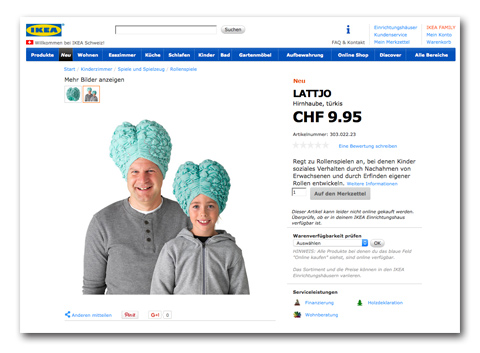
IKEA now carries the «Lattjo Hirnhaube» in its product lineup. And in doing so—no doubt by design—is causing some confusion.

"Encourages role-playing in which children develop social behavior by imitating adults and inventing their own roles." Thus describes Ikea Sense and purpose of the turquoise "brain hood", which the furniture giant recently added to its range worldwide. Also in Switzerland, available for just under ten francs.

Unbenannt-25_17
Unbenannt-25_18
Unbenannt-27_13

The brain cap, which seems a bit confusing at first, is part of the Lattjo series, which Ikea has been using since last November to encourage people to play. "This collection is intended to encourage young and old to play more with each other - preferably anywhere and anytime. It doesn't matter if you're 7 or 97 years old," Ikea wrote. The brain cap can already be seen in the four-and-a-half-minute promotional video released at the time. 

Whether Ikea's new product is really primarily about boosting role-playing games may be doubted. "The real target group seems to be party-hungry hipsters from the underground clubs of Berlin and the bratwurst stalls of the Ruhr region," suspects, for example, the Berlin Morning Post. The Berlin courier is overwhelmed with the abstract headgear and assumes it is a bathing cap: "Why children should play Mr. Super Smart in the bathtub, however, is somehow still not entirely clear to us..."

And the strange headgear is also spreading more and more on social media - mostly accompanied by incredulous comments. A lot of free attention - and presumably a lot of sales at the points of sale. Ikea just knows how to do it. (hae)
 

Netflix: Jerky trouble for Swisscom customers

Netflix customers who receive their signal via Swisscom have recently been increasingly struggling with poor picture quality. UPC Cablecom also had problems with the Netflix signal - but these have been resolved.

Swisscom confirmed to Schweiz am Sonntag that there has recently been an increase in negative customer reactions regarding the transmission of the US online service Netflix: stuttering and picture interference are spoiling the fun of the series.

However, the Swisscom network is not to blame for the poor picture quality. When Netflix launched in Switzerland in September 2014, the data was transmitted to Swisscom via DT's networks. In August 2015, Netflix terminated the contract for direct transmission with DT. Since then, DT has obtained the signal via transit providers such as Level 3 and Cogent and then forwards it to Swisscom. Cogent in particular is said to be known for overbooked capacity - traffic between Cogent and DT is said to be at its limit.

The solution to the problem would be a direct connection between Netflix and Swisscom. According to Swisscom, negotiations were held in this regard, but "did not lead to a result due to commercial considerations", as a Swisscom spokesperson explained to Schweiz am Sonntag. However, the company is in contact with Netflix to discuss improvements.

UPC Cablecom also had the same problem. However, the cable giant was able to resolve the problem by improving the connection between Netflix and its parent company Liberty Global in Amsterdam. (hae)
 

How to win the hearts of customers in digital business

Creating a positive impression of their brands and products through digital interactions with customers and prospects is a key factor for success today. Digital business expert Arithnea explains how companies can achieve this in practice.

In view of the general sensory overload and sheer endless choice, emotionalization is a decisive success factor for companies today. If they succeed in positively charging their products and brands, they can set themselves apart from the competition, win new customers more easily and retain existing ones. In addition, positive emotions towards a brand significantly increase the likelihood that it will be recommended to others.

This is why emotionalization should not stop at advertising. Companies should also aim to generate positive feelings on all channels through which they communicate with their customers and prospects. Arithnea names five steps to emotionalization in digital business.

1. focus on images and videos: If a company wants to appeal emotionally to visitors to its online store or its company and brand websites, it is of course not enough to simply present them with functional product features. The first step towards emotionalization is therefore the use of images and videos. They are ideally suited to arousing positive feelings, for example by showing what wonderful experiences are possible with a product or what positive reactions you can trigger in your environment.

2. frame products with storytelling: Ideally, the images and videos are part of a comprehensive "storytelling" in which authentic and coherent texts are used to convey that the products not only have certain technical features, but also bring joy and fun. For example, they can explain what the "fun factor" of a particular item of clothing is, how a piece of furniture can be ideally staged in a home or what other benefits an entertainment system has that you might not even think of at first.

3. offer only relevant content: Even the most emotional images and authentic stories have no effect if they are not relevant to the individual website or store visitor. That's why they need to be specifically adapted to the user. To do this, companies should firstly analyze which digital channels the various target groups prefer to use and align their content accordingly. However, they should also further personalize their content within the channels by identifying the needs of their visitors and then playing out the appropriate content.

4. use AR/VR applications: Augmented and virtual reality applications are the ideal way to bring brands and products to life digitally. They allow customers and prospective customers to take a tour of the store from the comfort of their own sofa, examine a potential new chest of drawers in their living room or virtually try on an item of clothing without having to make the inconvenient journey and search for a parking space - and thus create a particularly positive experience with the company.

5. support customer engagement: Another good way to emotionally bind customers and interested parties to your brand is to enter into as personal a relationship as possible with them. To do this, companies can offer them the opportunity to enter into dialog via channels such as Facebook and Twitter, to give their feedback and possibly even influence the further development of the brand. However, if a company decides to take this step, it must also use these channels continuously and promptly - otherwise the exact opposite effect will occur.

"Studies in the field of neuromarketing show time and again that purchasing decisions are largely made unconsciously and are significantly influenced by emotions. Those who win hearts also win customers," says Nico Rehmann, Chief Sales Officer at Arithnea in Neubiberg near Munich. "That's why companies should do everything they can to positively charge their brands in digital interactions with their customers and prospects."

Arithnea advises companies on their market strategies, creates brand worlds and develops integrated IT solutions. In this way, Arithnea creates holistic customer experiences across all communication channels and national borders. The company employs over 200 people, is headquartered in Neubiberg near Munich and has offices in Bremen, Dortmund, Frankfurt, Jena and Stuttgart. The company is part of a partner network and is a partner of Adobe, E-Spirit and SAP Hybris, among others.

Image: Clownbusiness - Shutterstock, Inc.

Walker: Flyboard Fishing for Fisherman's Friend

In the Arctic, rugged fishermen use an Aqua Flyboard to demonstrate the strength of Fisherman’s Friend in a refreshing TV commercial by Walker.

The Zurich agency Walker has created the new spectacular advertising presence for Fisherman's Friend #FlyBoardFishing, which went on air these days. The video, produced by Cobblestone Hamburg, was commissioned by Germany, Switzerland and England. It tells the legendary strength of Fischerman's Friend with an extraordinary story.

In the icy waters of the Arctic, a pithy bare-chested fisherman skillfully jumps over icebergs on a flyboard. He then dives dolphin-like in the Arctic sea in search of his prey. The fascinating sounds that accompany his movements are surprisingly produced by a second fisherman aboard a fishing boat. This gray, old sea bear blows into a long pipe and thus provides his mate with the necessary steam. Thanks to his strong lungs, a fish lands on the ship as a trophy a short time later.

IMG_4162
Photos: ZVG

The film was shot on Mallorca in 40 degree sweltering heat with hydroflight athlete Lindsay McQueen in the role of the second fisherman under the direction of Axel Laubscher. The sound design was created by Wave Studios in London. The film's pan-European production ultimately ended in Sweden, where the icebergs were integrated by Important Looking Pirates, a studio specializing in visual effects.

IMG_4182

The spot will be seen on TV on channels such as RTL, Pro7, Vox, SAT1 and MTV, as well as a YouTube preroll and on Facebook. On the client side at Fisherman's Friend, Chris Gibson (UK), Michael Geiseler (Germany), Philippe Bessire and J.Y. Cuendet (Switzerland) are responsible. On the agency side, Pius Walker as CD and Roger Beckett as copywriter created the new TV coup.

Walker won Fisherman's Friend in an agency evaluation a year ago (Werbewoche.ch reported). This is the first work for the new client of Pius Walker and his team, which made headlines around the world as recently as Christmas with the touching dementia spot "Grace" for Ifolor (Werbewoche.ch reported).

More on the current Fishermen's Friend campaign in the upcoming Print edition the advertising week.

Cicero: Symbolic price, Frank A. Meyer stays

Ringier has sold its German magazines Cicero and Monopol. The new co-owner, Alexander Marguier, explains the background to the management buyout.

Ringier: Management buyout of Cicero and Monopol in Germany

As editor-in-chief and new owner Alexander Marguier told the portal Kress.com reveals, the management buyout was not initiated by Ringier, but had its origins in an inquiry from the editor-in-chief to Michael Ringier as to whether he would be willing to transfer commercial responsibility to Marguier and his deputy Schwennicke. "We had good ideas. Our goal was to have a more direct influence on Cicero's commercial development as well, without the detours via Zurich." Later, Marc Walder asked the two if they could "imagine even more.

Unbenannt-8_98

Marguier is happy about the new situation: "It's optimal when such enthusiast papers are made commercially and editorially from a single source." As a small publisher, he now has a better view of the business than was possible "from far-off Zurich.

Accordingly, he is confident that Cicero and Monopol can finally be made profitable - although Ringier says it has never succeeded in the last twelve years. Vis-à-vis Horizon.net he explains how this could change: "We save all the overhead costs of a major publisher." The decisive factor, he says, is the revenue side - where, in addition to the Berlin "Cicero Foyer Talk," the company is focusing on new event formats in other cities. And on the new marketer IQ Media, which saves the entire five-person advertising department. Ringier has agreed not to disclose the purchase price. According to Marguier, however, it will be more of a symbolic nature.

The Ringier-affiliated publicist Frank A. Meyer will continue to write for the titles. Marguier told Horizont.net, "FAM can be exhausting, but he's an intellectual asset, a feisty, brilliant mind with incredibly good contacts." (hae)
 

Stämpfli launches online customer magazine for BEKB

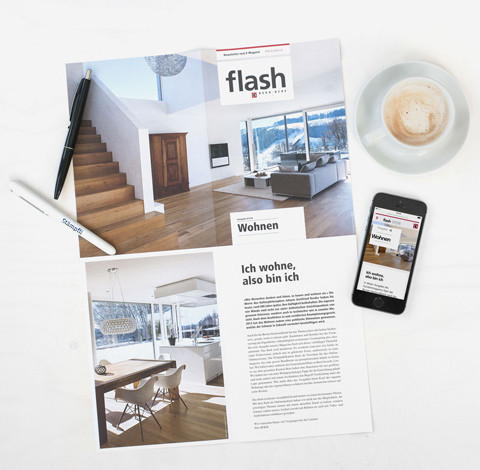
Until now, Berner Kantonalbank has kept its customers informed of the latest news through a six-page print publication. Starting this year, the customer magazine is now also available as an online publication. Stämpfli Kommunikation is behind this change.

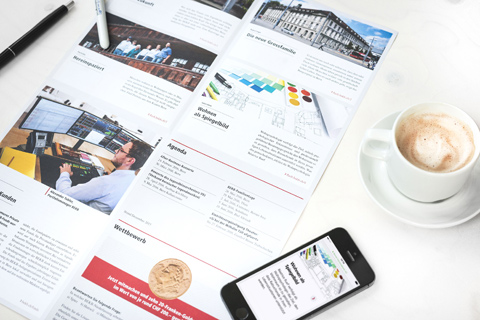
The customer magazine called "flash" of the Berner Kantonalbank BEKB has got a new and above all virtual face. A six-page print folder has been transformed into a Online magazine which deals not only with BEKB-specific topics but also with social issues. Editorial responsibility is borne by Stämpfli Kommunikation. "An inconspicuous product has developed into one that is as exciting as it is diverse," emphasizes Karl-Martin Wyss, Head of Marketing at BEKB. In addition to editorial responsibility, Stämpfli Kommunikation is significantly involved in the conceptual reorientation. The magazine is published quarterly together with an online and a print newsletter, each on a specific topic - the printed newsletter is produced entirely by Stämpfli.

BEKB-flash
BEKB-flash-2
 

Republica: The legend Mappamondo returns

Republica was commissioned by Sportgastro to create a typographic design celebrating the reopening of the Mappamondo restaurant. In staging the return of this Bernese institution, things were turned upside down—in the truest sense of the word.

In January, the cult restaurant Mappamondo at Länggassstrasse 44 celebrated its reopening - under the new management of Sportgastro. Republica was responsible for developing the CI/CD for the relaunch. Under the motto "Mappamondo, the legend returns", the return of the legendary restaurant was implemented typographically with words mirrored backwards. The idea behind it: When a legend returns, pasta, pizza, vino and sugo also return - and logically backwards.

Republica_Mappamondo_Zurueck_Alle-Postkarten_20160219

The play on words Atsap, Azzip, Oniv and Ogus were combined with illustrative depictions of the four seasons and typical Italian motifs that emphasize the seasonality of the Piedmontese cuisine at Mappamondo. As part of the campaign, advertisements, postcards, menus, the website, the murals inside the restaurant and the exterior signage were designed. On the occasion of the premiere of "Star Wars", audio spots were also produced that emphasized the return of the legend and the "power of Piedmontese cuisine" with a wink.

Republica_Mappamondo_Zurueck_Postkarte_1_Atsap_20160219
Republica_Mappamondo_Zurueck_Postkarte_2_Azzip_20160219
Republica_Mappamondo_Zurueck_Postkarte_3_Ogus_20160219
Republica_Mappamondo_Zurueck_Postkarte_4_Oniv_20160219

Responsible at Sportgastro: Sven Rindlisbacher, Managing Director. Responsible at Republica: Linda Berger (consulting), Aline Windler (graphics), Marge Fellerer (creative direction), Mike Krüll (creative direction, concept, text), Bala Trachsel (overall responsibility).
Link to the image material http://bit.ly/1SUykdo Links to the radio spots http://bit.ly/1or0cIJ / http://bit.ly/1SUgyHj
 

Gender and education influence recommendation behavior on the social web

Webguerillas and the Macromedia University of Applied Sciences have analyzed a study on influencers in Germany socio-demographically and show:Two socio-demographic characteristics significantly shape the recommendation behavior of influencers: gender and education.

Female influencers communicate differently on the social web than male influencers. Women like their favorite messages and share them in their network, while men tend to write more posts and comments. The level of education also plays a significant role in one's own communication: Multipliers with a degree post more of their own content than those with less formal education. In terms of age, young adults between 25 and 34 dominate. These are the two core findings of a recent evaluation of the study "Brand Recommendations in Social Media" by Macromedia University and Webguerillas. A representative online survey of 2,000 respondents between the ages of 18 and 65 was used to examine recommendation behavior in social media.

An influencer in social media is someone who has made a brand recommendation or a negative brand statement via social media at least once in the last six months and who is also particularly well connected on the social web, has above-average brand awareness and a reputation as a market expert. Influencers include around nine percent of 18 to 65-year-olds in Germany - that's 4.6 million people. The average influencer is over 35, male and has a university degree. The most popular platform in this group, which is so sought-after by the advertising industry, is Facebook; 95 percent use it daily. It is followed by blogs and forums (93 percent) and YouTube (81 percent). Twitter (59 percent) comes in a distant second.

PM_Influencer_Durchschnitts-Influencer

Men stage themselves more strongly than women on the social web

"Women and men live out their expertise on the social web in markedly different ways," explains Prof. Dr. Dr. Castulus Kolo, scientific project manager and dean of the Macromedia University of Applied Sciences, "Men are more extroverted here and more keen to shape opinions, while women act more subtly - and this applies to all major platforms. On Facebook, for example, 66 percent and 63 percent of male influencers comment and post regularly. For women, the figures are 56 percent and 42 percent, respectively. When it comes to liking and sharing Facebook content, women are again slightly ahead - with 75 to 71 and 69 to 63 percent respectively. A similar picture emerges for blogs and forums: men tend to write more of their own posts (53 vs. 49 percent) and comment more often (68 vs. 62 percent). The same applies to YouTube: Every second male, but only every third female influencer regularly comments on videos.

PM_Influencer_m-vs-w

The higher the level of education, the more content the user produces.

Influencers with a university degree are the most active on all the platforms surveyed. On Facebook, the differences are particularly clear: 52 percent of influencers with a university degree regularly post their own content - among influencers with only an education, secondary school diploma or high school diploma, the figure does not exceed 33 percent. Accordingly, influencers with a university degree participate most on blogs and forums: 71 percent write posts about their favorite brands, 82 percent comment on the posts of other users. For influencers with only a Mittlerer Reife /Abitur, the figures are 32 and 43 percent, respectively. The figures for influencers with only vocational training are also significantly lower than those for academics. Influencers with a university degree are also significantly more active on YouTube, with 58 percent of influencers with a university degree uploading their own videos, but only 33 percent each of those with an education or Mittlerer Reife/Abitur.

"Influencers are not a homogeneous group; they are fundamentally different. Just looking at the socio-demographic criteria shows how big the differences can be. Accordingly, influencer marketing must be designed in a differentiated way in order to fully exploit the interactions between product/brand, influencer and platforms," says David Eicher, CEO of Webguerillas.


New management structure at OMD Switzerland

Georges Bérard, 50, managing director of OMD City, will be leaving the agency after twelve years at his own request to pursue new opportunities.

Stefan Burgass, CEO of Omnicom Media Group Switzerland: "I regret Georges Bérard's decision to leave the agency. However, I can well understand that after twelve years he is taking time out to reorient himself. He has contributed a great deal to the positive development of the agency in recent years. We will use his departure as an opportunity to streamline OMD's management structure in line with our client-first strategy."

The current North, Sea and City units will be restructured and OMD will in future be headed by the two managing directors Markus Bettler and Christjan Esch. In addition, the Client Service Director level will be established to ensure an even more intensive focus on strategic customer consulting.
 

HWZ: Marcom Suisse takes over patronage for CAS

Another patronage partner has been acquired for the CAS Marketing Communications course at the HWZ: Marcom Suisse joins the existing partners Leading Swiss Agencies and SWA Schweizer Werbe-Auftraggeberverband.

As Stefan Vogler explains, this will anchor the marketing communication course at the Zurich University of Applied Sciences HWZ even more firmly in the Swiss marketing and communication industry. The management consultant for branding, marketing and communication, who has been in charge of this course since summer 2015, says: "Both leading associations are already on board and recommend our course to their members. With Marcom Suisse, an association of marketing executives is now following suit."
 

Criteo study: Mobile shopping is booming in Switzerland

Criteo released the «Q4 2015 State of Mobile Commerce Report» on Thursday. The study shows that four out of ten purchases are made across multiple devices. Nearly one-third of these purchases are completed on a mobile device.

The technology company for performance marketing conducts the "Q4 2015 State of Mobile Commerce Report" on a quarterly basis. Criteo examines mCommerce trends and offers insights into the shopping behavior of users. The report is based on 1.4 billion online transactions worldwide.

Mobile shopping is booming for online retailers

Online retailers with a good mobile experience achieved good sales results in 2015 and were able to attract mobile users as buyers. A good mobile marketing strategy addresses the wishes and needs of users across all end devices:

- In the fourth quarter of 2015, mobile transactions accounted for 33.2% of all eCommerce transactions in Switzerland.

- For leading online retailers in Switzerland, almost half (48.7 percent) of transactions were made via mobile devices.

The combination of better transaction options, accessibility, larger screens and fast wireless broadband offers online retailers the opportunity to better present their products on mobile devices and ultimately generate more transactions.

- 19.3 percent of Swiss people used a smartphone and 13.9 percent a tablet for mobile shopping.

- Compared to Germany and Austria, more iOS devices (24%) than Android devices (9.2%) were used for online purchases in Switzerland.

- The value of the goods compared to the desktop was 85 percent.

Cross-device use continues to increase

More and more customers are using multiple devices during the purchasing process. Understanding the buying behavior, influence and intent behind it are essential components of engaging users during their cross-device journey. For brands to be successful, they need to focus heavily on the user.

- Around 40 percent of all transactions worldwide were generated across multiple devices or channels in the fourth quarter of 2015.

- 37 percent of desktop users have visited the online retailer's website via another device at least once before making a purchase.

- 43 percent of users who make their purchases via a tablet use multiple devices in their purchasing process.

Apps generate sales

Shopping apps put the mobile web in the shade. They perform significantly better in the purchasing process - from research to completion of the purchase.

- Those online retailers whose apps focus on simply presenting relevant products to customers achieved 54 percent of all mobile retail transactions.

- Users view 286 percent more products in mobile apps than on the mobile web, which in turn led to a 90 percent higher shopping cart rate than on the mobile web.

- The general conversion rate for apps was 120 percent higher than for the mobile web in the fourth quarter of 2015.

Global mCommerce growth continues unabated

The share of sales via mobile devices in eCommerce transactions is also growing steadily worldwide, led by Japan, the UK and South Korea. As users primarily use their smartphone as their device of choice for purchases, international brands must ensure that their mobile marketing strategies are in line with user behavior:

- mCommerce accounted for 35 percent of global eCommerce sales in online retail.

- 50 percent of all global eCommerce transactions were carried out across devices.

You can find the full results of the Criteo Q4 State of Mobile Commerce Report here here.


Jenni Herren new at Radio 24

A new host is joining the team at Radio 24. Jenni Herren, from Bern, previously worked at SRF and is now joining the Radio 24 hosting team.

Jenni Herren will host "Ufsteller" for the first time this Saturday. With this commitment, the private broadcaster is expanding its team of presenters with another female voice. "Jenni Herren will host various shows in our daytime and weekend programming. We were looking for a symphatic female voice that we can use broadly. I am very happy to hear Jenni on air with us," says Jan Müller, head of moderation at Radio 24.

Jenni Herren previously worked at SRF as a presenter of the children's magazine "Zambo". Before that, she was at Radio BE1 and Radio 32, where she hosted the ratings-relevant morning show. "I am excited about the new challenge. Radio is my great passion! I'm thrilled that I'll be able to live it out at Radio 24 in the future," says the 32-year-old Bernese.
 

get_footer();