Sunrise expands cooperation with Whatsapp

Starting March 1, 2016, WhatsApp will be included for all Sunrise Freedom subscribers in Switzerland without using up their data allowance. Does this partnership constitute a violation of net neutrality?

Sunrise entered into a cooperation agreement with Whatsapp back in spring 2014. Since then, Whatsapp messaging data has been included in all MTV mobile Freedom subscriptions for the youth segment under 30 years of age. In the future, the data volume caused by the use of the app will no longer be deducted from the high-speed data volume of all Sunrise Freedom subscriptions, as Sunrise announced in a statement on Friday. 

Violation of net neutrality?

Advocates of a strict interpretation of net neutrality )such as the digital society Switzerland) see the cooperation with Whatsapp as a violation of network neutrality, as Sunrise treats data on the network unequally and puts alternative messaging services at a disadvantage. Over time, they fear, no more independent innovative services will emerge.

In contrast, the arbitration board for network neutrality, which was founded by the cable operators at the end of 2015, provides, according to its code of conduct (Werbewoche.ch reported) only stipulates that network providers may not block services. Offers tailored to customers are to be permitted. There has not yet been any legal regulation of network neutrality. (sis)


Last but not least: Feasting against hunger

An Australian NGO uses a creative approach to highlight the connection between our food and hunger in Africa.

In the past, children were often reminded of the hungry people in Africa when they didn't want to finish their plates. Many a child probably wondered what the one had to do with the other: What good will it do the people in Africa if we eat more here?

McCann Sydney has now launched a meaningful campaign that links feasting in Australia with hunger in the third world without pointing a finger - and ensures that one actually benefits the other: A Table to End Hunger.

The initial situation: In Australia, there are countless people with a great appetite for good restaurants. They are often confronted with the (luxury) problem of finding a free table at the last minute, especially at the weekend.

The Hunger Project ensures that some tables in Australia's top restaurants remain free and are auctioned off to the highest bidder at short notice. The proceeds will benefit people in the developing world. (sis)
 

Journalists' associations insist on CLA

German-speaking journalists' associations are calling for good working conditions and protection for journalists. They view collective bargaining agreements (CBAs) as the best way to ensure this, but such agreements do not exist in German-speaking Switzerland or in Ticino.

Around 20 representatives of journalists' associations and trade unions from Switzerland, Germany and Austria launched the "Bern Appeal" in Bern for good working conditions and a strengthening of public service in the media. This was announced by the Syndicom and Impressum unions on Friday.

The media must be strengthened in their role as "watchdogs" of democracy. Secure employment conditions, anchored in collective bargaining agreements, would allow media professionals to concentrate on their work and fulfill their role in democratic society.

CLA issue not off the table

The association representatives exchanged views on work situations and contractual conditions. There has been no CLA in Swiss German publishing houses for more than ten years. But the issue is not off the table: In September, the Swiss Media Association commissioned a working group to submit a contractual framework to the Executive Board.

Stephanie Vonarburg of Syndicom told SDA on Friday that there was no date yet for talks with the publishers. She added that the associations were in the process of preparing themselves and formulating their expectations and needs.

Andreas Häuptli, managing director ad interim at the Swiss Media Association, said it was still open whether negotiations would take place this year. The members would decide whether to enter into negotiations.

While Western Switzerland has a CLA for media workers, Vonarburg says Ticino is also without one. There are also collective labor agreements in Germany and Austria.

DSI is a de facto disenfranchisement initiative

Another topic at the meeting was the SVP's enforcement initiative, which will be voted on February 28. The association's representatives fear that journalists without Swiss citizenship would risk deportation with this "de facto disenfranchisement initiative" by conscientiously exercising their profession. (SDA)
 

On our own account: Werbewoche relaunch

After the summer break, Werbewoche will be published in print and online in a relaunched form. In an interview with Seiler's advertising blog, editor-in-chief Anne-Friederike Heinrich gives a brief insight into what is currently being worked on.

"Advertising Week is going mobile. But the design and operation of our trade magazine will also be more modern and contemporary. But much will remain the same: high-quality, well-written background information about the industry, for example."

You can find out more about what awaits the readers of Werbewoche at Seiler's advertising blog.

Teaser image: Seiler's advertising blog

To the point: from the eye straight into the heart

The question of what journalists are allowed to publish, when, where and how is once again the subject of public debate. A terrible train accident has occurred in Bad Aibling, Bavaria, in which ten people lost their lives.

Anyone who learns of such a tragic event usually wants to know exactly, as quickly as possible: What happened? How could this happen? Have people been injured or even died? Are there pictures of the accident that make it possible to imagine what happened there?

This has nothing to do with sensationalism or perverse ambitions, but with the curiosity of people who want to know about what is happening in their environment; who allow themselves to be touched by the suffering of other people, who empathize, mentally replay events for themselves in order to understand them - and who, in normal cases, are probably also glad that the same thing did not happen to them.

In this process, images are of great importance. They allow the viewer to experience facts and circumstances directly, transporting information from the eye directly to the heart without the detour via the brain.

"ARD-aktuell" answered some of its viewers' pressing questions about the Bad Aibling accident with extensive reporting, including a ten-second video sequence from inside one of the crashed regional trains, filmed by a person affected by the accident (Werbewoche.ch reported).

Why does someone sitting on a train who has just had a serious accident, who is perhaps bleeding, who has hurt himself, film what he sees? Because at that moment he thinks, "I'll sell this to ARD!" or "I'll make a viral hit out of this"? Or because the reflexive reach for the smartphone at that moment helps him to remain calm, to build up a distance to the event and to understand what has happened? It's the same process that takes place later in the viewer's mind from the other direction.

I have two small sons. And I have looked at the picture of the refugee boy Aylan, who was washed up dead in Bodrum last year, countless times. Why do you think? Out of sensationalism? Certainly not! Out of a thirst for knowledge? Also not. I felt physically sick at the sight of the little dead man and I could hold back the tears with difficulty. I felt great sorrow, grief, compassion - but also gratitude. For my boys being whole and alive. Call it repulsive, disgusting, to look at such pictures - that's just how we humans tick: The more unimaginable something is, the more we need images to be able to comprehend. Young people say "now I see it" and mean "I got it."

How many times have you looked at pictures of the smoking Twin Towers in Manhattan in shock, dejection, disbelief? People are jumping out of windows to their deaths and we are watching closely. Is this any different than the "Aylan case" or the amateur film of the train accident in Bad Aibling? Just because the footage shows what's happening from a distance, because you're not as close, you don't see as much? I think not. People don't necessarily have to see mutilated corpses to understand the scope and tragedy of events.

The question of what we show and what we don't show, what we look at and what we don't look at, cannot be settled in principle. The answer depends on who is watching and what is being shown. For those directly involved in an accident, such footage is almost unbearable; it deepens and aggravates the suffering, regardless of whether you see details of people or just a blurred shot of the accident site. But for people who want to inform themselves, and ultimately for investigating authorities who have to clear up an accident, pictures are important. The only limits here are those of good taste and reverence.

Kai Gniffke, head of "ARD-aktuell," decided to broadcast a ten-second video sequence about the Bad Aibling accident, cut together from six minutes of footage, without sound. No injured people are shown. Nevertheless, Gniffke was harshly criticized. Among other things, for saying that the video sequence had little information value. Of course, if it conveyed more information, Gniffke would probably have violated the rules of good taste and reverence ...

The video snippet is like a small testimony in picture form and, in the absence of a statement, has justification in the overall report. However, the film footage showing the crushed trains and the removal of corpses is far more shocking and drills into the memory. Ultimately, it is the job of journalists to make their audience understand. ARD-aktuell" succeeded in doing that.

He had to find a compromise between the information mandate and respect for the victims and viewers, justified the attacked ARD man Gniffke. He did the right thing and mastered the difficult balancing act that everyone who reports on horrific events in which people died has to do.

The only thing that gives journalists flank protection and orientation in such contortions is their own humanity.

Anne-Friederike Heinrich, Editor in Chief
[email protected]
 

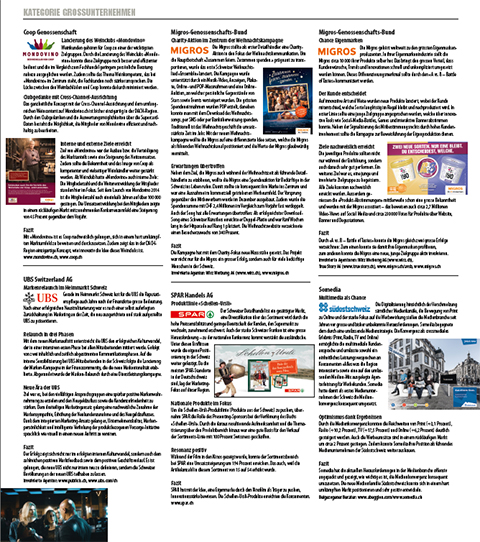
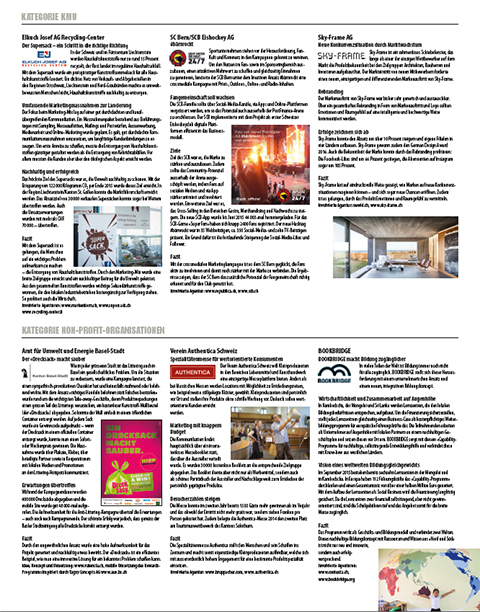
Who will win the Marketing Trophy 2016?

The nominees in the three categories—large companies, SMEs, and nonprofit organizations—have been announced. 

The Marketing Trophy is awarded every year by Swiss Marketing at the Swiss Marketing Day. This year, the interdisciplinary jury of experts, headed by advertiser and entrepreneur Peter Felser, nominated the following projects for the award:

marketingtrophy1
marketingtrophy2_0

Notch creates viral campaign for Straumann

The Zurich-based agency won a pitch and is now promoting a product innovation from Straumann with a «fabulous» and exciting online video.

The film is based on the Arthurian legend. For those who only remember darkly: the legendary sword Excalibur had been driven through a stone by the wizard Merlin and could only be pulled out again by the true future ruler. After many nobles and knights had failed in this task, Arthur mastered it with flying colors, which made him the rightful king.

In their version of "King Arthur," the creatives from Notch Interactive work with the classic elements of a fantasy film: a mystically dark atmosphere, charismatic protagonists and dramatic, specially composed music. But at the end, the film takes a surprising turn: Not even Arthur can pull the sword out of the stone. It is stuck - just like a Straumann implant is stuck in the jaw.

This punch line is intended to communicate to the target group, dentists and dental technicians, the exceptional quality of Straumann implants made of the innovative material Roxolid. This patented titanium-zirconium compound is said to be more stable than pure titanium and to shorten the healing process.

To optimally reach the target group, Notch Interactive developed an international online/seeding strategy for various social media channels. King Arthur" will be rolled out in the USA at the beginning of 2016, with other countries to follow in the course of the spring. The film can be seen exclusively in digital media and relies on a high viral effect.

Responsible at Notch Interactive: Peter A. van der Touw (overall responsibility), Jeff Gerber (Executive Creative Director), Martin Stauch (Senior Art Director), Marcel Vogt (Group Account Director), Paola Gächter (Consultant/Project Manager). Music composition: Jingle Jungle. Production: Zeitsprung Commercial.

Furrerhugi launches its own blog

Since Friday, the agency has been running a blog and newsletter on Influence.ch covering economic and social policy issues.

Under seven headings, the agency picks up on Influence.ch The magazine will address topics that are becoming important on a bi-weekly basis, according to a press release on Friday. The agency's internal editorial team, headed by Pascal Ihle, publishes analyses, summarizes relevant studies and conducts discussions with personalities who think outside the box. 

Furrerhugi wants to use the blog to help classify complex relationships in politics, business and society, to make the background understandable and to ask the right questions, it continues. In the first influence edition from today, Friday, among other things, a Interview with Valentin Vogt, 7 Responses to International Law or a Summary of the WEF study on the future of work published. 

The blog is freely accessible and the associated newsletter can be subscribed to free of charge.

Thomas Passen is not moving to Tamedia after all

Ringier's head of marketing, Thomas Passen, will not be moving to rival Tamedia after all. As recently as October, the media group had announced that Passen would be leaving to become head of the national media advertising division.

Passen should have taken up the new position at the end of 2016. However, he has now decided to become self-employed, Tamedia announced on Thursday evening.

According to the press release, Tamedia is waiving the fulfillment of the current employment contract. Thomas Passen is quoted as follows: "In recent weeks, a new opportunity has opened up for me that I do not want to turn down. I would like to thank Marcel Kohler and Tamedia for their flexibility and their willingness to accommodate the termination of our contract."

Tamedia will now announce in due course who will take over the management of the national media advertising market from the end of 2016. According to Tamedia, however, all other management positions in the future organization have been filled. 
 

Last but not least: Dedicated testimonial

Anthony Hopkins is the testimonial for the Turbo Tax software. However, he does not want to admit in this film that he is promoting the brand.

Advertising that takes the mickey out of its own mechanisms is often well received online. This commercial with Anthony Hopkins, who also stages the brand, is no exception.

From the coffee mug to the slippers to the lap dog, everything on the actor in this commercial has Turbo Tax labels on it. But Hopkins never tires of emphasizing that he is not advertising the brand. Because there is nothing to sell. (sis)
 

https://www.youtube.com/watch?v=c6T3F69oK30

The Impact Check of Werbewoche

We show how current TV commercials are performing with consumers.

Testing for some time Marketagent.com The pollsters also analyze selected posters and advertisements once a month for Advertising Week. Since the beginning of 2015, TV commercials have also been examined by the pollsters on an alternating basis. The editorial team selected five films that were frequently seen on screen in recent weeks. The commercials were shown to 461 web-active people from German-speaking Switzerland aged between 14 and 65. The survey tested how well the TV commercials were remembered by the population (awareness) and how they scored on a six-point scale in terms of the key characteristics "Likeability", "Stands out from other TV commercials" (uniqueness) and "Fits my image of this sender" (brand fit). In this article, Werbewoche presents the overall awareness values achieved and the top box ratings for the key characteristics.

Chocolat Frey spot goes well with the brand

"In Brazil, people love Chocolat Frey chocolates from Switzerland". Although the ad only ranks third in terms of unaided advertising recall (63.6%), it fits the brand very well according to respondents (38.5%). The Interdiscount ad is in first place in unaided recall (87.9%), followed by Sunrise (80.7.%). Although Microsoft performed relatively less well in unaided advertising recall (59.7%), it achieved the highest likeability score (18.7%) and the highest uniqueness score (15.8%) among respondents. The JobCloud ad also achieved a good score in the Uniqueness category (10%). The members of the Marketagent.com online access panel, which comprises around 45,700 active Swiss participants (as of February 2016), were interviewed using computer-assisted web interviews (CAWI). The online survey method guarantees anonymity and objectivity.

To the detailed results report (PDF)

The TV commercials surveyed:

impactcheck_1

New Co-Managing Director at Serviceplan

Pam Hügli assumed the role of managing director at Serviceplan Suisse effective January 1, 2016. Together with founding partner Christian Baertschi, she will be responsible for the agency’s day-to-day operations.

Hügli began her long advertising career at Advico Young & Rubicam in Gockhausen. She then moved on to Aemtlerstrasse, where she was part of the founding team of the Spillmann/Felser/Leo Burnett agency together with Christian Baertschi. There, as a consulting group leader and member of the management team, she was jointly responsible for the agency's fortunes.

Pam Hügli then took over the management of Alpha 245, which she expanded into a 25-person agency together with creative partner Diana Wick Rossi, adding entrepreneurial know-how to her already broad industry experience. Over the past two decades, Pam Hügli has managed diverse national and international brand projects - and played a decisive role in shaping many campaigns that have won awards for their creativity and effectiveness.

According to a statement on Thursday, Pam Hügli is looking forward to her new role: "My personal development opportunities in an owner-managed company were one of the decisive factors in this decision. In addition, and this was and is particularly important to me: With Christian Baertschi, I am working closely with someone I have known and trusted since I started in the advertising industry. And it's not just this companion I'll be meeting at Freiestrasse, but also others I'm very much looking forward to. The personal was and is very important to me and was the basis of many small and big successes in the past. I look forward to playing my part in the success of the Serviceplan Group."

get_footer();