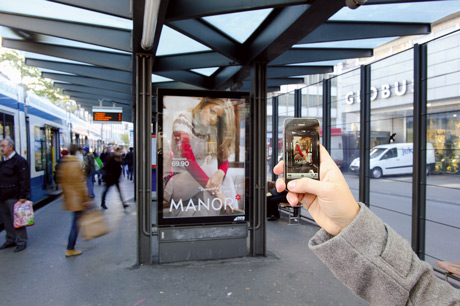
This article comes from the current print edition of Werbewoche.The possibility of enriching paper with additional information that appears directly on your phone with a single tap sparks the imagination: Just think of all the things you could do with newspaper articles and potato mash packaging, with ads and posters! You can embed photos, videos, recipes, coupons, contests, links, ordering tools, and much more. Anything is possible. And that’s exactly the crux of the matter. Because implementing everything that’s possible has never been a good idea.
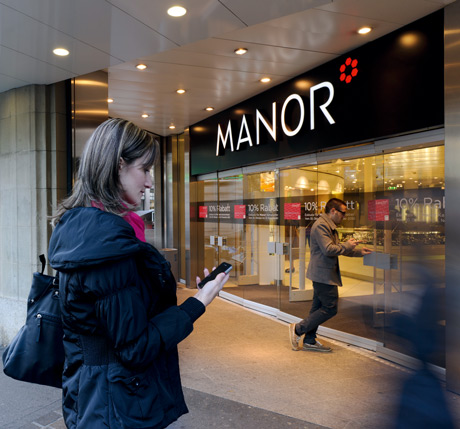
Experts such as Bruno Mettler of Vanija, Hansres Emch of LD Media, and Nicolas Adolph of APG emphasize that enriching print media with interactive content only makes sense if the additional content provides real added value to the user. In other words: Anyone who accesses the additional information behind an ad or poster on their smartphone must derive a clear benefit from it. Otherwise, they’ll take a photo of a subject exactly once—and then never use the technology again. Useful examples include a booking tool for a test drive behind an ad for the new Mini, a discount promotion behind a Coop or Migros poster, a video featuring a ski pro behind an ad for Zimtstern’s latest ski collection, a premium calculator behind an ÖKK poster, or a list of the nearest stores behind a Manor ad.
Posters with a background«We are firmly committed to the poster as a benefit-oriented mass medium,» emphasizes Nicolas Adolph, project manager at APG. «We want to identify individual mobility target groups as precisely as possible and address them in a way that meets their needs. While our business is traditionally analog—since our posters are still made of paper and are put up with glue—we nevertheless want to take advantage of the opportunities that digitalization offers us. Increasing mobility, changing media consumption habits, smartphones, and the shift in internet usage toward out-of-home settings are a wonderful development for our medium.»
However, what’s offered behind the poster or ad must not only be enjoyable and useful to the consumer—it must also align with the advertiser’s brand. And that’s exactly where the fine-tuning comes in, so that all the cogs mesh together seamlessly. To develop additional content and clever tools that are consistent in every respect, companies and their agencies need one thing above all else, in addition to ideas: time. Rushing to throw any old material behind a campaign just to have something to back it up and jump on the hype bandwagon will most likely lead to rapid consumer fatigue. This is to the detriment of the technology, which, when used correctly, opens up a wealth of creative possibilities. «With what’s currently on offer, you can’t yet get people on the street excited,» Adolph is convinced. «Five stars for the technology. But before we go out to consumers on a large scale, we need lots of good stories. Because we want to get five stars for that, too.»
That’s why APG is currently launching its new PosterPlus offering internally and among its clients and agencies. It plans to roll it out to the general public only later. Adolph can’t say exactly when, but it certainly won’t be before the second quarter of 2011: «That depends on how our customers respond to PosterPlus. We’re not putting any pressure on them, and we don’t have a set date for a consumer launch either. What’s important to us is that there’s real content behind many of our posters as soon as we put them up. Because if a consumer takes a photo of an ad and gets a »no match«—and that happens several times in a row—they’ll lose interest in the technology. But if you do it right and meet the needs of people on the street, there are huge opportunities.» Interactive advertising campaigns enable a direct, high-quality, and lasting dialogue with the target audience. Advertisers could hardly ask for more. Whether this exchange succeeds depends entirely on the content offered. «Of course, there will be big, spectacular campaigns,» says Adolph. “But even with small, subtle stories, you can already create extremely effective campaigns.”
Back in June, Publicitas Publimedia positioned itself in the interactive advertising market with its «Smart-Ads» offering. According to the company, Publicitas has held numerous discussions with potential clients since the summer, and in early November, it finally completed its first project. «It’s a Smart-Ad for the Skoda car brand, part of the AMAG Group,» reveals Cesare Patella, Head of Media Service and Research at Publicitas. «The ad has been appearing in various daily newspapers since November 7. Specific usage figures will follow soon.»
Custom software, custom iconBoth Publicitas and APG have brought Kooaba on board as a technology partner. APG also relies on the support of the specialized agencies mitLinks and Vanija to make its posters interactive. In addition, it has launched its own app for delivering and managing the additional content, which is used alongside Kooaba Paperboy. The technology is the same as that used in Paperboy, and the APG app’s icon resembles Kooaba’s shutter icon. While Paperboy stores all offers, additional tools, and gadgets created by advertisers, the APG database stores the poster designs—both those from the current campaign and those from older campaigns. APG uses its existing ad database and links it to Kooaba’s database. This allows the Kooaba solution to retrieve the requested ads from the APG archive. «We’re in the process of retroactively compiling the designs all the way back to 2001,» says Adolph. «It’s a time-consuming but worthwhile task.» In the future, anyone who photographs an APG poster will not only receive additional content from the advertiser but also the credits for the photographed ad, as well as—upon request—additional visuals from the current campaign and ads from past campaigns. «This allows users to track the evolution of the designs, the advertising company, and the agencies responsible,» emphasizes Adolph—an option that will be of particular interest to industry professionals. In addition, consumers can tweet the photographed image, post it on Facebook, forward it via email, or vote for it in the “Poster of the Month” contest for a chance to win a prize.
Advertisers can upload their own creative assets to the database via the APG website. When it comes to providing custom supplementary content, they can rely on APG’s sales team as well as the poster company’s implementation partners, mitLinks and Vanija. The costs for PosterPlus applications are reasonable: «According to information from mitLinks and Vanija, professional solutions can be implemented starting at 12,000 Swiss francs,» says Adolph. «This includes use of the platform as well as customized implementation of the campaign. With PosterPlus, clients can increase their return on investment, generate additional sales, sell tickets, offer test drives, and more. The possibilities are endless.»
Active in Creating Added ValueCurrently, the APG app is optimized for the iPhone, but the poster company’s technology partners are already working on versions for other operating systems, such as Android and Windows Mobile. For its app, APG has created its own shutter icon based on its logo so that users are always aware of the connection to the poster company. However, APG currently has no plans to mark its clients’ posters with this icon, as is customary with Kooaba Paperboy. This is because, in the future, consumers should naturally assume that there is more to most APG posters than meets the eye.
APG wants to ensure that as many consumers as possible download its app to their smartphones in the foreseeable future. But Adolph knows full well: «We can only achieve that if we present compelling use cases right from the start.» That’s why APG is now focusing first and foremost on its clients and their agencies. They need to get caught up in the interactive hype, recognize the new possibilities, and develop exciting tools for their campaigns. Adolph: «If we can persuade the majority of our major clients to provide useful additional content over the course of the next year, we’ll have a wonderful offering for passersby on the street.» Only then will APG use billboards to encourage consumers to download the APG app onto their phones. You can still download it from the APG website right now, though.
«We don’t just want to offer a new »Paperboy« story; we want to make posters truly interactive,» Adolph emphasizes. “For us, PosterPlus is an important element in the broader theme of ‘interactivity,’ which we’ve been working on for some time. This also includes hardware such as the new E-Panels from our sister company, E-Ad.” E-Panels are LCD displays that enable adhesive-free advertising in a 16:9 aspect ratio with a 82-inch screen. The displays will be installed in Switzerland’s largest train stations starting in spring 2011. APG is getting on board. Anne-Friederike Heinrich
In a nutshell
APG Affichage was founded in 1900 in Geneva, where the company’s headquarters remain to this day. APG is the market leader in Swiss outdoor advertising. Its approximately 550 employees procure, install, and maintain billboard spaces throughout Switzerland.
www.apg.ch
APG's implementation partners:
www.mitlinks.ch
www.vanija.ch