Advertising week on Star TV: "Selinah and Teletransporter"
On Thursday at 19:45, Star TV will open your eyes. The AIDS clip "Selinah" by creative agency Ogilvy Johannesburg draws attention to the charity "The Topsy Foundation" in an authentic way. The beer advertisement "Teletransporter" has a different purpose.
Editorial
-
December 1, 2010
The clip from Saatchi & Saatchi teaches that you no longer have to (not) lie since the teletransporter has been around. You can currently see in which category the two commercials were awarded a Golden Lion in Cannes in "Die Werbewoche" on Star TV or as a stream on www.startv.ch.
Vote: Which idea will be campaign of the year?
Vote and win gift certificates worth 5,000 francs.
Editorial
-
December 1, 2010
Agencies and advertising clients are not the only ones eagerly awaiting the results of the Campaign of the Year vote. There are also six lucky people who will automatically be entered into a prize draw to win attractive vouchers. These are being offered by the Hotel Saratz in Pontresina and St. Moritz.
If you want to vote, click on the campaign of your choice or send an SMS with the keyword CLIP and the corresponding number (e.g. CLIP00) of the campaign plus your name and address to the destination number 5555 (CHF 1.50 per SMS).
Online you can take part free of charge or send a postcard to: Werbewoche, Neugasse 10, P.O. Box 1753, 8031 Zurich.
Closing date: The votes received by January 5, 2011 will be counted for the expert jury voting of Werbewoche. This will be followed by another edition of this vote for the campaign of the year for the general public on Star TV. The opinions of the expert jury and the public jury will be analyzed later in Werbewoche.
The Swiss sponsorship market is caught between long-term commitments and the fast-paced nature of social media. Integrating social networks and designated websites has proven to be a particular challenge.
Editorial
-
December 1, 2010
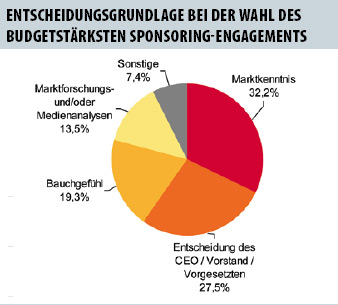
When Fredi Murer, old master of Swiss film, steps onto the stage of the Corso cinema theater in Zurich, he is greeted by well-wishing applause. He presents the premiere of Lorenz Keiser's film directorial debut "Länger leben". He briefly describes the genesis of the cinematic project of Switzerland's only biting political cabaret artist. For a long time, it was not certain whether "Länger leben" could be realized at all, because no funds had been granted by the public authorities. When Murer explains this, his words are drowned out in thunderous applause. It is not clear whether the applause is for the lack of public funding or for the persistent commitment of the filmmakers, who were nevertheless able to realize their project with the help of private and corporate funding. "As the applauded, you never really know what different meanings those applauding attach to their clapping," says Keiser, a newly minted film director. "But I would guess that it also included recognition that we had the film in the first place." Improved brand awareness The witty comedy starring Matthias Gnädinger and Nikolaus Paryla received a grant from the photo lab Ifolor, which in turn benefits from classic product placement in the form of poster advertising in the film and a marketing campaign with Matthias Gnädinger as the figurehead. "We support the film comedy because we are convinced of its likeability value" says Philipp Schwarz, Chairman of the Board and owner of Ifolor. "Switzerland's most popular actor, Matthias Gnädinger, certainly contributes a lot to this. Our involvement came about because we were approached to place a poster in the film, to which we spontaneously agreed. We would do it again at any time." Axa-Arag, the legal protection insurance company, also had itself featured in a pleasingly original way. In the film, it sponsors the TV search show "Notruf Live," which is modeled on "Aktenzeichen XY" and leads like a thread through the criminal events in the black comedy. "Our product placement is so clumsily used and is in the picture for so long that it's funny again," says Thierry Luterbacher, managing director of Axa-Arag, describing his company's involvement, which also had a short commercial produced using scenes from the film. Luterbacher used the opportunity to increase brand awareness, because no sooner had the filming been completed than the decision was made to change the name from Winterthur Arag to Axa Arag. Thus, during post-production work, the old logo was replaced by the current Axa Arag logo. "This meant that we were already able to get the new name, which was planned for 2011, on track by the end of the year," says Luterbacher. Stable Swiss sponsorship market The example of "Living Longer" (see interview opposite) may be one of the more original Swiss sponsorship projects of the past year, but where does our country stand in an international comparison? "As a result of the rapid recovery of the economy, the sponsorship market in Switzerland has stabilized. New, important contracts have been signed in recent months," says Ms. Bortoluzzi Dubach, author of "Sponsoring The Practical Guide." As in international comparisons, long-term commitments in the sports sector have remained stable, especially in football. One example is the Axpo Superleague. For smaller events and sponsorships for clubs and individuals, on the other hand, acquiring sponsors has become more difficult. As far as culture is concerned, larger organizers have been successful in acquiring sponsors, for example the Avo Session, but here too, smaller institutions in the regional area are suffering. For them, however, interesting financing opportunities are opening up via the foundation market. According to estimates, the distribution volume of foundations in Switzerland amounts to 1.5 billion SFr. Substantial sums go to the benefit of culture. In my opinion, the funding foundations in the area of culture have become very important as partners for cultural institutions in this submarket over the past two years. Biedermann and Arsonist Looking beyond national borders, a heterogeneous picture emerges: "Markets in which the conclusion of long-term sponsorship agreements has a tradition suffered less from the effects of the crisis. And: countries where international events were held were able to benefit more than average." According to the Sport+Markt Institute, banks and insurance companies dominate the top 10 new sponsors. AON, a global provider of insurance services, and Standard Chartered Bank are the leaders among all soccer sponsorship newcomers in Europe. Both companies are letting their sponsorship rights cost them around 24 million euros. Sports betting providers have also successfully positioned themselves in the world of soccer. BetClic, for example, has invested around 20 million since 2010 as the official shirt sponsor of Juventus Turin, Olympique Marseille and Olympique Lyonnais. The total spend of the top 10 soccer sponsorship newcomers is around EUR 120 million. Hollein inspires donors Finding the right tone with conservative institutions in particular, while remaining bold and innovative like Max Hollein in Frankfurt, Switzerland lacks such a figure of light. The son of renowned Viennese architect Hans Hollein, Max Hollein can look back on a stellar career in which he combined his innate understanding of culture with a flair for self-dramatization and business acumen. Der Spiegel called the exceptional talent "the youngest and currently biggest star in the museum business," and the lifestyle magazine GQ profiled him. The Handelsblatt praised him: "The hermaphrodite Hollein, half manager, half art man, has the trust of bankers and managers. He speaks their language, knows their codes and rules of the game, and doesn't make a millionaire banker look like a cultural ignoramus." With innovative campaigns that, as Hollein admits, "hardly cost anything, but attract a lot of attention," he inspires not only the potential audience of the three museums he now runs in Frankfurt, but also the donors. Eight years ago, for example, the 41-year-old turned Frankfurt's Kaufhof department store into a branch of the Schirn Museum for the exhibition "Shopping 100 Years of Art and Consumption," which was critical of consumerism. The department store management not only gave the green light for a 2200-square-meter poster by American artist Barbara Kruger on the facade, but also financed a brochure in the same consumer-critical style that promoted the exhibition and department store products. The bill paid off: Over 56,000 people visited the exhibition, and Kaufhof sold more products than with its usual advertising. Swiss SMEs rely on tradition It's one thing to find such original approaches, but then to have them gilded is truly the high art of sponsorship. Getting such daring and sometimes provocative projects off the ground in Switzerland is probably practically impossible. Risk-taking is not exactly one of the main characteristics of the Swiss SME landscape. They prefer to rely on solidity and tradition, which of course also has its value. It is therefore all the more painful when, for reasons of international political correctness and marketability, a pairing like Davidoff and the Basel Indoor Tennis Tournament comes to an end and its organizer now has to hope that Roger Federer will personally reach into his pocket. The organizers of the Arosa Humorfestival can count themselves more fortunate, having been able to rely on their main sponsor Axa for 12 years, just as one would expect from a reliable insurance company. "We feel we are in very good hands in Arosa," says then Tom Markwalder, Head of Sponsoring & Marketing Services at Axa. "It's a great end-of-year event for good customers and is ideal for deepening customer loyalty and emotionalizing the Axa brand. We are already looking forward to 2012, the 20th anniversary." Long-term relationships pay off It is these long-standing relationships that ultimately pay off for both parties. "Experience has shown that it takes some time for a sponsor to really benefit from its involvement and for stakeholders to even perceive the messages," explains Elisa Bortoluzzi Dubach. Over the years, the collaboration is optimized, the unique selling points of the partnership are honed and the implementation is improved. "We have many opportunities to get involved and have a say in many topics," says Markwalder, pointing to the Axa Lounge offers, which Axa has specially produced and makes available to Arosa Tourism free of charge every year. But one trend runs counter to building long-term relationships. Digital media are characterized by extreme fast-moving nature and represent a challenge for the sponsorship market. This impression is also confirmed by Ms. Bortoluzzi Dubach: "It requires quite a bit of personnel and financial effort to keep an eye on all possible relevant platforms on the one hand, and on the other hand to get involved with content there where it is necessary and makes sense." It is also costly to always be up to date with the latest knowledge about technologies. At the Sport Forum Switzerland, which took place in Lucerne in mid-November, Stephan Schröder from Sport+Markt noted that Nike is one of the few brands that serves practically all important social media platforms, but: "There is no attempt to transfer the content of the Nike website 1 to 1 to all social media platforms, but rather to see which content makes sense depending on the platform. It goes without saying that such an approach entails enormous know-how and no less effort. But "social media is becoming increasingly important in everyday life and, of course, also in sponsoring," says Patrick Seitter, Head of Marketing and Sales at ESB European Sponsoring Exchange, with conviction. A clear trend is discernible, Seitter finds: "Companies are placing more and more value on direct interaction with target groups than on pure contact numbers. Here, social media creates a simple and efficient feedback channel." But who can benefit and to what extent, and where the use of social networks may not be worthwhile, the next few months will show. And: "New concepts are also needed in evaluation and success monitoring in order to be able to work efficiently with the new tools," finds the sponsoring specialist. Social media may be the new playground of sponsorship, but the decision-making processes have changed little in recent years. This is also confirmed by the latest figures presented by Pascal Schulte, Sales Director Switzerland Sport+Markt. In just under 20 percent, gut feeling serves as the basis for decision-making, while in around 27 percent of cases, the CEO or the board of directors decides on the sponsorship commitment. "For sponsorship to have a successful impact, commitment from the boardroom is essential," explains Elisa Bortoluzzi Dubach, pointing to BSI's cultural commitment. "This would never work so well if there wasn't a CEO who stands for the credibility of this commitment with his person and his name." In that sense, a company's management is the first stakeholder that a sponsorship department must not only convince with its proposals, but inspire. "I also have absolutely nothing against so-called relationship offenses if this results in recognizable added value for the company," interjects the sponsoring specialist. It is interesting to note that according to Sport+Markt, market knowledge, at a good 32 percent, does not carry much more weight than "relationship offenses." In general, it can still be said that "sponsorship and sponsorship recipient must always fit together," says Ms. Bortoluzzi Dubach. "Typology of the project, level of sponsorship (top, medium, low, etc.), shared values, as well as the ability to address the same target groups and generate measurable added value for one's stakeholders are crucial factors." What does this mean for the future? Both the market research institute ZMS Analytics and the Swiss Sponsorship Barometer assume that the crisis period is over and that budgets are very likely to increase in the next two to four years. Not dramatically, but slightly upward, but that is at least something. Marc Bodmer
Interview with Lorenz Keiser and Adriano Viganò WW: How do you imagine the financing of "Live Longer" and how long did it take to get it up and running? Lorenz Keiser: Adriano Viganò drew up a kind of shareholders' agreement with which we went to (mainly small) investors and offered shares. Adriano Viganò: The investors saw that there was a good chance that they would get their money back, as well as how great the chances of winning were and how great the risk of default was. With this "going public" we had financed the film within three months. What was the decisive element that motivated the donors to make their contributions? Their commitment, producer Viganò, the actors, the story...? Keiser: Of course, an interplay of all these elements. On the one hand, the contract must be clear and promising, on the other hand, the possible success depends decisively on the script, the actors and the production. And then the personal involvement in such a story should not be underestimated for credibility. But it is important that the production costs are in reasonable proportion to the size of German-speaking Switzerland. In what order of magnitude were the contributions from companies? Of private individuals? Viganò: We have only private individuals as investors. The investments are between 20,000 and 200,000 francs. There were people who injected money à fond perdu, others profited from product placement. Were there other models? Viganò: The investors are real investors, which means they can get the invested amounts back from the revenues of the film and earn something on top when the film runs. Did the commitment of the supporters change over the course of the shoot? Did more enthusiasm emerge when you saw the direction the rough cut was taking? Viganò: The enthusiasm was there from the beginning and grew. There was an incredible team feeling among everyone involved, because we were making a film entirely on our own without the overlord state. And the more it became clear that we could do it, the better the mood became. Were there any ideas that were considered for the film due to the scarce funding but could not be realized? Keiser: If we had a lot of money, we would have shot the film much more technically expensive, of course. That means tracking shots, film instead of video, expensive lighting, more remote locations, breaking a few cars in the action scenes etc etc. When it was clear that we were financing the film privately and repayably, we as producers decided to shoot the film as economically as possible in the interest of the investors (and thus also in our interest). Would you take such a path again? If so, what have you learned from "Living Longer"? Keiser: It's definitely too early to answer that. If the film is a success, then we will certainly have developed a viable model. Interview: Marc Bodmer
The online tracking wave is rolling towards us
New developments in behavioral targeting promise better returns, bring new challenges and will trigger a surge in consolidation. Christoph J. Walther
Wunderman is training Microsoft partners across Europe using a game.
Editorial
-
December 1, 2010
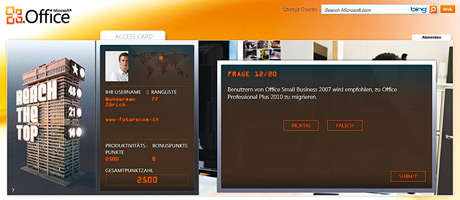
The new Office 2010 was successfully launched in May of this year. However, this does not guarantee lasting success. For this, it is extremely important that Microsoft partners know the product like the back of their hand. But how do you communicate a rather dry topic such as "licensing"? Or how do you make sales arguments accessible to partners without coming across as ingratiating or opinionated? Wunderman has found the solution in a central platform called "Reach The Top". The centerpiece is a game that extends over three levels. Microsoft partners from eleven European countries compete for the title of Microsoft expert. Players can consult the knowledge database at any time to answer even the trickiest questions. The campaign is being rolled out centrally by Wunderman Zurich for all eleven participating European countries. Anyone who plays through all three levels will not only learn everything they need to know about Office 2010, but will also automatically be entered into the prize draw for the main prize: a trip to the world's tallest building, the Burj Khalifa in Dubai. pan
Last but not least: Swiss Post puts together a not entirely convincing package
One thing is clear: Swiss Post knows how to do math. 40 francs + 5.90 francs = 45.90 francs. For someone who has relied on PostFinance for years, that’s certainly very reassuring.
Editorial
-
December 1, 2010
The question is, however, whether this advertisement, found this morning in 20 minutes, was actually supposed to be an offer that somehow went completely wrong. Or whether it's enough for bargain-loving postal customers that Swiss Post gives them the idea of quickly buying a pack of Lindor balls in addition to the vignette to make the end-of-work rush a little tastier. A little tip: there are also calculators in the post store. After about 20 minutes, it dawns on the viewer of the ad that it could be the Choco vignette mentioned in the jumble of text and images that the buyer is getting on top. But here too there are objections, as the Federal Office of Public Health warns that eating the wrong vignette can lead to indigestion. (afh)
Giger Com:New mandate won from the Swiss Panel Association
The Zug-based communications agency Giger Com, in collaboration with Logo 108 Werbung&Brandworking, successfully prevailed over two competitors in a pitch. The contract calls for a 5-year comprehensive communications campaign to promote ceramics in and around construction projects for the SPV (Swiss Tile Association).
Editorial
-
December 1, 2010
The first works will be visible on the market in spring 2011.Giger Com offers a full-service package in consulting, conception and realization for all aspects of communication work. Logo 108 Werbung&Brandworking offers a range of services from classic advertising and CI/CD.
Schükom launches "A career in the army"
Editorial
-
December 1, 2010
Mission Future getting young people excited about vocational training
The new youth website Mission Future is now online. It is the centerpiece of the Federal Office for Professional Education and Technology's new communication measures to promote vocational education and training.
Editorial
-
December 1, 2010
The youth website is aimed at young people between the ages of 12 and 16 with the aim of raising awareness of the strengths and opportunities of vocational training. The focus is on interaction and dialog. The aim is to get young people interested in vocational education and training, accompanied by a fictitious youth clique. The fictional clique includes two girls and two boys. The individual characters are intended to support the young people in their career planning as virtual role models or like older siblings: They pass on their experiences from the career choice process and from their everyday working lives to the younger primary target group. Profiles, photos, animations and their own Facebook group bring the characters to life and encourage them to share their experiences as equals. At the heart of the new youth portal, which will be gradually expanded over the coming years, is the Futurequest game. In this online game, boys and girls test their knowledge and receive basic information on basic vocational training in an easy and fun way. Mission Future was developed by the agencies cR Kommunikation and Bold Werbung and is part of Berufsbidlungplus.ch. This is an initiative by the federal government, cantons and professional organizations to promote vocational education and training.
The Rising CCO: Study on the "Threat of social media"
More than 30 percent of international heads of communications departments are not prepared for the threats posed by social media. This was revealed in the annual study «The Rising CCO.».
Editorial
-
December 1, 2010
Today, the reputation of companies and brands is increasingly exposed to greater risks from online threats. According to the annual study "The Rising CCO III", conducted by the global recruitment consultancy Spencer Stuart in collaboration with the PR agency Weber Shandwick, 34 percent of all heads of communications departments worldwide report that their company's reputation has been threatened by social media in the last 12 months. However, the same 33 percent say they are unprepared to deal with this type of online reputation threat. Social media threats are a top priority in the minds of CCOs at the world's largest companies this year. They predict that social or online media will not only be the biggest challenge next year, but also a huge opportunity; 54 percent cite experience with new/social media as the most important skill for communications professionals going forward. Across the globe, CCOs are gearing up for the challenge: social media/blogging is expected to be the fastest growing function in communications departments over the next 12 months, given its dramatic growth from 28 percent in 2008 to 41 percent in 2010. When it comes to new skills and know-how for the contemporary CCO, the online threat to corporate reputation makes mastery of social media all the more imperative, says George Jamison, who heads up the CCO division at Spencer Stuart. "Reliable experience in this area has gone from a nice-to-have to a must-have when it comes to the most coveted leadership positions," he says. The Rising CCO The study, now in its third year, examines the roles, responsibilities and opinions of communications executives in the world's largest companies. The study involved 127 participants from companies in North America, Europe and the Asia-Pacific region. Eighty-seven percent of respondents are members of Fortune 500 companies. The study was conducted online in May and June 2010.
TBWA\ZÜRICH projects Facebook users onto the Bundesplatz
Editorial
-
December 1, 2010
Vote: Which idea will be campaign of the year?
Vote and win gift certificates worth 5,000 francs.
Editorial
-
December 1, 2010
Agencies and advertising clients are not the only ones eagerly awaiting the results of the Campaign of the Year vote. There are also six lucky people who will automatically be entered into a prize draw to win attractive vouchers. These are being offered by the Hotel Saratz in Pontresina and St. Moritz. 1st prize: voucher worth 2,000 francs. 2nd prize: voucher worth 1000 francs. 3rd to 6th prize: voucher worth 500 francs. If you want to vote, click on the campaign of your choice or send an SMS with the keyword CLIP and the corresponding number (e.g. CLIP00) of the campaign plus your name and address to the destination number 5555 (CHF 1.50 per SMS). You can take part online free of charge or send a postcard to: Werbewoche, Neugasse 10, P.O. Box 1753, 8031 Zurich. Closing date: The votes received by January 5, 2011 will be counted for the expert jury voting of Werbewoche. This will be followed by another edition of this vote for the campaign of the year for the general public on Star TV. The opinions of the expert jury and the public jury will be analyzed later in Werbewoche. > To the campaigns > And here is the link to the online voting