Brands and makers

Starting March 10, Thebrander.com will feature stories about people who have put their hearts into creating a brand and are successfully running it—or who are even a brand themselves. The online magazine is being launched by the Zurich-based branding agency Branders.

Brands convey a certain way of life. At Apple, it’s «Think different.» BMW promises «the joy of driving.» At Zurich’s Kronenhalle, art and cuisine blend to become the restaurant’s hallmark. In all these cases, brands convey an experience and foster a sense of identification. But who are the people behind these brands? «We’re surrounded by many global, anonymous brands. Often, no one knows who’s behind them. At the same time, the trend and desire for authenticity and connection are steadily growing. This is becoming increasingly important for brand management. That’s why we give brands and their creators a voice,» says René Allemann, CEO of Branders in Zurich.

For some time now, this agency has been exploring the idea of bridging the gap between the two extremes of «anonymous brands» and «relatable figures.» The result is the first online magazine that takes a look behind the scenes of the brand world and aims to put a face to its creators. Who is behind the success of small, large, well-known, and unknown brands? What sets these people apart? What drives them? What are their recipes for success? Who is the CEO steering the ship? Who is the designer? What motivates them? What emotions do they want to convey through their brand?

Answers to these questions will be available starting March 10 in new stories published weekly on The Brander portal. The online magazine is bilingual, in German and English. It aims to distinguish itself—primarily through its emotional approach—from the few publications known to date, such as Brandchannel. This site by Interbrand functions primarily as a news portal for branding and rebranding and is aimed at a professional audience—similar to the CI portal of Mainz University of Applied Sciences. The Brander, on the other hand, combines the branding perspective with the lifestyle associated with brands. «Theory and practice are combined in a new way,» explains René Allemann. In this way, the topic of branding is meant to become an experience in itself, even while reading. Through in-depth reports, high-quality photography and video features, as well as extensive photo galleries, The Brander puts people and the stories behind their brands front and center—«because good brands tell a story,» Brander is convinced.

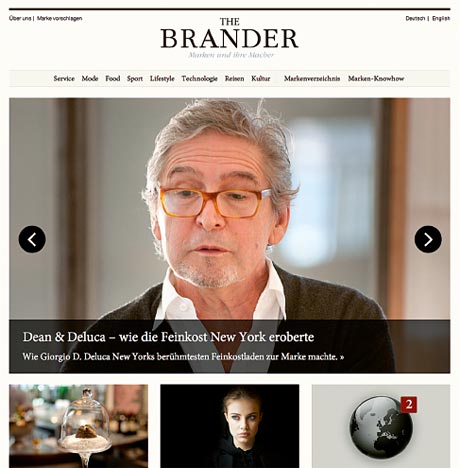
To provide fresh content every week, the agency has enlisted specialized writers from around the world, ranging from the NZZ to The New York Times. There will also be a monthly update featuring renowned columnists. To kick things off, The Brander is reporting from Milan, Naples, New York, Zurich, Sydney, and Taipei. The reports cover brands such as Pedrazzini for boats, Dean & Deluca for delicatessen goods in New York, and Michel Péclard for fine dining in Zurich.

«Food, fashion, and leisure are certainly key areas, but there are also stories about service brands, banks, insurance companies, and airlines. Technology brands, such as computers and cars, will also be a focus for us,» promises René Allemann.

thebrander

«BRANDS ARE VERY EMOTIONALLY DRIVEN»

WW: Who is the target audience for the new online magazine *The Brander*?
René Allemann: Our target audience is an international one—people who are generally interested in design, art, culture, and fashion, and who have an affinity for brands. People who also read magazines like *Monocle* or *Wallpaper*.

Why this initiative for an online magazine?
Because it meets a clear need. As a consumer, I often deal with anonymous global brands. But more and more, I want to know who’s behind them. I’m interested in the person behind the brand—their background, their location, their origins. It’s a general trend that’s evident everywhere—in companies and products alike. The magazine also expresses our philosophy: Brands are based on a clear strategy but are driven by strong emotions. They offer an experience and convey a certain attitude toward life. As consultants, we focus on brands that offer holistic experiences and on quality—locally, nationally, and internationally. We want to convey this vision. 

Is "The Brander" primarily a form of self-promotion for the Branders agency??
Ultimately, it helps us as an agency—that much is clear. But the magazine is also meant to encourage people to engage with the topic. We see our work as more experience-oriented and less technical. When we create brands, our goal is to make a brand’s lifestyle experience tangible in a holistic way. The magazine is meant to reflect this mindset. We want to show everything that can lie behind a brand—not just in our industry, but beyond it as well. So The Brander isn’t a traditional trade magazine. It combines the brand experience with branding theory, resulting in a new, unique, and experience-oriented way of presenting the subject.

How is The Brander funded?
The online magazine is free and is funded by advertising. However, we intend to keep advertising to a minimum. We’ll be satisfied if the project breaks even. We won’t publish PR pieces, and we won’t use promotional material for our photo spreads. Instead, we want to work with the best photographers and journalists who share our vision of quality.

How will the new magazine be promoted?
We hope that word about The Brander will spread throughout the online community. With social media, that can happen very quickly these days. Of course, we’re making the most of all the opportunities social media has to offer. On Twitter, for example, people from all over the world will be sharing exciting brand-related updates with us several times a day. Plus, The Brander has been designed to be interactive from the very start. Readers can submit suggestions for stories they’d like to see or vote for their favorite stories.

Given this context, I'm sure there's an iPad version, right?
We live in exciting times! The shift from print to online is the big topic. Together with the agency Information Architects, based in Tokyo and Zurich, we’ve developed a simple, attractive, and modern iPad version. The agency specializes in developing online portals for media companies and recently created the new app for *Die Zeit*. The app has received widespread praise for its «responsive design» from both industry experts and the general public. We, too, are making use of this new technology. A simple structure and a single-column layout make navigation easy and align with new reader habits.

Will there ever be a print version?
The speed and interactivity of online media have become indispensable. They are a fact. Of course, and hopefully, certain traditional media will remain relevant in print form. We, too, do not rule out a print version of the magazine at a later date. For the launch of The Brander, however, we deliberately chose the online channel. On the one hand, this allows us to incorporate various media formats, such as videos; on the other hand, interactivity is very important to us. We showcase the people behind the brands and want to encourage dialogue.

What is your goal for The Brander? 
In the long term, The Brander is set to become a visual encyclopedia of the brands of our time—an endless story of brands and their creators. This will undoubtedly make The Brander an exciting magazine and an attractive reference work.

Text and Interview: Andreas Panzeri

allemann

THE AGENCY
Branders was founded in 2005 as an independent branding consulting firm. Its team, which now consists of 20 employees, serves local, national, and international companies. The team—composed of specialists in business, psychology, and design—advises companies on all aspects of branding. Currently, the agency, based in Zurich’s Bellevue district, is working on projects in Switzerland, the U.S., and China.


Pro Sieben Sat1: Profit doubled

Last year, Pro Sieben Sat1 benefited from the recovery of the advertising markets and more than doubled its profits.

Thanks to booming advertising revenues and good Christmas business, the German TV group earned 312.7 million euros on the bottom line. Turnover grew by 8.7 percent to around 3 billion euros, as the company announced on Thursday according to SDA. The broadcasting group (Sat1, Kabel1) also sees itself strengthened by its strict cost-cutting measures and the restructuring of recent years.

The success is not only due to the economic tailwind, but also to the efficiency of the processes and the right strategic decisions, Pro Sieben Sat1 CEO Thomas Ebeling is quoted as saying in the press release. In view of the good economic situation, the manager expects further growth in revenues and earnings in 2011. However, following the sale of the news channel N24 and the move to Munich, the restructuring of the still highly indebted Group could continue.

Strategic opportunities in parts of Europe are being examined

Pro Sieben Sat1 is examining the strategic possibilities for its business in the Netherlands, Belgium and Northern Europe. There has been speculation for some time about a possible sale of the stations there. From today's perspective, a decision is expected in the second quarter.

Dachkom: Delta Möbel celebrates birthday with Christa Rigozzi

The Dachkom agency, based in Rheineck, has launched a campaign for Delta Möbel. Christa Rigozzi has been appointed as the new brand ambassador.

rigozzi_klein

For Dachkom in Rheineck, according to the statement, Christa Rigozzi's convincing personality and skillful role-playing in front of the camera were among the decisive factors in hiring her as the new ambassador for Delta Möbel, the furniture store in eastern Switzerland. The campaign includes a separate newspaper bundle, posters, advertisements, as well as radio and TV spots.

Responsible at Delta Möbel: Willi Gebelein (Management), Hans Vetsch (Marketing). Responsible at Dachkom: Bernd Leisner (text/concept), Simone Gmeiner (graphics), Otto Gmeiner and Jérôme Walz (consulting), Regina Rüesch (project coordination).


Radio Argovia: Olivia Folly becomes deputy editor-in-chief

The management of Radio Argovia has promoted Olivia Folly to deputy editor-in-chief, effective April 1, 2011.

Olivia Folly has been working as an editor at Radio Argovia since May 1, 2008, according to a press release issued on Thursday. The 30-year-old originally completed a commercial apprenticeship and then worked as a commercial employee at the Biel-based private radio station Canal 3. After a two-year stint in the Canal 3 editorial department, she was employed as editor and deputy editor-in-chief from August 2007.
 

Pitch win: Kreisvier commissioned with relaunch of Swissfriends.ch

Swissfriends.ch brings people together. And the Tamedia company has now found the right partner in the Kreisvier agency.

The Basel-based agency is developing the multi-stage relaunch, consisting of a classic campaign and integrated measures in the new media. Swissfriends.ch is the largest Swiss dating site with over 200,000 members annually and chose Kreisvier after a pitch among three agencies.

Responsible at Swissfriends.ch: Sarah Stiefel. Responsible at Kreisvier: Christian Jost, Fabia Meloni (consulting), Sven Kahler (art direction), Gerald Mink (text).
 

Brands and makers

Starting March 10, Thebrander.com will feature stories about people who have put their hearts into creating a brand and are successfully running it—or who are even a brand themselves. The online magazine is being launched by the Zurich-based branding agency Branders.

Brands convey a certain way of life. At Apple, it’s «Think different.» BMW promises «the joy of driving.» At Zurich’s Kronenhalle, art and cuisine blend to become the restaurant’s hallmark. In all these cases, brands convey an experience and foster a sense of identification. But who are the people behind these brands? «We’re surrounded by many global, anonymous brands. Often, no one knows who’s behind them. At the same time, the trend and desire for authenticity and connection are steadily growing. This is becoming increasingly important for brand management. That’s why we give brands and their creators a voice,» says René Allemann, CEO of Branders in Zurich.

For some time now, this agency has been exploring the idea of bridging the gap between the two extremes of «anonymous brands» and «relatable figures.» The result is the first online magazine that takes a look behind the scenes of the brand world and aims to put a face to its creators. Who is behind the success of small, large, well-known, and unknown brands? What sets these people apart? What drives them? What are their recipes for success? Who is the CEO steering the ship? Who is the designer? What motivates them? What emotions do they want to convey through their brand?

Answers to these questions will be available starting March 10 in new stories published weekly on The Brander portal. The online magazine is bilingual, in German and English. It aims to distinguish itself—primarily through its emotional approach—from the few publications known to date, such as Brandchannel. This site by Interbrand functions primarily as a news portal for branding and rebranding and is aimed at a professional audience—similar to the CI portal of Mainz University of Applied Sciences. The Brander, on the other hand, combines the branding perspective with the lifestyle associated with brands. «Theory and practice are combined in a new way,» explains René Allemann. In this way, the topic of branding is meant to become an experience in itself, even while reading. Through in-depth reports, high-quality photography and video features, as well as extensive photo galleries, The Brander puts people and the stories behind their brands front and center—«because good brands tell a story,» Brander is convinced.

To provide fresh content every week, the agency has enlisted specialized writers from around the world, ranging from the NZZ to The New York Times. There will also be a monthly update featuring renowned columnists. To kick things off, The Brander is reporting from Milan, Naples, New York, Zurich, Sydney, and Taipei. The reports cover brands such as Pedrazzini for boats, Dean & Deluca for delicatessen goods in New York, and Michel Péclard for fine dining in Zurich.

«Food, fashion, and leisure are certainly key areas, but there are also stories about service brands, banks, insurance companies, and airlines. Technology brands, such as computers and cars, will also be a focus for us,» promises René Allemann.
thebrander

«BRANDS ARE VERY EMOTIONALLY DRIVEN»

WW: Who is the target audience for the new online magazine *The Brander*?
René Allemann: Our target audience is an international one—people who are generally interested in design, art, culture, and fashion, and who have an affinity for brands. People who also read magazines like *Monocle* or *Wallpaper*.

Why this initiative for an online magazine?
Because it meets a clear need. As a consumer, I often deal with anonymous global brands. But more and more, I want to know who’s behind them. I’m interested in the person behind the brand—their background, their location, their origins. It’s a general trend that’s evident everywhere—in companies and products alike. The magazine also expresses our philosophy: Brands are based on a clear strategy but are driven by strong emotions. They offer an experience and convey a certain attitude toward life. As consultants, we focus on brands that offer holistic experiences and on quality—locally, nationally, and internationally. We want to convey this vision. 

Is "The Brander" primarily a form of self-promotion for the Branders agency??
Ultimately, it helps us as an agency—that much is clear. But the magazine is also meant to encourage people to engage with the topic. We see our work as more experience-oriented and less technical. When we create brands, our goal is to make a brand’s lifestyle experience tangible in a holistic way. The magazine is meant to reflect this mindset. We want to show everything that can lie behind a brand—not just in our industry, but beyond it as well. So The Brander isn’t a traditional trade magazine. It combines the brand experience with branding theory, resulting in a new, unique, and experience-oriented way of presenting the subject.

How is The Brander funded?
The online magazine is free and is funded by advertising. However, we intend to keep advertising to a minimum. We’ll be satisfied if the project breaks even. We won’t publish PR pieces, and we won’t use promotional material for our photo spreads. Instead, we want to work with the best photographers and journalists who share our vision of quality.

How will the new magazine be promoted?
We hope that word about The Brander will spread throughout the online community. With social media, that can happen very quickly these days. Of course, we’re making the most of all the opportunities social media has to offer. On Twitter, for example, people from all over the world will be sharing exciting brand-related updates with us several times a day. Plus, The Brander has been designed to be interactive from the very start. Readers can submit suggestions for stories they’d like to see or vote for their favorite stories.

Given this context, I'm sure there's an iPad version, right?
We live in exciting times! The shift from print to online is the big topic. Together with the agency Information Architects, based in Tokyo and Zurich, we’ve developed a simple, attractive, and modern iPad version. The agency specializes in developing online portals for media companies and recently created the new app for *Die Zeit*. The app has received widespread praise for its «responsive design» from both industry experts and the general public. We, too, are making use of this new technology. A simple structure and a single-column layout make navigation easy and align with new reader habits.

Will there ever be a print version?
The speed and interactivity of online media have become indispensable. They are a fact. Of course, and hopefully, certain traditional media will remain relevant in print form. We, too, do not rule out a print version of the magazine at a later date. For the launch of The Brander, however, we deliberately chose the online channel. On the one hand, this allows us to incorporate various media formats, such as videos; on the other hand, interactivity is very important to us. We showcase the people behind the brands and want to encourage dialogue.

What is your goal for The Brander? 
In the long term, The Brander is set to become a visual encyclopedia of the brands of our time—an endless story of brands and their creators. This will undoubtedly make The Brander an exciting magazine and an attractive reference work.

Text and Interview: Andreas Panzeri
This article is from the current print issue of Werbewoche.

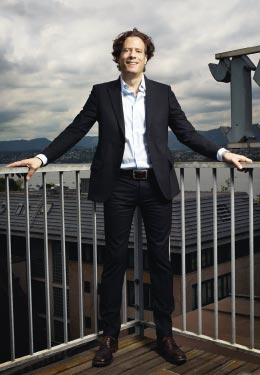
allemann

THE AGENCY
Branders was founded in 2005 as an independent branding consulting firm. Its team, which now consists of 20 employees, serves local, national, and international companies. The team—composed of specialists in business, psychology, and design—advises companies on all aspects of branding. Currently, the agency, based in Zurich’s Bellevue district, is working on projects in Switzerland, the U.S., and China.


Swiss Month launch event

Werbewoche features photos from the event.


Photos.

Last but not least: Happy nano-killing

«The Nanos are coming, and they’ll be everywhere. They’re small, fun, and easy to handle, and they encourage creative play and dexterity.» That’s what it says on the Migros website. What Migros doesn’t mention: They’re dangerous. Very dangerous.

The final hour has come for many of the cute little Nanos: on the Facebook page "Let's kill the Nanos" at least one specimen is cruelly killed every day. Even the rare special nanos are not spared. And of course the execution process or the dead nano is photographed. Cute! In order not to lose track of the Nanos that have been killed, a Nano cemetery set up.

Incidentally, among the fans of the campaign - no wonder - there are also many parents of children of nano-collecting age.... somehow it has to come out, the hatred of these small plastic parts.


The Impact Check of Werbewoche

We show how current campaigns are performing with consumers.

led by the advertising agency KSB, followed by the ShopVille-RailCity ad from Werbeanstalt and the VW ad from KSB. The ad for the self-help center by the advertising agency Draftfcb/Lowe took first place in the “Uniqueness” category, ahead of the ad for Jobwinner.ch by Wirz and the SmokeFree campaign by Wirz. In the “Brand Fit” category, the ShopVille-RailCity ad took first place, ahead of Coop and SmokeFree. In the “Likeability” category, the Jobwinner.ch ad took first place, followed by the VW ad in second place and the SmokeFree ad in third. 

Click here for Werbewoche's Impact Check.

Question and methodology
Method: Computer Assisted Web Interviews (CAWI).
Instrument: Online interviews via the Marketagent.com reSEARCH platform.
Target group: web-active people from German-speaking Switzerland between the ages of 14 and 59.
Sample size: n = 501 net interviews, random selection according to quotas.
Survey period: February 14, 2011 – January 21, 2011.

Questions:

  • At the beginning of today's survey, we showed you a few advertisements. Which of these advertisements do you remember? Please tell us the names of the companies or brands featured in the ads. (Awareness)
  • In your opinion, to what extent do these ads stand out from other advertisements in newspapers, magazines, and periodicals? Please rate each on a scale from 1 (= does not stand out at all) to 6 (= stands out very strongly). (Uniqueness)
  • To what extent do these ads align with the image you have of the respective brands/companies? Please rate each on a scale from 1 (= does not align at all with my image of this brand) to 6 (= aligns very well with my image of this brand). (Brand Fit)
  • How much do you like the following ads? Please rate each one on a scale from 1 (= I don't like it at all) to 6 (= I like it very much). (Likeability)

The values shown here are the top-box ratings: «stands out very strongly,» «fits very well with my image of the brand,» and «I like it very much.» The remaining values can be found on Werbewoche.ch. The author of the representative study «Switzerland’s Favorite Ads» is Marketagent.com Switzerland, a company specializing in online market research that has a registered panel of 20,000 respondents in German-speaking and French-speaking Switzerland. Marketagent.com Switzerland is a subsidiary of the leading Austrian market research company Marketagent.com online reSEARCH GmbH and the Swiss communications agency Contract Media AG.


Natural gas makes the flowers dance

Rod Kommunikation presents natural gas with new ideas in a look that is as charming as it is grateful.

To realize an eye-catching communication about an invisible product is not an easy task. But the advertisers at Rod Kommunikation have succeeded in doing just that. They present natural gas in a new look that focuses on emotions instead of facts. Elaborate spots make trees and flowers dance and present the product as "friendly energy".

After all, natural gas is also a natural energy that originated deep in the earth and pollutes the environment less than heating oil, wood chips, pellets and imported coal-fired electricity. It's no wonder that many Swiss people have been choosing natural gas as a clean, environmentally friendly heating energy for decades. And because more and more consumers are also discovering natural gas as a cost-effective, environmentally friendly fuel or are heating with renewable and CO₂-neutral biogas, the group of people who are doing something good for nature is growing. The strategic core idea of the new communication offensive is the principle of Actio = Reactio.

erdgas

Long live nature

This is visualized in the film and in the subjects, in that this ecological decision by natural gas consumers has a visible and direct impact on the environment. It is shown how nature thanks man for his exemplary behavior. Rod's creative team used this strategic core idea as inspiration and developed it into a campaign in which the flora with its plants, trees, flowers, grasses and shrubs make life easier for natural gas consumers in their everyday lives, in the spirit of a friendship service. This is also the origin of the claim: Natural gas - the friendly energy.

For the integrated campaign, TV commercials, billboards, advertisements, posters, below-the-line measures and a new website were developed to not only interest and inspire potential customers for natural gas, but also to be able to make them real offers at the local level.

In close collaboration with director Marco Lutz and photographer Patricia von Ah, a new world was developed for natural gas that charmingly stages the labors of love and gestures of gratitude of plants. All the plants had to be brought to life manually with the help of a puppeteer in fine production work. Thus, the film was composed of hundreds of individual parts and sequences. Rod was convinced that an artificial look would not have suited this natural energy, so 3-D animation was not an option.

pan


China massively restricts freedom of movement of foreign journalists

China's police have radically restricted the freedom of movement of foreign correspondents. In future, journalists will have to obtain permission from local authorities before reporting in China.

Dozens of correspondents were told this in briefings and interrogations at the police station. They were even threatened with imprisonment and deportation if they did not comply, correspondents reported on Thursday, according to SDA. Contrary to the previous rules that only the consent of the interviewee is required for interviews, the authority responsible for the public square or residential area must now also grant permission. "Journalists have been told that the requirement to obtain permission before reporting in public places applies to the whole of China," reported the Foreign Correspondents Association (FCCC).

Dozens of journalists have been summoned to Beijing and Shanghai in recent days. They were accused of violating Chinese regulations by appearing at the planned location of the protests, although the tightening of these regulations was only communicated afterwards.

China's Foreign Ministry defended the new approach to foreign journalists. It is not a change, not a step backwards. It is just a step forward, said spokeswoman Jiang Yu to the press in Beijing. Local authorities had made detailed regulations on the implementation of the rules.
 

get_footer();