The digital upgrade
Communication Technology: The 2011 KommTech Study shows that Swiss people are communicating in increasingly digital and mobile ways.


The Super Bowl is to communication professionals what the Oscars are to fashion victims. A must. And not because of the anthem (rather poorly performed by Christina this year) or the game (really exciting right to the end this year). But because of the half-time show, which always features a spectacular performance (rather average this year with the Black Eyed Peas). And because of the commercials, in which companies with petty cash of around 2.5 million USD compete for 30 seconds for the favor of buyers (this year, apart from VW, rather well ...).
However. The Super Bowl always sets new benchmarks. This year, it also set new benchmarks in terms of social media: for the first time, an event of this magnitude was simultaneously broadcast live on Twitter and commented on, as the National Football League has set up its own Twitter section on the official site (sbtwitter.nfl.com). It said "Join the conversation". So I joined.
I spent the whole night switching between the screens: the small one on my iPhone to tweet along, the middle one on my laptop to follow the pundits' commentary and the big one on the TV to follow all the moves live and then tweet what I thought of the score, the moves, the players and so on. And if I didn't catch an important attack one hundred percent, I could read up on it immediately afterwards.
Every second, enthusiastic supporters of both teams (this year the Packers and the Steelers) gave their opinions on plays and players. Many opinions were funny and entertaining. Others were professional and well-founded.
In the tweets that viewers posted via the official site, the players could be tagged immediately so that their names would light up in color in the mentions of the fans and readers could see what the tweet was about as they skimmed through it, allowing everyone to read or ignore tweets according to their interests. Of course, it was also possible to follow in real time which topics were currently being discussed the most.
Organized by "Players," who were currently battling for the ring on the field, "Media/Celebs," where people from the press expressed their opinions, and "NFL Personnel," where advertisements for the whole event were made, the NFL covered every area of fan interest.
40 million tweets were made about the Super Bowl (#sb45) during the almost five hours of the final game. This showed that the opportunity for football fans from all over the world to share their thoughts on Twitter was "social media at its best". After all, sport is a very social affair and what could be more social than when the whole world can not only watch a football game together, but also talk about it? A global dialog as it is written in the picture book.
Manuel P. Nappo, Head of Studies CAS Social Media Management HWZ.
The WWF is celebrating its 50th birthday this year. As a long-standing partner, Coop would like to thank Switzerland's largest environmental organization for its tireless efforts in the fight against global threats to our environment and for its successful commitment to species conservation. The congratulatory advertisement therefore also thanks those who demonstrably benefit from the work of the WWF: animals threatened with extinction. Lovingly illustrated, they present the WWF panda with a gift.
Responsible at Coop: Jürg Peritz (Head of Marketing/Procurement), Thomas Schwetje (Head of Marketing/Services), Christof Braun (Project Management). Responsible at KSB: Flo Wacker (CD), Susanne Weeber (AD), Nicole Maczko (text), Dany Kielholz (consulting manager), Andrea Braschler (consulting manager), Bettina Beyeler (DTP). Illustration: Nick Price. Image processing/litho: Detail. Media: Coop Media, Karin Heliopoulos and The whole Media.
His resignation was preceded by a media mudslinging. Only the Bild-Zeitung held on to the aristocratic political shooting star. What amazes me about the whole affair is that although Guttenberg's cheating was reported everywhere loudly and in part polemically, one thing was actually always disregarded. His doctoral thesis was accepted, it was not simply waved through, but awarded the rating "summa cum laude", which after all means "with the highest praise". An award that in retrospect is grotesque and does not exactly speak for the credibility of a university. But it gets worse. After the accusations became known, Bayreuth law professor Peter Häberle, Guttenberg's doctoral advisor, had told the Bild newspaper: "The work is not plagiarism." Later, the professor changed his mind. With very great regret, he had to acknowledge that the circumstances of the doctorate he supervised were likely to "bring the reputation of the University of Bayreuth into disrepute in the public discussion," Häberle announced in a written statement obtained by the newspaper Die Welt. A measly apology. It seems to me that a lot has gone wrong here. On the one hand, a shooting star in politics who, in addition to his ministerial and noble titles, lacked a doctorate, which is not entirely unimportant in Germany, and on the other hand, a mild-aged professor - Häberle is, after all, already 76 years old - who perhaps allowed himself to be blinded by Guttenberg's brash demeanor. Or did that not play a role? Would a doctoral student like Hans Mustermann also have received a "summa cum laude"? Probably so. And what did one read in the press on this subject? Nothing. Everything was picking on Guttenberg. There is no doubt that he made serious mistakes, but the fact that the countless instances of plagiarism in his doctoral thesis were not noticed is at least as big a scandal and an embarrassment for science and the university. As a reminder, in 2000, fake interviews with Hollywood stars by Tom Kummer appeared in various newspapers, including the Süddeutsche Zeitung and Magazine. Some senior editors who had bought Kummer's texts lost their jobs in the process.
Pierre C. Meier, Editor-in-Chief
[email protected]
As with the advent of search engine marketing, however, social media marketing is a new playground where traditional advertising knowledge is often of no help. Says Markus Gabriel, owner and creative director of the crossover agency Angelink AG, which specializes in online and social media marketing: "Viewing Facebook as a classic advertising medium is about as relevant as viewing a television as a sound carrier. Companies should see Facebook primarily as a trust-building dialog and a viral promotion platform, not as a parking lot for advertising messages."
The hype surrounding social media is gripping more and more companies, and it should not be forgotten that professional social media use is still in its infancy. After all, it has already become clear that those who first see the reach on Facebook and other social networks with a conventional understanding of advertising and place ads accordingly are often quickly disappointed. After all, people who are on Facebook want to communicate with friends, and impersonal push advertising is about as frowned upon as when the vacuum cleaner salesman shows up at the regulars' table.
Companies must therefore strive to become part of the social environment of the intended target group. The first step and basis for this is a dedicated fan page that functions like a homepage on a social network platform. According to a study conducted by the American market research company Nielsen in April 2010, purchase intentions are four times greater when a homepage is used (8 %) than when this is not the case (2 %). But a company's own presence on a social network must not be static, but must encourage interaction. This is where the new discipline of community management comes into play, which cannot simply be equated with forum moderation. There is still a lot of experience and corresponding competence to be built up here (corresponding courses are currently sprouting up everywhere). If these are lacking, even large brands have a presence, but only reach a relatively meager fan base. Advertising campaigns can now be based on this and are then often very successful. However, anyone who wants to increase their fan base with advertising on a social network will also be disappointed by such number-crunching. After all, it is easier to interact with (a few) real fans than with many purchased ones. In online marketing, reach is increasingly less relevant; instead, qualitative key figures are in demand. These are only just beginning to emerge, especially in social networks. Just as regular customers are important in business, social networks are all about strong connections, which can be seen, for example, in frequent and regular visits by fans to the Facebook page.
Christoph J. Walther
Experts are certain: Facebook will cut off the water from the classic media
Werbewoche asked social media professionals in Switzerland about their experiences with advertising on Facebook and their outlook for the future: Regula Fecker (Rod Kommunikation AG, Zurich), Sven Beichler (mySwissChocolate AG), Markus Gabriel (Angelink AG Crossover Agency, Zurich), Andrea Iltgen (xeit gmbh), Sandra Albisser (SocialCom GmbH), and Stefania Misteli (Valora Management AG).
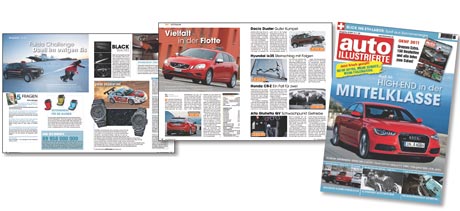
Auto-Illustrierte is the only monthly car magazine in Switzerland that does not report on the Swiss car market from the perspective of the German titles. Successful on the market for many years, "ai" is also the most popular advertising platform for Swiss importers' brand communication thanks to its expertise and market knowledge. The magazine has now been restyled in time for the Geneva Motor Show. Under the leadership of Editor-in-Chief Ulrich Saffering and Art Director Silvio Lötscher, the editorial team has optimized the look and concept. In terms of content, the publication now rests on four pillars: Panorama, Test, Magazine and Fascination.
All content is focused even more than before on the automotive scene in Switzerland. New cars and accessories are examined specifically for their suitability for Switzerland and the tests are carried out with the help of independent Swiss test experts. A more opulent visual language and clearer reader guidance are also promised. "With the optimized units under the bodywork and the new design, Auto-Illlustrierte will be more than ever the Swiss car navigator for Switzerland," says Ulrich Saffering. From mid-March, the website www.auto-illustrierte.ch will also provide "more up-to-date and comprehensive editorial and advertising coverage of cars than any other medium in Switzerland", says Michael Kleinjohann, CEO of Motor-Presse Schweiz.
pan
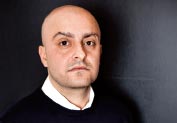
Mr. Kassaei: You claim to be one of the "few truthful people in an industry of hypocrites".
I don't just say that - I try to live it. A huge difference.
Then please tell us the truth about advertising in 2011.
This is not fundamentally different from the truth about advertising in 1961: we are in an industry that is all about making companies, products and services relevant to people's lives. However, we have neglected this in recent decades.
Why?
For a long time, quantitative growth and the associated quantitative consumption were a sure-fire success. It was possible to create demand for meaningless things without much brainpower or effort. However, with the digitalization of the world and a gradual change in values, this is slowly coming to an end. But the advertising industry has another problem: every day we tell our clients that they should have the courage to break new ground. In fact, the last innovation in advertising is 60 years old: Bill Bernbach's creative revolution.
Advertising is one of the most structurally conservative industries of all.
Thank you! That's why we at DDB Germany have broken up the entire old structure. The classic situation of a copywriter and an art director poring over a client consultant's brief and looking for an advertising idea has been completely turned on its head.
You also wanted to reform ADC Germany, but you threw in the towel after a year.
I was not diplomatic enough - and also too naive. I can take comfort in the fact that the biggest changes in ADC history were initiated during my ten months in office and that my 10-point program will be pursued unreservedly by the new Board.
They wanted to abolish the traditional creative ranking.
I wanted to replace it with a ranking with ten different criteria to assess the performance of an agency. The agency with the most creative awards is not per se the most innovative. You have to understand creativity in a much broader sense: as the ability to solve a problem in a way that no one has done before. The only thing that winning creative awards proves is that you are good at winning creative awards.
...says one of the most awarded advertisers in the world.
The proportionality is simply no longer right. The system of creative awards is a system of self-promotion that has almost nothing to do with the real problems of the clients. It's like car manufacturers building bad production cars and awarding prizes to their prototypes. And we advertisers are surprised that clients no longer take us seriously? That we have a bad status in society? That we earn less and less money? That we have more and more problems with young talent? Why would anyone want to work in this sometimes very hypocritical industry?
Why "mendacious"?
Our industry is producing less and less demonstrable added value for our clients. However, it is our task and responsibility to use our creativity to solve our clients' marketing and business problems. Only this will lead to a better reputation for our industry, to an innovative definition of creativity and to a business model in which we are paid for our ideas rather than our hours.
Is that the philosophy of your creative consultancy Hubble?
Hubble is not a management consultancy. Hubble is, as the name suggests, our telescope into the new world. A global open source network that aims to make people's lives easier, better and more efficient through innovation. A modern think tank that proactively analyzes the world, technological trends and people's needs in order to produce substantial solutions.
What will people think of in 50 years' time when they think of Amir Kassaei?
If they cite me as an example of the fact that with passion, will and courage, you can make something special out of your life despite not having the prerequisites, I would be satisfied.
In a nutshell
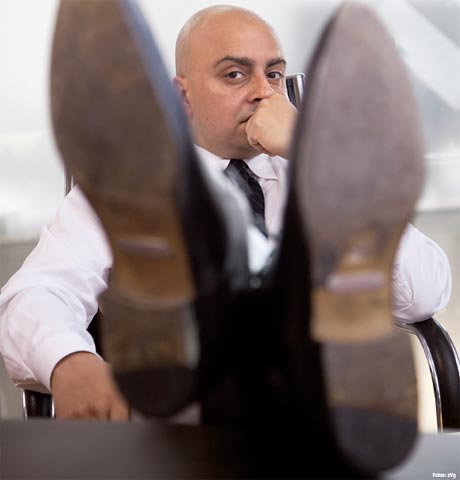
Amir Kassaei - born in Tehran in 1968 - was a marketing assistant at L'Oréal in Paris and then worked in Viennese advertising agencies as an accountant, consultant, final draftsman, art director, media planner, copywriter and agency co-founder. In 1997, he moved to Springer & Jacoby in Hamburg, where he rose to the position of Executive Creative Director. Since 2003, Kassaei has been jointly responsible for the turnaround of DDB Germany as Creative Director and Managing Partner. This has not gone unnoticed at DDB's New York headquarters: Kassaei has just been appointed as the new Chief Creative Officer of DDB Worldwide.
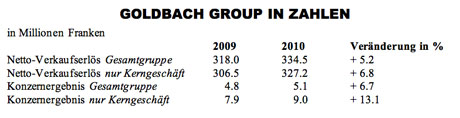
The 2010 financial statements of the Goldbach Group are not easy to read, because the company operates with two sets of figures. This has to do with the fact that in 2008 Goldbach acquired a stake in the German company ARBOmedia, which in addition to various Eastern European activities in advertising sales (TV, radio, online, print) also operates a print and newspaper business in Romania. Since the print division is not part of Goldbach's core business, the company would have liked to sell it long ago, but due to the crisis and lack of demand, the Group has so far remained stuck with it (exception: two newspapers were sold in 2009). For this reason, Goldbach Group is now presenting figures on two levels: First, those of the overall Group (with print), and second, those of the core business (without print). Officially, Group sales in 2010 rose by 5.2 percent to 334.5 million Swiss francs, while the core business alone increased by as much as 6.8 percent to 327.2 percent. Accordingly, profit excluding print business would have risen by 13.1 percent to 9 million Swiss francs, but in fact it now "only" grew by 6.7 percent to 5.1 million Swiss francs.
EU puts a spoke in Goldbach's wheel
The Goldbach Group, which is celebrating its 10th anniversary this year, would therefore have liked to spin off the Romanian print division for accounting purposes, which would be possible under current German law. However, this was prohibited by the EU in January. In any case, it is clear that the 2010 sales of the Romanian print business fell by 36.5 percent to 7.3 million Swiss francs due to the crisis and the sale of two newspapers, resulting in a loss of 1.6 million Swiss francs. Goldbach CEO Klaus Kappeler confirmed that the print business is a drag on the Goldbach Group. According to Goldbach CFO Mario Hrastnig, a value adjustment of CHF 5.7 million had already been made in 2009. Currently, the company is again in loose sales talks, said Kappeler. He wants to settle the matter by the end of the year in any case - if necessary also through liquidation.
Back to the core business: This developed positively throughout the Group. Net sales in the online segment amounted to CHF 119.6 million (+4.5 percent), and those in the offline segment to CHF 208.6 million (+8 percent). Foreign countries continue to contribute around 20 percent to the Goldbach Group's total sales.
12 percent growth in the Swiss TV business
In Switzerland alone, Goldbach increased its net revenues to 278 million Swiss francs (13.9 percent), with net sales from radio advertising just remaining at the previous year's level of 34 million Swiss francs, while those from TV advertising rose by 12 percent to 166 million Swiss francs and in the online sector net revenues even grew by 28 percent to 73 million Swiss francs.
A significant price increase for most TV advertising windows as of October 2010 undoubtedly contributed to the result in the TV business. Kappeler now expects further growth of around 30 percent in this area in 2011, because Goldbach has also been marketing the German advertising windows of Sat.1 (Switzerland) and kabel eins as well as the Swiss private station 3+ since the beginning of this year. It has also raised the prices of advertising windows by an average of 2.9 percent again as of 2011.
On the road to success with Wilmaa
Based on the first audience figures in January, Kappeler assumes that 34 percent of the population in the main target group 15/49 can be reached with the 16 channels now marketed by Goldbach in Switzerland, compared with 24 percent with the 7 SRG channels and just 2 percent with the 17 private channels. The rest (41 percent) consume (foreign) TV programs without Swiss advertising.
According to the 2011 Kommtech study, 40 percent of 15-24 year-olds use Internet TV. Kappeler is therefore convinced that Goldbach is reaching precisely this target group with the Wilmaa platform. The Internet TV service already has more than 700,000 users and is profitable two years after its launch.
For 2011, Kappeler expects a further increase in profitability. In the offline segment, he anticipates Group-wide (organic) sales growth of 30 percent, and in the online segment, where they recently entered into a cooperation with Adconion Media Group, he expects growth of 20 percent.
Markus Knöpfli
Marketing is required to use its funds measurably to increase sales. As the Internet offers attractive tools for efficient new customer acquisition, more and more funds are being withdrawn from traditional advertising every year and invested in search engine and display advertising. Each of these two online instruments is efficient on its own, but they only develop their full effect when used together.
According to Media Focus, seven percent of Swiss advertising expenditure, or CHF 450 million, was spent on online advertising in 2010: CHF 159 million on display advertising and CHF 125 million on search engine advertising (AdWords); the remaining funds flowed into advertisements on portals and affiliate programs. An AdWords campaign is undisputedly the most efficient instrument for acquiring new customers. When searching for information, AdWords are not seen as advertising, but as helpful support.
However, AdWords campaigns are very often seen as a stand-alone measure, although the information search is the last step in the acquisition chain (attention - interest - information search). AdWords create attention for the offer during the information search. Due to the intensive use of search engines, AdWords generate conversions per se. However, they cannot trigger attention or interest in the offer from potential new customers. This is reserved for display ads.
The success of search engine advertising is measured based on the cost per conversion: What did a lead or a purchase cost in relation to the spend? Various studies, such as the "brand to perform!" study by Tomorrow Focus AG, show that display ads have an impact on the ROI of search engine advertising: Not only do they achieve a branding effect, they also increase direct website traffic as well as search engine traffic. And not only immediately, but also with a time delay. Display ads therefore ensure that consumers who feel addressed by the advertisement will sooner or later also search for the offer in the search engines. The more people specifically search for an offer or a brand in the search engines, the more attractive the costs per conversion become. Multi-channel tracking makes it possible to analyze the advertising impact across the various channels in order to optimize their efficiency.
Year after year, we see rising CPC (cost per click) prices for AdWords. Cleverly set up, display ads achieve a lucrative side effect. If the text is based on key terms that are as specific as possible, the consumer's interest is drawn to cost-effective keywords. This in turn has a positive influence on the cost per conversion.
Imre Sinka, Dotpulse web agency,www.dotpulse.ch
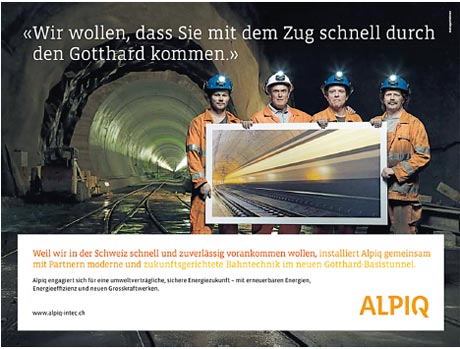
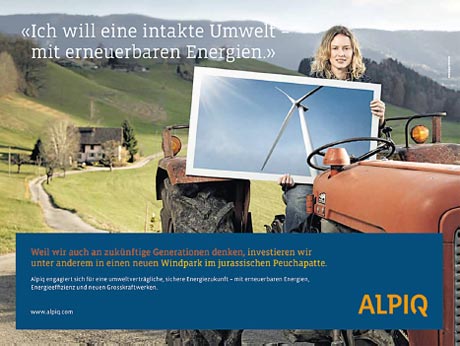
In the current campaign for the leading energy company Alpiq and the energy service provider Alpiq In Tec, Metzgerlehner lets electricity consumers and partners of these companies have their say. The Swiss have their say on the topics of renewable energies, energy efficiency, new large-scale power plants and security of supply. They are campaigning for projects and services from Alpiq and Alpic In Tec. As a visual symbol of their attitude and their need for energy, the protagonists present signs with relevant energy images. The aim of the campaign is to raise awareness of the company's activities and objectives throughout Switzerland, as Head of Strategy Marco Lehner explains. The subject highlights include the images with Swiss-Ski athletes and the first advertising subject, which was realized in the new Gotthard base tunnel. The campaign can be seen in print and online media as well as on TV with a spot by Shining Pictures and Marco Lutz. CD Felix Dammann and Patrick Meyer.