Reader's Digest: Swiss trust the brand classic

For the eleventh time, Reader’s Digest has identified which brands consumers consider particularly trustworthy. Classic brands such as Nivea, Kellogg’s, Swisscom, Visa, Nokia, Kuoni, Ricola, Lindt & Sprüngli, and Elmex once again topped the list in Switzerland.

Approximately 33,000 readers of the magazine in 16 countries participated in the «Reader’s Digest European Trusted Brands 2011» consumer survey, including about 1,700 in Switzerland. Reader’s Digest will honor Switzerland’s most trusted brands with the Pegasus Award for highest consumer trust.

An overview of the most trusted brands in Switzerland:
Non-alcoholic beverages: Coca-Cola

  • Automobiles: VW
  • Banks/financial service providers: Raiffeisen
  • Clothing: Charles Vögele
  • Gasoline/Gas Stations: Coop
  • Candies: Ricola
  • Decorative Cosmetics: NIVEA
  • Cold Remedies: NeoCitran
  • TV/Cable Network Provider: Cablecom
  • Photo devices: Canon
  • Breakfast cereals: Kellogg's
  • Hair Care Products: NIVEA
  • Household/kitchen appliances: Miele
  • Household cleaner: Meister Proper
  • Pet Food: Whiskas
  • Skin Care Products: NIVEA
  • Internet provider: Swisscom
  • Coffee: Nespresso
  • Health insurance companies: CSS
  • Credit cards: Visa
  • Life Insurance: Swiss Life
  • Mattresses: Bico
  • Dairy products: Emmi
  • Mobile network provider: Swisscom
  • Cell phones: Nokia
  • Natural remedies/homeopathy: Similasan
  • Opticians / Eyewear Brands: Fielmann
  • Personal Computers: HP
  • Tour operator: Kuoni
  • Property insurance: The Mobiliar
  • Pain reliever: Dafalgan
  • Chocolate: Lindt & Sprüngli
  • Vitamin Products: Burgerstein
  • Detergent: Ariel
  • Toothpaste/mouth care: Elmex

Score Points with Environmental Commitment

Study participants were also asked about their trust in companies’ environmental protection efforts. Nearly two-thirds (63%) said they prefer brands that are environmentally friendly. (Which brand do you think has the best reputation when it comes to environmental protection?):
 

  • Automobiles: Toyota
  • Gasoline / Gas Stations: Shell
  • Retail: Migros
  • Energy Company (New): Axpo
  • Airlines: Swiss
  • Household Batteries: Duracell
  • Household cleaners: Migros
  • Kitchen/Appliances: V-ZUG
  • Cosmetics: NIVEA
  • Detergent: Ariel


Media Focus: Advertising print remains above the 300 million mark

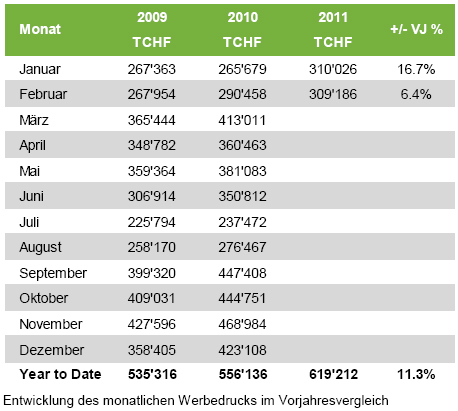
Gross advertising spend remains at a high level. This is shown by Media Focus’s Advertising Market Trend Report. As was the case in January 2011, advertising spend exceeded the 300-million mark in February as well. Compared to the same month last year, gross advertising spend rose by 6.4 percent to over 309 million francs (+18.7 million francs).

werbedruck_februar
(Table: Media Focus)

The "Food" sector nibbled at the 37 million mark in the advertising month of February 2011. Compared with the previous year, gross advertising increased by around 17 percent (+5.4 million Swiss francs). In terms of product groups, the heavyweight of the month was "Chocolate + Confectionery". The measured gross advertising print in February 2011 was around 9.6 million Swiss francs. This represents an increase of 17.5 percent (+1.4 million Swiss francs) compared with the previous year.

Although the "Telecommunications" sector was not quite able to clear the 20 million hurdle in the month of February 2011, no one was left behind thanks to Local.ch. Compared to the previous year, the gross value print was increased by more than 38 percent and amounted to over CHF 19 million (+ CHF 5.3 million). Among the top 10 products of the month, rank 1 to 4 came from the telecommunications sector; "Orange Me" at the top, followed by Local.ch, "Sunrise Free Internet Offer" and "Swisscom Natel Liberty". The top 4 products represented over 30 percent of the telecoms advertising print.

The "Watches + Jewelry" product group exceeded the 3 million level in February 2011. Around two-thirds of advertising pressure was invested in watch advertising alone (CHF 2.0 million, + 70.1 percent year-on-year). Watches were featured most intensively in the glossy press ("consumer, financial + business press"). Within the "Watches" segment, the "General, Financial + Business Press" held a media mix share of over 42 percent.

The "daily, weekly + Sunday press" and "TV" media groups again went head-to-head in February 2011. However, "TV" set the bar somewhat higher and ended the advertising month with around CHF 102 million. The "daily, weekly + Sunday press" just failed to break the 100 million mark.


Wirz advertising: Broken cars advertised for the TCS

Touring Club Switzerland is launching a radio ad campaign to raise awareness among drivers about its roadside assistance service and thereby attract new members. The ads, created by Wirz Werbung, show that people tend to underestimate how prone their cars are to breakdowns.

The radio spots begin as if a great new car is being advertised, but then not only are the first-class equipment details listed, but also the flooded fuel pump or the nasty marten damage. Finally, the voice-over points out that even the best car can break down. The radio spots run throughout March on various Swiss stations.

To the spot: Family car.
To the spot: Compact car.
To the spot: Sports car.

 
Responsible at TCS: Stéphanie Durrer (Marketing Project Manager), Peter Fluder (Senior Marketing Project Manager). Responsible at Wirz Advertising: Philipp Skrabal (CD), Andi Portmann (lyrics), Nicole Suter (art buying), Marcel Niedermann (PR consultant), Selmi Tonstudio (production).


SFLB: Giant puzzle abandoned for Swisscanto

The slogan for Swisscanto’s new fund promotion is «Having time makes you happy.» Time to solve the giant Sudoku puzzles created by Spillmann/Felser/Leo Burnett or to fill in the crossword puzzle posters. 

The message is that those who invest their money in Swisscanto funds have more time for other things. Swisscanto is giving people a taste for having more time themselves. From March 16 to April 6, giant sudokus will be set up one after the other in Lucerne, Zurich, Lausanne and Basel. Anyone can help solve the giant puzzles on site. And with posters to fill in yourself, the puzzles continue everywhere else too. There are more tricky puzzles on Swisscanto-zeit.ch. The main prize is Swisscanto investment funds with a total value of CHF 10,000.

Responsible at Swisscanto: Urs Wieser (Head of Marketing), Roman Kappeler (Communications), Felix Cabernard (Project Manager Client Marketing). Responsible at Spillmann/Felser/Leo Burnett: Martin Spillmann (ECD), Patrick Suter, Dan Strasser (CD), Roland Buob (AD), Christian Stüdi, Patrick Suter (text), Pam Hügli, Ivana Giannakis, Patricia Kuster (consulting). Puzzle production: RätselMedia Lotti, Oswaldo Lotti. Programming: Station. Event realization: Compresso.FastBreak.

Last but not least: Condom does not want to be a brand

The town of Condom in southern France is fighting back against being used as the namesake for a luxury condom brand. A court in Bordeaux has now ordered the company «The Original Condom Company» to stop selling condoms labeled «From Condom, France.».

This was announced by the municipality's lawyer this week. The Condom Company was founded by two French aristocrats, Charles-Emmanuel de Bourbon Parme and Gil de Bizemont, in 2009. They sold the contraceptives to America. They advertised on their website with the slogan "Condoms protect against everything, ours protect against ordinariness".
Contrary to what the slogan "From Condom, France" suggests, the two entrepreneurs had only registered the company headquarters in Condom in order to be able to advertise. However, according to the municipality, their condoms are manufactured in Malaysia.
The municipality of Condom, which is located between Bordeaux and Toulouse, found out about the business by chance from a newspaper article and now wants to take legal action against the brand name, as lawyer Caroline Lampre said. One of the town's arguments is that condoms are not called condoms in French, as they are in English, but préservatif. However, this does not add much to the argument that the municipality does not want to give its name to a condom.
 

Content&Shape: For Outdoor by SportXX in any weather outside

Outdoor by SportXX offers the right gear for any weather. Inhalt&Form effectively showcases the field test with a striking poster design, thereby underscoring Outdoor by SportXX’s commitment to quality.

Because Outdoor by SportXX only sells what has proven itself in use The notice board now ensures a greater presence in the immediate vicinity of the six stores.

Responsible at SportXX: Felix Kubat (Store Manager), Silvia Girtanner (Project Manager Market Development). Responsible for content&form: Serge Riedener (CD), Karin Estermann (AD), Fabian Zahner (text), Jan Löchler (graphics), Andrea Melileo (consulting). Image editing: Markus Graf
 

Advertising on Facebook could be much more efficient

Nearly two-thirds of Switzerland's largest companies actively use social media for marketing. Very few, however, do it right. Serranetga can provide professional assistance in this area.

Unbenannt-7
Everyone is talking about advertising on Facebook. What is it all about?
Remo Prinz: Media volumes on Facebook are increasing significantly. However, many companies or their agencies are booking more or less without a strategy. They buy from Facebook by credit card or intermediaries. The analysis, optimization or comparison of advertising media and how they are received by different target groups often fall by the wayside.

A study says: Only 22 percent of advertising on Facebook & Co. is based on a strategy. A wasted opportunity?
However. No other platform like Facebook offers such detailed information on the socio-demographic composition of users. They are present with a profile and have to log in every time. Of course, the information about the users is only available in correctly anonymized form. However, ads placed on Facebook could use the Facebook API to draw conclusions about the socio-demographics right up to the purchase decision. Professionally managed, this holds enormous potential.

How can Serranetga help here?
As a pioneer in Facebook advertising, we are the first German-speaking online agency to offer professional Facebook performance optimization at this level. At the moment, Facebook is still basically booked according to two scenarios: customers book their ads themselves via Facebook's own tool using a credit card. This is time-consuming, complicated, unreliable and only worthwhile for very small budgets. Our latest technology allows you to advertise much more efficiently for budgets of CHF 5,000 or more. With this, the ad placement is linked to Facebook's API so that the advertising can be checked for efficiency and performance. Facebook's own system does not offer this. The second outdated scenario is buying ads at a fixed click price.

What's wrong with that?
On the one hand, you sometimes pay high margins for the middleman. On the other hand, you book without a concept. How an advertisement works also depends on how it is designed. An advertising medium that is highly activating will have many click costs. Nevertheless, it does not guarantee success. We therefore see the booking of Facebook advertising as a separate discipline, similar to Google advertising. If Facebook is to be used seriously as an advertising channel, we need to optimize budgets at different levels.

With which tools?
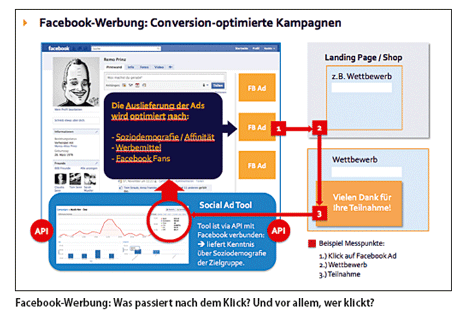
We work with a creative media approach: How do you get as many users as possible, and above all the right ones, onto the communication platform used? We look at this: What actually happens after the click? We therefore integrate a code, so-called tags, which track the user and measure where they have gone after clicking on a Facebook ad. For example, you can combine different tags with different images. We offer the technological support for this. This automatically creates countless combinations and highlights better and better combinations. So we no longer start from a target group planning that is already predefined and restrictive, but we start more broadly and can then narrow down the channelization more and more until we specifically arrive at a group where we realize that we have a target group: People are interested here. This means that we deliver different advertising material for different groups or age groups and then realize that an advertisement works better with older women here and younger men there. Different subjects therefore appeal to different target groups - and this can be measurably compared.

What does this cost the customer, and what are the benefits for Serranetga?
As with Google, margins must be reduced or even completely abolished, i.e. the click prices achieved must be credited 1:1 to the customer. Our conviction: If performance is optimized, a click should no longer be the cheapest! It's better to pay a few centimes more to convert the limited target group into real prospects, fans or buyers. The business model for Serranetga as a provider of performance-optimized Facebook advertising is therefore not based on margins from buying and selling, but on income from management fees - as has long been the case with Google.

Interview: Andreas Panzeri

Remo Prinz is co-founder of the digital agency Serranetga and the marketers Stailamedia and Adwebster. He sees his work as "inspiring and mobilizing communities for an idea". Serranetga employs 15 people.

This interview was taken from the current print edition of Werbewoche.

fb1
fb2

Ringier: Domo becomes a corporate magazine

Das Ringier-Magazin Domo erscheint seit dem 17. März 2011 mit einem neuen inhaltlichen und grafischen Konzept. Ab sofort wird es als Unternehmensmagazin  nicht nur an die Mitarbeiter, sondern auch an externe Geschäftspartner, Kunden und Medienschaffende verteilt.

As a result, Domo is now also intended to communicate Ringier's media competence to the outside world as a high-quality public relations tool. The magazine now appears in a modern, clear design that meets the standards befitting an international media company, according to a Ringier release. Ringier's Creative Director Stéphane Carpentier developed a new look and visual language together with CCO Matthias Graf and Domo Editor-in-Chief Andi Kämmerling.

In terms of content, the new DOMO will rest on the three pillars of relevance, competence and credibility, according to Graf. Especially in these turbulent times, the corporate magazine of an international media company must provide informative support for its employees, business associates and partners. Ringier wants to take a clear stand on relevant media topics in the new Domo, says Kämmerling. These topics should be presented in a good and at the same time understandable way, so that the reader can understand the world of media and thus better comprehend the decisions of Ringier. To meet these demands, the journalist Hannes Britschgi, the political journalist Johannes von Dohnanyi, the author and former foreign correspondent Peter Hossli, and the newspaper and book author Helmut-Maria Glogger, among others, were engaged for the editorial work and as authors. Ulli Glantz, deputy head of picture at Schweizer Illustrierte, was engaged for the visual realization.

Domo is now published four times a year with 32 pages and a circulation of 11,400 copies. The company magazine is printed in six languages: German, French, English, Hungarian, Romanian and Chinese.
 

Tele 1 launches new "Scene" program

Das Zentralschweizer Fernsehen lanciert mit «Szene» eine neue Sendung über Promis und Persönlichkeiten aus der Region. Gestartet wird diesen Sonntag, 20. März 2011.

Tele 1 television in Central Switzerland has now been on the air for a full year and, according to Telecontrol (Publica Data), has an average daily audience of 150,000 viewers. A broad-based market research survey is currently being carried out to ascertain the opinions and needs of the current program grid. The results will be used to initiate any adjustments and extensions in the near future.

However, a new program is already being launched these days. It is called "Szene" and will be shown every Sunday before the news. The 2-minute short program reports on prominent events from the region and lets regional personalities from politics, business and culture have their say.

Start is this Sunday, March 20, 2011 at 6:55 pm. "Scene" will be shown weekly thereafter on Central Switzerland TV.

SFLB: "If you don't like shopping centers, you should go to Sihlcity"

Die Agentur SFLB hat für das Einkaufszentrum Sihlcity eine neue Radiospot-Serie gestaltet. Die Botschaft der Kampagne: «Wer Einkaufszentren nicht mag, sollte ins Sihlcity gehen».

There are people for whom shopping in a large shopping center quickly becomes too much. According to the motto of the campaign designed by SFLB, these people should all go to Sihlcity. Because the architecture, the location, the many possibilities in addition to the range of stores - all this makes shopping much more pleasant. Even the biggest haters of shopping centers should get their money's worth in Sihlcity. This is precisely where the radio spots designed by Spillmann/Felser/Leo Burnett come in.

01_Sihlcity.mp3
02_Sihlcity.mp3
03_Sihlcity.mp3
 

Readers will pay for Internet reading of the New York Times in the future

In the future, readers of The New York Times will have to pay to read the paper online. Users will only be allowed to read 20 articles per month for free.

In addition, the content would only be available via paid subscriptions. Full access to the Nytimes.com website will cost 15 dollars for four weeks, with an additional subscription for a tablet computer costing 35 dollars.

The site, which had over 30 million visitors per month, was previously accessible free of charge. Sulzberger spoke of a significant change in the newspaper's offering. This was necessary in order to continue to deliver high-quality journalism. From Thursday, the paid model will apply to users in Canada on a trial basis. It will then apply to all readers in the USA and other countries from March 28.

While advertising revenue from the print edition of the New York Times continued to fall in January and February, revenue from advertising on the website increased, it was reported. Newspapers in the US are currently struggling with falling advertising revenues and circulation across the country, as many readers are migrating to free internet offerings.
 

Onflow at the upper lake of Zurich

The GS Graphic-Studio agency was founded in Siebnen 12 years ago. It is now rebranding with a new look and a new name: Onflow.

The agency currently employs ten people in the areas of communication, consulting, design, marketing and web development. Onflow's clients include Bank Linth, Helvetas and Key Security. The service portfolio covers the entire range of communication offline and online and is used in a target-oriented manner and, if required, also cross-medially.
 

get_footer();