Baidu, Tencent and Alibaba

China is the largest Internet market—when will the Far Eastern giants start making inroads here?

Even if China's online economy has developed in the same or a similar way to the West, there are still interesting independent developments. It is quite possible that the Chinese Internet giants will expand into Western markets in the longer term. It is therefore useful to familiarize yourself with the most important players today.

We say Google, the Chinese say Baidu. The Chinese search engine giant actually resembles its Western counterpart in many ways: in addition to search, it offers numerous other products, including a search service for MP3 music files and images as well as a weblog and encyclopaedia service. Like Google, Baidu was founded by two talented young entrepreneurs who had previously worked in the USA. Robin Li had already developed the search engine RankDex for the business news service IDD in the mid-1990s and used similar procedures to evaluate websites as the two Google founders did with their algorithm.

Both companies have comparable revenue models in online advertising, which can be booked for specific search terms and integrated into suitable search queries or on partner sites. Baidu advertises its offering with the argument that it can reach 95 percent of all Chinese Internet users. While Google is strongly driven by an engineering mindset, Baidu's focus is on product managers who are primarily oriented towards customer benefits. For the full year 2010, Baidu reported a turnover of almost 2 billion dollars, which corresponds to an increase of 78 percent compared to the previous year. Operating profit even multiplied by 147 percent to just under 600 million dollars.

Baidu has grown primarily because Google withdrew to Hong Kong in spring 2010 in order to avoid the requirements of the Chinese authorities, which demand that hits critical of the state be filtered out. As a result, Google's market share fell from 30 percent in 2009 to 26 percent, and it is expected that the Americans will continue to lose ground in China. However, Baidu is not happy about Google's withdrawal: not only are there accusations of abuse of its dominant position in the market, but a new competitor, Panguso, entered the scene in February. This search engine is a joint venture between the two state-owned companies China Mobile and the Xinhua news agency, although it remains to be seen how this offering will be received by the public.

Only those who know Tencent QQ can understand the Chinese Internet market. Unlike Baidu, Tencent is a purely Chinese phenomenon, the largest Internet company in China and the third largest in the world behind Google and Amazon. Founded in 1998, Tencent started out as an instant messaging service, and this feature remains important with its 636 million active users worldwide (as of September 2010). Since then, other services such as a comprehensive news portal, forums and chat rooms, blogs and micro-blogs, dating and, above all, games have been added. It is worth noting that Tencent is only financed to a very small extent (8 percent of revenue in 2009) by advertising. This is because Tencent is a master in the sale of additional services: more than three quarters of its income is generated on the Internet and the remaining 15 percent in the mobile sector.

This makes the Chinese a role model for online services in the West, which have gone as far as advertising revenue and no further in their search for revenue models. However, not all of the recipes for success from the East will be easy to adopt: Will virtual clothes and accessories for your own avatar (visual representative in online games or chat, for example) become a big hit here too? After all, the business with virtual goods is also booming in other Asian markets, as the examples of the two largest social networks in Japan, Gree and DeNA, show. Consequently, Tencent has introduced its own virtual currency, the Q coin. This is so popular that it has long since been accepted for payment in other online stores, which is why the Chinese central bank has raised concerns. But Tencent is also doing business in the real world thanks to the high profile of its QQ brand: merchandising articles such as bags, watches, clothes and penguins are sold as brand mascots in over 200 Q-Gen stores. Tencent has been expanding into foreign markets since 2008, creating an international version of its messaging portal and working with partners in Asia (India, Vietnam) and the USA (with America Online). Just like Facebook, the American competitor that cannot be reached in China, Tencent wants to open up its platform to third parties for the distribution of apps in future, as Tencent CEO Martin Lau recently revealed in an interview. Like Facebook, he also spoke of relying on user-specific (targeted) advertising in the future, which is not yet very well developed in China.

Blogging platforms are widespread in China and are offered by all the major portals, including Tencent, Sina, NetEase and Sohu. As access to Twitter is blocked in China, the country has its own counterparts, first and foremost the monster portal Sina with its Weibo service, which currently has over 100 million registered users. Recently, the Chinese have trumped their Western counterparts and added an instant messaging service as well as voicemail tweets and direct video uploads, further contemporary multimedia features. A public trial was also launched for location-based services with check-in functions. In promoting its services, Sina relies heavily on celebrities who are offered special accounts.

The eCommerce market in China is particularly hotly contested. Dangdang is the first, if not dominant, B2C player, founded in 1999 and one of the first websites to be financed by venture capital. Amazon took over Joyo.com in 2004, and 360buy.com came onto the scene at the same time. In the book market in particular, these three big players are engaged in a veritable price war: in the battle for market share, prices are being undercut without restraint. There is still no end in sight, as the war chests continue to be filled: Amazon is supported by its American parent company and Dangdang successfully went public on the New York Stock Exchange last December, while the American retail group Wal-Mart recently invested USD 500 million in 360buy.com and is also expected to go public.

Investors' optimism and companies' willingness to fight is understandable when one considers the forecasts of Credit Suisse, for example, which predicted a quadrupling of the Chinese e-commerce market by 2015 in a study published in January of this year. This market is then expected to be worth 311 billion dollars annually and therefore probably larger than the comparable US market. However, the lion's share of these transactions will continue to take place on the C2C portal Taobao, which currently handles 80 percent of Chinese e-commerce trade. Instead of setting up their own online stores, a number of major brands such as Procter & Gamble, Motorola, Nike and Adidas have preferred to sell their products on Taobao, which is particularly popular among young Chinese. Unlike its western counterpart, eBay, the vast majority of goods on Taobao are offered at fixed prices and are not auctioned. However, a special feature of Taobao comes into play here: buyers and sellers often communicate before the purchase via the site's built-in chat program called Ali¬WangWang. This is how customers are advised and prices negotiated. Payments are processed via the site's own online payment system AliPay. The project to bring buyers together in a dedicated social network to boost business with word-of-mouth promotions and targeted advertising is worthy of note. This huge online bazaar belongs to the realm of the billionaire and former teacher Jack Ma, who is often described as charismatic and elfish and who also owns the B2B platform Aliba¬ba.com, through which many export transactions are processed.

Background

At the end of last year, there were 457 million Internet users in China, an increase of 73.3 million within a year. Internet penetration is now 34.3% or 5.4% higher than in the previous year. In view of these growth rates, it is expected that a further 365 million Chinese will be online by the end of 2015. According to the Chinese Internet statistics published every six months, the number of mobile Internet users rose by 69.3 million to 303 million last year.

This makes China a very lucrative market for internet companies, but one that is heavily closed off due to government controls. This is one of the reasons why an independent online industry has been able to emerge, dominated by the three heavyweights Baidu, Tencent and Alibaba. If Twitter and Facebook had not been excluded from the market, it would hardly have been possible for one-hundred companies to develop to the extent that many of them are now successfully listed on the US stock exchange. Although they will still be able to grow extensively in their own markets, expansion abroad seems obvious, at least in the medium and longer term. Yu Yongfu, CEO of UC Technology, manufacturer of a web browser for mobile devices, recently put it in a nutshell: "If the USA is the center of the computer-based Internet, China will become the world leader in mobile Internet."
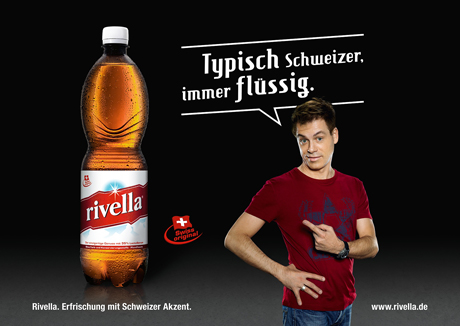
 

Jung von Matt/Limmat: Refreshment with Michael Mittermeier

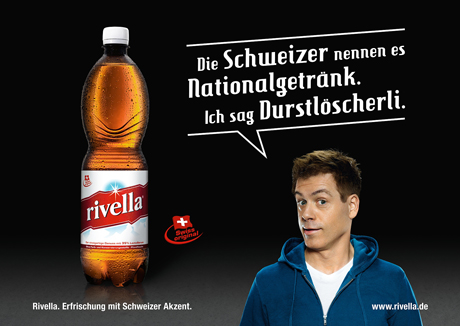
For the first time in his career, Michael Mittermeier is promoting a product - the Swiss national drink Rivella, of all things. The German comedian thus spins Emil Steinberger's successful Germany campaign further.

From the end of March, Michael Mittermeier will be advertising Rivella on TV, cinema, radio and posters, playing on the most obvious Swiss idiosyncrasy: language. The campaign was produced in Munich and will be launched in Germany on March 20. "In the campaign, it was important to us that Michael Mittermeier comes across as authentic and also contributes his own ideas," says Axel Kuhn, head of foreign business at Rivella.

Michael Mittermeier has never advertised a product before, says Rivella boss Franz Rieder. "It's all the more remarkable that he, as a German, is putting himself in the limelight for the very Swiss Rivella," he says. Mittermeier himself gives the reason: "I know Rivella from earlier, from skiing vacations. Rivella comforted me when there was no Kaiserschmarrn. Since then, I've found that the Swiss have good taste.

The result is an integrated campaign with cinema and TV spots, social and digital media, print, radio and POS measures under the campaign motto and brand claim "Rivella. Refreshment with a Swiss accent". Suspected amateur footage surfaced on Youtube and on Michael Mittermeier's Facebook fan page, showing Michael Mittermeier in everyday life, babbling a peculiar pseudo-Swiss German gibberish. At the height of speculation on the Facebook site, which is wide with over 150,000 fans, a documentary selfie provided the resolution. This is followed by the first film in the "Police Control" campaign, which shows what happens to Michael when he drinks Rivella.

A total of four cinema and TV spots, five Internet films, six radio spots, various ads and posters, online banners and online measures such as the automatic language translator, and POS materials play out the campaign idea on all channels. The campaign will be on air in Germany from March 20.

In his German Rivella campaign, Mittermeier follows in the footsteps of Emil Steinberger, whom he himself describes as his idol. For three years, Emil made Rivella known in southern Germany and Berlin with his commercials. The campaign was extraordinarily successful. During this time, sales of Rivella in Germany tripled. In the meantime, Rivella can be found not only in stores in many places, but also on the drink menus of bars, trendy bars and restaurants.

Michael Mittermeier's campaign for Rivella is running exclusively in Germany. For Swiss fans, the first TV spot, the radio clips and the making-of film are now available at Rivella.com ready

Responsible at Rivella International: Axel Kuhn (Head of International Department), Guido Nydegger (Product Manager International). Responsible at Jung von Matt/Limmat: Michael Rottmann, Alexander Jaggy (Creative Director), Alexander Holtz (Text), Inken Rohweder (Art Director), Wim Roelfs (Online Art Director), Adrian Merz (Graphics), Alexander Schradt (Screendesign), Fabian Röthlisberger, Michèle Gutmann, Daniel Nessler, Christian Brütsch (Consulting), Ilonka Galliard (Agency Producer), Erasmo Palomba (Art Buying) Martin Haerlin (Director), Pumpkin (Film Production), Ralf Noack (Camera), Jingle Jungle (Sound), Affonso Gavinha (Photographer).

rivella1
rivella2
rivella3


Flop of the week: Enemies of the Internet

To mark the third «World Day Against Internet Censorship» on March 12, the organization Reporters Without Borders (RSF) added ten countries to its list of «Enemies of the Internet.».

As in the two previous years, the list includes Burma, China, Cuba, Iran, North Korea, Saudi Arabia, Syria, Turkmenistan, Uzbekistan and Vietnam. According to the ROG report, these states censor the internet through massive filtering and blocking of websites, systematically persecute critical internet users and instrumentalize the internet for propagandistic purposes. Following the revolutionary upheavals, Tunisia and Egypt are no longer among the "enemies of the Internet", but are still "under observation". In addition to Tunisia and Egypt, ROG has placed 14 other countries "under observation". These are countries that have taken "worrying censorship measures that could easily be abused". France, Libya and Venezuela are now "under observation". France is on the list due to the new online law package "Loppsi 2" ("Loi d'orientation et de programmation pour la performance de la sécurité intérieure") passed in February 2011.

PIN data: Perplexity and new delay

The transition of TV planning to so-called individual viewer usage data (PIN data) has already been postponed three times, most recently to 2012. Now it’s official: With Mediapulse’s decision to sell the necessary tool only in a stripped-down version, the market transition will face a further delay until at least 2013.

I'm at a loss", "I don't want to comment on this", "I don't understand this decision" - these were the reactions of media agencies when asked about the PIN data issue in recent days and weeks. In fact, there was widespread surprise when Publica Data AG (PDAG), the data marketing subsidiary of Media-pulse, announced on February 25 that although it would offer PIN data together with the EvoAd tool from April 2011 as planned, it would only provide the tool in a slimmed-down form. Although EvoAd will include a reporting module, the forecasting and planning modules announced in November will not be completed for the time being. In April, PDAG will inform the market how much it will cost to obtain the data and the license for EvoAd.

However, many agencies are already wondering what this means. A reporting module that can only be used to evaluate the historical values of TV programmes in greater depth is of little use if you cannot also carry out your own forecasts, planning, optimizations and checks based on these analyses. "I assume that we will therefore continue to work with the same tools as before," speculates one agency owner, who does not wish to be named. Another believes that the large network agencies now have an advantage: they could evaluate the PIN data with EvoAd and then carry out forecasts and planning with their own tools, which they already use abroad. The small agencies would be at a disadvantage. "We will then have exactly the two-tier solution that EvoAd was actually intended to prevent," he fears.

However, Stephan Küng, President of the Interessengemeinschaft Elektronische Medien (IGEM), now disagrees. At a meeting of the IGEM board on March 14, the new situation was discussed and it was unanimously concluded "that we are sticking to a market solution for forecasting and planning". It is not yet known what this will look like, "but IGEM now wants to take a more active role in this vexed issue," says Küng. It remains to be seen whether a future tool will include and map all TV planning processes. It is conceivable that EvoAd will be used for evaluations in the future and that one or two tools for forecasting and planning will also be evaluated. "But one thing can be said with a fair degree of certainty," the IGEM President stated: "The conversion of the TV market to PIN data will therefore probably be postponed until fall 2012 at the earliest (opening of bookings in 2013)." Although the transitional solution is still open, maintaining the status quo with Telecontrol-Advertiser and Media-Optimizer would certainly be desirable, especially from the agencies' point of view.

However, this will only work if the two TV marketers Publisuisse (SRG) and Goldbach Media (private and advertising windows) also participate and continue to submit their offers to Media Optimizer until at least 2013. "The agencies have strongly recommended this to the two marketers, but their response is still pending," says Küng. The two marketers also did not (yet) want to commit themselves to Werbewoche. However, Publisuisse Head of Marketing Markus Hollenstein signaled a willingness to cooperate: "We are also currently evaluating how to proceed. As a TV planning tool accepted by the market, the Media Optimizer is of course the most obvious replacement option." The Goldbach Group, on the other hand, was unable to provide any information at various levels.

The fact that PDAG is only launching EvoAd on the market in a reduced version has to do with tests conducted last December. Agencies that were involved reported that the reporting tool was the only one that worked as desired, while the other modules were classified as "unusable to "not very user-friendly". Küng himself also fluctuates "between enthusiasm and frustration" depending on the application. Nevertheless, he pays tribute to Mediapulse and PDAG. "It takes a lot of courage to stop something that was about to be completed and in which enormous time and resources had been invested." However, PDAG itself had passed the ball to the industry: "The experience of recent months has clearly shown that the expectations and requirements of potential customers of this software are not only very complex, but also inconsistent," it said in the press release. Markus Knöpfli


Immoral image of the media industry

His Rich hagiography "King of Oil" has earned Daniel Ammann the title of Swiss "Business Journalist of the Year". A choice that is abysmal and prompts me to publicly resign from the jury responsible for this award. By Oliver Classen, press spokesman for the development policy organization Berne Declaration, previously media editor.

classen

The Schweizer Journalist (SJ) should actually be congratulated on five years of navel-gazing that is as uncomfortable as it is entertaining. However, the current anniversary edition of the industry journal of all publications has published two embarrassing articles that give itself and, more importantly, Swiss journalism a damning verdict on quality. After all, the first verdict "only" comes from the 1,550 participants in this year's Internet vote for "Journalist of the Year", which elevated the two mom bloggers from Tagesanzeiger.ch to the prestigious podium - at least until now. With all due respect for the sometimes refreshing insights into the splendor and misery of parenthood: in view of the research cracks, noble feathers and reportage professionals who were also nominated, it is certainly a soft choice that attributes more social relevance to crib gossip and family radio than, for example, political revelations and their classification.

The far greater affront, however, lurks in one of the eight sub-categories judged by a so-called expert jury. In the "Economy" category, the 25-member panel, which until today included the writer, awarded Daniel Ammann. The former head of department at Weltwoche, Magazin and Facts was honored explicitly for his biography of commodities trader Marc Rich, which was uncritical to say the least. There's no question about it: it's perfectly legitimate to reward three exclusive audience days with the world's most secretive and elusive business tycoon with a palatable bestseller. However, "King of Oil", the title of the heroic epic authorized by Rich, rehabilitates one of the most unscrupulous dealers and shameless profiteers of the 20th century - with moral soft focus and professional errors.

The magazine as a media vicarious agent

To illustrate Rich's "spirit of business innovation", Ammann circulates the legend that he introduced the spot market in oil trading. However, this trading technique goes back to the American Phillip Brothers. As a pioneer for Switzerland as a global commodities center, "Phibro", where Rich also learned his trade, was at least as important as the godfather of the Zug commodities Rambos. The fact that Ammann allowed himself to be instrumentalized by his key witness on his own behalf is also shown by the title of what is still the only relevant Rich research in book form: "Trading genius or lawbreaker? An Unwanted Biography" by US journalist Craig Copetas had many legal repercussions for a reason. Anyone who writes authoritatively about Rich is inevitably carrying out commissioned work.

However, this basically harmless home story, because it was simply reported rather than researched, only became a scandal thanks to those who turned it into a bestseller: Ammann's colleagues in the opinion-forming media. The magazine, for example, was not too shy to run a cover story with a laudatory Edito, a six-page pre-print and a cover with the same feisty Rich grin as the one on the book cover. The fact that this blatant case of free editorial advertising for news-poor non-fiction did not come before the Press Council is at least as outrageous as the trivialization of Rich's money-grubbing lack of conscience.

So now Ammann is also Swiss Business Journalist of the Year, awarded by a compliant or clueless group whose members range from App, Rolf (media editor of the St. Galler Tagblatt) to Zwyssig, Toni (ex-SF trainer). Despite this B-jury, the crowning of the court jester Ammann is tantamount to an oath of revelation for the entire industry and is also a mockery of all those nominees whose less glamorous work provided far more insight into what holds the business world together at its core. Reason enough for me to say goodbye to this illustrious committee.

PS: In Iceland, the local WikiLeaks spokesperson has just been named "Journalist of the Year". Other countries, better manners.


Graubünden supports Alpinavera marketing association

According to the Graubünden government, the Alpinavera association successfully markets regional products from the alpine and mountain regions. For this reason, the executive branch decided to provide Alpinavera with a total of 700,000 francs in funding from 2012 to 2016.

The association was founded in 2006 and offers joint marketing to processors and direct marketers from the mountain region. Alpinavera aims to increase added value locally, as the government announced on Wednesday. The canton has already provided CHF 1.1 million in funding to set up the organization.

According to the executive, the majority of Alpinavera's targets have been achieved and in some cases exceeded. Around 270 companies are now involved. More than 500 products with a turnover of around CHF 70 million are certified by Alpinavera. The cantons of Glarus and Uri have also joined the organization.


Fashion instead of lifestyle

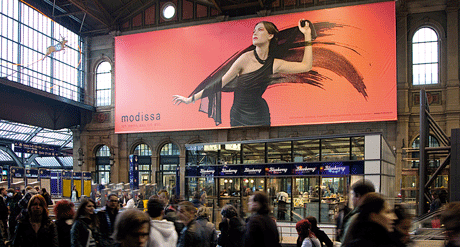
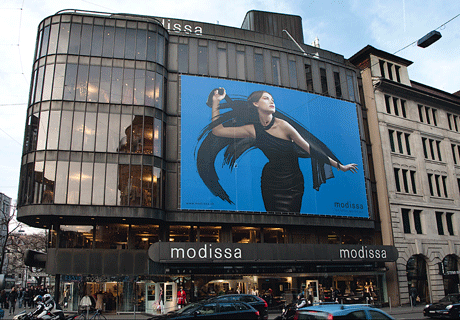
Cavegnwerbung continues to promote the new brand identity of the Zurich-based fashion house Modissa, drawing attention with eye-catching accents on the giant poster.

Like the brand, its appearance should be classic and consistent. To set itself apart from the world of fast-moving trends, Modissa continues to build on the motto "fashion instead of lifestyle". After all, women in their mid-thirties don't change their tastes with every trend, but look for the style of great fashion. And Modissa is all about this great classic world of fashion. The label's customers value style advice, attitude and quality. Cavegnwerbung's campaign continues to express this through large-scale and striking motifs. The images stage the journey of classic fashion from the design sketch to the dress that lasts for seasons. I know what I want. The claim expresses the self-confident attitude of the customer. This self-confident commitment is also expressed in the media. In addition to a poster campaign, Markus Cavegn and his designers Christ Burkhard and Daniel Soldenhoff as well as copywriter Markus Rottmann and photographer Julien Vonier are also using megaposters - highly visible on the façade of the Modissa main store and in Zurich's main railway station. Andreas Panzeri

modissa1
modissa2
 

The fireworks of news

An app for Marketing Day, audience interaction, an advertiser on the throne—promising new tools were put to use on “Day of Action” at the KKL Lucerne.

The appearance of Switzerland Tourism boss and in-house advertiser Peter Felser was one of the highlights of the Swiss Marketing Day. For once, it was possible to experience live how clients and external creatives work together. And you could comment on it live. When the audience can join in and vote on questions using handheld devices, it creates a higher degree of connection and can increase the pace and intensity of an event. As was the case on March 8, 2011, when the audience was able to contribute ideas in a "live case" on how the Samaritan Association could raise more donations. The winning idea chosen by the audience was that it should be possible to automatically round up remaining amounts to the nearest franc and donate them directly to the Samaritan Association every time you shop in a Migros or Coop store. Will the idea actually make it to the checkouts of our retailer top dogs in the future?

External performance accelerators

The extent to which the Swiss Marketing Day has already arrived in the future could already be seen in the run-up to March 8, 2011. With the free app, you could keep up to date at all times, upload your own pictures and put your own stamp on the event. Or exchange ideas in the newly designed networking area immediately afterwards.

The Marketing Trophy has also been given a clever facelift. The newly created special award makes it possible to recognize companies that might not succeed in the conventional categories. Because the award winners are often spurred on to top performance to a substantial extent by external creative professionals, it is also easy to understand why the external agencies are now also mentioned in the same breath as the winners and appear on stage with the winners. On the stage, by the way, which is already being prepared - at least mentally - for the Swiss Marketing Day 2012.

marketingtag
 

"Social Media" and Stress at the SWA Annual Meeting.

The annual meeting of the advertising client association SWA took place on Wednesday at the packed Stage One in Oerlikon. The meeting addressed the questions "Communication in rapid change - where will we advertise tomorrow? Where do we meet our customers?" as the theme.

SWA President Roger Harlacher welcomed more guests than ever at this year's meeting, as well as a whole host of new members - Sanofi-Aventis, Helvepharm, Bico, Schuler St. Jakobskellerei, Tchibo, Bank Vontobel, Estée Lauder, Hug and Zürich Tourismus. What everyone wanted to know at the moment was the impact of "social media" on communication and consumer behavior, according to an SWA release on Thursday. The meeting therefore focused on questions such as: "How do we use the new opportunities efficiently? And is success even measurable? Are they salvation or just hype?"

Moderator Dirk Schütz, Editor-in-Chief of Bilanz, introduced Frank Mühlenbeck, Managing Director of the German Institute for Communication and Law on the Internet, as the first guest speaker. In his presentation "Social Media - Perspectives of a Media Revolution," Mühlenbeck explained the success of social media by saying that thousands and thousands of people can be reached within a short time - and that people trust other people much more than companies and institutions. Above all, it is not only information that is transmitted in these contacts, but also emotions. But companies must integrate social media holistically throughout the entire value chain if they want to be successful with it. And they will no longer be able to afford to neglect social media.

Leila Summa, Social Media Director of Migros, said quite openly in her presentation "In online dialog with customers - and now?" that Migros had already given up control in social media because it was never possible in the first place. Migros follows the lead principle in its use of social media: Listen, Experiment, Apply, Develop. Listening is the most important thing. Gottlieb Duttweiler had deliberately used his first Migros trolleys not just as sales vehicles, but to engage in conversation with customers. That became increasingly difficult in a large company. Today, customers talk to each other and engage more intensively with the products than was ever possible with advertising.

In the panel discussion on the future benefits of TV advertising between Martin Krapf of IP Deutschland, Martin Schneider of Publisuisse and Markus Faschang, CEO of l'Oréal Switzerland, moderator Dirk Schütz had expected sharper controversies than actually took place. No wonder: TV advertising, so often pronounced dead, is thriving - partly because social media are a communication medium but not an advertising medium per se. In this respect, they are not really competition for TV advertising. But the interdependence of TV and social media is becoming important. After all, Facebookers and Twitterers are also TV viewers. In any case, the classic "30" commercial will be around for a very long time.

Rapper Stress took to the stage for the finale. Reto Lazzarotto, CEO of the management and concert agency Gadget and Stress' manager, explained where money is made in the music business - by no means everywhere. Stress himself had a lot to say about brand management - after all, he studied economics and worked at Procter&Gamble before devoting himself entirely to his music. He has 85,000 Facebook fans, and they tell him loudly and clearly and quickly what they like and what they don't like so much. And addressing advertisers, he said, "When you market artists, the artist and the brand have to go together, otherwise it doesn't work for either side."

SWA board members elected
At the ordinary general meeting, which immediately preceded the annual meeting, the two board members Werner Bärtschi (Subaru Switzerland) and Stefan Nünlist (SBB) were confirmed in office by acclamation for another 3 years. In place of Mrs. Danièle Michel (Nestlé), who had resigned for professional reasons, the director of the Mondo publishing house, which also belongs to Nestlé, Mrs. Kim Hoose was unanimously elected to the board. Flavio Caligaris, Contry Manager Coca Cola Switzerland, a representative of the beverage industry, was also unanimously elected to the Board.
 

Top of the Week: LZ Medien with Record Sales

The LZ Group generated record revenue of 166.4 million Swiss francs in fiscal year 2010. This represents a 4.6 percent increase over the previous year.

Operating profit almost doubled to CHF 15.6 million. Group profit amounted to 12.0 million francs. Following the dramatic economic downturn in 2009, the markets showed a slight recovery from the second half of the year onwards, according to a statement from the LZ Group. All business divisions took advantage of this environment and, together with the cost-saving measures introduced in 2010, operating results improved significantly. The growth in sales is mainly the result of higher advertising income and the income from Tele 1, which was fully integrated in the year under review, according to the statement. The economic recovery benefited advertising revenues in particular. These increased by CHF 3.9 million to CHF 50.3 million, also thanks to the acquisition of Anzeiger Luzern. An increase of 1.3 million francs (or 3.1 percent) to a total of 42.0 million francs was recorded in subscription and individual sales.

Like - Dislike

Manuel P. Nappo, Head of Studies CAS Social Media Management HWZ.

nappo

I like it when I can quickly find what I'm interested in on a website. Especially when it comes to social networks. I'm certainly not the only one, otherwise Facebook, Twitter, YouTube and the like wouldn't be so popular. These platforms are the best way to have a dialog with customers, as they are accessible all over the world at any time and information can be disseminated quickly.

Now there are companies that do not yet seek dialog with their stakeholders as much as they could. That may be ok. Time will tell. But when a company makes the following promises: "We connect people" and "We enrich and simplify the lives of our customers", it surprises me when I have to click through until I find a social link.

That's how I feel on the website of Swisscom, probably the best-known telecommunications group in our country. Mobile and Internet provider. It takes about four clicks (depending on what you try first) to find buttons for the social networks that you could use to communicate with Swisscom. If you don't do this, which is more likely to be the case, you can quickly get lost on this relatively impersonal homepage, and there is a risk that you will give up before you reach your destination.

Anyway. When I find the page and click on the icon, I am finally redirected. To where? To the official Twitter page @swisscomnews. But there are about nine of these (official pages) (if you search directly on Twitter). In all three national languages and of course for every area. Why does everyone always want to sell me everything from a single source when they talk to me separately? The official site speaks English, by the way. To me. Not to me, because they simply repeat media releases. Not a trace of dialog.

If you look further (on Twitter), you will find something like a personal customer service on @Swisscom_Care. "Help simple and uncomplicated" is the motto, but only "Mon-Fri (8-17h)". Exactly when you need it. To be fair, TizianaD^TD, NunoP^NP, SteveD^SD and DennisA^DA respond relatively quickly and try to provide competent information. I think it would be great if you could benefit from this service 24/7.

One last comment concerns the maltreated CI on the social networks. @Swisscom_Care, @swisscom_de, @swisscomnews, @swisscomlabs, @swisscom_fr, @swisscom_it, @JRZ_Swisscom, @swisscom, @swisscomITS, @SwisscomDiv are the names on Twitter. swisscom, Swisscom, Swisscom Labs, Swisscom TV are the names on Facebook. Perhaps it would make sense to agree on lower and upper case at the beginning. And to use names that are easy to understand.

From these and other examples not listed for reasons of space, it is clear that the Swisscom/social media relationship still has a lot of potential for optimization. As a loyal customer, I hope it does. Because as with the #fail comments on Twitter. Sometimes they are pure bashing. Most of the time, they are valuable input for improving a service. It's always worth taking them seriously. 1921 L'illustré will be published on September 10

Switzerland Tourism: New District Manager Western USA

Switzerland Tourism has filled the position of District Manager for the Western U.S. Alexandra Imhof is moving from Paris to Los Angeles.

Switzerland Tourism ST has appointed Alexandra Imhof as the new head of ST representation in Santa Monica/Los Angeles. After four years as Marketing Manager at ST Paris, she will assume responsibility for marketing Switzerland as a vacation destination on the West Coast of the United States as District Manager on April 1, 2011.

Alexandra Imhof succeeds Fausto Zaina. He is leaving Switzerland Tourism at the end of March 2011 to take up a new challenge with Swiss Travel System STS. Alexandra Imhof's successor is Véronique Mayor. Véronique Mayor, a communications planner with a federal diploma, gained her experience during six years with Migros Vaud, among others. Véronique Mayor will take up her position as Marketing Manager in Paris on March 21, 2011.

Alexandra Imhof has years of international professional experience, both in tourism and in the consumer and luxury goods industries, according to an ST release on Thursday. After obtaining her licentiate in political science from the Faculty of Social and Political Sciences at the University of Lausanne (SSP), she earned a Master of Commerce from the University of Sydney, Australia. In 2006, she joined Switzerland Tourism, where she acquired in-depth knowledge and experience in tourism through various positions. At ST France, for example, she was Marketing Manager responsible for the products winter, cities, gourmet travel and wellness, and she looked after SWISS International Arlines as Key Account Manager. Also at ST France, Alexandra Imhof was Campaign Manager for Euro 2008. Prior to that, she worked as Product Manager for L'Oréal in Geneva and Zurich and as Marketing Consultant at an Australian agency.
 

get_footer();