Illnau-Effretikon defends itself against publication organ

In Illnau-Effretikon, there is resistance to the official publication Regio.ch. The Juso and BDP write in a postulate that they have heard from the population and across all party boundaries that the information provided by this weekly newspaper is not satisfactory.

They are therefore calling on the city council to terminate the current contract at the end of the year. The city should also examine whether, in their opinion, a better print medium could be created instead of Regio.ch, the successor to the Kiebitz. To this end, the city council should invite all weekly newspapers distributed in the city and other interested parties to submit a competitive bid. Regio.ch, which is published by Zürcher Oberländer Medien AG, gives the impression of a journalistic one-size-fits-all, in which editorial content and advertising are increasingly mixed. (SDA)
 

"You can never please everyone"

The Association of Swiss Free Newspapers (VSGZ) will celebrate its 20th anniversary on September 27. Markus Knöpfli therefore looked back on the association’s recent history with VSGZ President Thomas Akermann and spoke with him about membership growth and resignations, the association’s adherence to its own quality criteria, and gaps in the VSGZ membership network. Akermann also explains why the Zehnder newspapers cannot join his association and why the VSGZ does not want to be a member of the Publishers’ Association.

Mr. Akermann, there must be 100 large and small free newspapers and advertisers in Switzerland. Which ones do you represent in your association?
Thomas Akermann: Those that are published weekly, reach all households in the distribution area and meet certain quality criteria (see below). Many of them are also traditional titles that have a high number of exclusive readers, i.e. people who do not read a subscription daily newspaper.

The VSGZ has been dormant for a long time over the past 20 years. But in 2007, when the commuter newspapers News, .ch, Cash daily and Heute/Blick am Abend caused a sensation, you reactivated the association. What has happened since then?
Since then, the number of members has more than doubled, we have launched an advertising package on the market, and we have offered internal seminars for better online presences. We also introduced the following on the website Free newspapers.ch We also introduced a combined calculator that quickly provides the advertising market with an offer. We also carried out active generic marketing and were active in the area of littering.

Where do you see construction sites?
I am not yet completely satisfied with the combination. We have gained more volume and also a few national customers, but there are potential customers who are not yet advertising with us. We also want to support the expansion of our members' online presence, for example with games that are attractive to readers and ideally combine online and print.

It seems to me that the VSGZ fell asleep again after News, .ch and Cash daily disappeared from the market: The combined project made slow progress and is now smaller than it was a year ago. Even a founding member, Biel-Bienne, turned its back on you. What went wrong?
I personally regret the withdrawal of Biel-Bienne. But you can't say that anything went wrong. And it's certainly not a case of falling asleep. You can never please everyone. The important thing is that we are growing overall and that the majority are satisfied. A look at the list of members shows this: We are well positioned!

Arc Hébdo and the Courrier Neuchâtelois are also no longer involved. Are you meeting with reservations in French-speaking Switzerland?
No, because Jean-Marc Vellmann from GHI is our Vice President, we are well anchored there - and we have the big players from French-speaking Switzerland with us. But we welcome every new member. However, publishers differ in their assessment of how important a national connection is for individual titles. The fact is that we have more members today.

How many members are there? Last year you communicated a combination of 21 titles, in a communiqué from August 2011 there was talk of 18, on your homepage 19 are listed, but in a downloadable brochure only 14.
This shows that we still have some room for improvement when it comes to integrated communication (laughs). There are currently 20 members, if you count Zuger Presse, which is published in Baar as a Zugerbieter, as two individual titles. The differences have arisen because sometimes individual titles are counted and sometimes publishers. AZ Medien, for example, is a member with four titles, while Tamedia has a stake in three.

In a recent press release, you praised the fact that the reach of VSGZ members had remained "extremely stable" according to Mach-Basic 2011-2. However, you failed to mention that several VSGZ members no longer report their readership at all.
As an association, we support participation in the Wemf readership research. I also believe that this is important for the marketing of the station wagon. It is also a sign of seriousness that we can use to differentiate ourselves from other market players. However, I cannot dictate this to the publishing houses.

According to the VSGZ website, participation in Mach Basic is a prerequisite for association membership.
That is correct. Sometimes the publishers simply disagree. We don't immediately exclude a member because of this.

After all, a quarter of your members - the RhoneZeitung, the Rheinzeitung, the Baslerstab, the Anzeiger Luzern, the Bündner Anzeiger - have been doing without the reach survey for years in some cases.
I can only emphasize this: It is right and important to be there, and it is a mistake not to be. But as president of the association, I can't tell anyone what to do.

You recently emphasized that the majority of VSGZ members in German-speaking Switzerland had not suffered any major losses in readership compared to 2004, and that they were "a solid and sustainable advertising medium". This is partly true. However, according to Wemf, the language-assimilated population in German-speaking Switzerland has increased by around 350,000 people since 2004. The individual free newspapers should therefore have grown in line with this thanks to the spread of households. Why couldn't they keep up?
(thinks) This conclusion is only theoretically correct. Due to changes in positioning and concepts, the distribution areas were reduced in some cases. However, the VSGZ titles were able to defend their territory surprisingly well compared to other print categories. Many subscription titles lost readers significantly during this period.

There are also VSGZ titles, such as those in Basel, Berne, Zurich, Lucerne, Geneva and Lausanne, which have 20,000 to 40,000 fewer readers today than in 2004.
Some of these titles have undergone drastic concept changes: they adapted their publications to the market, sharpened their profiles, restricted their distribution areas and focused on cities. In this respect, their figures are not comparable.

"You can avoid the stop-advertising sticker via a free newspaper..." promises the VSGZ website to customers. Surely this is only true for titles that are also official publication organs?
Legally speaking, we are in a gray area. But it is true that we are getting past the stop stickers. This is interesting for brochure inserts, where we are seeing growth.

However, there are titles among the VSGZ members that do not serve letterboxes with stop stickers - the Baslerstab, for example.
I assume that these are exceptions at the special request of individuals. In principle, we can get past the stop stickers and are therefore a very interesting partner for advertising clients.

There are still gaps in the VSGZ network - in western Switzerland, Ticino, Solothurn, central Switzerland and around Lake Zurich. Why have you never been able to close them?
Firstly, there are not comparable concepts or titles in all areas, and secondly, not all candidates meet our requirements.

Does this still apply to the many titles of Zehnder AG in Wil SG?
Yes, they do not meet the criteria. We are not prepared to dilute our clearly defined image and positioning. Because we want to be a serious and reliable partner for the advertising industry.

The only thing is that you would have to pay even more attention to your own quality criteria - in terms of reach, stop stickers and circulation: three VSGZ members - GHI, Lausanne Cités and the RheinZeitung - do not have their circulation certified.
In principle, the criteria are valid and we uphold them. However, if the situation is unclear in an individual case, we do not react immediately, but first seek a discussion.

What goals have you set yourself for the next two or three years?
The main thing now is to drive the Kombi forward. We want to position it even more clearly and professionalize its marketing. Then we want to represent the free newspapers even more strongly to the outside world in terms of generic marketing. We are also currently holding talks with potential members so that we can eliminate the blank spots on our map as far as possible.

Four years ago, the VSGZ negotiated with the publishers' association - the aim was to become a member of the association and form a sub-group.
We are in regular and good contact with the publishers' association. At the moment, however, we are of the opinion that we can achieve more for our genre as an independent organization. That is why we are continuing on this path.

The VSGZ membership criteria

To become a VSGZ member, a free title must have its own editorial team, have been on the market for at least one year and be distributed at least once a week to all households in its distribution area. In addition, the editorial share should be at least 20 percent of the volume and PR texts must be identified as such. The title must also have its circulation and reach surveyed by Wemf, and it should have at least 0.75 readers per copy.

The current VSGZ members

Affoltern district gazette
Lucerne gazette
Anzeiger St. Gallen/Thurgau/Appenzell/Liechtenstein
Basler rod
Bernese bear
Bündner Anzeiger
Fridolin
GHI
Lausanne Cités
Lenzburger Anzeiger
Upper Lake News
RheinZeitung
Rhone newspaper
Schaffhauser Bock
City Gazette Olten
Tagblatt of the City of Zurich
Winterthur City Gazette
Weekly newspaper for the Emmental and Entlebuch
Zug press
Zugerbieter (Baar)


Schoch&Sonders: Projects implemented for Emmi Caffè Latte and Kaltbach

The branding agency Schoch&Sonders has carried out projects for two new Emmi products, which will be available starting in the fall of 2011 at various stores in Switzerland and abroad.

The two Caffè Latte varieties Macchiato and Cappuccino are now also being launched on the market as a 4Pack. Aimed at the brand's heavy users, packaging was developed to convey Emmi Caffè Latte's brand values, the agency writes in a statement. The brand image focuses on the origin, taste, composition and fine processing of the leading products macchiato and cappuccino.

Emmi will also be launching Kaltbach Fondue in the new Kaltbach design in October. The packaging design, which will enter the range with the existing products, was developed by Schoch&Sonders.

Responsible at Schoch&Sonders: Roman Sonders (brand strategy, brand design, brand appearance), Dominik Schoch (strategy/concept), Annina Benz (design/concept), David Moore, Dominique Ghilardi (project management/consulting).
 

Weber Harbeke Partners: New beverage launched for Valora

Weber Harbeke Partners is launching an alcoholic sweet drink for Valora—one that still needed a name.

In addition to ok.- energy drinks, mineral water, and beer, there are now four colorful aluminum bottles on the shelves of Avec. and K Kiosk: ok.- Dizzer, fruity drinks with 4.7 % alcohol by volume. As a "sweet drink based on fruit wine" with just 4.7 % alcohol by volume, it is not considered an alcopop. That's why the Weber Harbeke Partners agency immediately invented its own product name: "Dizzler", derived from the English "dizzy" for "dizzy".

The packaging, developed and designed by Weber Harbeke Partners, also stands out from the Alkopop competition. The exotic flavors of ok.- Dizzler, such as Caipiriña/Coconut, Lime/Curaçao, Raspberry/Feijoa, and Passion Fruit, are not in glass bottles but in lightweight, brushed aluminum.

Responsible at Valora Switzerland: Helmut Wenzel (Category Manager), Rita Vozarov (Marketing), Jana Zimmermann (Advertising and Sales Promotion). Responsible at Weber Harbeke Partners, Zurich: Max Weber, Thomas Harbeke (CD), Giovanni Pucci, Diana Portmann (consulting), Marcel Fässler, Ramon Aemmer (AD), Christian Sidow (text).

dizzler2
dizzler3
dizzler1
 

Südostschweiz Medien launches smartphone app

Following the launch of the app for tablets, Südostschweiz Medien is now releasing its smartphone app. It is available for free immediately in the iTunes Store and the Android Market.

The focus of the application¨is on regional, national and international news, blogs and entertainment on the go, according to a press release. Radio Grischa is integrated into the app - a live cam makes it possible to follow what is happening in the studio. In a further step, Tele Südostschweiz will be available via the app.

Users can also find their favorite Südostschweiz Medien title, which they can read for free as an e-paper on their smartphone as a subscriber. And reader reporters can send their stories, pictures and videos to the editorial team quickly and easily using the form.

The "Südostschweiz Medien" app is now available free of charge in the iTunes Store and in the Android Market available.

> Südostschweiz" is now available with a tablet PC


New publishing director at Saiten, the cultural magazine for eastern Switzerland

Richard Zöllig, the head of Saiten-Verlag, will be leaving the offices in downtown St. Gallen at the end of September. Peter Olibet will take over as the new publishing director.

Richard Zöllig worked at Saiten for a good six years, according to a press release issued on Monday. Under his leadership, the successful second volume of Manuel Stahlberger's "Herr Mäder" was published - and the equally successful first volume was reissued in a revised edition, it says. He was also instrumental in the implementation of the region's most comprehensive online cultural calendar on Strings.ch  have been involved.

The former sports journalist is expanding his involvement with SC Brühl, which is ranked in the Challenge League, and will not only serve as vice president, but will also manage the office.

In future, the new publishing director Peter Olibet will be responsible for keeping the editorial team free from PR reporting and keeping the magazine on track commercially. After managing the secretariat of the SP of the Canton of St.Gallen for five years, the 35-year-old spent a year in Ecuador with his family until this summer to teach school there. Peter Olibet studied New Media at Hyperwerk Basel and will therefore ensure that Saiten remains agile and on the ball on the Internet.
 

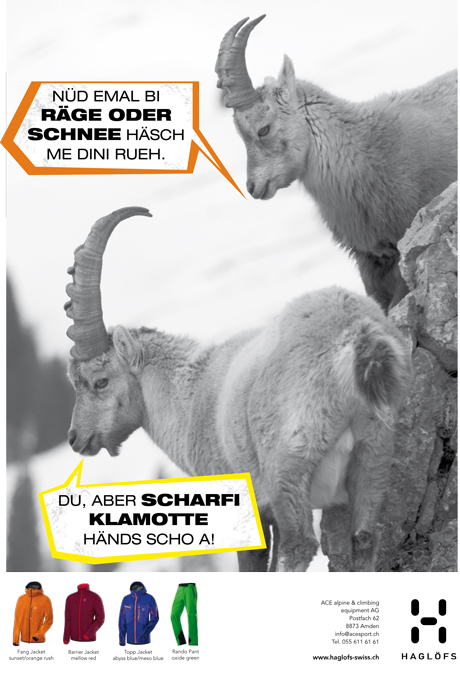
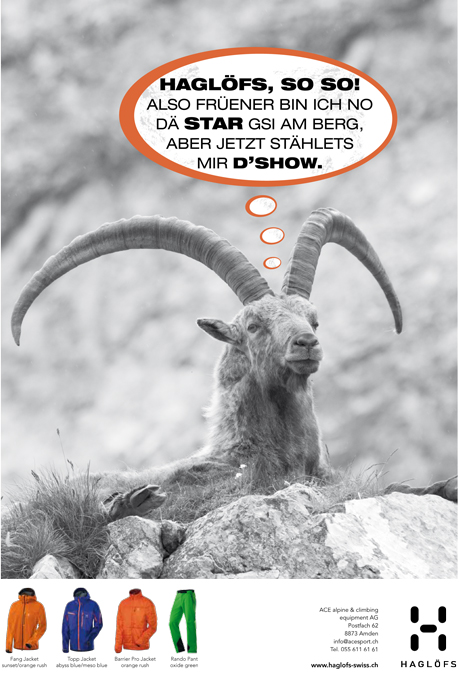
Haglöfs and WVC leave behind amazed ibexes

WVC Communications has signed Ace Alpine & Climbing Equipment, the general importer for Haglöfs, as a new client. The agency has been tasked with repositioning the brand.

WVC was commissioned to reposition the Haglöfs brand. As new brand ambassadors, the advertisers from the Zurich Oberland use ibexes, which embody alpine mountain sports in their own way. In the new image, the ibexes are seen marveling and full of appreciation for the latest Haglöfs products. Finally, mountaineers with the right equipment.

In addition to the ads, a product brochure, a microsite, POS material and postcards will be realized.

Responsible at Ace: Richi Bolt (Managing Director), Ueli Arnold (Product Manager). Responsible at WVC: Kurt Wettstein (overall responsibility), Yves Seiler (consulting, production management), Damian Thür (graphics), Nicole Antonietti, Kevin Wettstein, Alexandra Barnes (DTP), Michael Jud (online communication). Capricorn Photographer: Pierre Burkhart.

steinbock1
steinbock2
steinbock3


Miss Switzerland pageant: SF is dissatisfied with market share

After the Misters have already been kicked out of the program, the air is now also getting thin for the Misses: Swiss Radio and Television (SRF) is not satisfied with the market share of Saturday's Miss Switzerland election and now wants to "discuss the further procedure" in the next few days.

The election of Alina Buchschacher from Bern interested just 25.7 percent of all those who sat in front of the TV. In other words, 74.3 percent of viewers preferred to spend their evening on another channel than SF zwei.

Swiss television has been observing a downward trend for several years, but the market share for a pageant has never been as low as it was on Saturday. Three years ago, for example, when Whitney Toyloy was chosen, it was still almost 40 percent. The numbers were down ten percent compared to last year, Bernard Strapp, head of show and events, told SDA on Monday. "This shows that the acceptance of the Miss Switzerland election among the public has fallen." mIn the next few days, he said, the issue would therefore be discussed together with those responsible for RSI and RTS, the television stations in French-speaking Switzerland and Ticino, and then further action would be defined.

The Mister Schweiz election has already been taken off the air. Because the market share of this year's edition dropped to just 26.3 percent, Swiss television decided in May to stop broadcasting the show. Private broadcaster 3+ then granted the handsome men asylum and a three-year contract with the Mister Switzerland organization. Thus, the Misters continue to have a platform and 3+ the first big Saturday night show in their program. (SDA)

Last but not least: In the wrong movie

A young woman wakes up with a hangover in a hotel room. Confused, she realizes that she must have gotten married last night.

The perfectly fitting wedding dress and the glittering ring on her finger are clear indications of this. Then her new husband enters the bedroom - and she seems to have hit the jackpot. After watching the movie, the ladies among you are welcome to close your eyes for a moment and imagine what would happen if ...

Incidentally, the commercial advertises the Norwegian bank DnB NOR.


SRG: Negotiations with politicians about Billag and online advertising?

SRG Director General Roger de Weck is said to have been in Bern, along with his lobbyist Lorenz Furrer, to minimize opposition to the SRG's planned online advertising.

The SRG's latest coup is an offer to the powerful trade association (SGV), as the Sonntagzeitung writes in its current edition: They support the Billag relief for SMEs in the upcoming consultation process, as the SGV has demanded via the Büttiker motion. In return, the SGV must abandon its opposition to SRG online advertising. The argument is that if the Billag fee is waived for small companies, the loss of revenue must be made up with online advertising.

The parties are keeping a low profile. SRG spokesperson Daniel Steiner even categorically denies any talks with the SGV. However, research by the Sonntagszeitung shows that SRG has already approached the SGV leadership twice in this regard; the first time Roger de Weck received Trade Director Hans-Ulrich Bigler and his Head of Communications Ruedi Christen for a breakfast meeting just over a month ago. And the week before last, the SRF editorial team visited the SGV leadership.

Christen confirmed that informal talks had taken place with SRG Director General Roger de Weck and the SRF editorial team. "Mr. de Weck and SRF's editorial team explained SRG's position in the dispute over online advertising to us. The Billag issue was also addressed." However, he does not want to talk about a "deal". According to de Weck, nothing less than SRG's very existence is at stake with the move to the web. Publishers fear being crushed by SRG in the growth market of the Internet.

Zürcher Oberländer: Shareholders sought via newspaper advertisement

The Zürcher Oberländer wants to sell its own shares to readers and published a full-page ad to that effect in Saturday’s edition of the newspaper. In an accompanying article, the ZO promises an «attractive return» of 40 to 70 francs per share.

The offer includes 1000 shares, which are being sold at a price of CHF 760. According to the advertisement, Tamedia, which already holds 38 percent of ZO and is therefore the largest shareholder, is explicitly excluded from the purchase. The aim of the sale is to distribute the shares as widely as possible. The majority of ZO shares are currently held by a total of 470 small shareholders. They all own a maximum of two percent of the total number of shares. (SDA)
 

DRS music program undergoes gentle renovation

An analysis has shown that six percent of the programming on DRS 1 and DRS 3 overlaps. The two stations are now set to undergo a musical reorientation.

According to Robert Ruckstuhl, Head of Radio at SRF, DRS 3 will focus on newer, more current music in future, while DRS 1 will aim for "a broader spread": "Music from the 1960s to the modern era. However, we will play tracks from the 80s rather than the noughties," Ruckstuhl is quoted as saying in the newspaper Der Sonntag. He is convinced "that most people are musically socialized in their youth". A large proportion of DRS 1 listeners were born in the 1950s or earlier. This has to be taken into account. This will lead to an expansion of the repertoire. Chansons, canzoni and also German pop will be heard more often on DRS 1, while classic hits will continue to be part of the core business of DRS Musikwelle.

Not only the DRS music program will be gently renovated from November. According to Sonntag, information will also be slightly expanded. In future, a longer overview of the day's events will be offered from 4 p.m. onwards. Furthermore, important sports results will be announced immediately in the daily program.

Finally, the increasingly long traffic jam reports are to be packaged in a more original way. The aim is to "journalistically weight" the reports, "present them in a more comprehensible way" and generally "think more in terms of the user than the disseminator" when moderating. According to Ruckstuhl, several presenters are currently being piloted - tried and tested voices and those that are not yet known.
 

get_footer();