More than just clicks

The Internet is no longer a mystery. With its endless possibilities for sharing information and its ever-growing number of users, it has become an indispensable part of the marketing mix.

Since the beginning of Internet advertising, it was mainly about the click rates of the advertising banners. At last, advertising was directly measurable. This one-sided way of looking at things has actually long since become outdated, because it reduces Internet marketing to a kind of modern direct marketing. This is despite the fact that countless studies by renowned institutes prove that online advertising has a major impact not only in direct sales, but also in brand building, brand sympathy and brand topicality. 13 online key players - some of them competitors - got together in an uncomplicated way and launched the Internet site www.mehr-als-nur-klicks.ch this week. In a very informative way, the site explains the hitherto often unknown possibilities of online advertising. In addition to examples, there is also the possibility of downloading a large number of impact studies in the online sector. The offer is rounded off by further links with additional examples.

The companies involved in the campaign are Plan.Net Suisse, 20 Minuten online, Newsnetz, Blick.ch, Adextra, Swisscom/Bluewin, Search.ch, Microsoft Advertising, Axel Springer, gmx.ch, Omnimedia, Stailamedia and Zattoo. The fact that the campaign is so broadly based means that it will certainly not fail to have an impact. Werbewoche wanted to know from Urs Schneider, Chairman of the Board of Directors of mediaschneider, what he thinks of this initiative and what points are important to him in Internet advertising.

Urs Schneider: Compared to Germany, we are lagging behind in Internet advertising. Not only in terms of volume, but also in the use of creative options. Why is that?
We certainly lag behind the major European countries in terms of Internet advertising. But that's also due to the incomplete recording of advertising investments. There are also quite good creative solutions in Switzerland, but compared to Germany, we certainly have some catching up to do. Implementations with annoying pop-up ads are not really creative ideas.

Why did people talk mainly about click-through rates until today?
I think this is due to the standardized measurement methods that have been introduced. Judging the success of an online campaign only on the level of click rates is insufficient, because these can be massively influenced by the advertising media used. If you have to click away from an ad first in order to get to a website, this is simply nonsense. But it increases the click rates and thus apparently the success of a campaign. The annoyance is not even talked about. The demands and the technical possibilities for reporting have increased enormously and are not only based on click rates.

How important is the branding effect with the Internet?
Since every consumer receives between 4,000 and 5,000 advertising messages every day, advertising has to break through the filter in order to be noticed. That's where special forms of advertising help, even on the Internet.

Why has the branding effect of online advertising been treated so stepmotherly so far?
Perhaps because of the lack of blanket options. At the beginning of a campaign, it is definitely worth using branding days and switching to standard advertising formats after a few days. Streaming ads can also significantly increase the impact of standard ad formats.

Can branding advertising also increase the success of performance marketing?
I think so, because the influence of other media such as posters, ads or TV spots, which are used simultaneously, increase the response of performance campaigns. However, the success measurements of performance campaigns are questionable. Post-view conversions are partly based on adimp, which occurred weeks ago. This "contact" is then assigned to a transaction such as an order and counted as a success. This can all be calculated nicely, but the influence of other advertising contacts is possibly much stronger. From this point of view, the question of increased impact can only be answered to a limited extent.

Will an increased use of branding advertising on the Internet, be able to increase the share of Internet advertising in the total advertising volume?
Branding advertising also costs more, which certainly has a positive impact on providers' advertising revenues. In my opinion, the total volume of online advertising will continue to grow at double-digit rates over the next few years. A real boost will come in two to three years when TV and the Internet merge even more closely and interaction on TV advertising becomes a reality.
 

Process opens agency in Shanghai

The branding and design agency Process is opening a new office in Shanghai in September 2011. A team of local specialists will begin work in the heart of Shanghai’s historic district.

The new team in Shanghai consists of local specialists who will benefit from a lively transfer of knowledge between Zurich and Shanghai. According to a statement from the agency, this will also help to develop and consolidate the relatively new disciplines of branding and brand consulting in China.

After Process Corporate Design was founded in Zurich in 1995, it was joined four years later by Process Product Design in Lucerne. The Taipei location was also established in 2006 with a focus on product design. In response to growing demand from mainland China, the new agency in Shanghai focuses on branding and corporate design, according to the agency.
 

Apple: Tim Cooks presents iPhone 5

Apple is set to unveil its next-generation iPhone on October 4. Meanwhile, Samsung is seeking a court order to ban sales of the iPhone 5 throughout Europe.

Apple will present the next iPhone generation on October 4. The presentation will be the first major acid test for the new CEO Tim Cook, according to the U.S. blog portal  Allthingsd.com. At the same time, Apple also plans to launch its online storage service iCloud and the new generation of its mobile operating system iOS.

Although Samsung, as a hardware supplier, has so far made a good profit from the success of the iPhone, the company now even wants to have sales banned throughout Europe. This is reported according to Netzwoche.ch several media with reference to the Korean newspaper Maeil Business.
 

The text experts

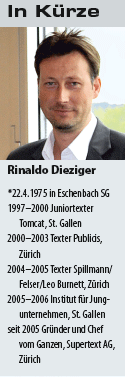
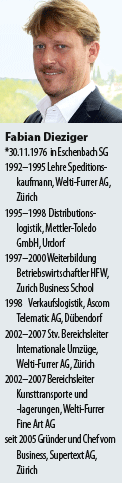
Rinaldo Dieziger, Fabian Dieziger, and Rémy Blättler are the Supertexters: In 2005, the copywriter, the business executive, and the IT professional founded the Supertext agency in Zurich. The agency coordinates a network of around 300 professional writers who produce all kinds of texts and translations. More than 1,500 companies and agencies already rely on this service—and the number is growing.

Unbenannt-12_0

Many a person has spent hours poring over a press release, a slogan, a business letter or a translation with the firm intention of formulating a super text. The result: an imposition for the reader. In such troubles Supertext, the first text agency in the Internet, helps. For five years the agency with its network of about 300 copywriters, authors, editors, proofreaders and translators texts web, newsletters, mailings, brochures, press releases, slogans and annual reports in German, French, English and Italian. And it works like this: Anyone who needs a text can go to www.supertext.ch and choose whether they want to have an existing text revised, have a new text created, or need a translation. Once the order has been placed, Supertext searches its freelancer pool for the right editor for the job. In the case of new clients, the writing professionals whose profile best matches the client's requirements are identified; orders from existing clients are always handled by the same professionals, because they are already familiar with the client's wording and specific requirements. The client sets out in a short written briefing what service he expects and what is to be paid particular attention to in the text production.

The freelancers who are part of Supertext's pool have proven qualifications and experience as authors, journalists, copywriters, editors or translators. "At the beginning, we received great support from the Swiss copywriters' association Script, where I am now also on the board," explains Supertext CEO Rinaldo Dieziger (36). "We work exclusively with professionals. Hobby authors and nightstand poets have no place with us." These professionals are either well-known heads of the industry, whom the agency specifically addresses, or text specialists who apply to Supertext - about two to three dossiers are received per day. The three founders have therefore hired their own "pool keeper" to process the applications and expand the freelancer pool.

Software at the heart

The complete processing of text and translation orders, including status documentation, runs via web-based software that the Supertext founders designed and developed themselves. "Our system is flexible. We can integrate texts directly into the client's content management system after editing, for example into the finished layout of an annual report or into the blog on the company website," explains IT professional Rémy Blättler (35). A workflow without interruptions and additional intermediate steps for the client - it couldn't be more convenient. "Our software simplifies quite a few steps involved in text production or translation, because we wanted a solution that was as simple as possible for us and our customers," says Blättler. "Our system can be connected to any of our clients' CMSs without difficulty. This also puts us ahead of many larger competitors." In 2009, Supertext was even nominated as a finalist for the Red Herring 100 Europe, one of the most important awards for technology start-ups.

Wolf Schneider, the linguistic pundit, coined the bon mot: "When it comes to text, someone has to agonize - the sender or the recipient. It's better if the sender agonizes." This is also the argument that Supertext uses to lure its customers. The agency's client base already includes over 1,500 customers, among them the marketing and communications departments of medium-sized and large companies, agencies such as Wirz, Unic and Burson-Marsteller, as well as brands such as Ovomaltine, Swissmilk, Toshiba, Digicomp, Ochsner-Sport, OBI, Amag Retail and Ebay. Text purchasing pays off: "We're not a low-cost provider and don't cut any corners when it comes to text quality. But thanks to the automated processes, we are more efficient and can offer a first-class price," says Fabian Dieziger (34), who is responsible for commercial matters at Supertext. "We sell solutions: For example, we deliver ten slogans within 24 hours for just under 1,000 francs." Anyone who has ever had to create a slogan under deadline pressure knows that this is not expensive.

Supertext does not charge for the editing or creation of texts by the hour, but according to the complexity of the text, the number of characters and the number of copywriters involved: a text for an advertisement, for example, is cheaper than a press release; if the customer wants suggestions from three copywriters instead of one, he has to dig deeper into his pocket. Express deliveries also cost extra; clients can choose between five tempo and price levels: 6 hours, 24 hours, 48 hours, three days or one week. For the client, it is clear from the outset what the torture of the super copywriters will cost him.

Supertext ensures the quality of the delivered texts with a net and double bottom: Every German text is proofread by a proofreader before delivery, translations are only carried out by native speakers and then edited again by a native speaker. Because a good translation is only one that is not recognizable as a translation. In addition, all translations go through a software tool that ensures that company-specific wording and terms are not translated differently in each text. This ensures that the wording remains consistent even in the foreign language. And if a client should still not be satisfied: Reworking is included in the price of every order.

Versatile trio

Rinaldo and Fabian Dieziger and Rémy Blättler were born and raised in Eschenbach SG. Rinaldo is one and a half years older than his brother, Fabian and Rémy go to the same school class. The two become friends and Rinaldo also gets along well with his brother's childhood friend. Nevertheless, the paths of the three diverge after graduation: Rinaldo, who as a boy actually wanted to become a sports reporter, astronaut, archaeologist or mayor like his father, goes to the St. Gallen advertising agency Tomcat as a junior copywriter for three years after graduating from high school. He then moved to Zurich to work for Publicis and finally wrote copy for Spillmann/Felser/Leo Burnett. After a trip around the world, at the invitation of a friend, he assists the St. Gallen Institute for Young Enterprises with a trade fair presentation and writes the institute's website texts as a freelancer. From then on, Rinaldo only wants one thing: to become an entrepreneur. "When everyone in the room has their own business but you," he says, "you start to wonder."

Fabian set his sights on logistics: after completing his apprenticeship as a forwarding merchant at Welti-Furrer, he joined Mettler-Toledo as a distribution logistics specialist, completed further training in business administration at the Zurich Business School, moved to Ascom Telematic in Dübendorf in 1998 as a sales logistics specialist, and finally took over as deputy manager of the International Removals division at Welti-Furrer. In 2002, as a member of the management team, he assumed responsibility for the art transport and storage division.

Rémy, who as a boy had dreamed of becoming a car designer or architect, did an electronics apprenticeship at the Siemens subsidiary Cerberus, completed a bachelor's degree in computer science at HSR Rapperswil and then went to Northwestern University Chicago on a Siemens scholarship. There he completed his master's degree in computer engineering. Blättler then starts working in the IT department of the UBS branch in New York. Two years later, he moved to Sungard, a high-tech company specializing in financial software. In 2005, he received an inquiry from his old home country: the two Dieziger brothers wanted to know whether he could imagine founding a text company with them.

Plan with a future

During his time at the Institute for Young Entrepreneurs, Rinaldo Dieziger is surrounded by quite a few young entrepreneurs. This inspires him. He develops various business plans, including one for an Internet text agency, which he plans to breathe life into in 2005. His brother Fabian is immediately enthusiastic about the business idea and decides to support Rinaldo in founding the company - even if self-employment means a "return to modesty" for him. After all, Fabian Dieziger has now reached the management level, with responsibility for twelve employees and a corresponding salary. Nevertheless, he is swapping his boss's desk for the Ikea chair: "I was attracted by the idea of helping to build up my own company, to set something in motion and to learn something completely new," he says. "Until March 2007, I was permanently employed by Welti-Furrer, and I couldn't wait to finally hit the ground running at Supertext."

Rémy Blättler feels very much at home in New York. Nevertheless, he leaves the city with a heavy heart, because the challenge of programming his own system for the business idea of his two schoolmates tempts him all too much. He spent long nights in New York working on a first software prototype and even turned down a lucrative job at a major bank for Supertext at the end of 2006. At the beginning of 2007, the IT expert finally joins Super¬text for good. "Actually, I had assumed that the Supertext IT project would be completed after about two weeks," Blättler recalls and laughs. "That's why I spent two years shuttling between Zurich and New York before pulling up stakes in the U.S. in 2009. In the meantime, I've been with Supertext for five years and I'm enjoying it immensely. It's a great feeling to build something from absolutely nothing. Besides, I never have to do anything because someone tells me I have to - I always know why I'm doing it." Rinaldo Dieziger looks back proudly on the past five years, "When I first got into advertising as a junior copywriter in 1997, I liked Tom Monahan's saying, 'Advertising is the rock 'n' roll of the business world.' Recently, one of our biggest competitors said of Supertext, 'These are the Rock 'n' Roll Guys of the Industry.'" What a compliment.

Three in a row

The three Supertext owners could not be more different. The copywriter, the businessman and the IT specialist not only have very different training and skills, but also very different characters. But that is precisely what makes them so successful: They complement each other perfectly and cover all central areas of responsibility in the company, from creation to administration to IT. At the same time, they are united in wanting "their baby" to grow and prosper. Rinaldo Dieziger: "We had ambitious goals right from the start; after all, we discovered a gap in the market with Supertext."

Obviously: In the past five years, the agency has grown from an ambitious three-man business to a well-run text agency with nine permanent employees, a pool of copywriters with over 300 experts and more than 1,500 customers. "Until 2007, we put all our energy into the concept and development and handled the orders on the side," Fabian Dieziger recounts. "Then we launched a telephone sales offensive that gave Supertext the decisive kick. At the urging of our customers, we also launched the translation service in 2007. Since then, we are no longer just a text agency, but a language service provider."

The three Supertexters have other big plans: they want to open agency branches abroad in the next year or two, initially in Germany and France, and later in the USA and South America. Blättler and his IT team are already in the process of setting up the Supertext software in multiple languages.

Rare film tear

Of course, there have also been black days in the development of Supertext. For example, the futile visit of a television crew from SF, which the three company founders can fortunately laugh about today: "In our company history, there was exactly one day when no one was in the office," says Fabian Dieziger. "Of all things, when an SF television crew stopped by to film a report on startups for the 'Tagesschau' and conduct an interview with us, all three of us were in New York. Almost a million Swiss people watch the Tagesschau and would have heard about us - and we're not in the office!"

This breakdown proves it: For Rinaldo and Fabian Dieziger and Rémy Blättler, despite all their dedication to their agency, there is a life besides Supertext. At the moment, Rinaldo Dieziger is mainly busy with his seven-month-old daughter Estella, who inspires and drives him. He also dreams of one day writing something that will still be read in 100 years, and tries not to forget how to play the piano. His brother Fabian is also a family man: as the father of a twelve-year-old daughter and godfather of three, he is constantly on the road with young people. In quieter hours, he likes to read, bake and cook, and finds inspiration on his travels. Rémy Blättler needs travel and motorcycling as a balance to his programming work and secretly harbors the dream of one day opening a boutique hotel with a fantastic view. Who will then write the snappy advertising slogans for the hotel should already be clear today.

Anne-Friederike Heinrich

Unbenannt-13_0
Unbenannt-14_0
Unbenannt-15

Media planning in millisecond cycles

Automated trading platforms for the marketing of online advertising are gradually appearing in Switzerland - industry experts expect prices to fall in the Swiss online advertising market.

Swiss Marketing: Rockin' all over Lucerne

Rising sales among sales professionals: A far higher number of young talents than last year were honored at the Casino Lucerne. Reason enough to surrender to the big sound wave.

SRG: Raymond Loretan is the new President

Raymond Loretan is the new president of the SRG. The delegates elected him on Thursday in Bern.

They have thus followed the proposal of the Board of Directors. Born in 1955, bilingual Loretan replaces Jean-Bernard Münch. Among other things, Loretan was CVP Secretary General and Consul General in New York. Regula Fecker will be a new member of the Board of Directors. Lucy Küng was confirmed in office for another period. This writes the SRG on Thursday in a communiqué.

Loretan received 21 votes in the third ballot. He will take office on January 1, 2012. Viktor Baumeler, President of SRG.D and member of the SRG Board of Directors, who was nominated for election by the Presidents of the member companies of SRG Deutschschweiz (SRG.D), was narrowly defeated by 19 votes.

Raymond Loretan was, among other things, Secretary General of the CVP. From 1997 to 2002 he was Ambassador of the Swiss Confederation in Singapore and from 2002 to 2007 Consul General at Embassy rank in New York. Loretan graduated in law from the University of Fribourg with a licentiate and obtained a diploma in European law from the University of Strasbourg. He is co-founder and partner of the consulting firm "Fasel Balet Loretan Associés" in Geneva and represents various companies and foundations in different functions and mandates. Loretan is a member of various boards of directors, including chairman of the hospital group "Genolier Swiss Medical Network". In the SRG announcement, he says of his new post: "Sponsors and companies - we all need to join forces to master the major challenges together. This will be one of my priorities."

Jean-Bernard Münch is satisfied that the BoD's proposal was accepted: "In a time of upheaval and major challenges, Raymond Loretan, who is bilingual French and German, can strengthen the BoD thanks to his experience and his Swiss and international perspective, and promote dialogue with politicians.

Lucy Küng, former member of the Board of Directors, was confirmed in office for a further period. Regula Fecker, partner and co-founder of the Zurich advertising agency Rod Kommunikation, was newly elected to the Board of Directors.


Coupons are the trend in shopping - mobile coupons still underestimated

Couponing, i.e., the granting of shopping benefits on presentation of a coupon, is now widespread in Germany. While classic paper coupons and their online variants are far ahead in terms of usage, mobile coupons, for example for cell phones, are not yet widely known.

Four out of five Germans have already redeemed a coupon at least once. 60 percent of those surveyed believe that the importance of coupons for shopping will continue to increase in the future. Only one in five of those surveyed who are aware of mobile coupons have already redeemed one. These were the findings of a recent TNS Emnid survey on "Couponing in Germany.

Four out of ten users redeem coupons at least once a month, with 68 percent of respondents seeing price savings as the biggest benefit. More than two-thirds of respondents (67 percent) like to use their coupons frequently on supermarket products. Fashion stores are also a popular option for just under half of those surveyed (46 percent) - followed by the food service sector (45 percent), cosmetics (40 percent) and electronics (33 percent). Couponing will continue to gain in importance in Germany: Almost one in three previous non-users (28 percent) said they would use coupons in the future, provided this did not involve a great deal of additional effort for them.

The representative study was conducted by TNS Emnid Medien- und Sozialforschung on behalf of Payback. A total of 1,119 people aged 16 and over were surveyed. The study is available for download at Tns-emnid.com as well as under Payback.net ready
 

"We want to get involved again in poster research SPR+".

Jürg Rötheli has been CEO of Clear Channel Switzerland (CCS), the number two in the Swiss billboard business, for 15 months. In an interview with Werbewoche, he tells us why he switched from Swisscom to outdoor advertising, how he wants to improve CCS's image and make digital street space palatable to cities. And he explains why CCS is now a member of the Outdoor Advertising Association and is also seeking to rejoin the SPR+ poster research project. In 2005, CCS had dropped out and started its own project, but never finished it.

You have been CEO of CCS for just over a year, and so far few people know who you are.

Jürg Rötheli: This has changed a lot in the past few months. The fact that I am not yet known everywhere in the marketing and communications scene is due to my professional history. Before Clear Channel, I was a member of the Group Executive Board at Swisscom, where I was responsible for the associated companies.

Where do you see your strengths? What are your weaknesses?
I am a very open and communicative person who believes very strongly in the performance of his team. I compare my job as CEO of Clear Channel to that of the conductor of a large orchestra. We rehearse the individual parts, and I put them together with all the musicians to form a harmonious whole. Of course, I set the tempo. But the concert is only really good when the whole orchestra joins in.

Do you have a leadership principle?
If you want to talk about a principle, then I would call it the "trust principle. As a matter of principle, all my employees have my trust. They don't have to spend years proving it. I always try to give my people responsibility across all hierarchical levels. This responsibility should also motivate people and leads to good performance.

What about your weaknesses?
I have a tendency to push forward quickly, to want to achieve a lot in a very short time. That can exert a certain pressure and overwhelm the people around me. That's where you have to proceed with a lot of sensitivity and make changes gradually and gently, without taking away people's enthusiasm and motivation.

You came to CCS from Swisscom - what was your motivation for the change?
I joined the Swisscom Executive Board at a very young age, 35, and worked there for ten years. After this rather long period of time, I felt the need for a change. In addition, as CEO of Swisscom's subsidiaries, I had to manage a lot of different companies: Nine companies in nine different markets, including real estate, the telemedicine company Medgate, an international software company, a customer card company, all the collection companies, including Billag. Today at Clear Channel, I like being able to focus on a single industry.

15 months ago, you joined CCS as CEO. What state did you find the company in?
I found a motivated team. This was not a matter of course, as the employees had just come through a crisis at the parent company Clear Channel International. My focus in the first twelve months was therefore on structural issues such as organization and personnel, in order to be able to tackle the major challenges in this market - keyword: digitization of advertising space - in the best possible way. I also held many talks with agencies, advertising clients and contractual partners on the real estate side, where we have our advertising spaces.

They touted it: In 2008, private equity firms Thomas H. Lee Partners and Bain Capital joined Clear Channel International, the financial crisis hit, and the company was about to be split up. The uncertainty was great.
Yes, the Group went through a difficult phase - but not in Switzerland: CCS was always solidly financed. Today, Clear Channel International is also doing very well again, and the investors want to expand the business. Of course, private equity investors always have the goal of exiting at a profit at some point. But this is not in sight in the next two to three years.

Your predecessor Beat Roeschlin always had to secure his position at the top first. How is that today?
The situation back then cannot be compared with today. The Group gives us a lot of freedom to develop the business locally. In Switzerland, we benefit from the fact that Clear Channel is active in 27 countries on four continents, for example in purchasing and the development of innovative products. The European headquarters in London supports us. I see that as very positive.

Your competitor APG generated sales of 259 million Swiss francs in Switzerland last year, 3.6 percent more than in the previous year. Where does CCS stand?
As a company listed on the US stock exchange, we do not publish sales figures at national level. But I can say this much: with 200 employees, we generate an offer volume of around 200 million Swiss francs in Switzerland. Our operating margin has been significantly better than that of our main competitor for years. With around 20 percent of the advertising space, we achieve a market share of around 30 percent.

I thought CCS had 20 percent market share, APG 75 percent?
I tend to assume a ratio of 30 percent CCS and 65 percent APG. The rest is shared by various smaller providers.

CCS has 20'000 road surfaces, a city contract with Bellinzona and 2 of 16 so-called lots in Zurich. You also have an exclusive contract with Zurich Airport. The latter is probably your cash cow?
Zurich Airport is an outstanding, absolutely innovative partner and a clear "flagship" for CCS. Nevertheless, our main revenues still come from the "roadside locations".

You mentioned expansion and digitization before. What steps do you have in mind?
We have three thrusts in digitization: First, we are already expanding digital advertising at Zurich Airport this fall. The second initiative concerns the POS (Point of Sale): Today, we are number one in terms of POS volume in Switzerland, including contracts with shopping centers and gas stations. We want to expand this market digitally as well. In the third initiative, digital outdoor advertising in cities, on the other hand, we are only at the beginning: It was a "regulatory" taboo for a long time. We also have other growth projects.

For example?
We want to expand business with direct customers who are not represented by media agencies. In addition, there are many companies that do not advertise with posters but through other channels. Today, outdoor advertising has a market share of only about 11 percent. We want to develop this with new technology. Our focus is therefore not on the classic competitors, but on the genres of print, TV, and online.

Back to digital advertising for cities: What does it look like in concrete terms?
We are thinking of soundless screens in the common formats F12 and F200, which easily allow moving images and can also be installed "outdoors". We are already in contact with some big cities with the aim to build up a pilot project.

What arguments do you use to approach the cities?
For example, that digital surfaces concentrate advertising in public spaces in those places where a strong advertising effect can be achieved, and that in return some unpopular places may disappear. Advertising in public spaces is always part of the cityscape. If a city wants to appear modern or innovative, digital advertising can be a building block for this. There are also studies that show that digital advertising does not impair traffic safety any more than conventional advertising.

CCS has had little success with conventional billboard submissions in cities. Recently, you also lost the tender in Geneva. What goals are you setting yourself in this area?
Until now, the city inventory has usually been awarded exclusively to one provider for several years. However, we are in favor of a model like in Zurich, where a public tender with so-called lots was carried out in 2006. This means that the city inventory was put out to public tender and divided among several providers, which led to a win-win situation for all sides, including the city of Zurich. Our goal is not necessarily to win entire cities.

These are new tones. Until now, CCS had the image of a sore loser, regularly challenging decisions in favor of the competition through all instances.
That was yesterday and is not the way of the future for me. We want to convince the cities that we are a competent partner for the management of advertising space and that a balanced distribution of inventory and a healthy competitive situation has its advantages for the cities.

Does this mean that your ears are open?
Yes, I sense that this partnership approach is being positively received. I expect that not only Zurich will again tender in lots, but that other cities will also go this way.

A cooperation trial between CCS and the Geneva transport companies has been running for nine months. What is the next step there?
We are managing 100 F12 and F200 advertising formats there at the rear and on the side of buses. Our goal is clear: we want to turn this pilot into a longer-lasting partnership. In the important Geneva area, we currently have an insufficient presence. With transit advertising, we could expand this presence.

CCS has no other means of transport advertising. So is Geneva supposed to serve as a showcase for you?
Correct. The concept can easily be transferred to other transport companies in Basel, Bern or Zurich.

You recently joined the Swiss Outdoor Advertising Association (AWS) with CCS. Why?
Even if you look at the competitive situation of the two main market players, I don't think we should just fight each other. There are a lot of things we can do together.

For example?
There are similar interests, for example when it comes to regulating outdoor advertising, as well as advertising bans or the exclusion of certain advertising categories. But here, too, it cannot simply be a matter of pushing through our ideas against the sensitivities of the population. We have to take them seriously and try to deal with them sensibly.

CCS has been in the headlines twice recently - for tobacco advertising around schools and for advertising a brothel in a residential neighborhood.
As far as tobacco advertising in schools is concerned, the case is clear to me: we were wrong. With political or erotic advertising, on the other hand, the boundaries are less clear. Moreover, as an advertising service provider, we must not allow ourselves to be forced into a censor role.

Back to the AWS: Poster research could also be a topic there.
Yes, we are working intensively on this. Together with APG, for example, we are considering whether and how CCS can once again become involved with the SPR+ research company. The goal must be to have only one "industry currency" in outdoor advertising.

Is this change in strategy coming from you or from London?
It comes from me and Affichage. Our joining the association and the new collaboration were made extremely easy because both companies are under new management. The new Affichage CEO, Daniel Hofer, and I are unencumbered and get along well personally.

But leaving SPR in 2005 was not a whim of your predecessor Beat Roeschlin, but a directive from Clear Channel headquarters. The same applies to the fact that you invested in your own research system called More. What caused the turnaround?
I don't know the background, and for me this belongs to the past. Let's look ahead. More has been replaced by the "Mobility Atlas," a project of ETH Zurich, the Federal Statistical Office, Affichage and CCS, and other partners. It allows us to map mobility flows. Specifically, we get a system that tells us where and how people move and with what intention. The question will be how we can bring this groundbreaking innovation together with SPR+ to create an "industry currency."

But the main problem is that CCS has been a free rider on SPR+ since the phase-out: SPR+ collected all the CCS areas and designated them, but CCS paid nothing for them.
That is precisely the crux of the matter. The trick will be to find a solution - be it via a partnership or participation - that takes into account what has been done at SPR+ since then, but conversely also accommodates those things that we can bring to the table. Achieving such a result is not easy.

Is this an issue in AWS, and will a solution be under the roof by the end of the year?
Yes. And based on the players I met there, I believe that bringing the two approaches together can succeed.

Your predecessor's research advisor was Urs Zeier, former project manager of the free newspaper Metropol. Is he also at your service?
Yes, he has been working for CCS on a mandate basis for many years and manages some strategic projects for me. Due to his many years of experience, he is an excellent sparring partner for me and the entire management team.

Is Toni Jarvis, the former head of research at Clear Channel International, still in the mix as well?
No.

Interview: Markus Knöpfli

Unbenannt-11_0

Communication concepts: Never stop learning

Communications consultants Nicole Zeiter Sixt and Marion Tarrach are passionate about concepts. In an interview with Werbewoche, they shed light on the changes that concept work must undergo in order to meet the demands of the times.

Some specialist books are almost outdated by the time they appear on the market. In concept literature, however, time seems to have stood still. In the past two decades, current conceptual theory has hardly changed, the conceptual grid has remained the same - but not the world around it. This draws attention to the adaptability of conceptual work.

You both work as consultants and concept developers as well as lecturers in concept technology. What fascinates you about this subject?
Marion Tarrach: That conception is not just a technique, but something very practical and lively.
Nicole Zeiter Sixt: We see conceptualization as the core of our consulting work. The conceptual examination of topics, organizations, people and opinions is one of the most exciting tasks that the PR business has to offer. Precisely because there are always new demands and new situations to take on board and integrate.

Can concept work be learned at the school desk?
Zeiter Sixt: The basics for sure. An understanding of the concept steps, their interplay, the approach to a new question... What you can also develop in the exchange with each other is an awareness that every concept is different in practice. Copy/paste does not work.

Tarrach: Conception is like driving a car. First you have to learn the technique. Personal style, anticipating potentially tricky situations, the ability to feel comfortable and safe on any road, in any weather and in different vehicle models - all this comes with experience. Design is largely a matter of experience.

The concept grid has remained stable over the years. Is there nothing new to say about the concept grid?
Zeiter Sixt: Yes, of course. For example, there is a question mark behind the well-known problem orientation in concept work. The classic concept is divided into an analytical, a strategic and an operational part. Firstly, the problem is outlined and pinpointed, then the future and the approach are mapped out and finally a coherent package of measures is defined. Psychotherapy and coaching are also familiar with the approach of completely avoiding the "problem talk" and dealing directly with the future as an already realized ideal. This releases positive energy and ideas that can be put to good use alongside a carefully conducted situation analysis.

Concept work takes time. Is such a luxury still suitable for everyday use in today's environment, where high speed and information density dominate?
Tarrach: The more hectic the environment, the more important concepts are. They create an overview, order and orientation - things that are sometimes lost in day-to-day business. They protect against actionism and increase efficiency. You can't develop a concept without taking a step back and looking at the current issue with a little distance and calm.
Zeiter Sixt: The concept serves as a set of arguments for what we do and what we leave out for good reasons. But without producing a tome. Brevity, conciseness and pragmatism have clearly become more important in concept work. Not in every case and for every client, for example, does every concept step need to be fully elaborated. Depending on the task (and resources), a catalog of ideas may suffice instead of a detailed action plan. Or a diagnosis "at first glance" instead of a well-founded, broad-based analysis.
Tarrach: And, of course, it's always about working towards a business benefit and emphasizing this in the concept. It's great if we achieve greater employee identification or create a new, modern image. But what does the organization gain from this? We need to make this clear, even if this cannot usually be backed up with hard figures.

How do the new communication platforms play into the concept?
Zeiter Sixt: The temptation to do everything and be present everywhere has increased with social media. A communication concept must derive new strategies from this and work towards establishing a specific attitude of give and take within an organization.
Tarrach: We are dealing with a strong dynamic in the opinion markets. This unpredictability means that we have to think even more in terms of scenarios and options. Concept work offers this platform.
Timer: The unplannable, monitoring and interaction with dialog partners as unknowns must be factored into the concept. It must be possible to make course corrections "in the middle of the game". This is the only way we can remain capable of communicative action, even if something surprising happens in the environment. This requires, among other things, short communication channels and response times.

Do you also see changes in the process of concept work itself, in the collaboration between concept creators and clients?
Tarrach: From our early days in communications, we still remember the situation when we took on a concept order and delivered a paper several weeks later. We were suppliers and experts at the same time and developed a ready-made solution for the customer. Today, it's much more of a "with" than a "for". The attitude towards consultants of all kinds has generally become more critical. Instead, coaching is very popular, understood as a partnership of equals. Ideally, consultants and concept creators go through a development or problem-solving process together with the client that is more transparent, more intensive and closer to the client.

Interview: Regula Ruetz, PR Suisse

In a nutshell
Nicole Zeiter works as a communications consultant and coach/supervisor BSO in Winterthur. Marion Tarrach (PR consultant and adult educator) runs a communications agency in Basel. Both regularly teach at the SPRI in Zurich and the MAZ in Lucerne and are involved in other organizations as lecturers or specialist coaches. Together they run the blog Prkonzepte.wordpress.com. Their documentation "PR-Konzeption - Arbeitsmaterial, Leitfaden, Diskussionsbeiträge" was published in March 2011.

Unbenannt-9_0
 

Flop of the week: End of Ringier's iPad magazine The Collection

Ringier's monothematic tablet magazine The Collection has come to an end after just two issues. One of the main reasons for the discontinuation or change was the poor sales figures.

This is what the previous CEO of The Collection, Thomas Trüb, told Medienwoche.ch. Trüb was still confident when the magazine was launched. He said in April that he wanted to launch further topics on a regular basis. The two monothematic magazines appeared on the subject of "Royal Wedding" and the "Global Baby". However, the recipe for success of elaborate journalism did not work, at least with this iPad magazine. According to Trüb in an interview with Medienwoche, The Collection did not sell as well as expected. In addition, the marketing effort required to boost sales would have been too great. Ringier therefore decided to adapt its business model and abandon user financing. Ringier now wants to have its independent journalistic apps financed by partners and sponsors. However, this does not apply to the apps of existing newspapers and magazines.

50 jury members for the Rose d'Or Festival 2012

The international jury for the 51st Rose d'Or Festival has been announced: The 50 experts from the television industry hail from 27 countries. From May 6 to 10, 2012, they will select the winners of the Golden Roses at the Global Entertainment Television Festival.

The Rose d'Or Festival competition awards the best programs of the year in 13 different categories. Telenovela, Series, Lifestyle and TV Movie as well as Children and Youth are now also included as independent categories. Anyone who wants to win a Golden Rose in Lucerne in May 2012 can enter the competition until December 31, 2011.

The 2012 jury is headed by Shane Allen (Channel 4, UK) for Comedy and Sitcom, Fabrizio Battocchio (RTI, Mediaset Group, Italy) for Game Show, Barbara Uecker (ABC, Australia) for Children and Youth, Karoline Spodsberg (Banijay International, France) for Factual Entertainment, Aurelio Valcárcel (Telemundo Internacional, USA) for Series and Telenovela, Reinhold Elschot (ZDF, Germany) for TV Movie, Toshio Asaoka (NHK Enterprises, Japan) for Arts Documentary & Performing Arts, Roek Lips (Nederlandse Publieke Omroep, Holland) for Live Event Show, Lyne Denault (Canal Vie, Les Chaînes Télé Astral, Canada) for Lifestyle and Ricardo Villa (RTVE, Spain) for Multiplatform. The other 40 jury members are also experts in television entertainment from all over the world, according to a statement from the organizers.

Registration for the Rose d'Or competition is now online. This enables the international festival jury to access the entries directly at any time during the pre-selection process. The nominated programs in the 13 categories will then be announced in February 2012. The conditions of participation and further information can be found on the website
 

get_footer();